
Planning for Automated Vehicles Providing Support to the
- Slides: 8
Planning for Automated Vehicles
Providing Support to the Introduction of CAV Impacts into Regional Transportation Planning and Modeling Tools NCHRP 896 (2018) http: //www. trb. org/Publications/Blurbs/178392. aspx NCHRP Report 896
NCHRP 896: New Planning Needs • MPOs and DOTs should consider adapting their planning processes to address the uncertainties posed by CAV deployment and use. • Models can help explore sources and consequences of uncertainty. • Careful attention to model assumptions is key to risk management and confident decision-making.
Strategies for Addressing Uncertainty • Incorporate exploratory modeling alongside predictive modeling • Exploratory modeling: Focused on assumptions (what if…) • Predictive modeling: Focused on what will happen • Conduct scenario planning https: //www. fhwa. dot. gov/planning/scenario_and_visualization/scenar io_planning/
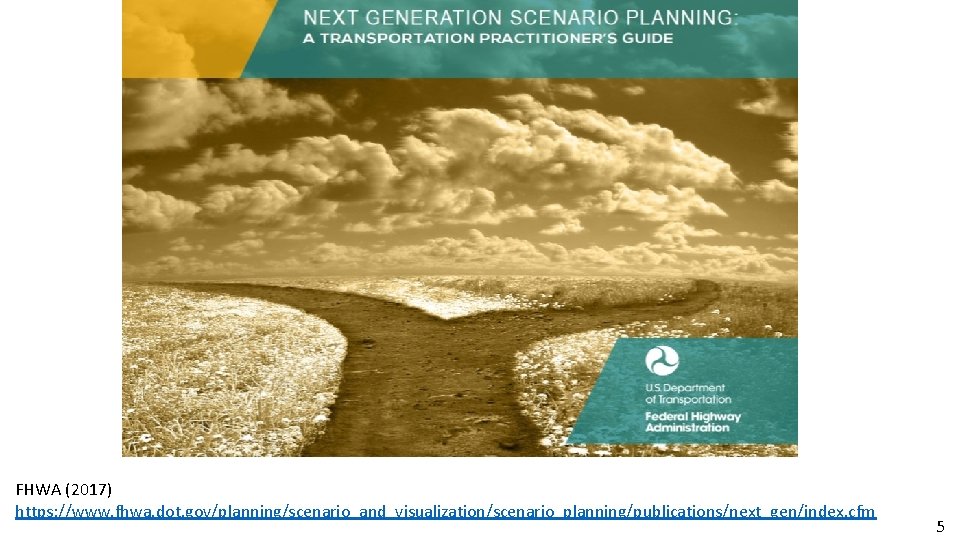
FHWA (2017) https: //www. fhwa. dot. gov/planning/scenario_and_visualization/scenario_planning/publications/next_gen/index. cfm 5
Next Generation Scenario Planning A TRANSPORTATION PRACTITIONER’S GUIDE • Understand contingency of future predictions • Clarify community goals • Explore possible risks and opportunities • Formal scenario planning may be more than necessary • Consider a public conversation about what highway automation technologies may mean
National Framework for Regional Connected and Automated Vehicles Planning http: //www. ampo. org/wp-content/uploads/2019/04/2019 -AMPO-Framework 11. pdf 7
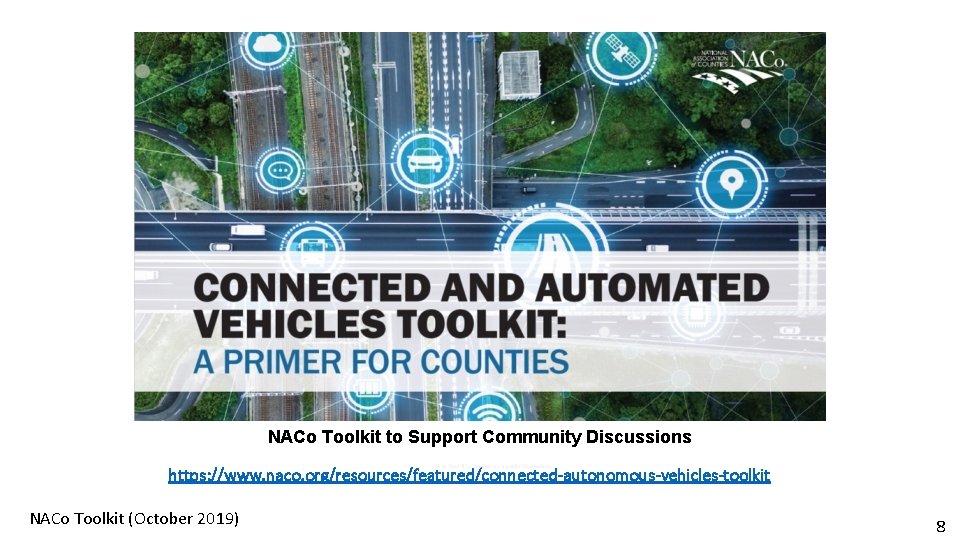
NACo Toolkit to Support Community Discussions https: //www. naco. org/resources/featured/connected-autonomous-vehicles-toolkit NACo Toolkit (October 2019) 8