
Planning for and Managing Change In Academic Libraries

Planning for and Managing Change In Academic Libraries 1
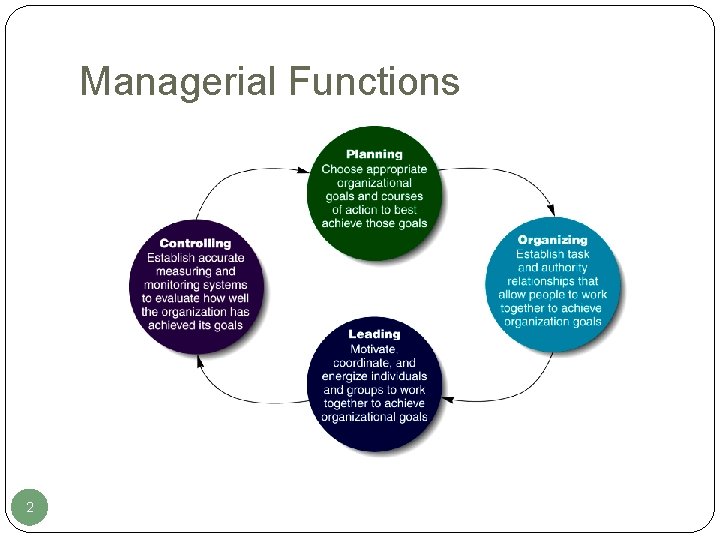
Managerial Functions 2
Why Plan? Want to plan change, not become a victim of change planning is an effort to anticipate future change Gives the organization a sense of direction Involve staff in decision making Helps coordinate the different functions and departments Facilitate control and demonstrate accountability 3
Manage Change Do this by: delegating decision-making; empowering the staff increasing staff flexibility -- decline of specialist and rise of generalist structuring to respond to quickly changing user needs creating and then focusing on a user-centered culture 4
Factors in Planning Time frame Collecting and analyzing data Levels of planning in the organizational structure Flexibility Accountability 5
Types of Plans Overall strategic plan Annual budget/operations plan Collection development plan Information technology plan Development (fund raising) plan Staff development (training) plan Marketing plan Building / facilities plan Instructional plan Evaluation or outcomes assessment plan 6

Planning Process Systematic process, primarily five steps situational and environmental analysis development of organizational direction formulate strategy implement strategy control, feedback and evaluation 7
Planning Process Identify a planning team that will be responsible for carrying out the major planning phase and will involve other work teams and task forces at appropriate times 8
Planning Process Conduct environmental scanning SWOT analysis (identify strengths, weaknesses within the organization; opportunities and threats from outside the organization) self-analysis external PEST political issues, including the parents attitude towards the library economic force, looking at general economic conditions and trends social forces, including the norms and values of the local culture technological forces, change in IT 9
Planning Process Identify the needs of the various end users and other stakeholders Identify the organizational culture and values or assumptions that are the organization’s guiding principles. Formulate the vision and mission statements that identify the library 10
Planning Process Develop goals and objectives Develop strategic and action plans Implement the strategic plan Monitor, evaluate, and adjust the plan as objectives and activities are accomplished and priorities shift 11
Planning Techniques Management by Objectives (MBO) merges organizational goals and objectives with individual goal setting establishes objectives and approaches them as a team over a stated period of time objectives must be measurable, with time limits, and they must require specific and realistic action is a form of participatory management because it involves everyone, to an extent, in the management process 12
Planning Techniques Total Quality Management (TQM) used by libraries to emphasize quality, especially customer services focus on the customer in the development of products and the delivery of services be constantly aware of process both in development and delivery, and vigilant for opportunities for improvement libraries became more interested in quality, customer service, teamwork and getting things done right the first time 13
Planning Techniques Forecasting a process of projections or predictions are opinions about facts projections are based upon systematic review forecasting are predictions based upon assumptions about the future scenario planning is the generation of multiple forecasts of future condition followed by an analysis of how to respond to each scenario 14
Scenario Planning Emerged in 1960 s, used by Royal Dutch Shell to survive oil crisis of 1973. Involves examining the range of options and influences confronting us and establishing stories of how each option could play out. Disconnecting from present to engage with future Identifies major forces and guides decision-making Probable, Possible, & Preferable Futures 15
Steps in Scenario Planning 1. 2. 3. 4. 5. 6. 16 Identify and choose the central point or decision to be made Identify the key forces in the environment List and analyze those driving forces Rank the forces Choose the main themes or assumptions to develop the scenarios Complete scenarios
Steps in Scenario Planning Starting with your central theme, choose the two most important independent variables that will affect that topic. Use the two variables to form a matrix that will result in four scenarios. 17
Matrix for Journal Collections Scholarly communication is cheaply/ freely accessed- budget money is freed up for other purposes Scholarly communication is cheaply/ freely accessed, but little money is available so decisions need to be made about re -allocation 18 Publishers still control most access, money is available but most goes to maintaining vendor contracts Publishers control access and budgets have been severely cut. Maintaining current levels of access is not possible.
Responding to Scenarios Once scenarios have been developed, teams engage in developing responses to each possible future. We might debate the “probability” of each scenario, but Emphasis should be on devising strategies for being successful for every case. Types of strategies Robust- hold up well in all scenarios, or hold up well in some and are indifferent in others Contingent- hold up well in some scenarios but could cause problems in others Losing propositions-ill-advised under all scenarios 19
Responding to Strategies Don’t just plan- take action/ make decisions Focus on robust strategies, but invest in contingency plans 20
Components of a Planning Document �Mission Statement �a mission statement discusses what the library is or does �usually identifies critical values and principles, such as “free access” and “lifelong learning” �these values are sometimes found in a separate statement 21 Hernon and Dugan LIS 451
Components of the Document �Vision Statement �a vision is a statement of what the library wants to become, its future direction. �helps users understand the library’s intentions. �becomes a focus for advocacy for years to follow 22 Hernon and Dugan LIS 451
Components of the Document �Goals �broad areas we would like to achieve or change �should be challenging but realistic �Objectives and Strategies �objectives are action-oriented, measurable and/or “budget-able” initiatives and applications �explain how the goals will be supported and user services improved 23 Hernon and Dugan LIS 451
Components of the Document �Activities / Action Plan �specifies how the objective will be achieved, and who is responsible �establishes a time line for implementation �expected performance measures for each objective and their activities are identified �identifies needed resources for implementation 24 Hernon and Dugan LIS 451
Components of the Document �Appendices �current situation �expected levels of user services provided �relationships and partnerships �historical information �user surveys �details concerning resources needed for implementation �policies and procedures 25 Hernon and Dugan LIS 451
Implementation of the Plan �Plan is implemented �Performance measures for each objective and their activities are complied, compared, evaluated and reported against the expected measure �Opportunities for feedback are identified and provided 26 Hernon and Dugan LIS 451
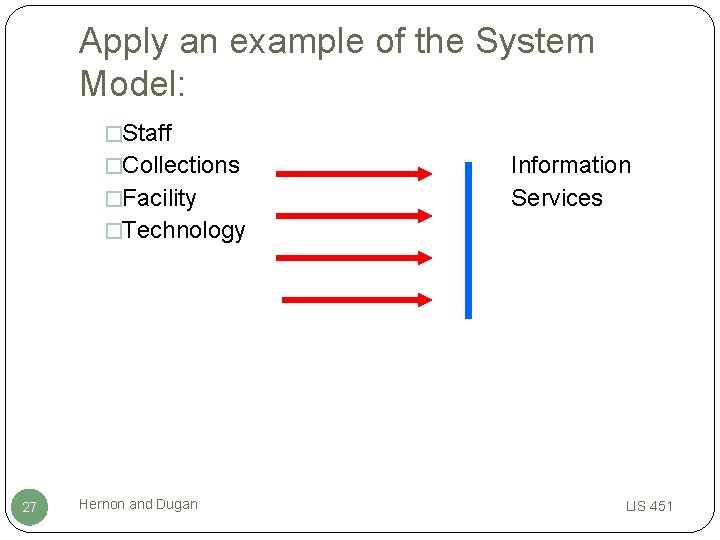
Apply an example of the System Model: �Staff �Collections �Facility Information Services �Technology 27 Hernon and Dugan LIS 451
Summary �Class discussion: Lakos, A. , & Phipps, S. (2004). Creating a culture of assessment: A catalyst for organizational change. Portal: Libraries and the Academy, 4, 345 -361. 28 Hernon and Dugan LIS 451
- Slides: 28