
Planning Design appropriate learning activities to meet requirements
- Slides: 13
Planning • Design appropriate learning activities to meet requirements of athletes’ stage of development • Setting goals for the season/session • Choose coaching methods to enable athlete learning • Plan for different ability levels • Plan equipment and facility usage
Training Session Principles • Provide plenty of activity • Provide maximum use of time, facilities and equipment • Provide a variety of activity • Ensure skills have a progression from simple to complex • Provide a safe, successful, nonthreatening environment • Ensure athletes progress at their own rates • Be organised, yet flexible in your planning
Planning Activity Checklist • How will you introduce the task? Will you explain it? Demonstrate it? Use questioning? • How will you know that the athletes understood your instructions? • What materials or instructional aids will you need to teach the tasks and enable athletes to practise effectively? • How safe are the tasks and activities that you have planned? Do you need to check equipment? • Are the progressions of the skill at the athletes’ level? • Do your activities cover all domains of learning? • Will both your higher and lesser ability athletes get something out of the session?
Planning Considerations • • • Background of season to date Background of athletes Purpose or learning objectives Games/activities to be used Learning opportunities Evaluation
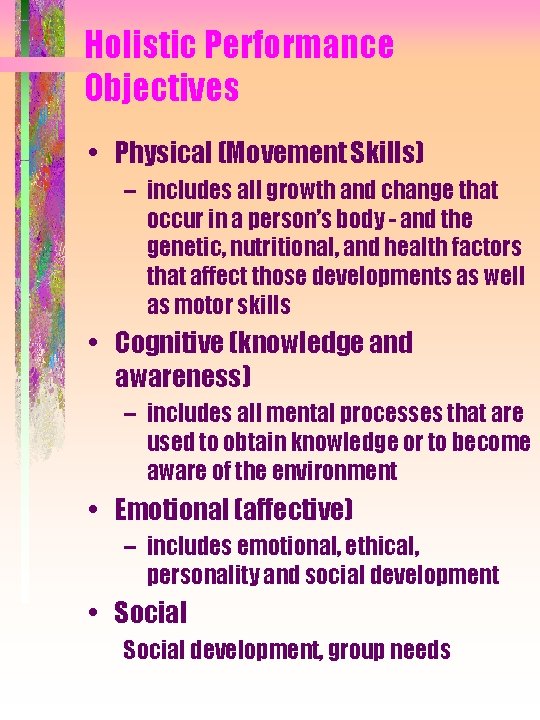
Holistic Performance Objectives • Physical (Movement Skills) – includes all growth and change that occur in a person’s body - and the genetic, nutritional, and health factors that affect those developments as well as motor skills • Cognitive (knowledge and awareness) – includes all mental processes that are used to obtain knowledge or to become aware of the environment • Emotional (affective) – includes emotional, ethical, personality and social development • Social development, group needs
Performance Objectives • Having performance objectives enables coaches to – select or design learning activities to suit athletes’ needs – provide a basis for whether or not athletes achieve objectives and goals set – provide clear direction for athletes in attaining the established objectives
Athletes’ Learning Setting Objectives/Purpose • Emotional – emotional needs – Mental skills • Social – emotional needs, social needs, • Cognitive – decision-making, tactics and strategies • Physical – Fitness, technique
Competition Phases • Transition/Foundation • Preparation • Competition
Planning for Competition • Integrate into day training sessions, for example − Mental preparation, eg practising in pressure situations (TGf. U fantastic for this), timing of training to match competition – Physical athletes will play the way they train (intensity level) – Practise competition routines – Practice skill in meaningful contexts
Planning for Competition • Mental Preparation • Physical Preparation • Pre-competition routines – warm up – technique – fitness – psychological routines • Competition strategy • Competition Talk • Half time Talk
Testing • Is this necessary - why or why not? • General planning considerations – training emphases – fitness foundation – basic training – emphasis shifts
• • • Example of Pre-competition Routine Arrive at venue XX minutes before the start Check equipment Begin warm-up and stretching Think happy, relaxed thoughts Positively image upcoming performance Listen to coach’s brief comments (no new information) Apply these comments to imagery and/or self-talk Engage in heavier physical preparation Use more imagery if necessary Engage in quicker physical activity Ready self for the start - think of opening skills and game plans Cue word for the first skill – (Kidman and Hanrahan, 2004)
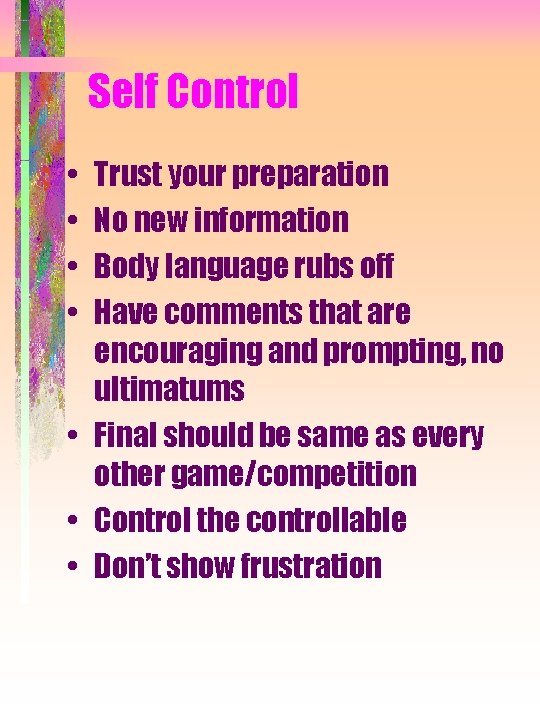
Self Control • • Trust your preparation No new information Body language rubs off Have comments that are encouraging and prompting, no ultimatums • Final should be same as every other game/competition • Control the controllable • Don’t show frustration