
Planning Chapter 6 with Duane Weaver Outline Purpose

- Slides: 7
Planning Chapter 6 with Duane Weaver
Outline • • Purpose of planning Well designed goals Types of plans Criticisms of Formal Planning
Purpose of Planning • • Reduces uncertainty Reduces overlaps and waste Establishes goals and standards for controlling Planning = Performance: 1. higher profits, 2. quality of plan counts, 3. external environment breeds poor performance, not the plan, and 4. planning timeframe of 4 yrs. of consistency to see outcomes.
Well Designed Goals • • • Written in terms of outcomes Measurable and quantifiable Clear time frame Realistic (challenging yet attainable) Written down (recorded) Communicated (to all necessary)
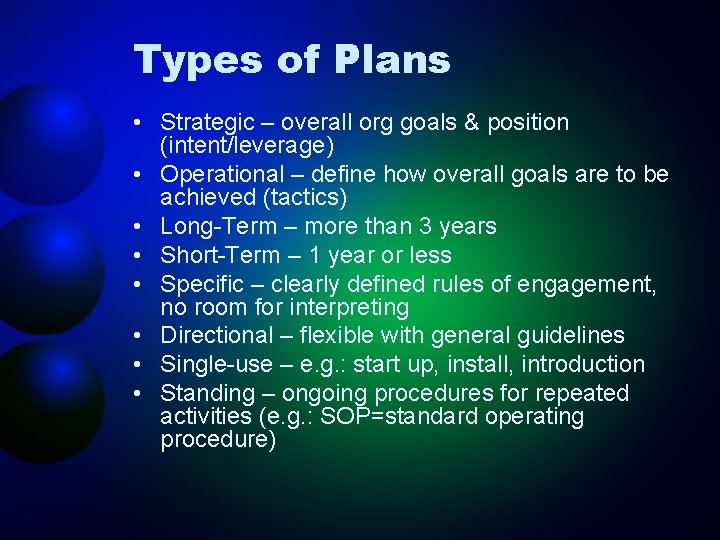
Types of Plans • Strategic – overall org goals & position (intent/leverage) • Operational – define how overall goals are to be achieved (tactics) • Long-Term – more than 3 years • Short-Term – 1 year or less • Specific – clearly defined rules of engagement, no room for interpreting • Directional – flexible with general guidelines • Single-use – e. g. : start up, install, introduction • Standing – ongoing procedures for repeated activities (e. g. : SOP=standard operating procedure)
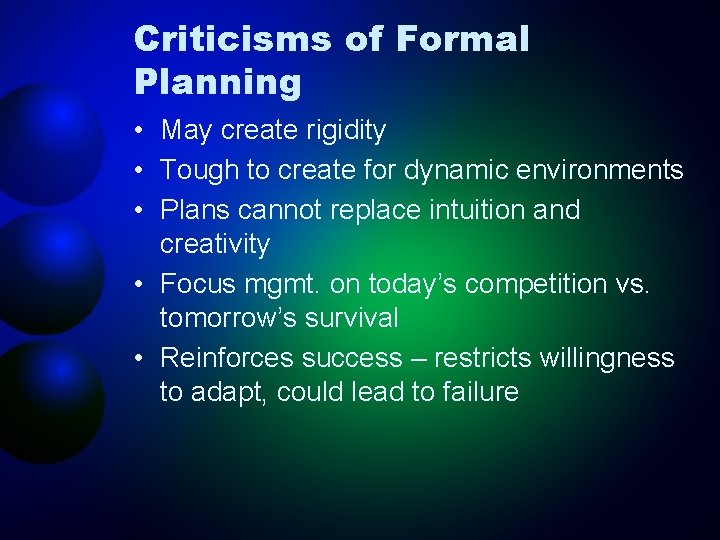
Criticisms of Formal Planning • May create rigidity • Tough to create for dynamic environments • Plans cannot replace intuition and creativity • Focus mgmt. on today’s competition vs. tomorrow’s survival • Reinforces success – restricts willingness to adapt, could lead to failure