
PLANNING AND ORGANIZATIONAL DEVELOPMENT Management Toolbox The National
PLANNING AND ORGANIZATIONAL DEVELOPMENT Management Toolbox The National Democratic Institute
ICEBREAKER/INTRO/ GROUND RULES • Intro • Ground rules • Ice breaker exercise
OBJECTIVES • Understand components of organizational structure and admin systems • Learn steps of project planning and management • Value strategic planning as an organizational development tool
TOPICS • • • Organizational skills Administrative systems Project planning and management Strategic planning Event planning
KEY TERMS • • Organization Structure Planning Stakeholder Photo: From Carol’s Quill
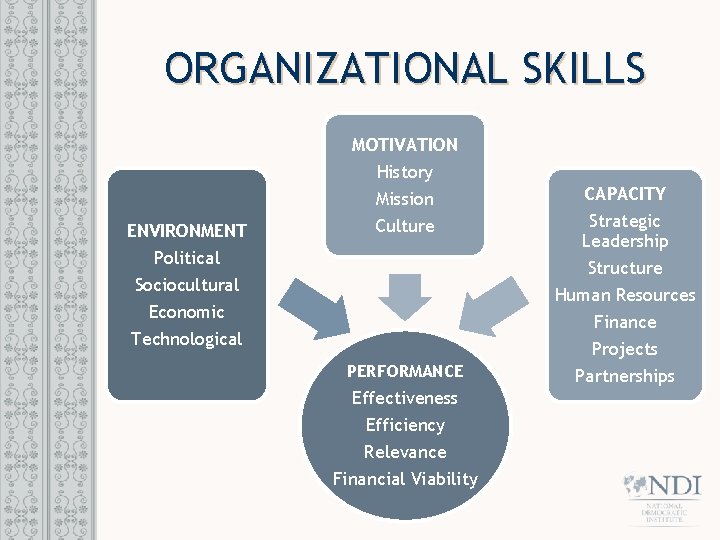
ORGANIZATIONAL SKILLS MOTIVATION ENVIRONMENT Political Sociocultural Economic Technological History Mission Culture PERFORMANCE Effectiveness Efficiency Relevance Financial Viability CAPACITY Strategic Leadership Structure Human Resources Finance Projects Partnerships
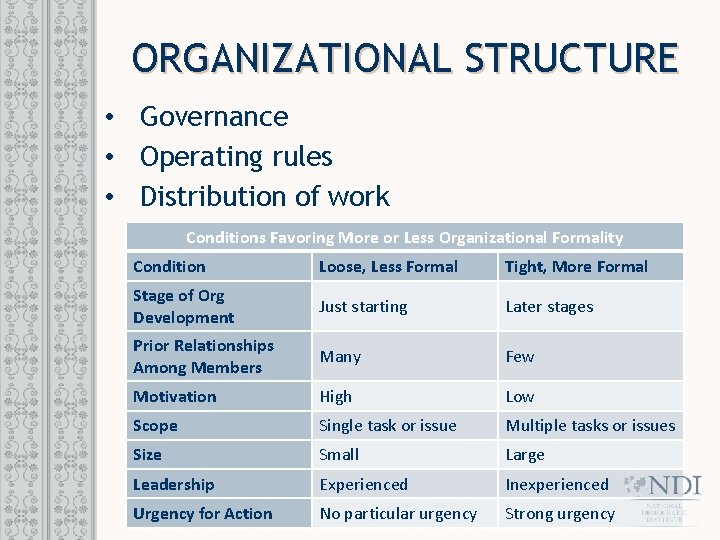
ORGANIZATIONAL STRUCTURE • Governance • Operating rules • Distribution of work Conditions Favoring More or Less Organizational Formality Condition Loose, Less Formal Tight, More Formal Stage of Org Development Just starting Later stages Prior Relationships Among Members Many Few Motivation High Low Scope Single task or issue Multiple tasks or issues Size Small Large Leadership Experienced Inexperienced Urgency for Action No particular urgency Strong urgency
ADMINISTRATIVE SYSTEMS • Accounting • Human Resources • Operations
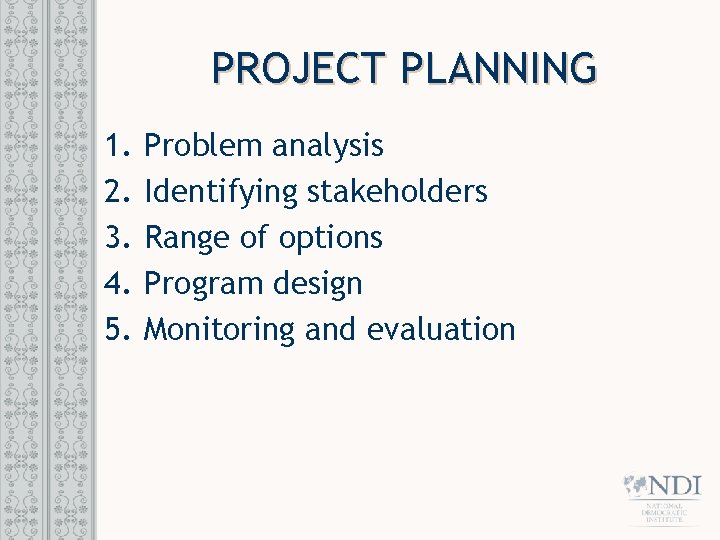
PROJECT PLANNING 1. 2. 3. 4. 5. Problem analysis Identifying stakeholders Range of options Program design Monitoring and evaluation

PROBLEM ANALYSIS Using a Problem Tree 1. Core problem 2. Causes and effects 3. Relationships 4. Intervention Effects Core problem Causes There is no perfect problem tree - the point is to identify the problems and the relationship between causes and effects.
EXERCISE: PROBLEM TREE • Causes Ø Why has this problem occurred? Ø What factors caused the problem? • Effects Ø What are the “symptoms” of the problem? Ø What outcomes are we hoping to change?
IDENTIFY STAKEHOLDERS Identify: Ø Beneficiaries Ø Implementers Ø Decision-makers Ø Donors Analyze: Ø Interest Ø Influence Ø Relationships Ø Participation Ø Resources
RANGE OF OPTIONS • • • SWOT analysis Alternative solutions Prioritize Feasibility and appropriateness Potential partners
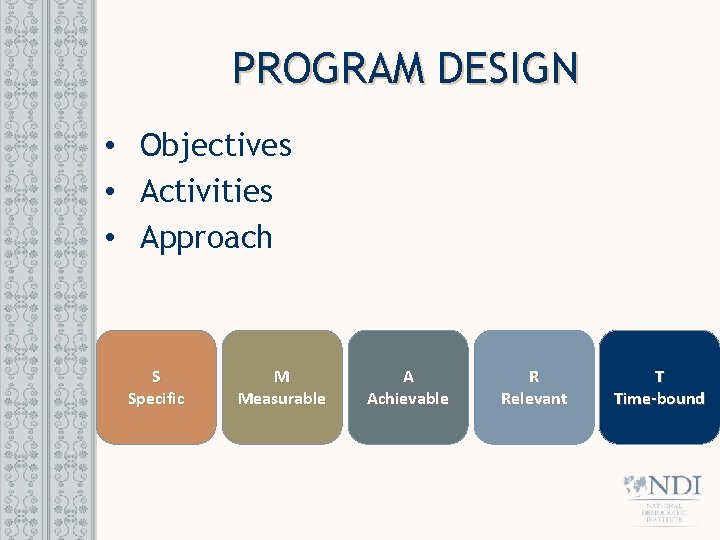
PROGRAM DESIGN • Objectives • Activities • Approach S Specific M Measurable A Achievable R Relevant T Time-bound
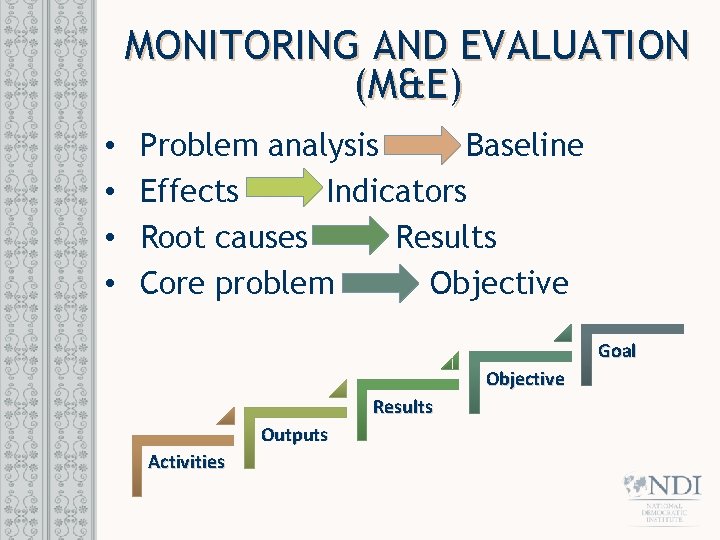
MONITORING AND EVALUATION (M&E) • • Problem analysis Baseline Effects Indicators Root causes Results Core problem Objective Goal Objective Results Outputs Activities

EXAMPLE: SMART INDICATOR Negative Effect Indicator Negative Effect (of a root cause): “The citizenry is cynical about the capacity of political parties to represent their interests. ”
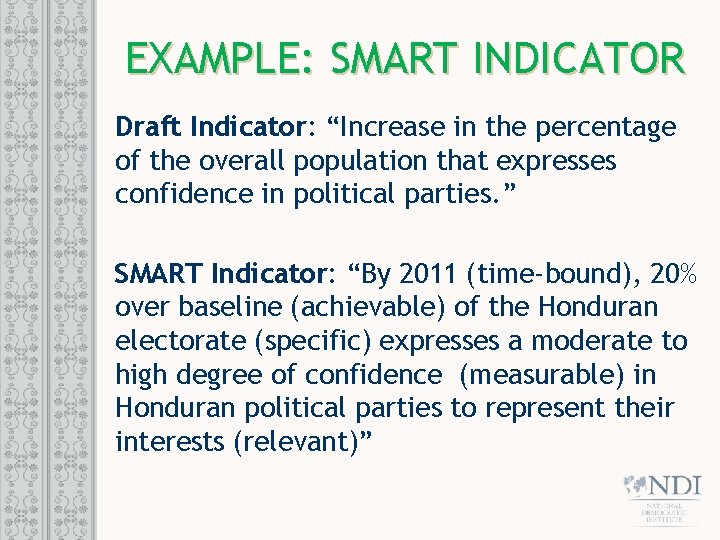
EXAMPLE: SMART INDICATOR Draft Indicator: “Increase in the percentage of the overall population that expresses confidence in political parties. ” SMART Indicator: “By 2011 (time-bound), 20% over baseline (achievable) of the Honduran electorate (specific) expresses a moderate to high degree of confidence (measurable) in Honduran political parties to represent their interests (relevant)”
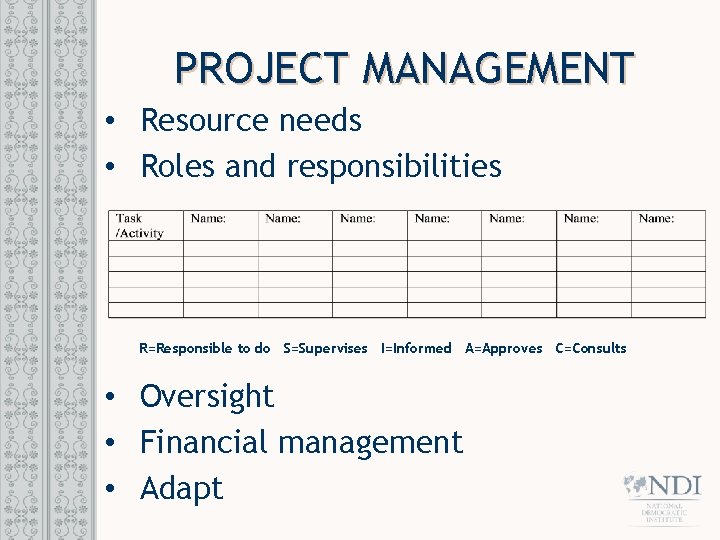
PROJECT MANAGEMENT • Resource needs • Roles and responsibilities R=Responsible to do S=Supervises I=Informed A=Approves C=Consults • Oversight • Financial management • Adapt
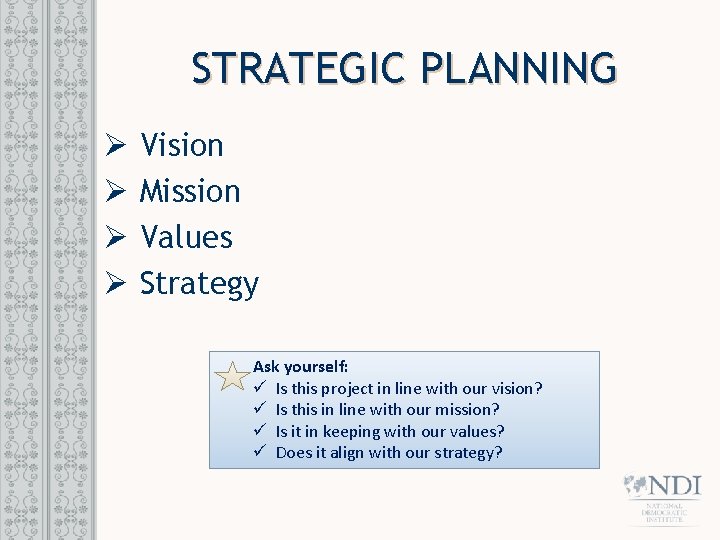
STRATEGIC PLANNING Ø Ø Vision Mission Values Strategy Ask yourself: ü Is this project in line with our vision? ü Is this in line with our mission? ü Is it in keeping with our values? ü Does it align with our strategy?

EXAMPLE: WIKIMEDIA FOUNDATION Click here for video
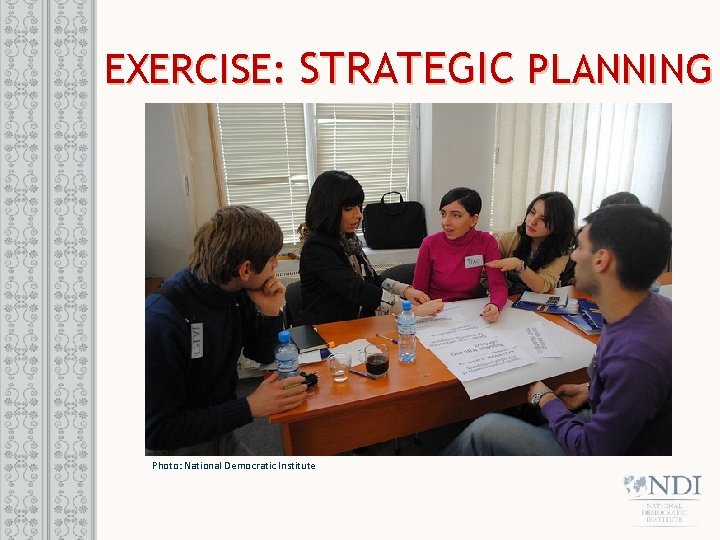
EXERCISE: STRATEGIC PLANNING Photo: National Democratic Institute

EVENT PLANING • • • Message Target group Time planning Budget Assignment Photo: National Democratic Institute
CONCLUSION • • • Organizational Skills and Structure 5 Steps of Project Planning Project Management Strategic Planning Event Planning Ø Questions? Ø Feedback?
- Slides: 23