
Planning and Focusonform in Task Based Language Learning
Planning and Focus-on-form in Task. Based Language Learning Ryo Nitta University of Warwick TBLT Conference Leuven, 2005
Introduction 1. 3. 4. Two research traditions in SLA: planning and focus-onform The study: analysis of task performance and verbal protocols Findings of task performance analysis Implications 5. Issues for the second stage 2.
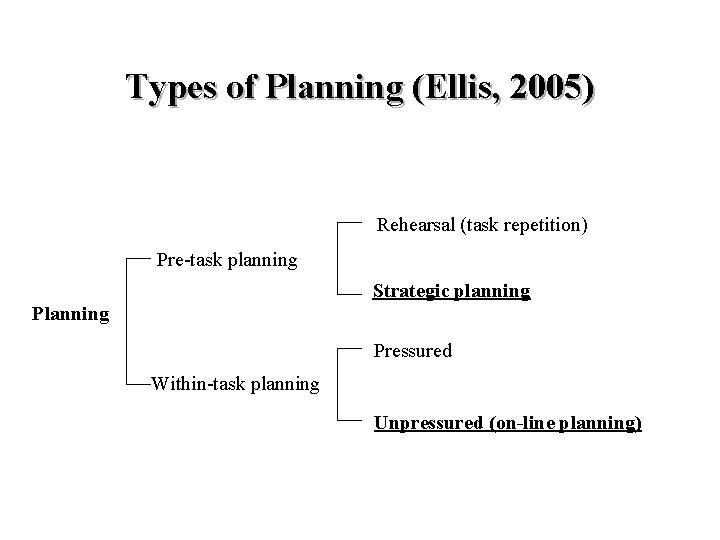
Types of Planning (Ellis, 2005) Rehearsal (task repetition) Pre-task planning Strategic planning Pressured Within-task planning Unpressured (on-line planning)
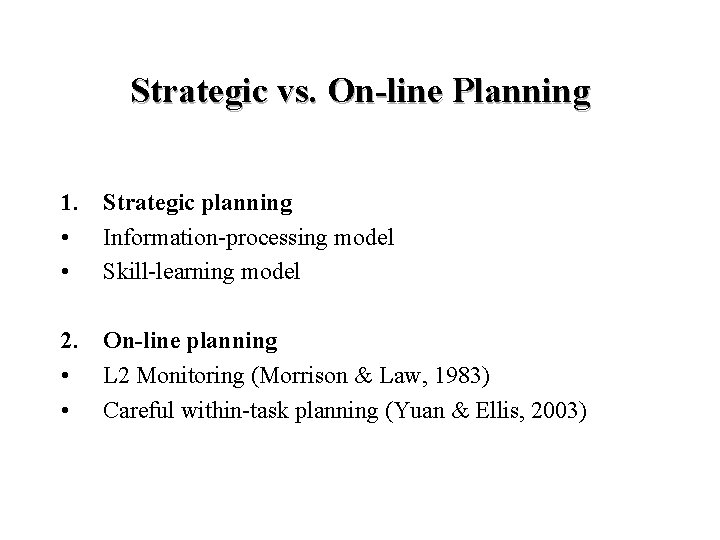
Strategic vs. On-line Planning 1. Strategic planning • Information-processing model • Skill-learning model 2. On-line planning • L 2 Monitoring (Morrison & Law, 1983) • Careful within-task planning (Yuan & Ellis, 2003)
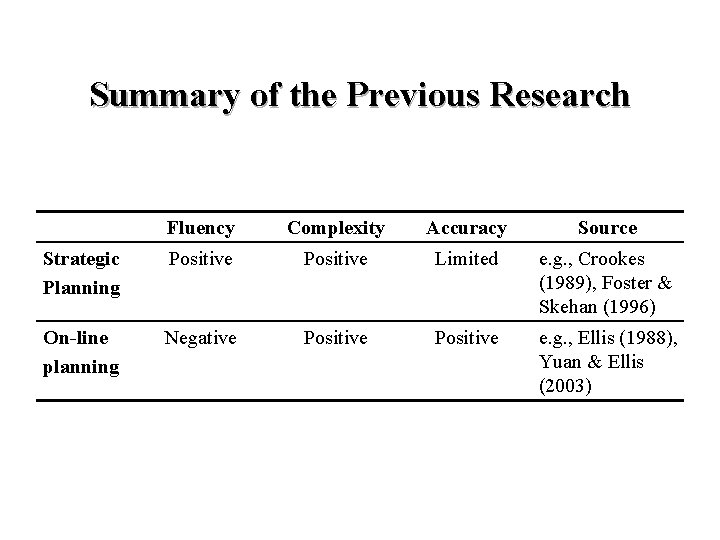
Summary of the Previous Research Fluency Complexity Accuracy Source Strategic Planning Positive Limited e. g. , Crookes (1989), Foster & Skehan (1996) On-line planning Negative Positive e. g. , Ellis (1988), Yuan & Ellis (2003)

Focus-on-Form Instruction • The noticing issue: Do learners have the cognitive resources to notice the gap between their IL utterances and the TL utterances around them? • The interruption issue: Is a pedagogical intervention that does not interrupt the learner’s own processing for language learning even possible? • The timing issue: If so, then precisely ‘when’, in cognitive terms, should the pedagogical intervention occur? (Doughty, 2001)
Identifying a Link between Planning and Focus-on-Form • Theoretical issue: Strategic planning facilitates a learnerdriven focus-on-form (Ortega, 1999, 2005) • Methodological issue: A process-product approach to planning. How do L 2 learners plan during strategic planning time? (Ortega, 1999, 2005; Sangarun, 2005)

Research Questions • Do different planning conditions differently influence the oral performance? • How do L 2 speakers plan their speech on-line when their performance is underway? Do they focus on form in online planning more frequently than strategic and noplanning conditions?
Research Hypotheses for Task Performance Analysis (1) • Hypothesis One: Strategic planning (SP) will give more positive influence on fluency, complexity and accuracy than no-planning (NP). • Hypothesis Two: On-line planning (OP) will give more positive influence on complexity and accuracy, but more negative influence on fluency than NP. • Hypothesis Three: OP will give more positive influence on complexity and accuracy, but more negative influence on fluency than SP.
Research Hypotheses for Task Performance Analysis (2) • Hypothesis Four: The effects of SP will interact with the different proficiency levels. • Hypothesis Five: The effects of OP will interact with the different proficiency levels.
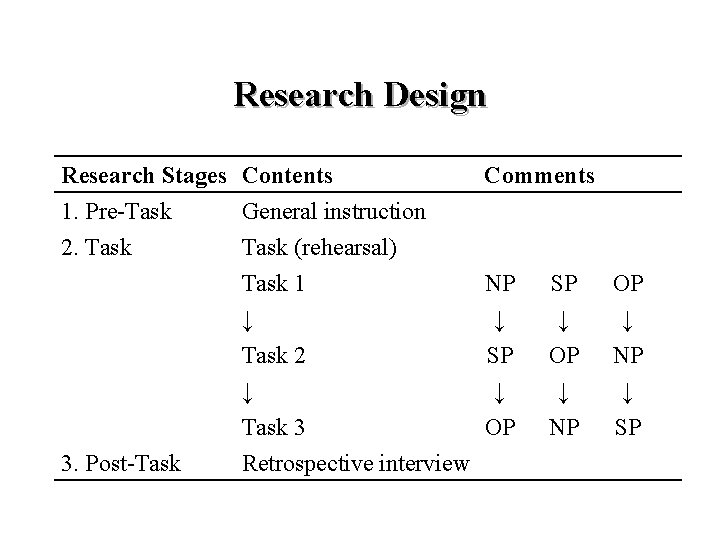
Research Design Research Stages Contents 1. Pre-Task General instruction 2. Task (rehearsal) Task 1 3. Post-Task Comments NP ↓ SP ↓ ↓ Task 2 ↓ Task 3 OP Retrospective interview SP ↓ OP ↓ NP SP

Task • Story-telling tasks x 3: 6 picture cartoons taken from a popular story-telling resource book for EFL learners (Heaton, 1975). • Different, but clearly structured tasks (cf. Tavakoli & Skehan, 2005) • The first obligatory sentence was given to encourage the use of past tense forms in each task, following Ellis (1987).

Task Implementation No-planning (NP) Before Task During Task 30 seconds 2 minutes Strategic planning (SP) 10 minutes On-line planning (OP) 30 seconds 2 minutes unlimited
Participants • 27 Japanese speakers of English (male = 11, female = 16) • Length of residence: mean = 11. 86 (months), SD = 13. 74, Range = 0. 25 (i. e. , 1 week) - 41. 00 (i. e. , 3 years and 5 months) • High vs. Low Proficiency: 6 -point global ratings by three raters to judge the NP speech. The average scores were used to categorize high and low proficient groups.
Fluency 1. 2. 3. 4. 5. 6. 7. Pruned speech rates Mean length of run Total length of pauses per minute Number of end-clause pauses per 100 words Number of mid-clause pauses per 100 words Number of filled pauses Number of dysfluencies (i. e. , false-starts, reformulation, repetition and self-correction)
Complexity 1. 2. • • Syntactic complexity: the number of clauses per ASunit (Foster, Tonkyn and Wigglesworth, 2000) Discoursal complexity: the number of discourse organization devices (Ejzenberg, 2000) Chaining integration devices Grammatical integration devices
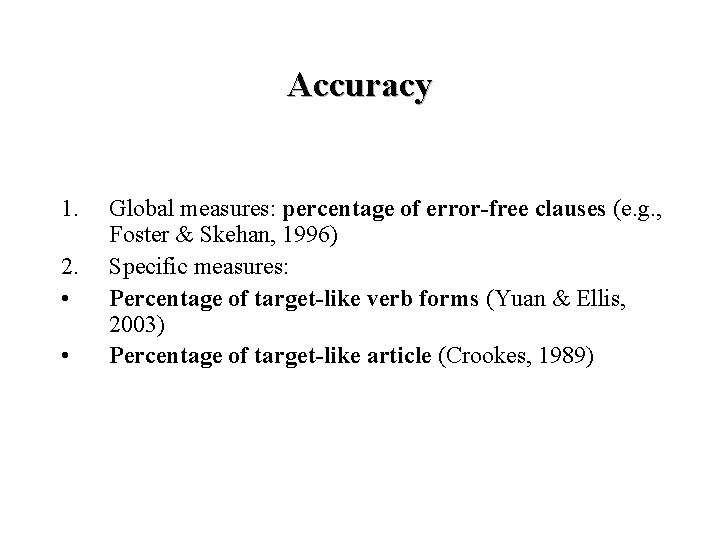
Accuracy 1. 2. • • Global measures: percentage of error-free clauses (e. g. , Foster & Skehan, 1996) Specific measures: Percentage of target-like verb forms (Yuan & Ellis, 2003) Percentage of target-like article (Crookes, 1989)
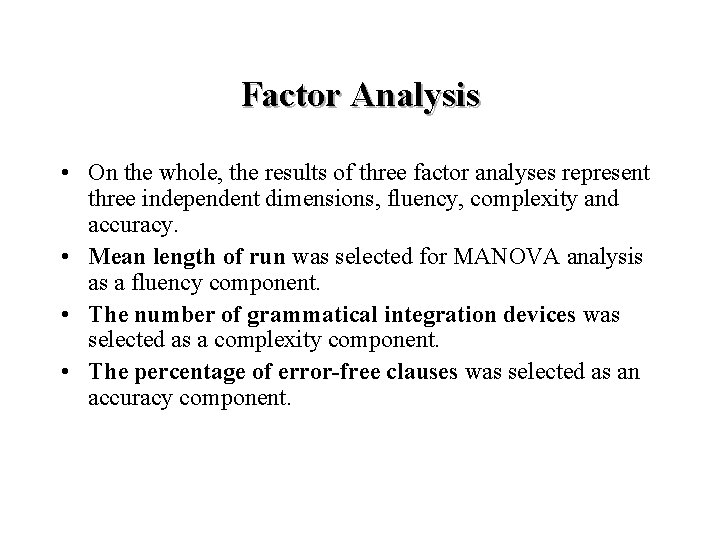
Factor Analysis • On the whole, the results of three factor analyses represent three independent dimensions, fluency, complexity and accuracy. • Mean length of run was selected for MANOVA analysis as a fluency component. • The number of grammatical integration devices was selected as a complexity component. • The percentage of error-free clauses was selected as an accuracy component.
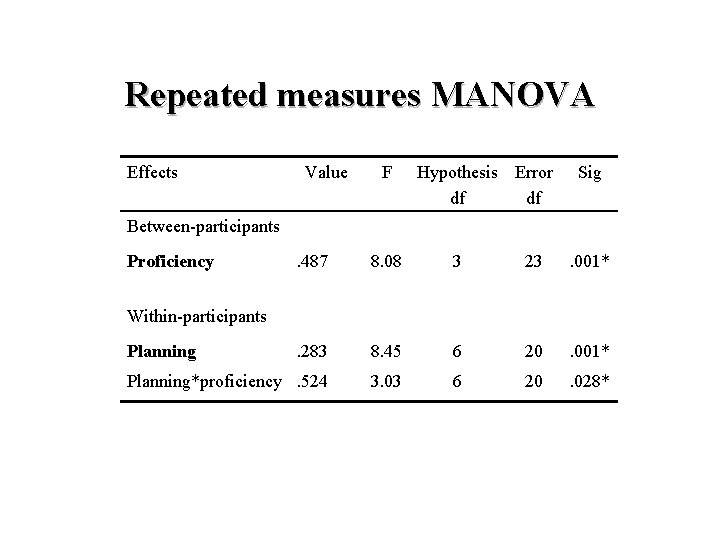
Repeated measures MANOVA Effects Value F Hypothesis Error df df Sig Between-participants Proficiency . 487 8. 08 3 23 . 001* . 283 8. 45 6 20 . 001* Planning*proficiency. 524 3. 03 6 20 . 028* Within-participants Planning
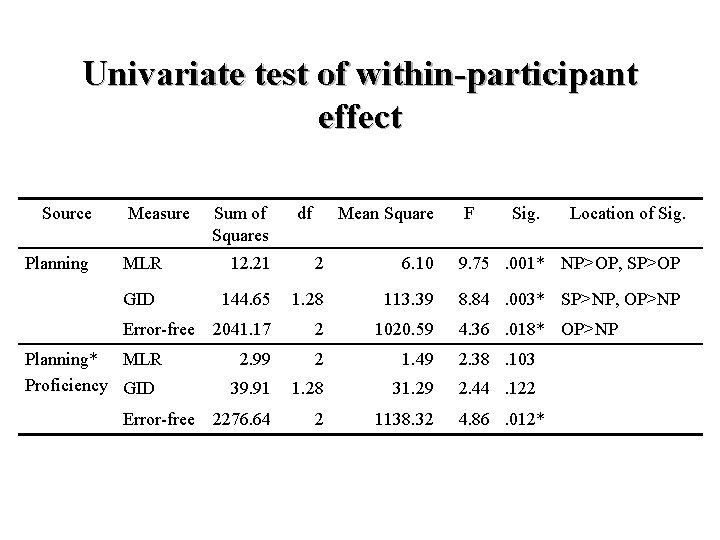
Univariate test of within-participant effect Source Planning Measure Sum of Squares df Mean Square F Sig. Location of Sig. MLR 12. 21 2 6. 10 9. 75. 001* NP>OP, SP>OP GID 144. 65 1. 28 113. 39 8. 84. 003* SP>NP, OP>NP 2041. 17 2 1020. 59 2. 99 2 1. 49 2. 38. 103 39. 91 1. 28 31. 29 2. 44. 122 2276. 64 2 1138. 32 Error-free Planning* MLR Proficiency GID Error-free 4. 36. 018* OP>NP 4. 86. 012*
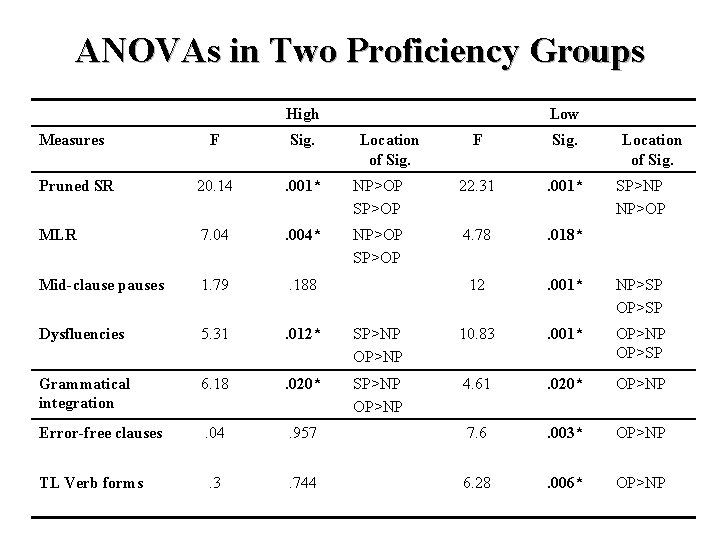
ANOVAs in Two Proficiency Groups High Measures F Sig. Pruned SR 20. 14 . 001* MLR 7. 04 . 004* Mid-clause pauses 1. 79 . 188 Dysfluencies 5. 31 . 012* Grammatical integration 6. 18 . 020* Error-free clauses . 04 TL Verb forms . 3 Low Location of Sig. F Sig. Location of Sig. NP>OP SP>OP 22. 31 . 001* NP>OP SP>OP 4. 78 . 018* 12 . 001* NP>SP OP>SP SP>NP OP>NP 10. 83 . 001* OP>NP OP>SP SP>NP OP>NP 4. 61 . 020* OP>NP . 957 7. 6 . 003* OP>NP . 744 6. 28 . 006* OP>NP SP>NP NP>OP
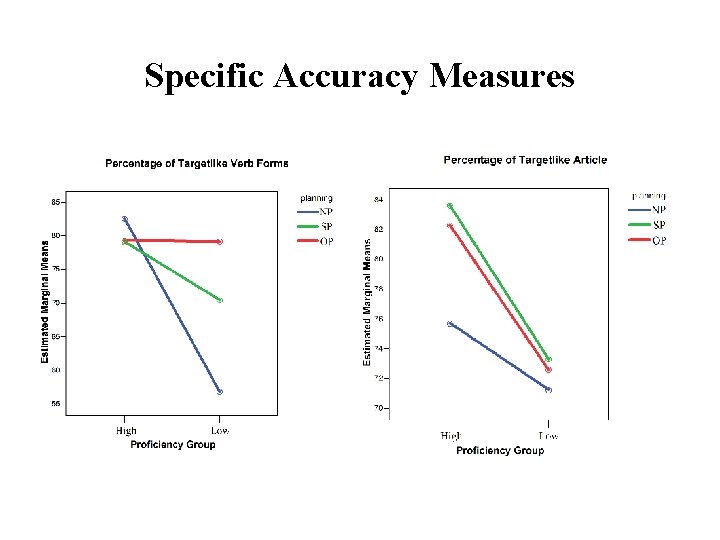
Specific Accuracy Measures
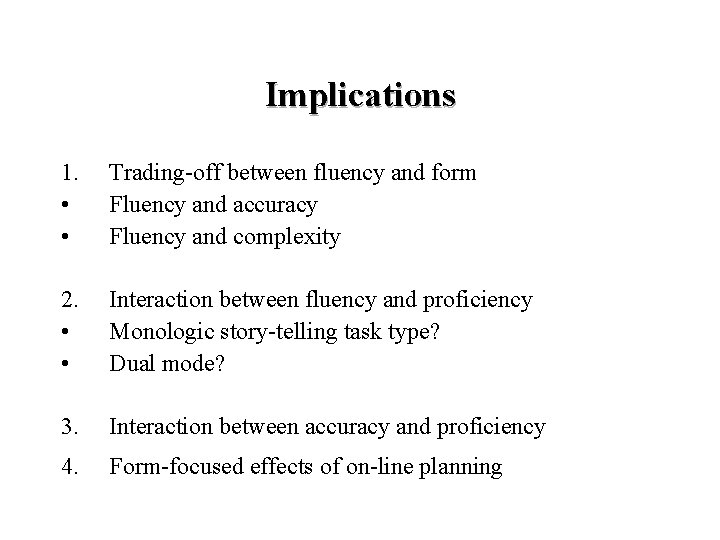
Implications 1. • • Trading-off between fluency and form Fluency and accuracy Fluency and complexity 2. • • Interaction between fluency and proficiency Monologic story-telling task type? Dual mode? 3. Interaction between accuracy and proficiency 4. Form-focused effects of on-line planning
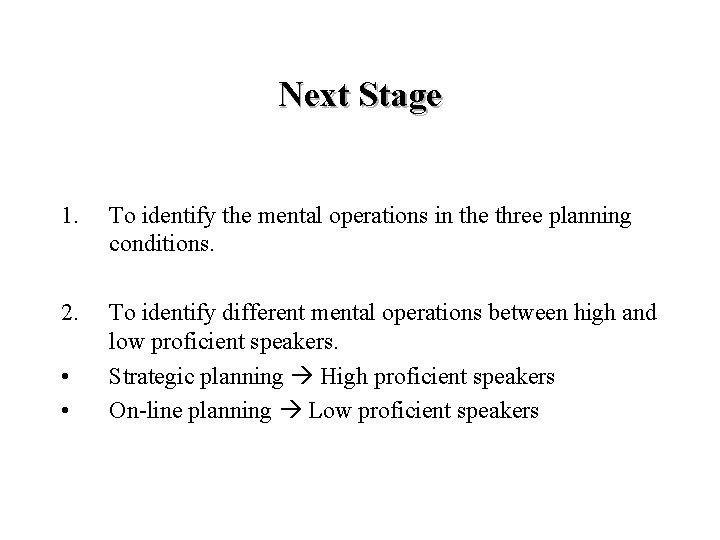
Next Stage 1. To identify the mental operations in the three planning conditions. 2. To identify different mental operations between high and low proficient speakers. Strategic planning High proficient speakers On-line planning Low proficient speakers • •
- Slides: 24