
Planning and Estimation You have a bunch of

Planning and Estimation
You have a bunch of user stories, so what’s next?
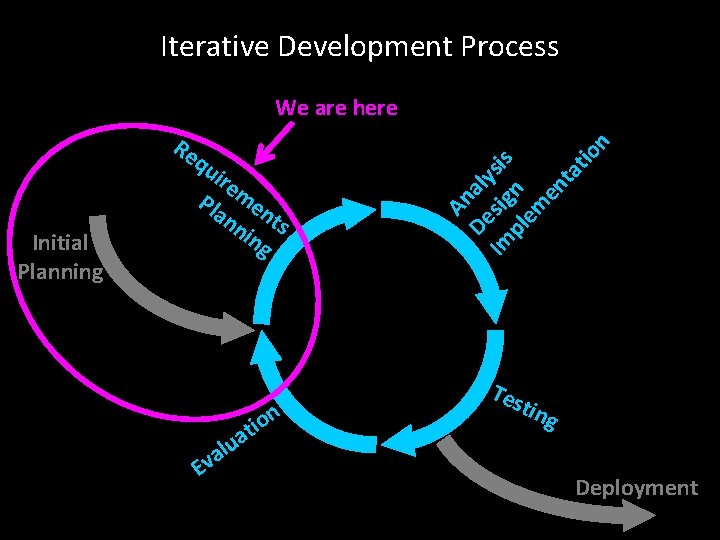
Iterative Development Process Initial Planning ire Pla men nn ts ing a v E it on lua An Re qu De aly Im sig sis pl n em en ta tio n We are here Tes tin g Deployment
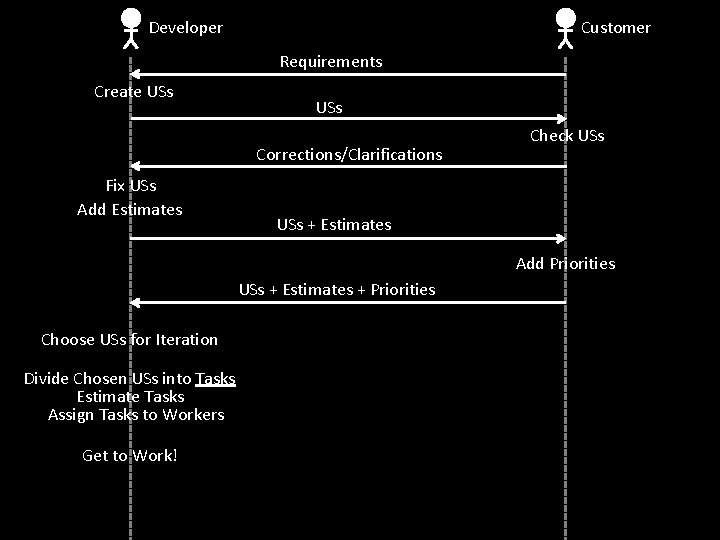
Customer Developer Requirements Create USs Corrections/Clarifications Fix USs Add Estimates Check USs + Estimates Add Priorities USs + Estimates + Priorities Choose USs for Iteration Divide Chosen USs into Tasks Estimate Tasks Assign Tasks to Workers Get to Work!
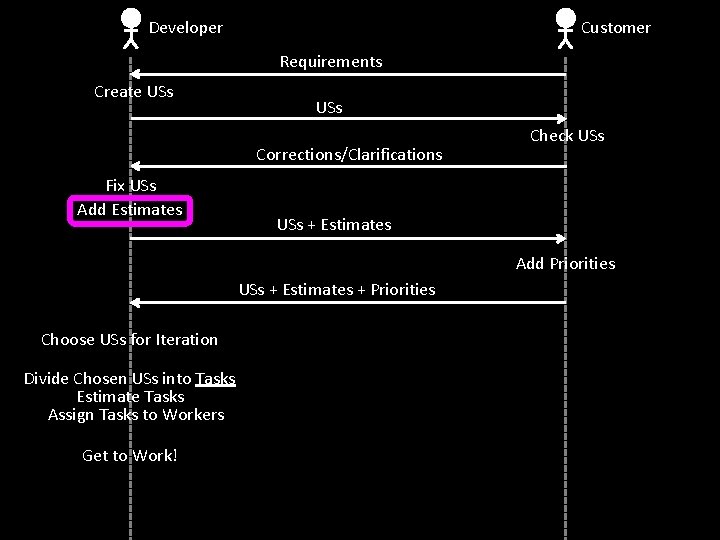
Customer Developer Requirements Create USs Corrections/Clarifications Fix USs Add Estimates Check USs + Estimates Add Priorities USs + Estimates + Priorities Choose USs for Iteration Divide Chosen USs into Tasks Estimate Tasks Assign Tasks to Workers Get to Work!

Estimating Time http: //xkcd. com/1658/
Hofstadter's Law It always takes longer than you expect, even when you take into account Hofstadter's Law. — Douglas Hofstadter, Gödel, Escher, Bach
Mythical Man Month • “Adding manpower to a late project makes it later. ” – Group communication grows very fast – n(n – 1) / 2 • “How does a large project get to be one year late? ” “One day at a time. ” – Lot of small milestones miss deadlines by a bit
Principles for Estimation • Principle: Past performance is the best indicator of future performance – Approach: Track your outcomes; refine your estimates • Principle: Wisdom of the crowd – Goal: Predict how events will unfold • Think event planning – Problem: Easy to miss something – Solution: More brains = more opportunities to catch eventualities
Principles for Estimation • Principle: Past performance is the best indicator of future performance – Approach: Track your outcomes; refine your estimates • Principle: Wisdom of the crowd How did the first Iteration go? ? – Goal: Predict how events will unfold • Think event planning – Problem: Easy to miss something – Solution: More brains = more opportunities to catch eventualities
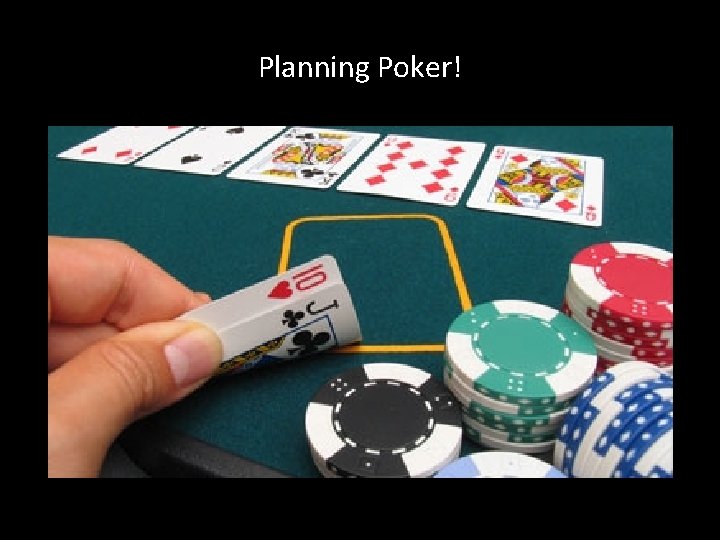
Planning Poker!
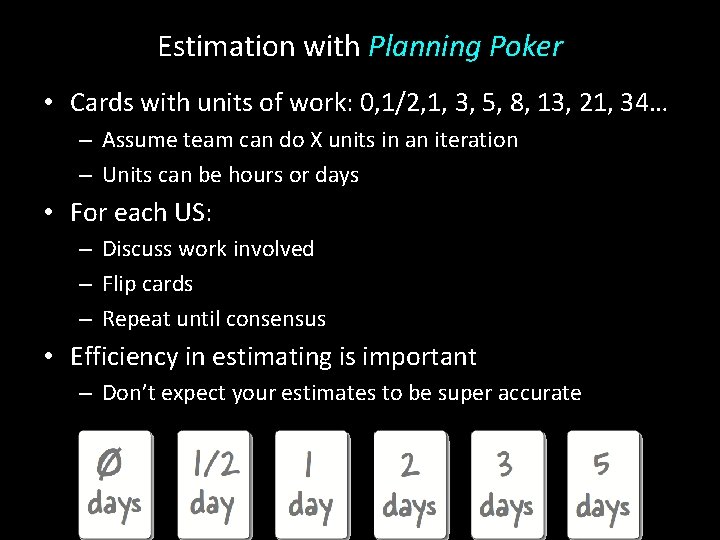
Estimation with Planning Poker • Cards with units of work: 0, 1/2, 1, 3, 5, 8, 13, 21, 34… – Assume team can do X units in an iteration – Units can be hours or days • For each US: – Discuss work involved – Flip cards – Repeat until consensus • Efficiency in estimating is important – Don’t expect your estimates to be super accurate

Let’s watch this video to find out what planning poker is all about: http: //youtu. be/0 Fbn. CWWg_NY
More Estimation Principles • Engineers refine estimates; customers refine expectations – Estimates are basis for customer’s cost assessment • Give honest estimates that customers can trust – Don’t do this: https: //youtu. be/t 9 SVhg 6 ZENw • Work at a sustainable pace – No heroes, no all-nighters, no super-human feats – Either you get the code done like a human being, or you don’t
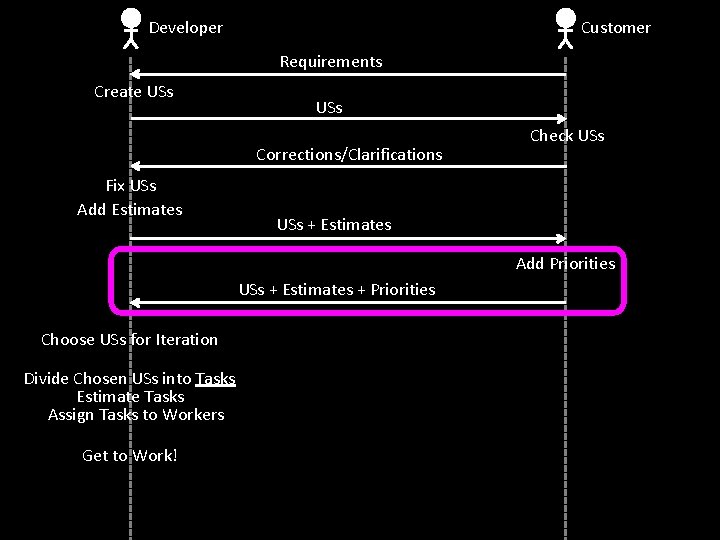
Customer Developer Requirements Create USs Corrections/Clarifications Fix USs Add Estimates Check USs + Estimates Add Priorities USs + Estimates + Priorities Choose USs for Iteration Divide Chosen USs into Tasks Estimate Tasks Assign Tasks to Workers Get to Work!
Principle: Customer sets priorities • Ensures alignment with customer goals • Helps customer feel in control – Project isn’t going “off the rails” • Estimates help customer maximize cost-benefit
Priority Numbering Scheme • • • P 0 – drop everything, critical task, often fatal bugs P 1 – high priority, others depend on this P 2 – should be completed during iteration P 3 – only complete if time permits P 4 – low value or superficial, don’t spend time on it
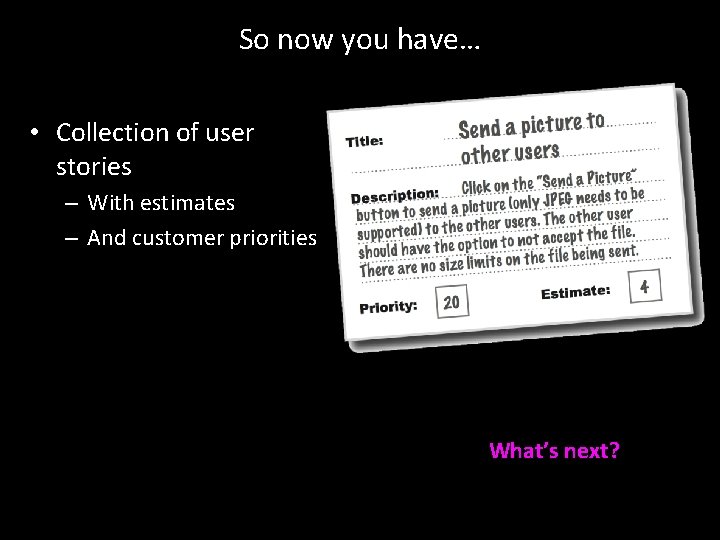
So now you have… • Collection of user stories – With estimates – And customer priorities What’s next?
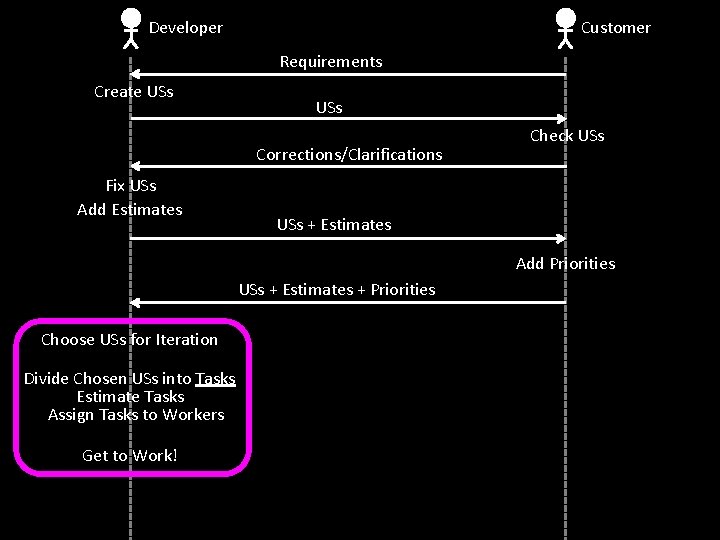
Customer Developer Requirements Create USs Corrections/Clarifications Fix USs Add Estimates Check USs + Estimates Add Priorities USs + Estimates + Priorities Choose USs for Iteration Divide Chosen USs into Tasks Estimate Tasks Assign Tasks to Workers Get to Work!
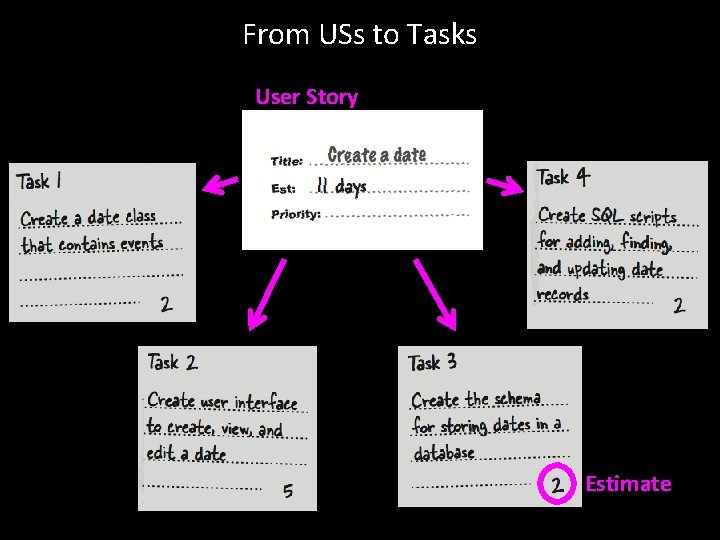
From USs to Tasks User Story Estimate
Incremental Development Principle • Each task produces running code – Unit tests count
Task design strategy • Make tasks build upon one another – First task makes subset of US work (e. g. , partial form) – Second task makes bit more work (e. g. , add persistence) – Etc…
Planning Process • Part 1: Estimate USs – Use Planning Poker – Start designing • Part 2: Collect customer priorities – Assign number each US – Also note any corrections/clarifications • Part 3: – Choose tasks for the iteration • 2 weeks worth of work – Fill out iteration plan with what each team member will do • Everyone codes • Tasks must be verifiable and executable
- Slides: 23