
PLANNING AICPA auditing standards state Three main reasons


- Slides: 17
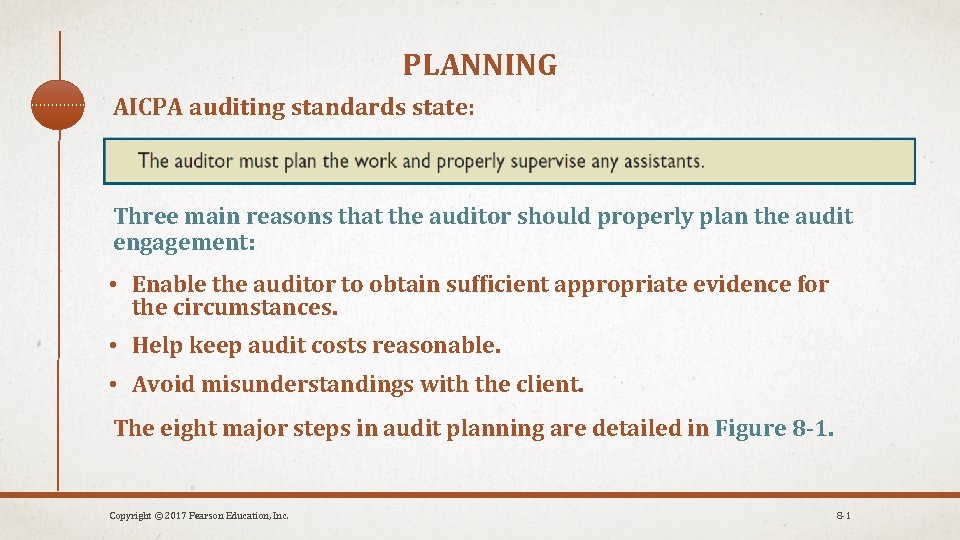
PLANNING AICPA auditing standards state: Three main reasons that the auditor should properly plan the audit engagement: • Enable the auditor to obtain sufficient appropriate evidence for the circumstances. • Help keep audit costs reasonable. • Avoid misunderstandings with the client. The eight major steps in audit planning are detailed in Figure 8 -1. Copyright © 2017 Pearson Education, Inc. 8 -1
Copyright © 2017 Pearson Education, Inc. 8 -2
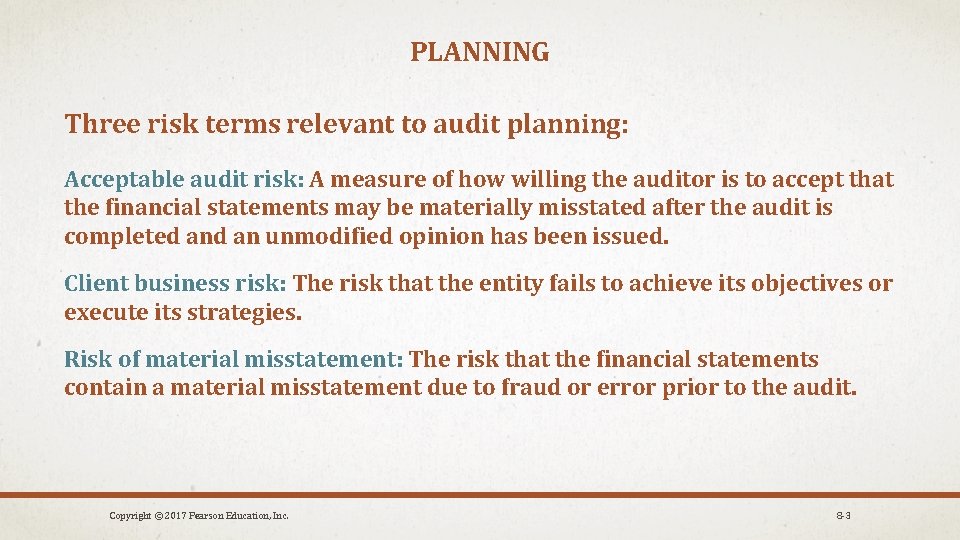
PLANNING Three risk terms relevant to audit planning: Acceptable audit risk: A measure of how willing the auditor is to accept that the financial statements may be materially misstated after the audit is completed an unmodified opinion has been issued. Client business risk: The risk that the entity fails to achieve its objectives or execute its strategies. Risk of material misstatement: The risk that the financial statements contain a material misstatement due to fraud or error prior to the audit. Copyright © 2017 Pearson Education, Inc. 8 -3
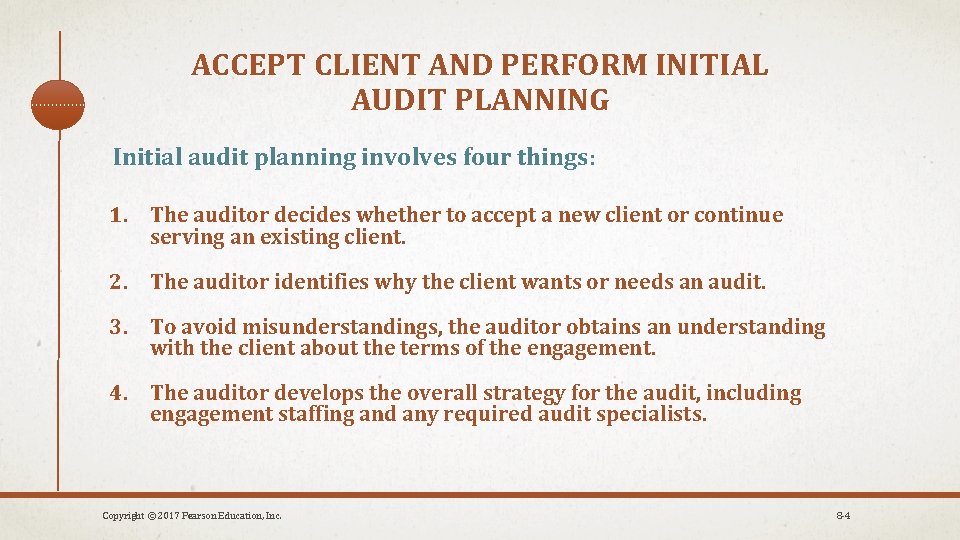
ACCEPT CLIENT AND PERFORM INITIAL AUDIT PLANNING Initial audit planning involves four things: 1. The auditor decides whether to accept a new client or continue serving an existing client. 2. The auditor identifies why the client wants or needs an audit. 3. To avoid misunderstandings, the auditor obtains an understanding with the client about the terms of the engagement. 4. The auditor develops the overall strategy for the audit, including engagement staffing and any required audit specialists. Copyright © 2017 Pearson Education, Inc. 8 -4
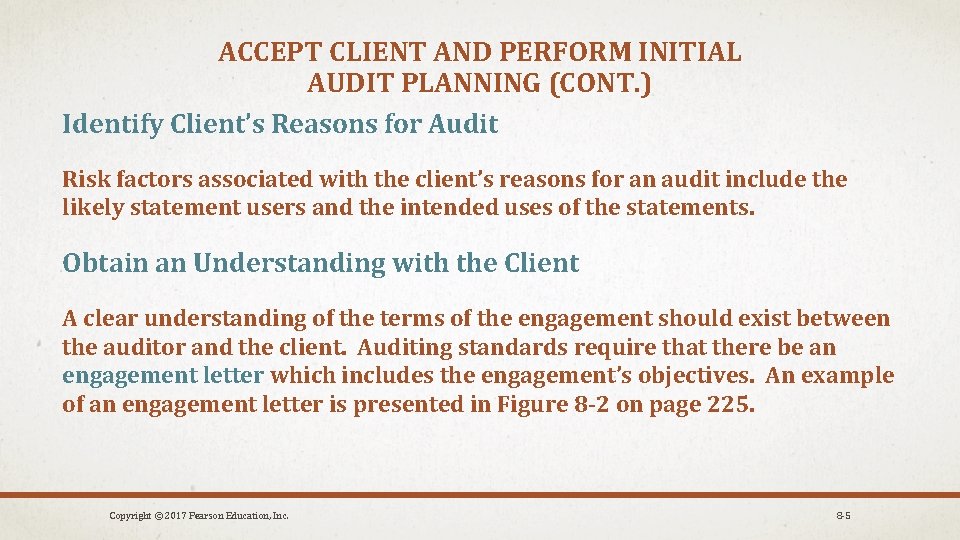
ACCEPT CLIENT AND PERFORM INITIAL AUDIT PLANNING (CONT. ) Identify Client’s Reasons for Audit Risk factors associated with the client’s reasons for an audit include the likely statement users and the intended uses of the statements. Obtain an Understanding with the Client A clear understanding of the terms of the engagement should exist between the auditor and the client. Auditing standards require that there be an engagement letter which includes the engagement’s objectives. An example of an engagement letter is presented in Figure 8 -2 on page 225. Copyright © 2017 Pearson Education, Inc. 8 -5
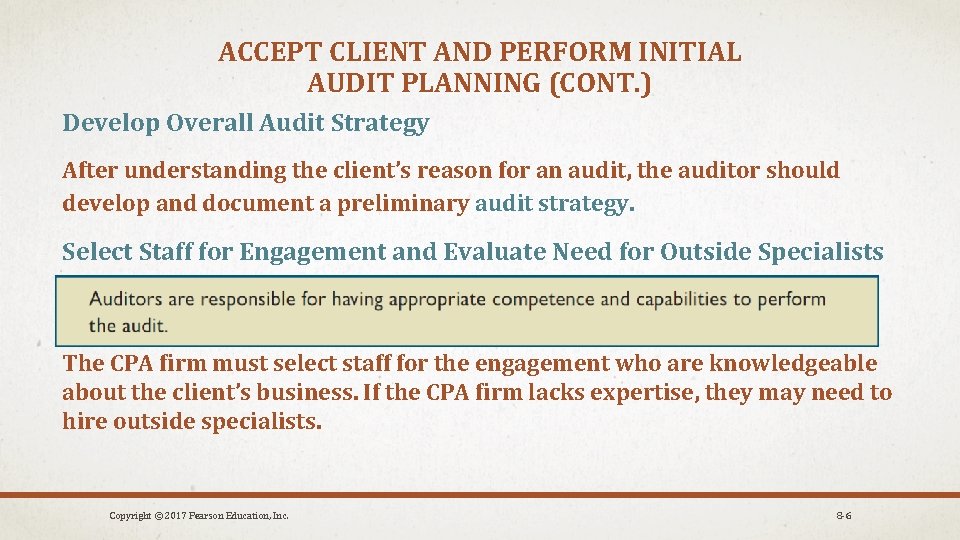
ACCEPT CLIENT AND PERFORM INITIAL AUDIT PLANNING (CONT. ) Develop Overall Audit Strategy After understanding the client’s reason for an audit, the auditor should develop and document a preliminary audit strategy. Select Staff for Engagement and Evaluate Need for Outside Specialists The CPA firm must select staff for the engagement who are knowledgeable about the client’s business. If the CPA firm lacks expertise, they may need to hire outside specialists. Copyright © 2017 Pearson Education, Inc. 8 -6
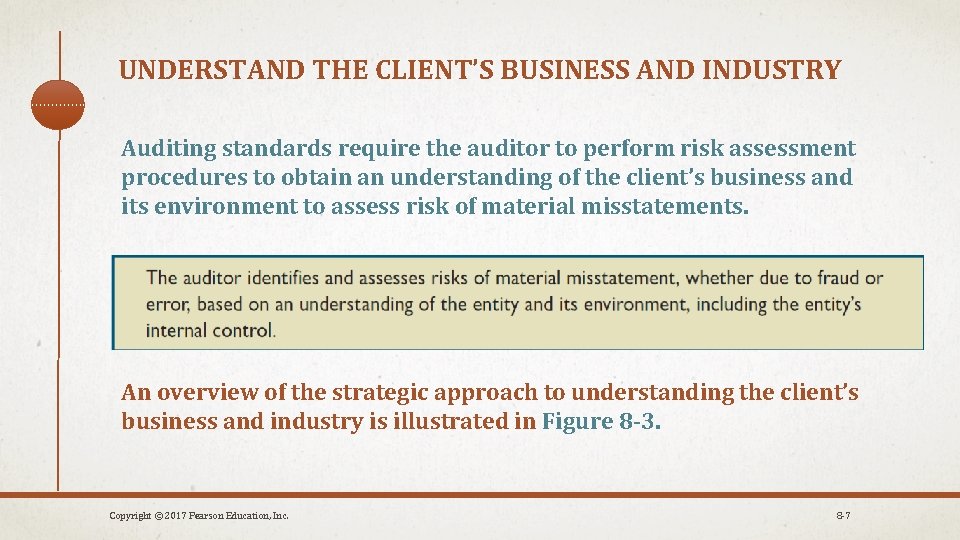
UNDERSTAND THE CLIENT’S BUSINESS AND INDUSTRY Auditing standards require the auditor to perform risk assessment procedures to obtain an understanding of the client’s business and its environment to assess risk of material misstatements. An overview of the strategic approach to understanding the client’s business and industry is illustrated in Figure 8 -3. Copyright © 2017 Pearson Education, Inc. 8 -7
Copyright © 2017 Pearson Education, Inc. 8 -8
PERFORM PRELIMINARY ANALYTICAL PROCEDURES As noted in Chapter 7, auditors are required to perform preliminary analytical procedures as part of risk assessment. Key financial ratios, along with industry standards, are presented in Table 8 -1. Common-size financial statements are also often used for one or more years for comparison as a preliminary analytical procedure. This is illustrated in Figure 8 -4 on page 233. Copyright © 2017 Pearson Education, Inc. 8 -9
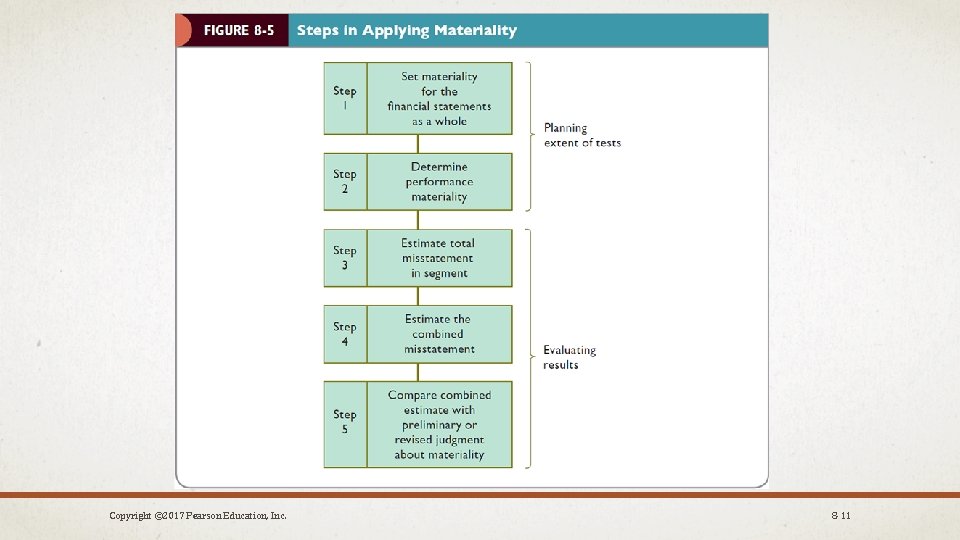
MATERIALITY The fourth step in audit planning is to make a preliminary judgment about materiality for the audit. Auditing standards define materiality as the magnitude of misstatements that individually, or when aggregated with other misstatements, could reasonably be expected to influence the economic decision of users. There are five steps to applying materiality as noted in Figure 8 -5. The first two are part of the planning process. Copyright © 2017 Pearson Education, Inc. 8 -10
Copyright © 2017 Pearson Education, Inc. 8 -11
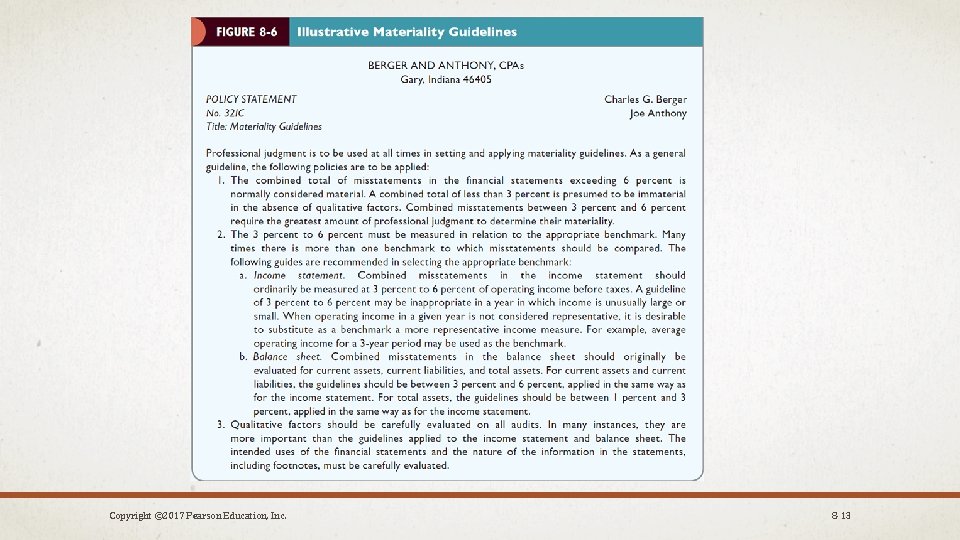
MATERIALITY FOR FINANCIAL STATEMENTS AS A WHOLE Step 1 in Figure 8 -5 is to set materiality for the financial statements as a whole as part of the planning process. Factors Affecting Preliminary Materiality Judgment: • Materiality is a relative rather than an absolute concept. • Benchmarks are needed for evaluating materiality. • Qualitative factors also affect materiality. Illustrative guidelines are shown in Figure 8 -6 in the form of policy guidelines of a CPA firm. Copyright © 2017 Pearson Education, Inc. 8 -12
Copyright © 2017 Pearson Education, Inc. 8 -13
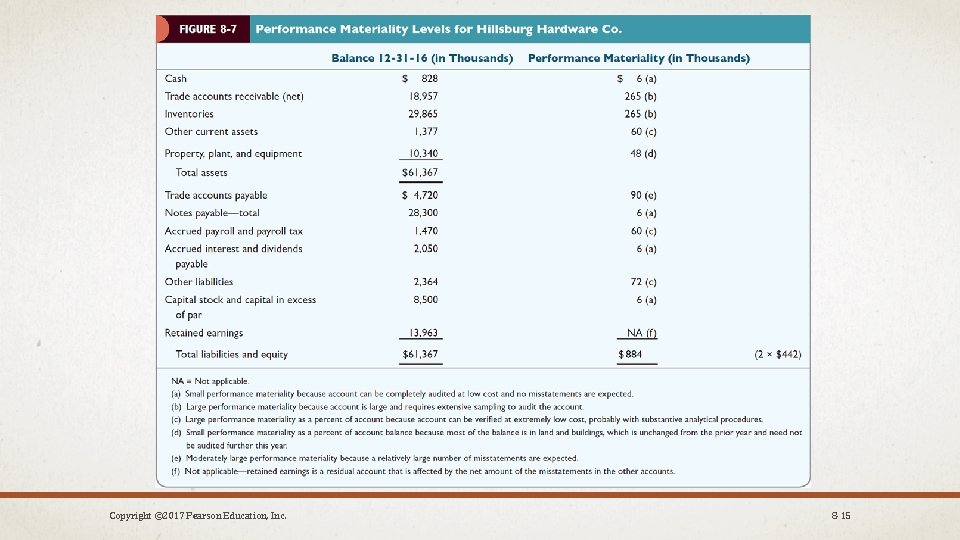
DETERMINE PERFORMANCE MATERIALITY Step 2 in Figure 8 -5 is to determine performance materiality, which can also be referred to as the allocation of the preliminary judgment about materiality to segments. • PCAOB standards refer to performance materiality as tolerable misstatement. • Performance materiality for an account is often set at 50– 75 percent of overall materiality. • Auditors have three major difficulties when allocating materiality to balance sheet accounts: 1. Auditors expect certain accounts to have more misstatements than others. 2. Both overstatements and understatements must be considered. 3. Relative audit costs affect the allocation. Figure 8 -7 illustrates the allocation process. Copyright © 2017 Pearson Education, Inc. 8 -14
Copyright © 2017 Pearson Education, Inc. 8 -15
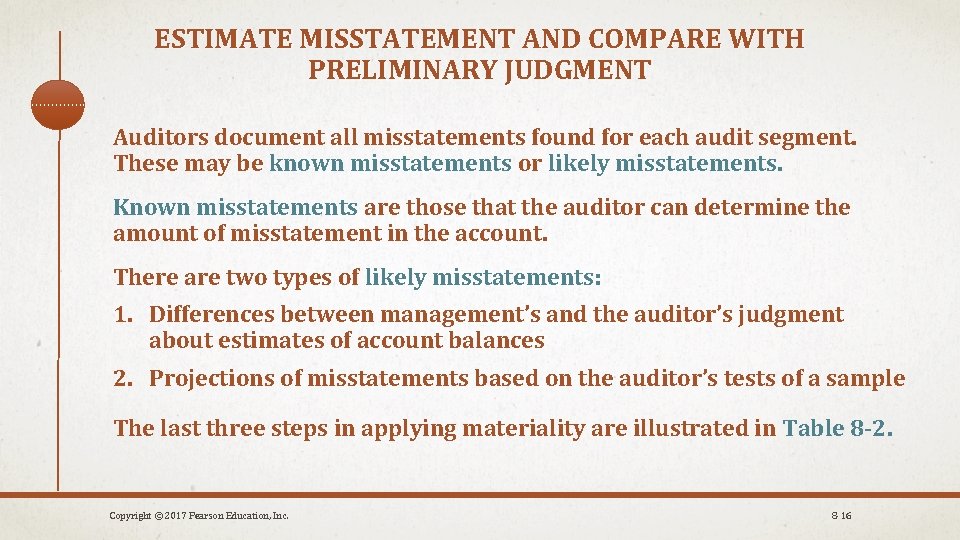
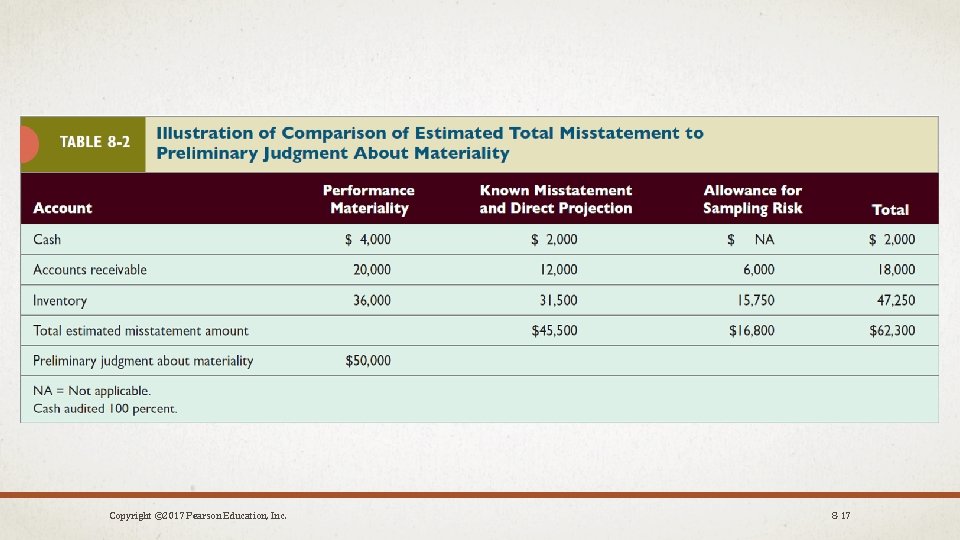
ESTIMATE MISSTATEMENT AND COMPARE WITH PRELIMINARY JUDGMENT Auditors document all misstatements found for each audit segment. These may be known misstatements or likely misstatements. Known misstatements are those that the auditor can determine the amount of misstatement in the account. There are two types of likely misstatements: 1. Differences between management’s and the auditor’s judgment about estimates of account balances 2. Projections of misstatements based on the auditor’s tests of a sample The last three steps in applying materiality are illustrated in Table 8 -2. Copyright © 2017 Pearson Education, Inc. 8 -16
Copyright © 2017 Pearson Education, Inc. 8 -17