
Planning 101 South Dakota Municipal League Planning Overview



- Slides: 33
Planning 101 South Dakota Municipal League Planning Overview October 2019
Why Plan? • Shape the future Long range planning does not deal with future decisions, but with the future of present decisions. — Peter Drucker • • • Enhance economic development Provide more efficient public service Minimize land-use conflicts Protect natural resources Limit safety and health hazards
What Is The Difference Between Planning And Zoning? • Zoning is process of dividing land in a city into zones (e. g. residential, industrial) in which certain land uses are permitted or prohibited. • Planning is the process to help citizens build a great community. City planners work with neighborhood groups, business people, and many others to make the community the best place to live. • Planners think ahead. They help residents decide how to improve their community today, 5 years from now, and 20 years from now. • Planners always are thinking of how a city can do things in better ways. • There are many different kinds of planners: community, environmental, land use, transportation, affordable housing, economic development, historic preservation.
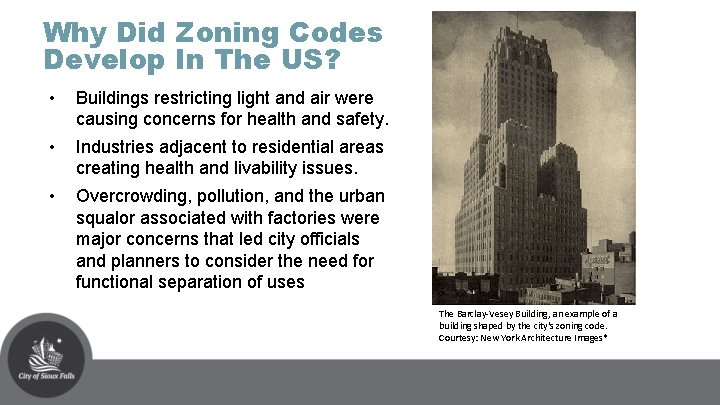
Why Did Zoning Codes Develop In The US? • Buildings restricting light and air were causing concerns for health and safety. • Industries adjacent to residential areas creating health and livability issues. • Overcrowding, pollution, and the urban squalor associated with factories were major concerns that led city officials and planners to consider the need for functional separation of uses The Barclay-Vesey Building, an example of a building shaped by the city's zoning code. Courtesy: New York Architecture Images*
Land Use Planning And Zoning Legal Issues – Balancing Interests • Planning and zoning must balance the needs for • orderly, efficient, and compatible development of all with • each citizen’s private property rights. • A zoning or subdivision ordinance is considered an acceptable method to balance private property rights with orderly, efficient, and compatible development. • A zoning ordinance must include • adequate public involvement (due process) • standards that provide for equal treatment of all citizens.
Takings Clause • Eminent Domain: The fifth amendment to the U. S. Constitution provides that “private property shall not be taken for public use, without just compensation. ” • • Police Power: Control property use for the public health, safety, and welfare in a reasonable manner is not a taking as long as it does not eliminate all economically beneficial use of the property. ” • • Example: Condemnation of property for road or other public project. Example: Zoning and Subdivision Ordinance An abuse of eminent domain or police power by a governing body may pave the way for takings litigation if it goes too far.
Due Process • Due Process is derived from the 5 th Amendment to the U. S. Constitution and is applied to the states via the 14 th Amendment. • “No person shall be deprived of life, liberty, or property without the due process of law” • Two types of due process: • Procedural: Ensures that the government creates a fundamentally fair and reasonable process as it acts in making land use decisions • Substantive: Requires that land use regulations be fair and be applied in a fair and reasonable way.
Equal Protection • No law may unduly favor one group over another and no law may impose a hostile discrimination on any particular group. (14 th Amendment) • Persons under like circumstances must be given equal protection in the enjoyment of personal rights. • Persons bringing such a claim must have substantial evidence that they were treated differently from others in similar circumstances.
Statutory Authority Under State Law • Dillon’s Rule: A doctrine, framed by Judge John Dillon (1868), stating that the power of municipalities is limited to those powers “expressly granted, necessarily or fairly implied, or absolutely indispensable. ” (Municipalities are creatures of the state so if statutes are silent, the power does not exist. ) • Home Rule Charter – Sioux Falls must follow state laws also, but where state law is silent Sioux Falls can, in some cases, create own rules. • Standard Enabling Acts of 1920’s basis for most state planning statutes around the country • Planning and zoning authority granted by the State of South Dakota Legislature can be found in SDCL 11 -2, 11 -3, 11 -4 and 11 -6.
State Statutory Authority • Comprehensive Plan required before Zoning or Subdivision Ordinances are effective • Planning Commission recommendation required for comprehensive plans and amendments to zoning ordinances and subdivision ordinances • Due process requires public hearings for both planning commission and governing body (10 day notice ahead of meeting) • Due Process!
Local Ordinances And Administration “The referee must abide by the rule book. ” All local ordinances must comply with • US Constitution • State Law Basis of decision making must be substantiated by your plans and ordinances.
Legislative vs Administrative Decisions • Legislative Decisions • Adopts (or amends) Plans or ordinances that sets policies for future application. • All legislative decisions are made by elected bodies, but not every decision by an elected body is a legislative decision. • Administrative (Quasi-Judicial) • Decisions that apply previously established policies. • Decisions can be made by elected bodies, planning commission, board of adjustment, or staff. Approval authority identified in the ordinance and/or state law. • Legislative decisions allow the community more discretion in setting policies with limited predictability for landowners. Decisions can be based on community norms to some extent. • Administrative decisions allow limited discretion for the community in providing input. Decisions based just on the Facts.
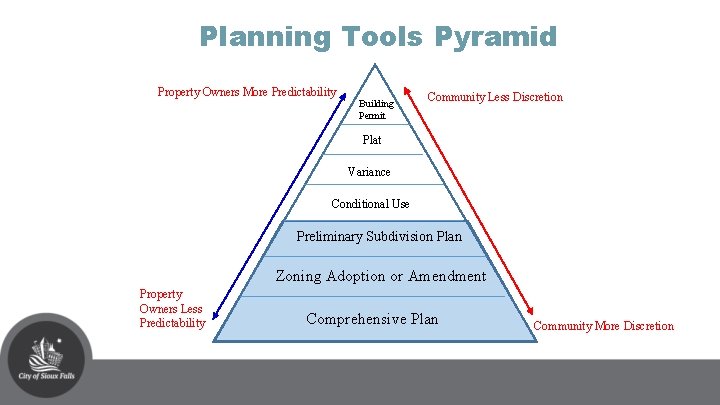
Planning Tools Pyramid Property Owners More Predictability Building Permit Community Less Discretion Plat Variance Conditional Use Preliminary Subdivision Plan Zoning Adoption or Amendment Property Owners Less Predictability Comprehensive Plan Community More Discretion
Comprehensive Plan is a Legal Document • A public document adopted by government to address the planning requirements of state law. • Pennington County Supreme Court Decision • Must have an adopted comprehensive plan for a zoning ordinance to be enforceable • Must adopt through procedures addressed in state law and be able to prove it.
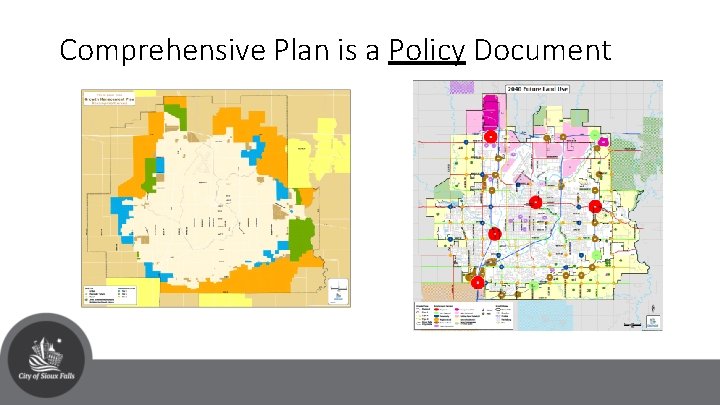
Comprehensive Plan is a Policy Document
Comprehensive Plan Adoption Procedure in South Dakota • Planning Commission Public Hearing – published at least 10 days in advance in newspaper. Planning Commission must recommend • Governing Body Public Hearing – published at least 10 days in advance in newspaper. Governing body must then pass by resolution.
Basis of Land Use Regulations • The plan should include goals and policies to follow when structuring your zoning and subdivision ordinance. • The zoning and subdivision ordinance should be consistent with the comprehensive plan. • Planning Commission and governing body should make land use decisions that are consistent with the comprehensive plan • Rezoning (Future Land Use Map and Policies) • Zoning and Subdivision Ordinance Revisions (Policies)
Living Document – Comprehensive Plan • The Comprehensive Plan should be updated as conditions change with appropriate public involvement • Is one public hearing appropriate public involvement? • Legally, yes • Practically, NO • Do not let this document “collect dust on the shelf” for legal and practical reasons
How do you implement a Comprehensive Plan? • Annexation • Zoning (also Joint Zoning) • Subdivision • Capital Improvement Program, special assessments, impact fees. • More plans - Sub-plans, corridor studies, design engineering, and master plans etc.
Zoning Regulations Regulating the Use of Private Property for the Public Good
What is Zoning? • Zoning is the division of land into districts (or zones), each having different uses. • Zoning regulations are designed to protect the individual and community or county from uses of land which are potentially harmful or which conflict with the community’s or county’s development objectives.
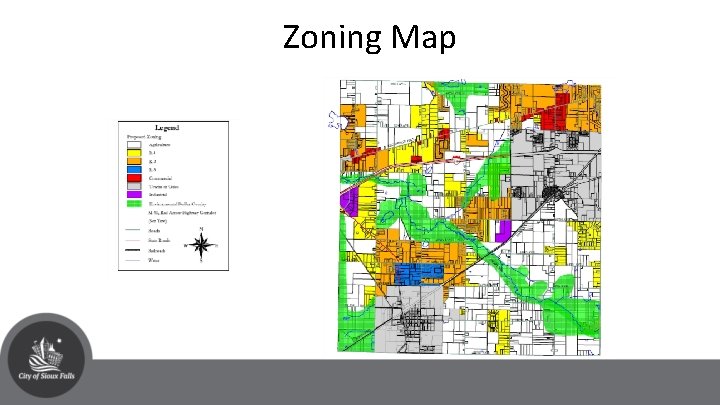
Districts/Zones and the Zoning Map • Districts allow listed uses and prohibit unlisted uses. • This method provides the planning commission with a method to separate conflicting uses. • The zoning map illustrates the exact location of the districts or zones. The process to change the districts or zones is to rezone or amend the zoning ordinance. • Once the rezoning/amendment is completed, the zoning map should be changed • The amendment/rezoning process is the same as the initial adoption process under South Dakota Law
Zoning Map
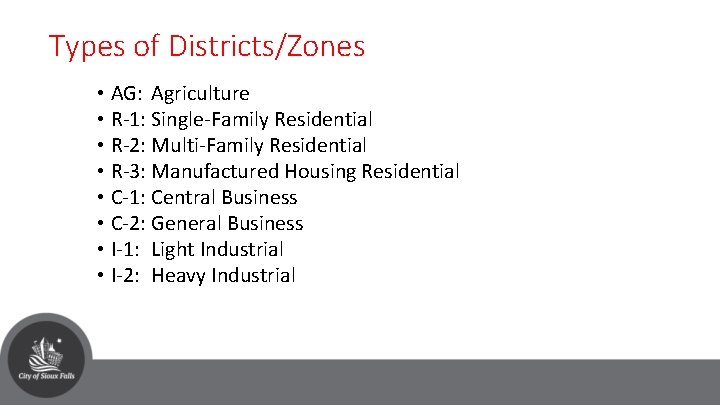
Types of Districts/Zones • AG: Agriculture • R-1: Single-Family Residential • R-2: Multi-Family Residential • R-3: Manufactured Housing Residential • C-1: Central Business • C-2: General Business • I-1: Light Industrial • I-2: Heavy Industrial
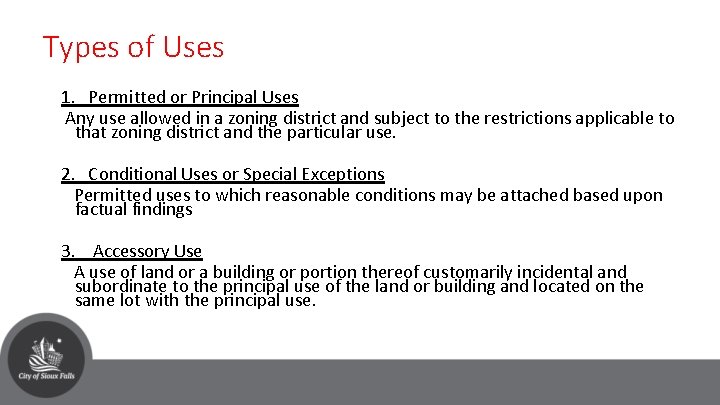
Types of Uses 1. Permitted or Principal Uses Any use allowed in a zoning district and subject to the restrictions applicable to that zoning district and the particular use. 2. Conditional Uses or Special Exceptions Permitted uses to which reasonable conditions may be attached based upon factual findings 3. Accessory Use A use of land or a building or portion thereof customarily incidental and subordinate to the principal use of the land or building and located on the same lot with the principal use.
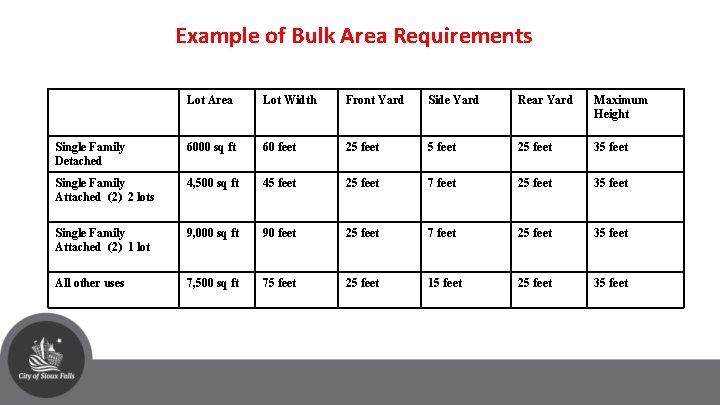
Example of Bulk Area Requirements Lot Area Lot Width Front Yard Side Yard Rear Yard Maximum Height Single Family Detached 6000 sq ft 60 feet 25 feet 35 feet Single Family Attached (2) 2 lots 4, 500 sq ft 45 feet 25 feet 7 feet 25 feet 35 feet Single Family Attached (2) 1 lot 9, 000 sq ft 90 feet 25 feet 7 feet 25 feet 35 feet All other uses 7, 500 sq ft 75 feet 25 feet 15 feet 25 feet 35 feet
Variances • • • All bulk regulations are minimum requirements and must be satisfied before receiving approval to build or expand. Variance: A variance may be approved to reduce the minimum requirements by a Board of Adjustment only if the applicant has a significant hardship. (See Board of Adjustment Discussion). There is no such thing as a use variance. That is called a rezoning.
Subdivision Regulations Regulating the division of land placement of streets and utilities
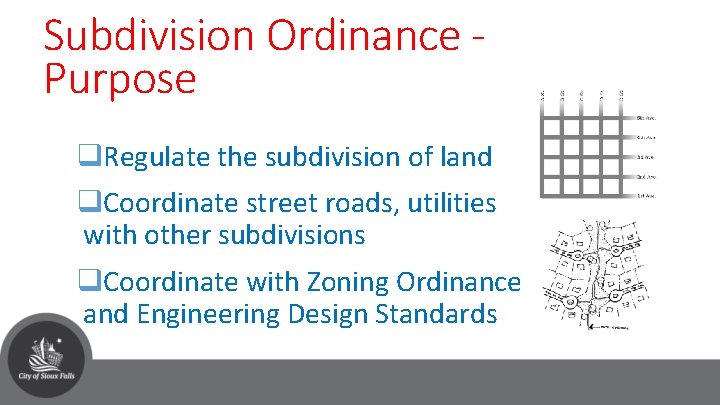
Subdivision Ordinance Purpose q. Regulate the subdivision of land q. Coordinate street roads, utilities with other subdivisions q. Coordinate with Zoning Ordinance and Engineering Design Standards
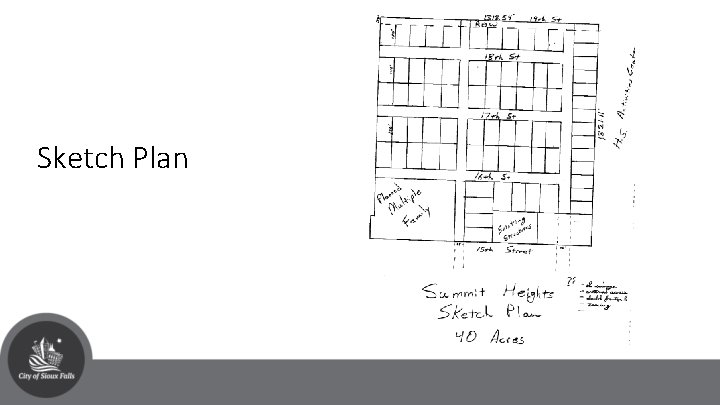
Sketch Plan
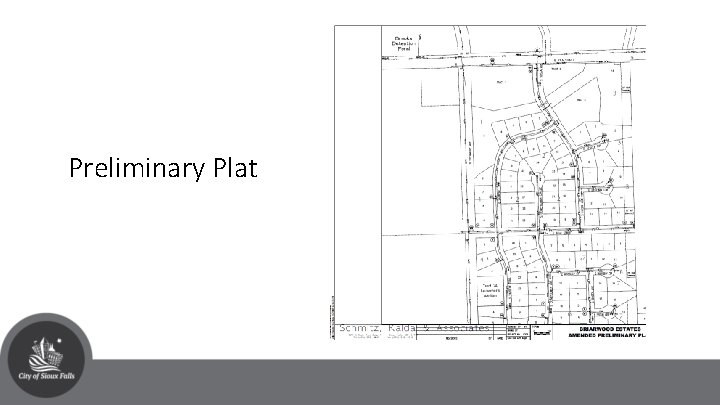
Preliminary Plat
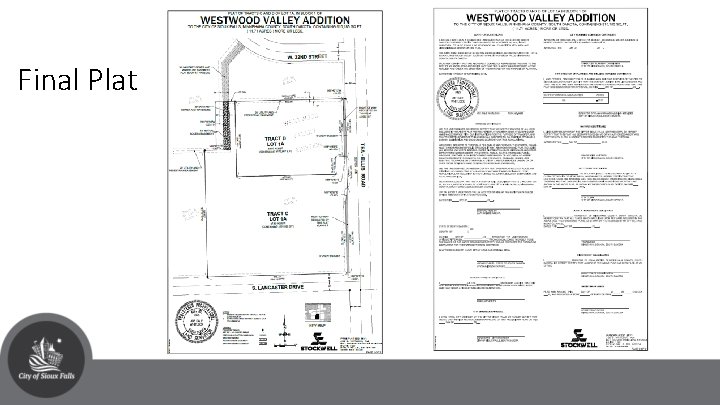
Final Plat