
PLANNAR CHROMATOGRAPHY l It includes two types 1
- Slides: 27
PLANNAR CHROMATOGRAPHY
l It includes two types: 1 - Thin Layer Chromatography (TLC). 2 - Paper Chromatography (PC).
Thin Layer Chromatography (TLC) l In this type a thin layer of a solid coating material is spread on a suitable supporting surface. l Types Supporting Surfaces: 1 - Glass Plates. 2 - Plastic sheets. 3 - Aluminum sheets.
Coating materials: 1 -Adsorption: a- silica gel (silicic acid). b- Alumina (Aluminum oxide c- Magnesium Silicate (florisil) for Lipids 2 -Partition: a- Cellulose. 3 -Ion Exchange TLC: a- Cellulose phosphate 4 -Reversed – phase partition: a- C-18 silica gel b- C-8 silica gel c- C-4 silica gel . (.
5 - Polyamides: a- E-poly caprolactam b- Poly acrylonitrite 6 - Gel chromatography (Size exclusion): a- Sephadex G 25 b- Sephadex G 50 c- Sephadex G 75 d- Sephadex G 100 e- Sephadex LH 20
Binders: These are materials used to hold the thin layer of the coating material into the surface of the supporting plates. Types of binders: a- Ca. SO 4 (Plaster of Paris) Gypsum (10 -15%) b- Silicon dioxide c- Starch (1 -3 (% d- Organic polymers e. g. polyvinyl alcohol.
Indicators: These are materials mixed with the coating material and binder to help locating the spots on the TLC. The most common used indicator is the fluorescent materials (silica gel 60 F 254).
Sample Application (Spotting): l Samples are applied as a solution in any volatile solvent using glass Capillaries for Qualitative, Preparative applications. Graduated syringes are used for Qualitative analyses. l The spots must be about 1 -1. 5 cm away from the bottom of the plate and 0. 5 cm away from the plate sides and 0. 5 cm away from each other.
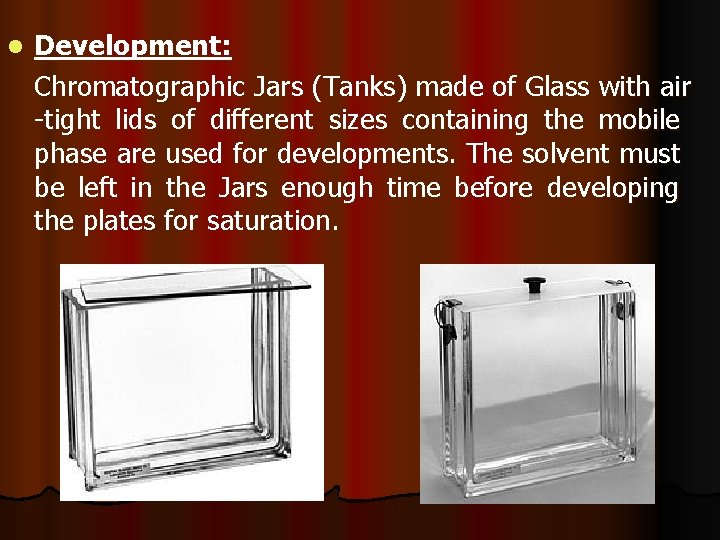
l Development: Chromatographic Jars (Tanks) made of Glass with air -tight lids of different sizes containing the mobile phase are used for developments. The solvent must be left in the Jars enough time before developing the plates for saturation.
Developing system: (Mobile phase – developing solvent) Using a single solvent (very rare) or mixture of solvents to allow the separation. The type of adsorbent used will affect the choice of the developing system. Adsorption: Usually mixture of non polar organic solvents are used. Partition: More polar organic solvents such as butanol- acetic acid – water are Buffer solution are also used in partition chromatography. Ion Exchange: Acidic or basic solutions are used. (HCl, Na. OH, Na. Cl, Li. Cl) Reversed phase: Methanol- acetonitril- water- acetone-acetic acid are used as mixtures. Polyamide: Mixtures of Water – ethanol- acetone can be used. Gel: Buffer solutions and aqueous acidic or basic solutions can be used.
Types of developments: A- Ascending: 1 - Single development: The solvent system is allowed to move through the stationary phase one time only against gravity. 2 - Repeated developments: a- Multiple developments: The plated are developed more than one time using the same solvent system. The plates must be completely dried after each development. b- Stepwise developments: The plated are developed more than one time using different solvent systems.
3 - Two-dimensional development: Is used to verify if a given spot on TLC using the above methods of development (one Dimensional) is one pure compound or mixture of two closely related compounds. The spots are applied to one corner and the plate developed as usual. The plate is then rotated 90 ˚C and then developed again. This method allow better separation of related compounds.
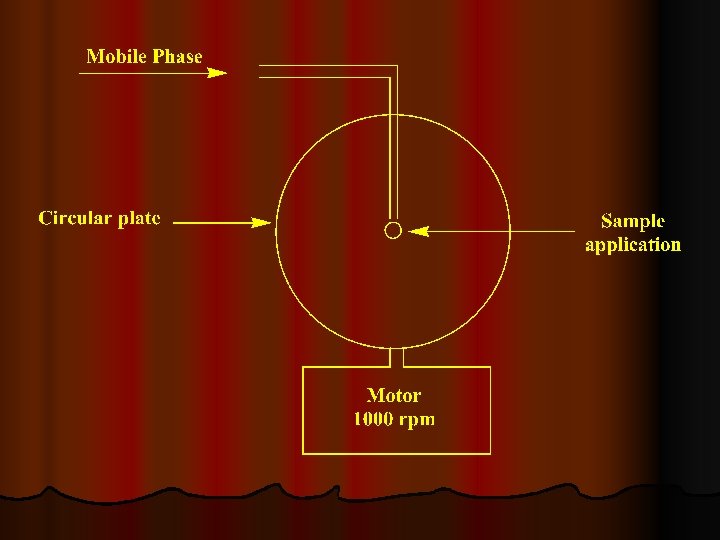
B- Centrifugal (chromatotron): This method of development require the use of Chromatotron. Simply it is composed of motor rotate in high speed (about 1000 rpm) to accelerate the speed of the mobile phase. Circular plates are used and the mixture is applied to the center of the plate. Mobile phase is also allowed to flow from the plate center to the edges. The separated materials will appear as concentric zones. Chromatotron is used only for preparative work.
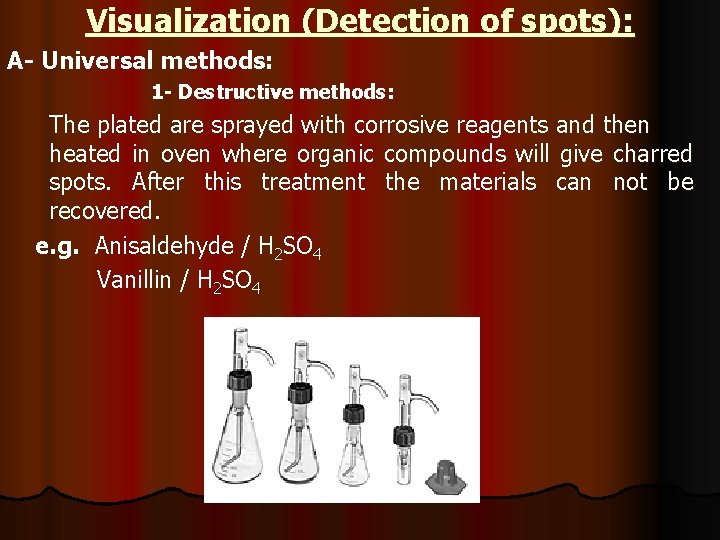
Visualization (Detection of spots): A- Universal methods: 1 - Destructive methods: The plated are sprayed with corrosive reagents and then heated in oven where organic compounds will give charred spots. After this treatment the materials can not be recovered. e. g. Anisaldehyde / H 2 SO 4 Vanillin / H 2 SO 4
2 - Non – Destructive methods: In these methods the materials can be recovered. Day light for colour compounds. l UV light for fluorescent compounds (conjugated double bonds). l I 2 vapour for any compounds contain at least one double bond l Spray with water where organic compounds appear as white opaque spots. l
B- Specific Methods: l These reagents are used for the detection of certain classes of compounds. They are usually destructive. l Dragendorff΄s reagent for Alkaloids. l Ferric Chloride (Fe. Cl 3) for phenolic compounds. l Aniline phthalate for sugars. l Ninhydrine for nitrogenous Amines, Amino acids. compounds as
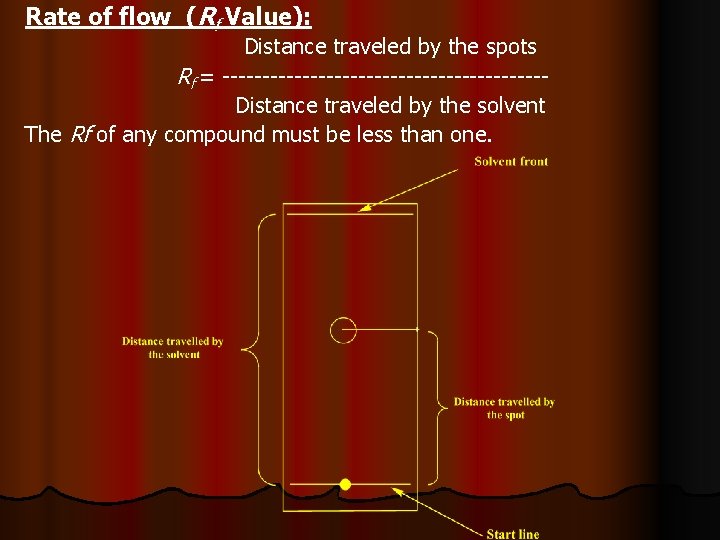
Rate of flow (Rf Value): Distance traveled by the spots Rf = --------------------Distance traveled by the solvent The Rf of any compound must be less than one.
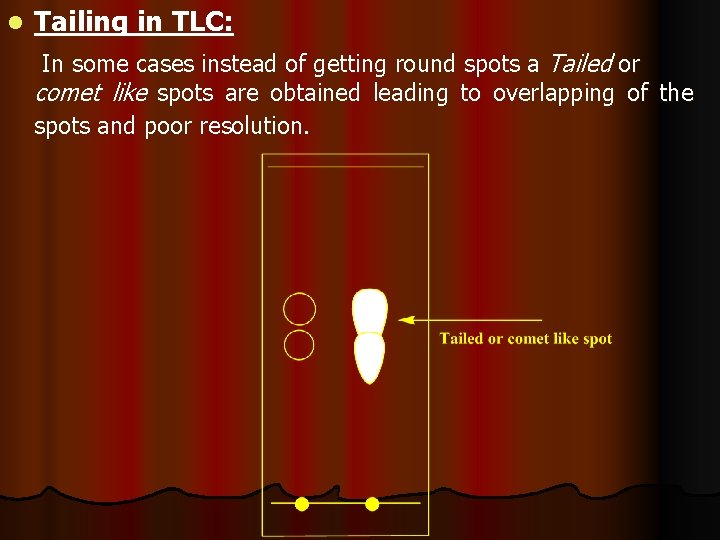
l Tailing in TLC: In some cases instead of getting round spots a Tailed or comet like spots are obtained leading to overlapping of the spots and poor resolution.
Reasons and solution for tailing problem:
Application: 1 - Qualitative: Identification through comparison of the Rf value with that of Reference material. Ø Determination of Complexity of mixtures. That will be indicated from number of spots. Ø Determination the purity of materials. Ø Monitoring the progress of Chemical reactions. Ø Monitoring of column chromatography. Ø Development of finger print TLC for extracts, volatile oils or pharmaceutical preparation for future identification and comparison. In this application plates 5× 5, 5× 10 cm with thin film of coating material are usually used. Ø
2 - Quantitative: l In this case an accurate volume of samples are applied using syringes. The dimensions of plates range from 5 x 10 to 20 x 20 according to the number pf spots used. The plates are developed as usual in the chromatographic tanks. After development the concentration of material can be determined by: Ø Ø Ø Spot area measurement: Which is directly proportional to the conc. of materials. Photodensitometry: Measure transmittance, reflection or fluorescence of spots. Radioactivity: For radioactive material. These measurements are done using TLC Scanner connected to computer that perform all calculations.
3 - Preparative TLC: In preparative application 20× 20 plates with thick layer of adsorbent 0, 25 m are used. The mixture is apply as bands and a pilot or guide spots may be used in one side of the plate to enable the detection of the spots location.
Paper Chromatography (PC)
Stationary phase: Papers (cellulose), mechanism of separation is through partition. Mobile phase: As TLC but more polar mixtures are usually used. Buffers can also be used. Sample application: A line drawn by pencil, spot places are determined as dots. Apply sample as in TLC.
Development: 1 - Ascending: The mobile phase move against Gravity. 2 -Descending: The mobile phase move with Gravity. 3 -Horizontal. 4 - Radial. Visualization: As TLC but must be non-destructive or specific with no use of heat. Applications: As in TLC.