
Planets What do you know about the planets
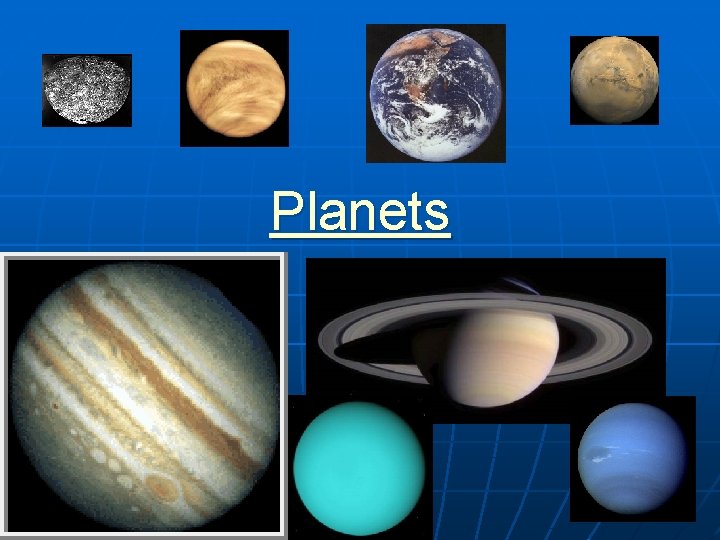
Planets
What do you know about the planets?
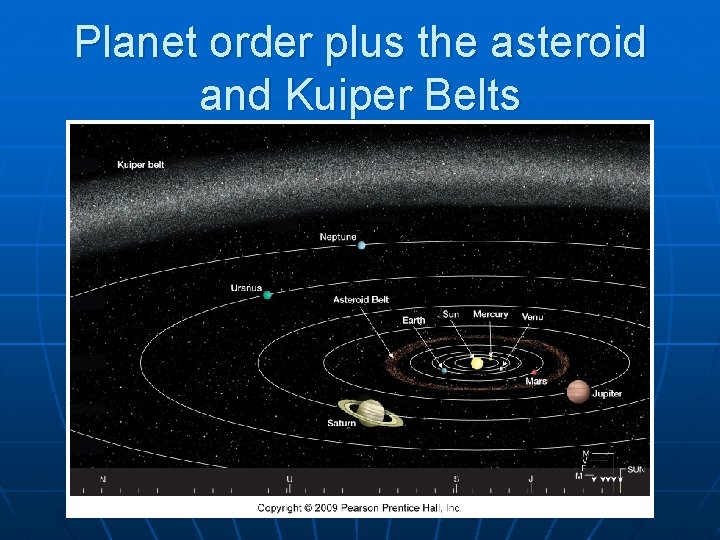
Planet order plus the asteroid and Kuiper Belts
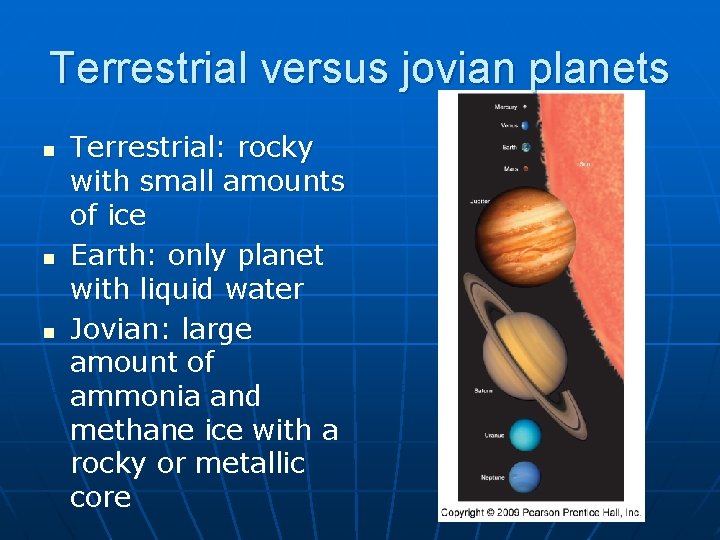
Terrestrial versus jovian planets n n n Terrestrial: rocky with small amounts of ice Earth: only planet with liquid water Jovian: large amount of ammonia and methane ice with a rocky or metallic core
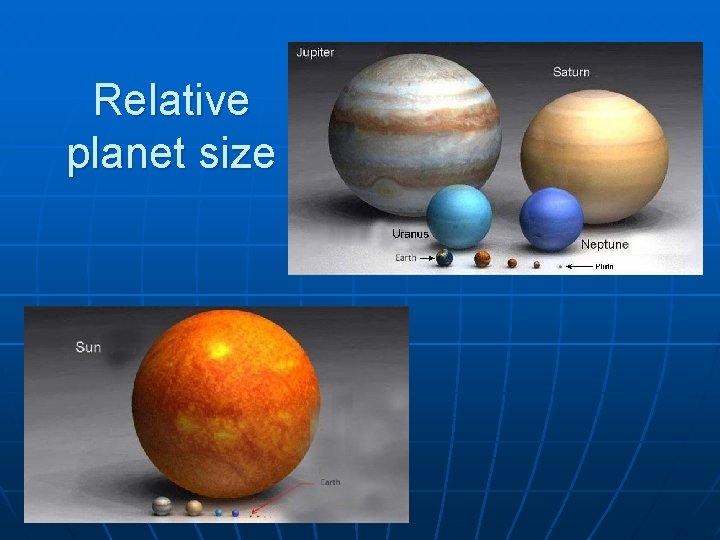
Relative planet size
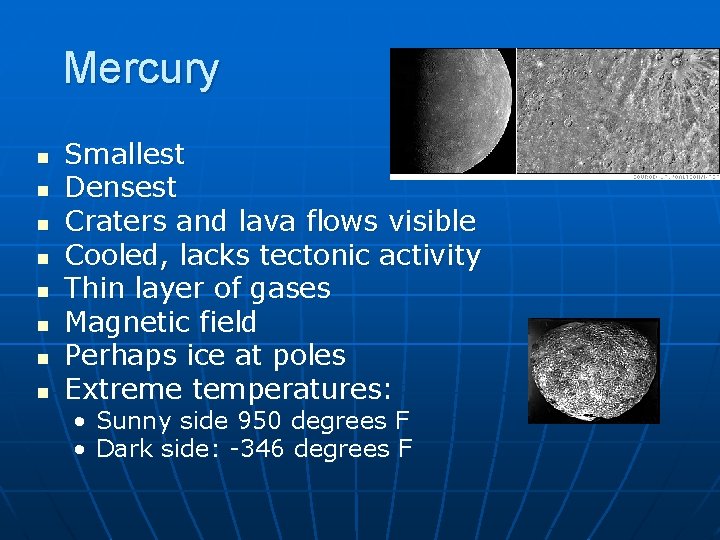
Mercury n n n n Smallest Densest Craters and lava flows visible Cooled, lacks tectonic activity Thin layer of gases Magnetic field Perhaps ice at poles Extreme temperatures: • Sunny side 950 degrees F • Dark side: -346 degrees F
Why are craters rare on Earth and common on the Moon and Mercury? The Earth’s surface is mobile due to processes that produce plate tectonics.
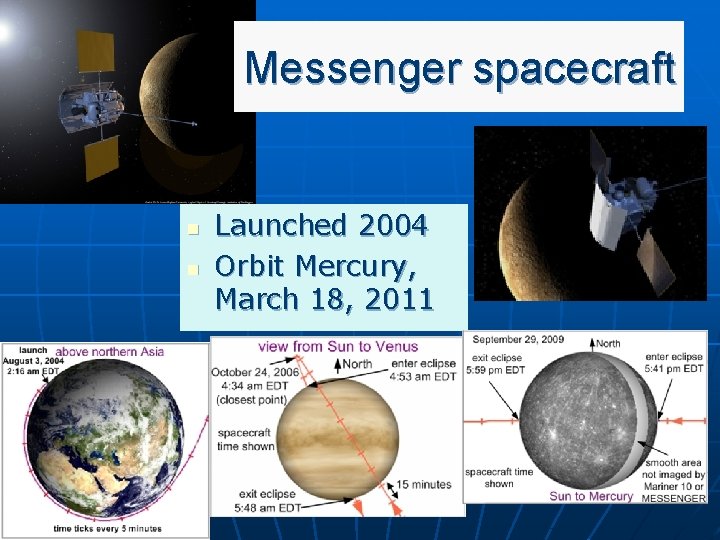
Messenger spacecraft n n Launched 2004 Orbit Mercury, March 18, 2011
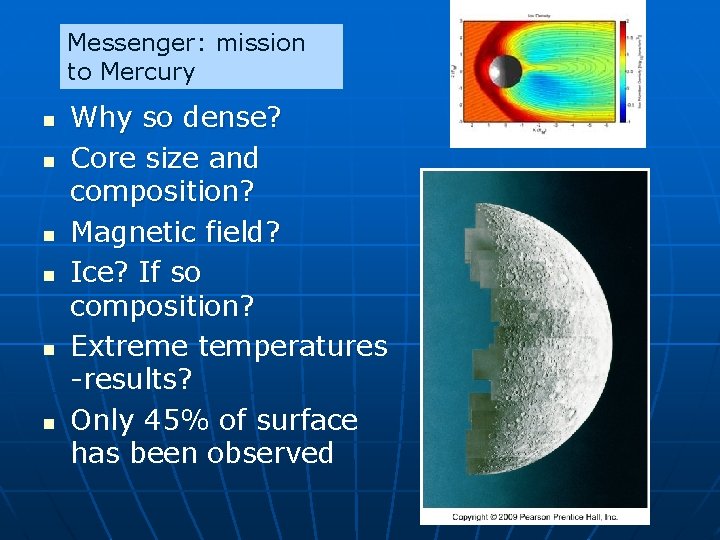
Messenger: mission to Mercury n n n Why so dense? Core size and composition? Magnetic field? Ice? If so composition? Extreme temperatures -results? Only 45% of surface has been observed
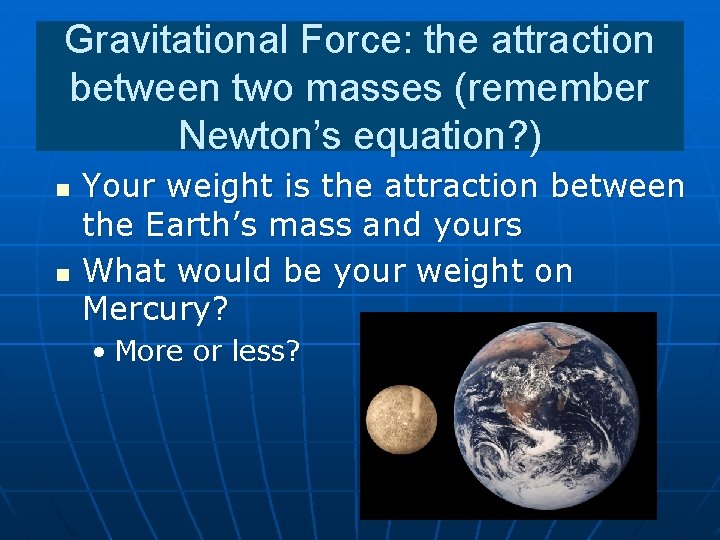
Gravitational Force: the attraction between two masses (remember Newton’s equation? ) n n Your weight is the attraction between the Earth’s mass and yours What would be your weight on Mercury? • More or less?
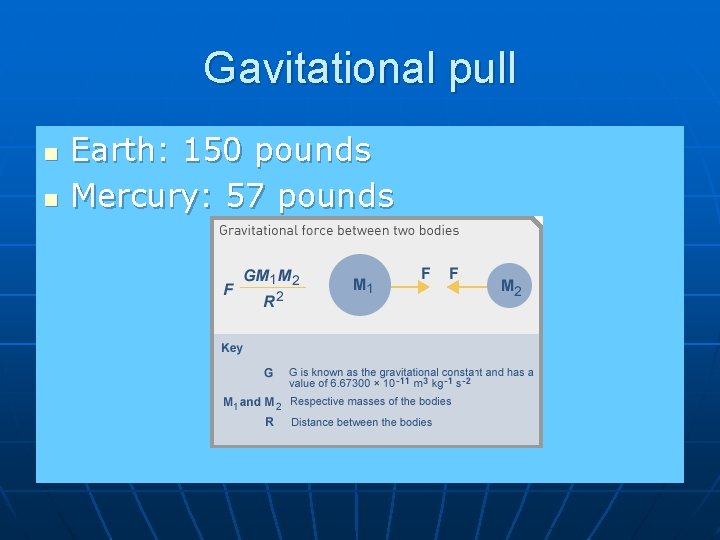
Gavitational pull n n Earth: 150 pounds Mercury: 57 pounds
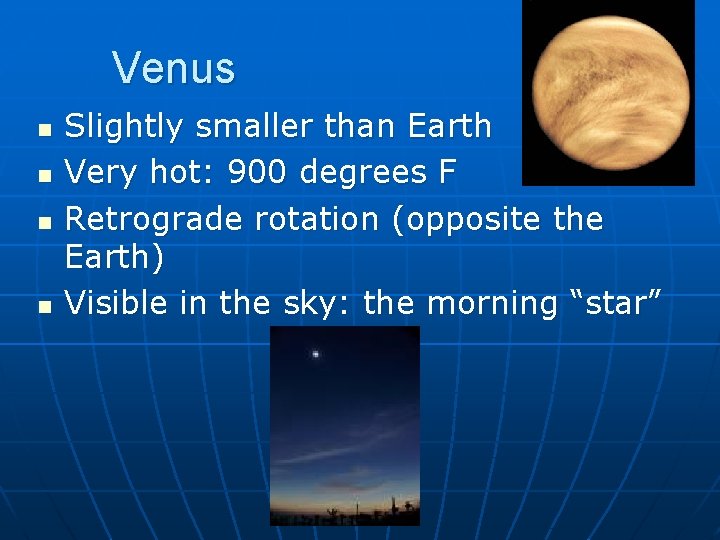
Venus n n Slightly smaller than Earth Very hot: 900 degrees F Retrograde rotation (opposite the Earth) Visible in the sky: the morning “star”
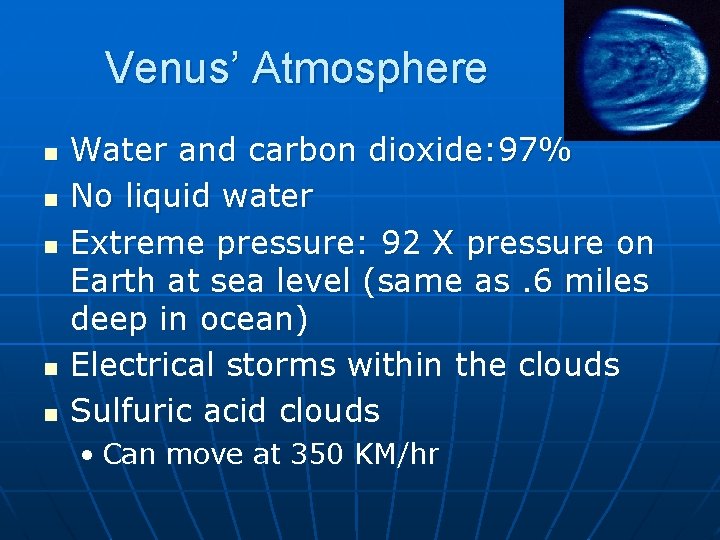
Venus’ Atmosphere n n n Water and carbon dioxide: 97% No liquid water Extreme pressure: 92 X pressure on Earth at sea level (same as. 6 miles deep in ocean) Electrical storms within the clouds Sulfuric acid clouds • Can move at 350 KM/hr
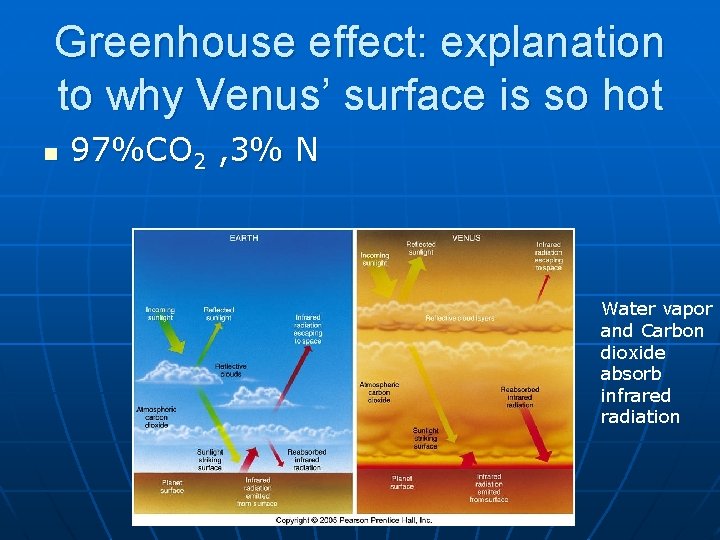
Greenhouse effect: explanation to why Venus’ surface is so hot n 97%CO 2 , 3% N Water vapor and Carbon dioxide absorb infrared radiation
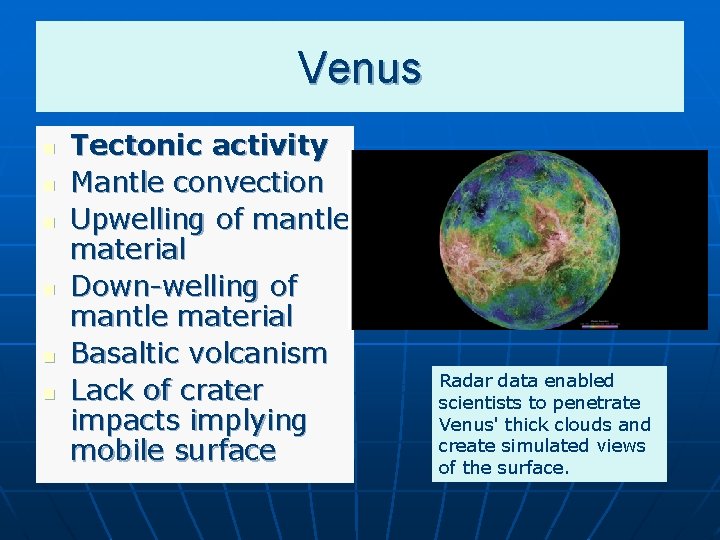
Venus n n n Tectonic activity Mantle convection Upwelling of mantle material Down-welling of mantle material Basaltic volcanism Lack of crater impacts implying mobile surface Radar data enabled scientists to penetrate Venus' thick clouds and create simulated views of the surface.
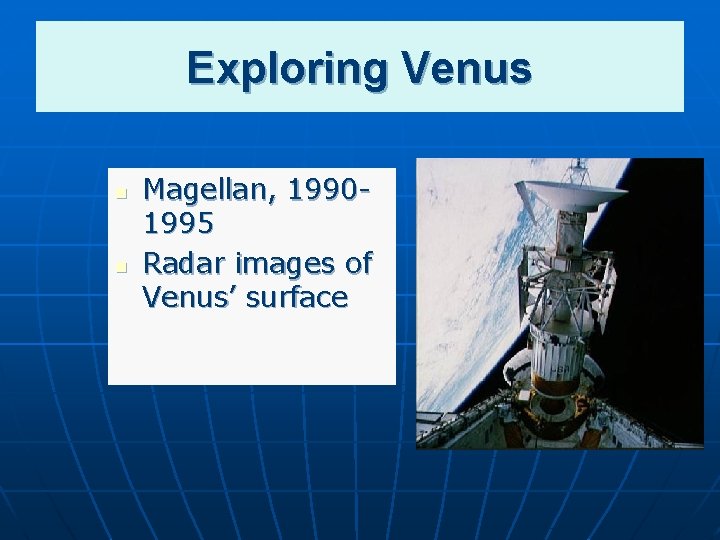
Exploring Venus n n Magellan, 19901995 Radar images of Venus’ surface
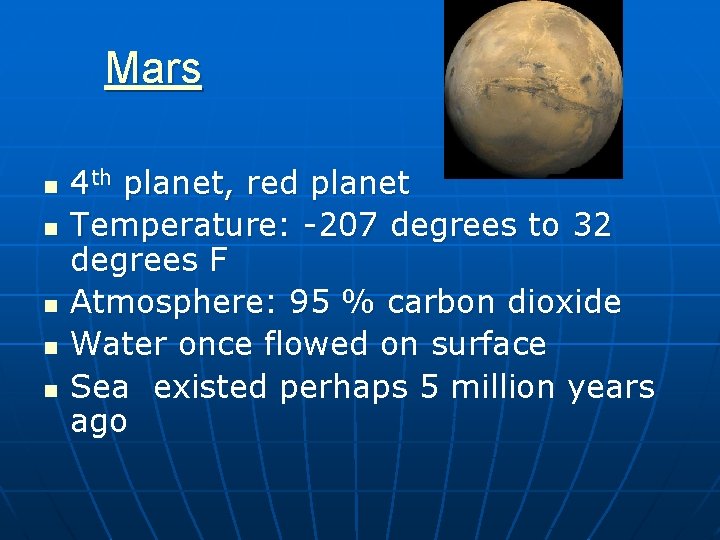
Mars n n n 4 th planet, red planet Temperature: -207 degrees to 32 degrees F Atmosphere: 95 % carbon dioxide Water once flowed on surface Sea existed perhaps 5 million years ago
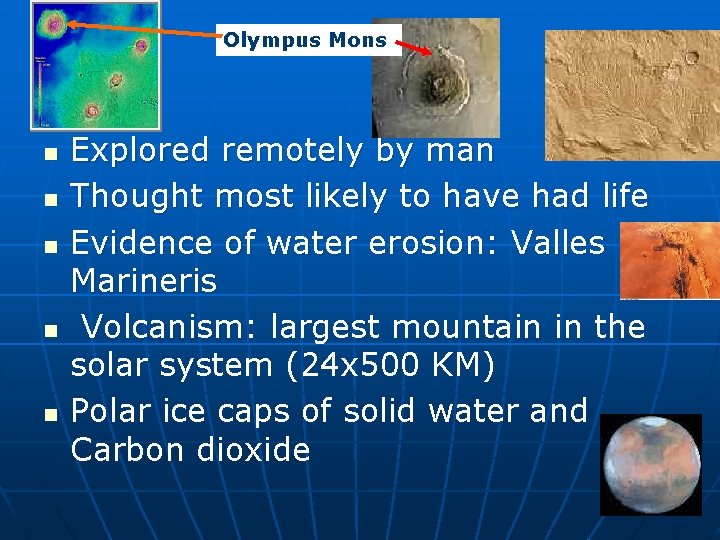
Olympus Mons n n n Explored remotely by man Thought most likely to have had life Evidence of water erosion: Valles Marineris Volcanism: largest mountain in the solar system (24 x 500 KM) Polar ice caps of solid water and Carbon dioxide
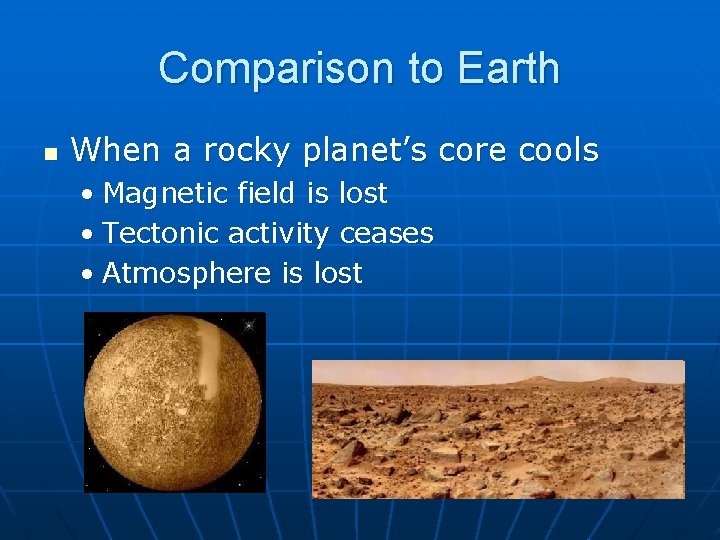
Comparison to Earth n When a rocky planet’s core cools • Magnetic field is lost • Tectonic activity ceases • Atmosphere is lost
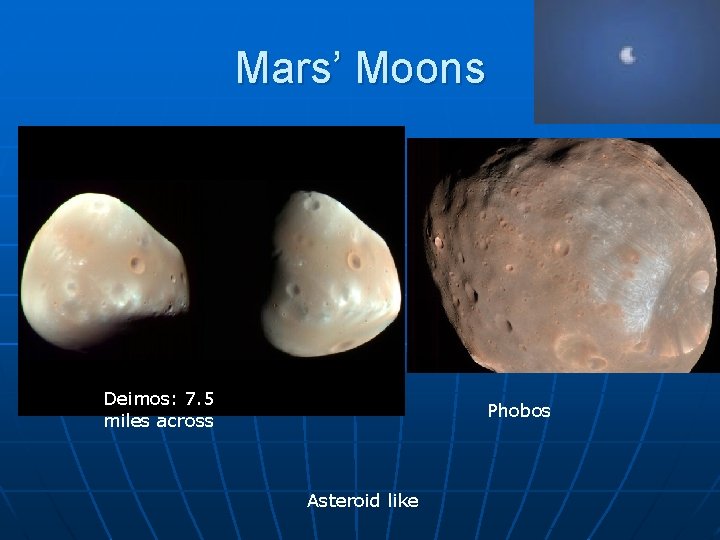
Mars’ Moons Deimos: 7. 5 miles across Phobos Asteroid like
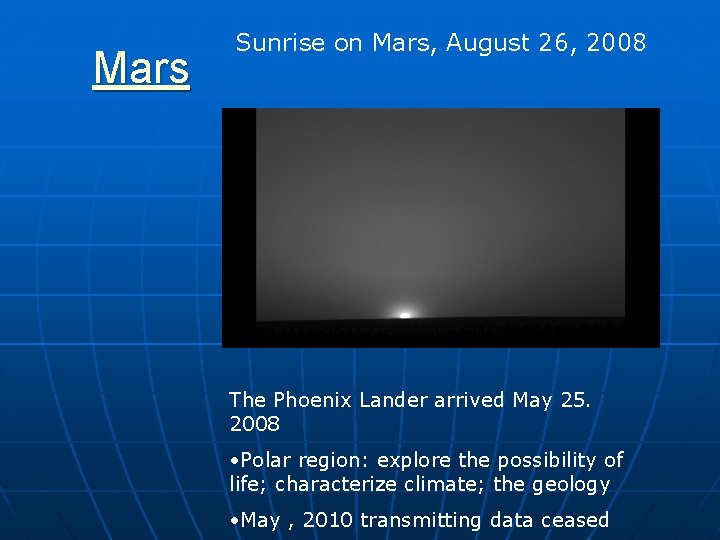
Mars Sunrise on Mars, August 26, 2008 The Phoenix Lander arrived May 25. 2008 • Polar region: explore the possibility of life; characterize climate; the geology • May , 2010 transmitting data ceased
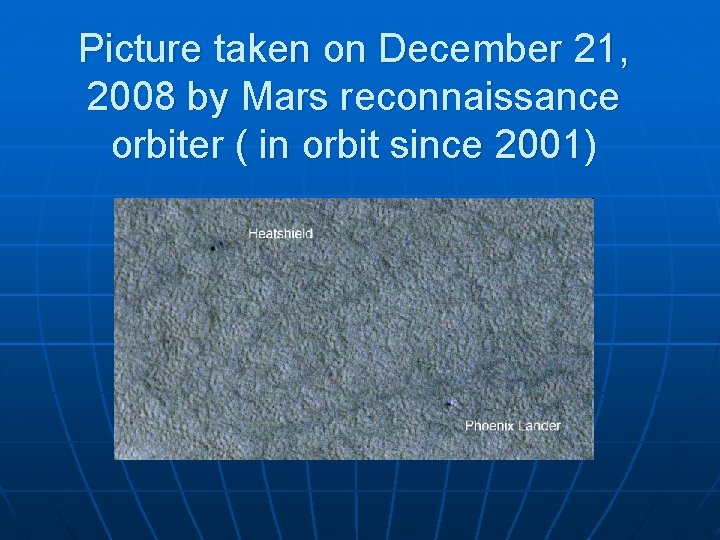
Picture taken on December 21, 2008 by Mars reconnaissance orbiter ( in orbit since 2001)
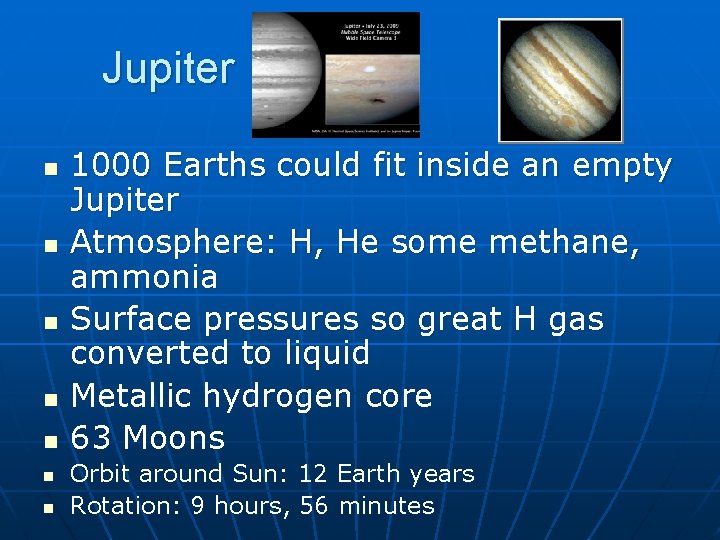
Jupiter n n n n 1000 Earths could fit inside an empty Jupiter Atmosphere: H, He some methane, ammonia Surface pressures so great H gas converted to liquid Metallic hydrogen core 63 Moons Orbit around Sun: 12 Earth years Rotation: 9 hours, 56 minutes
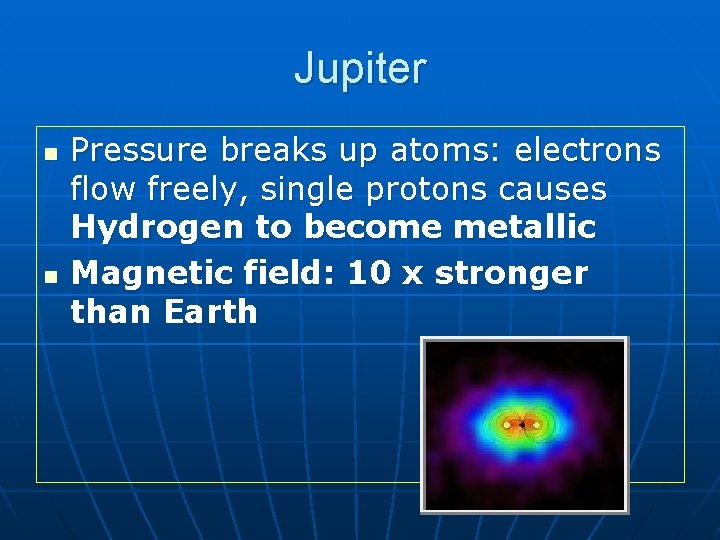
Jupiter n n Pressure breaks up atoms: electrons flow freely, single protons causes Hydrogen to become metallic Magnetic field: 10 x stronger than Earth
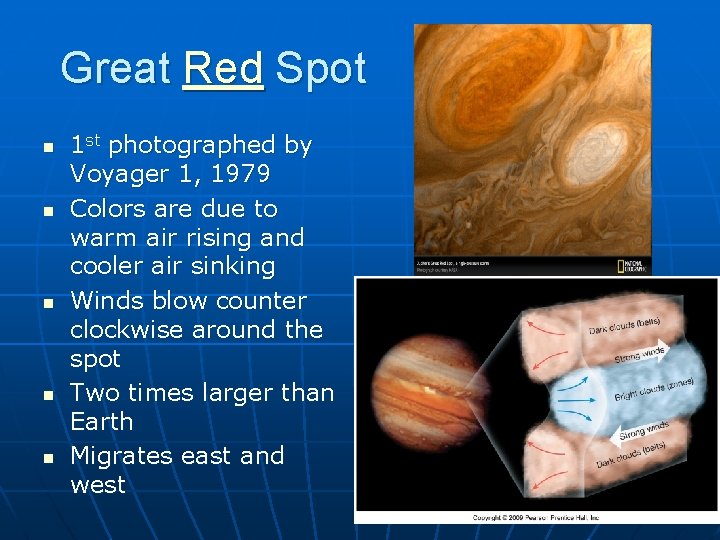
Great Red Spot n n n 1 st photographed by Voyager 1, 1979 Colors are due to warm air rising and cooler air sinking Winds blow counter clockwise around the spot Two times larger than Earth Migrates east and west
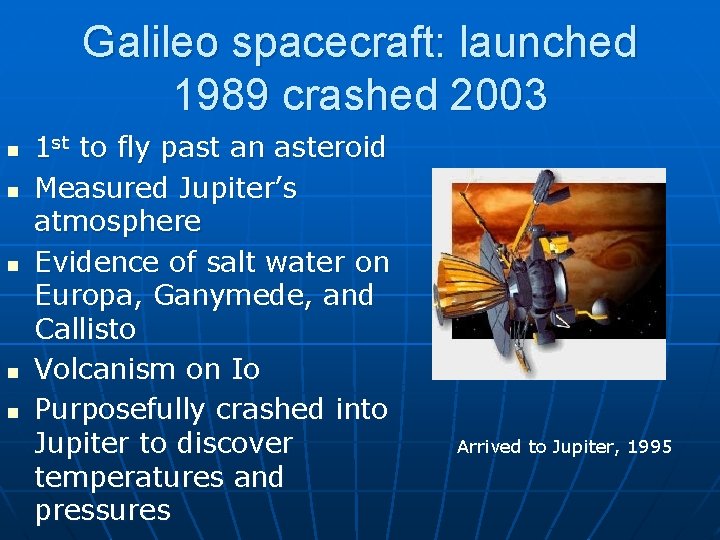
Galileo spacecraft: launched 1989 crashed 2003 n n n 1 st to fly past an asteroid Measured Jupiter’s atmosphere Evidence of salt water on Europa, Ganymede, and Callisto Volcanism on Io Purposefully crashed into Jupiter to discover temperatures and pressures Arrived to Jupiter, 1995
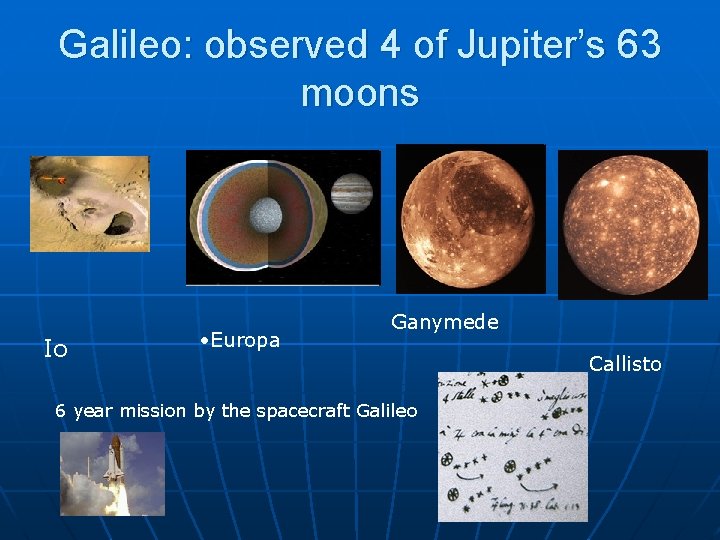
Galileo: observed 4 of Jupiter’s 63 moons Io • Europa Ganymede 6 year mission by the spacecraft Galileo Callisto
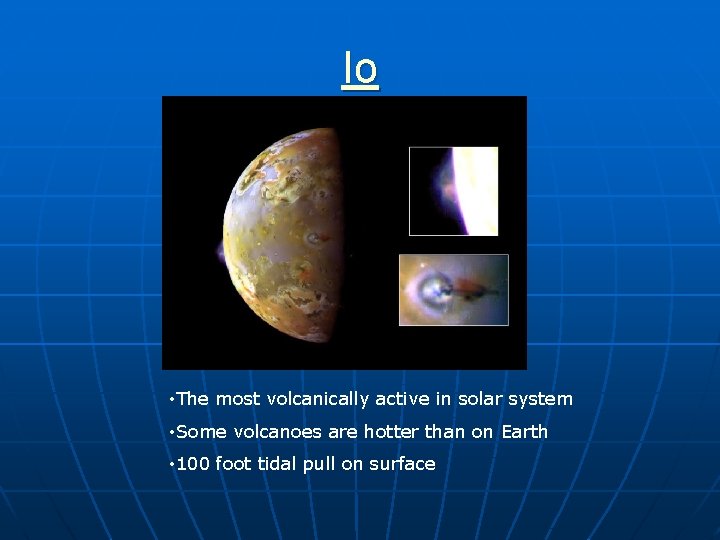
Io • The most volcanically active in solar system • Some volcanoes are hotter than on Earth • 100 foot tidal pull on surface
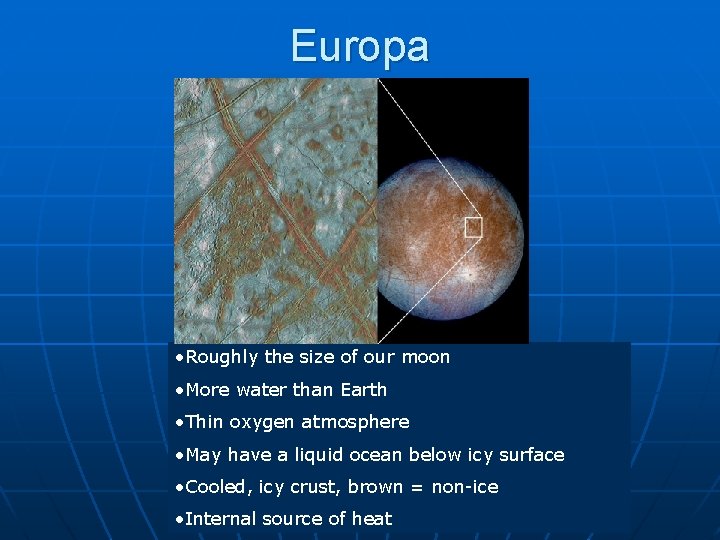
Europa • Roughly the size of our moon • More water than Earth • Thin oxygen atmosphere • May have a liquid ocean below icy surface • Cooled, icy crust, brown = non-ice • Internal source of heat
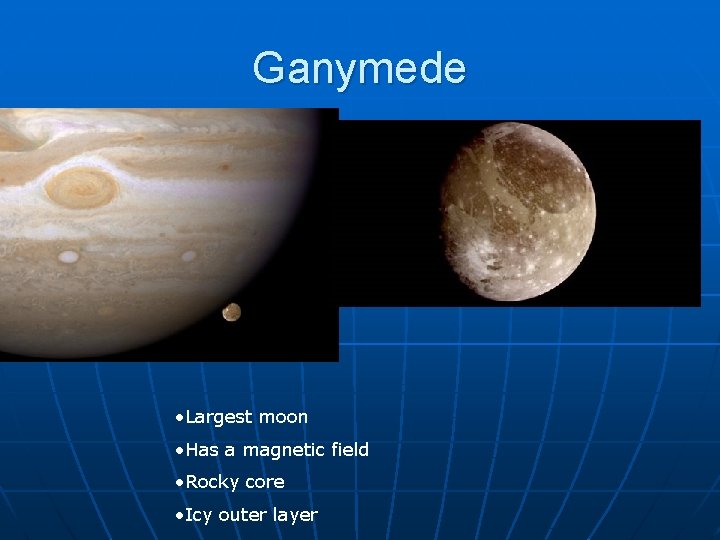
Ganymede • Largest moon • Has a magnetic field • Rocky core • Icy outer layer
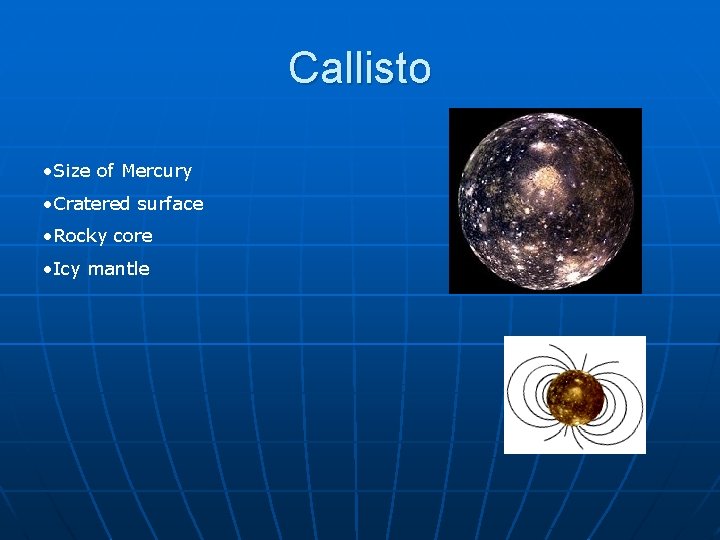
Callisto • Size of Mercury • Cratered surface • Rocky core • Icy mantle
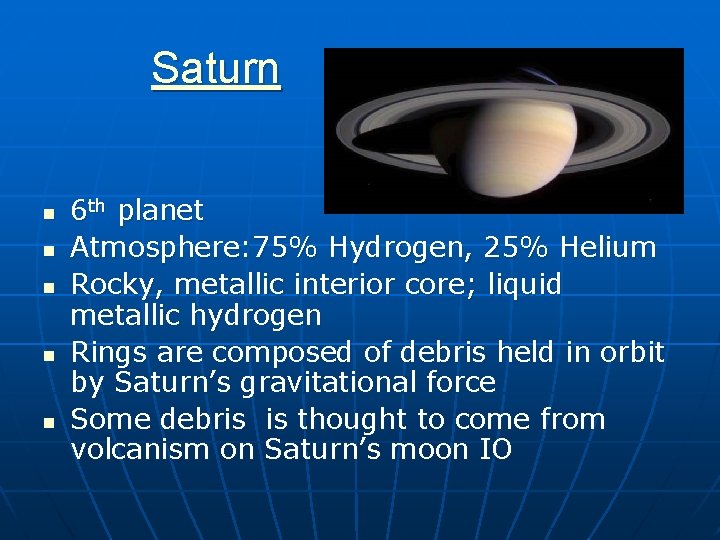
Saturn n n 6 th planet Atmosphere: 75% Hydrogen, 25% Helium Rocky, metallic interior core; liquid metallic hydrogen Rings are composed of debris held in orbit by Saturn’s gravitational force Some debris is thought to come from volcanism on Saturn’s moon IO
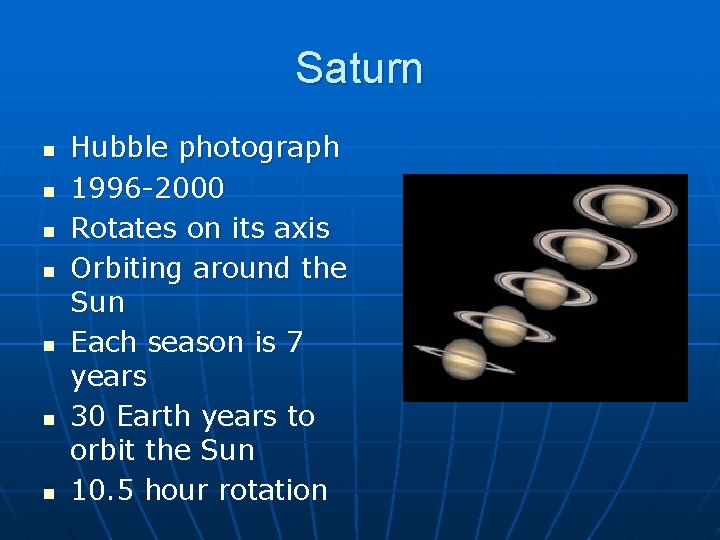
Saturn n n n Hubble photograph 1996 -2000 Rotates on its axis Orbiting around the Sun Each season is 7 years 30 Earth years to orbit the Sun 10. 5 hour rotation
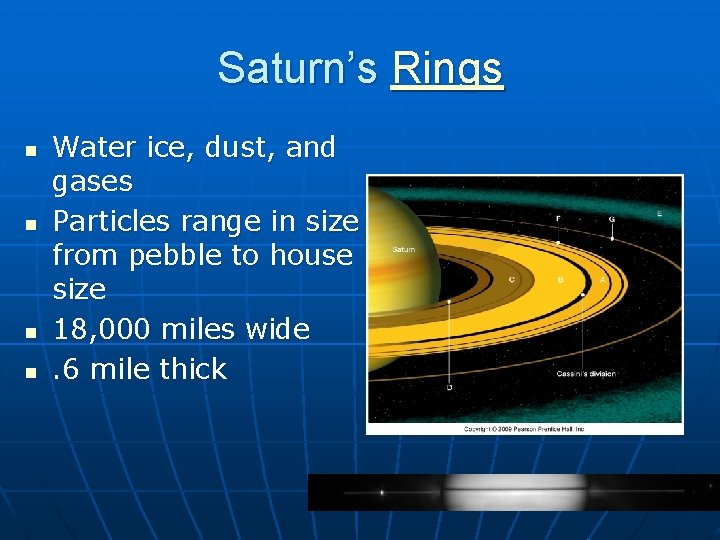
Saturn’s Rings n n Water ice, dust, and gases Particles range in size from pebble to house size 18, 000 miles wide. 6 mile thick
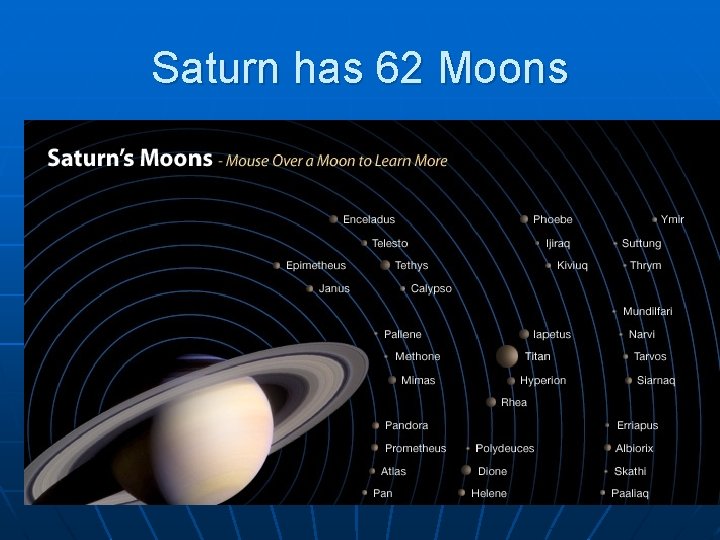
Saturn has 62 Moons
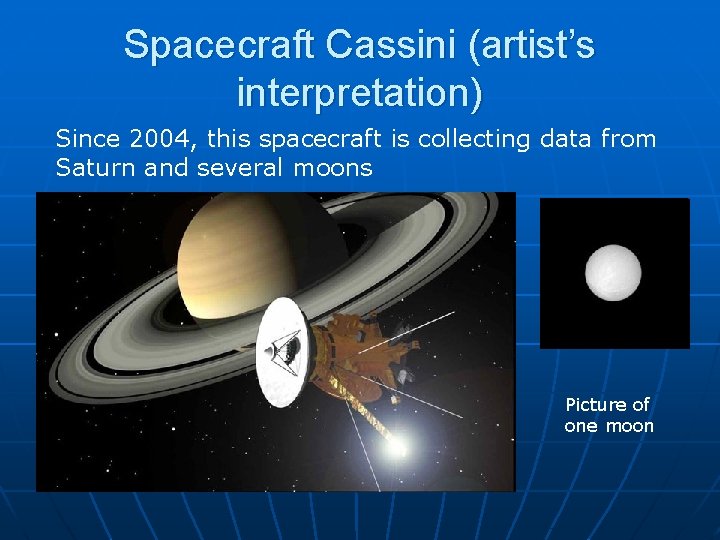
Spacecraft Cassini (artist’s interpretation) Since 2004, this spacecraft is collecting data from Saturn and several moons Picture of one moon
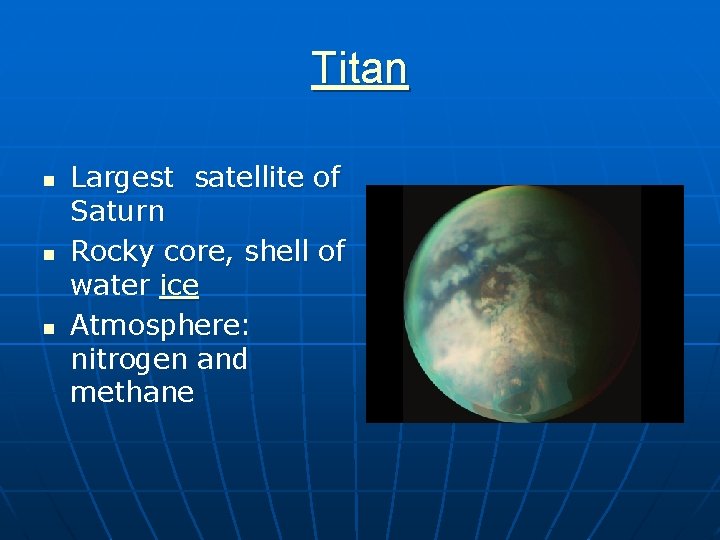
Titan n Largest satellite of Saturn Rocky core, shell of water ice Atmosphere: nitrogen and methane
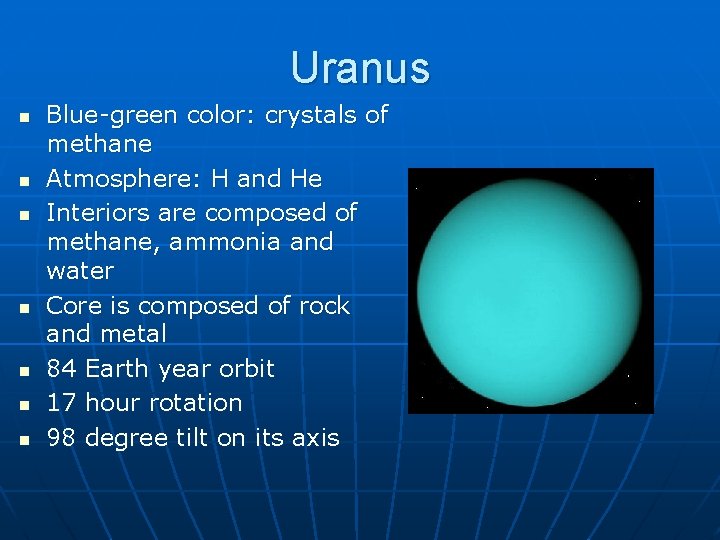
Uranus n n n n Blue-green color: crystals of methane Atmosphere: H and He Interiors are composed of methane, ammonia and water Core is composed of rock and metal 84 Earth year orbit 17 hour rotation 98 degree tilt on its axis
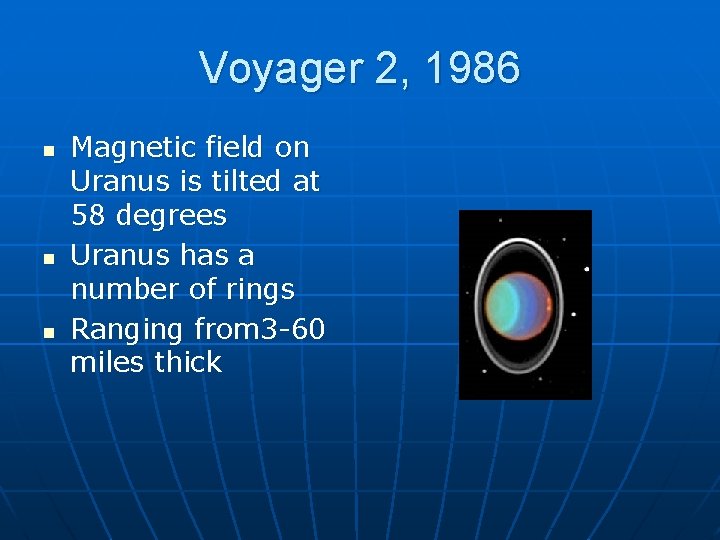
Voyager 2, 1986 n n n Magnetic field on Uranus is tilted at 58 degrees Uranus has a number of rings Ranging from 3 -60 miles thick
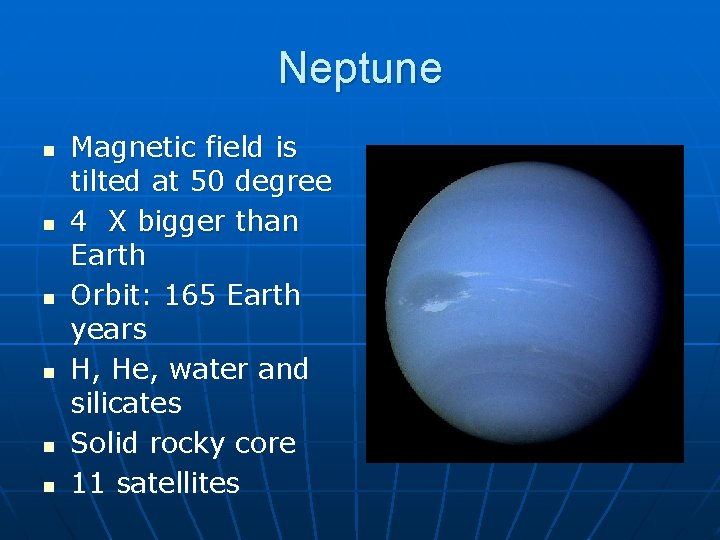
Neptune n n n Magnetic field is tilted at 50 degree 4 X bigger than Earth Orbit: 165 Earth years H, He, water and silicates Solid rocky core 11 satellites
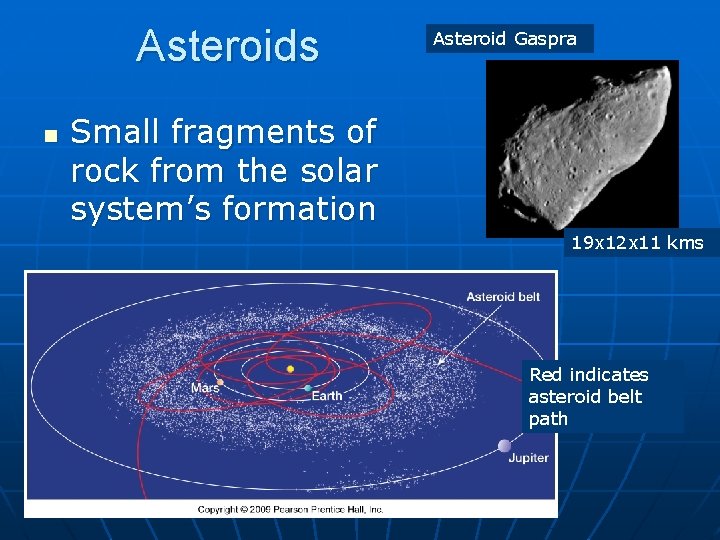
Asteroids n Asteroid Gaspra Small fragments of rock from the solar system’s formation 19 x 12 x 11 kms Red indicates asteroid belt path
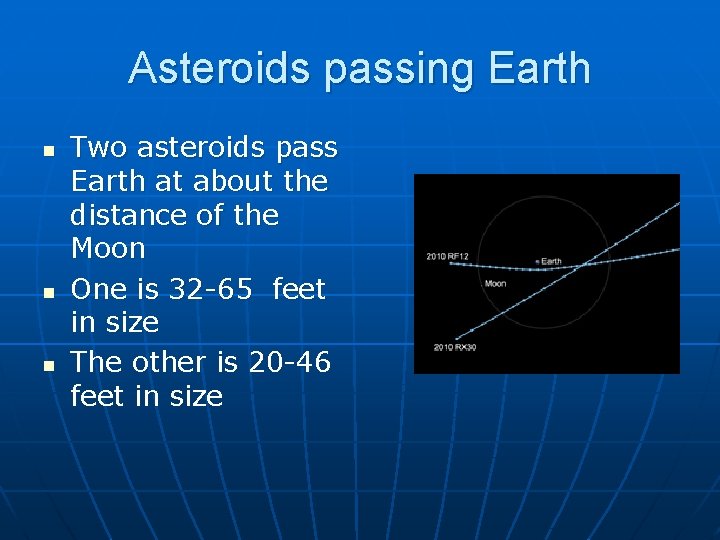
Asteroids passing Earth n n n Two asteroids pass Earth at about the distance of the Moon One is 32 -65 feet in size The other is 20 -46 feet in size
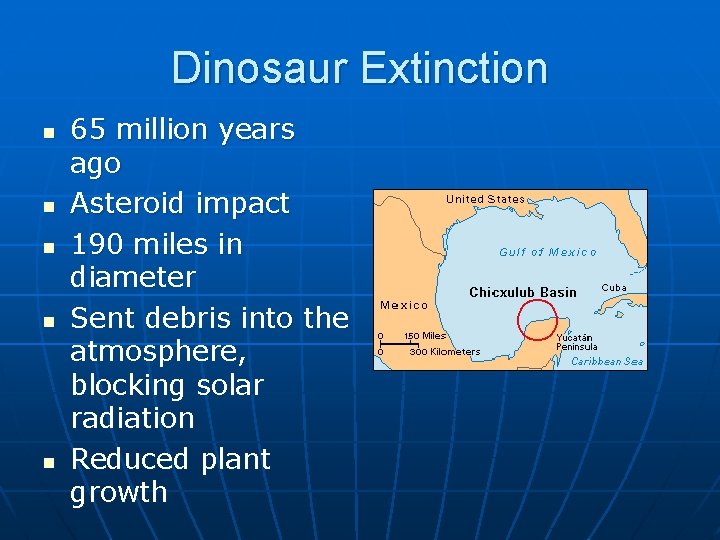
Dinosaur Extinction n n 65 million years ago Asteroid impact 190 miles in diameter Sent debris into the atmosphere, blocking solar radiation Reduced plant growth
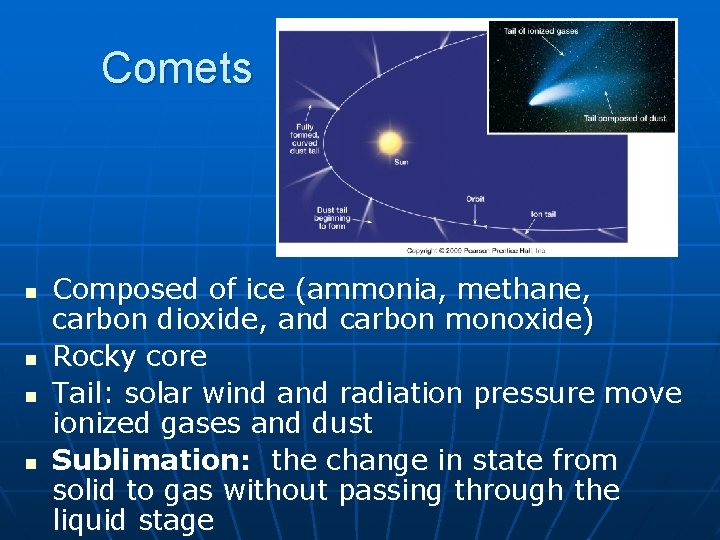
Comets n n Composed of ice (ammonia, methane, carbon dioxide, and carbon monoxide) Rocky core Tail: solar wind and radiation pressure move ionized gases and dust Sublimation: the change in state from solid to gas without passing through the liquid stage
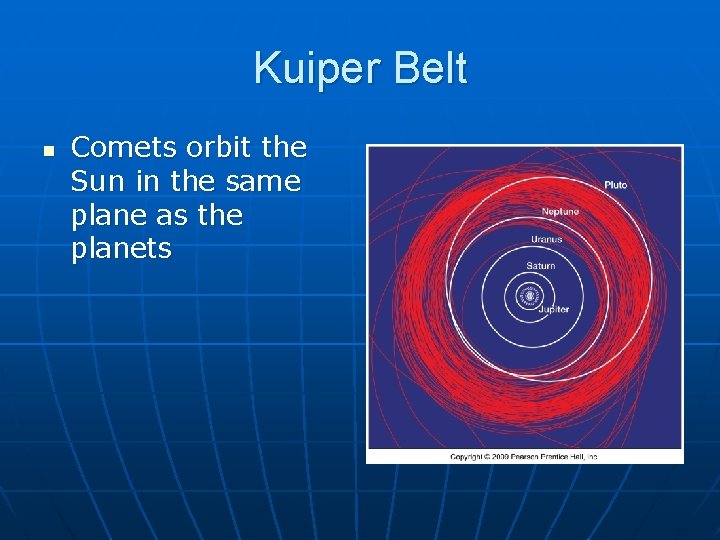
Kuiper Belt n Comets orbit the Sun in the same plane as the planets
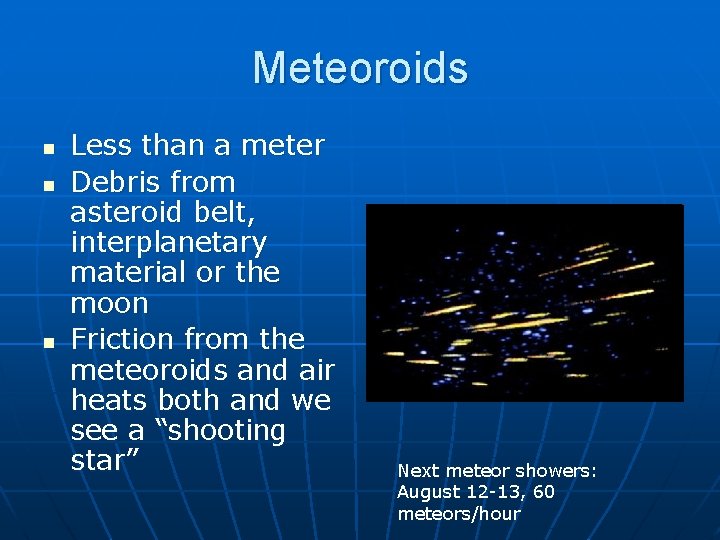
Meteoroids n n n Less than a meter Debris from asteroid belt, interplanetary material or the moon Friction from the meteoroids and air heats both and we see a “shooting star” Next meteor showers: August 12 -13, 60 meteors/hour
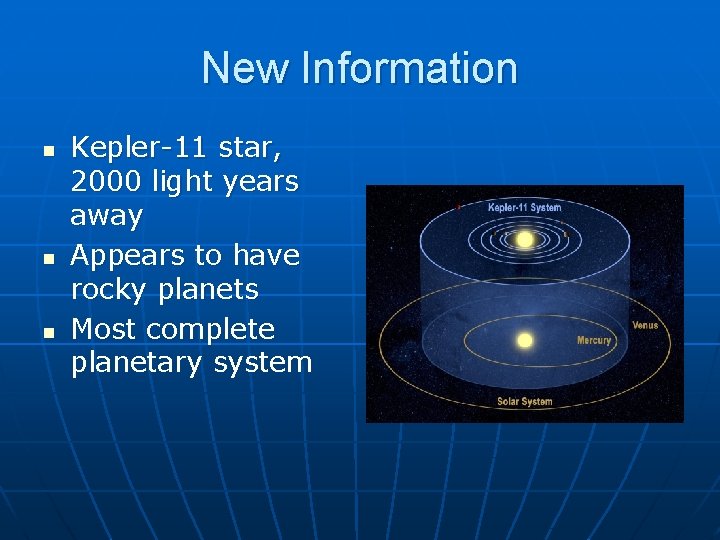
New Information n Kepler-11 star, 2000 light years away Appears to have rocky planets Most complete planetary system
This concludes the astronomy portion of the class.
- Slides: 48