
Planets of the Solar System Mark Mao Computer
- Slides: 10
Planets of the Solar System Mark Mao Computer Studies A Period 3
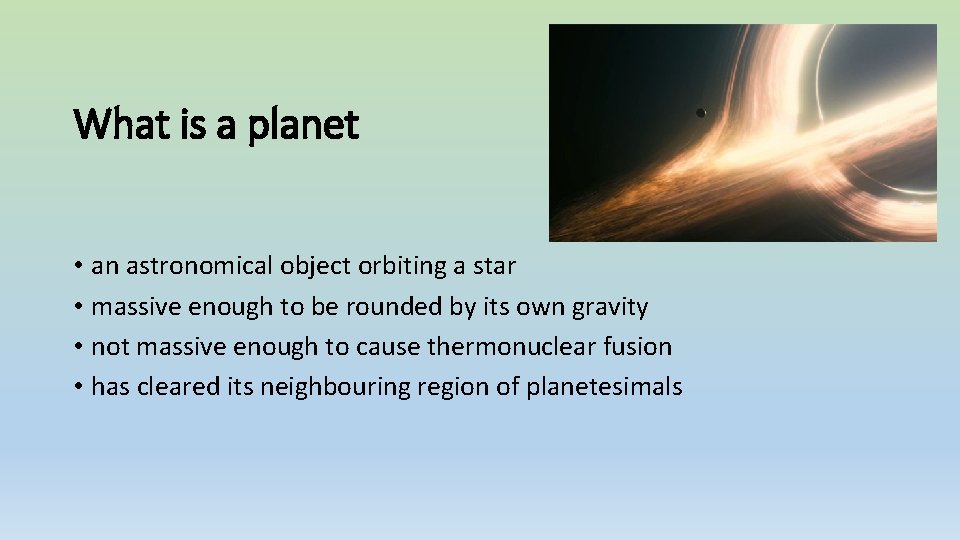
What is a planet • an astronomical object orbiting a star • massive enough to be rounded by its own gravity • not massive enough to cause thermonuclear fusion • has cleared its neighbouring region of planetesimals
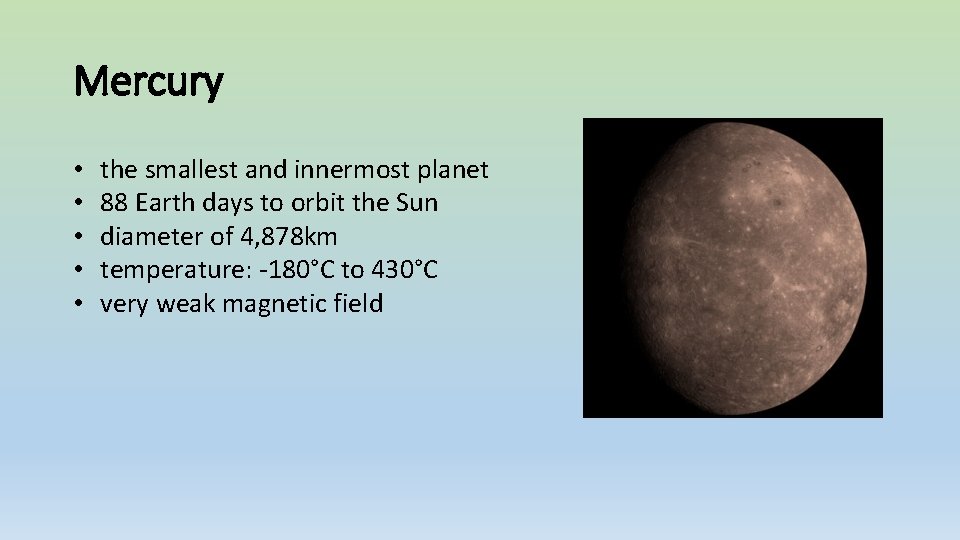
Mercury • • • the smallest and innermost planet 88 Earth days to orbit the Sun diameter of 4, 878 km temperature: -180°C to 430°C very weak magnetic field
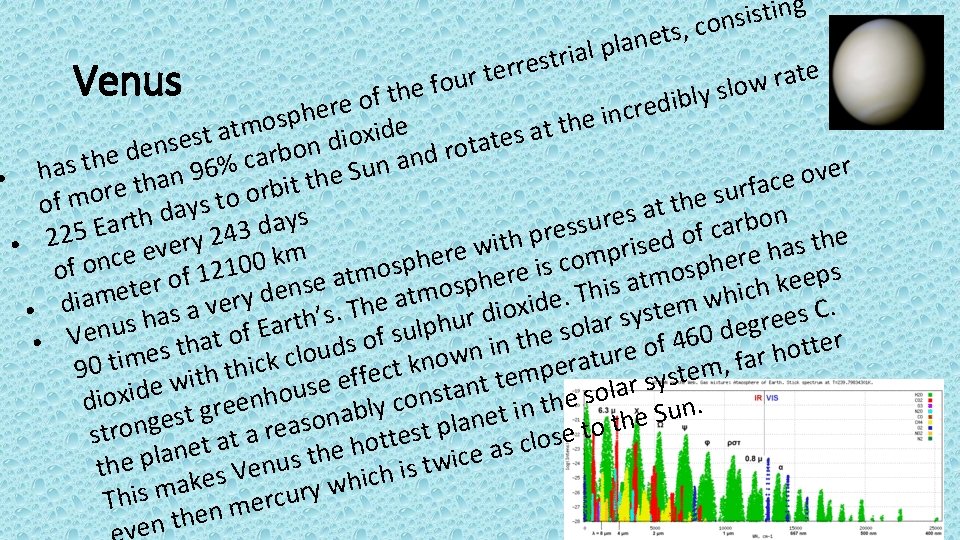
g n i t s i s n o c , s t e n a l p l a i r t s e r r e e t t a r r u o w f Venus o l e s h t y l f ib o d e e r r e c h n i p s e o h t m e t t d a a xi t s s o e i e t d s a t n n e o ro d b r d e a n h c a t s n % r a u 6 e h S v 9 o e n • ce t th tha a i f r b e r r u o o s e o t h t s of m y t a a d s n e s h o r t y r b u a r s a d s a E c e 3 r f p o e h h d t t i e s s • 225 ce every 24 km i w a r h e p r e e m r h o e n 0 c p h 0 o s s 1 i o sp 2 of s e o m 1 r p t f e m e a t o h e a e r k p s s s e i n h t o h c e e i T m d h t m. y a a e w r i d e i m ve h x. e T o C a t i • d. s s s d s y ’ e a r s e h u th r r r s h g a l a u p e l o E n d s u f e s 0 e 6 h r t 4 e f • V mes that o clouds of t n i t o o n e h r r ow tu a f k a n r c , k i e t h m 90 ti p c t e e t m h f s t f e i y t e s w t e r n s e a dioxid t greenhou ably consta t in the sol Sun. s e n e e n o h g a s t l n a p o o e t t r r s e st a e s t t o t l a o c t h as e ne a h e l t c p i s e w u t n th s e i V h s c i h ke a w m y r s i cu r Th e m n e h t n ve
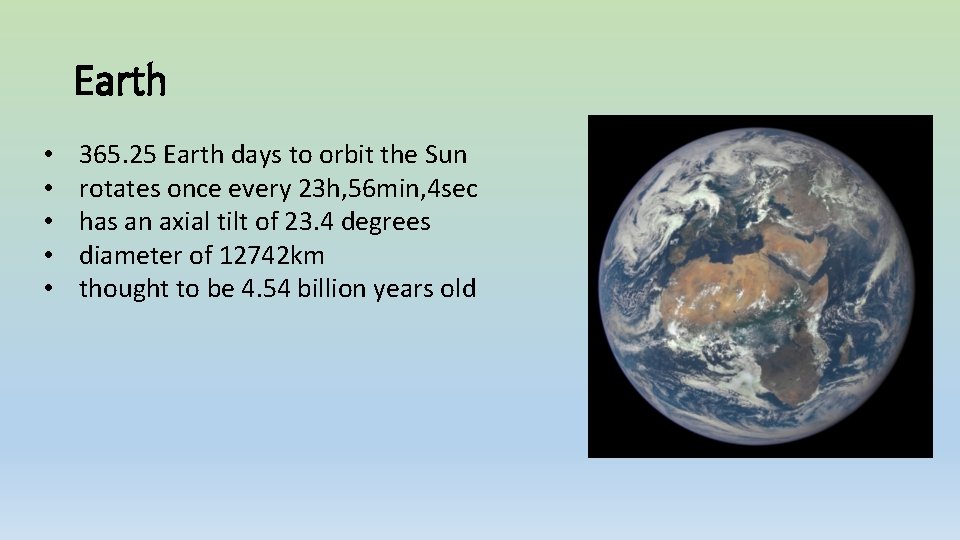
Earth • • • 365. 25 Earth days to orbit the Sun rotates once every 23 h, 56 min, 4 sec has an axial tilt of 23. 4 degrees diameter of 12742 km thought to be 4. 54 billion years old
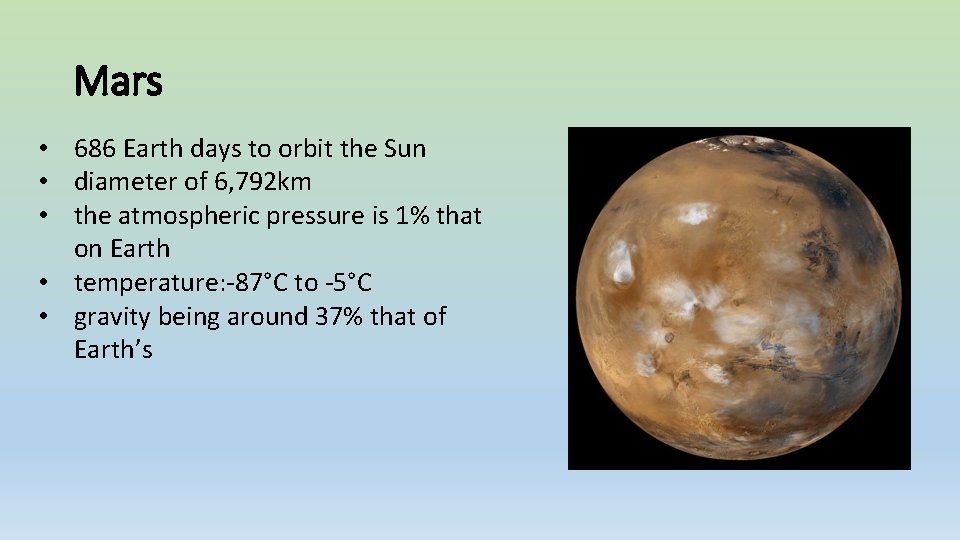
Mars • 686 Earth days to orbit the Sun • diameter of 6, 792 km • the atmospheric pressure is 1% that on Earth • temperature: -87°C to -5°C • gravity being around 37% that of Earth’s
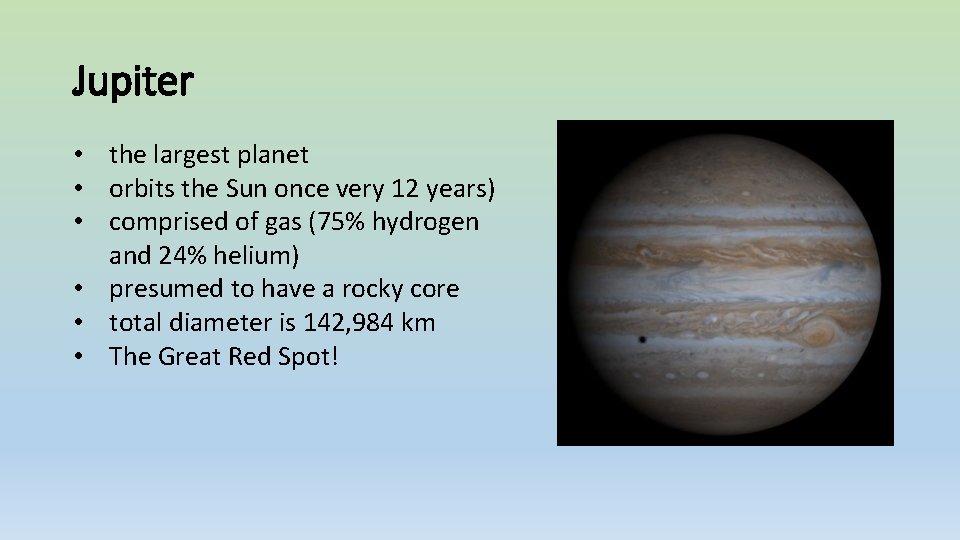
Jupiter • the largest planet • orbits the Sun once very 12 years) • comprised of gas (75% hydrogen and 24% helium) • presumed to have a rocky core • total diameter is 142, 984 km • The Great Red Spot!
Saturn • radius 9 times that of Earth (57, 000 km) and a mass 95 times that of Earth • orbits the Sun once very 29 years (at about 1400 million km) and is mainly comprised of gas (96% hydrogen and 3% helium) and is presumed to have a rocky core surrounded by a sea of liquid metallic hydrogen which forms a ball some 56, 000 km in diameter. The upper layers are thought to comprise of liquid water, ammonium hydrosulfide, hydrogen and helium. • Ring!
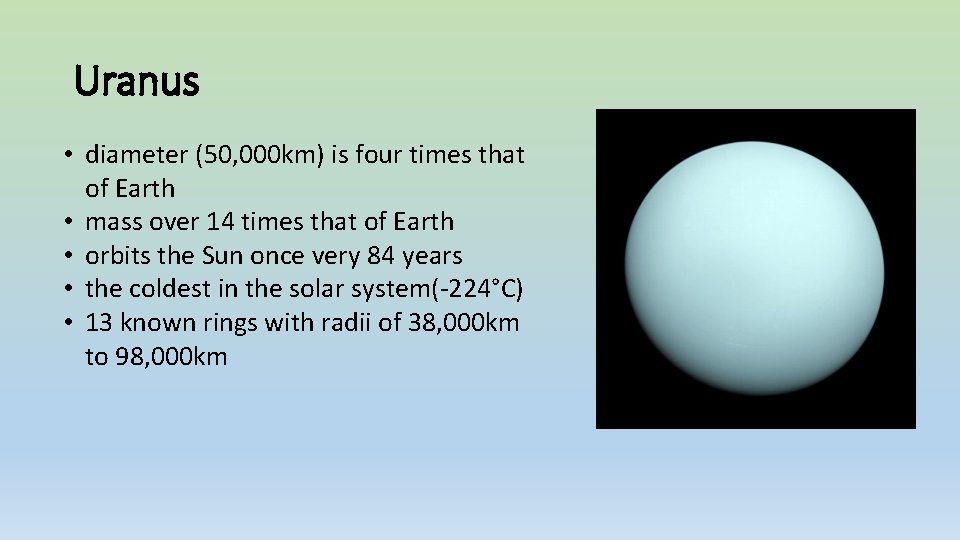
Uranus • diameter (50, 000 km) is four times that of Earth • mass over 14 times that of Earth • orbits the Sun once very 84 years • the coldest in the solar system(-224°C) • 13 known rings with radii of 38, 000 km to 98, 000 km
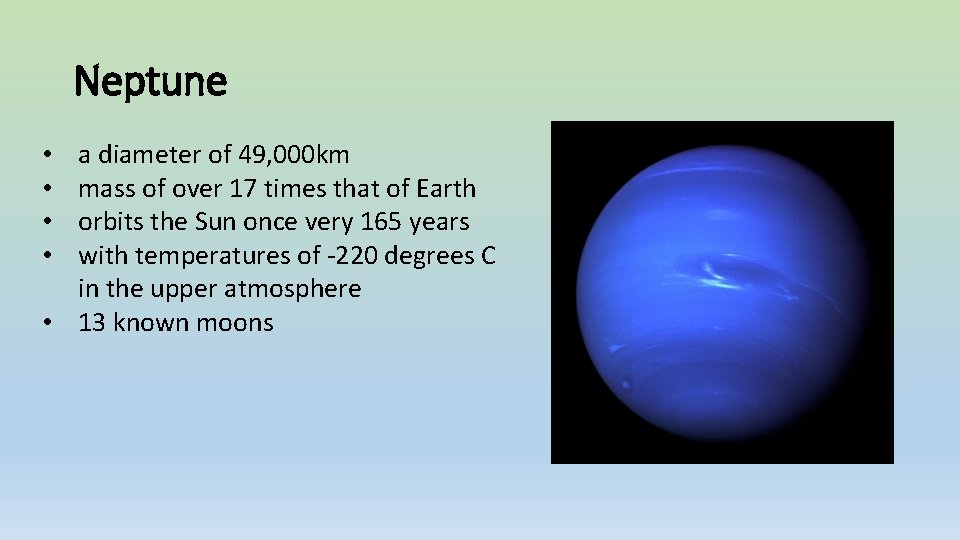
Neptune a diameter of 49, 000 km mass of over 17 times that of Earth orbits the Sun once very 165 years with temperatures of -220 degrees C in the upper atmosphere • 13 known moons • •