
Planets and Solar System Science at Low Frequencies
- Slides: 24
Planets and Solar System Science at Low Frequencies Philippe Zarka LESIA, CNRS-Observatoire de Paris France philippe. zarka@obspm. fr Towards a European Infrastructure for Lunar Observatories Bremen, 22 -23/3/2005 - EADS / ASTRON / Radionet
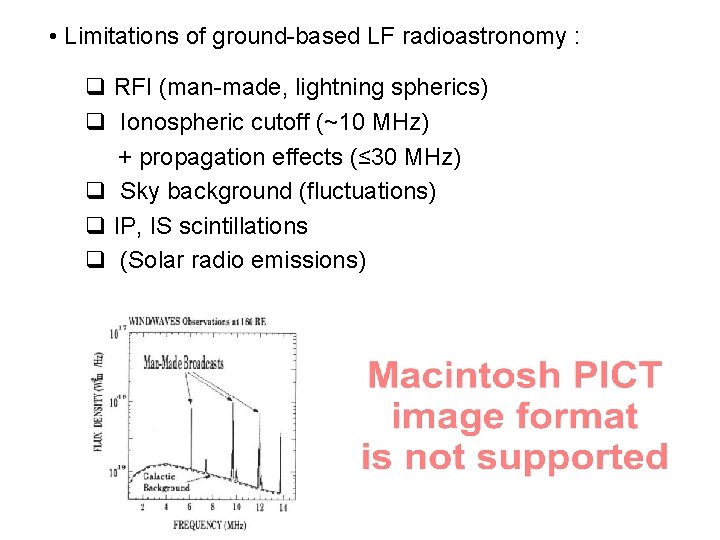
• Limitations of ground-based LF radioastronomy : q RFI (man-made, lightning spherics) q Ionospheric cutoff (~10 MHz) + propagation effects (≤ 30 MHz) q Sky background (fluctuations) q IP, IS scintillations q (Solar radio emissions)
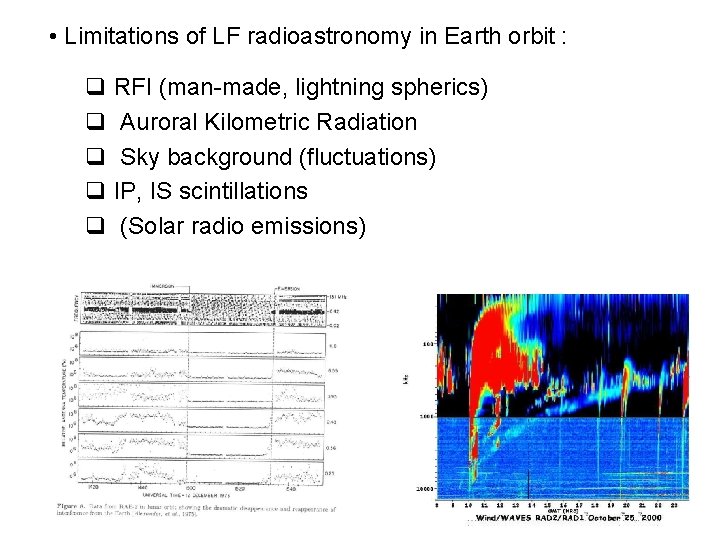
• Limitations of LF radioastronomy in Earth orbit : q RFI (man-made, lightning spherics) q Auroral Kilometric Radiation q Sky background (fluctuations) q IP, IS scintillations q (Solar radio emissions)
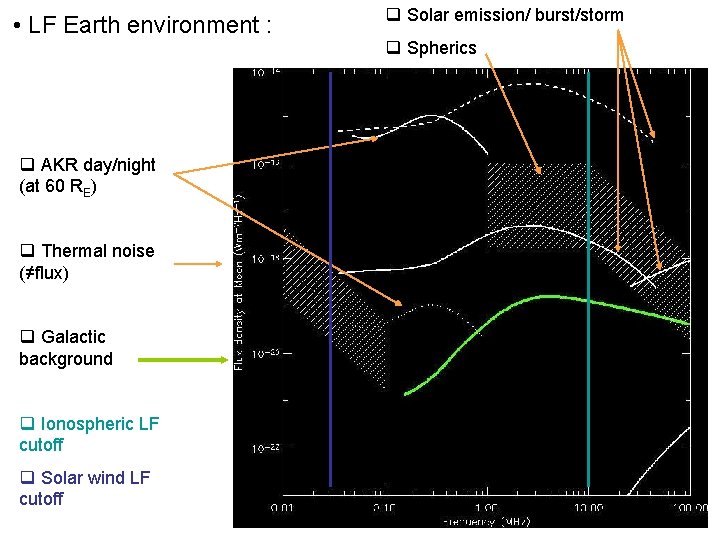
• LF Earth environment : q AKR day/night (at 60 RE) q Thermal noise (≠flux) q Galactic background q Ionospheric LF cutoff q Solar wind LF cutoff q Solar emission/ burst/storm q Spherics
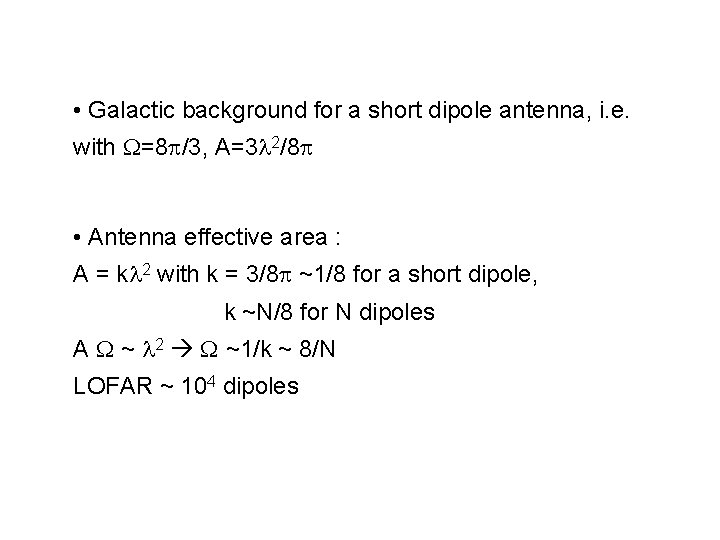
• Galactic background for a short dipole antenna, i. e. with =8 /3, A=3 2/8 • Antenna effective area : A = k 2 with k = 3/8 ~1/8 for a short dipole, k ~N/8 for N dipoles A ~ 2 ~1/k ~ 8/N LOFAR ~ 104 dipoles
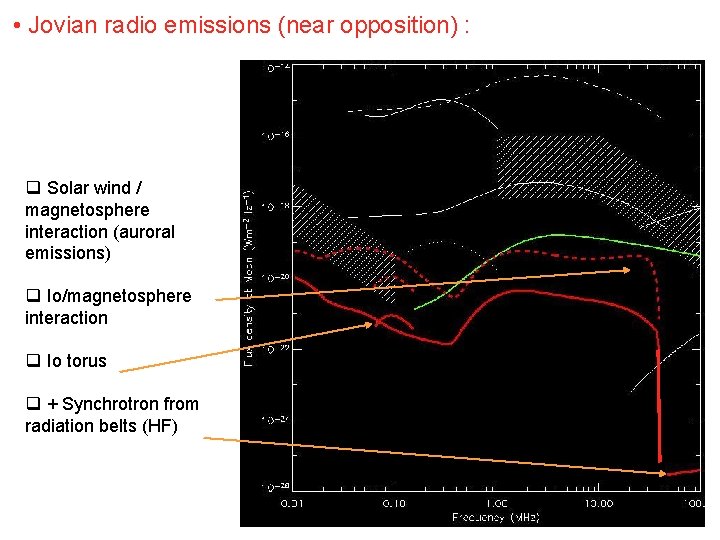
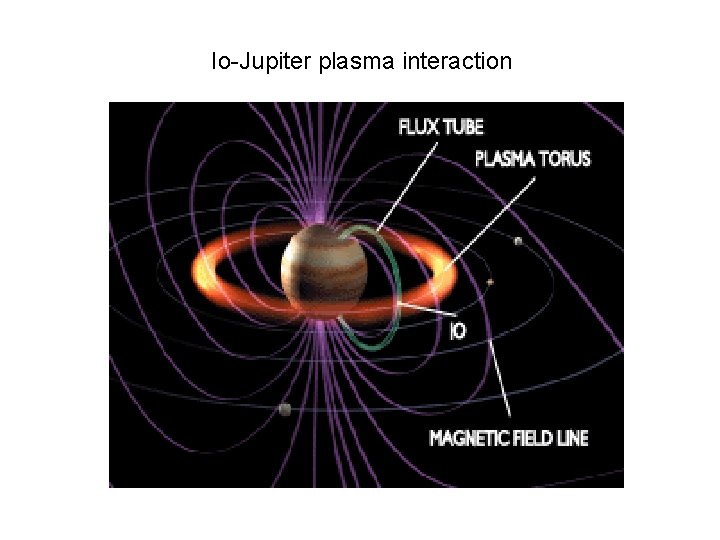
• Jovian radio emissions (near opposition) : q Solar wind / magnetosphere interaction (auroral emissions) q Io/magnetosphere interaction q Io torus q + Synchrotron from radiation belts (HF)
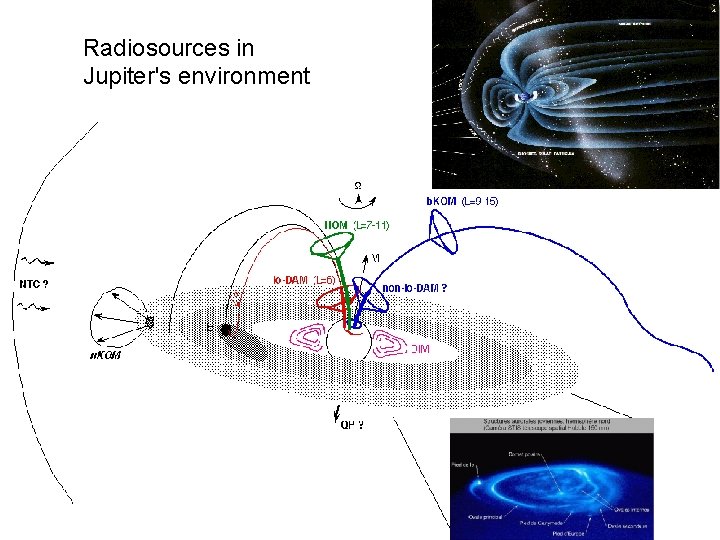
Radiosources in Jupiter's environment
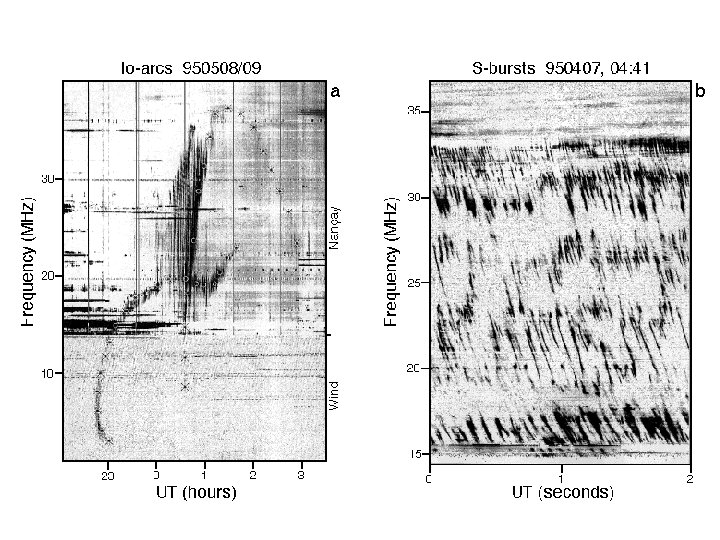
Io-Jupiter plasma interaction
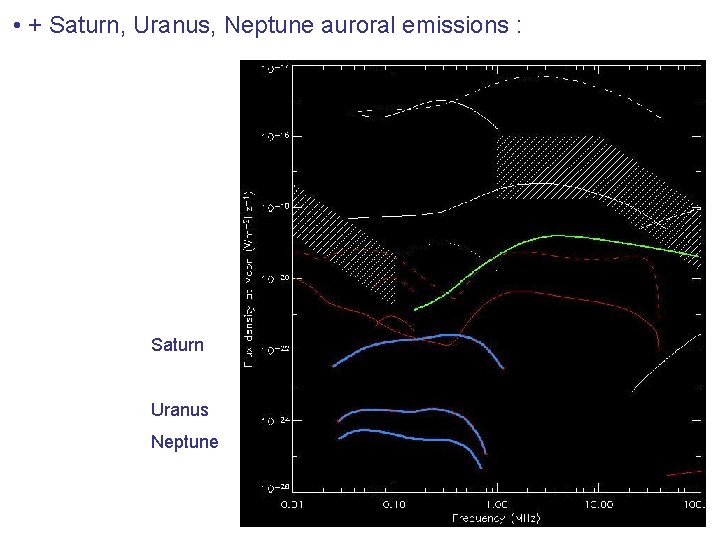
• + Saturn, Uranus, Neptune auroral emissions : Saturn Uranus Neptune
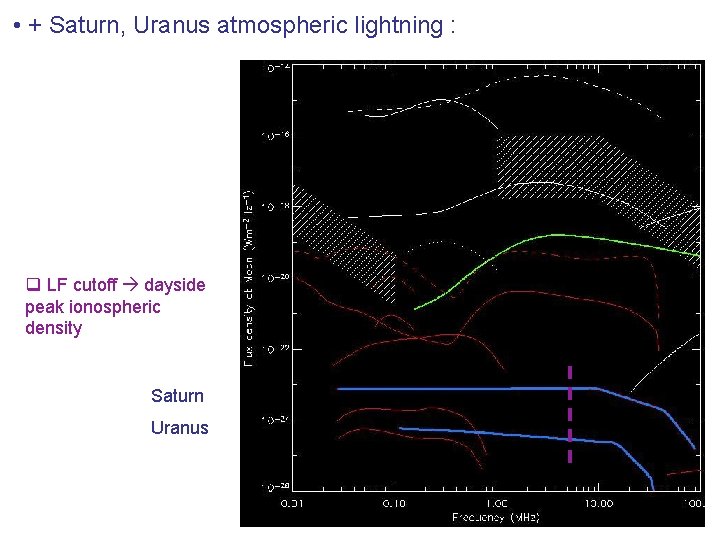
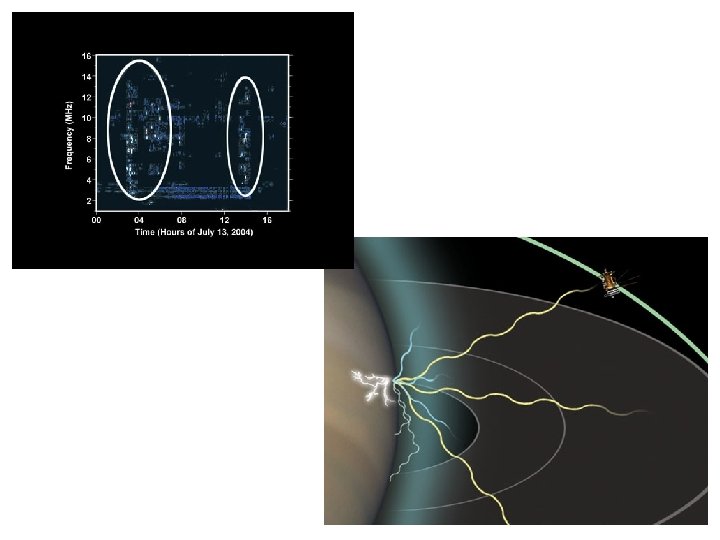
• + Saturn, Uranus atmospheric lightning : q LF cutoff dayside peak ionospheric density Saturn Uranus
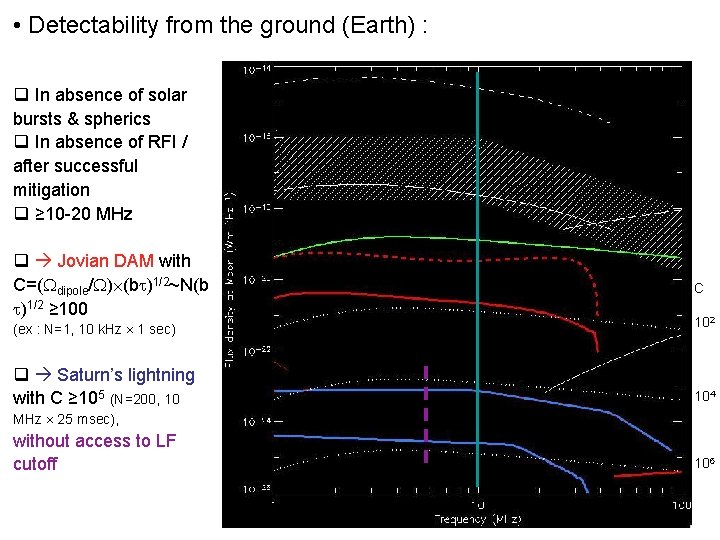
• Detectability from the ground (Earth) : q In absence of solar bursts & spherics q In absence of RFI / after successful mitigation q ≥ 10 -20 MHz q Jovian DAM with C=( dipole/ ) (b )1/2~N(b )1/2 ≥ 100 (ex : N=1, 10 k. Hz 1 sec) q Saturn’s lightning with C ≥ 105 (N=200, 10 C 102 104 MHz 25 msec), without access to LF cutoff 106
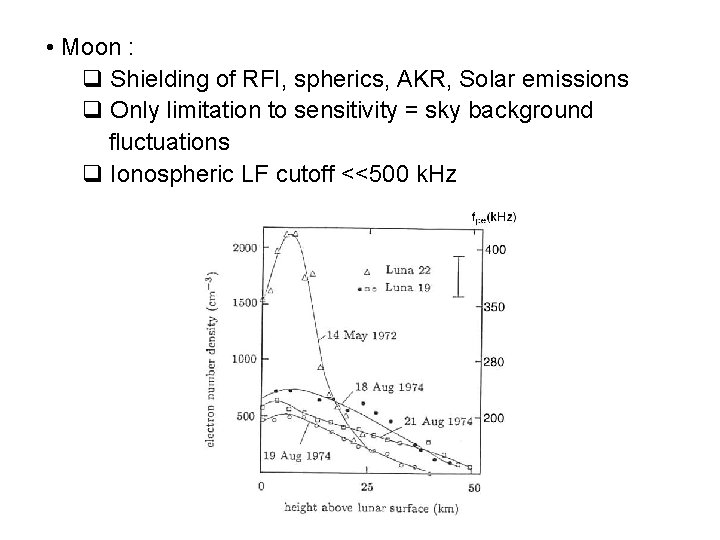
• Moon : q Shielding of RFI, spherics, AKR, Solar emissions q Only limitation to sensitivity = sky background fluctuations q Ionospheric LF cutoff <<500 k. Hz
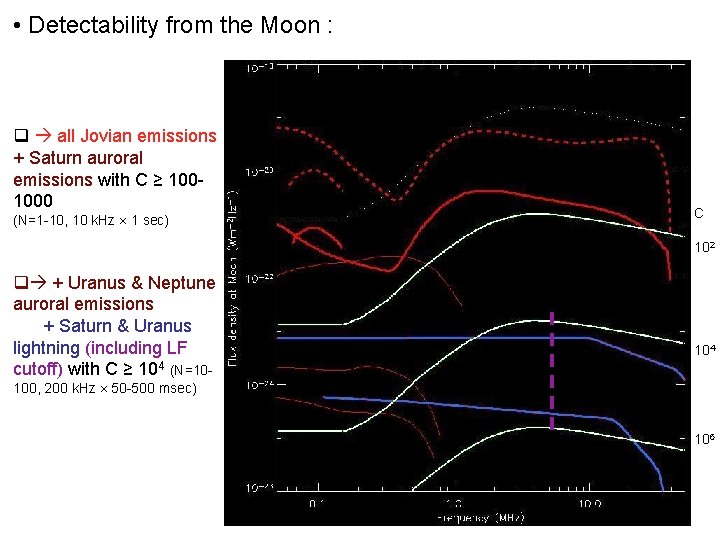
• Detectability from the Moon : q all Jovian emissions + Saturn auroral emissions with C ≥ 1001000 (N=1 -10, 10 k. Hz 1 sec) C 102 q + Uranus & Neptune auroral emissions + Saturn & Uranus lightning (including LF cutoff) with C ≥ 104 (N=10 - 104 100, 200 k. Hz 50 -500 msec) 106
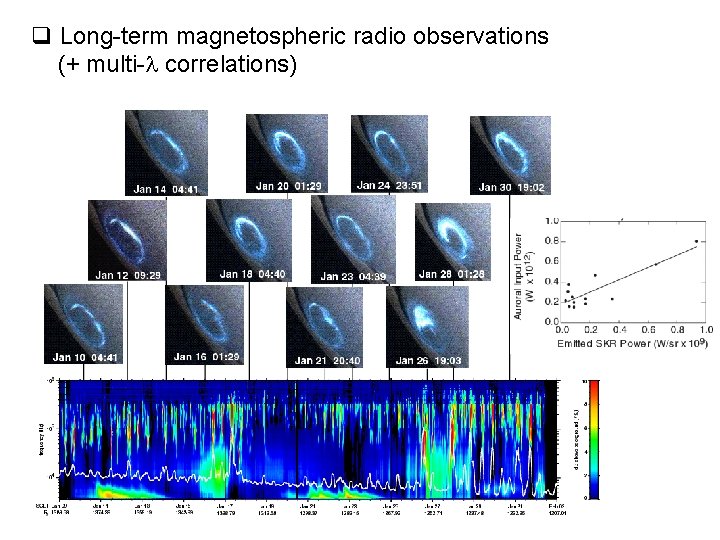
q Long-term magnetospheric radio observations (+ multi- correlations)
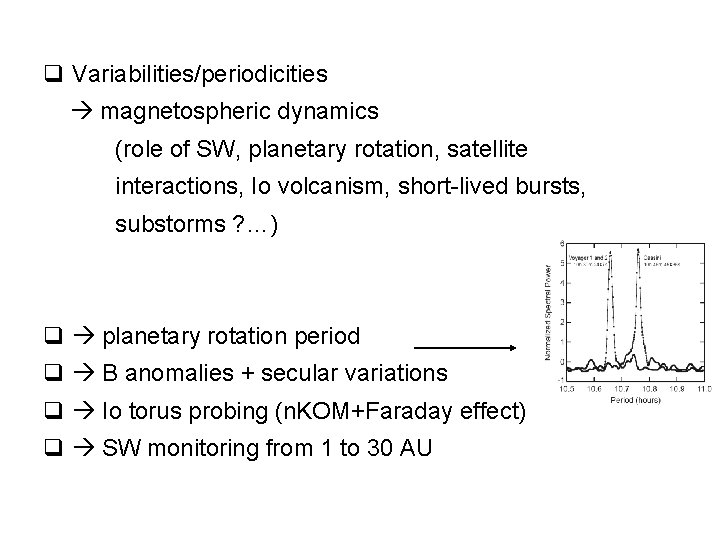
q Variabilities/periodicities magnetospheric dynamics (role of SW, planetary rotation, satellite interactions, Io volcanism, short-lived bursts, substorms ? …) q planetary rotation period q B anomalies + secular variations q Io torus probing (n. KOM+Faraday effect) q SW monitoring from 1 to 30 AU
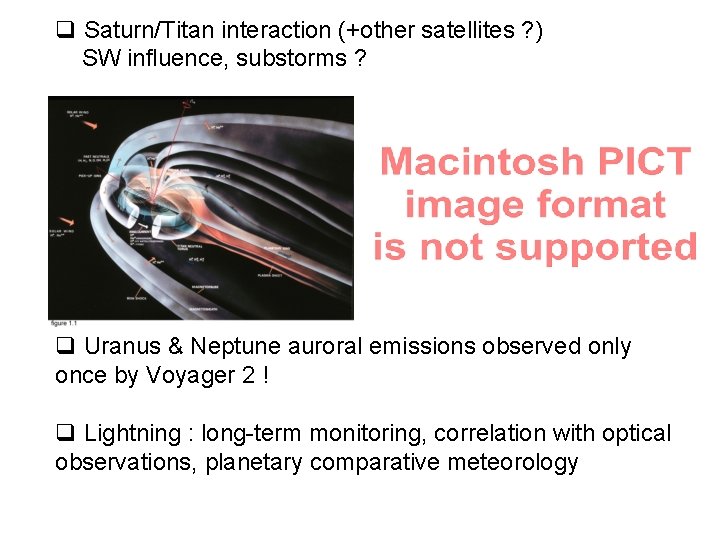
q Saturn/Titan interaction (+other satellites ? ) SW influence, substorms ? q Uranus & Neptune auroral emissions observed only once by Voyager 2 ! q Lightning : long-term monitoring, correlation with optical observations, planetary comparative meteorology
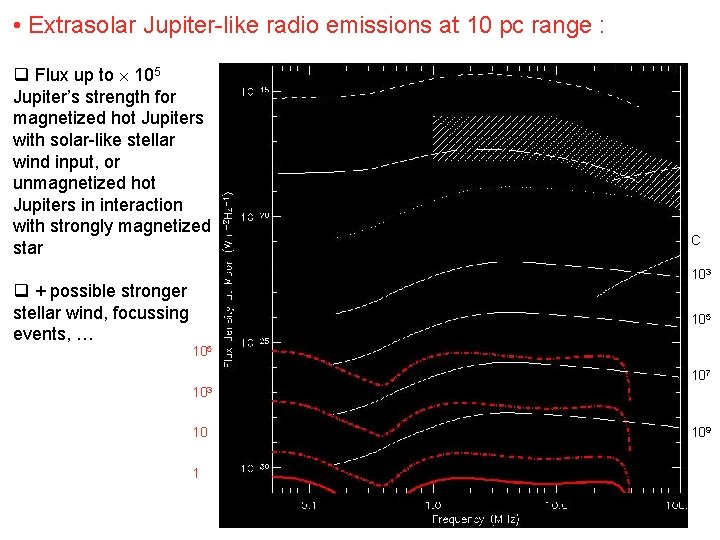
• Extrasolar Jupiter-like radio emissions at 10 pc range : q Flux up to 105 Jupiter’s strength for magnetized hot Jupiters with solar-like stellar wind input, or unmagnetized hot Jupiters in interaction with strongly magnetized star q + possible stronger stellar wind, focussing events, … C 103 105 107 103 10 1 109
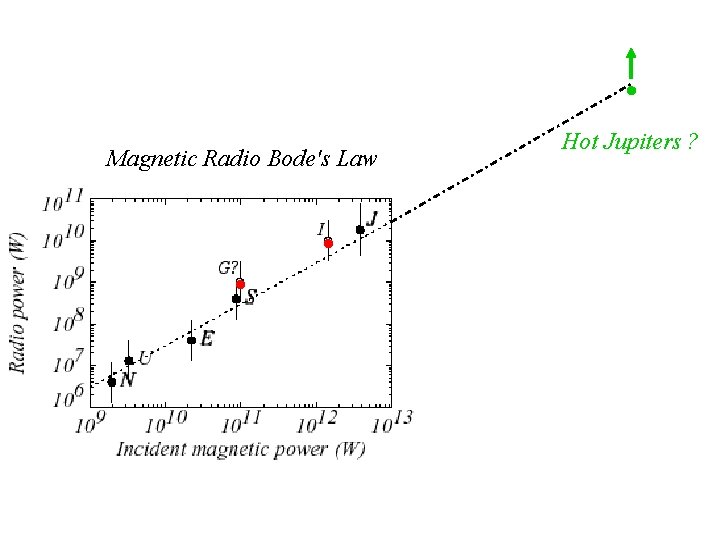
• Magnetic Radio Bode's Law • • Hot Jupiters ?
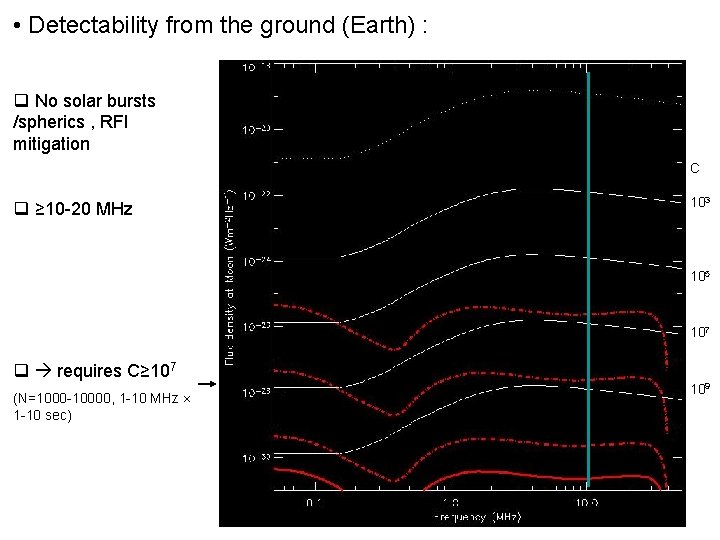
• Detectability from the ground (Earth) : q No solar bursts /spherics , RFI mitigation C q ≥ 10 -20 MHz 103 105 107 q requires C≥ 107 (N=1000 -10000, 1 -10 MHz 1 -10 sec) 109
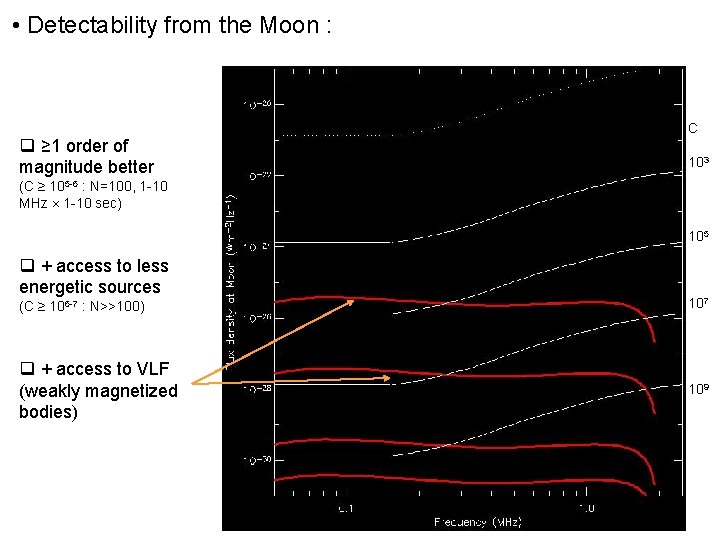
• Detectability from the Moon : q ≥ 1 order of magnitude better C 103 (C ≥ 105 -6 : N=100, 1 -10 MHz 1 -10 sec) 105 q + access to less energetic sources (C ≥ 106 -7 : N>>100) 107 q + access to VLF (weakly magnetized bodies) 109
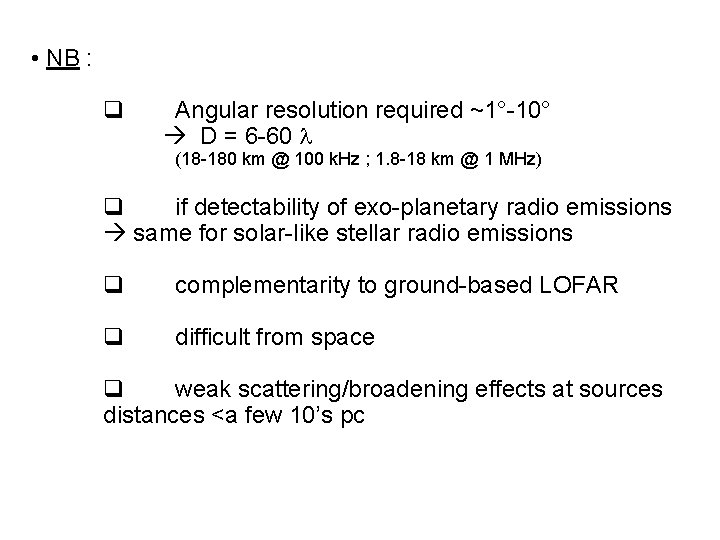
• NB : q Angular resolution required ~1°-10° D = 6 -60 (18 -180 km @ 100 k. Hz ; 1. 8 -18 km @ 1 MHz) q if detectability of exo-planetary radio emissions same for solar-like stellar radio emissions q complementarity to ground-based LOFAR q difficult from space q weak scattering/broadening effects at sources distances <a few 10’s pc
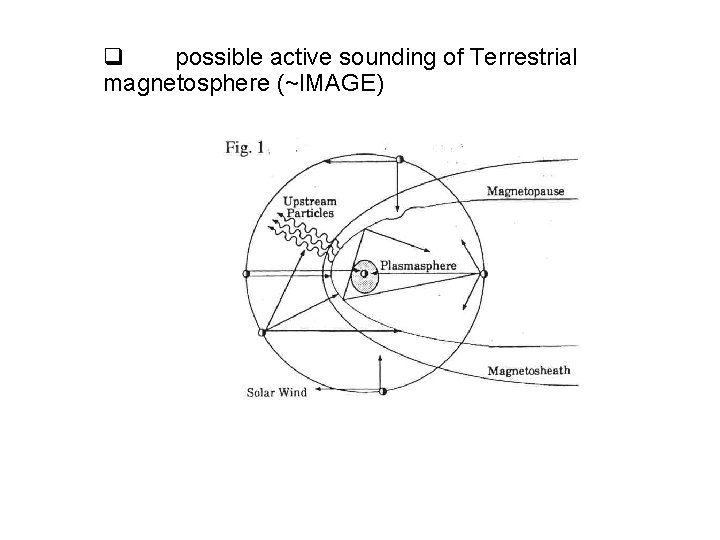
q possible active sounding of Terrestrial magnetosphere (~IMAGE)