
Planets A Solar System is formed Nebula Stage
Planets
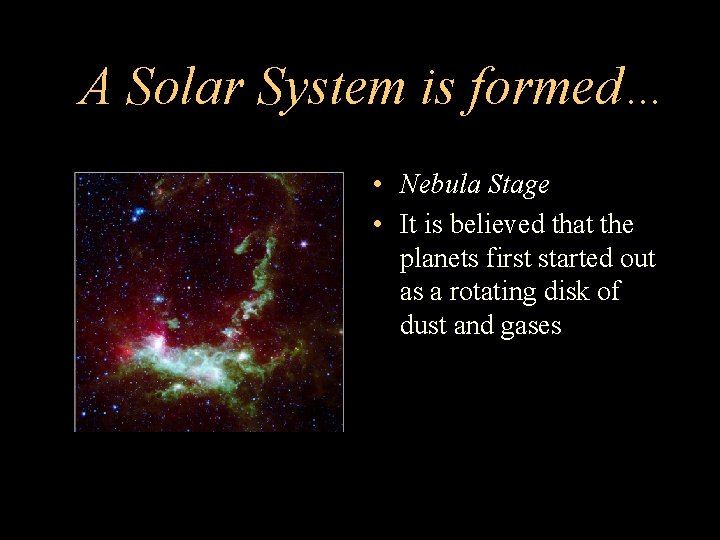
A Solar System is formed… • Nebula Stage • It is believed that the planets first started out as a rotating disk of dust and gases
After the nebula stage… • As the speed of the rotation increased, the center of the disk flattened out. • As matter became more condensed at the center, the sun eventually formed and the remaining matter condensed as planetesimals. • These planetesimals collided, eventually gaining enough mass to be planets.
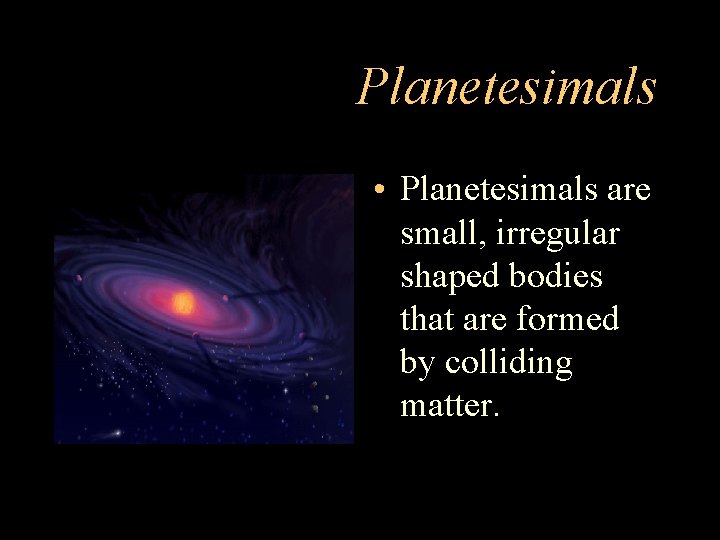
Planetesimals • Planetesimals are small, irregular shaped bodies that are formed by colliding matter.
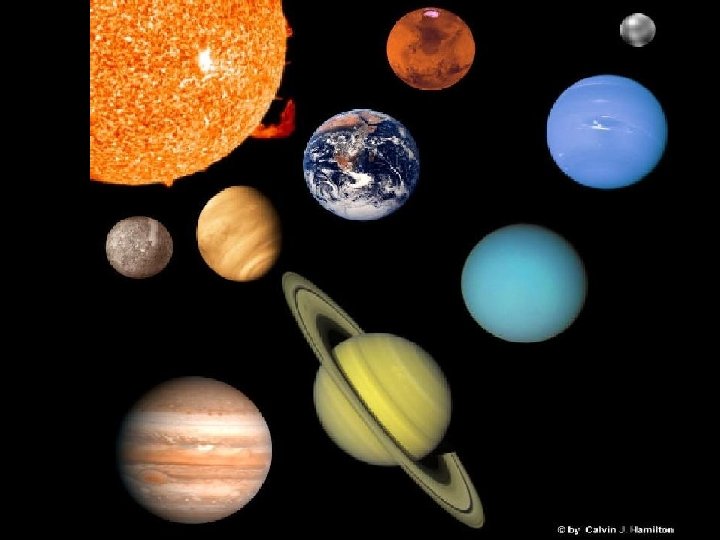
What are the nine planets in our solar system? • • • Inner Planets Mercury Venus Earth Mars • • • Outer Planets Jupiter Saturn Uranus Neptune Pluto
Our Solar System • Each planet moves in an elliptical orbit, which is guided by the gravitational force from the sun. • All planets travel in the same direction and on the same orbital plane. Pluto is the exception and travels at a 17 degree angle.
The Formation of the Inner Planets • The inner planets were close enough to the sun so that any form of ice melted and heavier elements (such as aluminum, iron, and nickel) melted and hardened.
The Outer Planets • The outer planets are far away from the sun so the temperatures of them are really cold. • The Jovian planets grew not only from accumulations of solid bits of of material, but also from large quantities of ices. • Eventually, they became large enough to draw in many gases, causing them to grow into giants.
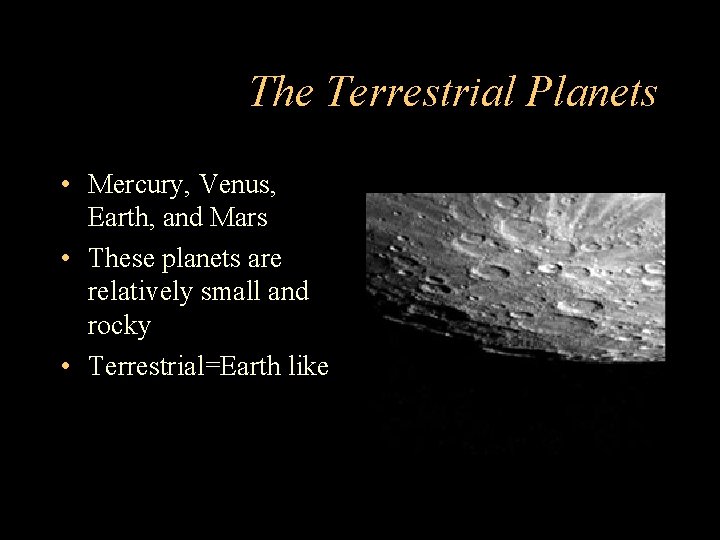
The Terrestrial Planets • Mercury, Venus, Earth, and Mars • These planets are relatively small and rocky • Terrestrial=Earth like
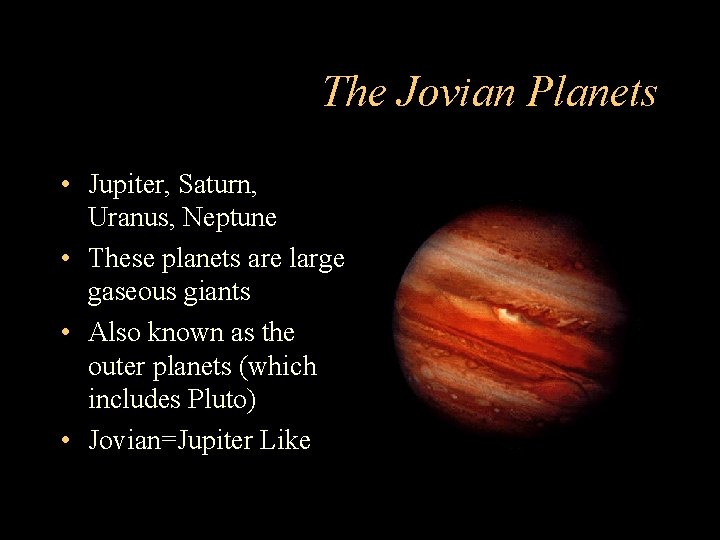
The Jovian Planets • Jupiter, Saturn, Uranus, Neptune • These planets are large gaseous giants • Also known as the outer planets (which includes Pluto) • Jovian=Jupiter Like
Mercury • Distance: 0. 39 AU • Revolution: 88 days • It rotates on its axis very slowly. One Mercury day lasts 3 months and one night is 3 months long. Due to this, the day gets really hot (427 C) and the night gets really cold (– 173 C).
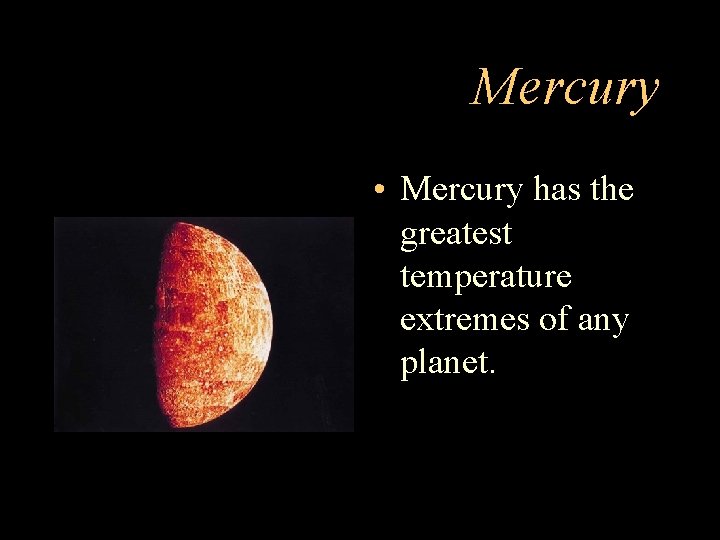
Mercury • Mercury has the greatest temperature extremes of any planet.
Venus • Distance: 0. 72 AU • Revolution: 225 days • Venus is covered by many basaltic volcanoes.
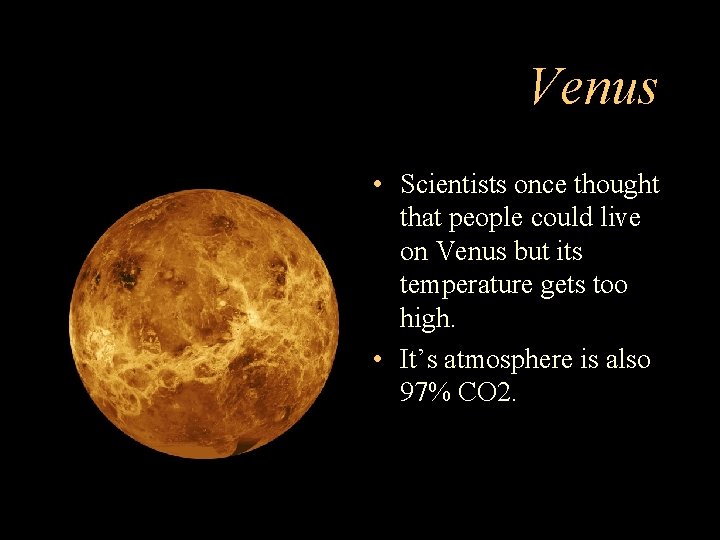
Venus • Scientists once thought that people could live on Venus but its temperature gets too high. • It’s atmosphere is also 97% CO 2.
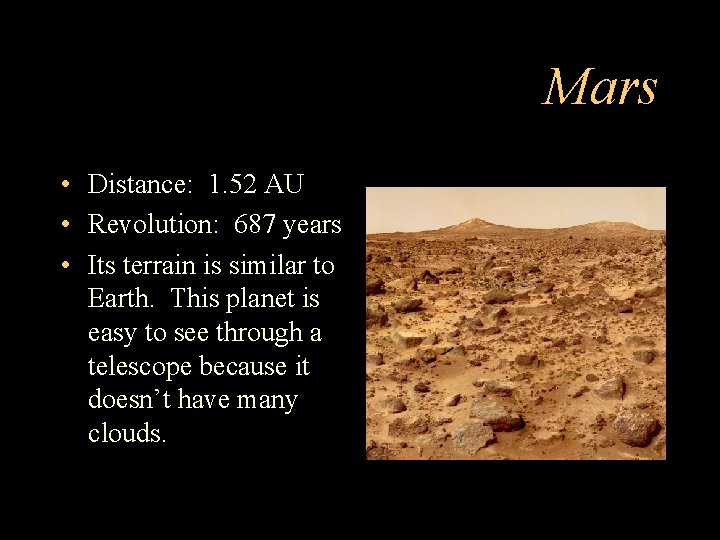
Mars • Distance: 1. 52 AU • Revolution: 687 years • Its terrain is similar to Earth. This planet is easy to see through a telescope because it doesn’t have many clouds.
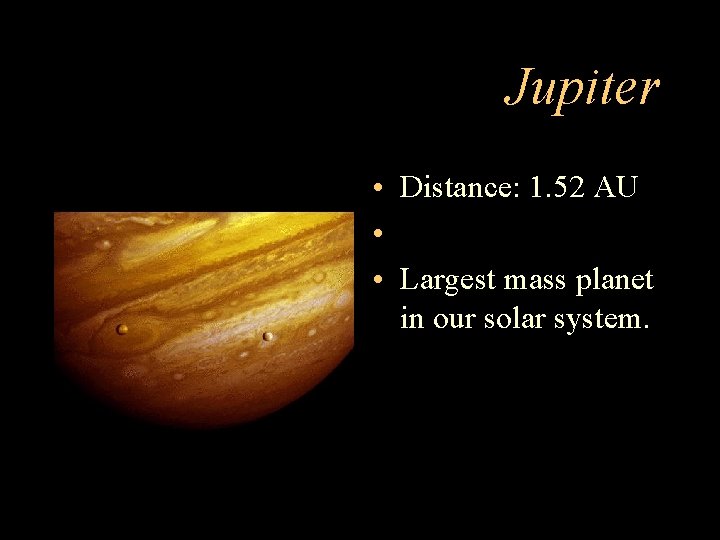
Jupiter • Distance: 1. 52 AU • • Largest mass planet in our solar system.
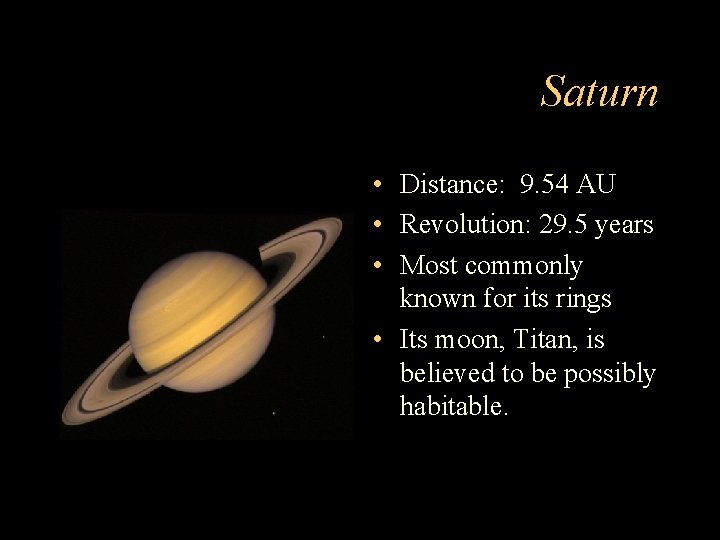
Saturn • Distance: 9. 54 AU • Revolution: 29. 5 years • Most commonly known for its rings • Its moon, Titan, is believed to be possibly habitable.
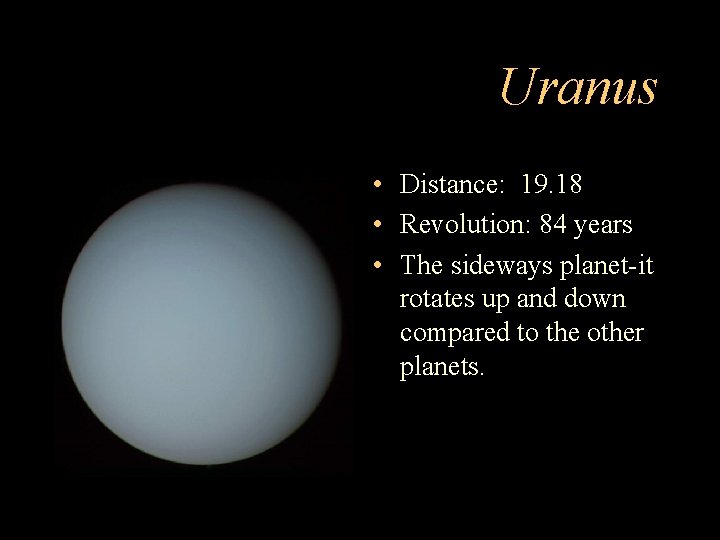
Uranus • Distance: 19. 18 • Revolution: 84 years • The sideways planet-it rotates up and down compared to the other planets.
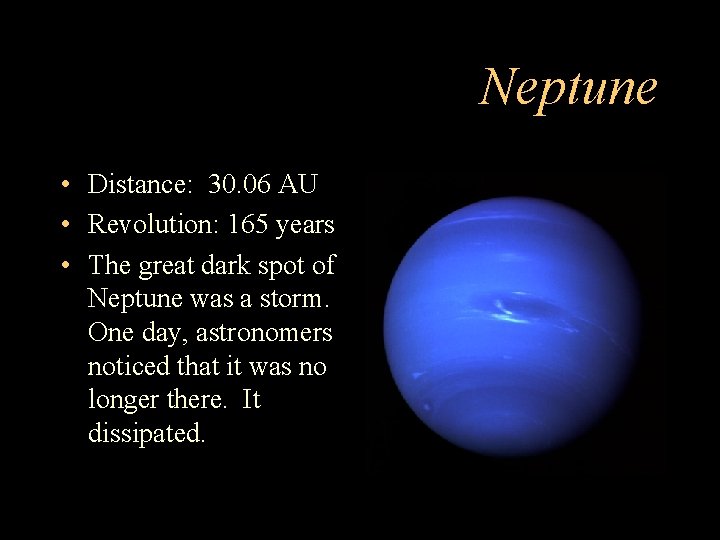
Neptune • Distance: 30. 06 AU • Revolution: 165 years • The great dark spot of Neptune was a storm. One day, astronomers noticed that it was no longer there. It dissipated.
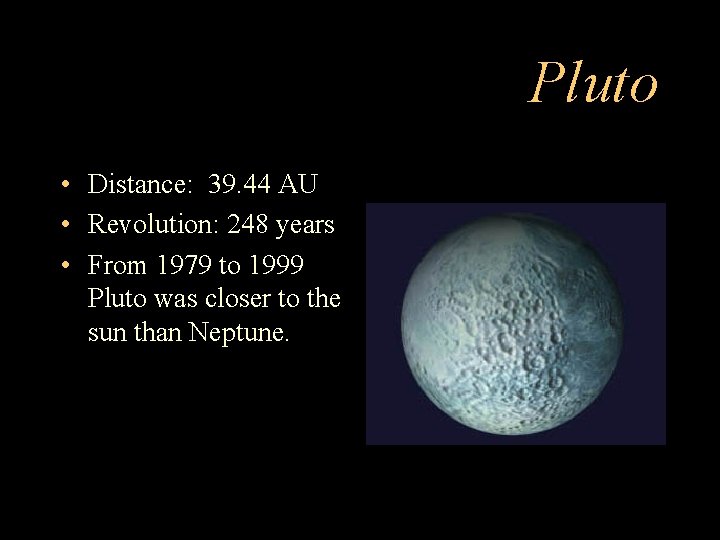
Pluto • Distance: 39. 44 AU • Revolution: 248 years • From 1979 to 1999 Pluto was closer to the sun than Neptune.
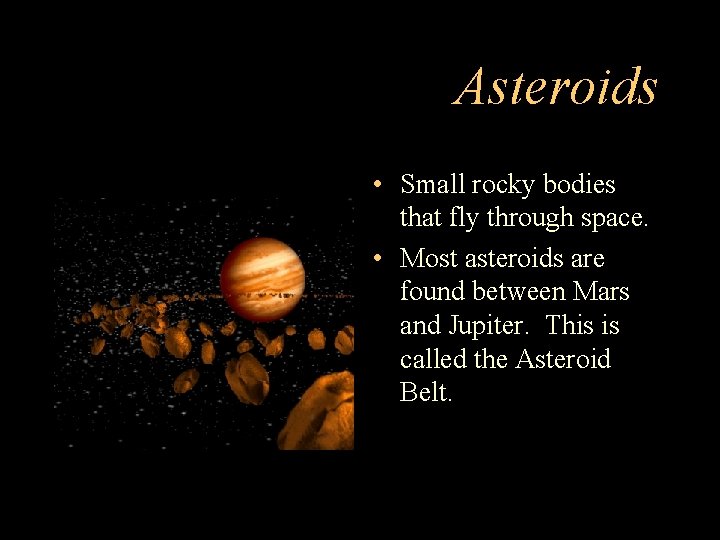
Asteroids • Small rocky bodies that fly through space. • Most asteroids are found between Mars and Jupiter. This is called the Asteroid Belt.
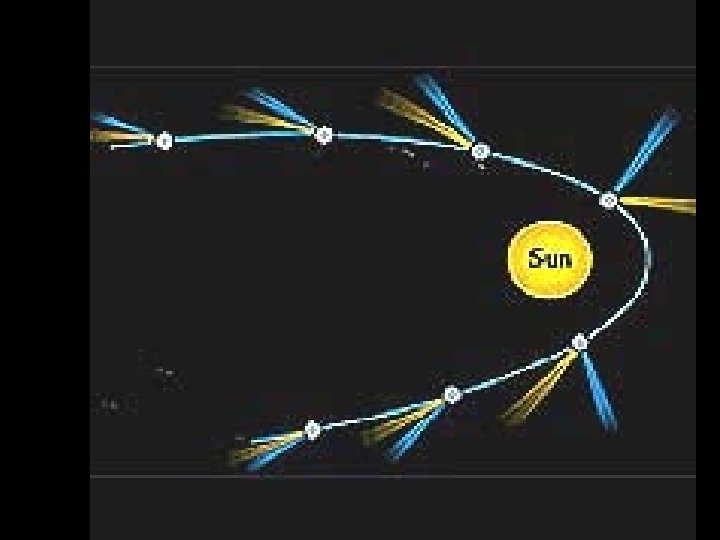
Comets • Comets are pieces of rocky and metallic materials held together by frozen gases. • Many comets travel in elongated orbits around the sun. • It takes some comets hundreds of thousands of years to complete one revolution around the sun.
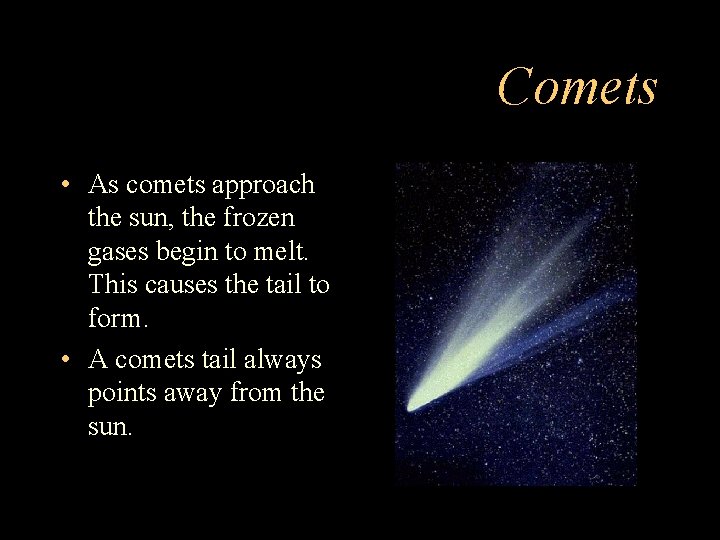
Comets • As comets approach the sun, the frozen gases begin to melt. This causes the tail to form. • A comets tail always points away from the sun.
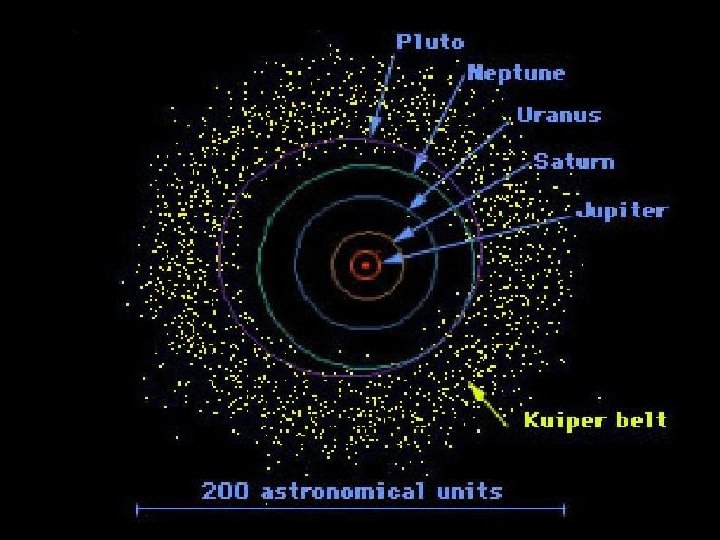
Kuiper Belt • This is a region outside of Neptune’s orbit that is full of space debris. • This is where astronomers think that all comets come from.
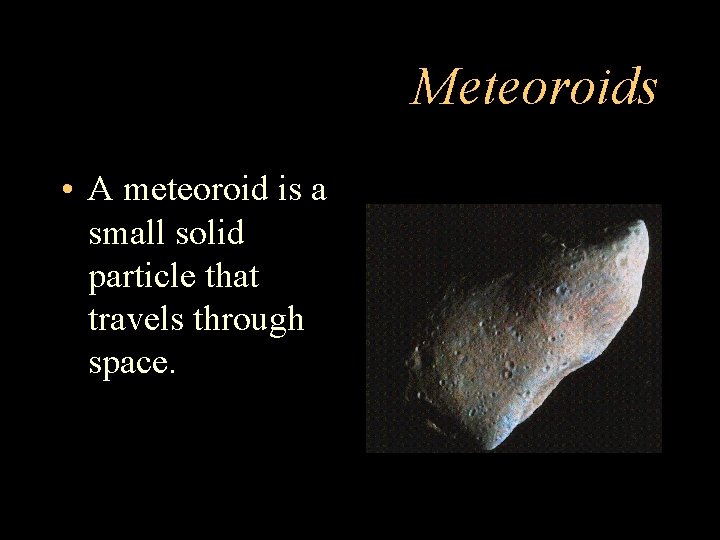
Meteoroids • A meteoroid is a small solid particle that travels through space.
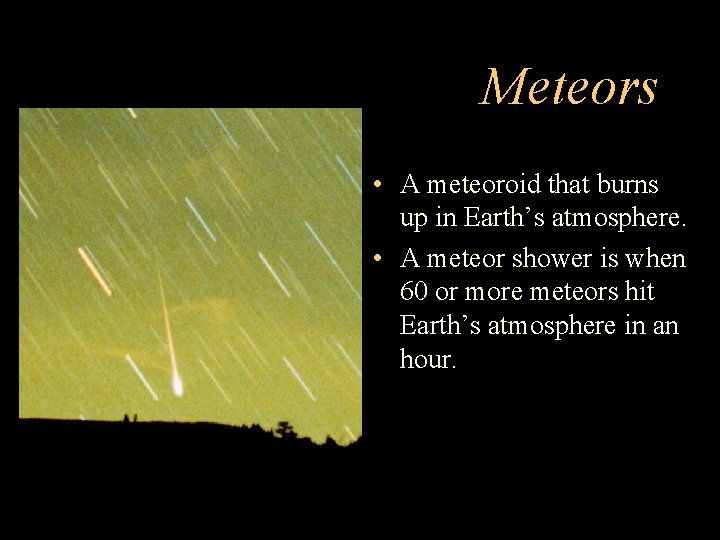
Meteors • A meteoroid that burns up in Earth’s atmosphere. • A meteor shower is when 60 or more meteors hit Earth’s atmosphere in an hour.
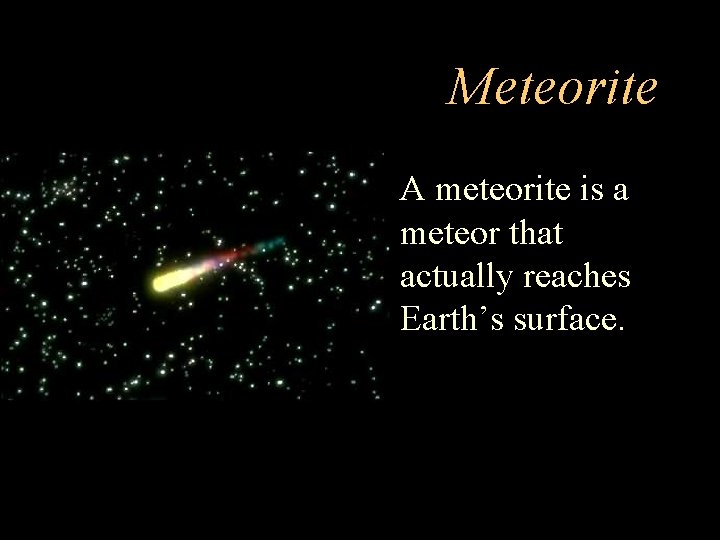
Meteorite • A meteorite is a meteor that actually reaches Earth’s surface.
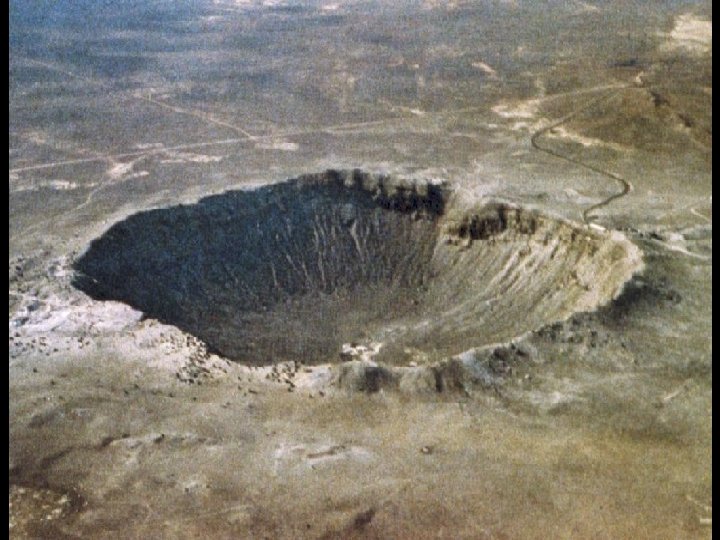
Meteor Crater, Arizona • A meteorite more than 30 tons in size blasted into the countryside 26, 000 years ago.
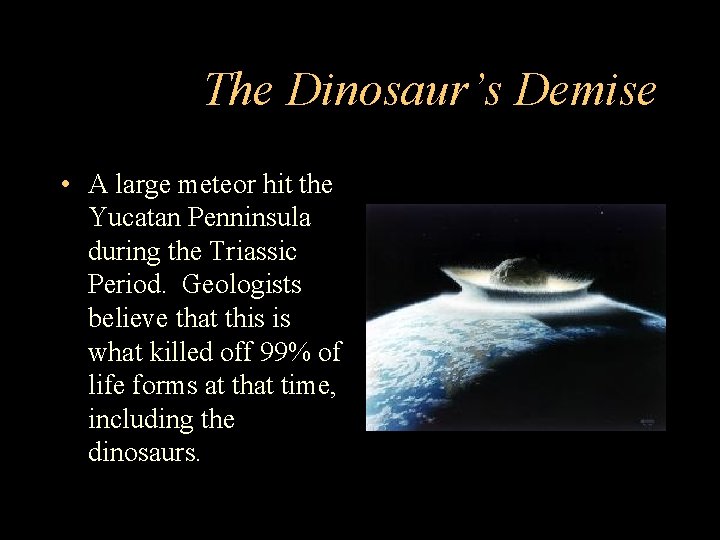
The Dinosaur’s Demise • A large meteor hit the Yucatan Penninsula during the Triassic Period. Geologists believe that this is what killed off 99% of life forms at that time, including the dinosaurs.
- Slides: 32