
Planetary Orbits Planetary orbits in terms of ellipse

Planetary Orbits • Planetary orbits in terms of ellipse geometry. In the figure, ε e • Compute major & minor axes (2 a & 2 b) as in text. Get (recall k = Gm. M): a (α)/[1 - e 2] = (k)/(2|E|) (depends only on energy E) b (α)/[1 - e 2]½ = ( )/(2 m|E|)½ a[1 - e 2]½ (αa)½ (Depends on both energy E & angular momentum ) • Apsidal distances rmin & rmax (or r 1 & r 2): rmin = a(1 - e) = (α)/(1 + e), rmax = a(1+ e) = (α)/(1 - e) Orbit eqtn is: r = a(1 - e 2)/[1 + e cos(θ - θ´)]

• Planetary orbits = ellipses, sun at one focus: Fig: • For a general central force, we had Kepler’s 2 nd Law: (Constant areal velocity!): (d. A/dt) = ( )/(2 m) = const Use to compute orbit period: dt = (2 m)/( ) d. A Period = time to sweep out ellipse area: τ = ∫dt = [(2 m)/( )] ∫d. A = [(2 m)/( )]A
![• Period of elliptical orbit: τ = [(2 m)/( )] A (A =](http://slidetodoc.com/presentation_image/5ed574b4ab7773eef16b2c4f83a811a7/image-4.jpg "• Period of elliptical orbit: τ = [(2 m)/( )] A (A =")
• Period of elliptical orbit: τ = [(2 m)/( )] A (A = ellipse area) (1) • Analytic geometry: Area of ellipse: A πab (2) • In terms of k, E & , we just had: a = (k)/(2|E|); b = ( )/(2 m. E)½ (3) (1), (2), (3) τ = πk(m/2)½|E|-(3/2) • Alternatively: b = (αa)½ ; α [ 2 (mk)] τ2 = [(4π2 m)/(k)] a 3 The square of the period is proportional to cube of semimajor axis of the elliptic orbit Kepler’s Third Law
![• Kepler’s Third Law τ2 = [(4π2 m)/(k)] a 3 The square of](http://slidetodoc.com/presentation_image/5ed574b4ab7773eef16b2c4f83a811a7/image-5.jpg "• Kepler’s Third Law τ2 = [(4π2 m)/(k)] a 3 The square of")
• Kepler’s Third Law τ2 = [(4π2 m)/(k)] a 3 The square of period is proportional to the cube of the semimajor axis of the elliptic orbit • Note: Actually, m μ. The reduced mass μ actually enters! As derived empirically by Kepler: Kepler’s 3 rd Law states that this is true with the same proportionality constant for all planets. This ignores the difference between the reduced mass μ & the mass m of the planet: μ = (m)[1 + m. M-1]-1 μ m[1 - (m/M) + (m/M)2 -. . . ] Note: k = Gm. M ; μ m (m << M) (μ/k) 1/(GM) τ2 = [(4π2)/(GM)]a 3 (m << M) So Kepler was only approximately correct!
Kepler’s Laws • Kepler’s First Law: The planets move in elliptic orbits with the Sun at one focus. – Kepler proved empirically. Newton proved this from Universal Law of Gravitation & calculus. • Kepler’s Second Law: The area per unit time swept out by a radius vector from sun to a planet is constant. (Constant areal velocity). (d. A/dt) = ( )/(2 m) = constant – Kepler proved empirically. We’ve proven in general for any central force. • Kepler’s Third Law: τ2 = [(4π2 m)/(k)] a 3 The square of a planet’s period is proportional to cube of semimajor axis of the planet’s elliptic orbit.
Example (from Marion) • Halley’s Comet, which passed around the sun early in 1986, moves in a highly elliptical orbit: Eccentricity e = 0. 967; period τ = 76 years. Calculate its minimum and maximum distances from the sun. • Use the formulas just derived & find: rmin = 8. 8 1010 m (Inside Venus’s orbit & almost to Mercury’s orbit) rmax = 5. 27 1012 m (Outside Neptune’s orbit & near to Pluto’s orbit)
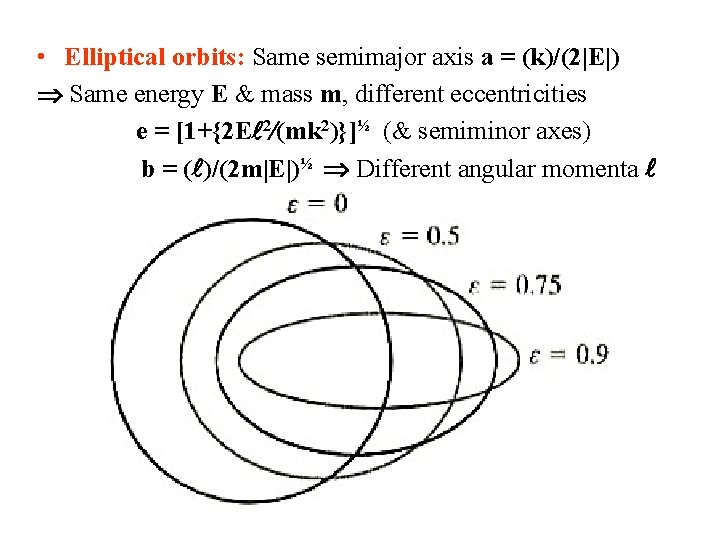
• Elliptical orbits: Same semimajor axis a = (k)/(2|E|) Same energy E & mass m, different eccentricities e = [1+{2 E 2 (mk 2)}]½ (& semiminor axes) b = ( )/(2 m|E|)½ Different angular momenta
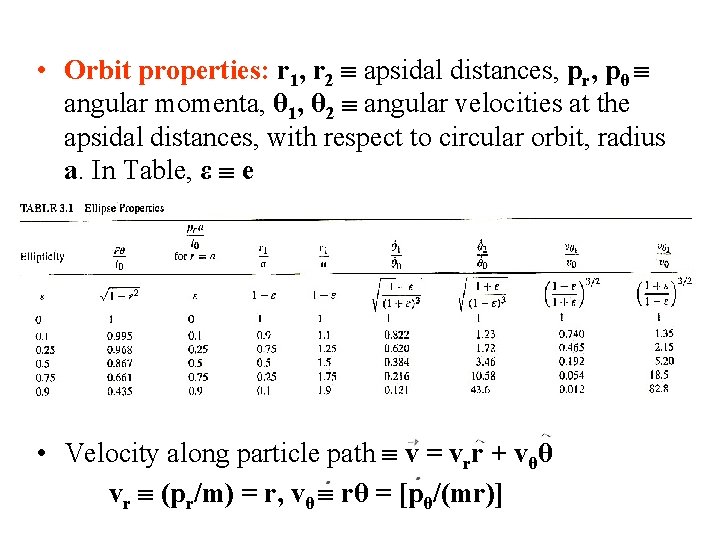
• Orbit properties: r 1, r 2 apsidal distances, pr, pθ angular momenta, θ 1, θ 2 angular velocities at the apsidal distances, with respect to circular orbit, radius a. In Table, ε e • Velocity along particle path v = vrr + vθθ vr (pr/m) = r, vθ rθ = [pθ/(mr)]
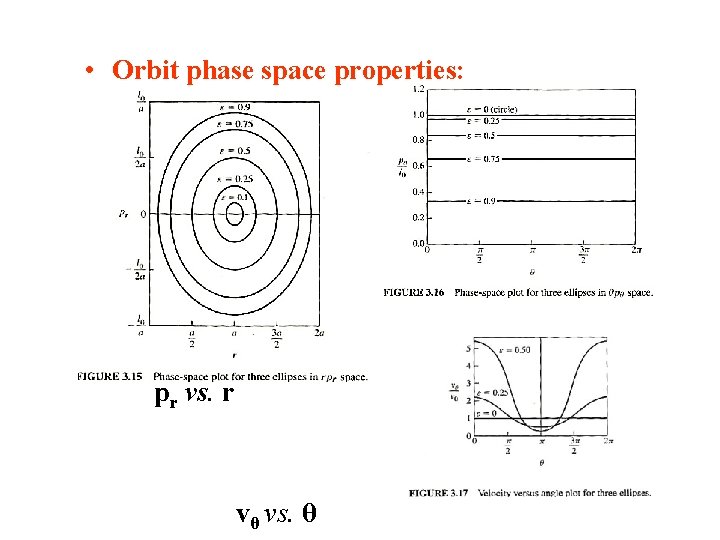
• Orbit phase space properties: pθ vs. θ pr vs. r vθ vs. θ
- Slides: 10