
Planetary Boundaries A safe operating space for humanity
Planetary Boundaries ‘A safe operating space for humanity’ Rockström 2009 © WJEC CBAC Ltd 2016
Planetary Boundaries THE CONCEPT OF PLANETARY BOUNDARIES • Nine global processes regulate the stability of the land, atmosphere and sea. • A tipping point in any may be reached, when a change in a process does not give a linear response. A small change may have a large and unpredictable effect on the environment. • Estimates for upper and lower values for the processes have been made, between which the response to change is gradual. Exceeding these limits is likely to produce sudden, catastrophic changes to the environment. © WJEC CBAC Ltd 2016
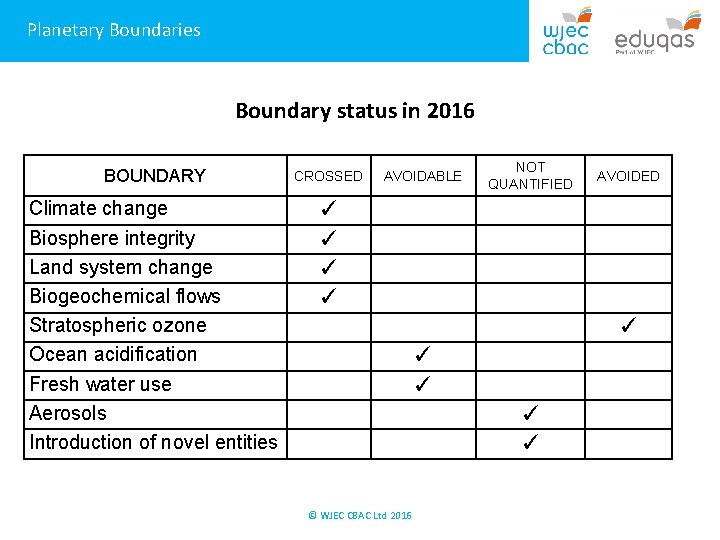
Planetary Boundaries Boundary status in 2016 BOUNDARY CROSSED AVOIDABLE NOT QUANTIFIED AVOIDED Climate change Biosphere integrity Land system change Biogeochemical flows Stratospheric ozone Ocean acidification Fresh water use Aerosols Introduction of novel entities ✓ ✓ ✓ © WJEC CBAC Ltd 2016
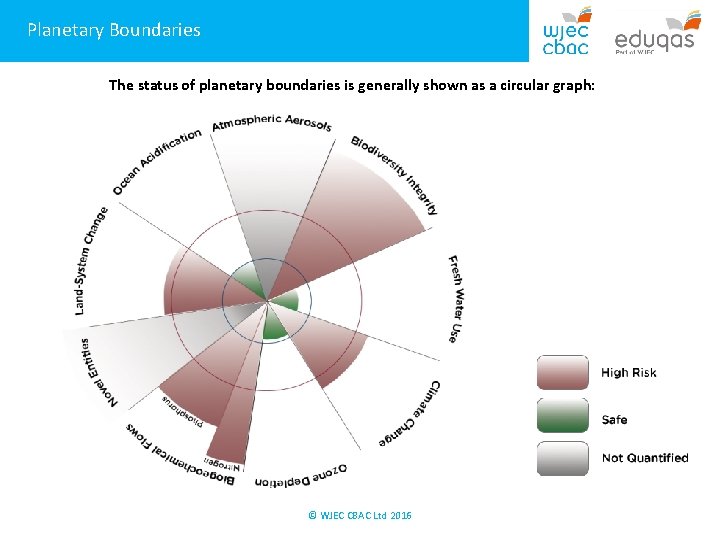
Planetary Boundaries The status of planetary boundaries is generally shown as a circular graph: © WJEC CBAC Ltd 2016
Planetary Boundaries C R O S S E D The Climate Change Boundary A ‘core boundary’ © WJEC CBAC Ltd 2016
Planetary Boundaries The problem • The Earth’s temperature is largely controlled by greenhouse gases in the atmosphere. • Evidence shows that periods of higher atmospheric carbon dioxide are correlated with higher average global temperature. • Atmospheric temperature affects wind patterns, ocean currents, rainfall and other precipitation. • Positive feedback occurs e. g. warmer seas melt polar ice; the sea is less reflective than ice so more heat is absorbed so the sea gets even warmer. • Thermal expansion and melted ice running off land raise the average sea level. Without significant action, a rise of up to 7 m is predicted by 2100. © WJEC CBAC Ltd 2016
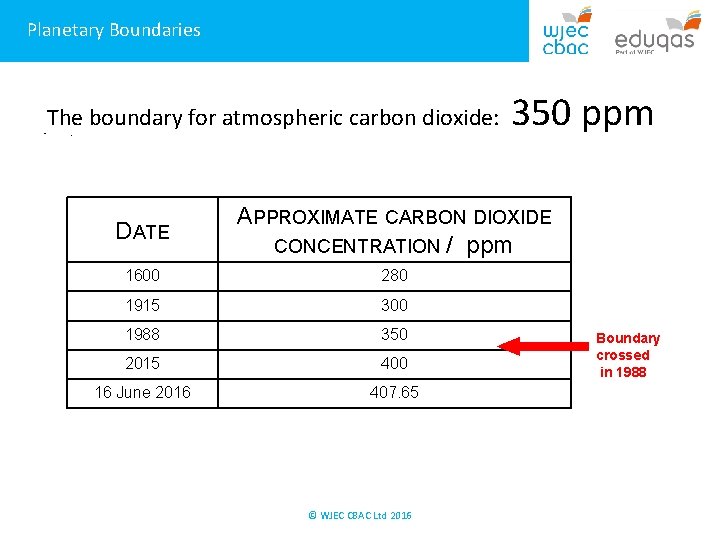
Planetary Boundaries • The boundary for atmospheric carbon dioxide: . 350 ppm DATE APPROXIMATE CARBON DIOXIDE CONCENTRATION / ppm 1600 280 1915 300 1988 350 2015 400 16 June 2016 407. 65 © WJEC CBAC Ltd 2016 Boundary crossed in 1988
Planetary Boundaries Combatting climate change • International agreements Ø The Kyoto Protocol, agreed by 84 countries in 1997, was the first of many major international agreement to address global warming. It set targets for reducing the greenhouse gases in the atmosphere. Some major polluters did not sign the agreement. Ø The COP 21 meeting in Paris in 2015, which, by April 2016 had been agreed by 174 countries, made further resolutions. • Most people accept that the biofuel industry has a role in the reduction of fossil fuel combustion and that renewable resources should provide a greater proportion of the energy we use. © WJEC CBAC Ltd 2016
Planetary Boundaries COP 21 – the Paris agreement of 2015 174 countries have made an agreement to combat climate change. They have undertaken to: • Keep global temperatures ‘well below’ 2. 0 o. C above pre-industrial times and ‘to endeavour to limit’ them to 1. 5 o. C • Limit greenhouse gas emission by human activity to what can be naturally absorbed, to start between 2050 and 2100 • Review each country's achievements every five years • For rich countries to help poorer nations to adapt to climate change and switch to renewable energy. © WJEC CBAC Ltd 2016
Planetary Boundaries C R O S S E D The Biosphere Integrity Boundary A ‘core boundary’ © WJEC CBAC Ltd 2016
Planetary Boundaries The route to biodiversity loss • Habitat destruction has occurred in many ecosystems e. g. tundra, coral reefs, tropical rain forests. • Populations of living organisms are reduced. • If too few individuals in a species remain, the survival of the species may be under threat, and it may become extinct. • Species interact so entire communities come under threat. © WJEC CBAC Ltd 2016
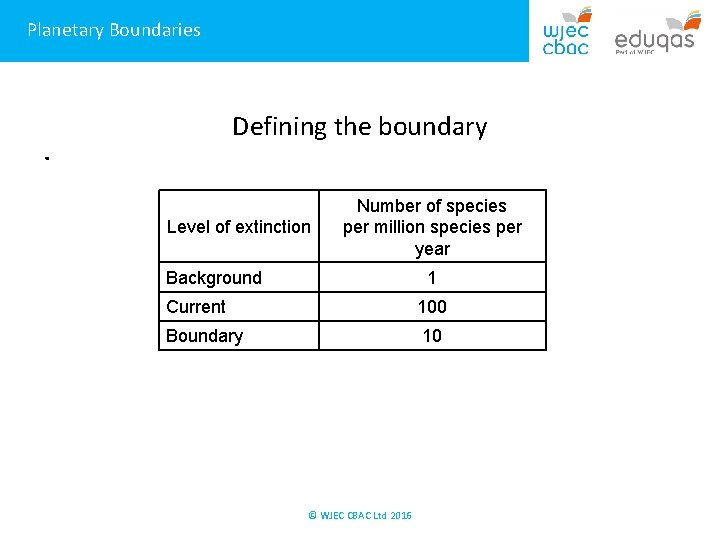
Planetary Boundaries Defining the boundary . Level of extinction Number of species per million species per year Background 1 Current 100 Boundary 10 © WJEC CBAC Ltd 2016
Planetary Boundaries Some ways to protect species • Monitor biodiversity • Species conservation e. g. seed banks, sperm banks • Prohibit international trade in endangered species and their products e. g. ivory • Limit fishing when fish are spawning • Limit logging • Limit the use of agricultural chemicals e. g. fertilisers, pesticides • Increase public awareness © WJEC CBAC Ltd 2016
Planetary Boundaries C R O S S E D The Land System Change Boundary © WJEC CBAC Ltd 2016
Planetary Boundaries The problem • Natural ecosystems, including rain forests, have been used for urban development, raising livestock and farming, including growing biofuel crops. • Pollutants derived from agriculture and other human activities further degrade the remaining land. • The production of biofuel crops and crops grown for export means that not enough food may be produced for local use. © WJEC CBAC Ltd 2016
Planetary Boundaries The boundary and how to live within it • No more than 15% of ice free land should be used for crop growing and human habitation. • Farming should be concentrated in the most productive areas. • People should eat less meat to reduce the area under cultivation. • More efficient crop plants should be grown. © WJEC CBAC Ltd 2016
Planetary Boundaries C R O S S E D The Biogeochemical Flows Boundary © WJEC CBAC Ltd 2016
Planetary Boundaries The balance of chemical elements maintained by natural cycles has been disrupted: • Fertilisers use - atmospheric nitrogen is fixed in the Haber process and phosphorus is extracted from rocks. • Agricultural nitrogen fixation • Combustion of fossil fuels and biomass © WJEC CBAC Ltd 2016
Planetary Boundaries Some consequences • Eutrophication from nitrate and phosphate run-off into bodies of water: algal blooms and anoxic zones are a direct threat to biodiversity. • Acidification as excess carbon dioxide dissolves in seas, lakes and rivers: effects on aquatic organisms include the disruption of gas exchange in fish and the softening of the shells of Molluscs and exoskeletons of Arthropods. © WJEC CBAC Ltd 2016
Planetary Boundaries The boundary No more than 62 million tonnes of nitrogen should be added to ecosystems each year, to prevent disruption of the global nitrogen cycle. Currently we add 150 million tonnes. Boundaries are defined for other elements e. g. phosphorus in the context of their biogeochemical cycles. © WJEC CBAC Ltd 2016
Planetary Boundaries A V O I D E D The Stratospheric Ozone Boundary © WJEC CBAC Ltd 2016
Planetary Boundaries The problem • By 1970, the concentration of ozone in the stratosphere had decreased so much that in spring, a ‘hole’ in the ozone layer could be detected over Antarctica. • As ozone absorbs ultra-violet light, much more uv was penetrating the atmosphere than in the past. • Ultra-violet light generates mutations in DNA and cause damage to living organisms. © WJEC CBAC Ltd 2016
Planetary Boundaries The Montreal Protocols (1987) By international agreement, the manufacture and use of chlorinated and brominated hydrocarbons, which are ozone -destroying, was to be phased out. The stratospheric ozone boundary is the only one that has been avoided by deliberate action. © WJEC CBAC Ltd 2016
Planetary Boundaries The boundary • The thickness of the ozone layer is measured in Dobson units. • The thickness of the ozone layer should be at least 276 Dobson units. • In 2016, the thickness is approximately 300 Dobson units. © WJEC CBAC Ltd 2016
Planetary Boundaries A V O I D A B L E The Ocean Acidification Boundary © WJEC CBAC Ltd 2016
Planetary Boundaries The problem • Atmospheric carbon dioxide dissolves in bodies of water such as the oceans, and decreases their p. H. • Before the advent of industry, the p. H of the oceans was 8. 16 but it is now about 8. 03. This means that H+ ions are 30 times as concentrated. © WJEC CBAC Ltd 2016
Planetary Boundaries Some effects of lowered p. H • Absorbing excess H+ ions decreases the internal p. H of phytoplankton. Their ability to perform enzyme-mediated reactions e. g. photosynthesis is compromised. So less oxygen is produced and less carbon dioxide is removed from the water. • Gas exchange in fish is less efficient. • Calcium leaches out of the calcium carbonate skeletons of corals, out of the shells of Molluscs and out of the exoskeletons of Arthropods. Even if the organisms survive this, they become more susceptible to predators. © WJEC CBAC Ltd 2016
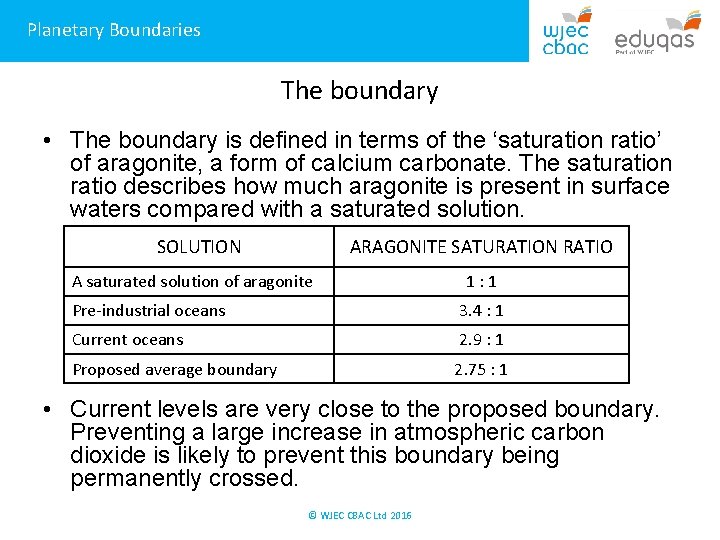
Planetary Boundaries The boundary • The boundary is defined in terms of the ‘saturation ratio’ of aragonite, a form of calcium carbonate. The saturation ratio describes how much aragonite is present in surface waters compared with a saturated solution. SOLUTION ARAGONITE SATURATION RATIO A saturated solution of aragonite 1 : 1 Pre-industrial oceans 3. 4 : 1 Current oceans 2. 9 : 1 Proposed average boundary 2. 75 : 1 • Current levels are very close to the proposed boundary. Preventing a large increase in atmospheric carbon dioxide is likely to prevent this boundary being permanently crossed. © WJEC CBAC Ltd 2016
Planetary Boundaries A V O I D A B L E The Fresh Water Use Boundary © WJEC CBAC Ltd 2016
Planetary Boundaries The fundamental problem • Only 2. 5% of the water on Earth is fresh, and 61% of that is frozen. • Not all available fresh water is drinkable as it may contain toxic ions or dust. • Fresh water is not uniformly distributed around the world so some places have very little. © WJEC CBAC Ltd 2016
Planetary Boundaries Human activity further reduces water availability: • Increased use e. g. irrigating crops, daily life • Climate change • Pollution • Change in land use e. g. draining wetlands, deforestation • Increased human population and longer life spans © WJEC CBAC Ltd 2016
Planetary Boundaries Some consequences • Desertification • Rives may fail to reach the sea • Fisheries are destroyed • The loss of bodies of water gives a wider area more extreme temperatures and makes it more arid e. g. following the drying of the Aral Sea. © WJEC CBAC Ltd 2016
Planetary Boundaries But: • We continue to pump yet more water out of rivers. • We pump ‘fossil water’ from underground sources. © WJEC CBAC Ltd 2016
Planetary Boundaries The boundary • We should limit the volume of water we take from rivers to 4000 km 3 y-1. • Current use: 2600 km 3 y-1. This boundary is avoidable if we: Ø Ø Stop irrigating non-food crops e. g. biofuels Use drip irrigation for food crops Apply the 3 Rs i. e. reduce, reuse, recycle Use desalinated water © WJEC CBAC Ltd 2016
Planetary Boundaries N O T Q U A N T I F I E D The Atmospheric Aerosol Loading Boundary © WJEC CBAC Ltd 2016
Planetary Boundaries The problem • The atmosphere contains minute particles. Some are natural e. g. the ash from volcanoes, but others are put there by human activity. • Their effect depends upon their physical and chemical nature. • They are so varied that their effects have not been quantified, but they are estimated to cause 800 000 premature deaths each year. © WJEC CBAC Ltd 2016
Planetary Boundaries Some examples • Soot absorbs heat and contributes to global warming. • Sulphates reflect heat and have a cooling effect. • Particles from diesel engines are inhaled and lodge in the lungs, increasing the risk of lung cancer, or, if small enough, pass into blood capillaries and increase the risk of cardio-vascular disease. © WJEC CBAC Ltd 2016
Planetary Boundaries Some consequences • The ‘Asian Brown Cloud’ over India comes from coal power stations, wood burning stoves and heavy industry. It blocks about 10% of the sunlight, lowering the temperature, evaporation rates and rainfall, disrupting the monsoon, increasing floods and droughts. • The extreme drought in the Sahel in the 1970 s and 1980 s is linked to pollution from Europe and America reducing moisture in the air that moves over Africa. • Soot, especially from burning felled trees after deforestation, accumulates in the atmosphere, largely over the poles. It falls and darkens the ice sheets, which reflect less heat and melt more quickly. © WJEC CBAC Ltd 2016
Planetary Boundaries The boundary The effects of atmospheric particulates are so variable that it is not currently possible to determine safe limits. © WJEC CBAC Ltd 2016
Planetary Boundaries N O T Q U A N T I F I The Introduction of E D Novel Entities Boundary © WJEC CBAC Ltd 2016
Planetary Boundaries The problem Novel entities may be persistent and have irreversible effects. They include: • synthetic organic pollutants e. g. DDT, PCBs • radioactive materials e. g. 131 I, 32 P, 14 C, 90 Sr • genetically modified organisms • nanomaterials i. e. particles with at least one dimension no bigger than 100 nm e. g. coatings on computer chips, self-cleaning textiles, antimicrobial silver nanoparticles in socks • micro-plastics e. g. plastic beads in cosmetics © WJEC CBAC Ltd 2016
Planetary Boundaries Some novel entities are useful e. g. : • Nanoparticles - thin films or surface coatings on computer chips - self-cleaning textile surfaces - protective insulating clothing - antimicrobial silver nanoparticles in socks - health and health care advances e. g. targeted methods drug delivery, new cancer therapies, early detection of diseases • Genetically modified organisms are recognised as being part of the solution to many problems e. g. those associated with world food shortages, drug manufacture, cleaning up pollution © WJEC CBAC Ltd 2016
Planetary Boundaries The boundary • Some novel entities are already controlled e. g. the use of DDT is banned. • But of the estimated 100 000 manufactured chemicals and other entities, few have been properly assessed. • It is widely agreed that a defined boundary would be useful but it is not yet possible to establish one. © WJEC CBAC Ltd 2016
Planetary Boundaries SOME USEFUL RESOURCES A TALK: www. ted. com Johan Rockström (2010) Let the environment guide our development A WEBSITE: www. stockholmresilience. org/planetaryboundaries Includes Rockström’s talk during the ‘Earth’s Safe Operating Space for Humanity: From concept to action’ seminar, Stockholm, January 2016 AN ARTICLE: Earth’s Nine Lives Fred Pearce New. Scientist February 2010 A THINK-TANK: Planetary Boundaries Initiative planetaryboundariesinitiative. org © WJEC CBAC Ltd 2016
- Slides: 44