
Planet Formation Topic Dust motion and coagulation Lecture



- Slides: 57
Planet Formation Topic: Dust motion and coagulation Lecture by: C. P. Dullemond
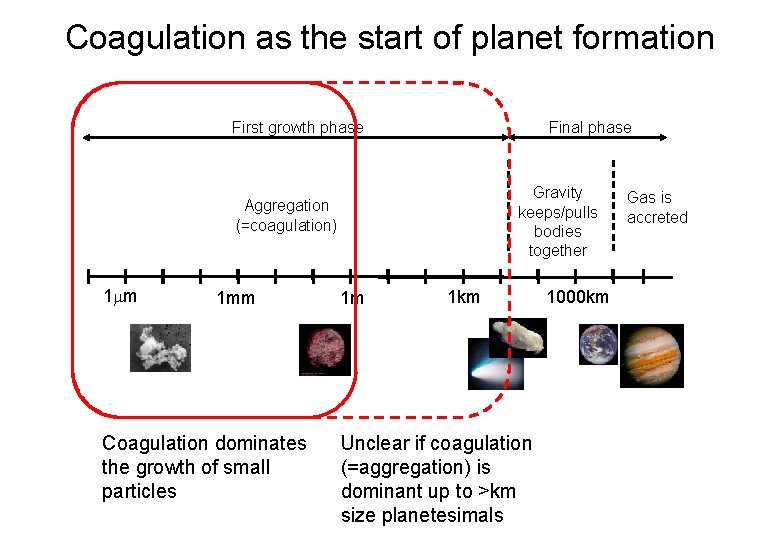
Coagulation as the start of planet formation Final phase First growth phase Gravity keeps/pulls bodies together Aggregation (=coagulation) 1 m 1 mm Coagulation dominates the growth of small particles 1 m 1 km Unclear if coagulation (=aggregation) is dominant up to >km size planetesimals 1000 km Gas is accreted
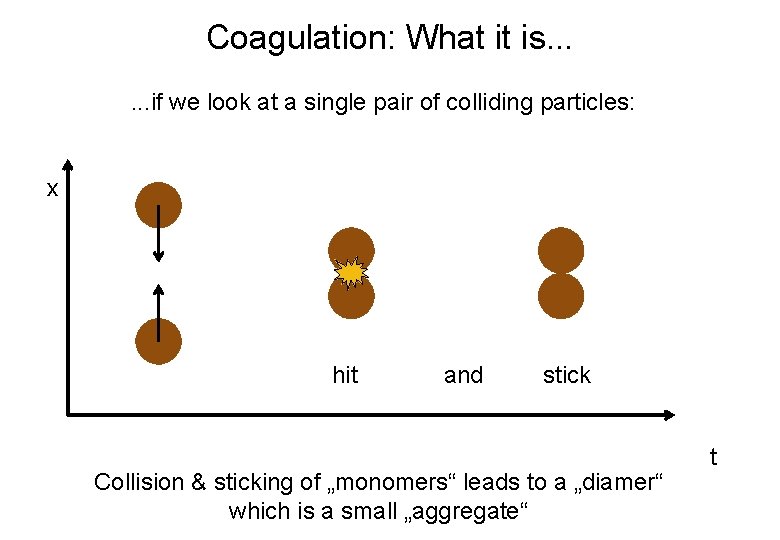
Coagulation: What it is. . . if we look at a single pair of colliding particles: x hit and stick Collision & sticking of „monomers“ leads to a „diamer“ which is a small „aggregate“ t
Coagulation: What it is. . . if we look at a single pair of colliding particles: x hit and stick Collision & sticking of aggregates leads to larger aggregates. t
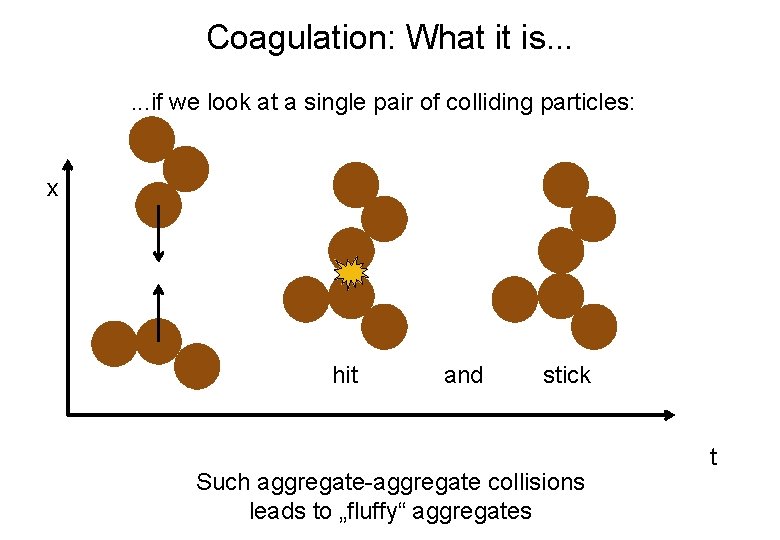
Coagulation: What it is. . . if we look at a single pair of colliding particles: x hit and stick Such aggregate-aggregate collisions leads to „fluffy“ aggregates t
Coagulation is driven by particle motion Part 1: Stochastic motions: Brownian Motion and Turbulence
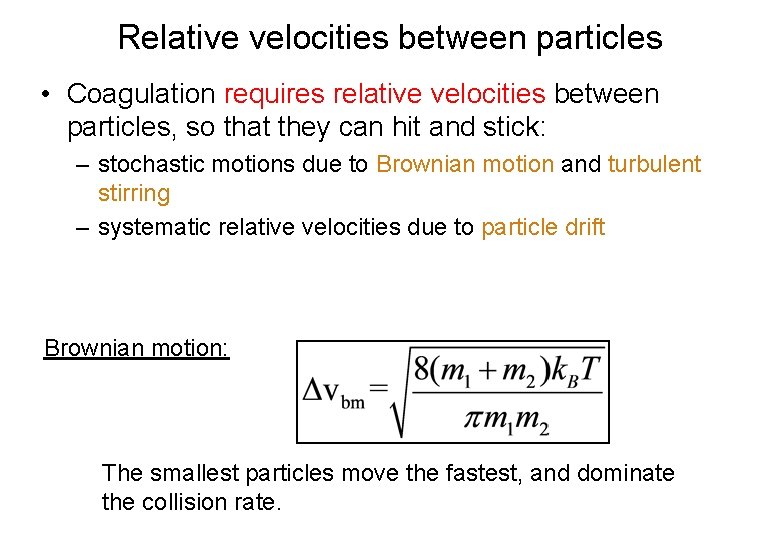
Relative velocities between particles • Coagulation requires relative velocities between particles, so that they can hit and stick: – stochastic motions due to Brownian motion and turbulent stirring – systematic relative velocities due to particle drift Brownian motion: The smallest particles move the fastest, and dominate the collision rate.
Turbulent stirring • Turbulence can induce stochastic motions of particles. • To compute this, we must first understand friction between dust and gas. . . • . . . and for this we must understand a few things about the Maxwell-Boltzmann distribution of the gas. So hold on a moment as we discuss friction. . .
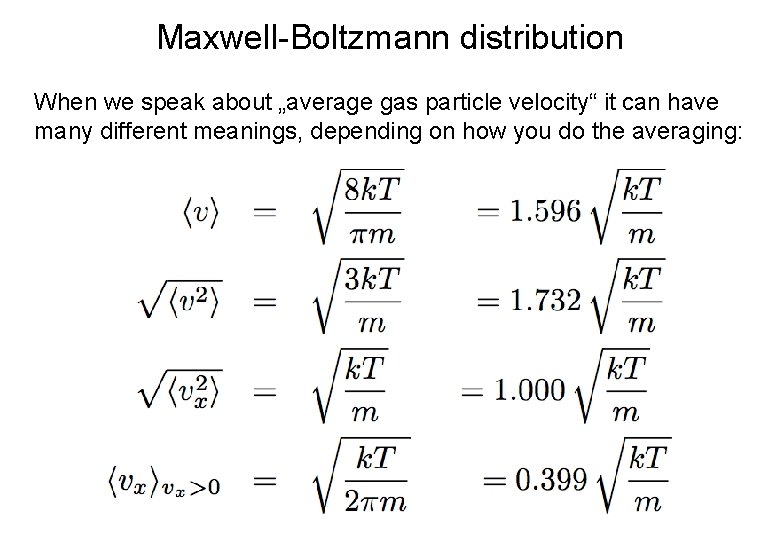
Maxwell-Boltzmann distribution When we speak about „average gas particle velocity“ it can have many different meanings, depending on how you do the averaging:
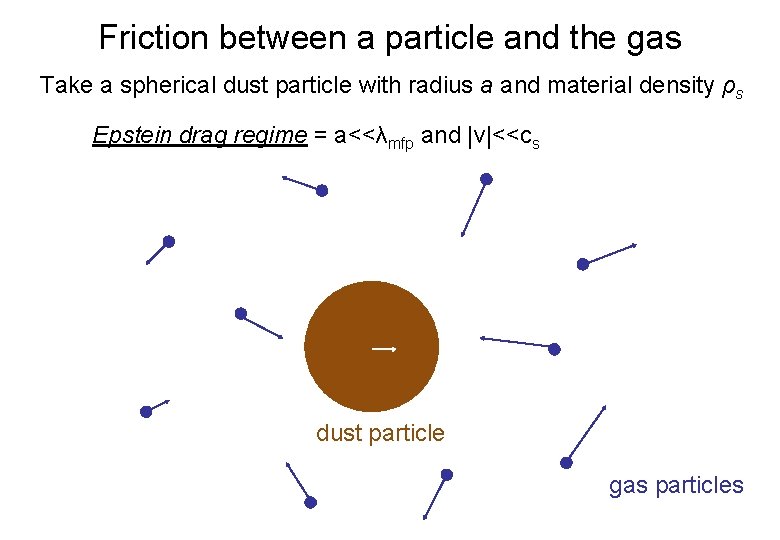
Friction between a particle and the gas Take a spherical dust particle with radius a and material density ρs Epstein drag regime = a<<λmfp and |v|<<cs dust particle gas particles
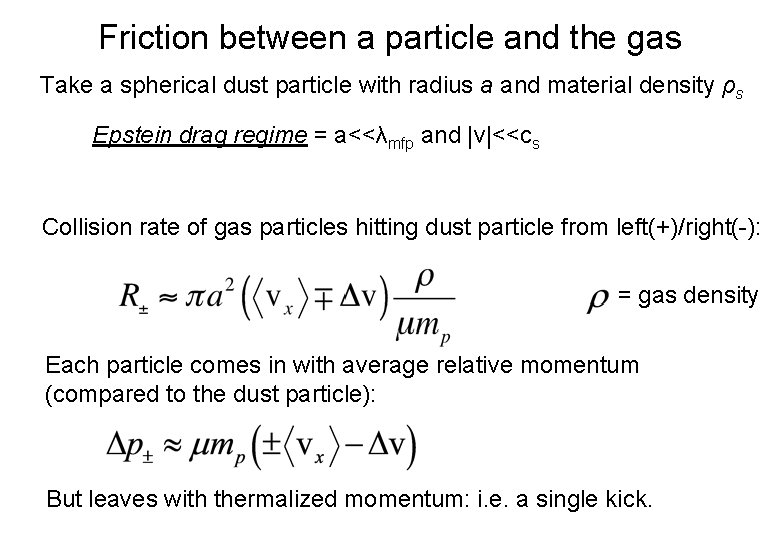
Friction between a particle and the gas Take a spherical dust particle with radius a and material density ρs Epstein drag regime = a<<λmfp and |v|<<cs Collision rate of gas particles hitting dust particle from left(+)/right(-): = gas density Each particle comes in with average relative momentum (compared to the dust particle): But leaves with thermalized momentum: i. e. a single kick.
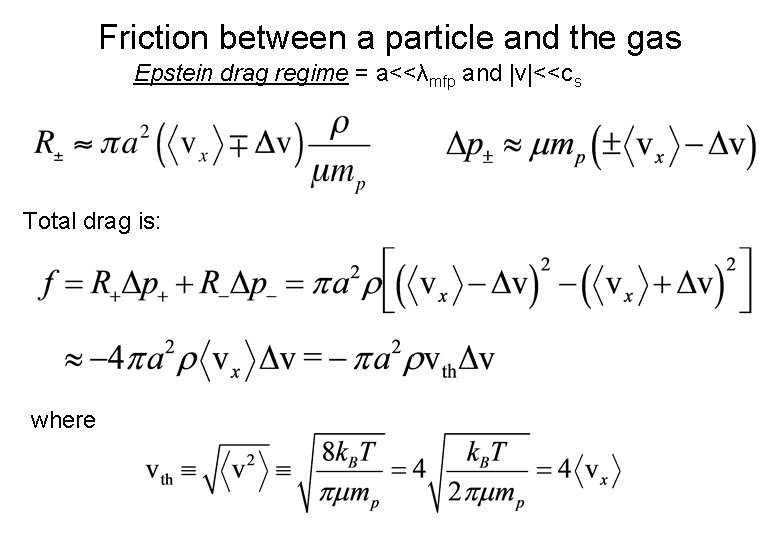
Friction between a particle and the gas Epstein drag regime = a<<λmfp and |v|<<cs Total drag is: where
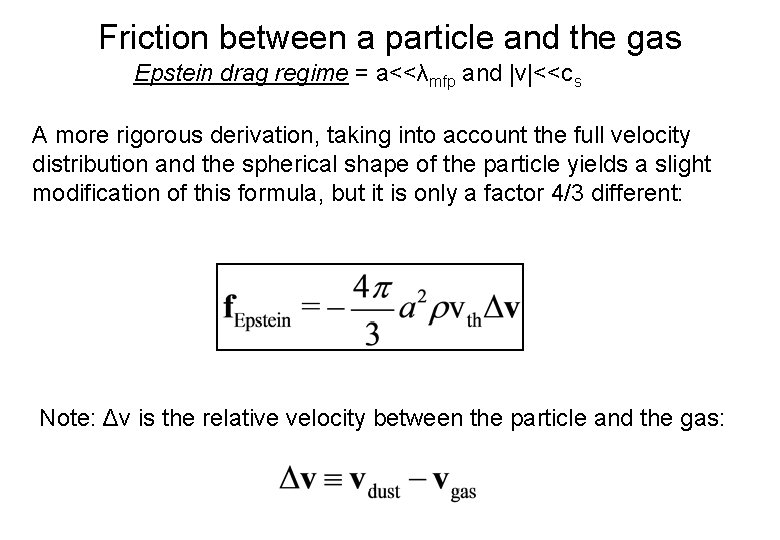
Friction between a particle and the gas Epstein drag regime = a<<λmfp and |v|<<cs A more rigorous derivation, taking into account the full velocity distribution and the spherical shape of the particle yields a slight modification of this formula, but it is only a factor 4/3 different: Note: Δv is the relative velocity between the particle and the gas:
Friction between a particle and the gas • The Epstein regime is valid for small enough dust particles. • Other regimes include: – Stokes regime: Particle is larger than gas mean free path – Supersonic regime: Particle moves faster than sound speed • For simplicity we will assume Epstein from now on, at least for this chapter.
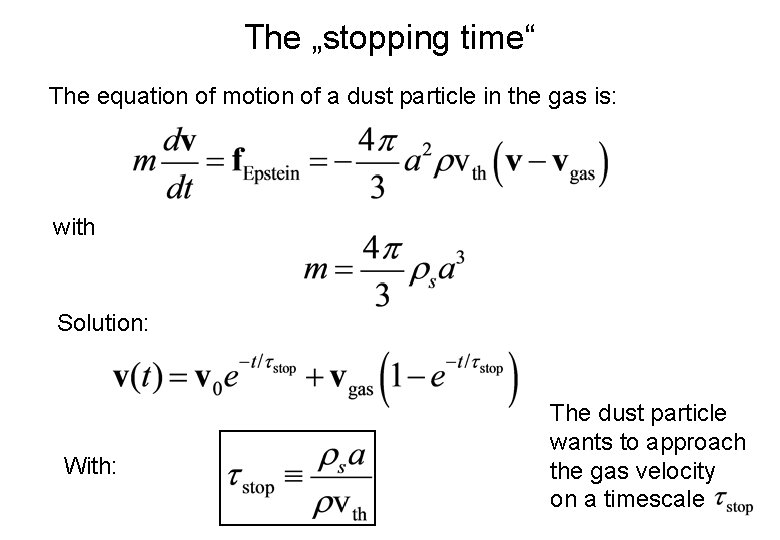
The „stopping time“ The equation of motion of a dust particle in the gas is: with Solution: With: The dust particle wants to approach the gas velocity on a timescale
back to: Turbulent stirring Small dust grains have small stopping time, so they quickly adapt to the local flow: eddy small dust grain Big dust grains have long stopping time, so they barely adapt to the local flow: eddy large dust grain
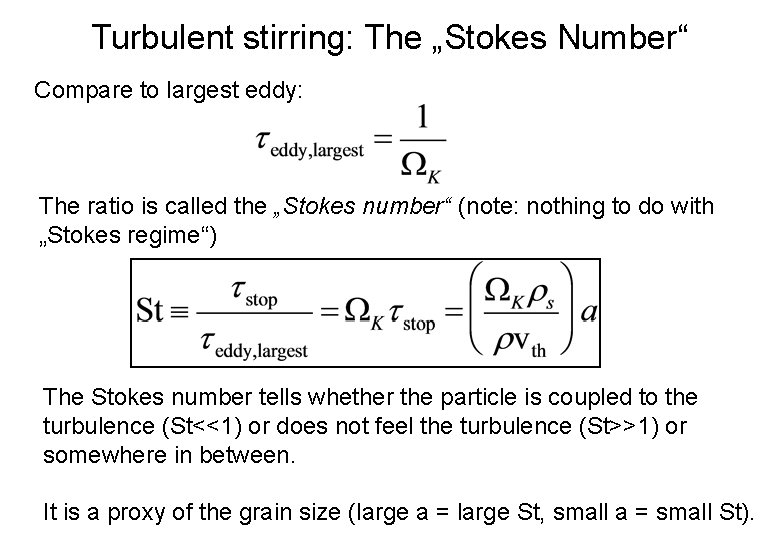
Turbulent stirring: The „Stokes Number“ Compare to largest eddy: The ratio is called the „Stokes number“ (note: nothing to do with „Stokes regime“) The Stokes number tells whether the particle is coupled to the turbulence (St<<1) or does not feel the turbulence (St>>1) or somewhere in between. It is a proxy of the grain size (large a = large St, small a = small St).
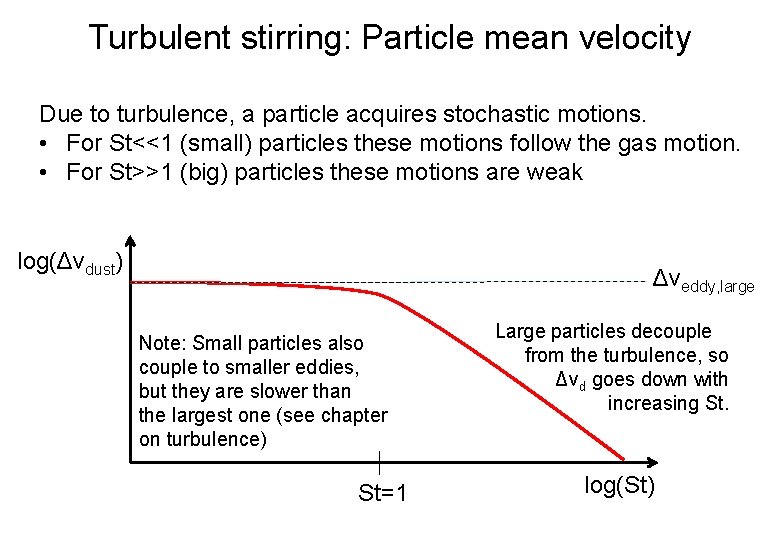
Turbulent stirring: Particle mean velocity Due to turbulence, a particle acquires stochastic motions. • For St<<1 (small) particles these motions follow the gas motion. • For St>>1 (big) particles these motions are weak log(Δvdust) Δveddy, large Note: Small particles also couple to smaller eddies, but they are slower than the largest one (see chapter on turbulence) St=1 Large particles decouple from the turbulence, so Δvd goes down with increasing St. log(St)
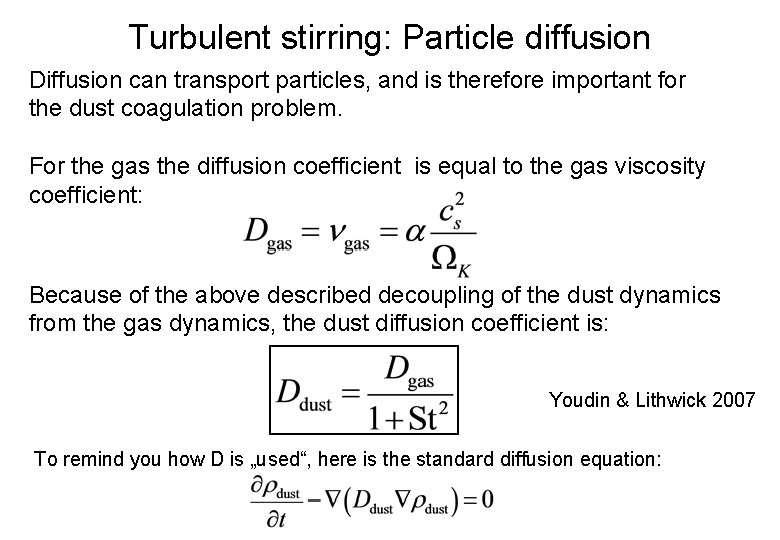
Turbulent stirring: Particle diffusion Diffusion can transport particles, and is therefore important for the dust coagulation problem. For the gas the diffusion coefficient is equal to the gas viscosity coefficient: Because of the above described decoupling of the dust dynamics from the gas dynamics, the dust diffusion coefficient is: Youdin & Lithwick 2007 To remind you how D is „used“, here is the standard diffusion equation:
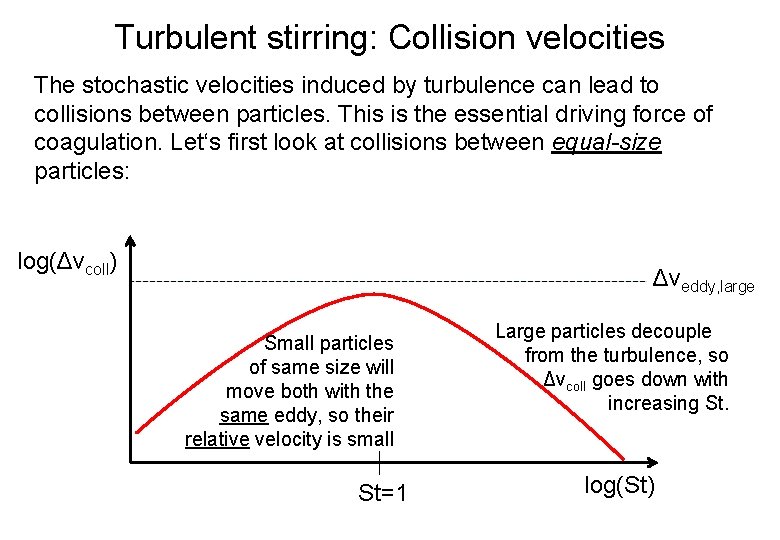
Turbulent stirring: Collision velocities The stochastic velocities induced by turbulence can lead to collisions between particles. This is the essential driving force of coagulation. Let‘s first look at collisions between equal-size particles: log(Δvcoll) Δveddy, large Small particles of same size will move both with the same eddy, so their relative velocity is small St=1 Large particles decouple from the turbulence, so Δvcoll goes down with increasing St. log(St)
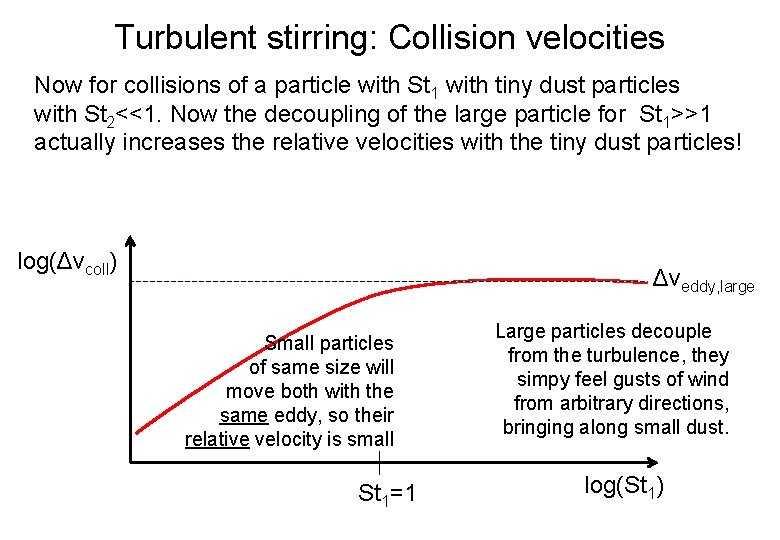
Turbulent stirring: Collision velocities Now for collisions of a particle with St 1 with tiny dust particles with St 2<<1. Now the decoupling of the large particle for St 1>>1 actually increases the relative velocities with the tiny dust particles! log(Δvcoll) Δveddy, large Small particles of same size will move both with the same eddy, so their relative velocity is small St 1=1 Large particles decouple from the turbulence, they simpy feel gusts of wind from arbitrary directions, bringing along small dust. log(St 1)
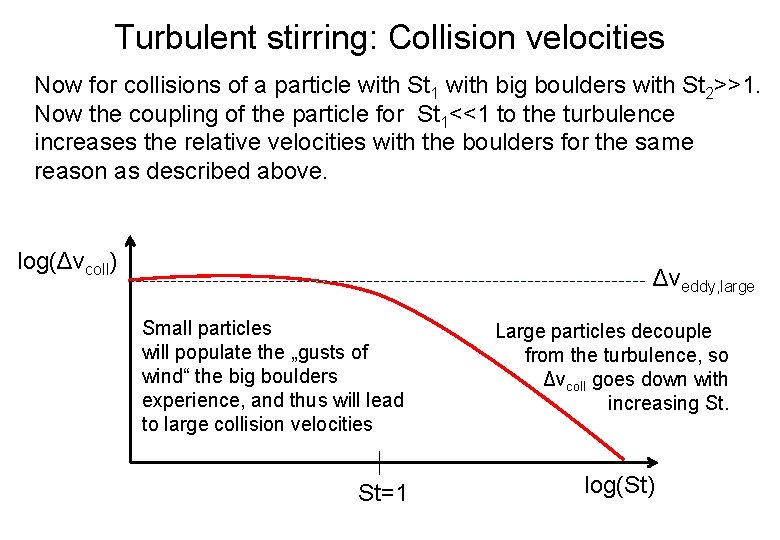
Turbulent stirring: Collision velocities Now for collisions of a particle with St 1 with big boulders with St 2>>1. Now the coupling of the particle for St 1<<1 to the turbulence increases the relative velocities with the boulders for the same reason as described above. log(Δvcoll) Δveddy, large Small particles will populate the „gusts of wind“ the big boulders experience, and thus will lead to large collision velocities St=1 Large particles decouple from the turbulence, so Δvcoll goes down with increasing St. log(St)
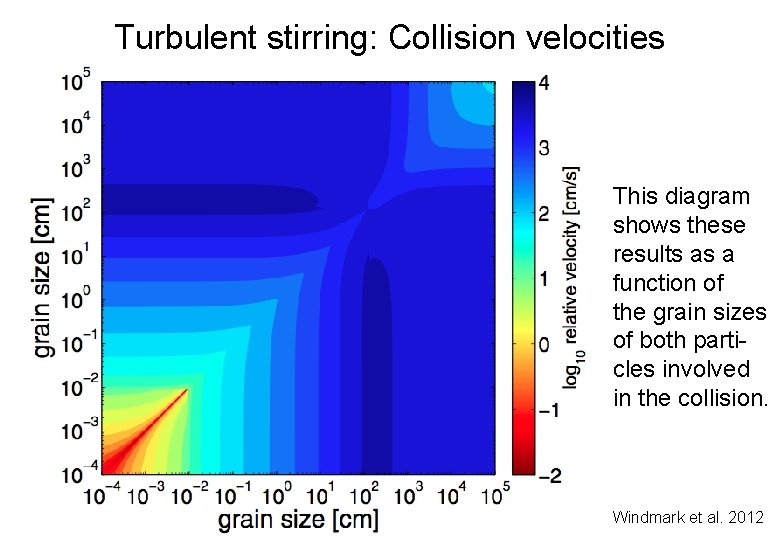
Turbulent stirring: Collision velocities This diagram shows these results as a function of the grain sizes of both particles involved in the collision. Windmark et al. 2012
Coagulation is driven by particle motion Part 2: Systematic motions: Vertical settling and radial drift
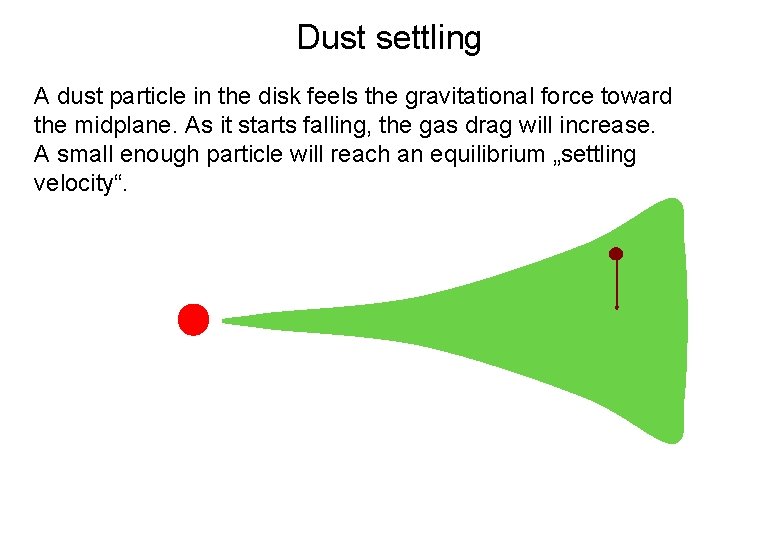
Dust settling A dust particle in the disk feels the gravitational force toward the midplane. As it starts falling, the gas drag will increase. A small enough particle will reach an equilibrium „settling velocity“.
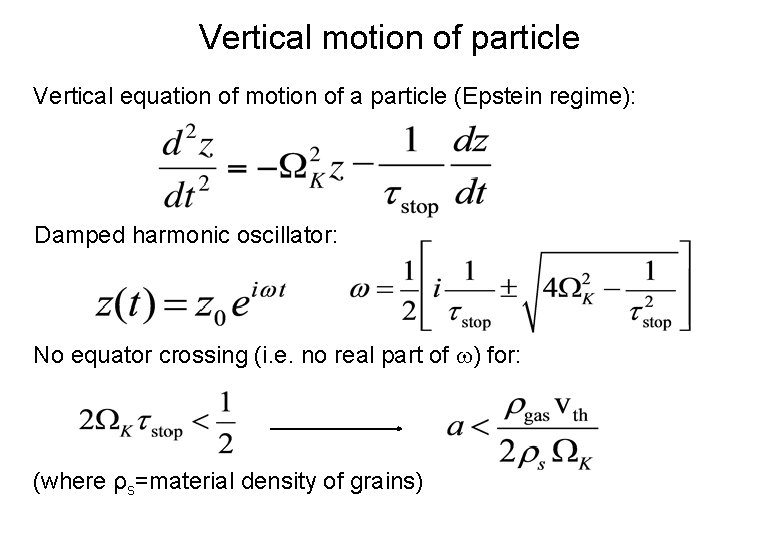
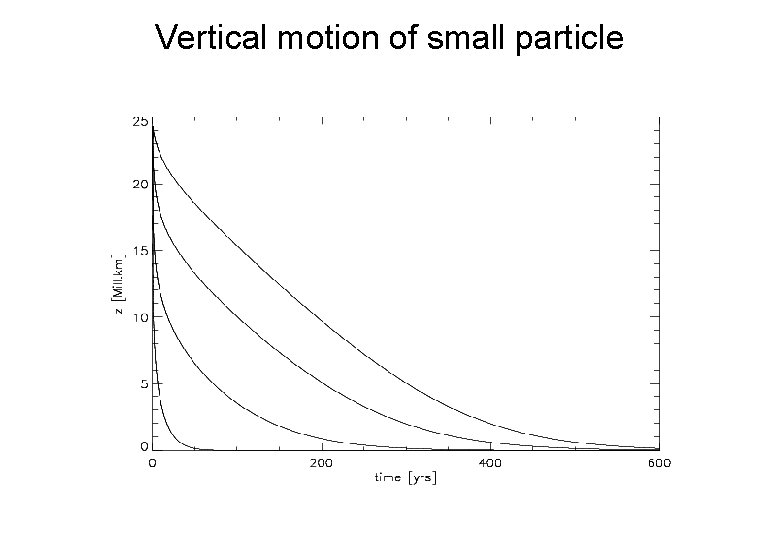
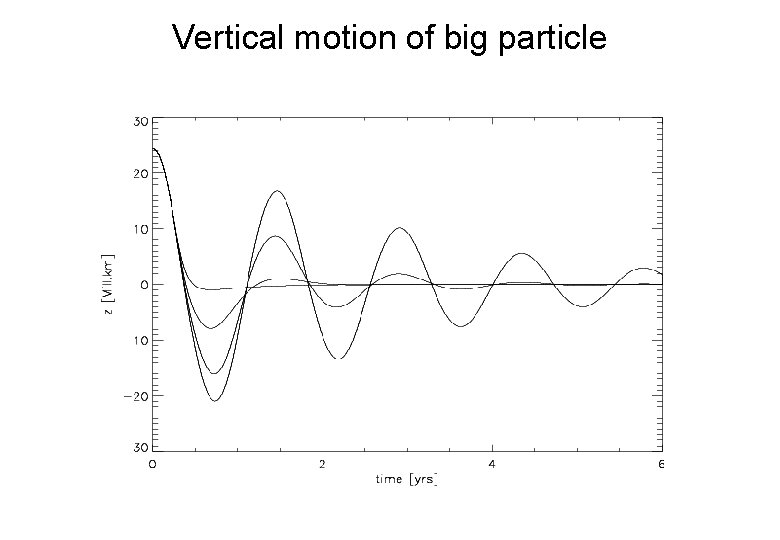
Vertical motion of particle Vertical equation of motion of a particle (Epstein regime): Damped harmonic oscillator: No equator crossing (i. e. no real part of ) for: (where ρs=material density of grains)
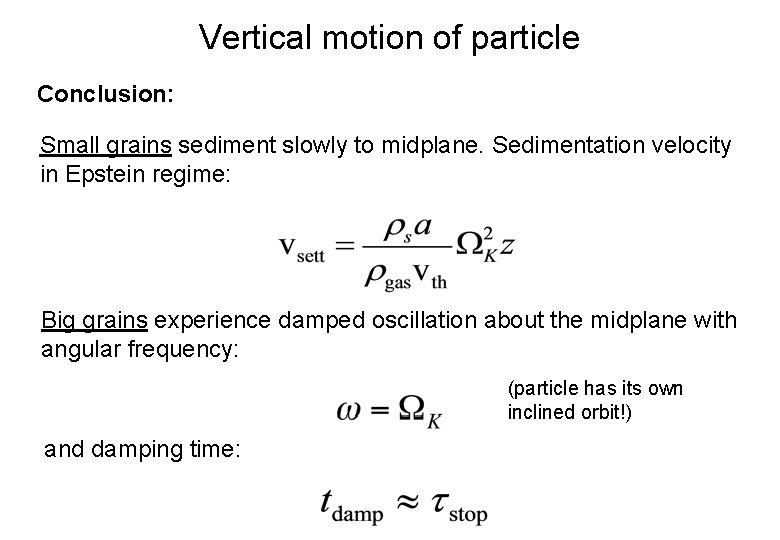
Vertical motion of particle Conclusion: Small grains sediment slowly to midplane. Sedimentation velocity in Epstein regime: Big grains experience damped oscillation about the midplane with angular frequency: (particle has its own inclined orbit!) and damping time:
Vertical motion of small particle
Vertical motion of big particle
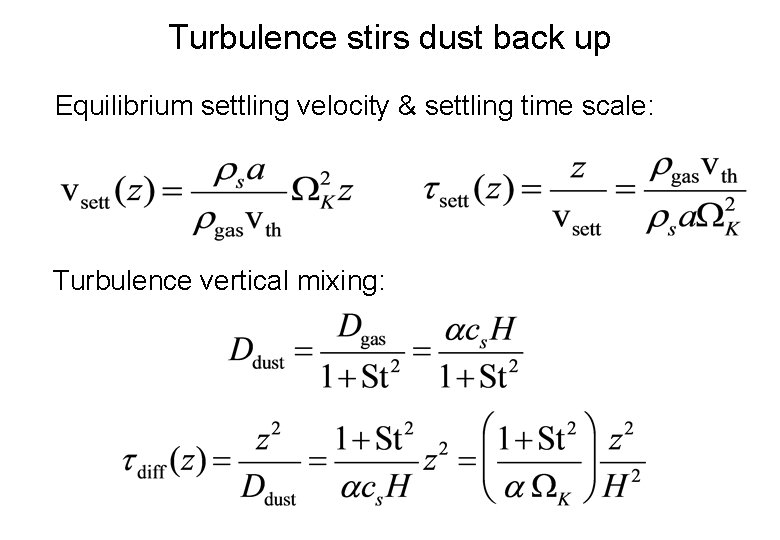
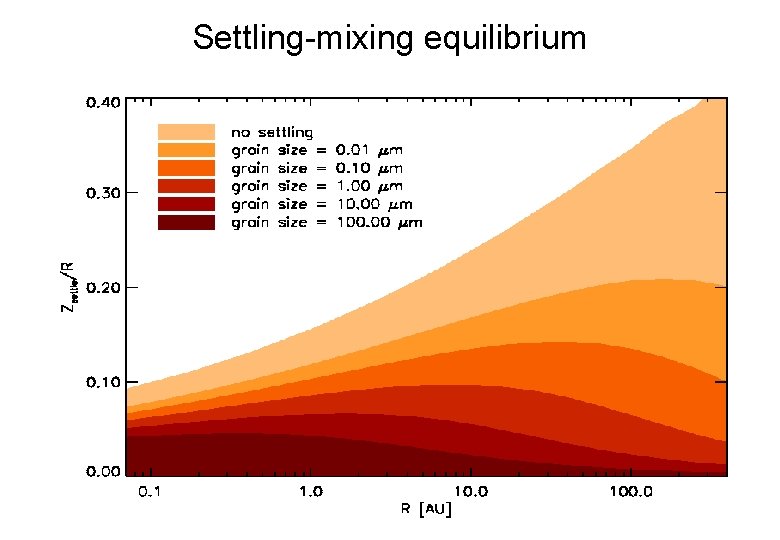
Turbulence stirs dust back up Equilibrium settling velocity & settling time scale: Turbulence vertical mixing:
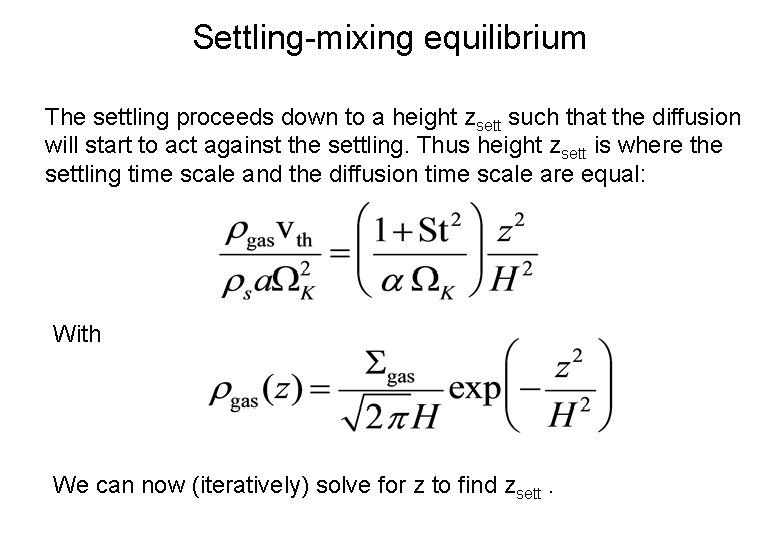
Settling-mixing equilibrium The settling proceeds down to a height zsett such that the diffusion will start to act against the settling. Thus height zsett is where the settling time scale and the diffusion time scale are equal: With We can now (iteratively) solve for z to find zsett.
Settling-mixing equilibrium
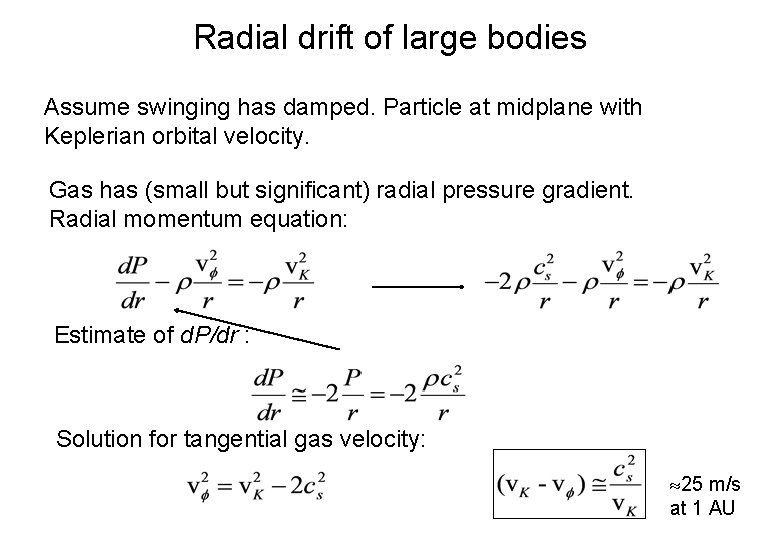
Radial drift of large bodies Assume swinging has damped. Particle at midplane with Keplerian orbital velocity. Gas has (small but significant) radial pressure gradient. Radial momentum equation: Estimate of d. P/dr : Solution for tangential gas velocity: 25 m/s at 1 AU
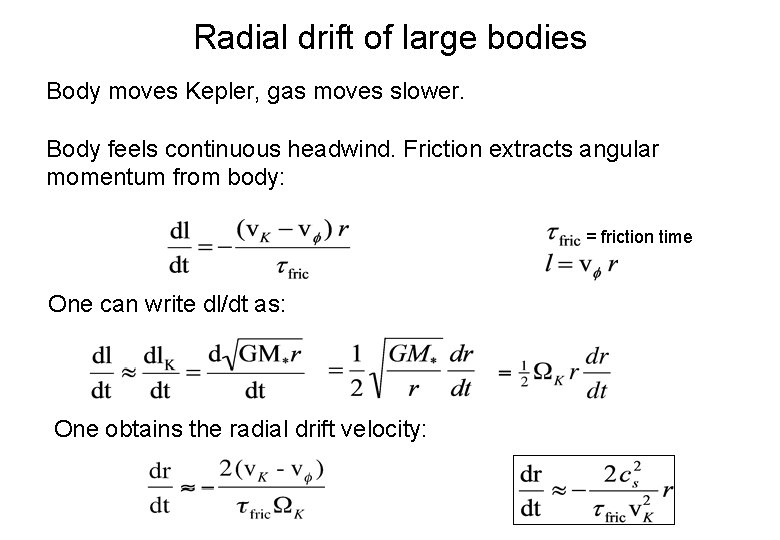
Radial drift of large bodies Body moves Kepler, gas moves slower. Body feels continuous headwind. Friction extracts angular momentum from body: = friction time One can write dl/dt as: One obtains the radial drift velocity:
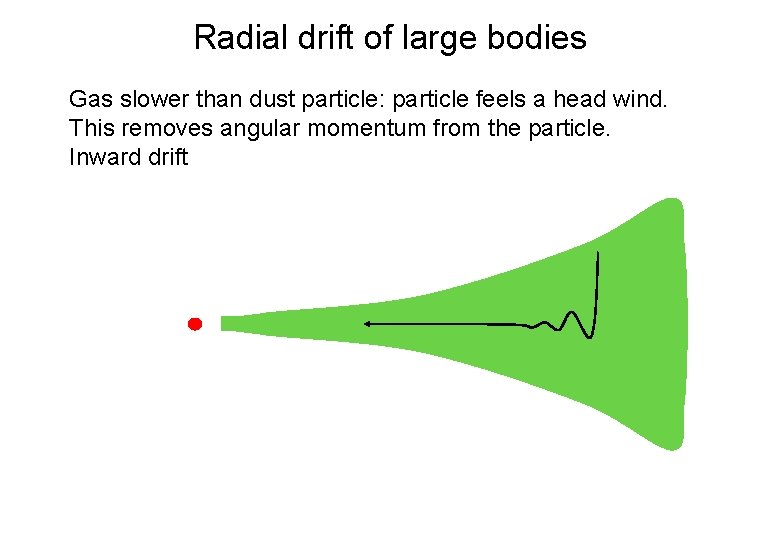
Radial drift of large bodies Gas slower than dust particle: particle feels a head wind. This removes angular momentum from the particle. Inward drift
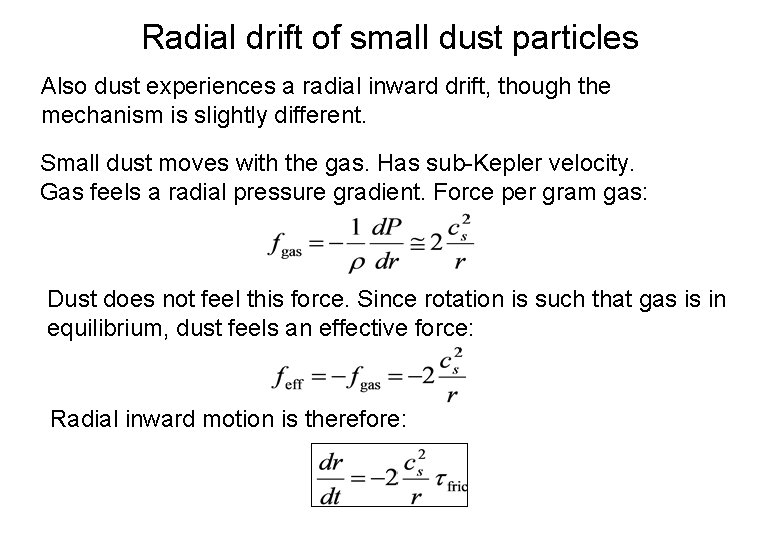
Radial drift of small dust particles Also dust experiences a radial inward drift, though the mechanism is slightly different. Small dust moves with the gas. Has sub-Kepler velocity. Gas feels a radial pressure gradient. Force per gram gas: Dust does not feel this force. Since rotation is such that gas is in equilibrium, dust feels an effective force: Radial inward motion is therefore:
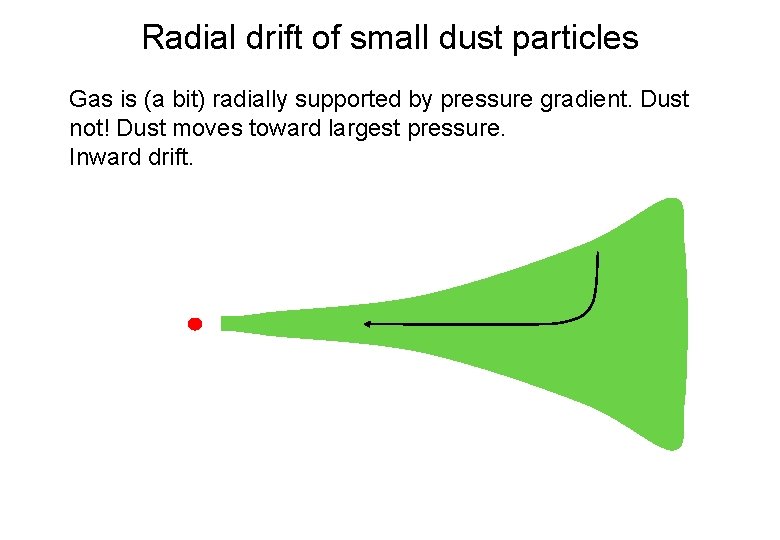
Radial drift of small dust particles Gas is (a bit) radially supported by pressure gradient. Dust not! Dust moves toward largest pressure. Inward drift.
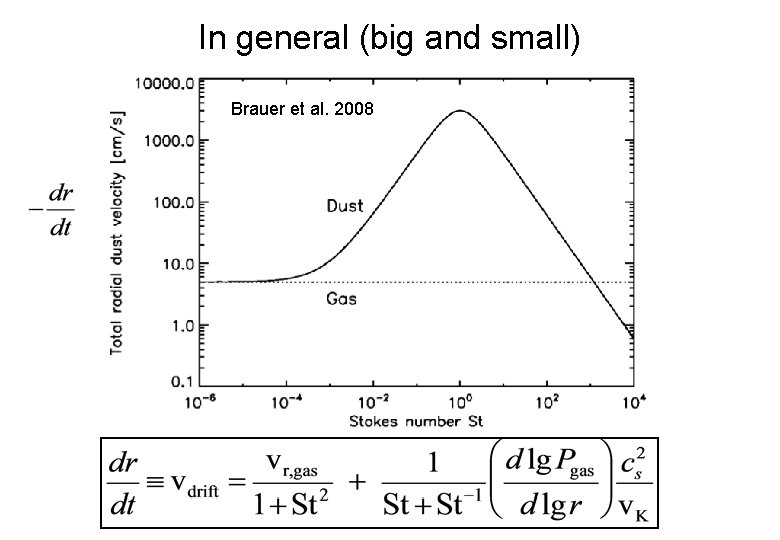
In general (big and small) Brauer et al. 2008
Simple analytical models of coagulation
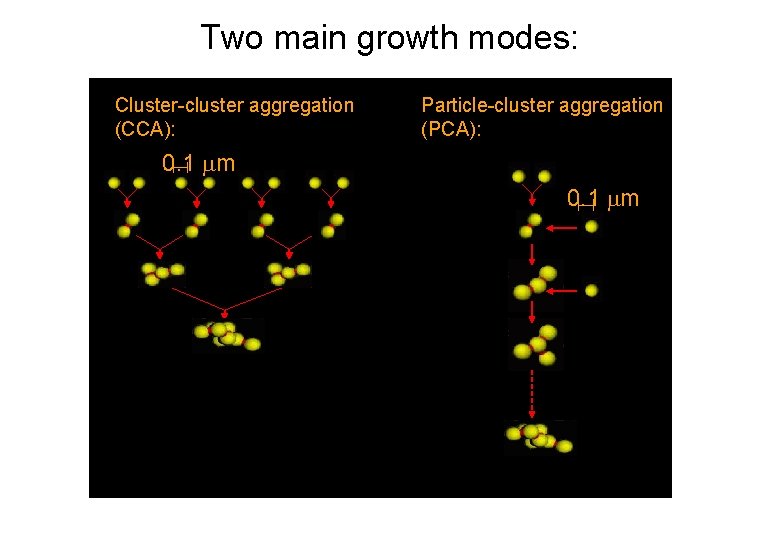
Two main growth modes: Cluster-cluster aggregation (CCA): Particle-cluster aggregation (PCA): 0. 1 m
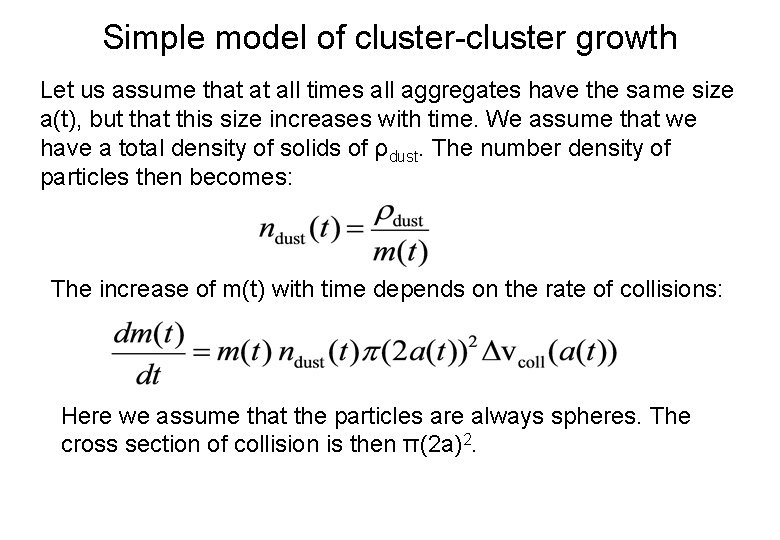
Simple model of cluster-cluster growth Let us assume that at all times all aggregates have the same size a(t), but that this size increases with time. We assume that we have a total density of solids of ρdust. The number density of particles then becomes: The increase of m(t) with time depends on the rate of collisions: Here we assume that the particles are always spheres. The cross section of collision is then π(2 a)2.
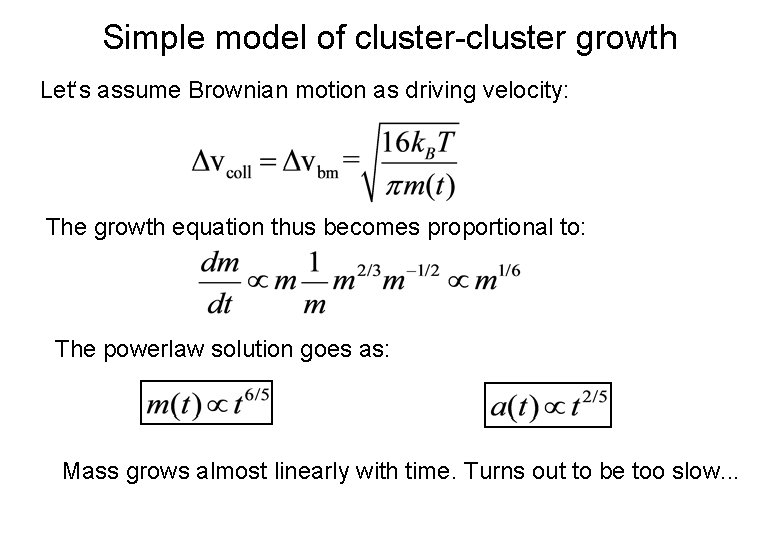
Simple model of cluster-cluster growth Let‘s assume Brownian motion as driving velocity: The growth equation thus becomes proportional to: The powerlaw solution goes as: Mass grows almost linearly with time. Turns out to be too slow. . .
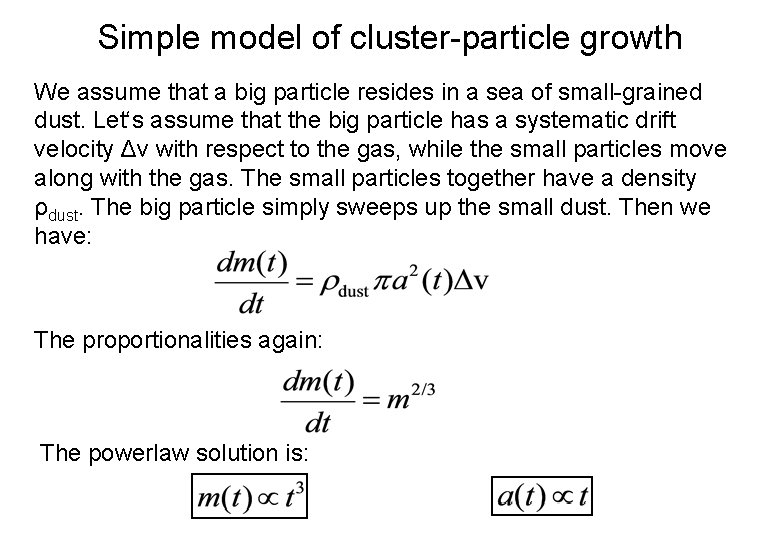
Simple model of cluster-particle growth We assume that a big particle resides in a sea of small-grained dust. Let‘s assume that the big particle has a systematic drift velocity Δv with respect to the gas, while the small particles move along with the gas. The small particles together have a density ρdust. The big particle simply sweeps up the small dust. Then we have: The proportionalities again: The powerlaw solution is:
How to properly model 30 the coagulation of 10 particles?
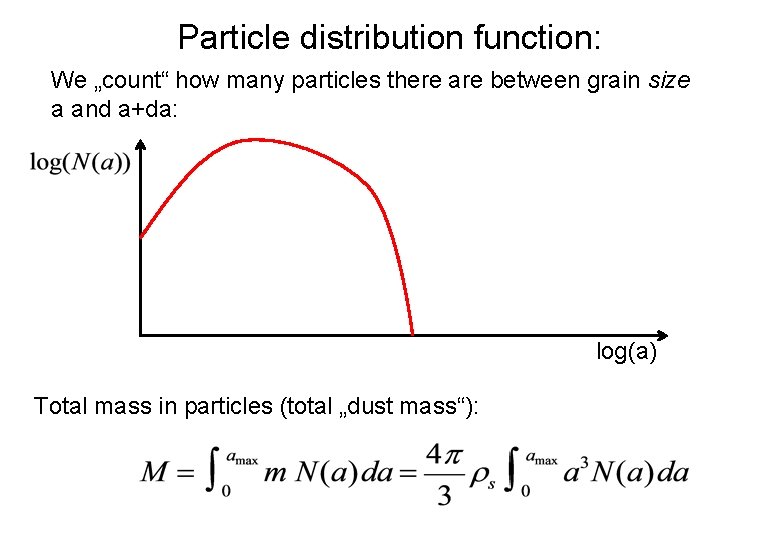
Particle distribution function: We „count“ how many particles there are between grain size a and a+da: log(a) Total mass in particles (total „dust mass“):
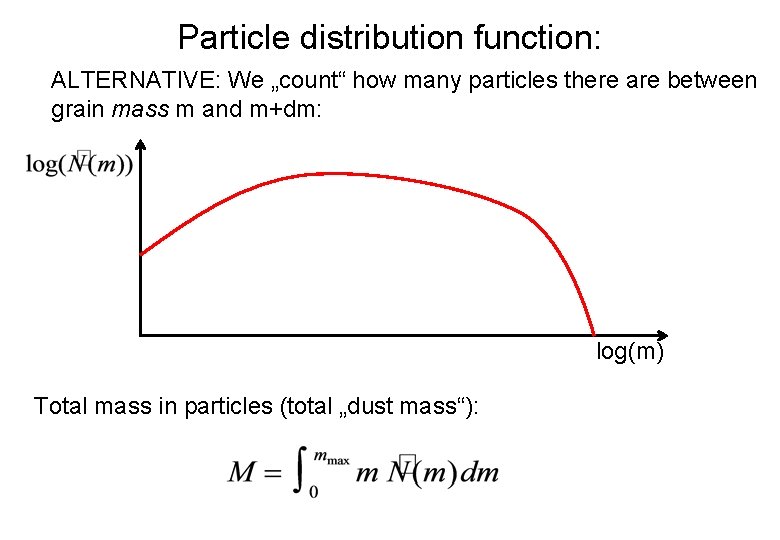
Particle distribution function: ALTERNATIVE: We „count“ how many particles there are between grain mass m and m+dm: log(m) Total mass in particles (total „dust mass“):
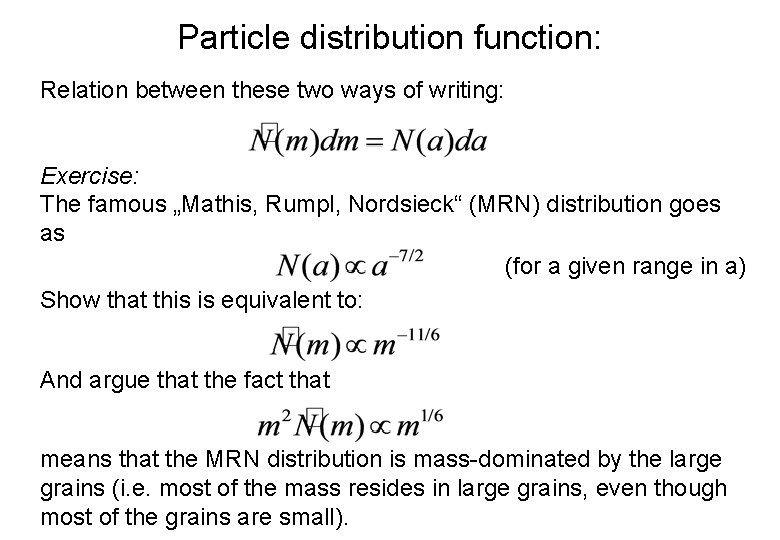
Particle distribution function: Relation between these two ways of writing: Exercise: The famous „Mathis, Rumpl, Nordsieck“ (MRN) distribution goes as (for a given range in a) Show that this is equivalent to: And argue that the fact that means that the MRN distribution is mass-dominated by the large grains (i. e. most of the mass resides in large grains, even though most of the grains are small).
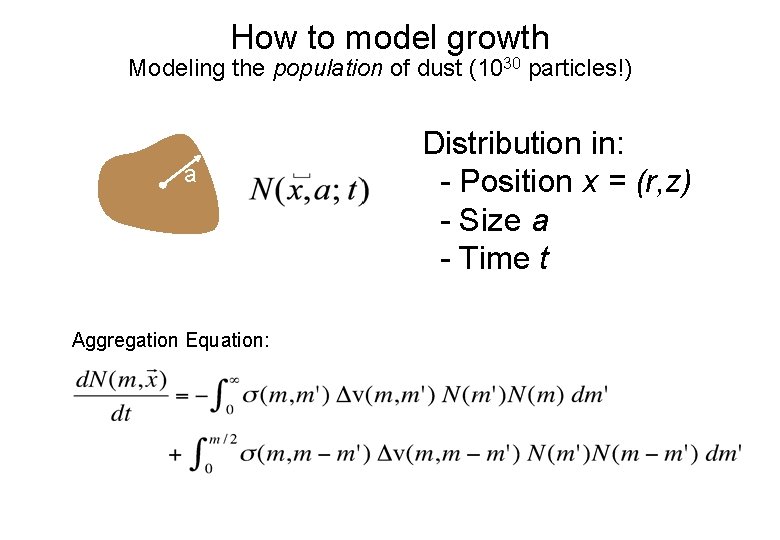
How to model growth Modeling the population of dust (1030 particles!) a Aggregation Equation: Distribution in: - Position x = (r, z) - Size a - Time t
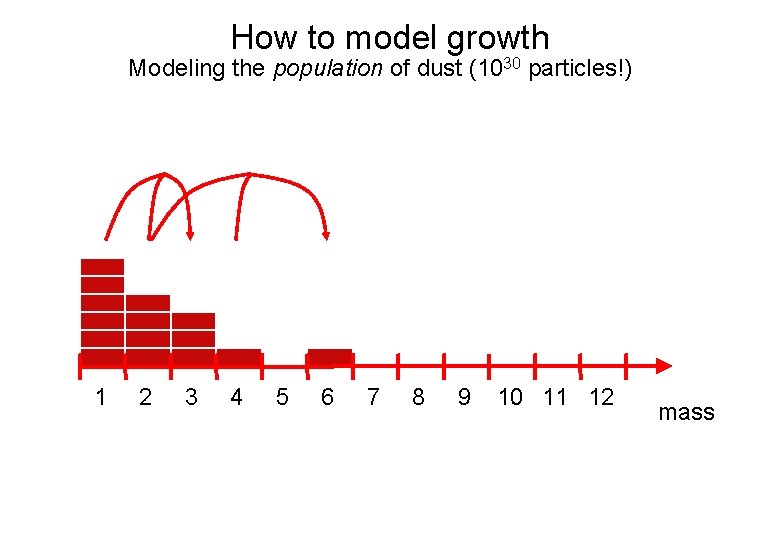
How to model growth Modeling the population of dust (1030 particles!) 1 2 3 4 5 6 7 8 9 10 11 12 mass
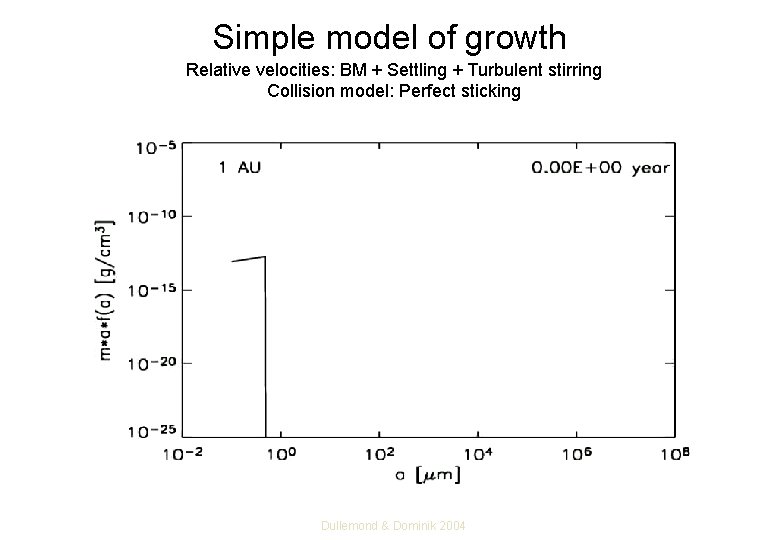
Simple model of growth Relative velocities: BM + Settling + Turbulent stirring Collision model: Perfect sticking Dullemond & Dominik 2004
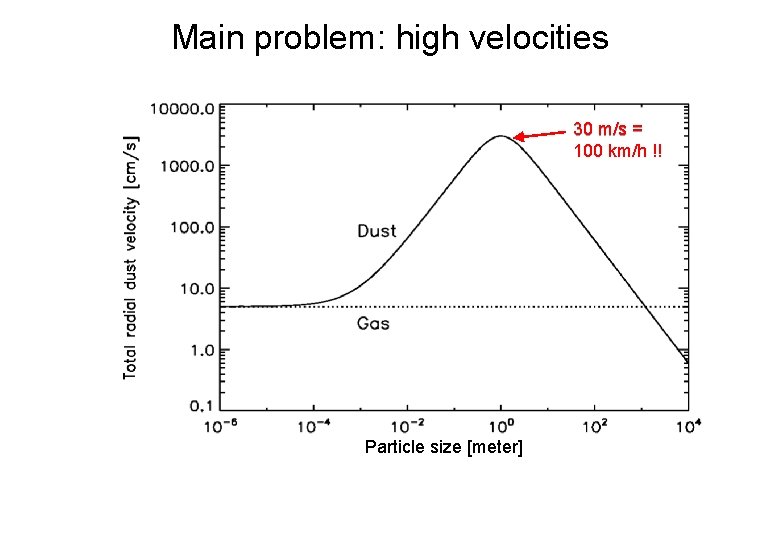
Main problem: high velocities 30 m/s = 100 km/h !! Particle size [meter]
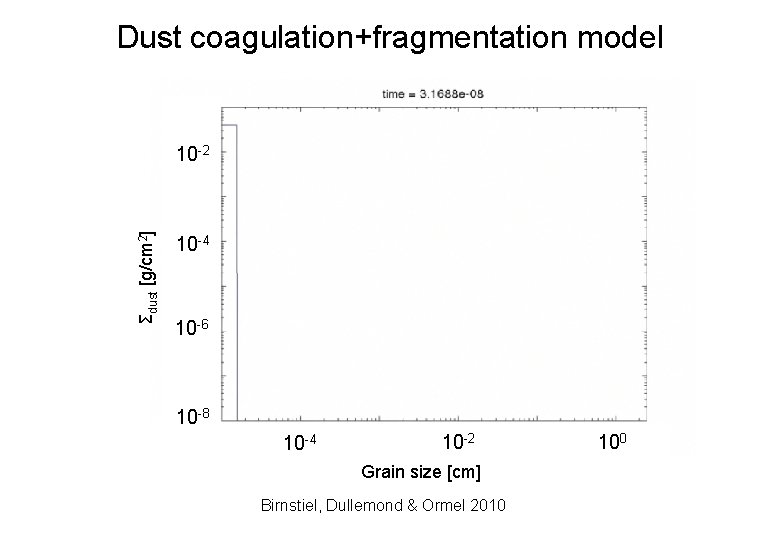
Dust coagulation+fragmentation model Σdust [g/cm 2] 10 -2 10 -4 10 -6 10 -8 10 -4 10 -2 Grain size [cm] Birnstiel, Dullemond & Ormel 2010 100
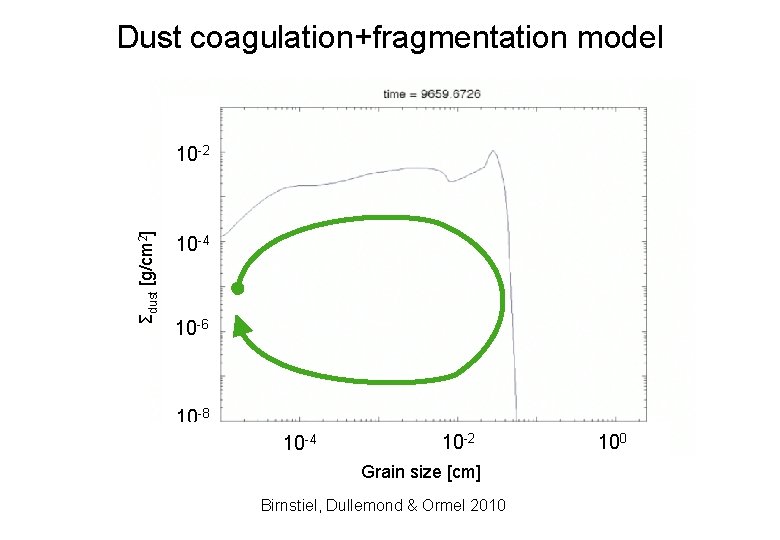
Dust coagulation+fragmentation model Σdust [g/cm 2] 10 -2 10 -4 10 -6 10 -8 10 -4 10 -2 Grain size [cm] Birnstiel, Dullemond & Ormel 2010 100
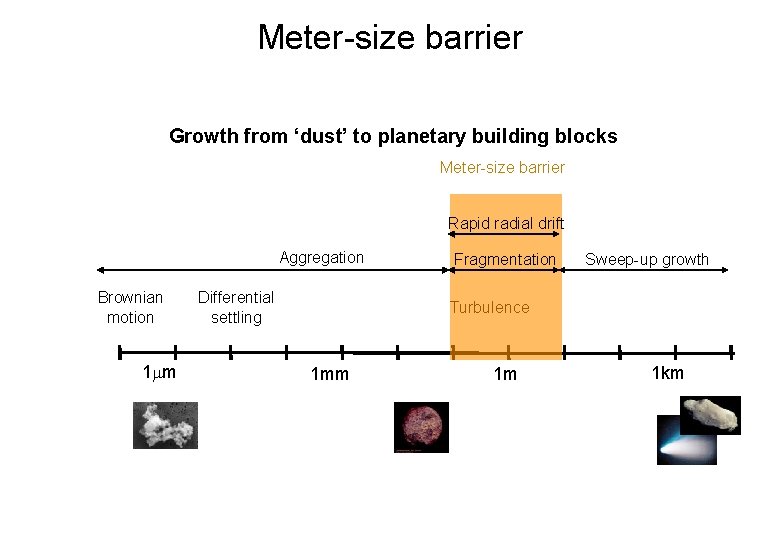
Meter-size barrier Growth from ‘dust’ to planetary building blocks Meter-size barrier Rapid radial drift Aggregation Brownian motion 1 m Differential settling Fragmentation Sweep-up growth Turbulence 1 mm 1 m 1 km
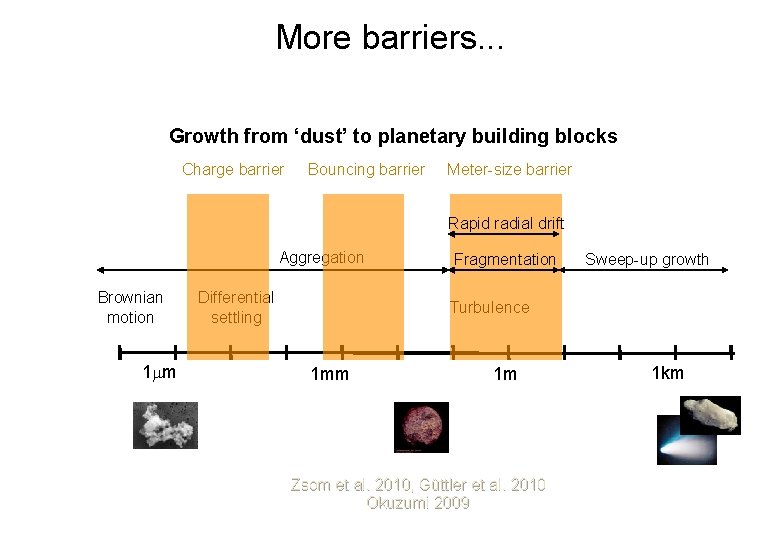
More barriers. . . Growth from ‘dust’ to planetary building blocks Charge barrier Bouncing barrier Meter-size barrier Rapid radial drift Aggregation Brownian motion 1 m Differential settling Fragmentation Sweep-up growth Turbulence 1 mm 1 m Zsom et al. 2010, Güttler et al. 2010 Okuzumi 2009 1 km
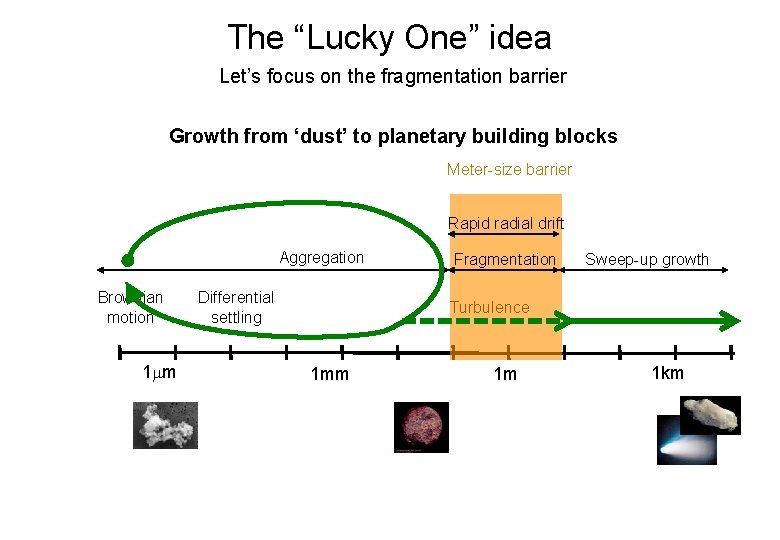
The “Lucky One” idea Let’s focus on the fragmentation barrier Growth from ‘dust’ to planetary building blocks Meter-size barrier Rapid radial drift Aggregation Brownian motion 1 m Differential settling Fragmentation Sweep-up growth Turbulence 1 mm 1 m 1 km
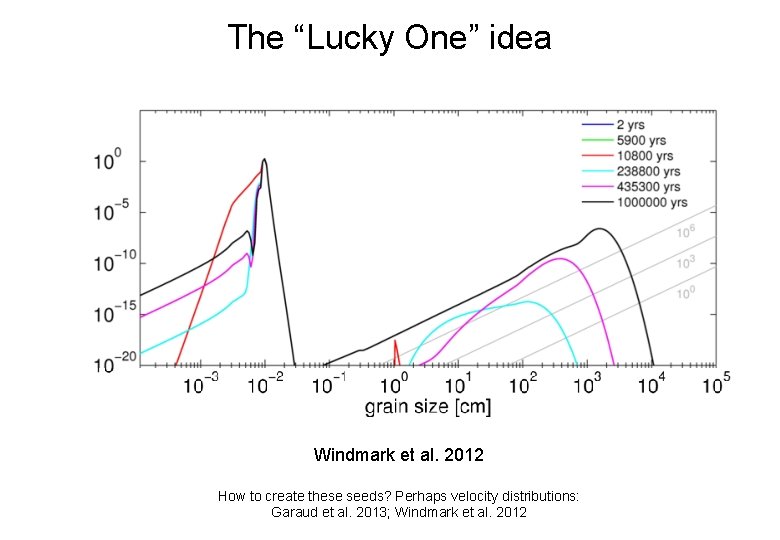
The “Lucky One” idea Particle abundance Low sticking efficiency Windmark et al. 2012 How to create these seeds? Perhaps velocity distributions: Garaud et al. 2013; Windmark et al. 2012