
PLANET FORMATION BY DISC INSTABILITY IN M DWARF
PLANET FORMATION BY DISC INSTABILITY IN M DWARF DISCS ΔΗΜΗΤΡΗΣ ΣΤΑΜΑΤΕΛΛΟΣ (with Anthony Mercer)
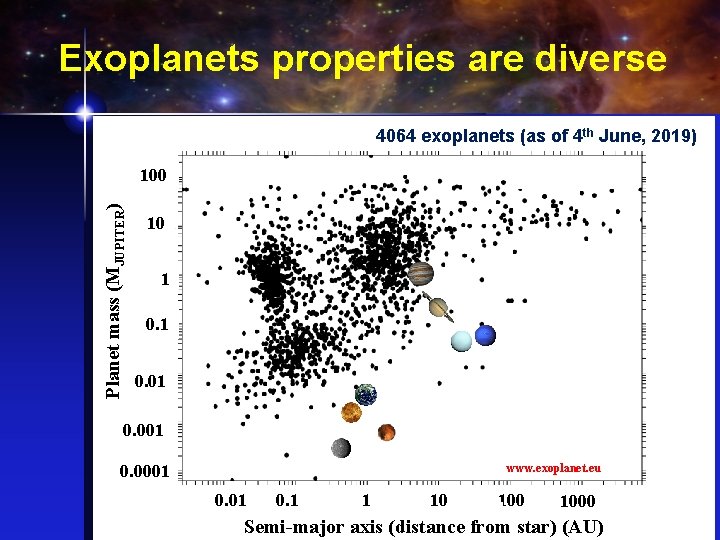
Exoplanets properties are diverse 4064 exoplanets (as of 4 th June, 2019) Planet mass (MJUPITER) 100 10 1 0. 01 0. 001 www. exoplanet. eu 0. 0001 0. 1 1 10 1000 Semi-major axis (distance from star) (AU)
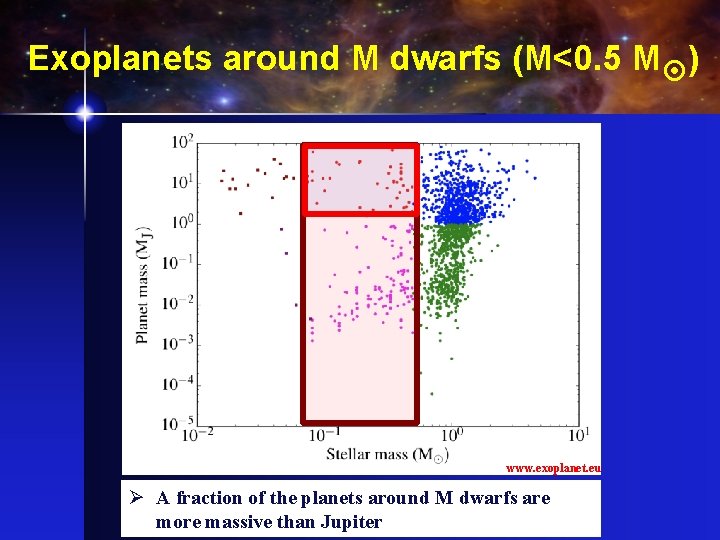
Exoplanets around M dwarfs (M<0. 5 M ) www. exoplanet. eu Ø A fraction of the planets around M dwarfs are more massive than Jupiter
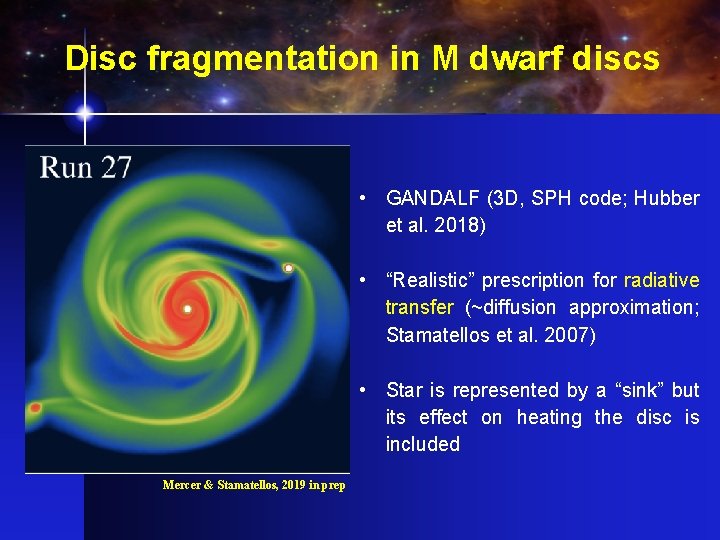
Disc fragmentation in M dwarf discs • GANDALF (3 D, SPH code; Hubber et al. 2018) • “Realistic” prescription for radiative transfer (~diffusion approximation; Stamatellos et al. 2007) • Star is represented by a “sink” but its effect on heating the disc is included Mercer & Stamatellos, 2019 in prep
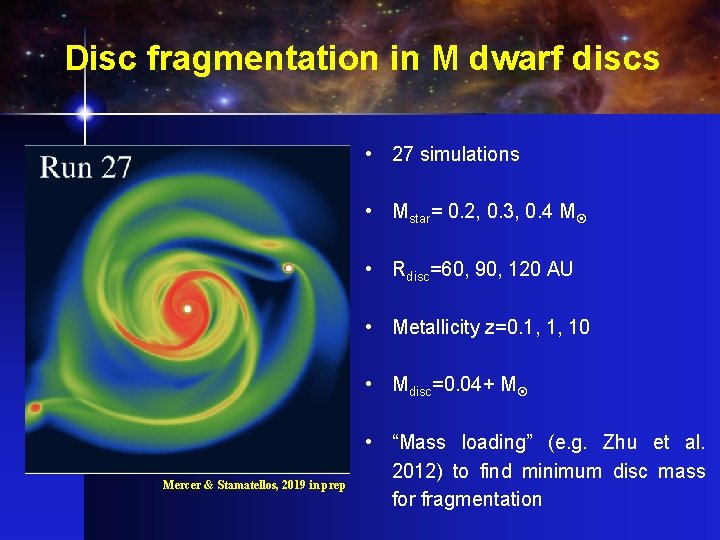
Disc fragmentation in M dwarf discs • 27 simulations • Mstar= 0. 2, 0. 3, 0. 4 M • Rdisc=60, 90, 120 AU • Metallicity z=0. 1, 1, 10 • Mdisc=0. 04+ M Mercer & Stamatellos, 2019 in prep • “Mass loading” (e. g. Zhu et al. 2012) to find minimum disc mass for fragmentation
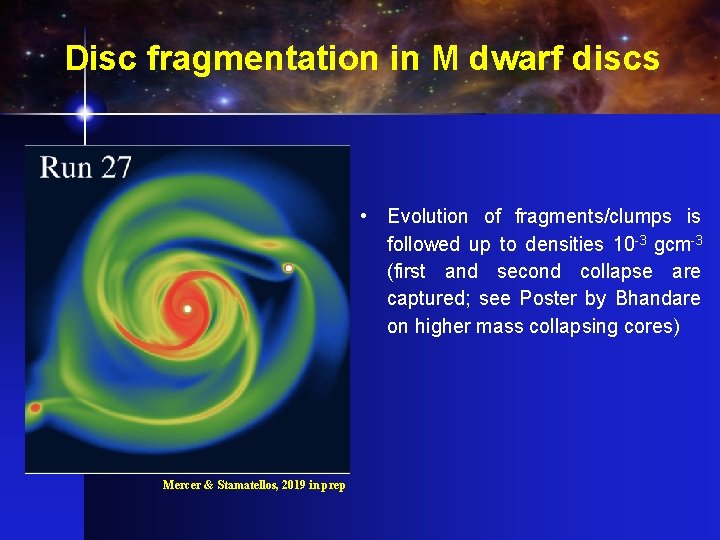
Disc fragmentation in M dwarf discs • Evolution of fragments/clumps is followed up to densities 10 -3 gcm-3 (first and second collapse are captured; see Poster by Bhandare on higher mass collapsing cores) Mercer & Stamatellos, 2019 in prep
![Disc minimum mass for fragmentation [27 simulations] Ø High disc-to-stellar mass ratios are needed](http://slidetodoc.com/presentation_image_h2/bd621f30b3c5e5e864b20239aff8060d/image-7.jpg "Disc minimum mass for fragmentation [27 simulations] Ø High disc-to-stellar mass ratios are needed")
Disc minimum mass for fragmentation [27 simulations] Ø High disc-to-stellar mass ratios are needed
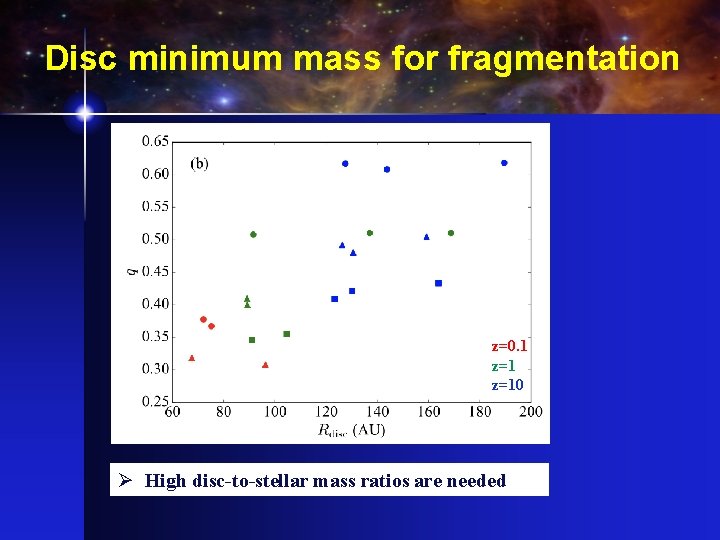
Disc minimum mass for fragmentation z=0. 1 z=10 Ø High disc-to-stellar mass ratios are needed
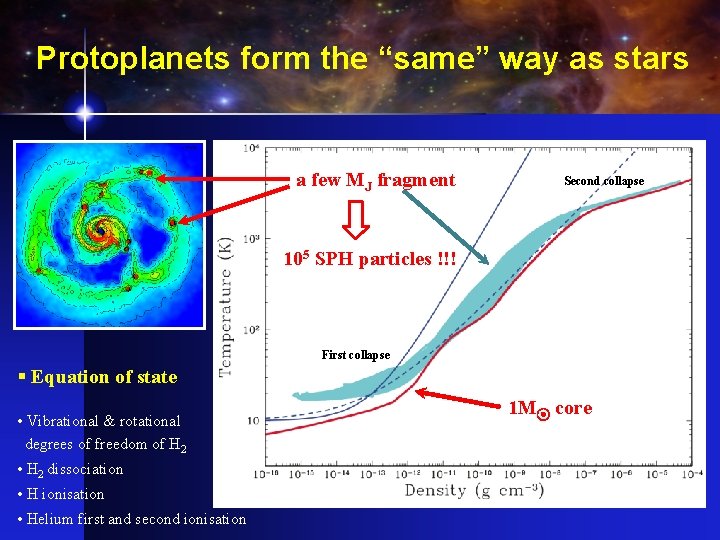
Protoplanets form the “same” way as stars a few MJ fragment Second collapse 105 SPH particles !!! First collapse § Equation of state • Vibrational & rotational degrees of freedom of H 2 • H 2 dissociation • H ionisation • Helium first and second ionisation 1 M⦿ core
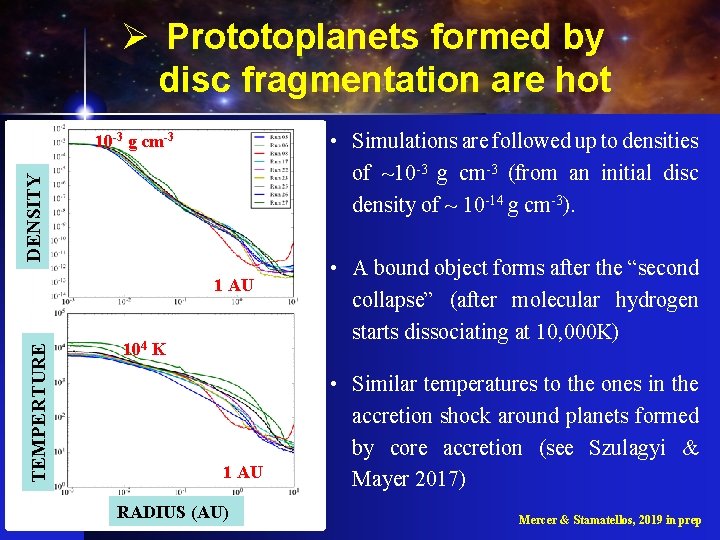
Ø Prototoplanets formed by disc fragmentation are hot • Simulations are followed up to densities of ~10 -3 g cm-3 (from an initial disc density of ~ 10 -14 g cm-3). DENSITY 10 -3 g cm-3 TEMPERTURE 1 AU 104 K 1 AU RADIUS (AU) • A bound object forms after the “second collapse” (after molecular hydrogen starts dissociating at 10, 000 K) • Similar temperatures to the ones in the accretion shock around planets formed by core accretion (see Szulagyi & Mayer 2017) Mercer & Stamatellos, 2019 in prep
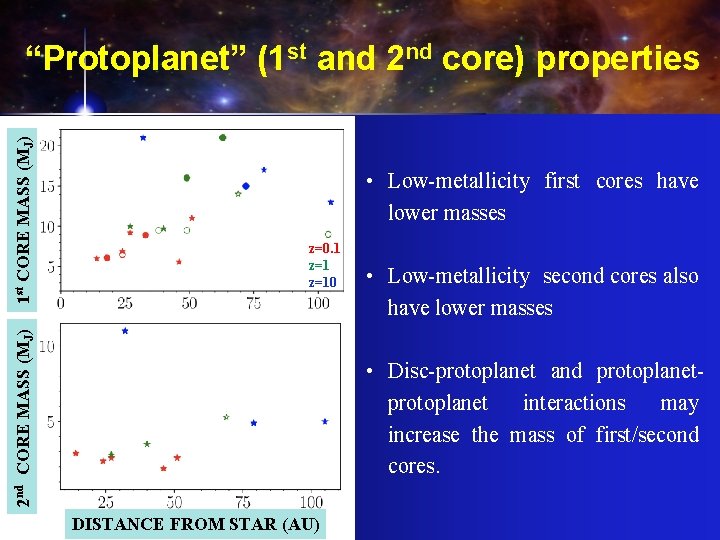
• Low-metallicity first cores have lower masses z=0. 1 z=10 2 nd CORE MASS (MJ) 1 st CORE MASS (MJ) “Protoplanet” (1 st and 2 nd core) properties • Low-metallicity second cores also have lower masses • Disc-protoplanet and protoplanet interactions may increase the mass of first/second cores. DISTANCE FROM STAR (AU)

Disc instability protoplanets: Evolution is critical for their final properties Stamatellos & Whitworth 2009 Gas accretion Stamatellos & Inutsuka 2018 Baruteau et al. 2011 PLANET MASS (MJ) Migration Nayakshin 2018 Tidal downsizing z=0. 1 z=10 DISTANCE FROM STAR (AU)

Disc instability protoplanets: Evolution is critical for their final properties Ø Protoplanet final mass and radius as estimated by hydrodynamic simulations are uncertain by a factor of ~2 Fletcher et al. 2019, MNRAS
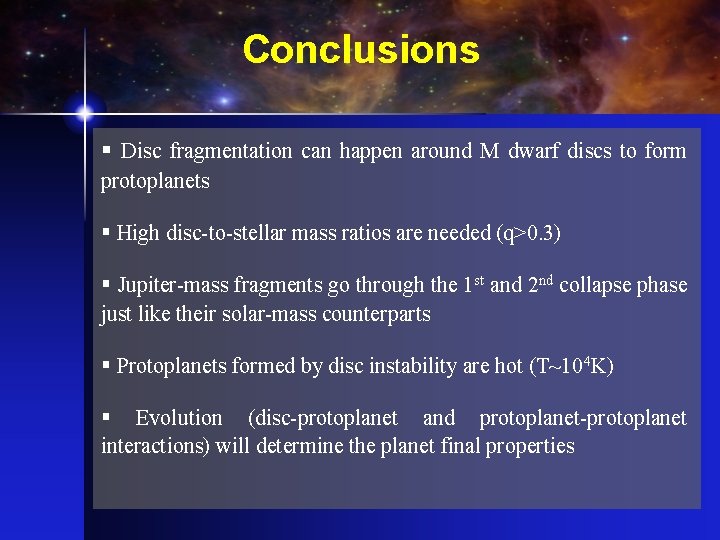
Conclusions § Disc fragmentation can happen around M dwarf discs to form protoplanets § High disc-to-stellar mass ratios are needed (q>0. 3) § Jupiter-mass fragments go through the 1 st and 2 nd collapse phase just like their solar-mass counterparts § Protoplanets formed by disc instability are hot (T~104 K) § Evolution (disc-protoplanet and protoplanet-protoplanet interactions) will determine the planet final properties
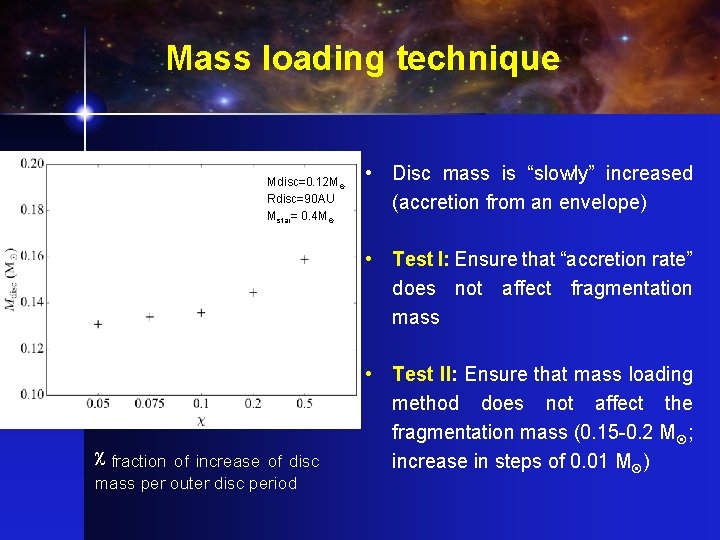
Mass loading technique Mdisc=0. 12 M Rdisc=90 AU Mstar= 0. 4 M • Disc mass is “slowly” increased (accretion from an envelope) • Test I: Ensure that “accretion rate” does not affect fragmentation mass χ fraction of increase of disc mass per outer disc period • Test II: Ensure that mass loading method does not affect the fragmentation mass (0. 15 -0. 2 M ; increase in steps of 0. 01 M )
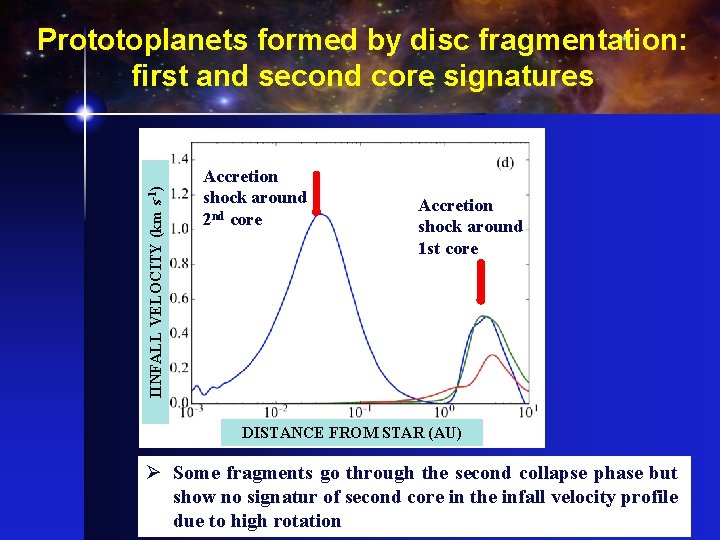
IINFALL VELOCITY (km s-1) Prototoplanets formed by disc fragmentation: first and second core signatures Accretion shock around 2 nd core Accretion shock around 1 st core DISTANCE FROM STAR (AU) Ø Some fragments go through the second collapse phase but show no signatur of second core in the infall velocity profile due to high rotation
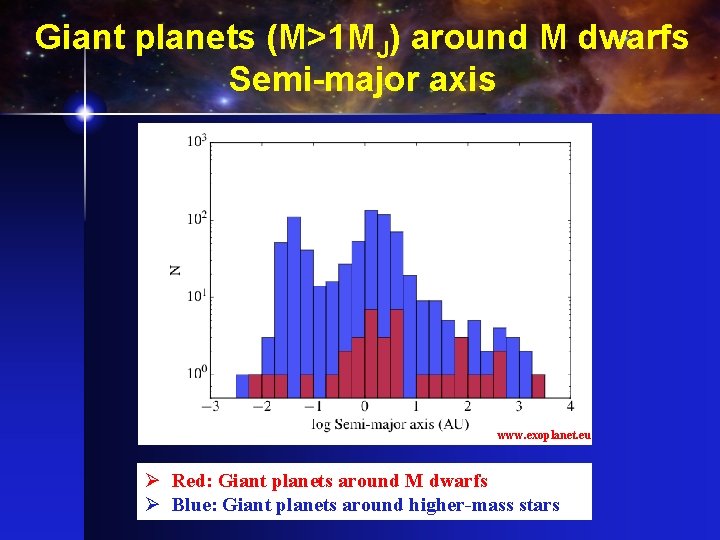
Giant planets (M>1 MJ) around M dwarfs Semi-major axis www. exoplanet. eu Ø Red: Giant planets around M dwarfs Ø Blue: Giant planets around higher-mass stars
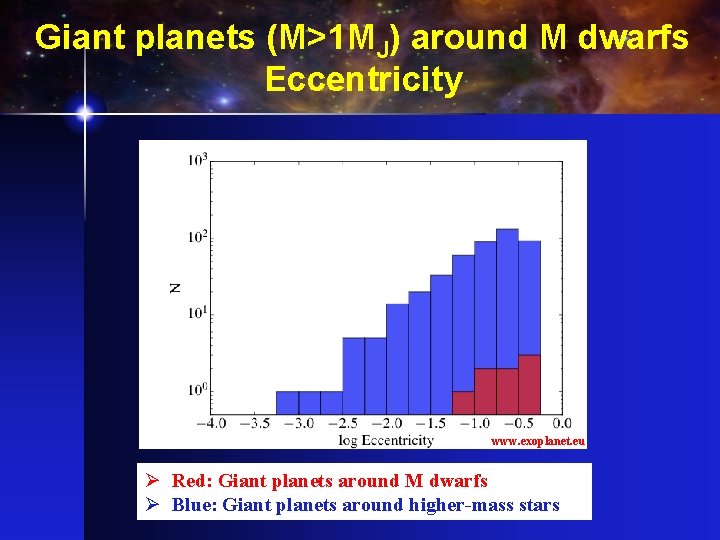
Giant planets (M>1 MJ) around M dwarfs Eccentricity www. exoplanet. eu Ø Red: Giant planets around M dwarfs Ø Blue: Giant planets around higher-mass stars
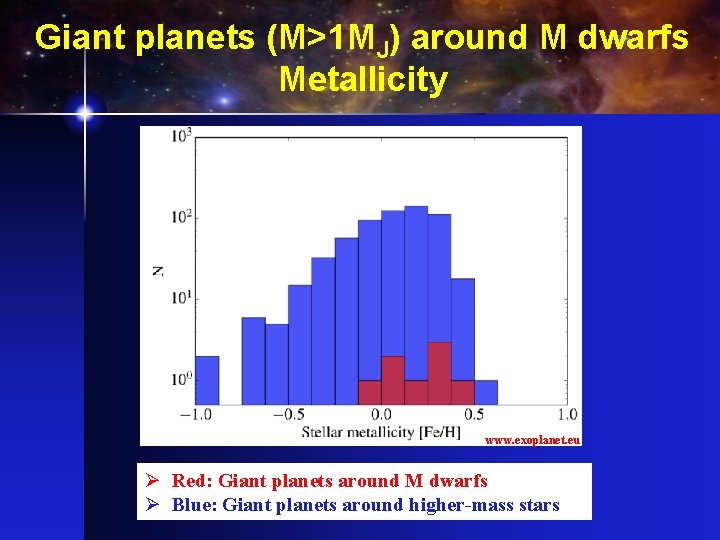
Giant planets (M>1 MJ) around M dwarfs Metallicity www. exoplanet. eu Ø Red: Giant planets around M dwarfs Ø Blue: Giant planets around higher-mass stars
- Slides: 19