
Planet Earths Cycles http apod nasa govapodimage0201earthriseapollo 8
- Slides: 18
Planet Earth’s Cycles http: //apod. nasa. gov/apod/image/0201/earthrise_apollo 8. jpg
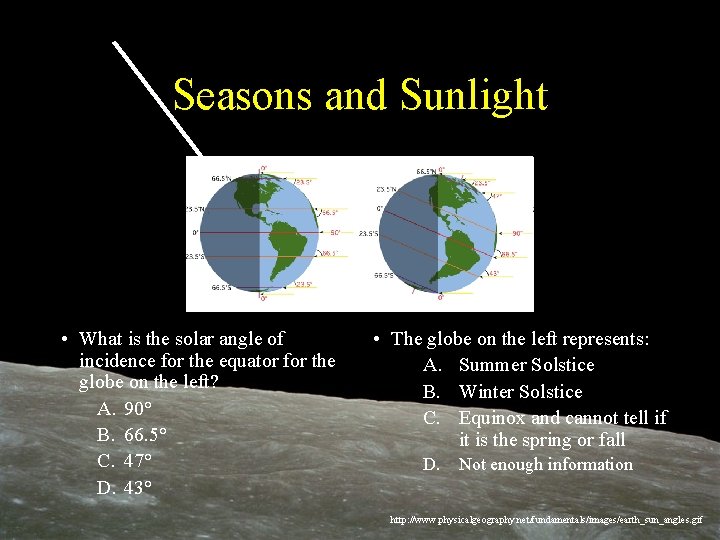
Seasons and Sunlight • What is the solar angle of incidence for the equator for the globe on the left? A. 90° B. 66. 5° C. 47° D. 43° • The globe on the left represents: A. Summer Solstice B. Winter Solstice C. Equinox and cannot tell if it is the spring or fall D. Not enough information http: //www. physicalgeography. net/fundamentals/images/earth_sun_angles. gif
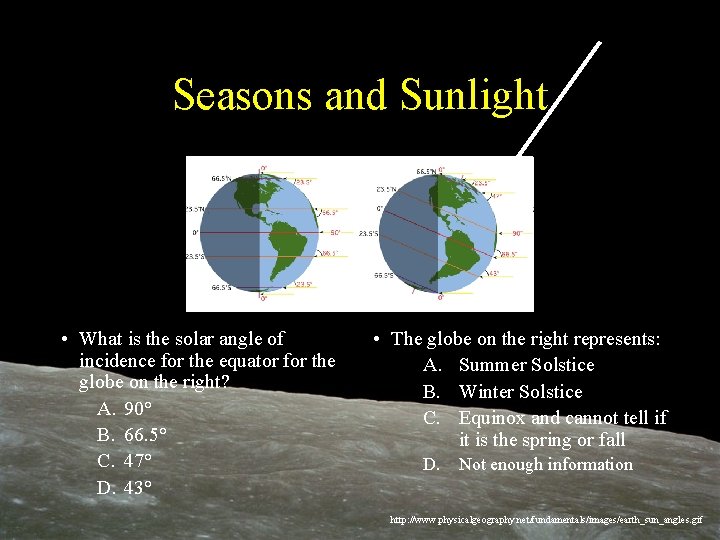
Seasons and Sunlight • What is the solar angle of incidence for the equator for the globe on the right? A. 90° B. 66. 5° C. 47° D. 43° • The globe on the right represents: A. Summer Solstice B. Winter Solstice C. Equinox and cannot tell if it is the spring or fall D. Not enough information http: //www. physicalgeography. net/fundamentals/images/earth_sun_angles. gif
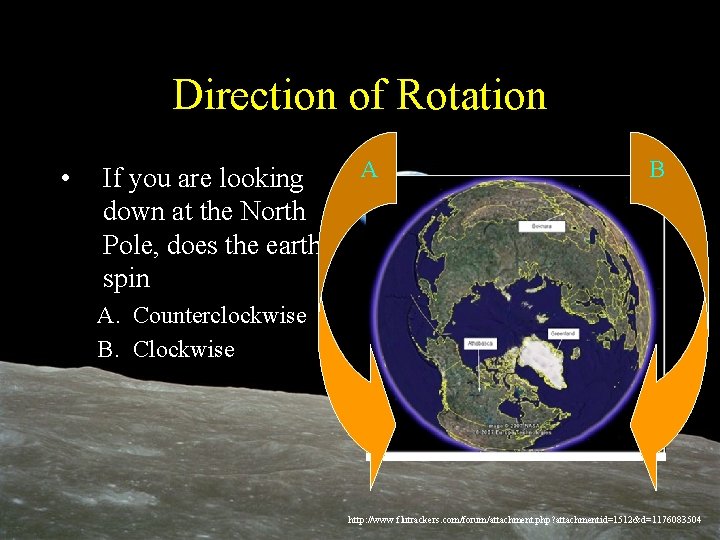
Direction of Rotation • If you are looking down at the North Pole, does the earth spin A B A. Counterclockwise B. Clockwise http: //www. flutrackers. com/forum/attachment. php? attachmentid=1512&d=1176083504
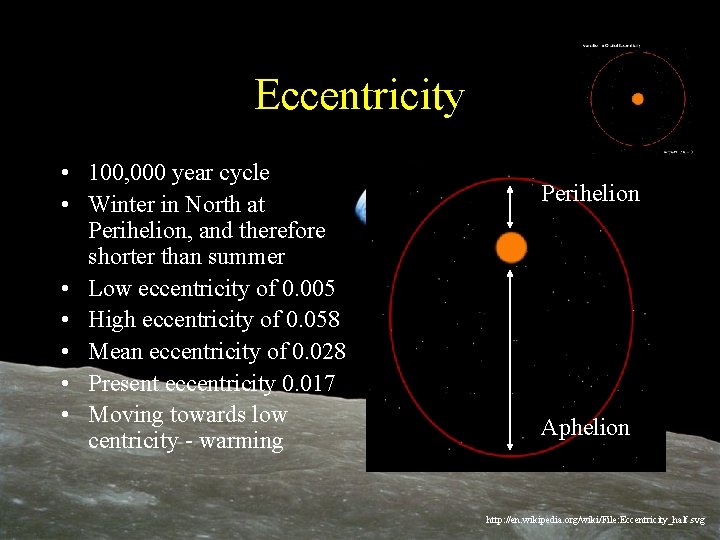
Eccentricity • 100, 000 year cycle • Winter in North at Perihelion, and therefore shorter than summer • Low eccentricity of 0. 005 • High eccentricity of 0. 058 • Mean eccentricity of 0. 028 • Present eccentricity 0. 017 • Moving towards low centricity - warming Perihelion Aphelion http: //en. wikipedia. org/wiki/File: Eccentricity_half. svg
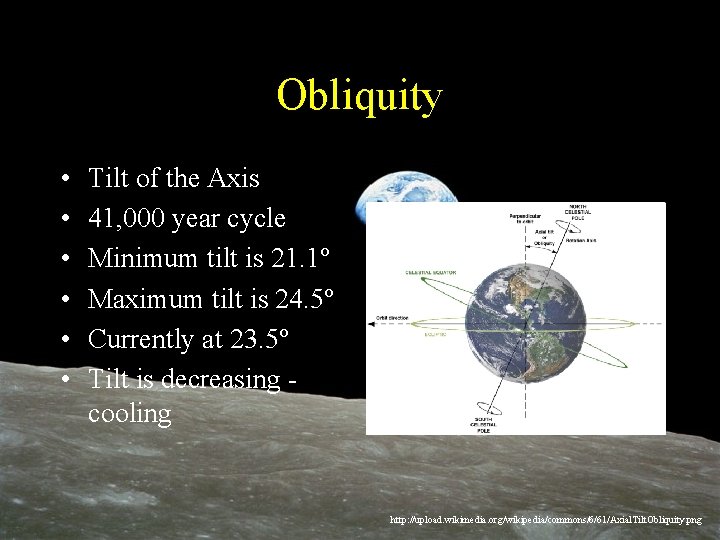
Obliquity • • • Tilt of the Axis 41, 000 year cycle Minimum tilt is 21. 1º Maximum tilt is 24. 5º Currently at 23. 5º Tilt is decreasing cooling http: //upload. wikimedia. org/wikipedia/commons/6/61/Axial. Tilt. Obliquity. png
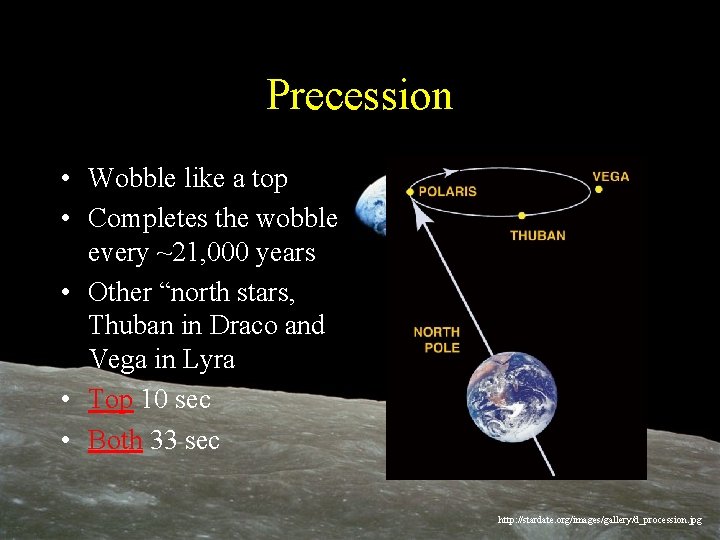
Precession • Wobble like a top • Completes the wobble every ~21, 000 years • Other “north stars, Thuban in Draco and Vega in Lyra • Top 10 sec • Both 33 sec http: //stardate. org/images/gallery/d_procession. jpg
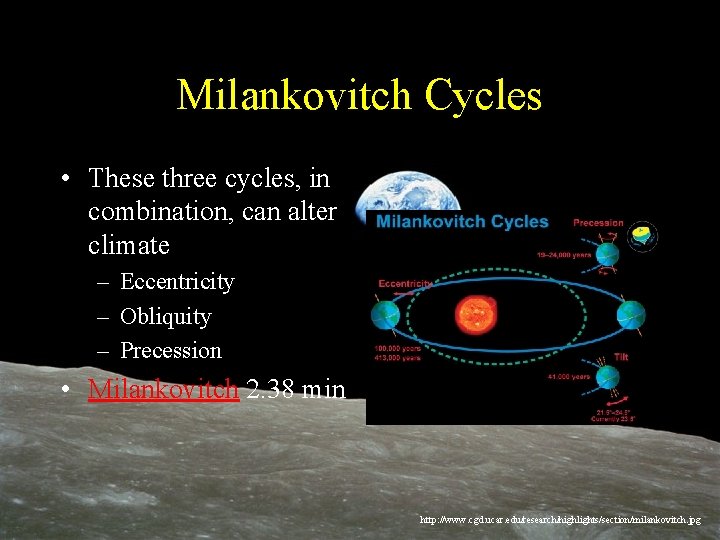
Milankovitch Cycles • These three cycles, in combination, can alter climate – Eccentricity – Obliquity – Precession • Milankovitch 2. 38 min http: //www. cgd. ucar. edu/research/highlights/section/milankovitch. jpg
Questions?
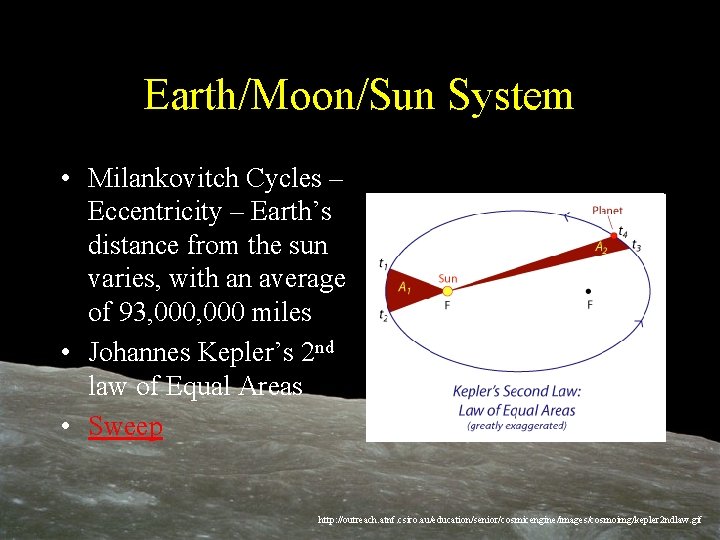
Earth/Moon/Sun System • Milankovitch Cycles – Eccentricity – Earth’s distance from the sun varies, with an average of 93, 000 miles • Johannes Kepler’s 2 nd law of Equal Areas • Sweep http: //outreach. atnf. csiro. au/education/senior/cosmicengine/images/cosmoimg/kepler 2 ndlaw. gif
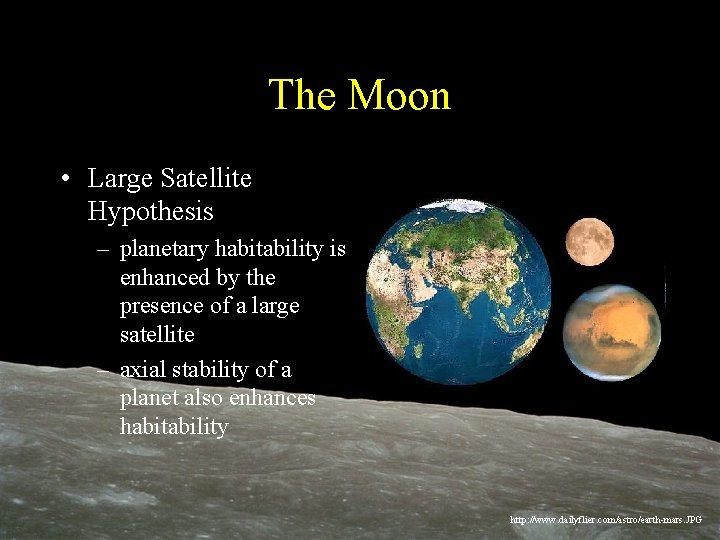
The Moon • Large Satellite Hypothesis – planetary habitability is enhanced by the presence of a large satellite – axial stability of a planet also enhances habitability http: //www. dailyflier. com/astro/earth-mars. JPG
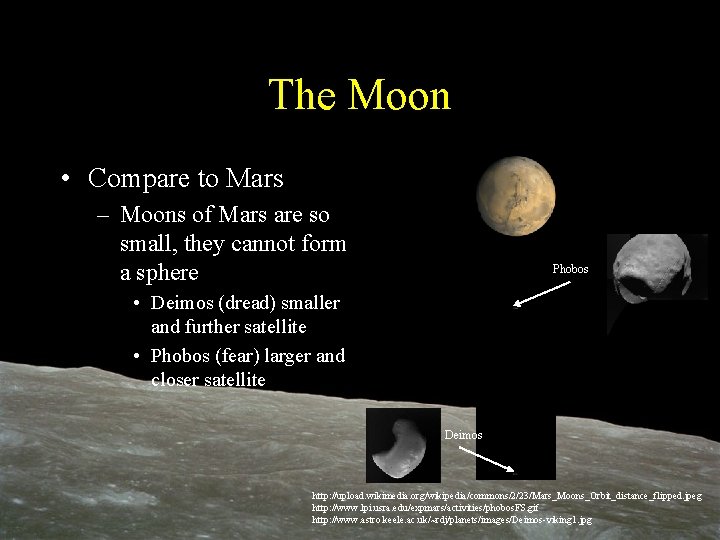
The Moon • Compare to Mars – Moons of Mars are so small, they cannot form a sphere Phobos • Deimos (dread) smaller and further satellite • Phobos (fear) larger and closer satellite Deimos http: //upload. wikimedia. org/wikipedia/commons/2/23/Mars_Moons_Orbit_distance_flipped. jpeg http: //www. lpi. usra. edu/expmars/activities/phobos. FS. gif http: //www. astro. keele. ac. uk/~rdj/planets/images/Deimos-viking 1. jpg
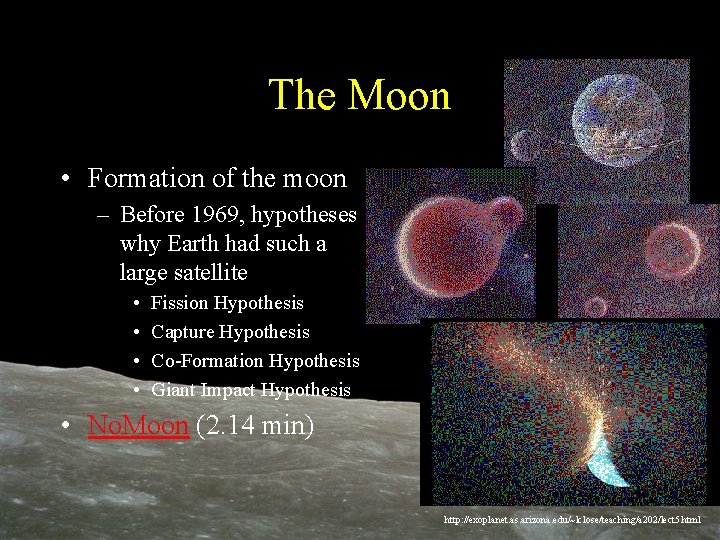
The Moon • Formation of the moon – Before 1969, hypotheses why Earth had such a large satellite • • Fission Hypothesis Capture Hypothesis Co-Formation Hypothesis Giant Impact Hypothesis • No. Moon (2. 14 min) http: //exoplanet. as. arizona. edu/~lclose/teaching/a 202/lect 5. html
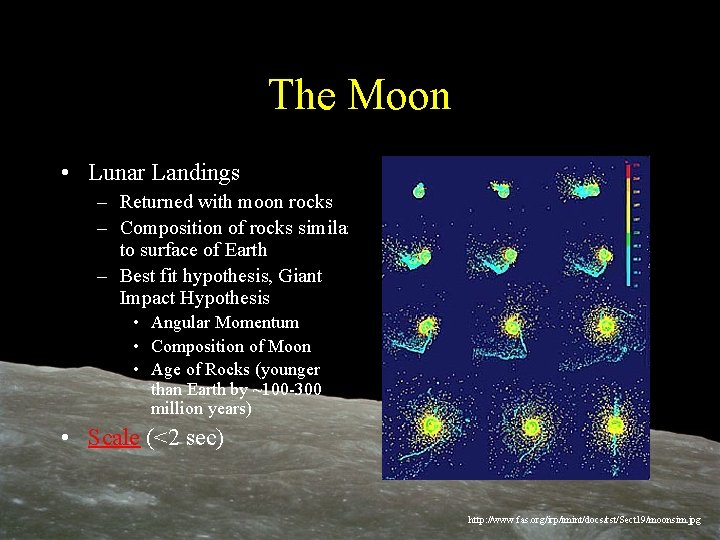
The Moon • Lunar Landings – Returned with moon rocks – Composition of rocks similar to surface of Earth – Best fit hypothesis, Giant Impact Hypothesis • Angular Momentum • Composition of Moon • Age of Rocks (younger than Earth by ~100 -300 million years) • Scale (<2 sec) http: //www. fas. org/irp/imint/docs/rst/Sect 19/moonsim. jpg
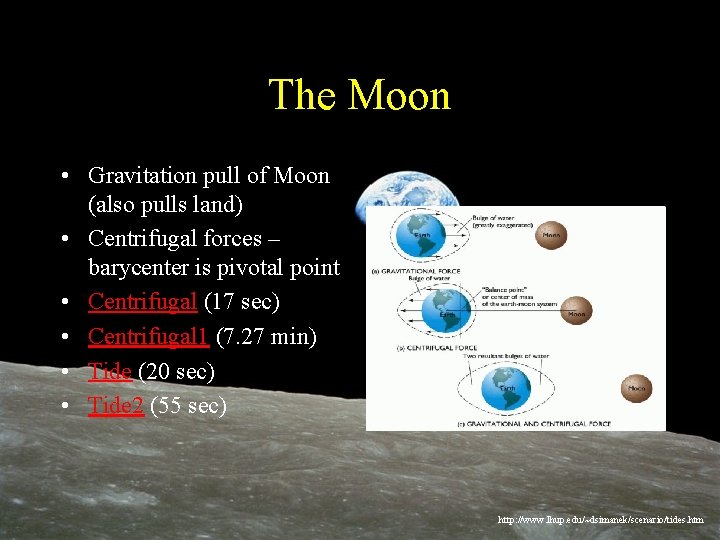
The Moon • Gravitation pull of Moon (also pulls land) • Centrifugal forces – barycenter is pivotal point • Centrifugal (17 sec) • Centrifugal 1 (7. 27 min) • Tide (20 sec) • Tide 2 (55 sec) http: //www. lhup. edu/~dsimanek/scenario/tides. htm
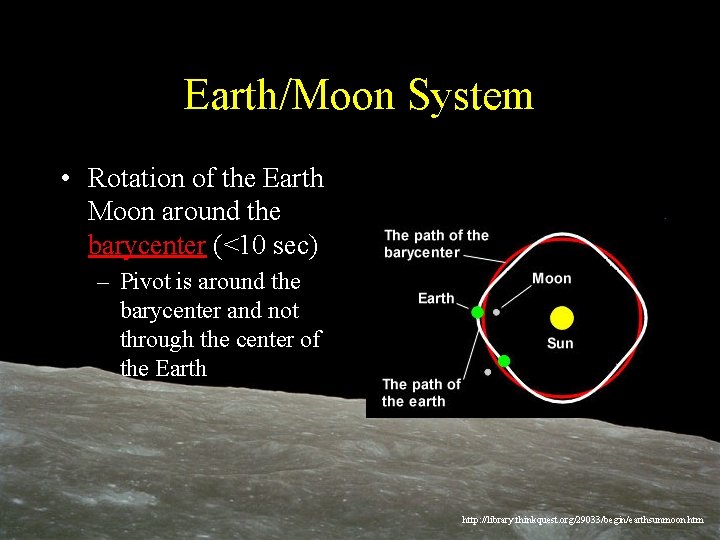
Earth/Moon System • Rotation of the Earth Moon around the barycenter (<10 sec) – Pivot is around the barycenter and not through the center of the Earth http: //library. thinkquest. org/29033/begin/earthsunmoon. htm
Rare Earth Hypothesis • Astronomical events – Within galactic habitable zone – Supernovae to seed our system – Sun the “right” size – Within solar system’s habitable zone – Large gas giants – Large satellite (Moon) – Occasional bolides strikes • Geologic events – Size of Earth – Dynamo Earth forms magnetic poles • Magnetosphere – – Plate tectonics Atmosphere Lithosphere Oceans (water terrestrial or extraterrestrial? ) – Glaciations
Mediocrity Principle • Intelligent life is common throughout the universe because, as Carl Sagan would say, the universe is a very big place • Assumes that the Earth’s life is a common occurrence • Assumes that if life occurs, then rational life will form with advanced technology • Drake Equation: – N = N* fp ne fl fi fc f. L • • N* # of stars in the Milky Way Galaxy (125 -500 billion) fp fraction of stars that have planets (20 – 50%). ne # planets/star capable of sustaining life (1 to 5) fl fraction of planets in ne where life evolves (0 -100%) fi fraction of fl where intelligent life evolves (0 -100%) fc is the fraction of fi that communicate (10 – 20% f. L fraction of the planet's life during which the communicating civilizations live (1/1, 000 th) N, the number of communicating civilizations in the galaxy.