
Planet Earth Section 1 What is Earths Interior
- Slides: 16
Planet Earth Section 1 What is Earth’s Interior Like? 〉 How is Earth’s interior structured? 〉 Earth’s interior is made up of several distinct compositional layers. • crust: the thin and solid outermost layer of Earth above the mantle • mantle: the layer of rock between Earth’s crust and core
Planet Earth Section 1 What is Earth’s Interior Like? continued • Earth’s interior gets warmer with depth. • Earth’s core is nearly as hot as the surface of the sun. – Earth’s core is composed mainly of nickel and iron. – The inner core is thought to be solid and metal. – The outer core is thought to be made of liquid metal. • core: the center part of the Earth below the mantle
Planet Earth Section 1 What is Earth’s Interior Like? continued • Radioactivity contributes to high internal temperatures. – The breakdown of radioactive isotopes uranium, thorium and potassium give off energy that contributes to Earth’s high internal temperatures. – Temperatures in the mantle can reach more than 1250 °C. – The core may reach temperatures above 5000 °C.
Planet Earth Section 1 Plate Tectonics 〉 How has the appearance of Earth changed over time? 〉 Alfred Wegener hypothesized that all of the continents might have been part of one landmass in the past before they drifted apart. – Wegener pieced the continents together like a puzzle and called the supercontinent they formed Pangaea. – Wegener found nearly identical fossils on widely separate continents, which supported his idea.
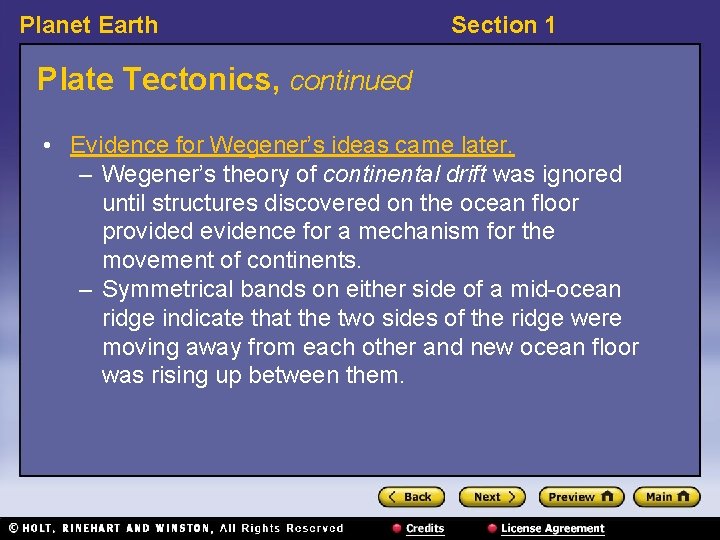
Planet Earth Section 1 Plate Tectonics, continued • Evidence for Wegener’s ideas came later. – Wegener’s theory of continental drift was ignored until structures discovered on the ocean floor provided evidence for a mechanism for the movement of continents. – Symmetrical bands on either side of a mid-ocean ridge indicate that the two sides of the ridge were moving away from each other and new ocean floor was rising up between them.
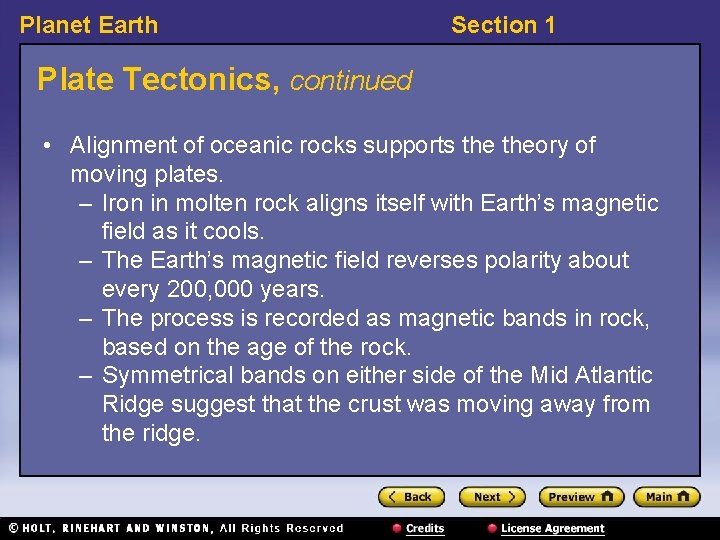
Planet Earth Section 1 Plate Tectonics, continued • Alignment of oceanic rocks supports theory of moving plates. – Iron in molten rock aligns itself with Earth’s magnetic field as it cools. – The Earth’s magnetic field reverses polarity about every 200, 000 years. – The process is recorded as magnetic bands in rock, based on the age of the rock. – Symmetrical bands on either side of the Mid Atlantic Ridge suggest that the crust was moving away from the ridge.
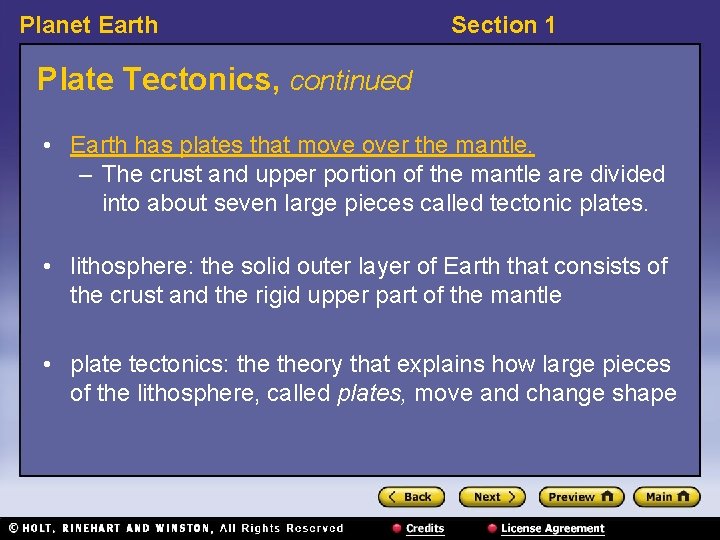
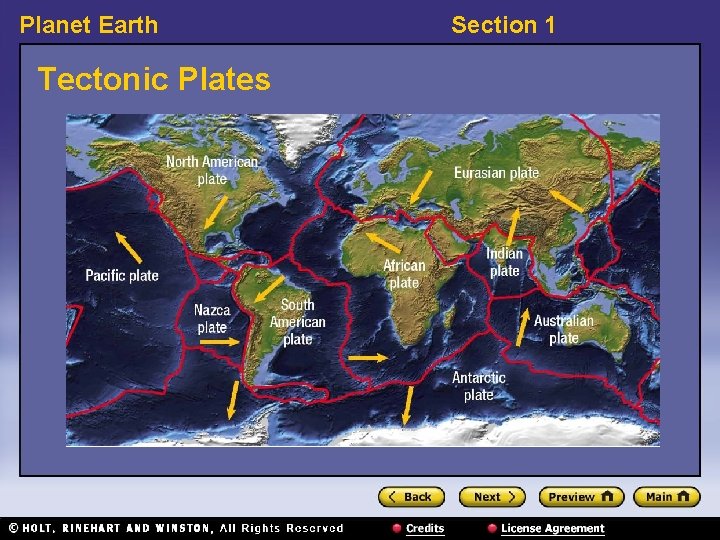
Planet Earth Section 1 Plate Tectonics, continued • Earth has plates that move over the mantle. – The crust and upper portion of the mantle are divided into about seven large pieces called tectonic plates. • lithosphere: the solid outer layer of Earth that consists of the crust and the rigid upper part of the mantle • plate tectonics: theory that explains how large pieces of the lithosphere, called plates, move and change shape
Planet Earth Tectonic Plates Section 1
Planet Earth Section 1 Plate Tectonics, continued • Scientists do not understand exactly what makes tectonic plates move. – One hypothesis suggests that plate movement results from convection currents in the asthenosphere, the hot, fluid portion of the mantle. – Another hypothesis suggests that plate movement results from the force of gravity acting on the plates.
Planet Earth Section 1 Plate Boundaries 〉 What geologic features are common near tectonic plate boundaries? 〉 Volcanoes and earthquakes most often occur where tectonic plates come together. At plate boundaries, many other dramatic features, such as mountains and rift valleys, can also occur.
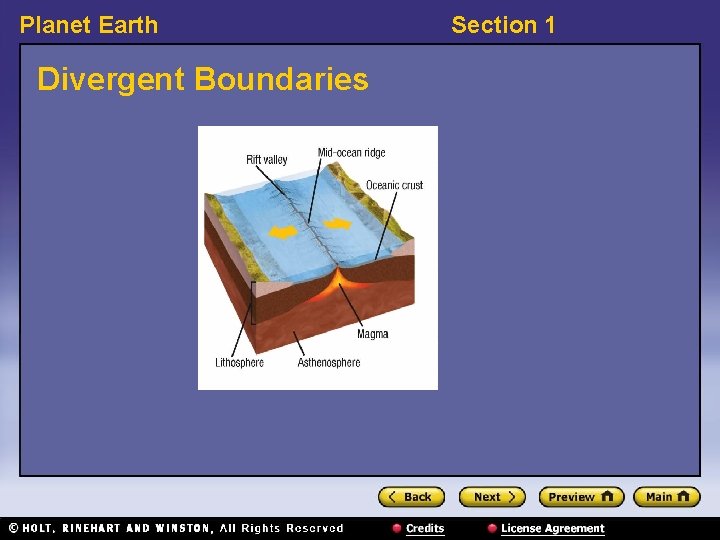
Planet Earth Section 1 Plate Boundaries, continued • Mid-oceanic ridges result from divergent boundaries. – The border between two tectonic plates is called a boundary. – A divergent boundary is a place where two tectonic plates are moving apart. – New rock forms between divergent boundaries. – Magma is liquid rock produced under Earth’s surface. – A rift valley is a narrow valley that forms where tectonic plates separate.
Planet Earth Divergent Boundaries Section 1
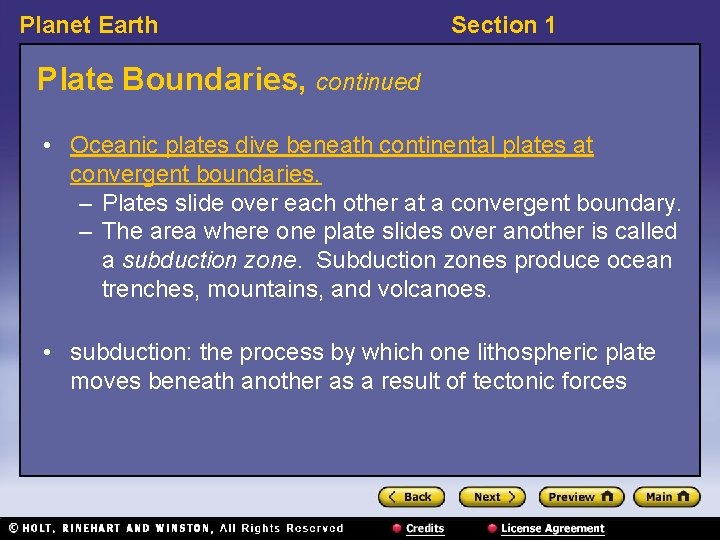
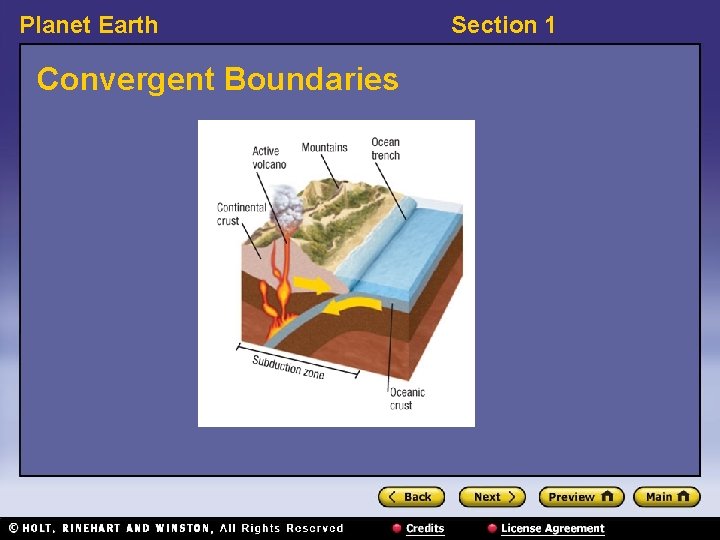
Planet Earth Section 1 Plate Boundaries, continued • Oceanic plates dive beneath continental plates at convergent boundaries. – Plates slide over each other at a convergent boundary. – The area where one plate slides over another is called a subduction zone. Subduction zones produce ocean trenches, mountains, and volcanoes. • subduction: the process by which one lithospheric plate moves beneath another as a result of tectonic forces
Planet Earth Convergent Boundaries Section 1
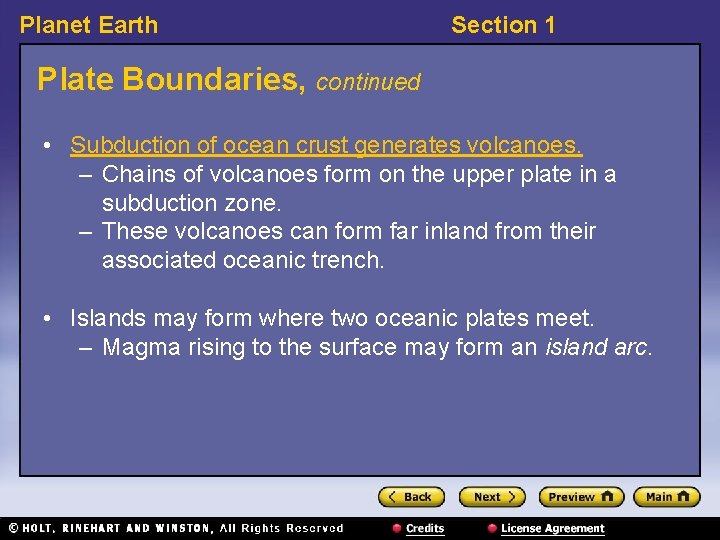
Planet Earth Section 1 Plate Boundaries, continued • Subduction of ocean crust generates volcanoes. – Chains of volcanoes form on the upper plate in a subduction zone. – These volcanoes can form far inland from their associated oceanic trench. • Islands may form where two oceanic plates meet. – Magma rising to the surface may form an island arc.
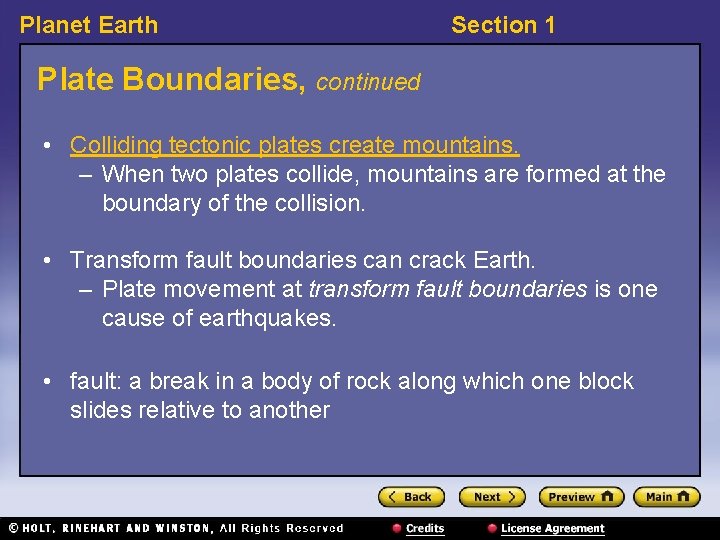
Planet Earth Section 1 Plate Boundaries, continued • Colliding tectonic plates create mountains. – When two plates collide, mountains are formed at the boundary of the collision. • Transform fault boundaries can crack Earth. – Plate movement at transform fault boundaries is one cause of earthquakes. • fault: a break in a body of rock along which one block slides relative to another