
Planet Earth Could There be Life Presentation by

Planet Earth – Could There be Life? Presentation by: Heather De. Roy
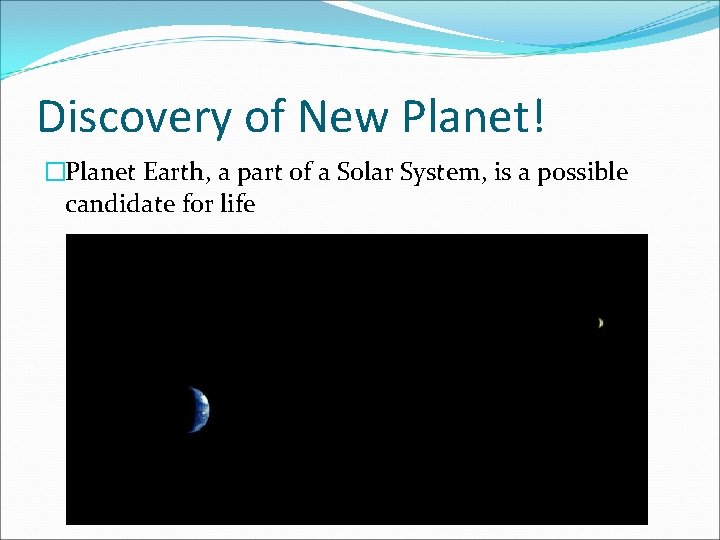
Discovery of New Planet! �Planet Earth, a part of a Solar System, is a possible candidate for life
Let’s investigate whether life is possible on this new planet, Earth!
Let’s investigate the location of planet Earth to see if it is a possible location for life to form!

Galactic Neighborhood �Galactic environment impacts habitability �Milky Way galaxy’s edge is a life-favorable spot �Not near active gamma ray source �Not near galactic center with high star density and ionizing radiation �Loneliness in galaxy is helpful for life
The galactic neighborhood is good… let’s investigate the star it orbits!
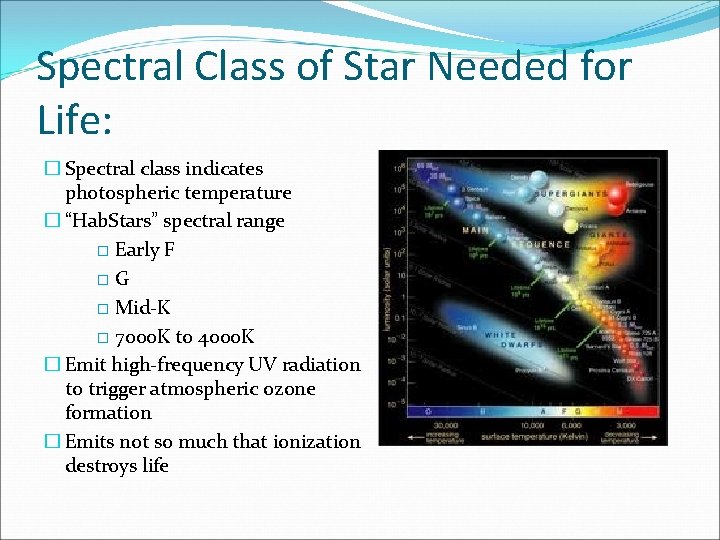
Spectral Class of Star Needed for Life: � Spectral class indicates photospheric temperature � “Hab. Stars” spectral range � Early F �G � Mid-K � 7000 K to 4000 K � Emit high-frequency UV radiation to trigger atmospheric ozone formation � Emits not so much that ionization destroys life
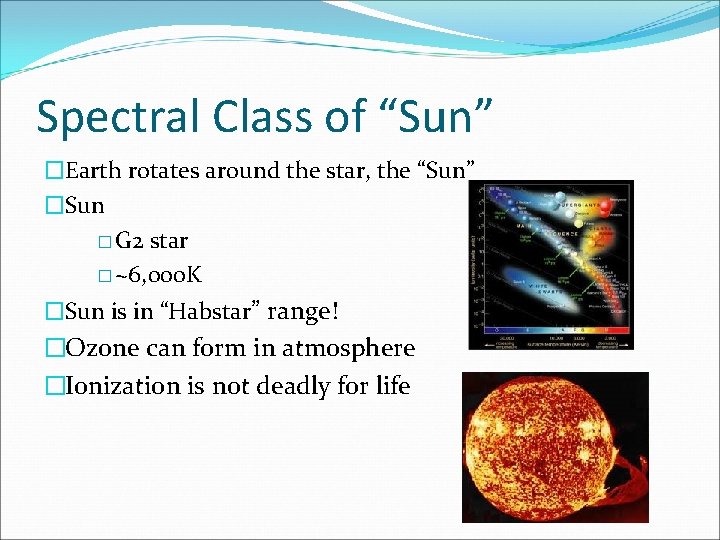
Spectral Class of “Sun” �Earth rotates around the star, the “Sun” �Sun � G 2 star � ~6, 000 K �Sun is in “Habstar” range! �Ozone can form in atmosphere �Ionization is not deadly for life
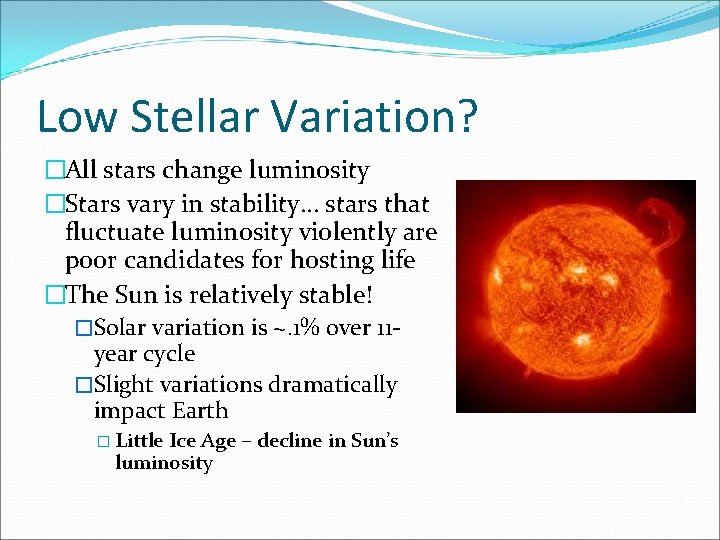
Low Stellar Variation? �All stars change luminosity �Stars vary in stability… stars that fluctuate luminosity violently are poor candidates for hosting life �The Sun is relatively stable! �Solar variation is ~. 1% over 11 year cycle �Slight variations dramatically impact Earth � Little Ice Age – decline in Sun’s luminosity

Now that we know the Sun star is a good candidate to support life, let’s look at planet Earth’s position relative to the Sun!
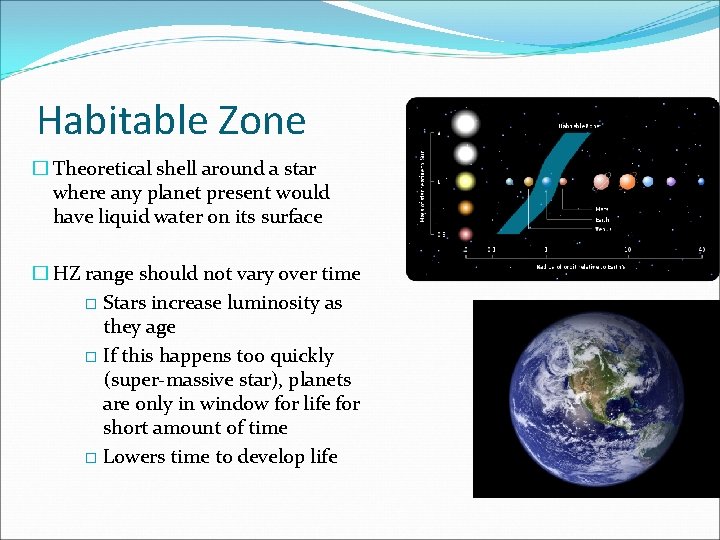
Habitable Zone � Theoretical shell around a star where any planet present would have liquid water on its surface � HZ range should not vary over time � Stars increase luminosity as they age � If this happens too quickly (super-massive star), planets are only in window for life for short amount of time � Lowers time to develop life
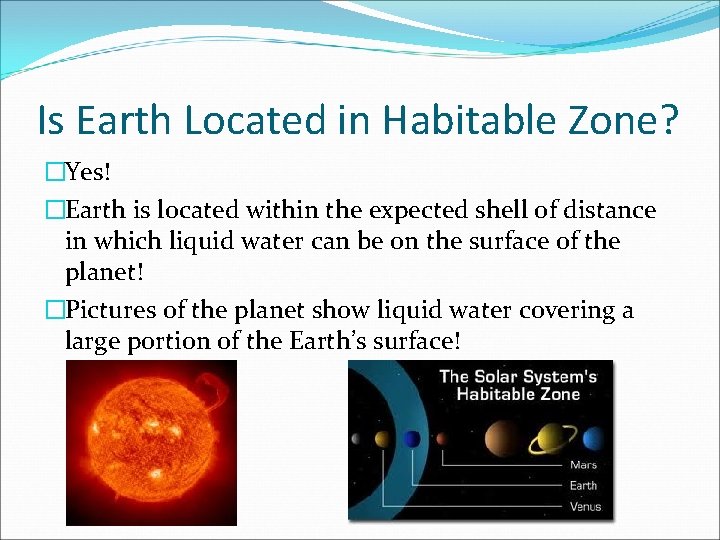
Is Earth Located in Habitable Zone? �Yes! �Earth is located within the expected shell of distance in which liquid water can be on the surface of the planet! �Pictures of the planet show liquid water covering a large portion of the Earth’s surface!
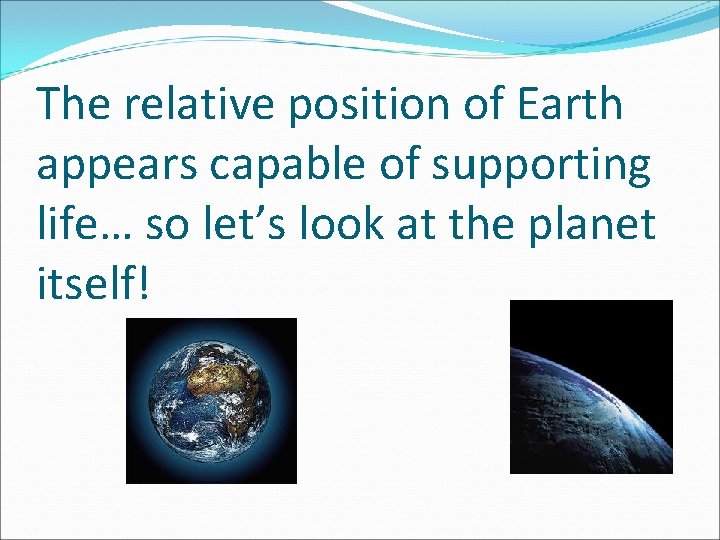
The relative position of Earth appears capable of supporting life… so let’s look at the planet itself!
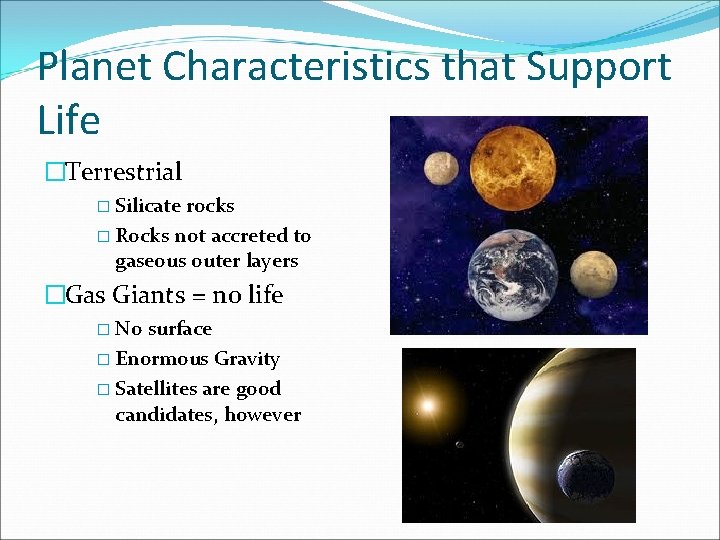
Planet Characteristics that Support Life �Terrestrial � Silicate rocks � Rocks not accreted to gaseous outer layers �Gas Giants = no life � No surface � Enormous Gravity � Satellites are good candidates, however
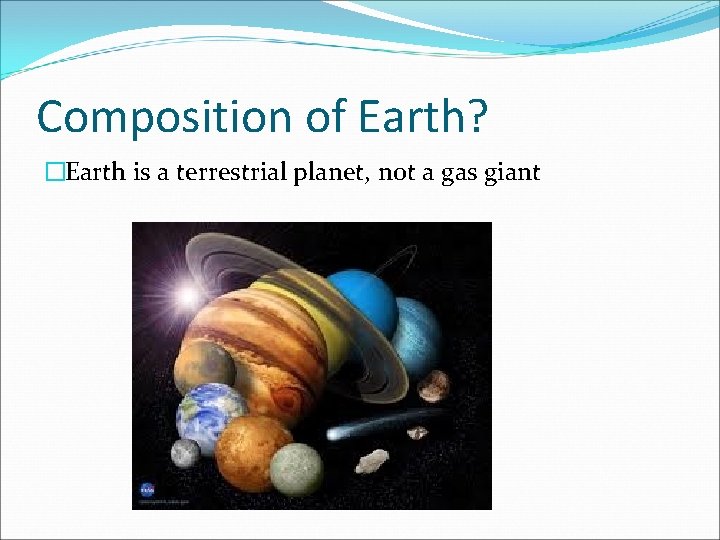
Composition of Earth? �Earth is a terrestrial planet, not a gas giant
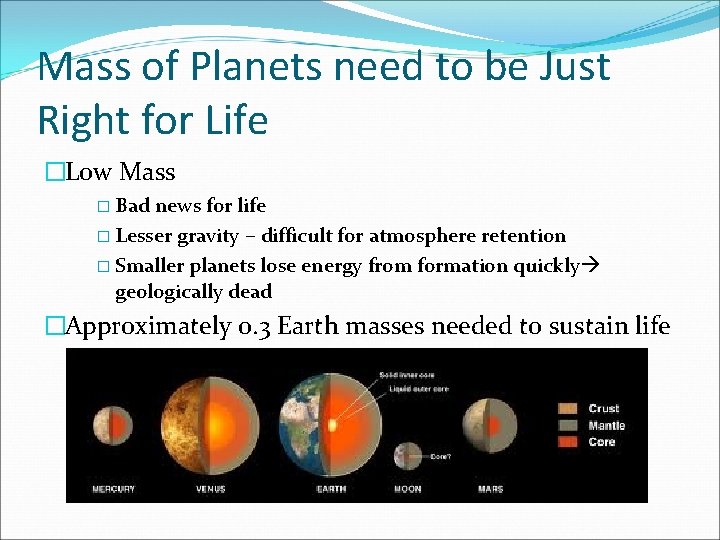
Mass of Planets need to be Just Right for Life �Low Mass � Bad news for life � Lesser gravity – difficult for atmosphere retention � Smaller planets lose energy from formation quickly geologically dead �Approximately 0. 3 Earth masses needed to sustain life
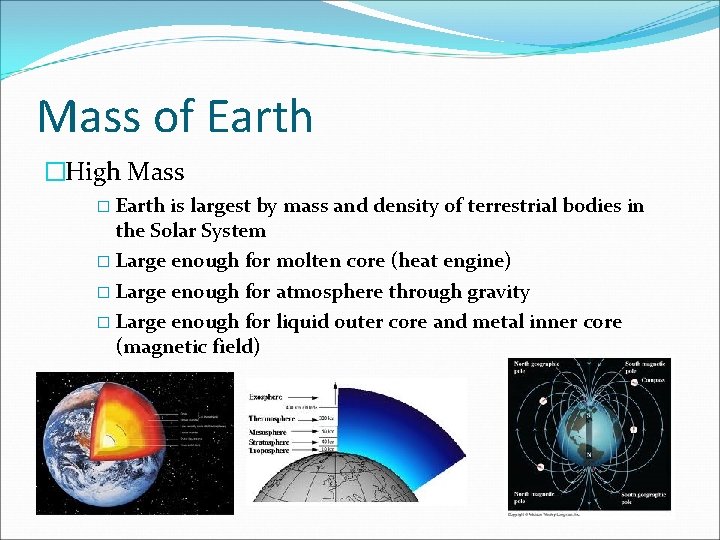
Mass of Earth �High Mass � Earth is largest by mass and density of terrestrial bodies in the Solar System � Large enough for molten core (heat engine) � Large enough for atmosphere through gravity � Large enough for liquid outer core and metal inner core (magnetic field)
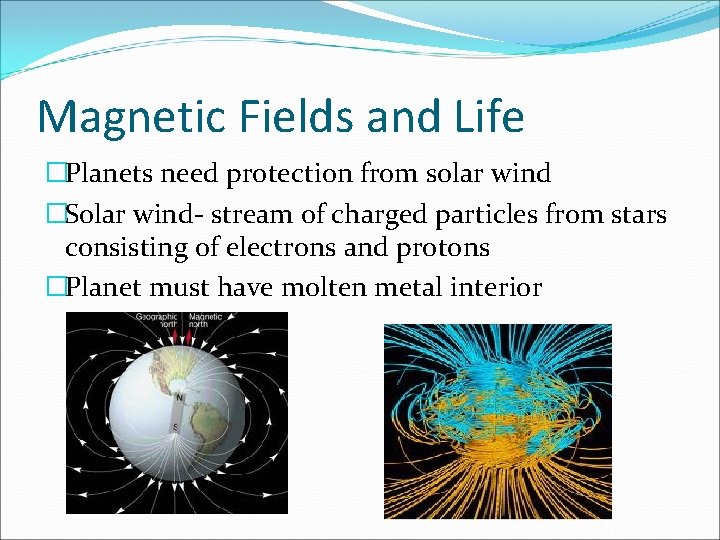
Magnetic Fields and Life �Planets need protection from solar wind �Solar wind- stream of charged particles from stars consisting of electrons and protons �Planet must have molten metal interior
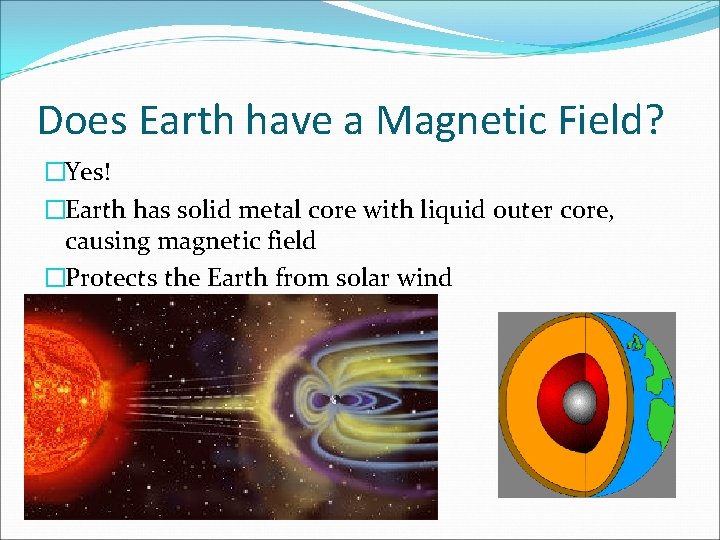
Does Earth have a Magnetic Field? �Yes! �Earth has solid metal core with liquid outer core, causing magnetic field �Protects the Earth from solar wind
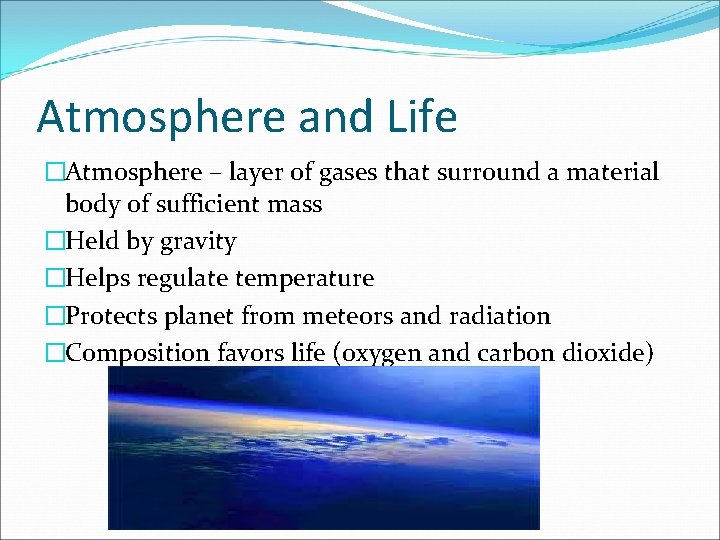
Atmosphere and Life �Atmosphere – layer of gases that surround a material body of sufficient mass �Held by gravity �Helps regulate temperature �Protects planet from meteors and radiation �Composition favors life (oxygen and carbon dioxide)
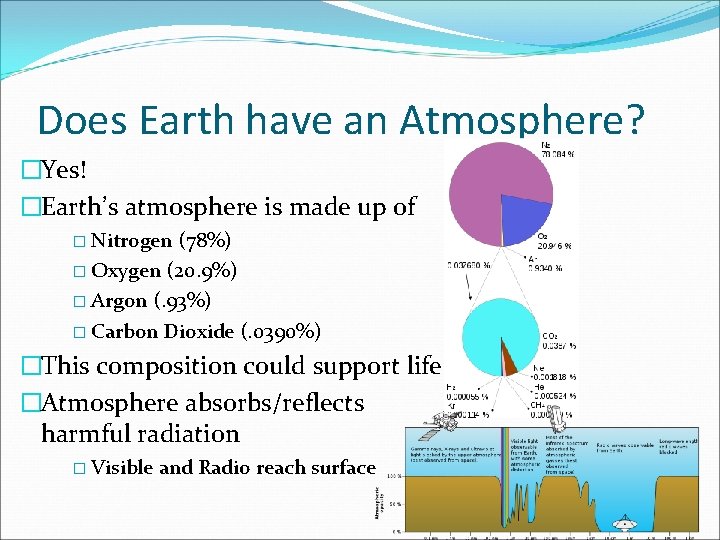
Does Earth have an Atmosphere? �Yes! �Earth’s atmosphere is made up of � Nitrogen (78%) � Oxygen (20. 9%) � Argon (. 93%) � Carbon Dioxide (. 0390%) �This composition could support life �Atmosphere absorbs/reflects harmful radiation � Visible and Radio reach surface
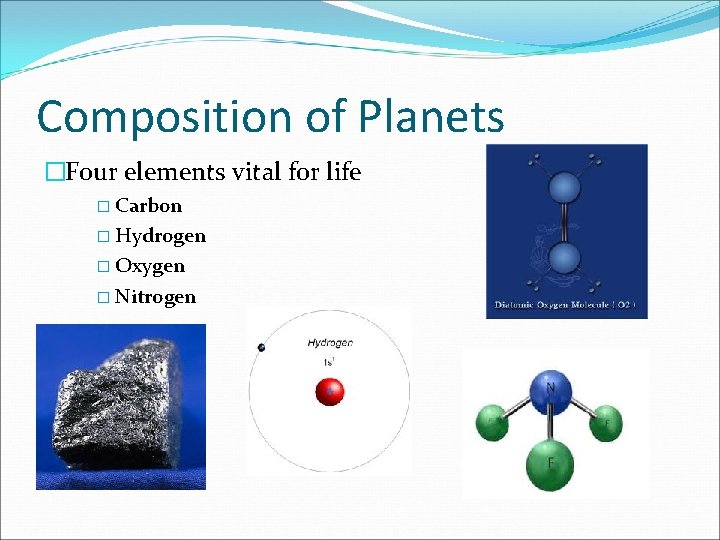
Composition of Planets �Four elements vital for life � Carbon � Hydrogen � Oxygen � Nitrogen
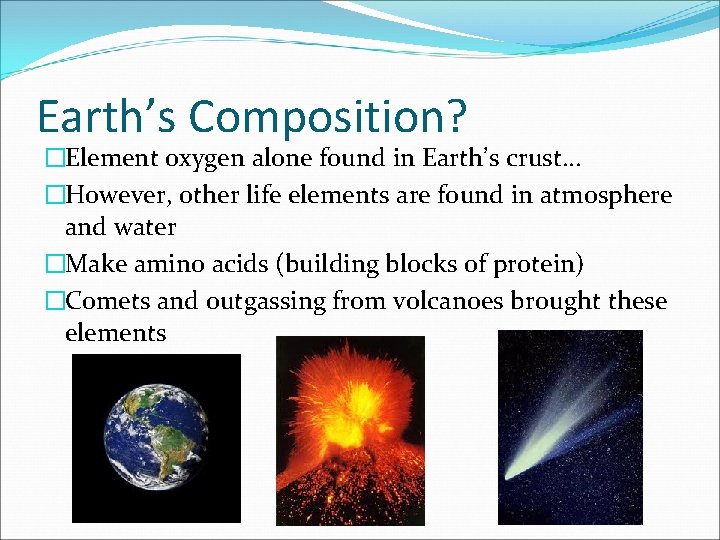
Earth’s Composition? �Element oxygen alone found in Earth’s crust… �However, other life elements are found in atmosphere and water �Make amino acids (building blocks of protein) �Comets and outgassing from volcanoes brought these elements
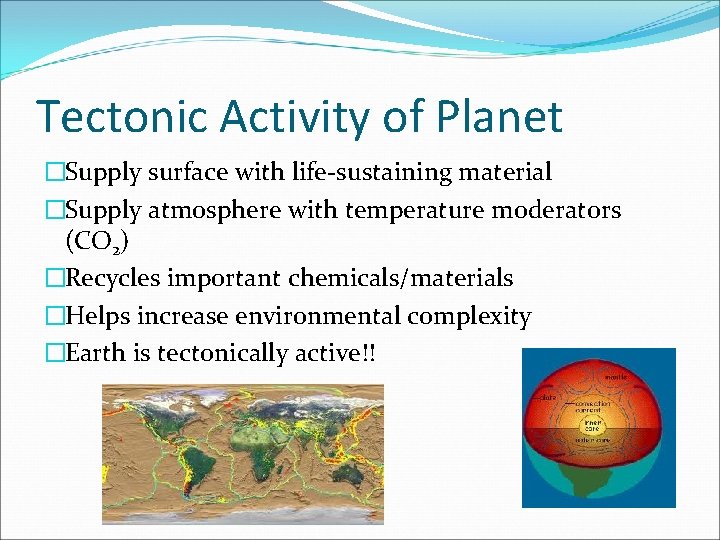
Tectonic Activity of Planet �Supply surface with life-sustaining material �Supply atmosphere with temperature moderators (CO 2) �Recycles important chemicals/materials �Helps increase environmental complexity �Earth is tectonically active!!
The planet Earth itself looks hopeful for supporting life… what about it’s orbit and rotation?
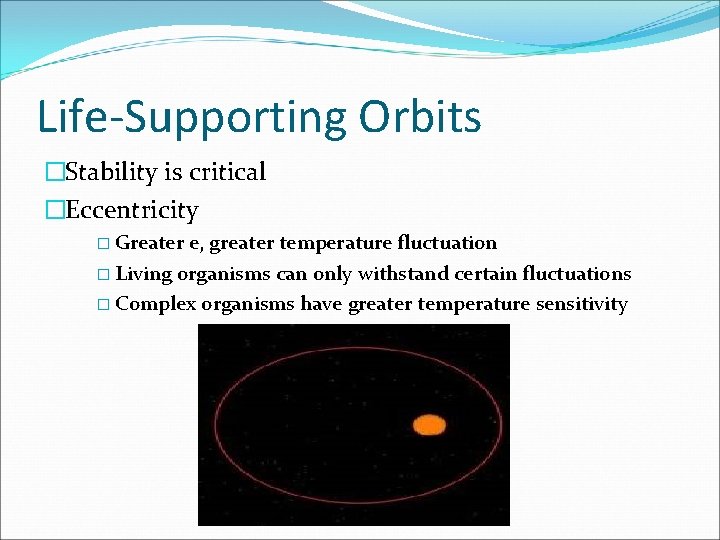
Life-Supporting Orbits �Stability is critical �Eccentricity � Greater e, greater temperature fluctuation � Living organisms can only withstand certain fluctuations � Complex organisms have greater temperature sensitivity
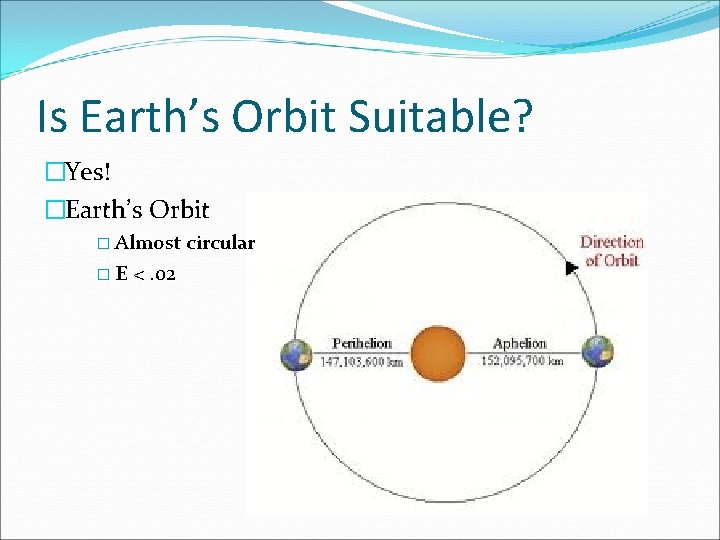
Is Earth’s Orbit Suitable? �Yes! �Earth’s Orbit � Almost �E <. 02 circular
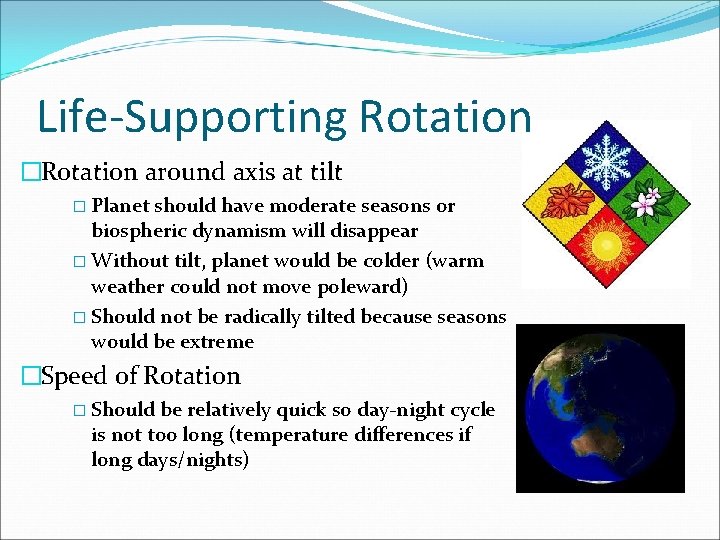
Life-Supporting Rotation �Rotation around axis at tilt � Planet should have moderate seasons or biospheric dynamism will disappear � Without tilt, planet would be colder (warm weather could not move poleward) � Should not be radically tilted because seasons would be extreme �Speed of Rotation � Should be relatively quick so day-night cycle is not too long (temperature differences if long days/nights)
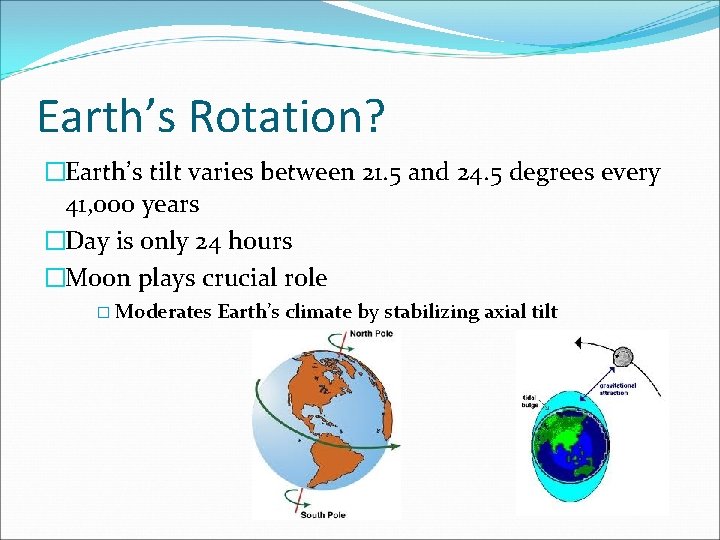
Earth’s Rotation? �Earth’s tilt varies between 21. 5 and 24. 5 degrees every 41, 000 years �Day is only 24 hours �Moon plays crucial role � Moderates Earth’s climate by stabilizing axial tilt
Earth COULD have life! � Galactic Neighborhood � � Star � � Arm of Milky Way galaxy Spectral class G 2 Low stellar variation � Distance from Star � � Earth is located in Habitable Zone Liquid Water � Composition/Size � � Orbit � Terrestrial planet, relative high mass Magnetic Field Atmosphere Nearly circular � Rotation � � Tilt allows seasons Short night/day

Now we need a closer look.
- Slides: 31