
Planet detection and characterization through high contrast imaging
- Slides: 19
Planet detection and characterization through high contrast imaging Raffaele Gratton INAF – Osservatorio Astronomico di Padova La ricerca sui pianeti extrasolari in Italia, Roma, 5 -7 novembre 2014
Content • • • The difficulty of HCI Extrasolar planets may be detected in HCI! Struggling against speckles: the principles of HCI High contrast imagers: first and second gen’s What we can do with HCI? – Detection – Characterization • Photometry • Astrometry • Spectroscopy La ricerca sui pianeti extrasolari in Italia, Roma, 5 -7 novembre 2014
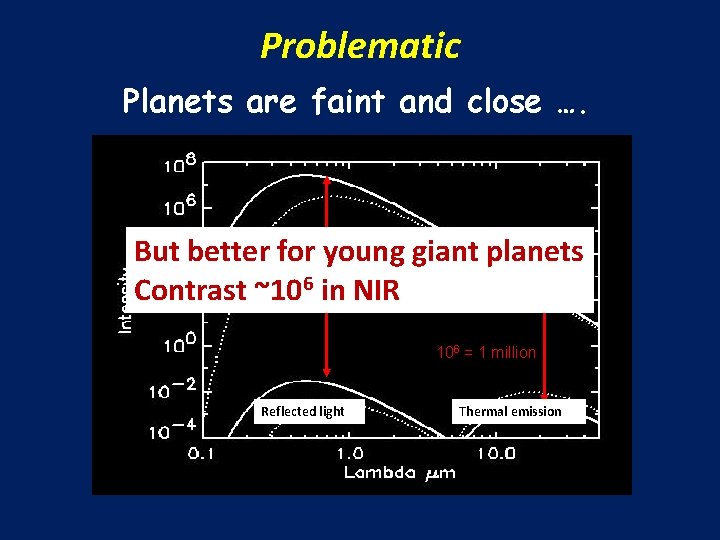
Problematic Planets are faint and close …. But better for young giant planets 10 = 1 billion 6 Contrast ~10 in NIR 9 106 = 1 million Reflected light Thermal emission
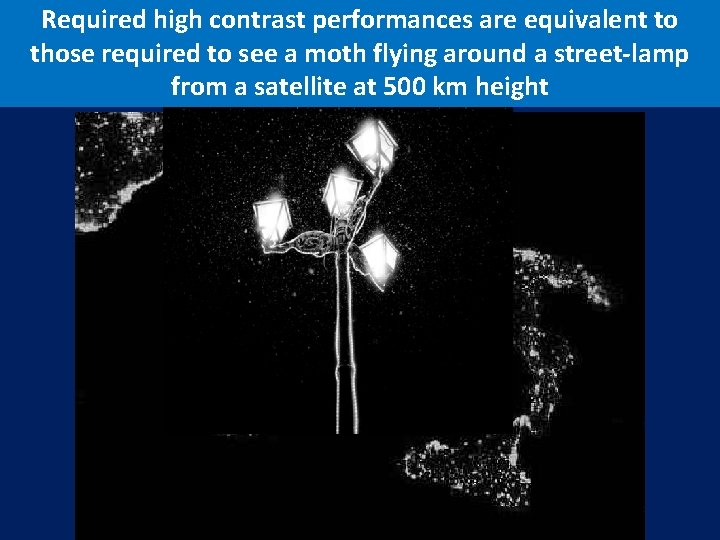
Required high contrast performances are equivalent to those required to see a moth flying around a street-lamp from a satellite at 500 km height
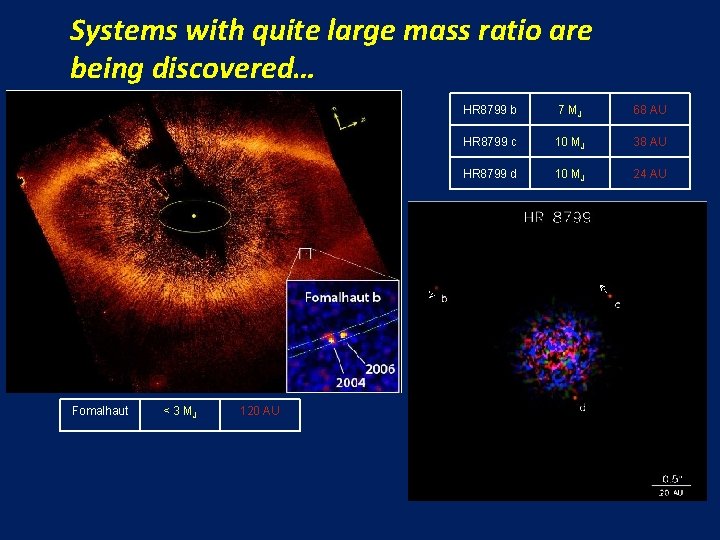
Systems with quite large mass ratio are being discovered… Fomalhaut < 3 MJ 120 AU HR 8799 b 7 MJ 68 AU HR 8799 c 10 MJ 38 AU HR 8799 d 10 MJ 24 AU
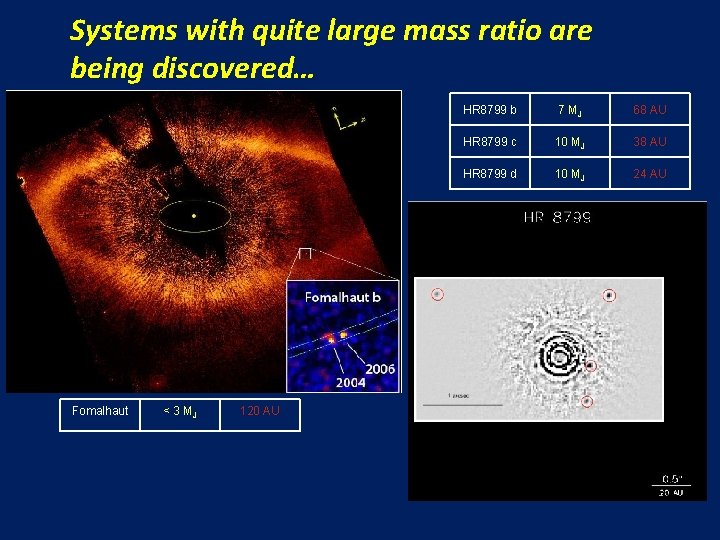
Systems with quite large mass ratio are being discovered… Fomalhaut < 3 MJ 120 AU HR 8799 b 7 MJ 68 AU HR 8799 c 10 MJ 38 AU HR 8799 d 10 MJ 24 AU
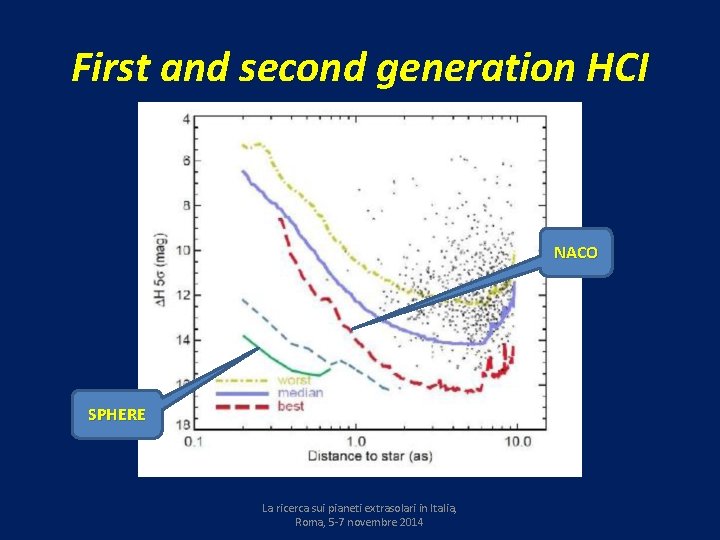
First generation HCI • These discoveries were made using first generation HCI systems such as NACO, NIRC, or Hi-CIAO • These instruments used moderately high order AO systems (<200 actuators, sampling the pupil at ~50 cm SR(H)~0. 5) available since early 2000 s, and were not specially designed to fully exploit the potential of HCI La ricerca sui pianeti extrasolari in Italia, Roma, 5 -7 novembre 2014
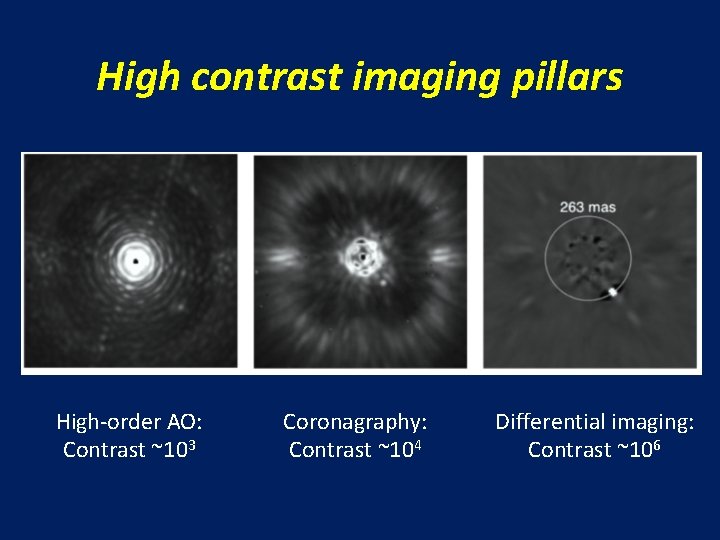
State-of-the-art HCI • Combines various techniques to provide high contrast imaging, with excellent stellar PSF suppression and stability: – a high density high frequency AO system that corrects turbulence and static optical aberrations (WFE~100 nm, SR(H)~0. 9, 5 -σ contrast at 0. 5 arcsec: ~10 -3) – coronagraphy (gain by a factor of 10) – differential imaging, in which images at different wavelengths or polarization states are observed simultaneously (further gain by a factor of 100)
Angular Differential Imaging • ADI exploits the fact that the field and the pupil rotate with respect to each other • In pupil stabilized mode, most speckles are caused by instrumental artifacts and are locked up in the pupil plane, whereas the object of interest, a companion or a disk, will rotate as the field rotates (see video_adi. avi ) • This allows distinguishing the stellar halo from the object (provided instrument is stable)
Spectral deconvolution • Simultaneous observation of several monochromatic images can be used to reduce the impact of speckles (Sparks and Ford, 2002) • For a given observation, the location of a companion around a star is constant while the location of speckles from the star increases with wavelength and their intensity decreases (see video_spectrum. avi ) • For a wide enough wavelength range this allows subtraction of the speckles. This process is known as spectral deconvolution (Thatte et al. 2007)
High contrast imaging pillars High-order AO: Contrast ~103 Coronagraphy: Contrast ~104 Differential imaging: Contrast ~106
First and second generation HCI NACO SPHERE La ricerca sui pianeti extrasolari in Italia, Roma, 5 -7 novembre 2014
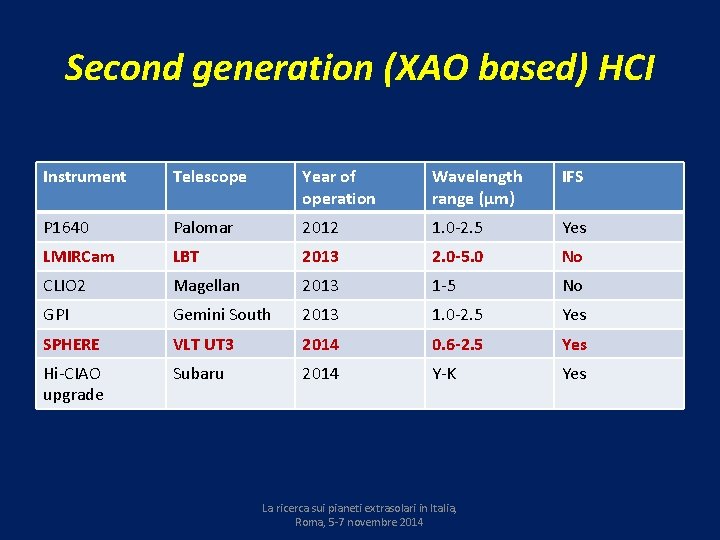
Second generation (XAO based) HCI Instrument Telescope Year of operation Wavelength range (µm) IFS P 1640 Palomar 2012 1. 0 -2. 5 Yes LMIRCam LBT 2013 2. 0 -5. 0 No CLIO 2 Magellan 2013 1 -5 No GPI Gemini South 2013 1. 0 -2. 5 Yes SPHERE VLT UT 3 2014 0. 6 -2. 5 Yes Hi-CIAO upgrade Subaru 2014 Y-K Yes La ricerca sui pianeti extrasolari in Italia, Roma, 5 -7 novembre 2014
What is SPHERE? • SPHERE is the new high contrast imager for the VLT • It just passed commissioning and is offered in P 95 • SPHERE also provides narrow-field (few arcsec), very high quality diffraction-limited imaging over the wavelength range 0. 6 -2. 5 micron • It requires a bright NGS (I<14 -16)
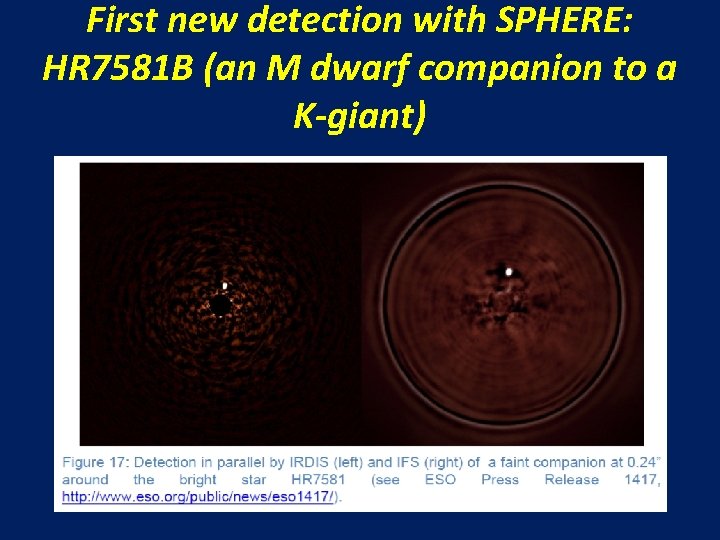
First new detection with SPHERE: HR 7581 B (an M dwarf companion to a K-giant)
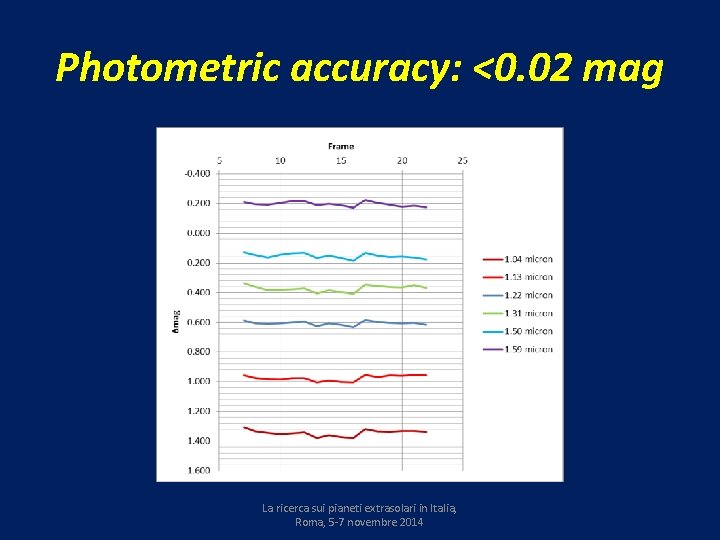
Photometric accuracy: <0. 02 mag La ricerca sui pianeti extrasolari in Italia, Roma, 5 -7 novembre 2014
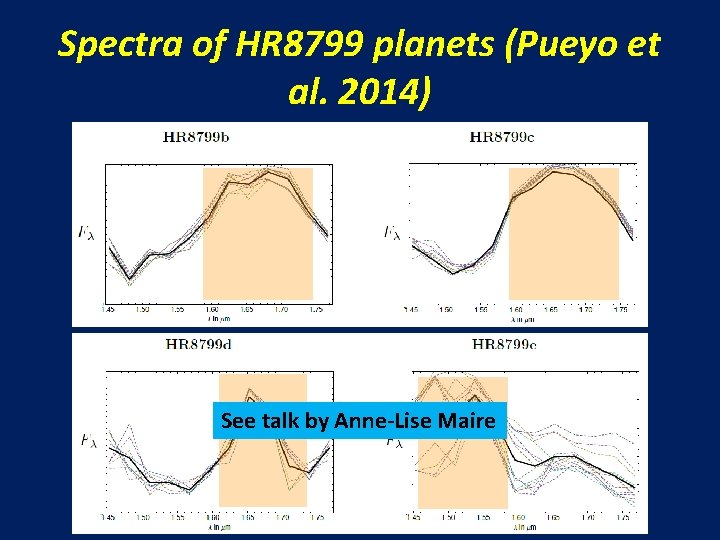
Spectra of HR 8799 planets (Pueyo et al. 2014) See talk by Anne-Lise Maire La ricerca sui pianeti extrasolari in Italia, Roma, 5 -7 novembre 2014
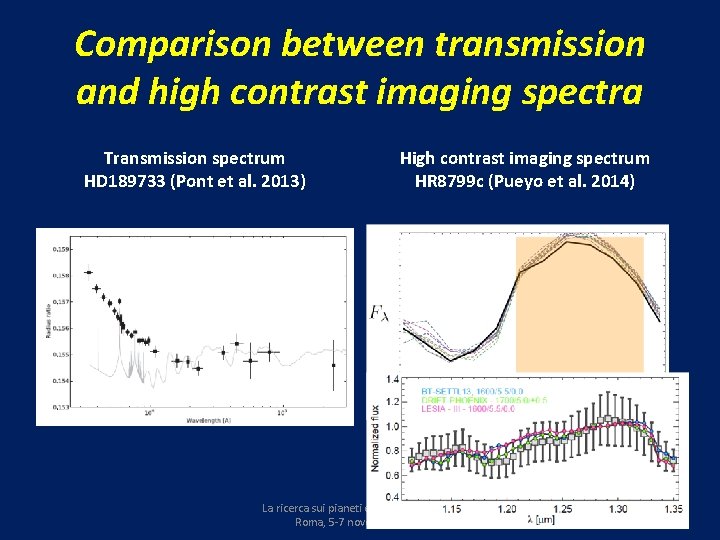
Comparison between transmission and high contrast imaging spectra Transmission spectrum HD 189733 (Pont et al. 2013) High contrast imaging spectrum HR 8799 c (Pueyo et al. 2014) La ricerca sui pianeti extrasolari in Italia, Roma, 5 -7 novembre 2014
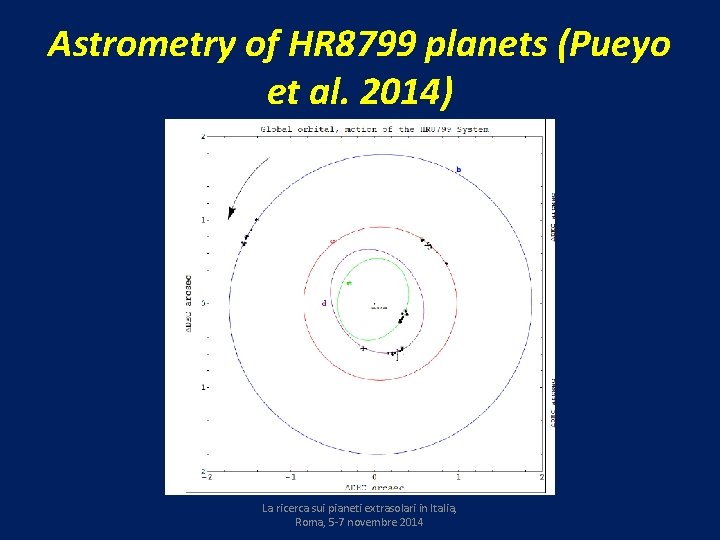
Astrometry of HR 8799 planets (Pueyo et al. 2014) La ricerca sui pianeti extrasolari in Italia, Roma, 5 -7 novembre 2014