
Planes of the Body i Transverse Horizontal Plane

Planes of the Body i) Transverse (Horizontal) Plane ii) Frontal Plane iii) Sagittal Plane Figure 7 -4 b OH 3 -9
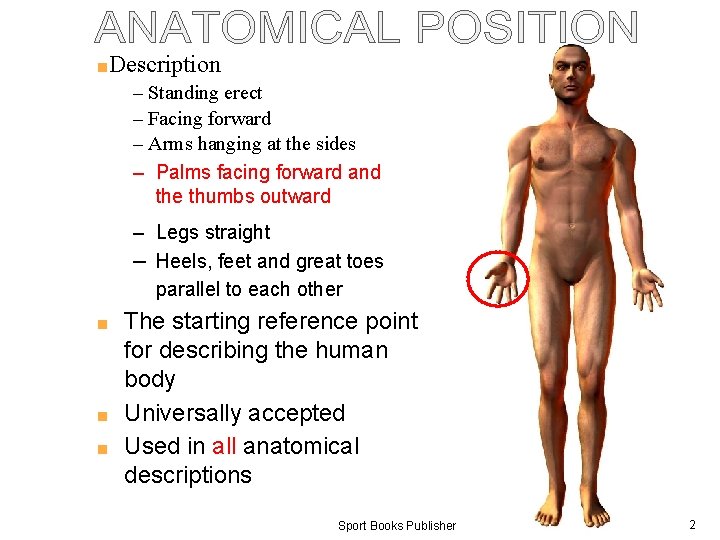
■Description – Standing erect – Facing forward – Arms hanging at the sides – Palms facing forward and the thumbs outward – Legs straight – Heels, feet and great toes parallel to each other The starting reference point for describing the human body ■ Universally accepted ■ Used in all anatomical descriptions ■ Sport Books Publisher 2
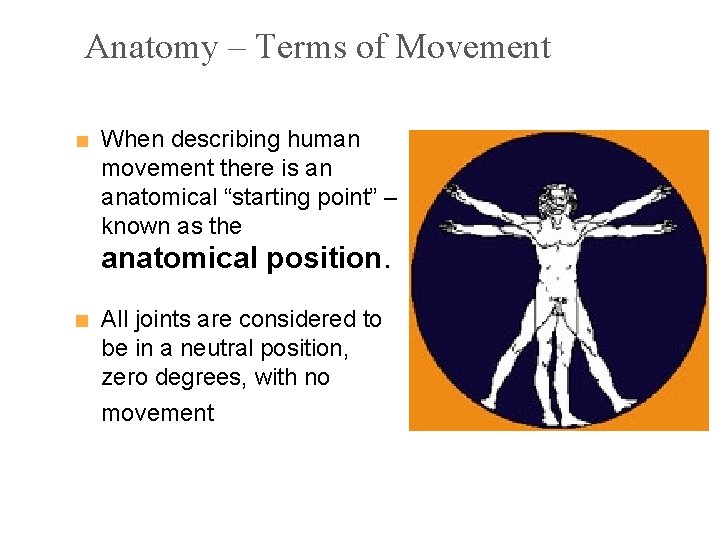
Anatomy – Terms of Movement ■ When describing human movement there is an anatomical “starting point” – known as the anatomical position. ■ All joints are considered to be in a neutral position, zero degrees, with no movement
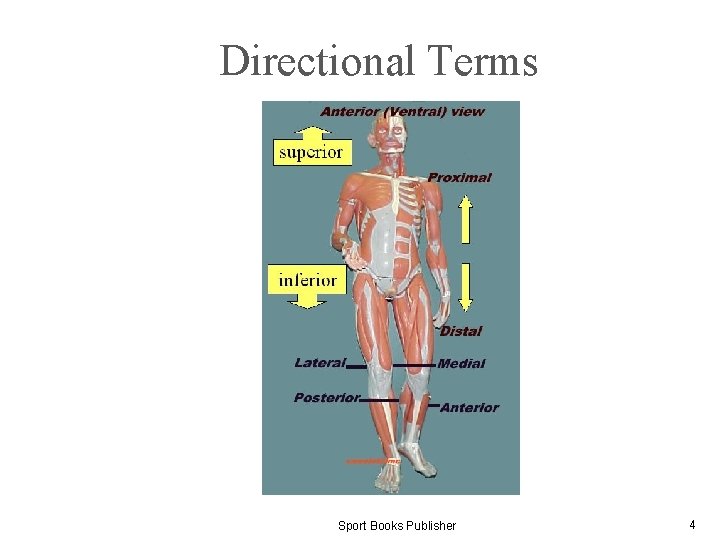
Directional Terms Sport Books Publisher 4
Reminder: All directional terms are based on the assumption that the body is in the anatomical position. Sport Books Publisher 5
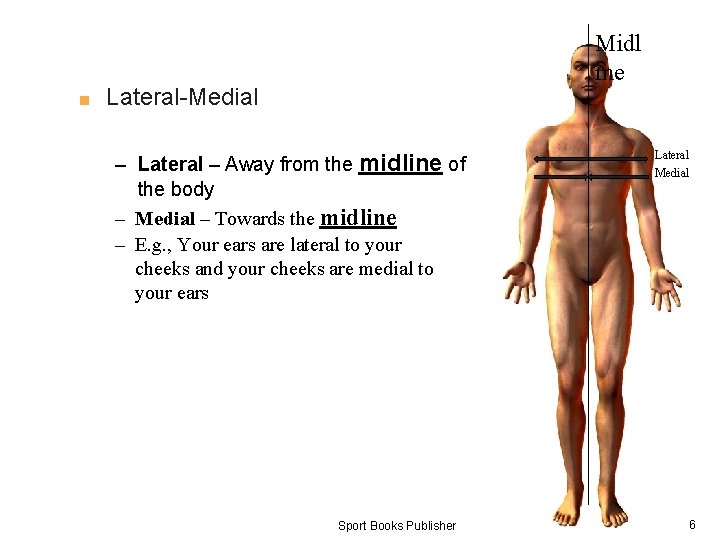
■ Midl ine Lateral-Medial – Lateral – Away from the midline of the body – Medial – Towards the midline – E. g. , Your ears are lateral to your cheeks and your cheeks are medial to your ears Sport Books Publisher Lateral Medial 6
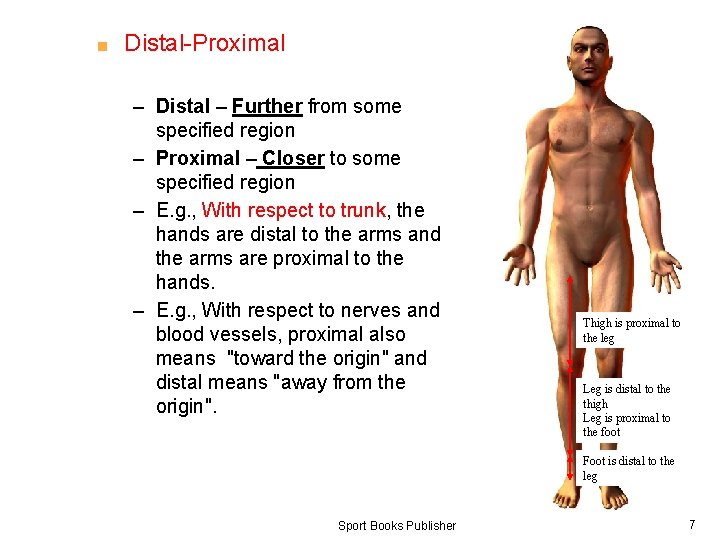
■ Distal-Proximal – Distal – Further from some specified region – Proximal – Closer to some specified region – E. g. , With respect to trunk, the hands are distal to the arms and the arms are proximal to the hands. – E. g. , With respect to nerves and blood vessels, proximal also means "toward the origin" and distal means "away from the origin". Thigh is proximal to the leg Leg is distal to the thigh Leg is proximal to the foot Foot is distal to the leg Sport Books Publisher 7
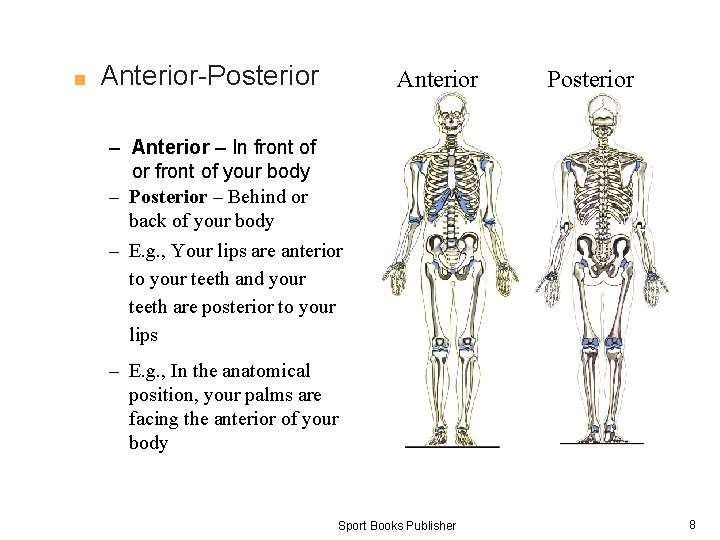
■ Anterior-Posterior Anterior Skeleton Posterior Skeleton – Anterior – In front of or front of your body – Posterior – Behind or back of your body – E. g. , Your lips are anterior to your teeth and your teeth are posterior to your lips – E. g. , In the anatomical position, your palms are facing the anterior of your body Sport Books Publisher 8
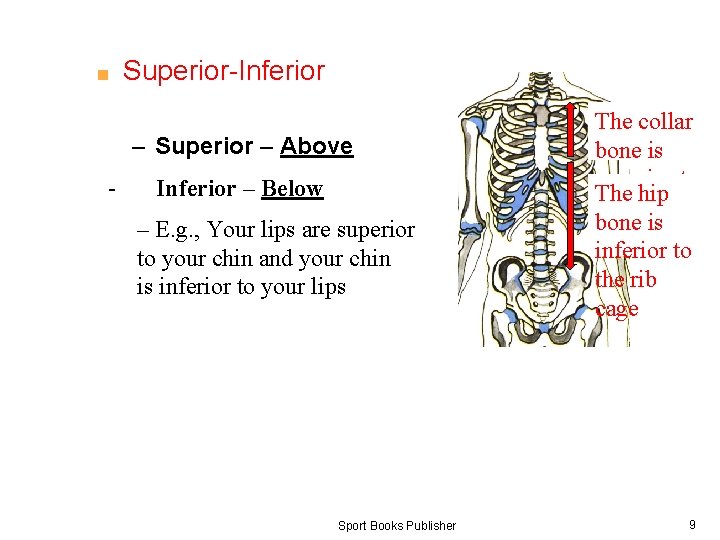
■ Superior-Inferior – Superior – Above - Inferior – Below – E. g. , Your lips are superior to your chin and your chin is inferior to your lips Sport Books Publisher The collar bone is superior to The hip the rib bone is cage inferior to the rib cage 9
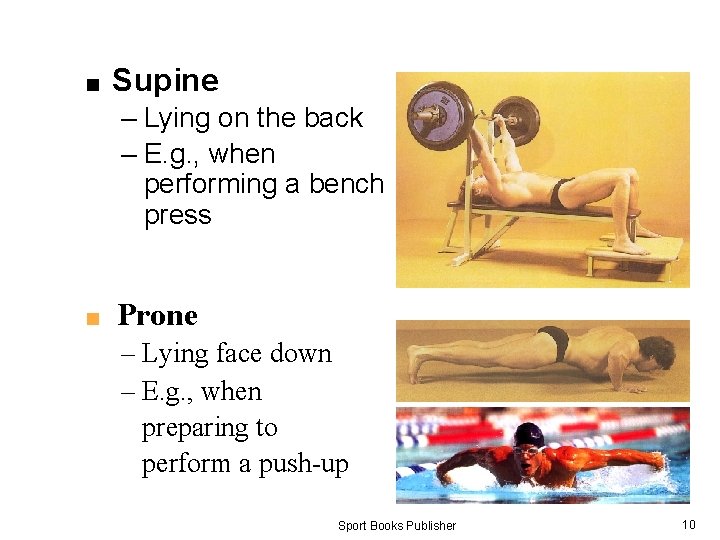
■ Supine – Lying on the back – E. g. , when performing a bench press ■ Prone – Lying face down – E. g. , when preparing to perform a push-up Sport Books Publisher 10
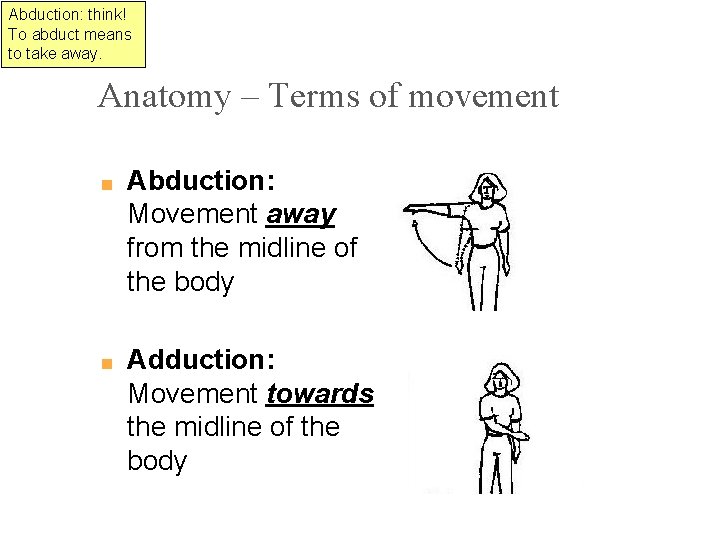
Abduction: think! To abduct means to take away. Anatomy – Terms of movement ■ Abduction: Movement away from the midline of the body ■ Adduction: Movement towards the midline of the body
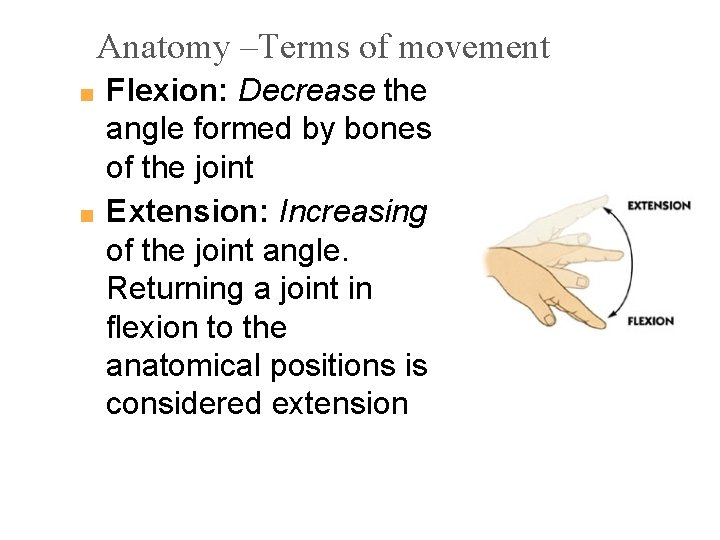
Anatomy –Terms of movement Flexion: Decrease the angle formed by bones of the joint ■ Extension: Increasing of the joint angle. Returning a joint in flexion to the anatomical positions is considered extension ■
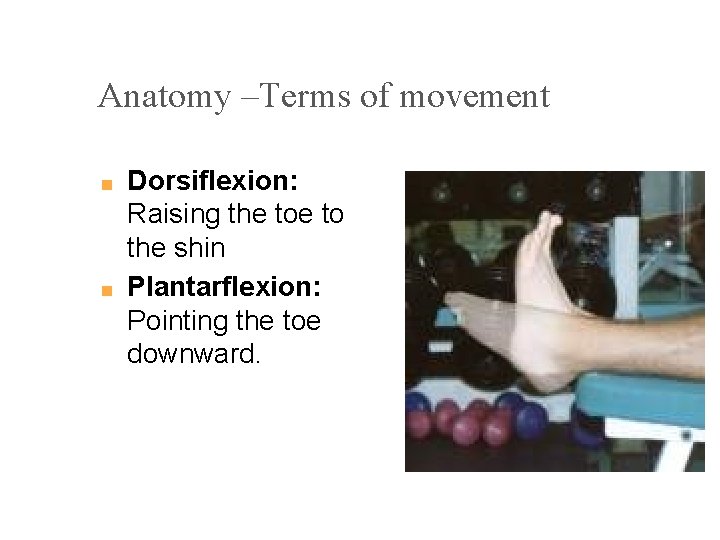
Anatomy –Terms of movement ■ ■ Dorsiflexion: Raising the to the shin Plantarflexion: Pointing the toe downward.
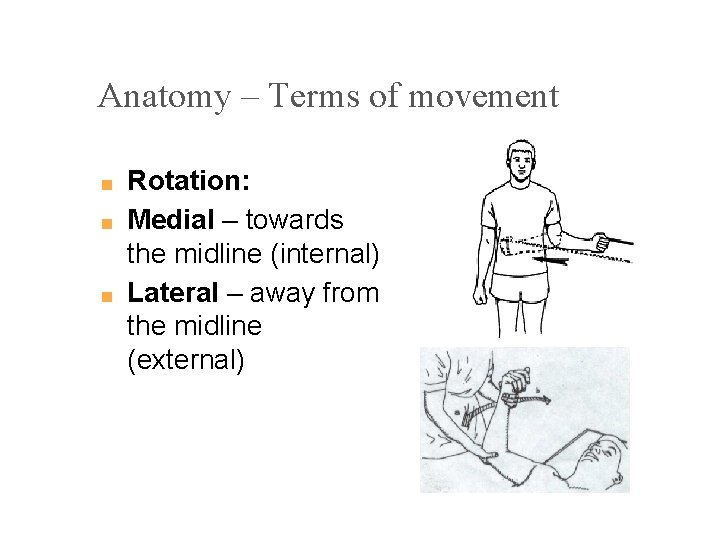
Anatomy – Terms of movement ■ ■ ■ Rotation: Medial – towards the midline (internal) Lateral – away from the midline (external)
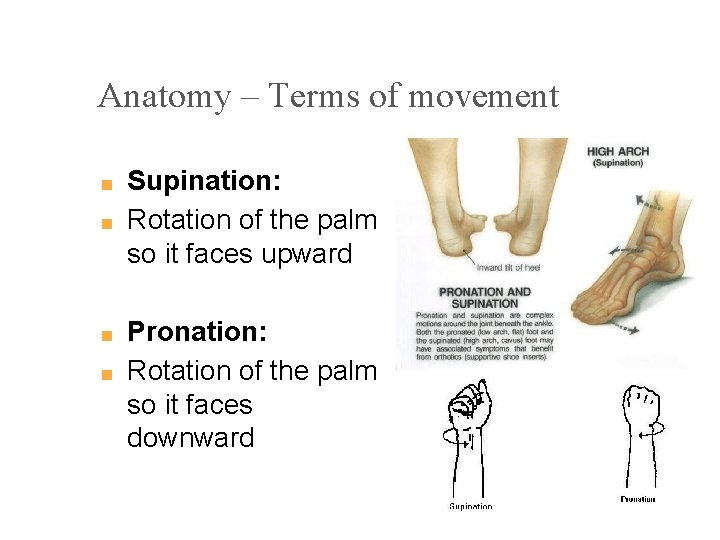
Anatomy – Terms of movement ■ ■ Supination: Rotation of the palm so it faces upward Pronation: Rotation of the palm so it faces downward

Anatomy – Terms of movement ■ Inversion: sole of the foot turns inwards ■ Eversion: sole of the foot turns outwards
17
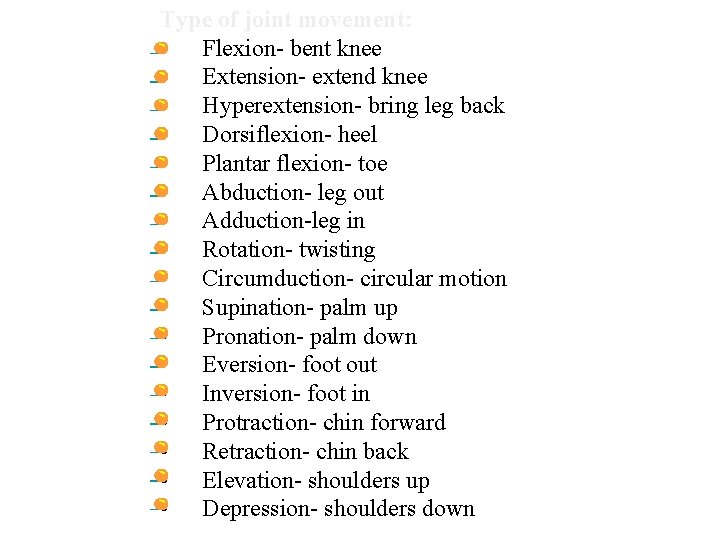
Type of joint movement: • Flexion- bent knee • Extension- extend knee • Hyperextension- bring leg back • Dorsiflexion- heel • Plantar flexion- toe • Abduction- leg out • Adduction-leg in • Rotation- twisting • Circumduction- circular motion • Supination- palm up • Pronation- palm down • Eversion- foot out • Inversion- foot in • Protraction- chin forward • Retraction- chin back • Elevation- shoulders up • Depression- shoulders down
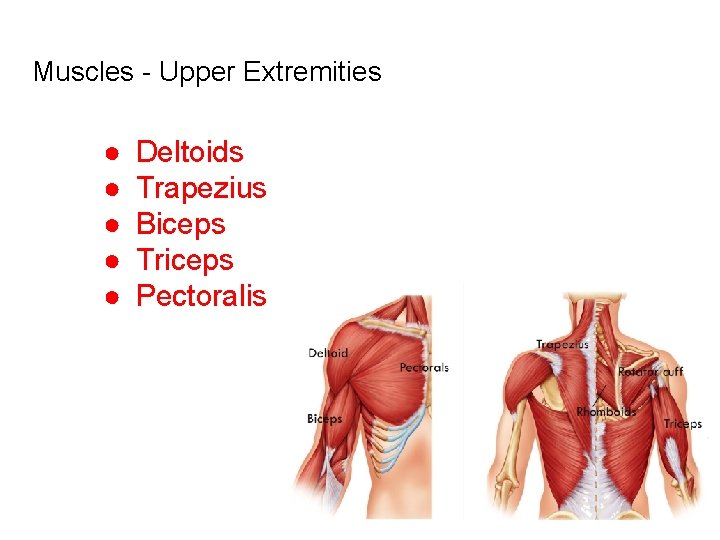
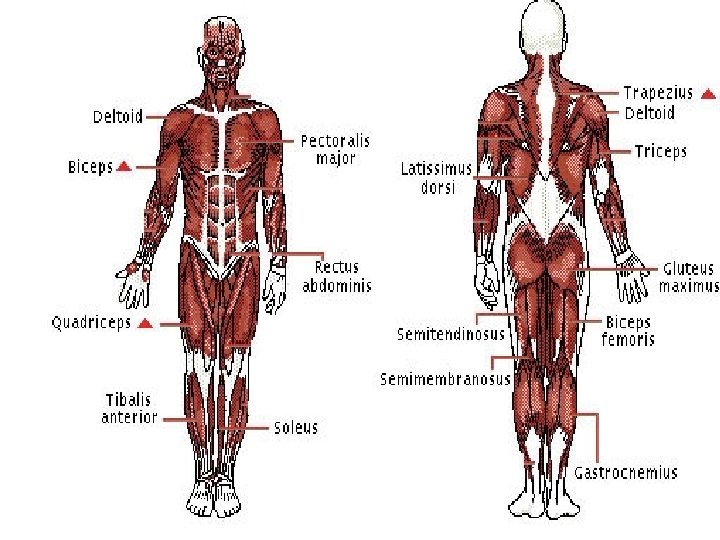
Muscles - Upper Extremities ● ● ● Deltoids Trapezius Biceps Triceps Pectoralis 19
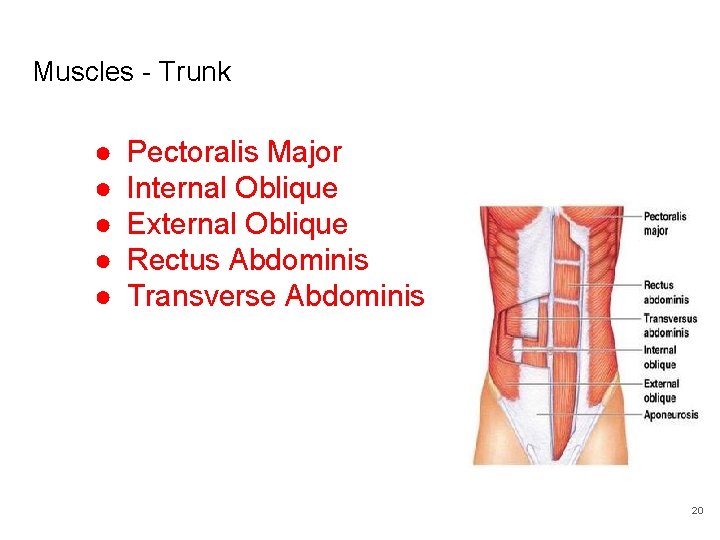
Muscles - Trunk ● ● ● Pectoralis Major Internal Oblique External Oblique Rectus Abdominis Transverse Abdominis 20
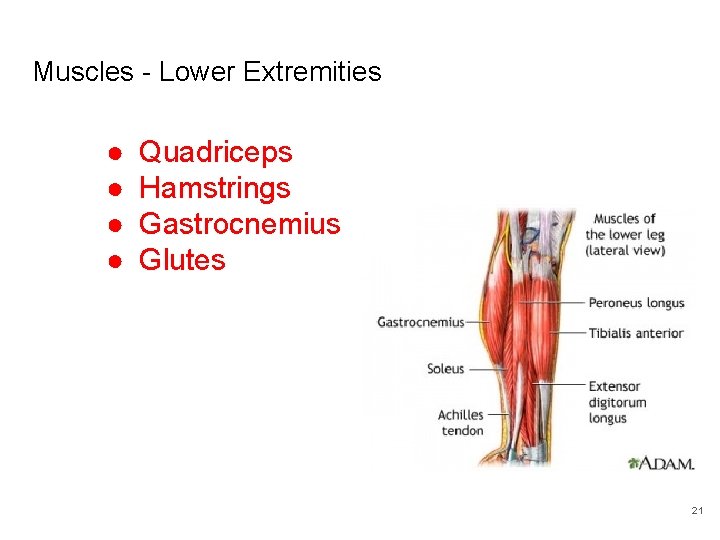
Muscles - Lower Extremities ● ● Quadriceps Hamstrings Gastrocnemius Glutes 21
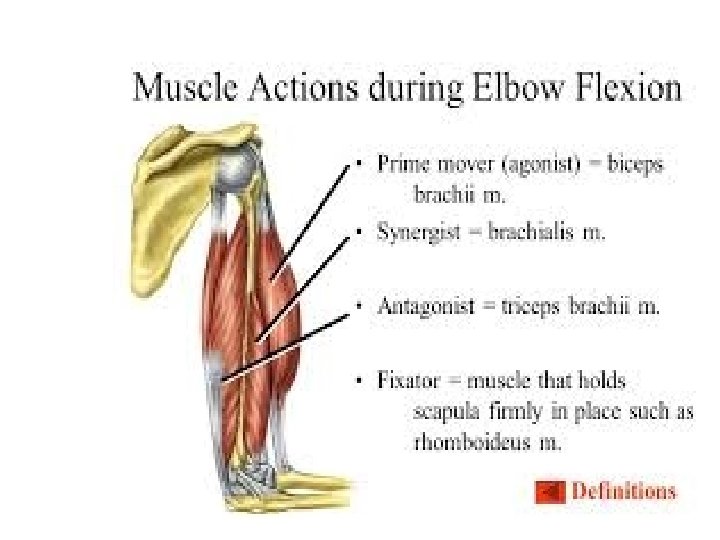
Muscle Pairing Movement Agonists - These muscles cause the movement to occur (also known as the prime mover) Antagonists - These muscles act in opposition to the agonist and usually return a limb to its initial position
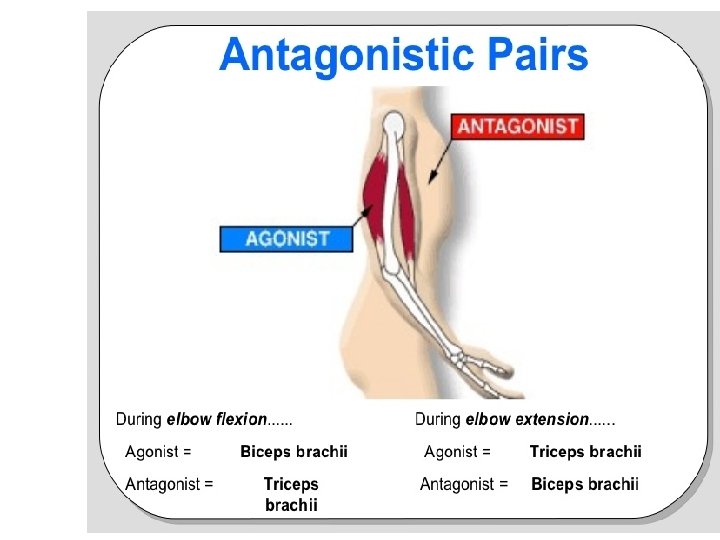
Muscle Pairing Movement Synergists - These muscles perform, or assist in performing the same set of joint motion as the agonists. (neutralizers) Fixators - These muscles provide the necessary support to assist in holding the rest of the body in place while the movement occurs (stabilizers)
Static Contraction ■ Muscle tension or internal force exerted against an external load ■ Internal force is equal to, or weaker than, the external load ■ No visible movement of the external load occurs Sport Books Publisher 26

Static Contraction ■ In most sports, the need for maximal static contraction is rare ■ Maximal static contraction is most often seen in gymnastics, wrestling, and judo Sport Books Publisher 27

Static Contraction ■ Most sports require low to submaximal static contraction ■ Examples of sports that require this type of contraction include sail-boarding, alpine skiing, and shooting events Sport Books Publisher 28
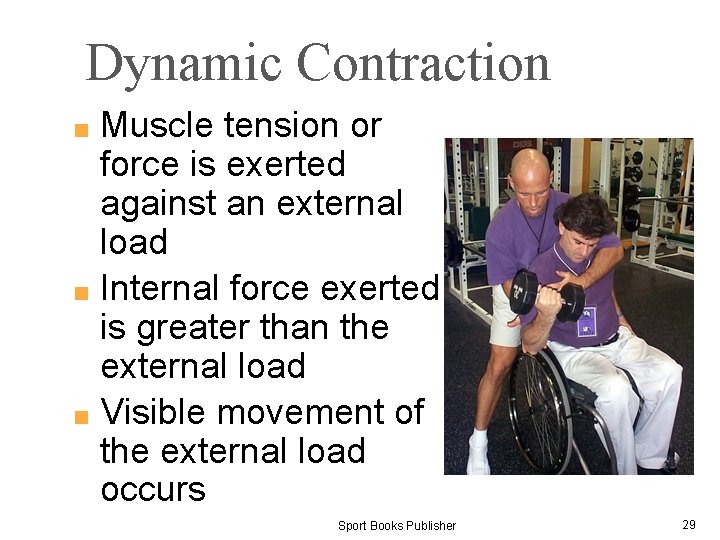
Dynamic Contraction Muscle tension or force is exerted against an external load ■ Internal force exerted is greater than the external load ■ Visible movement of the external load occurs ■ Sport Books Publisher 29
Isometric Contraction ■ ■ ■ ■ A static contraction Muscle contraction against an external force No visible change in muscle length External load is greater than the force generated by the internal force No external movement occurs No work is performed because no movement occurs A high amount of tension is developed, energy is used Sport Books Publisher 30

Concentric Contractions ● Length of the muscles shorten while undergoing tension ● For example, when you pick up a curl bar and perform a bicep curl, the length of your biceps muscles shorten. Your hands start down by your sides, and ends with your hands up by your shoulders. The biceps muscles shorten during this motion. 31
Eccentric Contractions ● Length of the muscle elongates, or lengthens, while undergoing tension ● For example, after you have completed the first part of the biceps curl, where your elbows are flexed, and your hands are holding on to the curl bar up by your shoulders, it is now time to return the weight back down towards your waistline. ● This is done in a smooth and controlled motion where the muscle, in this case the biceps, acts to decelerate the elbow joint at the end of the movement. 32
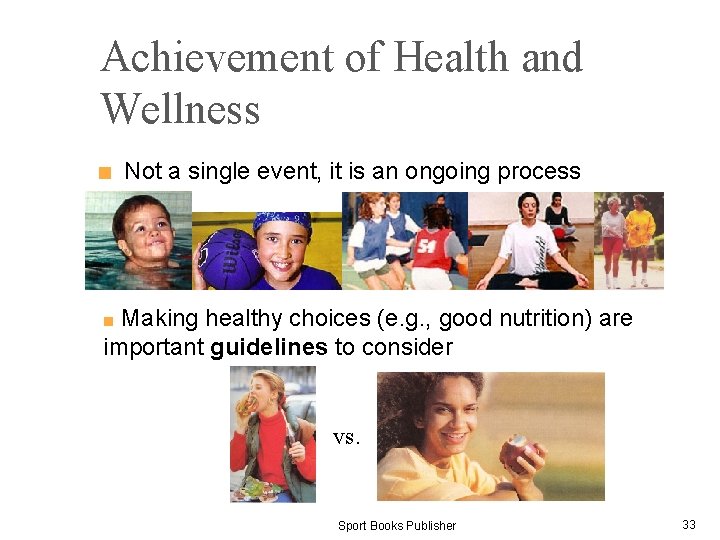
Achievement of Health and Wellness ■ Not a single event, it is an ongoing process Making healthy choices (e. g. , good nutrition) are important guidelines to consider ■ vs. Sport Books Publisher 33
Achievement of Health and Wellness ■ ■ Ultimately, it is up to each individual to choose what combination of healthy choices create a healthy balance for them Remember, do things in moderation. Too much or too little of anything is a potential problem – E. g. Too little exercise=poor cardiovascular health Too much exercise=weakened immune system Sport Books Publisher 34
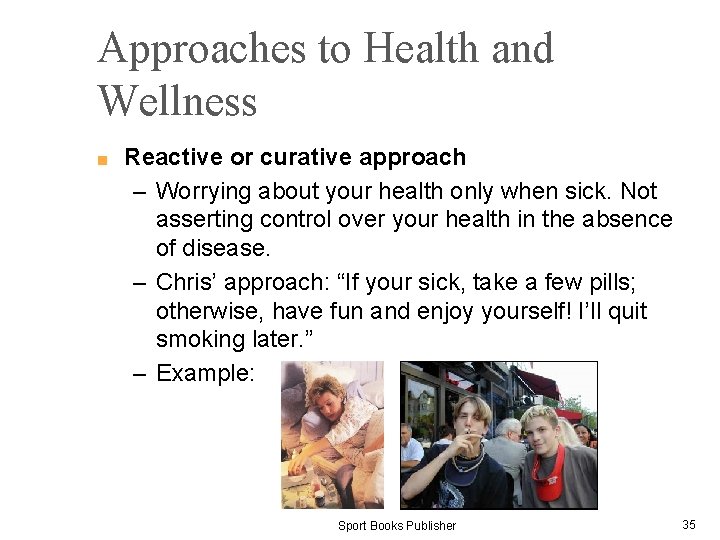
Approaches to Health and Wellness ■ Reactive or curative approach – Worrying about your health only when sick. Not asserting control over your health in the absence of disease. – Chris’ approach: “If your sick, take a few pills; otherwise, have fun and enjoy yourself! I’ll quit smoking later. ” – Example: Sport Books Publisher 35
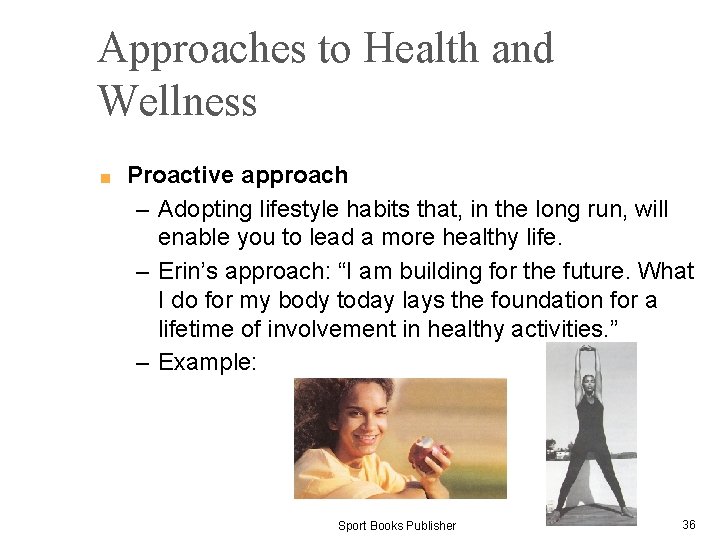
Approaches to Health and Wellness ■ Proactive approach – Adopting lifestyle habits that, in the long run, will enable you to lead a more healthy life. – Erin’s approach: “I am building for the future. What I do for my body today lays the foundation for a lifetime of involvement in healthy activities. ” – Example: Sport Books Publisher 36
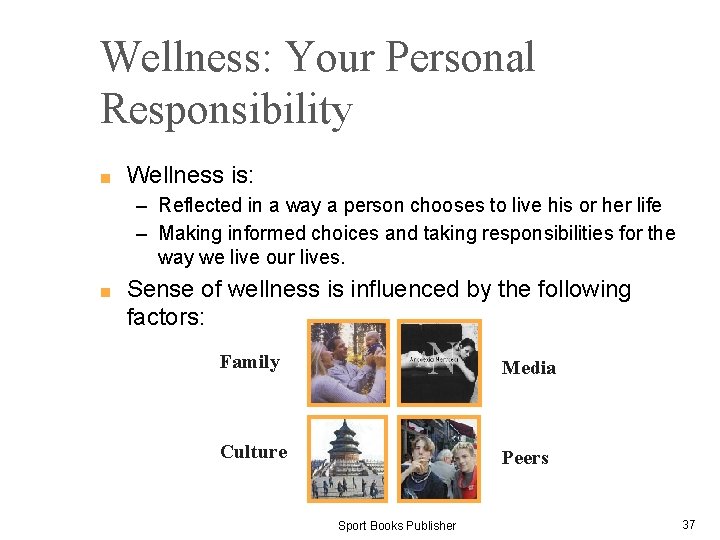
Wellness: Your Personal Responsibility ■ Wellness is: – Reflected in a way a person chooses to live his or her life – Making informed choices and taking responsibilities for the way we live our lives. ■ Sense of wellness is influenced by the following factors: Family Media Culture Peers Sport Books Publisher 37
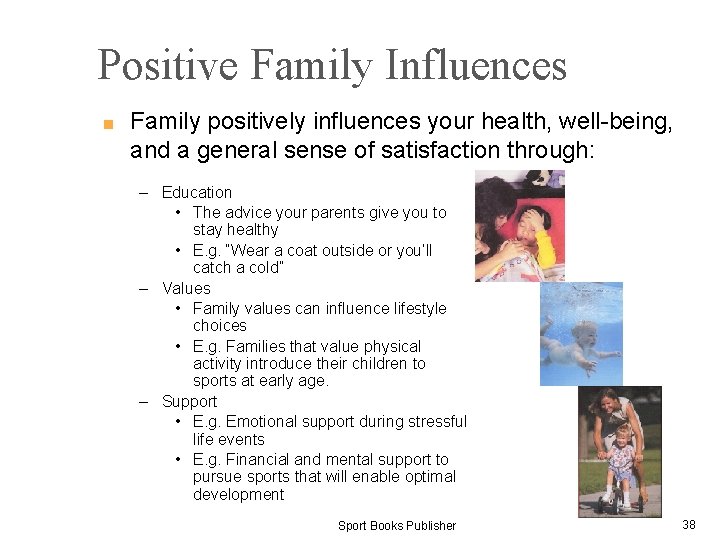
Positive Family Influences ■ Family positively influences your health, well-being, and a general sense of satisfaction through: – Education • The advice your parents give you to stay healthy • E. g. “Wear a coat outside or you’ll catch a cold” – Values • Family values can influence lifestyle choices • E. g. Families that value physical activity introduce their children to sports at early age. – Support • E. g. Emotional support during stressful life events • E. g. Financial and mental support to pursue sports that will enable optimal development Sport Books Publisher 38
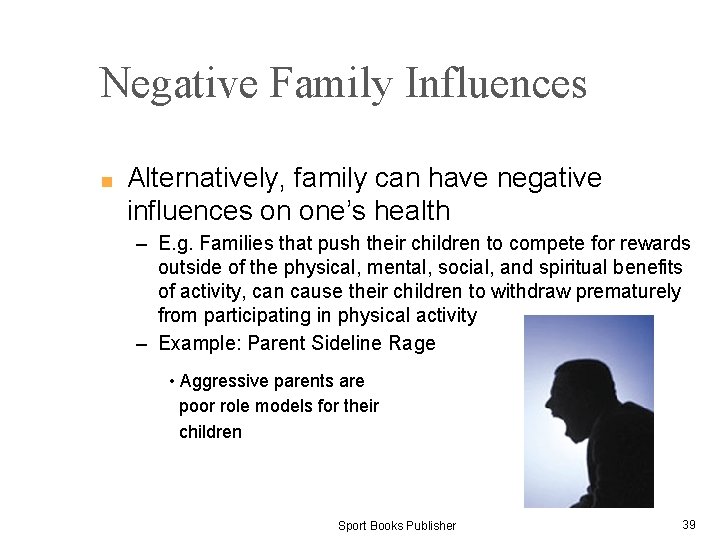
Negative Family Influences ■ Alternatively, family can have negative influences on one’s health – E. g. Families that push their children to compete for rewards outside of the physical, mental, social, and spiritual benefits of activity, can cause their children to withdraw prematurely from participating in physical activity – Example: Parent Sideline Rage • Aggressive parents are poor role models for their children Sport Books Publisher 39
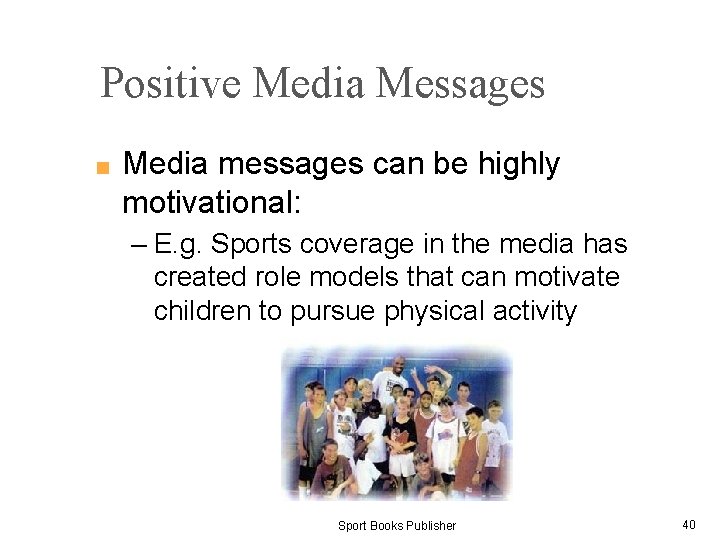
Positive Media Messages ■ Media messages can be highly motivational: – E. g. Sports coverage in the media has created role models that can motivate children to pursue physical activity Sport Books Publisher 40
Negative Media Messages ■ Unfortunately, media also has to power to encourage unhealthy choices: – E. g. Commercialization of the body image has distorted interpretation of healthy body Sport Books Publisher 41
Negative Media Messages ■ Further, media has distorted interpretation of what it means to be an accomplished performer. • Media coverage has some believe that the pinnacle of achievement comes from beating the competition, being the toughest, and gaining multi-million contracts. • However, wellness is about the journey towards personal improvement and aspiring to achieve your individual potential. Sport Books Publisher 42
It’s Up To You! In conclusion, images of the sporting life can be motivational or cause unhealthy distortions. ■ Ultimately, it is up to each individual to judge these images in relation to his or her personal goals and values. ■ Sport Books Publisher 43
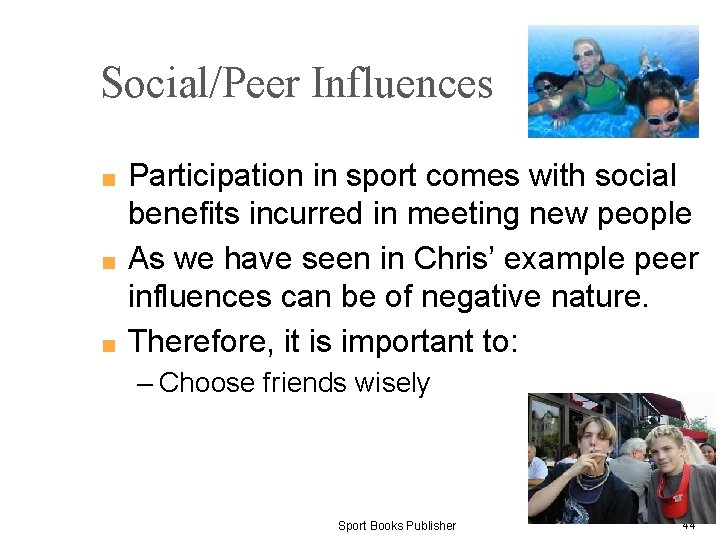
Social/Peer Influences Participation in sport comes with social benefits incurred in meeting new people ■ As we have seen in Chris’ example peer influences can be of negative nature. ■ Therefore, it is important to: ■ – Choose friends wisely Sport Books Publisher 44
Health in North America ■ Views about health are understood differently across cultures. North Americans tend to think about disease from a scientific point of view. – Western medicine deals largely with treatment of organs and systems, in isolation from the person’s mind and environment. – Increasingly, a more holistic approach is emerging. • E. g. Recognition of the influence of personality on cardiovascular health • E. g. Recognition of the influence of environment on obesity Sport Books Publisher 45
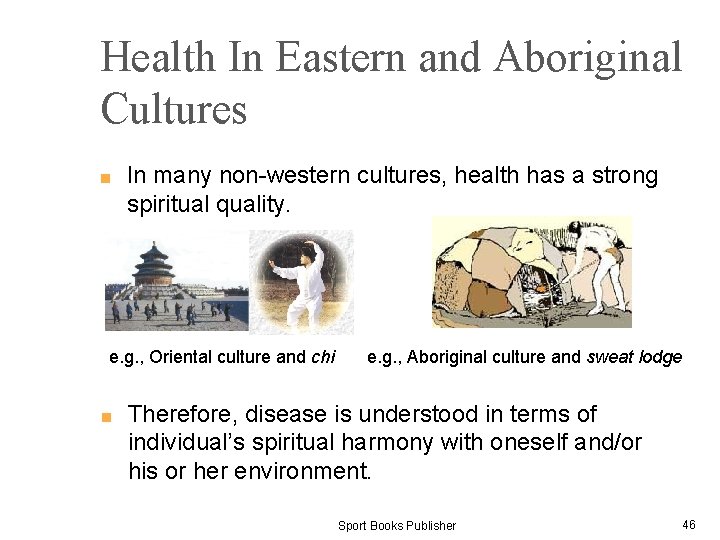
Health In Eastern and Aboriginal Cultures ■ In many non-western cultures, health has a strong spiritual quality. e. g. , Oriental culture and chi ■ e. g. , Aboriginal culture and sweat lodge Therefore, disease is understood in terms of individual’s spiritual harmony with oneself and/or his or her environment. Sport Books Publisher 46
Putting It All Together Health is multidimensional ■ One must make informed decision that relate to all the various dimensions of health ■ Perspectives and decisions about health are influenced by family, peers, media, and the culture ■ The journey towards health is lifelong ■ Sport Books Publisher 47
- Slides: 47