
Plane Stress Fracture Prediction for Aluminum and High
- Slides: 7
Plane Stress Fracture Prediction for Aluminum and High Strength Steel Sheets Using Digital Image Correlation Yannis Korkolis University of New Hampshire UNH - 28 October 2016 Sheet Metal Forming Slide 1
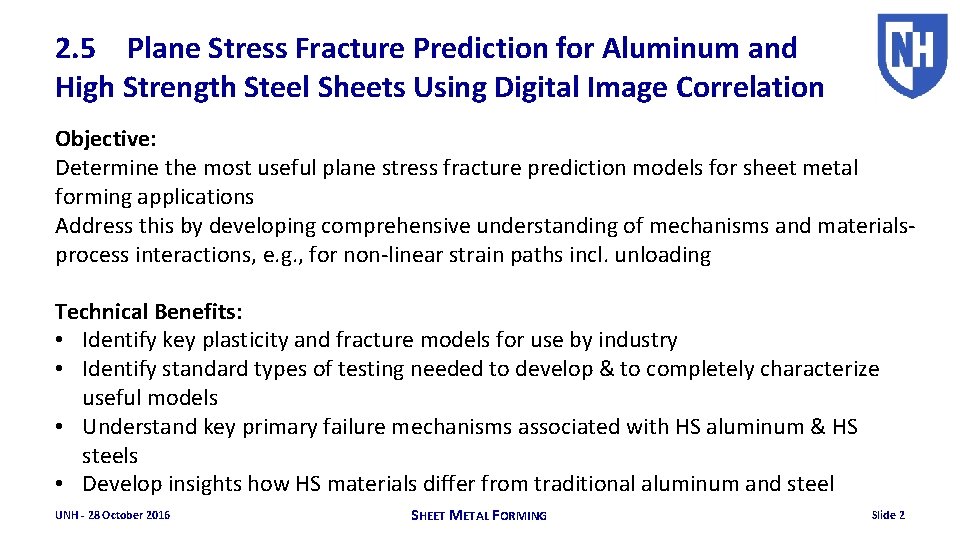
2. 5 Plane Stress Fracture Prediction for Aluminum and High Strength Steel Sheets Using Digital Image Correlation Objective: Determine the most useful plane stress fracture prediction models for sheet metal forming applications Address this by developing comprehensive understanding of mechanisms and materialsprocess interactions, e. g. , for non-linear strain paths incl. unloading Technical Benefits: • Identify key plasticity and fracture models for use by industry • Identify standard types of testing needed to develop & to completely characterize useful models • Understand key primary failure mechanisms associated with HS aluminum & HS steels • Develop insights how HS materials differ from traditional aluminum and steel UNH - 28 October 2016 SHEET METAL FORMING Slide 2
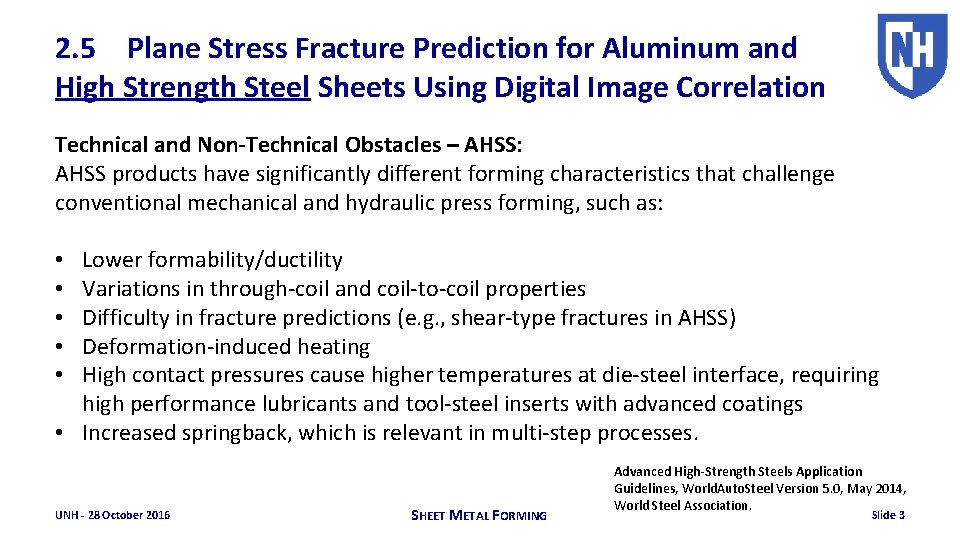
2. 5 Plane Stress Fracture Prediction for Aluminum and High Strength Steel Sheets Using Digital Image Correlation Technical and Non-Technical Obstacles – AHSS: AHSS products have significantly different forming characteristics that challenge conventional mechanical and hydraulic press forming, such as: Lower formability/ductility Variations in through-coil and coil-to-coil properties Difficulty in fracture predictions (e. g. , shear-type fractures in AHSS) Deformation-induced heating High contact pressures cause higher temperatures at die-steel interface, requiring high performance lubricants and tool-steel inserts with advanced coatings • Increased springback, which is relevant in multi-step processes. • • • UNH - 28 October 2016 SHEET METAL FORMING Advanced High-Strength Steels Application Guidelines, World. Auto. Steel Version 5. 0, May 2014, World Steel Association. Slide 3
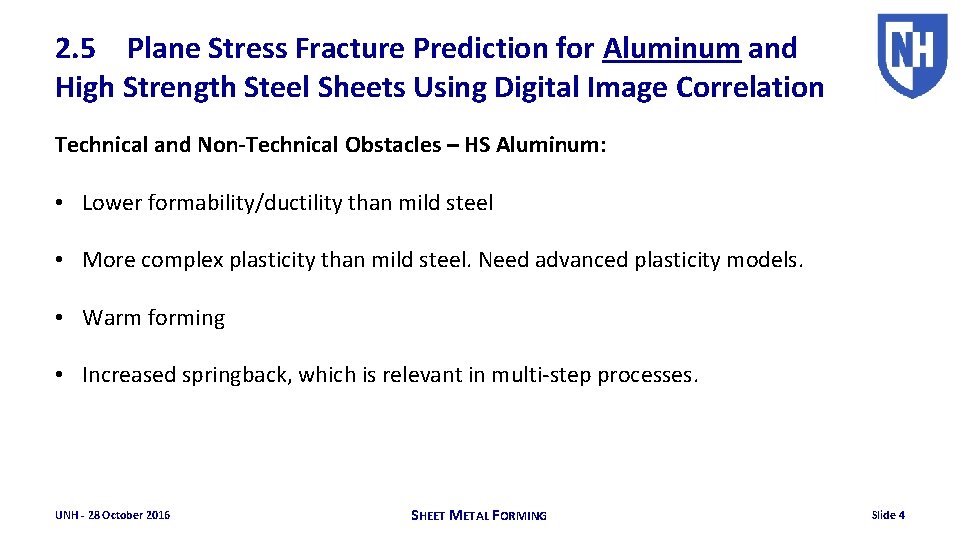
2. 5 Plane Stress Fracture Prediction for Aluminum and High Strength Steel Sheets Using Digital Image Correlation Technical and Non-Technical Obstacles – HS Aluminum: • Lower formability/ductility than mild steel • More complex plasticity than mild steel. Need advanced plasticity models. • Warm forming • Increased springback, which is relevant in multi-step processes. UNH - 28 October 2016 SHEET METAL FORMING Slide 4
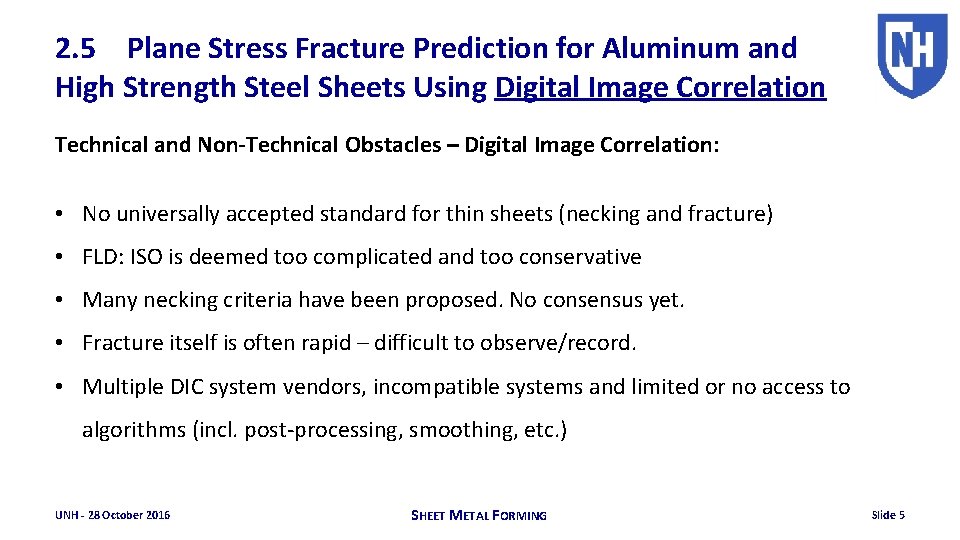
2. 5 Plane Stress Fracture Prediction for Aluminum and High Strength Steel Sheets Using Digital Image Correlation Technical and Non-Technical Obstacles – Digital Image Correlation: • No universally accepted standard for thin sheets (necking and fracture) • FLD: ISO is deemed too complicated and too conservative • Many necking criteria have been proposed. No consensus yet. • Fracture itself is often rapid – difficult to observe/record. • Multiple DIC system vendors, incompatible systems and limited or no access to algorithms (incl. post-processing, smoothing, etc. ) UNH - 28 October 2016 SHEET METAL FORMING Slide 5
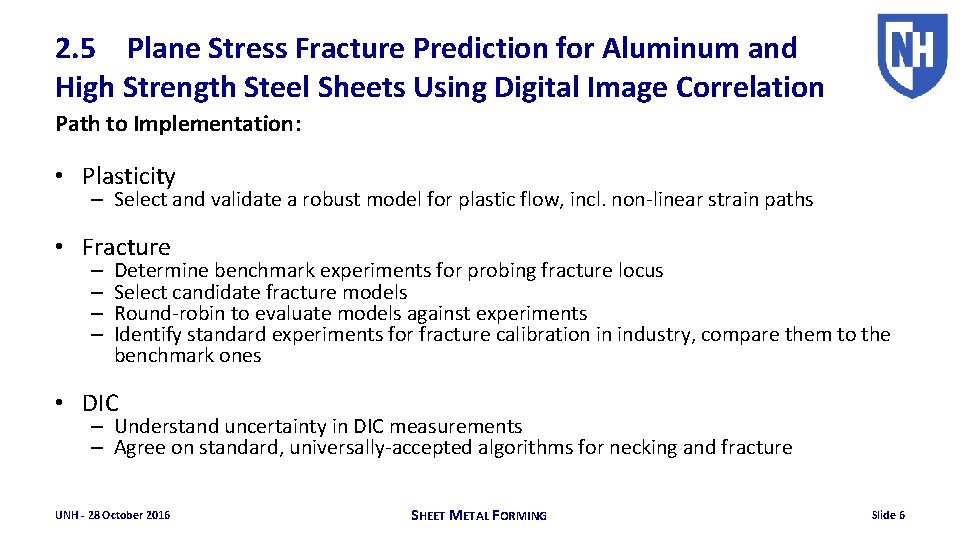
2. 5 Plane Stress Fracture Prediction for Aluminum and High Strength Steel Sheets Using Digital Image Correlation Path to Implementation: • Plasticity – Select and validate a robust model for plastic flow, incl. non-linear strain paths • Fracture – – Determine benchmark experiments for probing fracture locus Select candidate fracture models Round-robin to evaluate models against experiments Identify standard experiments for fracture calibration in industry, compare them to the benchmark ones • DIC – Understand uncertainty in DIC measurements – Agree on standard, universally-accepted algorithms for necking and fracture UNH - 28 October 2016 SHEET METAL FORMING Slide 6
2. 5 Plane Stress Fracture Prediction for Aluminum and High Strength Steel Sheets Using Digital Image Correlation Discussion: • Anything missing for active industry support? • Estimated benefits realistic & complete? • Technical and non-technical obstacles complete? • Alternative implementation paths or better approaches? • Conflicts with intellectual property or trade secrets? • Round-robins? UNH - 28 October 2016 SHEET METAL FORMING Slide 7