
Planar Graphs Lecture 10 Oct 21 This Lecture
- Slides: 32
Planar Graphs Lecture 10: Oct 21
This Lecture Today we will talk about planar graphs, and how to color a map using 6 colors. • Planar graphs • Euler’s formula • 6 -coloring
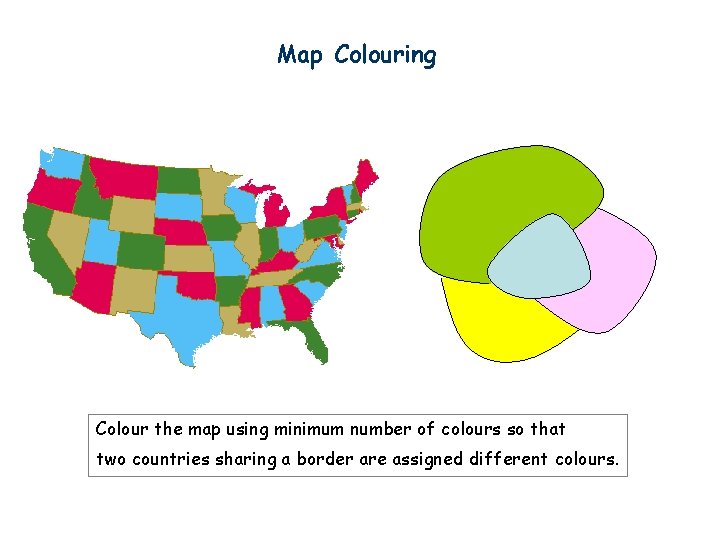
Map Colouring Colour the map using minimum number of colours so that two countries sharing a border are assigned different colours.
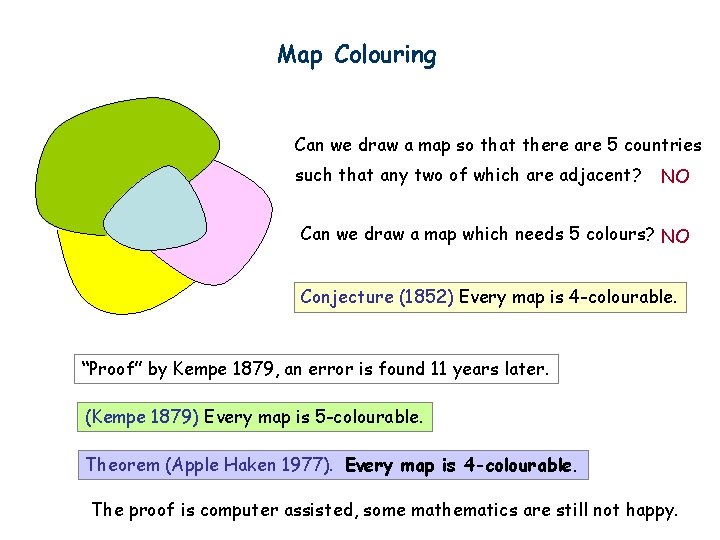
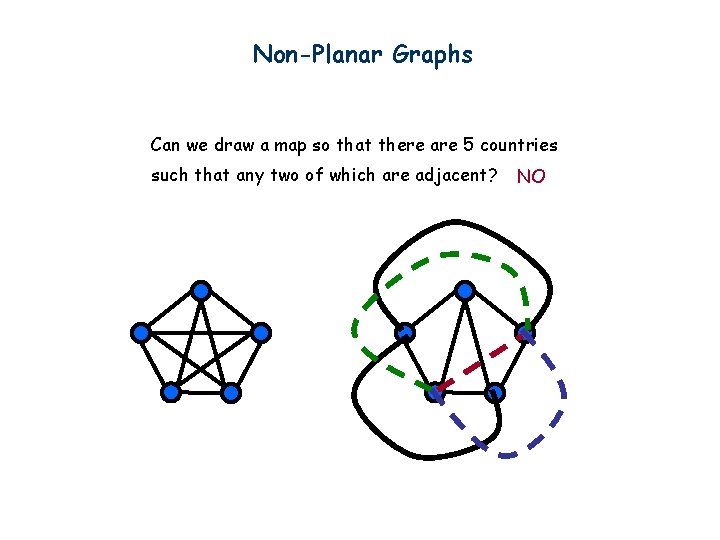
Map Colouring Can we draw a map so that there are 5 countries such that any two of which are adjacent? NO Can we draw a map which needs 5 colours? NO Conjecture (1852) Every map is 4 -colourable. “Proof” by Kempe 1879, an error is found 11 years later. (Kempe 1879) Every map is 5 -colourable. Theorem (Apple Haken 1977). Every map is 4 -colourable. The proof is computer assisted, some mathematics are still not happy.
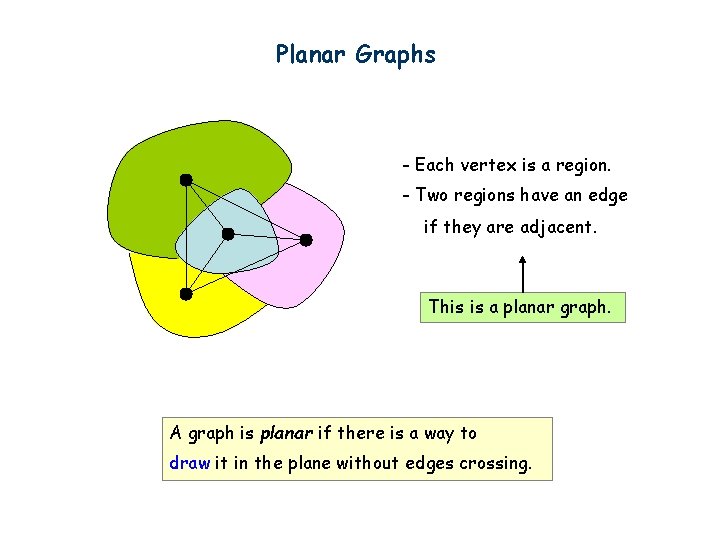
Planar Graphs - Each vertex is a region. - Two regions have an edge if they are adjacent. This is a planar graph. A graph is planar if there is a way to draw it in the plane without edges crossing.
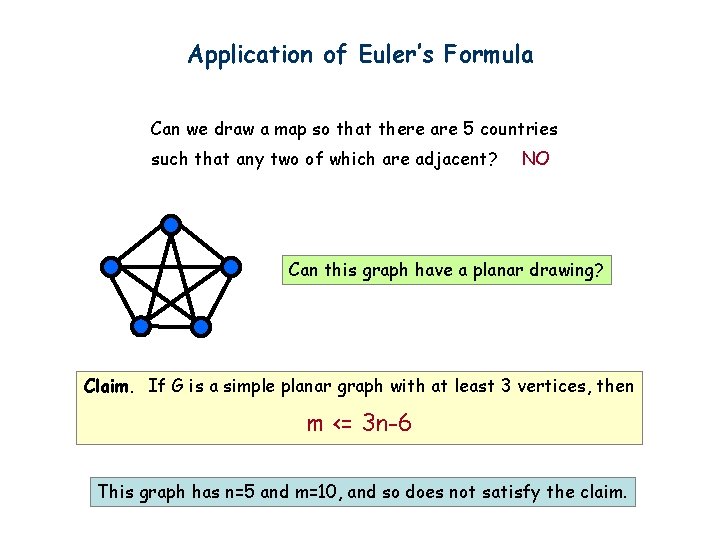
Non-Planar Graphs Can we draw a map so that there are 5 countries such that any two of which are adjacent? NO
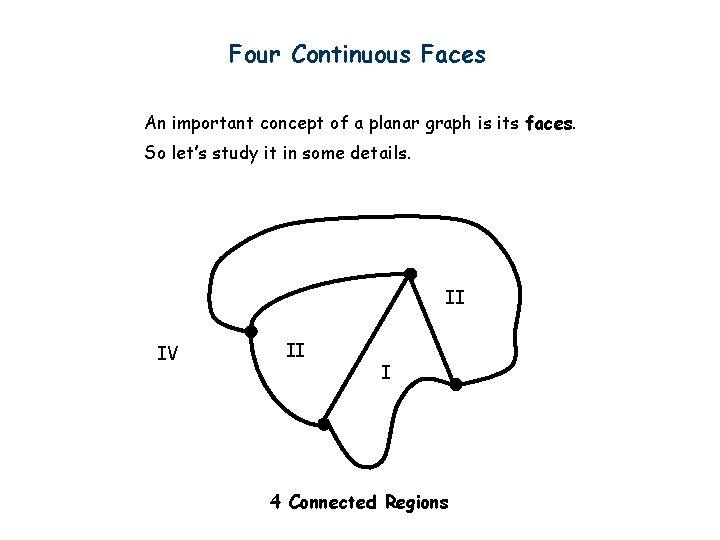
Four Continuous Faces An important concept of a planar graph is its faces. So let’s study it in some details. II IV II I 4 Connected Regions
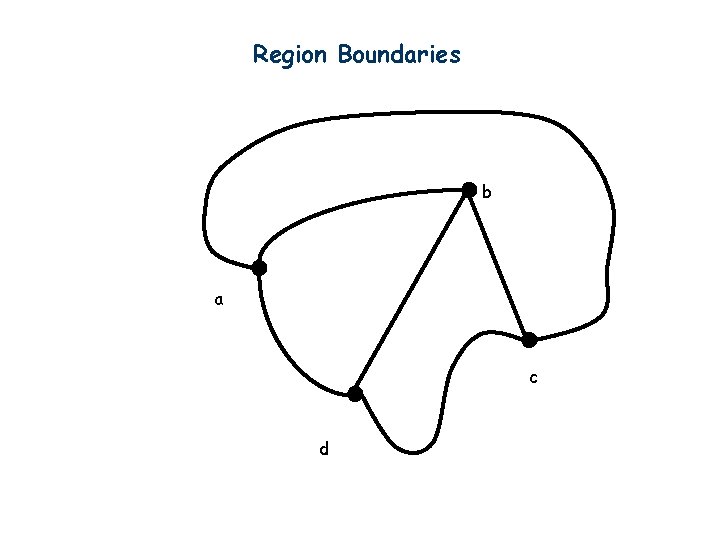
Region Boundaries b a c d
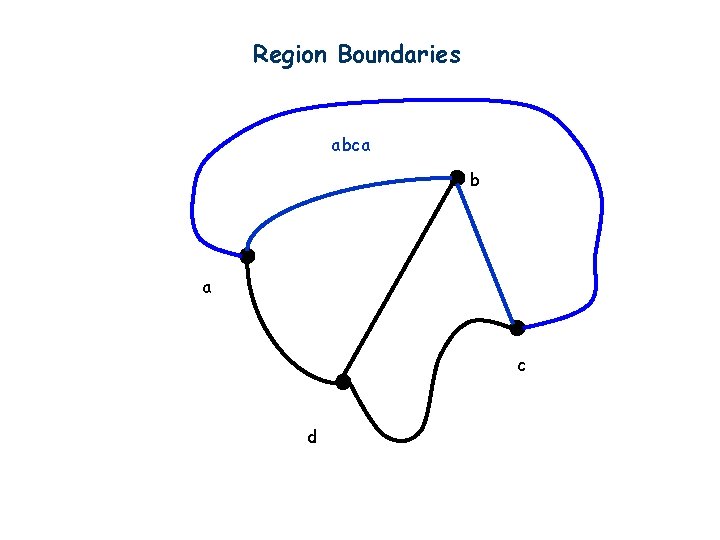
Region Boundaries abca b a c d
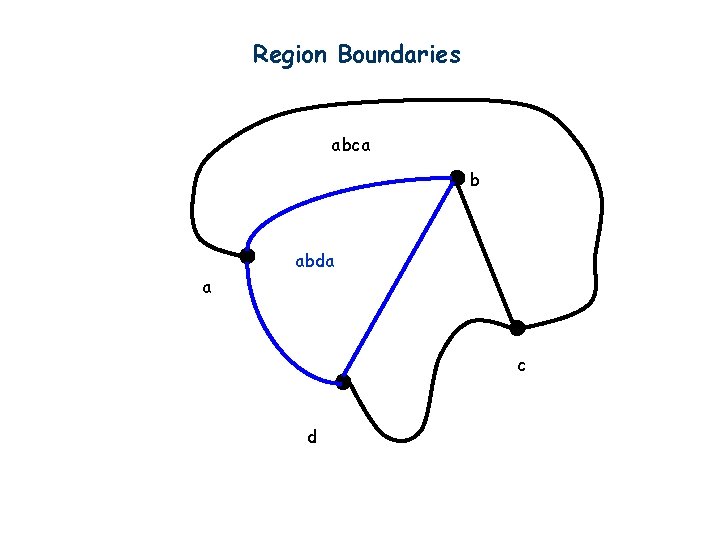
Region Boundaries abca b abda a c d
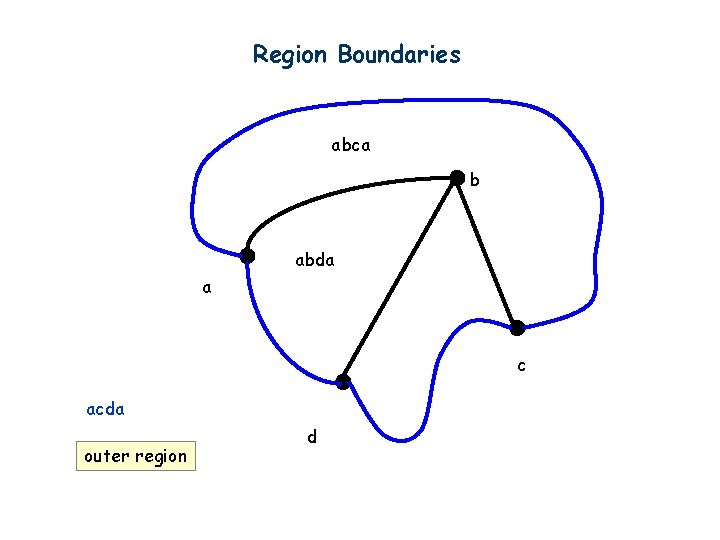
Region Boundaries abca b abda a c acda outer region d
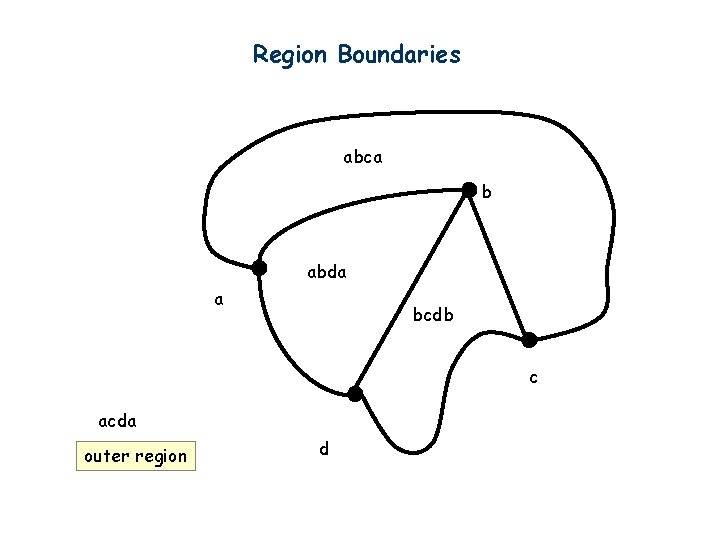
Region Boundaries abca b abda a bcdb c acda outer region d
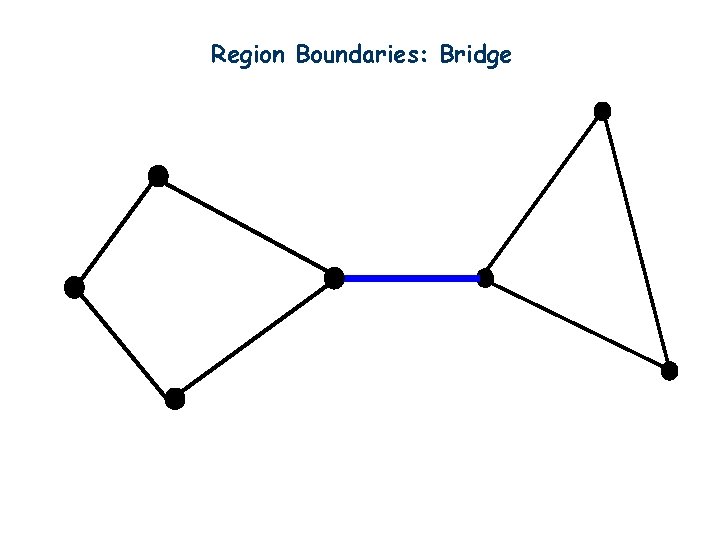
Region Boundaries: Bridge
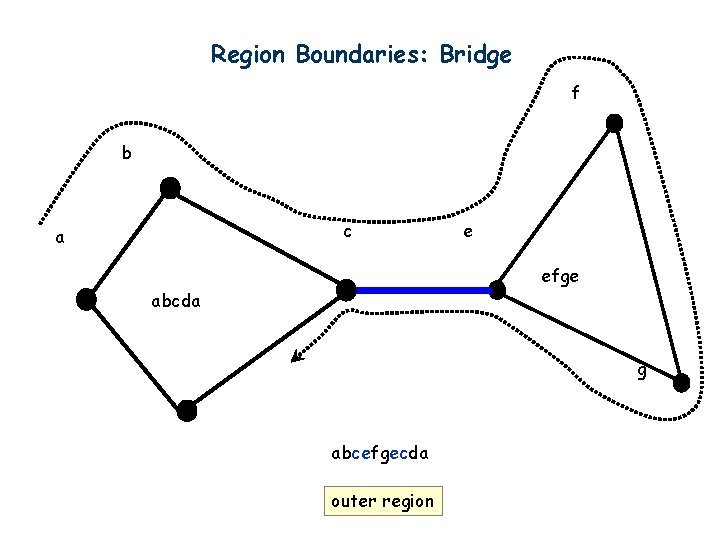
Region Boundaries: Bridge f b c a e efge abcda g d abcefgecda outer region
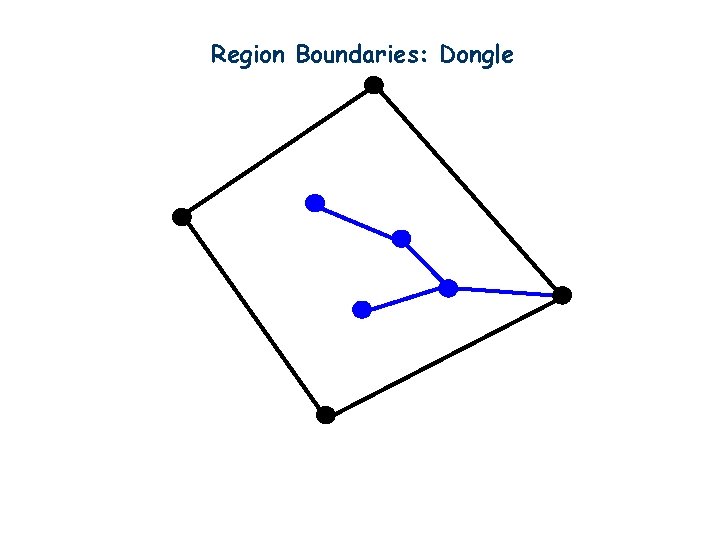
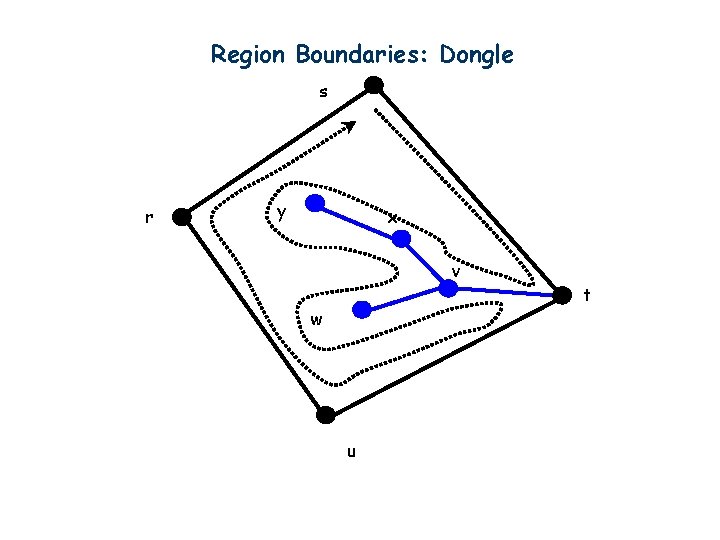
Region Boundaries: Dongle
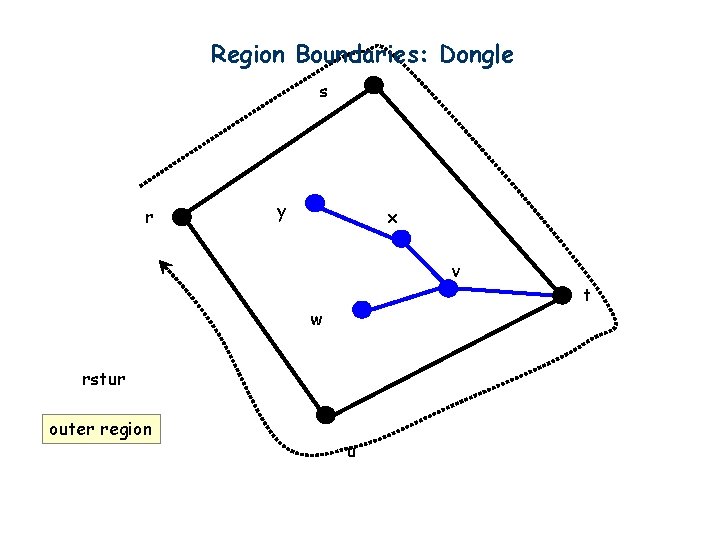
Region Boundaries: Dongle s r y x v w rstur outer region u t
Region Boundaries: Dongle s r y x v w u t
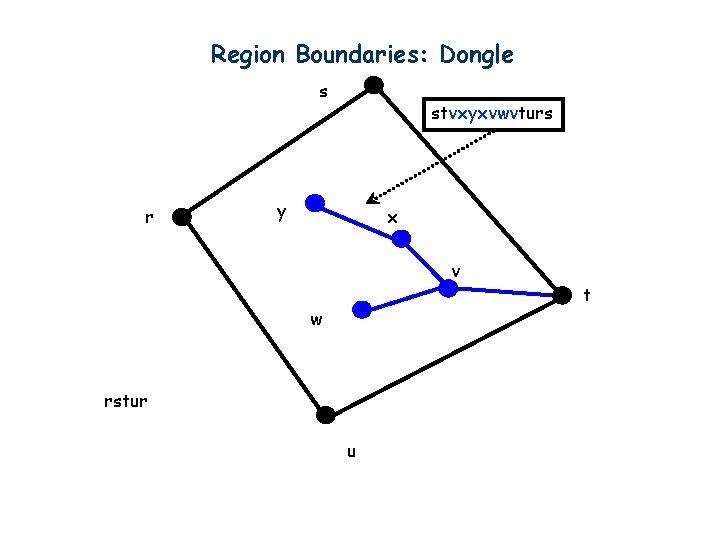
Region Boundaries: Dongle s r stvxyxvwvturs y x v w rstur u t
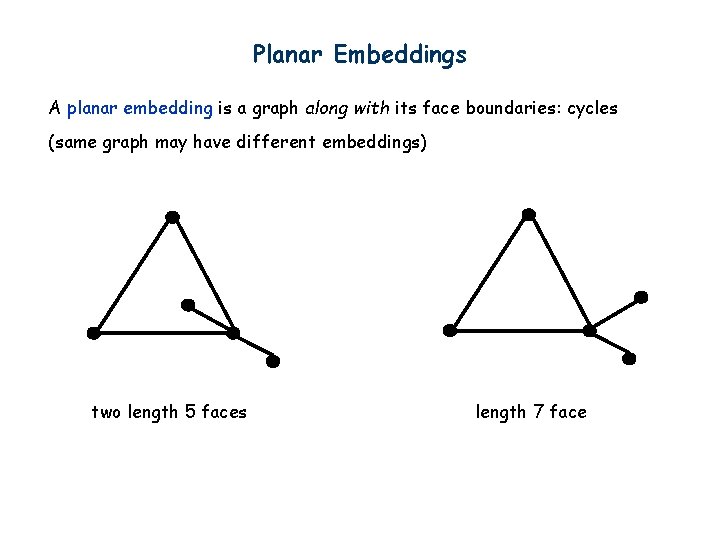
Planar Embeddings A planar embedding is a graph along with its face boundaries: cycles (same graph may have different embeddings) two length 5 faces length 7 face
This Lecture • Planar graphs • Euler’s formula • 6 -coloring
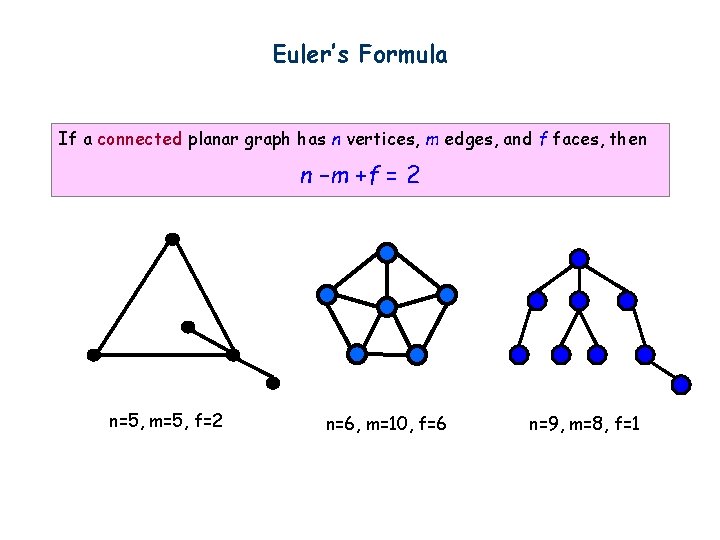
Euler’s Formula If a connected planar graph has n vertices, m edges, and f faces, then n –m +f = 2 n=5, m=5, f=2 n=6, m=10, f=6 n=9, m=8, f=1
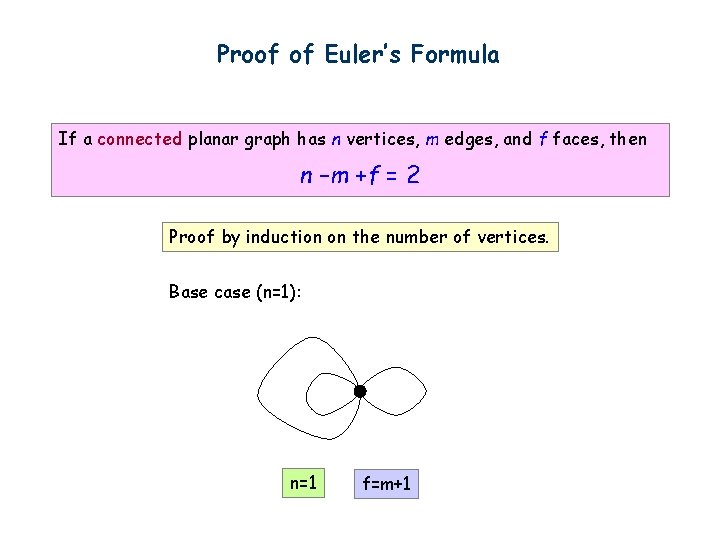
Proof of Euler’s Formula If a connected planar graph has n vertices, m edges, and f faces, then n –m +f = 2 Proof by induction on the number of vertices. Base case (n=1): n=1 f=m+1
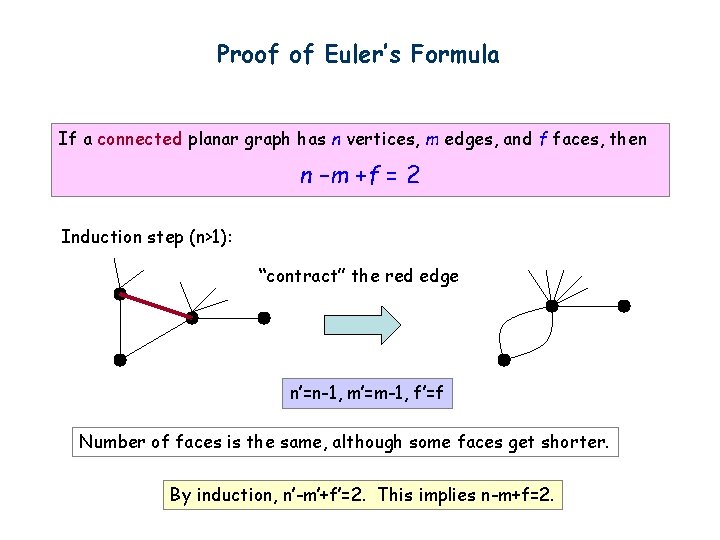
Proof of Euler’s Formula If a connected planar graph has n vertices, m edges, and f faces, then n –m +f = 2 Induction step (n>1): “contract” the red edge n’=n-1, m’=m-1, f’=f Number of faces is the same, although some faces get shorter. By induction, n’-m’+f’=2. This implies n-m+f=2.
This Lecture • Planar graphs • Euler’s formula • 6 -coloring
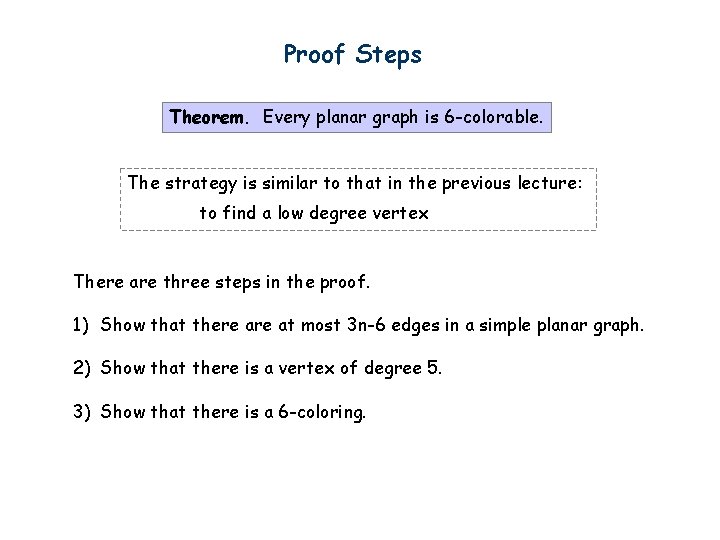
Proof Steps Theorem. Every planar graph is 6 -colorable. The strategy is similar to that in the previous lecture: to find a low degree vertex There are three steps in the proof. 1) Show that there at most 3 n-6 edges in a simple planar graph. 2) Show that there is a vertex of degree 5. 3) Show that there is a 6 -coloring.
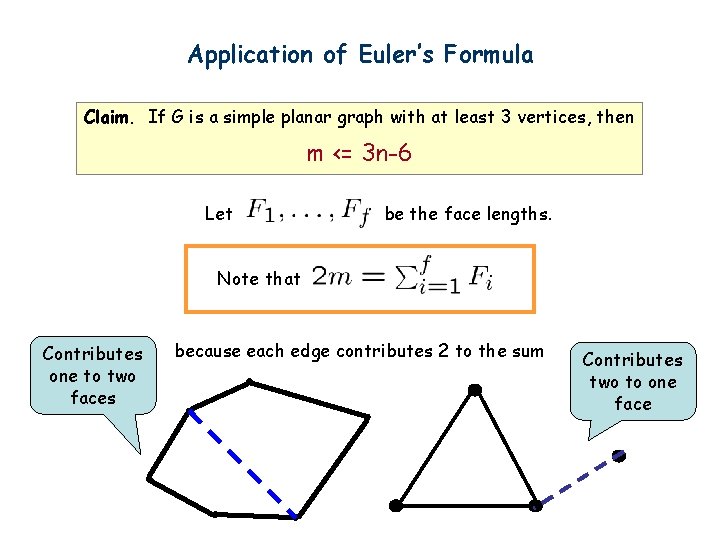
Application of Euler’s Formula Claim. If G is a simple planar graph with at least 3 vertices, then m <= 3 n-6 Let be the face lengths. Note that Contributes one to two faces because each edge contributes 2 to the sum Contributes two to one face
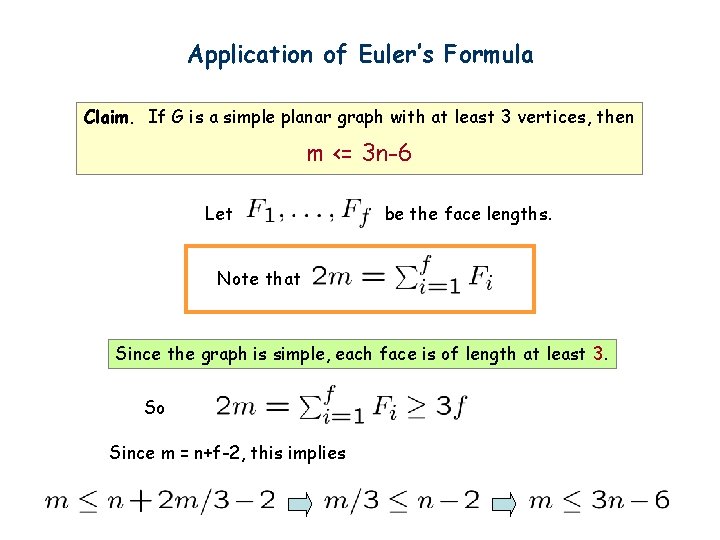
Application of Euler’s Formula Claim. If G is a simple planar graph with at least 3 vertices, then m <= 3 n-6 Let be the face lengths. Note that Since the graph is simple, each face is of length at least 3. So Since m = n+f-2, this implies
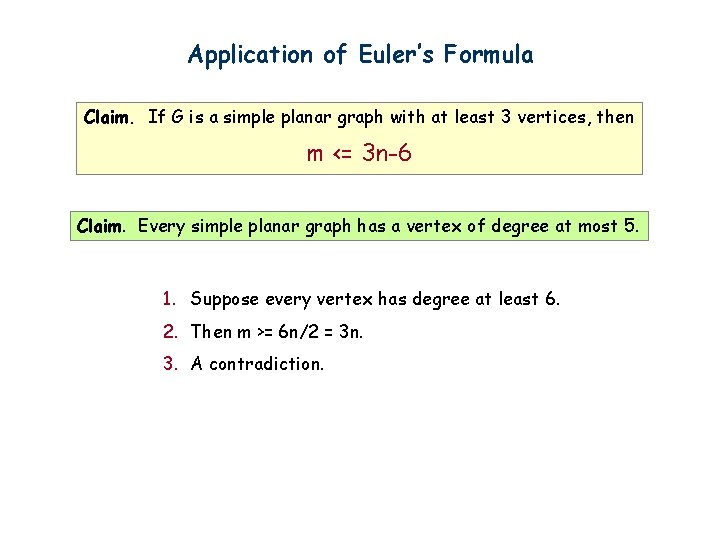
Application of Euler’s Formula Claim. If G is a simple planar graph with at least 3 vertices, then m <= 3 n-6 Claim. Every simple planar graph has a vertex of degree at most 5. 1. Suppose every vertex has degree at least 6. 2. Then m >= 6 n/2 = 3 n. 3. A contradiction.
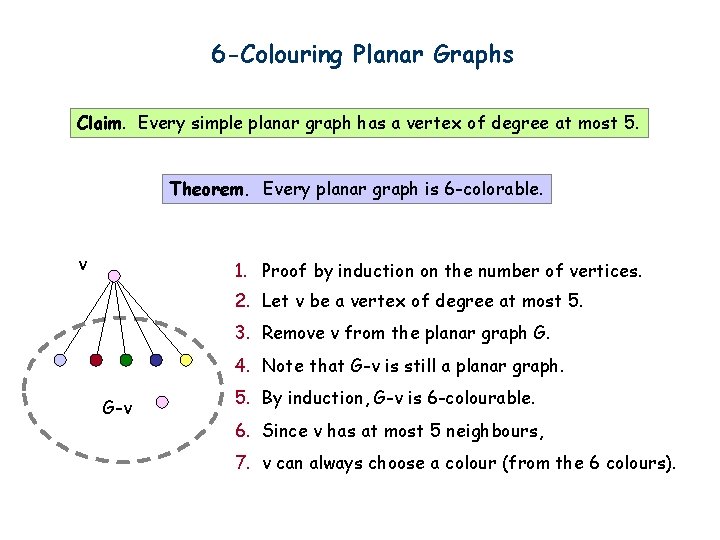
6 -Colouring Planar Graphs Claim. Every simple planar graph has a vertex of degree at most 5. Theorem. Every planar graph is 6 -colorable. v 1. Proof by induction on the number of vertices. 2. Let v be a vertex of degree at most 5. 3. Remove v from the planar graph G. 4. Note that G-v is still a planar graph. G-v 5. By induction, G-v is 6 -colourable. 6. Since v has at most 5 neighbours, 7. v can always choose a colour (from the 6 colours).
Application of Euler’s Formula Can we draw a map so that there are 5 countries such that any two of which are adjacent? NO Can this graph have a planar drawing? Claim. If G is a simple planar graph with at least 3 vertices, then m <= 3 n-6 This graph has n=5 and m=10, and so does not satisfy the claim.
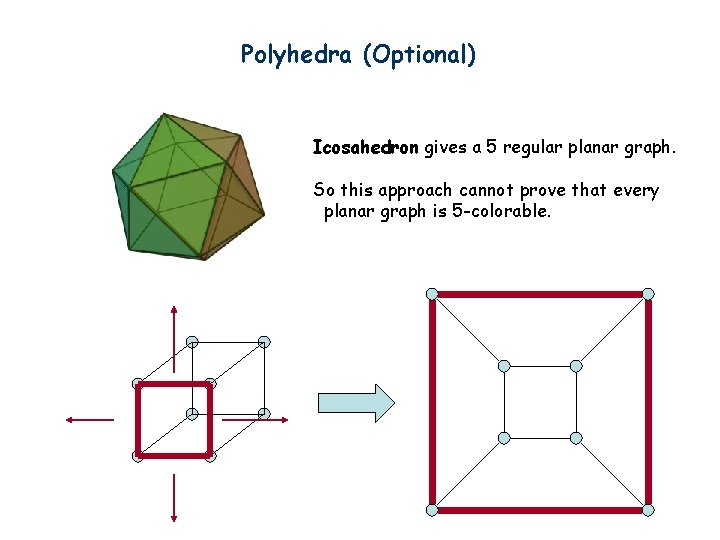
Polyhedra (Optional) Icosahedron gives a 5 regular planar graph. So this approach cannot prove that every planar graph is 5 -colorable.
Summary It is not very difficult to prove that every planar graph is 5 -colorable. (See wiki if you are interested. ) We have finished our second topic of this course, graph theory. In this topic, I hope you learn (1) how to apply the proof techniques in proving results in graph theory. (2) how to model problems as graph problems (3) how to reduce one problem to another (e. g. maximum matching to perfect matching, k-stroke graph to 1 -stroke graph, etc. ) Reductions and inductions are important techniques in computer science.