
Planar gradient metasurface to focus EM waves in
- Slides: 1
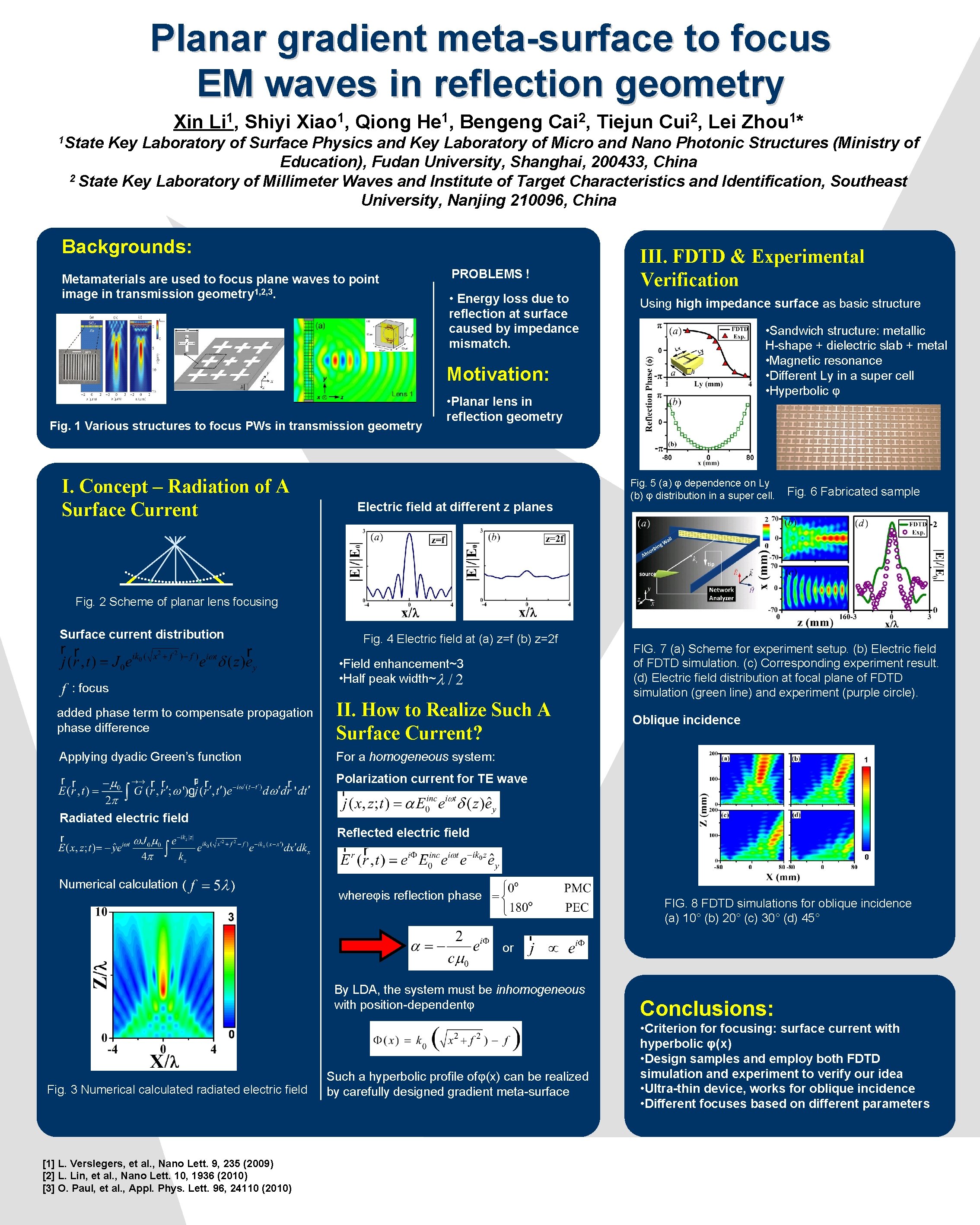
Planar gradient meta-surface to focus EM waves in reflection geometry Xin 1 Li , Shiyi 1 Xiao , Qiong 1 He , Bengeng 2 Cai , Tiejun 2 Cui , Lei 1 Zhou * 1 State Key Laboratory of Surface Physics and Key Laboratory of Micro and Nano Photonic Structures (Ministry of Education), Fudan University, Shanghai, 200433, China 2 State Key Laboratory of Millimeter Waves and Institute of Target Characteristics and Identification, Southeast University, Nanjing 210096, China Backgrounds: Metamaterials are used to focus plane waves to point image in transmission geometry 1, 2, 3. PROBLEMS ! • Energy loss due to reflection at surface caused by impedance mismatch. III. FDTD & Experimental Verification Using high impedance surface as basic structure • Sandwich structure: metallic H-shape + dielectric slab + metal • Magnetic resonance • Different Ly in a super cell • Hyperbolic φ Motivation: Fig. 1 Various structures to focus PWs in transmission geometry I. Concept – Radiation of A Surface Current • Planar lens in reflection geometry Electric field at different z planes Fig. 5 (a) φ dependence on Ly (b) φ distribution in a super cell. Fig. 6 Fabricated sample Fig. 2 Scheme of planar lens focusing Surface current distribution Fig. 4 Electric field at (a) z=f (b) z=2 f • Field enhancement~3 • Half peak width~ : focus added phase term to compensate propagation phase difference II. How to Realize Such A Surface Current? Applying dyadic Green’s function For a homogeneous system: FIG. 7 (a) Scheme for experiment setup. (b) Electric field of FDTD simulation. (c) Corresponding experiment result. (d) Electric field distribution at focal plane of FDTD simulation (green line) and experiment (purple circle). Oblique incidence Polarization current for TE wave Radiated electric field Reflected electric field Numerical calculation ( ) whereφis reflection phase FIG. 8 FDTD simulations for oblique incidence (a) 10° (b) 20° (c) 30° (d) 45° or By LDA, the system must be inhomogeneous with position-dependentφ Fig. 3 Numerical calculated radiated electric field [1] L. Verslegers, et al. , Nano Lett. 9, 235 (2009) [2] L. Lin, et al. , Nano Lett. 10, 1936 (2010) [3] O. Paul, et al. , Appl. Phys. Lett. 96, 24110 (2010) Such a hyperbolic profile ofφ(x) can be realized by carefully designed gradient meta-surface Conclusions: • Criterion for focusing: surface current with hyperbolic φ(x) • Design samples and employ both FDTD simulation and experiment to verify our idea • Ultra-thin device, works for oblique incidence • Different focuses based on different parameters