
PLAN Primary Science Supporting Assessment Living things and
- Slides: 24
PLAN Primary Science – Supporting Assessment Living things and their Habitats Year 5 Shannon © Pan London Assessment Network (PLAN) July 2019 This resource has been developed by the Pan London Assessment Network and is supported by the Association for Science Education. 1
PLAN Primary Science - Supporting Assessment PLAN Primary Science is a set of resources produced to enable teachers to have a clearer understanding of National Curriculum expectations for meeting the standard. Annotated collections of children’s work provide examples of what working at the expected standard for primary science might look like for the knowledge and conceptual understanding statements of the programmes of study (POS). It is not the intention of these resources to specifically exemplify the working scientifically statements. However, aspects of working scientifically have been shown as an integral part of the teaching and learning of the knowledge and concepts. The resources provided have been cross moderated multiple times before publishing so that they can be used with confidence by teachers and subject leaders. Each collection of work shows one example of how a pupil has met National Curriculum statements for a particular area of content but these are not intended to be the definitive way of teaching these statements. 2
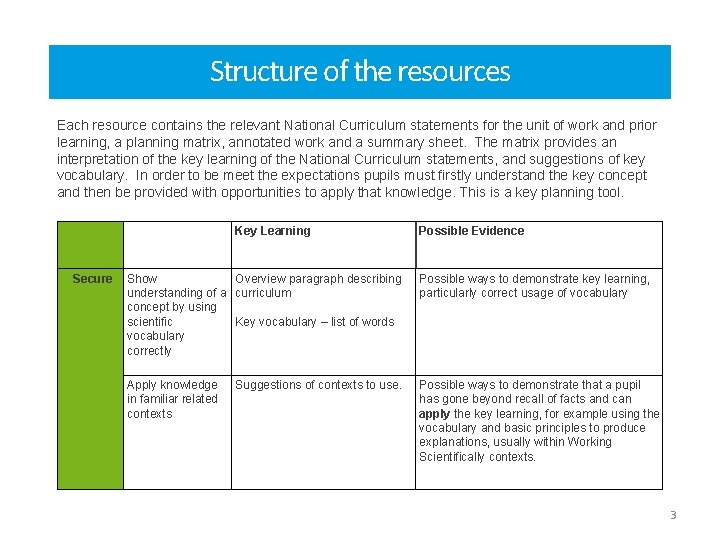
Structure of the resources Each resource contains the relevant National Curriculum statements for the unit of work and prior learning, a planning matrix, annotated work and a summary sheet. The matrix provides an interpretation of the key learning of the National Curriculum statements, and suggestions of key vocabulary. In order to be meet the expectations pupils must firstly understand the key concept and then be provided with opportunities to apply that knowledge. This is a key planning tool. Key Learning Secure Possible Evidence Show Overview paragraph describing understanding of a curriculum concept by using scientific Key vocabulary – list of words vocabulary correctly Possible ways to demonstrate key learning, particularly correct usage of vocabulary Apply knowledge in familiar related contexts Possible ways to demonstrate that a pupil has gone beyond recall of facts and can apply the key learning, for example using the vocabulary and basic principles to produce explanations, usually within Working Scientifically contexts. Suggestions of contexts to use. 3
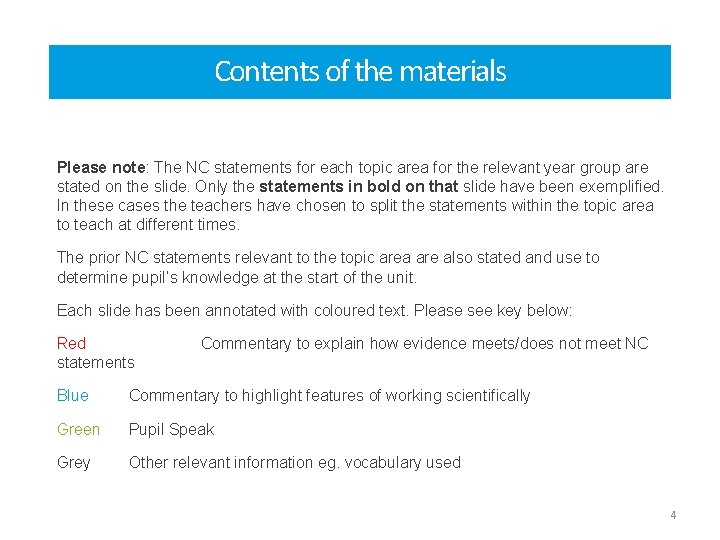
Contents of the materials Please note: The NC statements for each topic area for the relevant year group are stated on the slide. Only the statements in bold on that slide have been exemplified. In these cases the teachers have chosen to split the statements within the topic area to teach at different times. The prior NC statements relevant to the topic area are also stated and use to determine pupil’s knowledge at the start of the unit. Each slide has been annotated with coloured text. Please see key below: Red statements Blue Commentary to explain how evidence meets/does not meet NC Commentary to highlight features of working scientifically Green Pupil Speak Grey Other relevant information eg. vocabulary used 4
Year 2 Statements – Prior learning Pupils should be taught to: • notice that animals, including humans, have offspring which grow into adults (2 -Animals, including Humans) 5
Year 3 Statements – Prior learning Pupils should be taught to: • explore the part that flowers play in the life cycle of flowering plants, including pollination, seed formation and seed dispersal. (3 -Plants) 6
Year Statements Year 4 5 statements Pupils should be taught to: • describe the differences in the life cycles of a mammal, an amphibian, an insect and a bird (5 Living things and their Habitats) • describe the life process of reproduction in some plants and animals. (5 -Living things and their Habitats) 7
Later Statements Pupils do not need to be taught content they will learn in later year groups. They can be challenged by applying the content for their year group in broader contexts. Pupils in Key Stage 3 will be taught about: • reproduction in humans (as an example of a mammal), including the structure and function of the male and female reproductive systems, menstrual cycle (without details of hormones), gametes, fertilisation, gestation and birth, to include the effect of maternal lifestyle on the foetus through the placenta • reproduction in plants, including flower structure, wind and insect pollination, fertilisation, seed and fruit formation and dispersal, including quantitative investigation of some dispersal mechanisms.
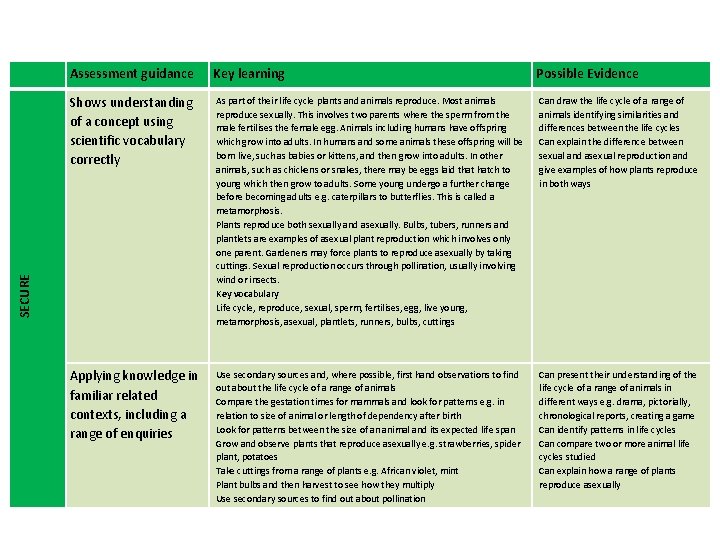
Key learning Possible Evidence Shows understanding of a concept using scientific vocabulary correctly As part of their life cycle plants and animals reproduce. Most animals reproduce sexually. This involves two parents where the sperm from the male fertilises the female egg. Animals including humans have offspring which grow into adults. In humans and some animals these offspring will be born live, such as babies or kittens, and then grow into adults. In other animals, such as chickens or snakes, there may be eggs laid that hatch to young which then grow to adults. Some young undergo a further change before becoming adults e. g. caterpillars to butterflies. This is called a metamorphosis. Plants reproduce both sexually and asexually. Bulbs, tubers, runners and plantlets are examples of asexual plant reproduction which involves only one parent. Gardeners may force plants to reproduce asexually by taking cuttings. Sexual reproduction occurs through pollination, usually involving wind or insects. Key vocabulary Life cycle, reproduce, sexual, sperm, fertilises, egg, live young, metamorphosis, asexual, plantlets, runners, bulbs, cuttings Can draw the life cycle of a range of animals identifying similarities and differences between the life cycles Can explain the difference between sexual and asexual reproduction and give examples of how plants reproduce in both ways Applying knowledge in familiar related contexts, including a range of enquiries Use secondary sources and, where possible, first hand observations to find out about the life cycle of a range of animals Compare the gestation times for mammals and look for patterns e. g. in relation to size of animal or length of dependency after birth Look for patterns between the size of an animal and its expected life span Grow and observe plants that reproduce asexually e. g. strawberries, spider plant, potatoes Take cuttings from a range of plants e. g. African violet, mint Plant bulbs and then harvest to see how they multiply Use secondary sources to find out about pollination Can present their understanding of the life cycle of a range of animals in different ways e. g. drama, pictorially, chronological reports, creating a game Can identify patterns in life cycles Can compare two or more animal life cycles studied Can explain how a range of plants reproduce asexually SECURE Assessment guidance
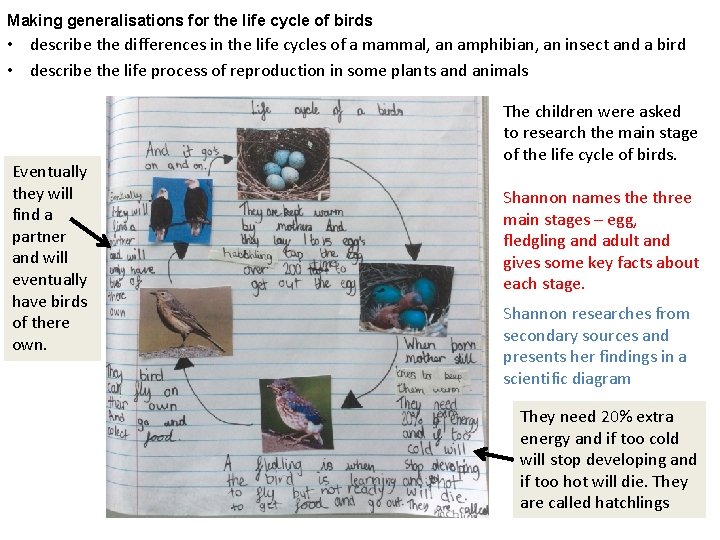
Making generalisations for the life cycle of birds • describe the differences in the life cycles of a mammal, an amphibian, an insect and a bird • describe the life process of reproduction in some plants and animals Eventually they will find a partner and will eventually have birds of there own. The children were asked to research the main stage of the life cycle of birds. Shannon names the three main stages – egg, fledgling and adult and gives some key facts about each stage. Shannon researches from secondary sources and presents her findings in a scientific diagram They need 20% extra energy and if too cold will stop developing and if too hot will die. They are called hatchlings
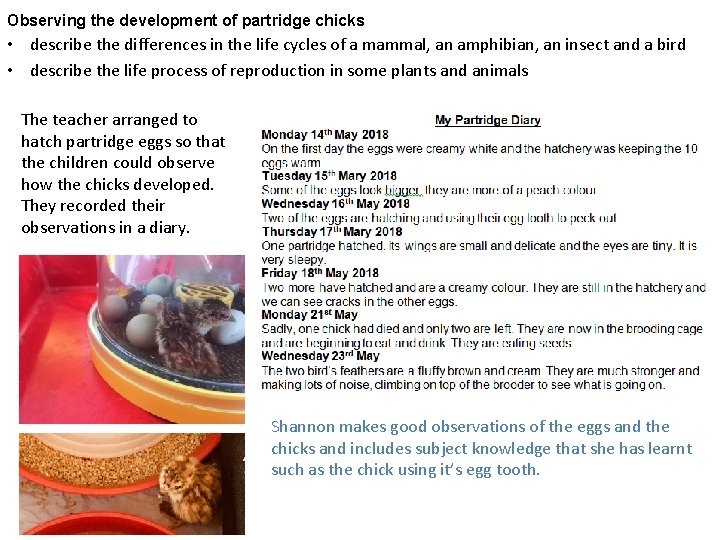
Observing the development of partridge chicks • describe the differences in the life cycles of a mammal, an amphibian, an insect and a bird • describe the life process of reproduction in some plants and animals The teacher arranged to hatch partridge eggs so that the children could observe how the chicks developed. They recorded their observations in a diary. Shannon makes good observations of the eggs and the chicks and includes subject knowledge that she has learnt such as the chick using it’s egg tooth.
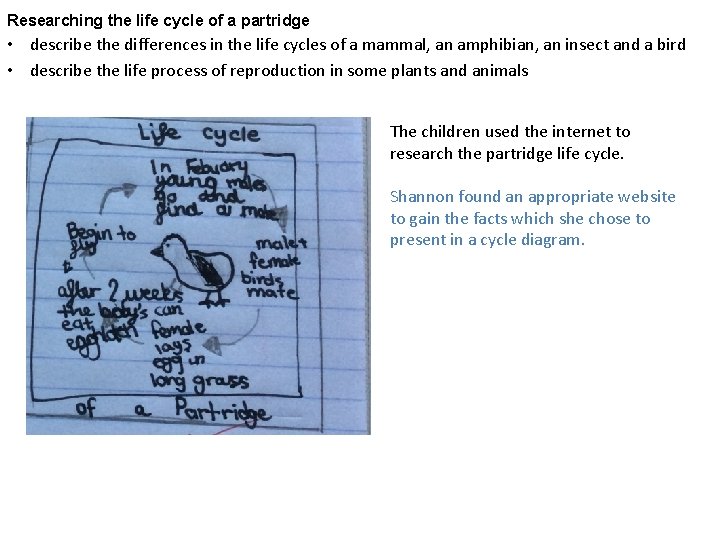
Researching the life cycle of a partridge • describe the differences in the life cycles of a mammal, an amphibian, an insect and a bird • describe the life process of reproduction in some plants and animals The children used the internet to research the partridge life cycle. Shannon found an appropriate website to gain the facts which she chose to present in a cycle diagram.
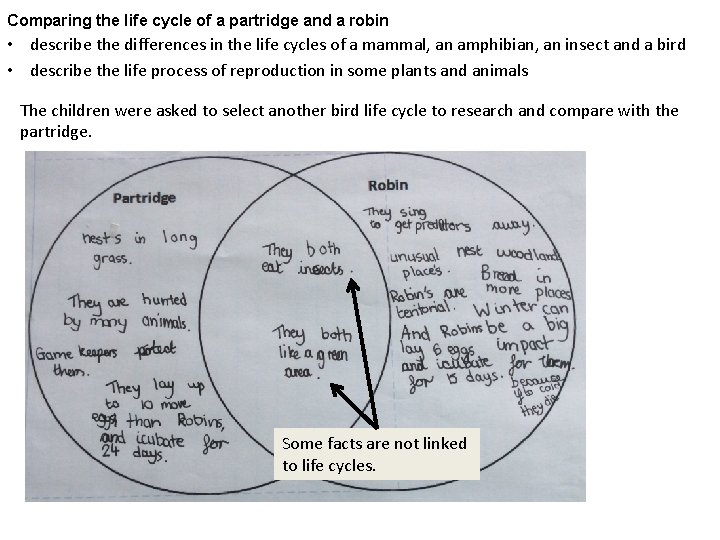
Comparing the life cycle of a partridge and a robin • describe the differences in the life cycles of a mammal, an amphibian, an insect and a bird • describe the life process of reproduction in some plants and animals The children were asked to select another bird life cycle to research and compare with the partridge. Some facts are not linked to life cycles.
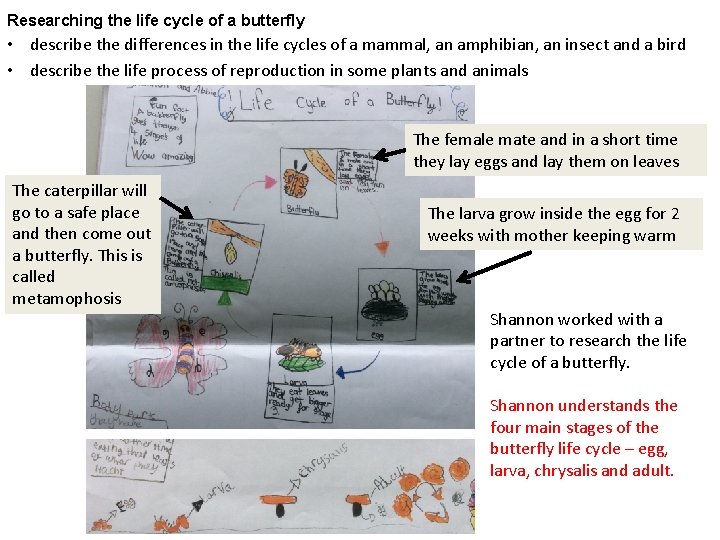
Researching the life cycle of a butterfly • describe the differences in the life cycles of a mammal, an amphibian, an insect and a bird • describe the life process of reproduction in some plants and animals The female mate and in a short time they lay eggs and lay them on leaves The caterpillar will go to a safe place and then come out a butterfly. This is called metamophosis The larva grow inside the egg for 2 weeks with mother keeping warm Shannon worked with a partner to research the life cycle of a butterfly. Shannon understands the four main stages of the butterfly life cycle – egg, larva, chrysalis and adult.
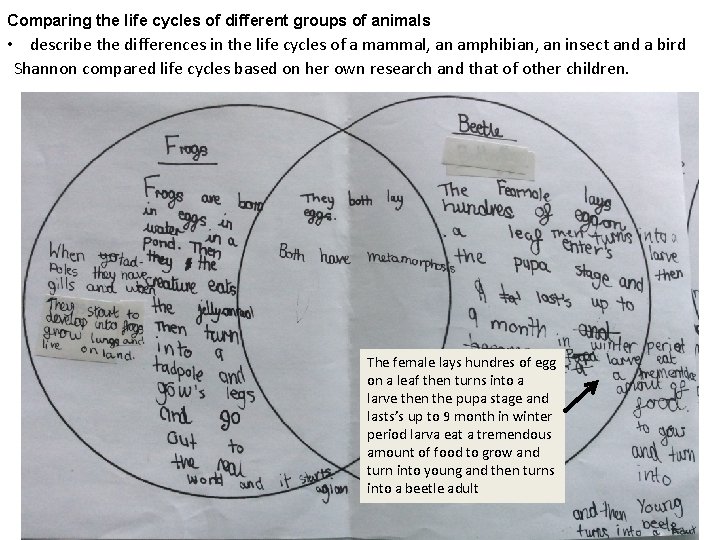
Comparing the life cycles of different groups of animals • describe the differences in the life cycles of a mammal, an amphibian, an insect and a bird Shannon compared life cycles based on her own research and that of other children. The female lays hundres of egg on a leaf then turns into a larve then the pupa stage and lasts’s up to 9 month in winter period larva eat a tremendous amount of food to grow and turn into young and then turns into a beetle adult
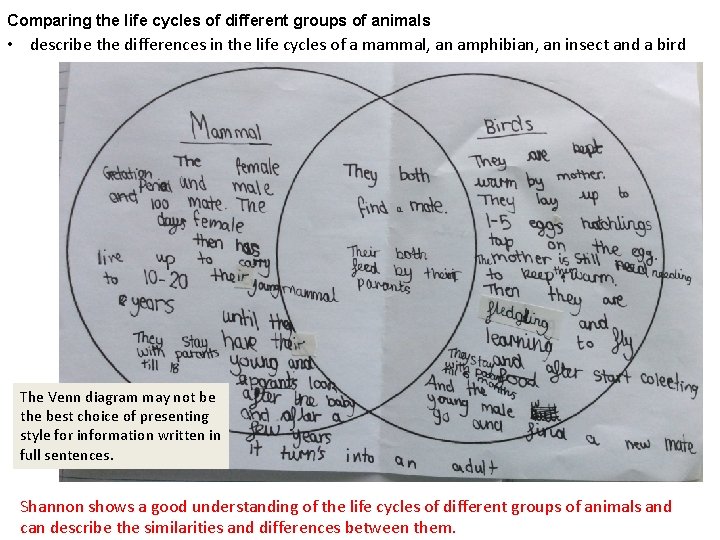
Comparing the life cycles of different groups of animals • describe the differences in the life cycles of a mammal, an amphibian, an insect and a bird The Venn diagram may not be the best choice of presenting style for information written in full sentences. Shannon shows a good understanding of the life cycles of different groups of animals and can describe the similarities and differences between them.
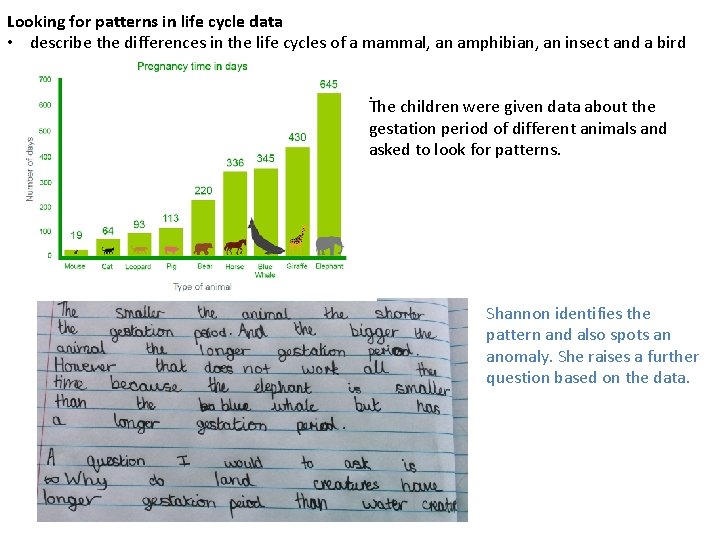
Looking for patterns in life cycle data • describe the differences in the life cycles of a mammal, an amphibian, an insect and a bird. The children were given data about the gestation period of different animals and asked to look for patterns. Shannon identifies the pattern and also spots an anomaly. She raises a further question based on the data.
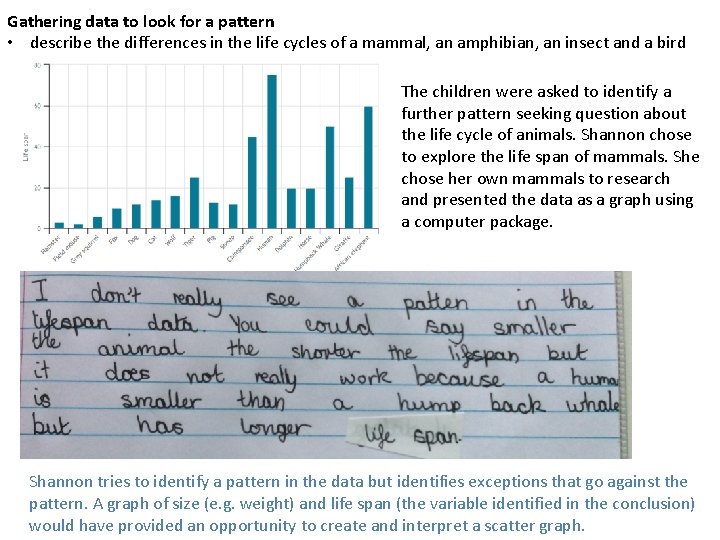
Gathering data to look for a pattern • describe the differences in the life cycles of a mammal, an amphibian, an insect and a bird The children were asked to identify a further pattern seeking question about the life cycle of animals. Shannon chose to explore the life span of mammals. She chose her own mammals to research and presented the data as a graph using a computer package. Shannon tries to identify a pattern in the data but identifies exceptions that go against the pattern. A graph of size (e. g. weight) and life span (the variable identified in the conclusion) would have provided an opportunity to create and interpret a scatter graph.
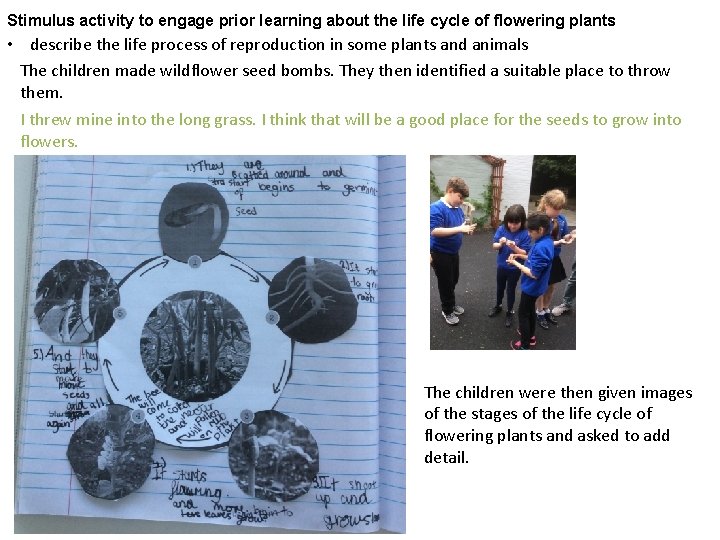
Stimulus activity to engage prior learning about the life cycle of flowering plants • describe the life process of reproduction in some plants and animals The children made wildflower seed bombs. They then identified a suitable place to throw them. I threw mine into the long grass. I think that will be a good place for the seeds to grow into flowers. The children were then given images of the stages of the life cycle of flowering plants and asked to add detail.
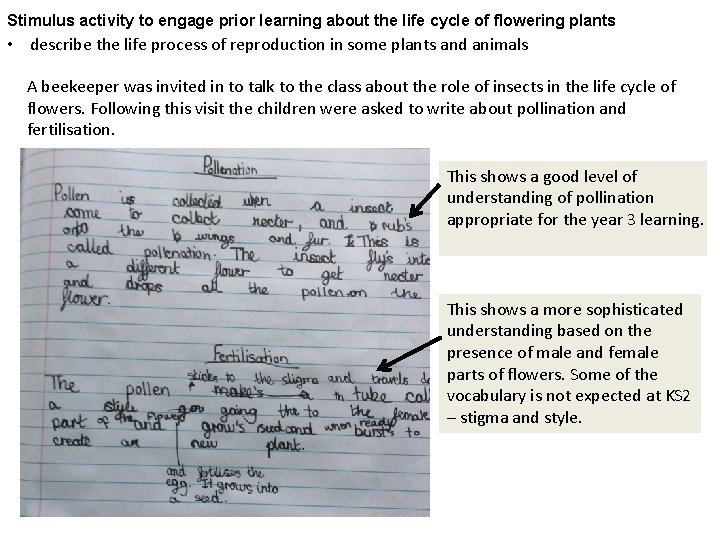
Stimulus activity to engage prior learning about the life cycle of flowering plants • describe the life process of reproduction in some plants and animals A beekeeper was invited in to talk to the class about the role of insects in the life cycle of flowers. Following this visit the children were asked to write about pollination and fertilisation. This shows a good level of understanding of pollination appropriate for the year 3 learning. This shows a more sophisticated understanding based on the presence of male and female parts of flowers. Some of the vocabulary is not expected at KS 2 – stigma and style.
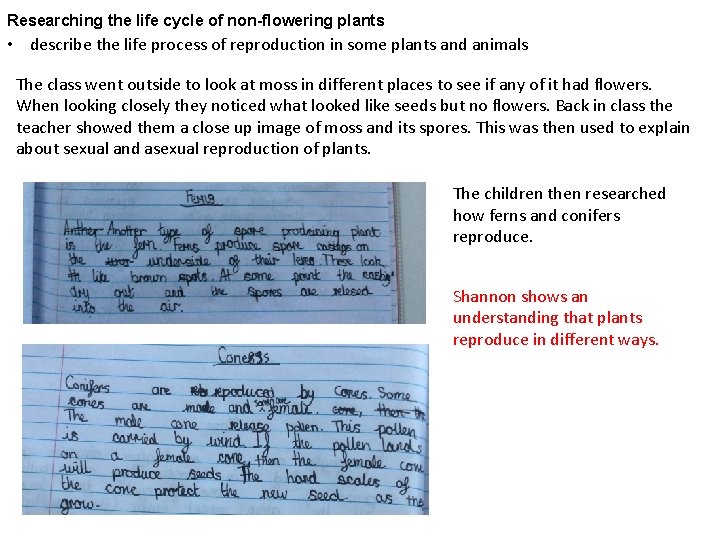
Researching the life cycle of non-flowering plants • describe the life process of reproduction in some plants and animals The class went outside to look at moss in different places to see if any of it had flowers. When looking closely they noticed what looked like seeds but no flowers. Back in class the teacher showed them a close up image of moss and its spores. This was then used to explain about sexual and asexual reproduction of plants. The children then researched how ferns and conifers reproduce. Shannon shows an understanding that plants reproduce in different ways.
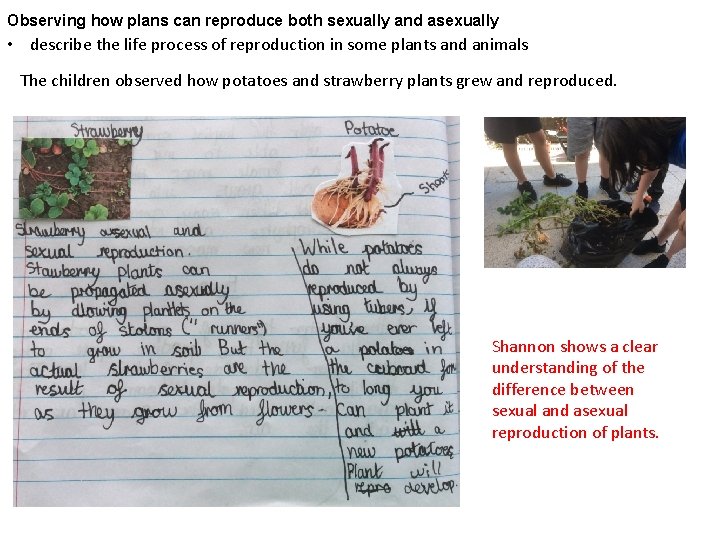
Observing how plans can reproduce both sexually and asexually • describe the life process of reproduction in some plants and animals The children observed how potatoes and strawberry plants grew and reproduced. Shannon shows a clear understanding of the difference between sexual and asexual reproduction of plants.
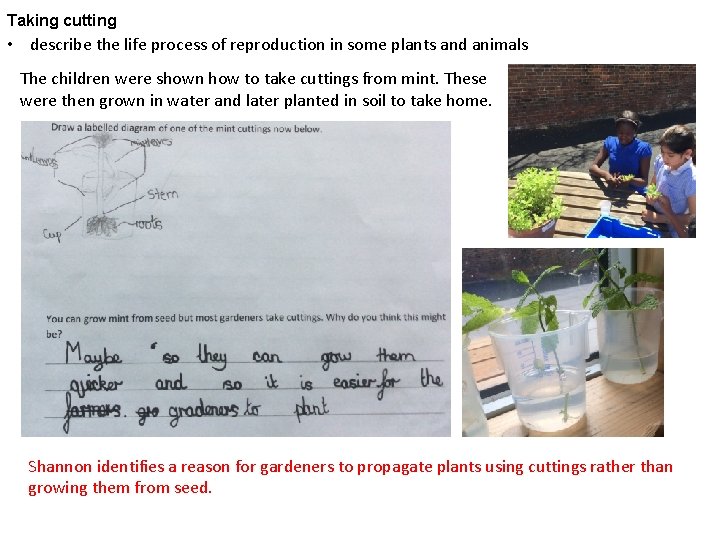
Taking cutting • describe the life process of reproduction in some plants and animals The children were shown how to take cuttings from mint. These were then grown in water and later planted in soil to take home. Shannon identifies a reason for gardeners to propagate plants using cuttings rather than growing them from seed.
Overall Summary - Secure Shannon describes the differences between the life cycles of different groups of animals. She shows an understanding of the process of reproduction of animals and plants and has an awareness that plants can also reproduce asexually.