
PLAN Primary Science Supporting Assessment Earth and Space
- Slides: 20
PLAN Primary Science – Supporting Assessment Earth and Space Year 5 -Isabella © Pan London Assessment Network (PLAN) July 2019 This resource has been developed by the Pan London Assessment Network and is supported by the Association for Science Education. 1
PLAN Primary Science - Supporting Assessment PLAN Primary Science is a set of resources produced to enable teachers to have a clearer understanding of National Curriculum expectations for meeting the standard. Annotated collections of children’s work provide examples of what working at the expected standard for primary science might look like for the knowledge and conceptual understanding statements of the programmes of study (POS). It is not the intention of these resources to specifically exemplify the working scientifically statements. However, aspects of working scientifically have been shown as an integral part of the teaching and learning of the knowledge and concepts. The resources provided have been cross moderated multiple times before publishing so that they can be used with confidence by teachers and subject leaders. Each collection of work shows one example of how a pupil has met National Curriculum statements for a particular area of content but these are not intended to be the definitive way of teaching these statements. 2
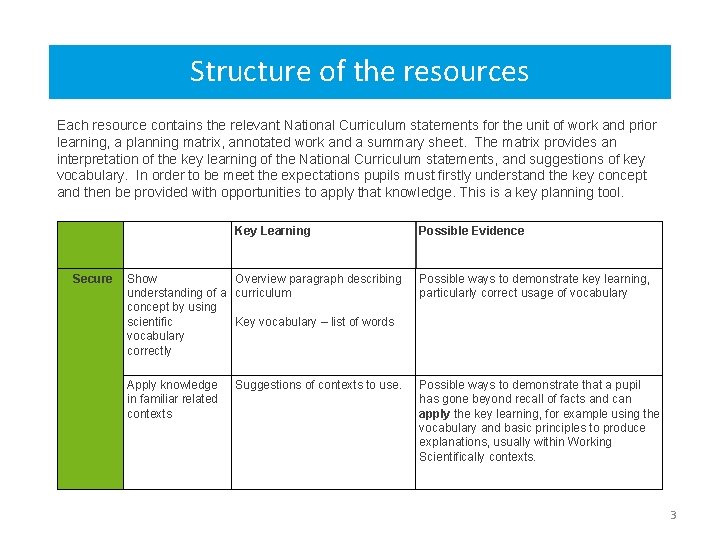
Structure of the resources Each resource contains the relevant National Curriculum statements for the unit of work and prior learning, a planning matrix, annotated work and a summary sheet. The matrix provides an interpretation of the key learning of the National Curriculum statements, and suggestions of key vocabulary. In order to be meet the expectations pupils must firstly understand the key concept and then be provided with opportunities to apply that knowledge. This is a key planning tool. Key Learning Secure Possible Evidence Show Overview paragraph describing understanding of a curriculum concept by using scientific Key vocabulary – list of words vocabulary correctly Possible ways to demonstrate key learning, particularly correct usage of vocabulary Apply knowledge in familiar related contexts Possible ways to demonstrate that a pupil has gone beyond recall of facts and can apply the key learning, for example using the vocabulary and basic principles to produce explanations, usually within Working Scientifically contexts. Suggestions of contexts to use. 3
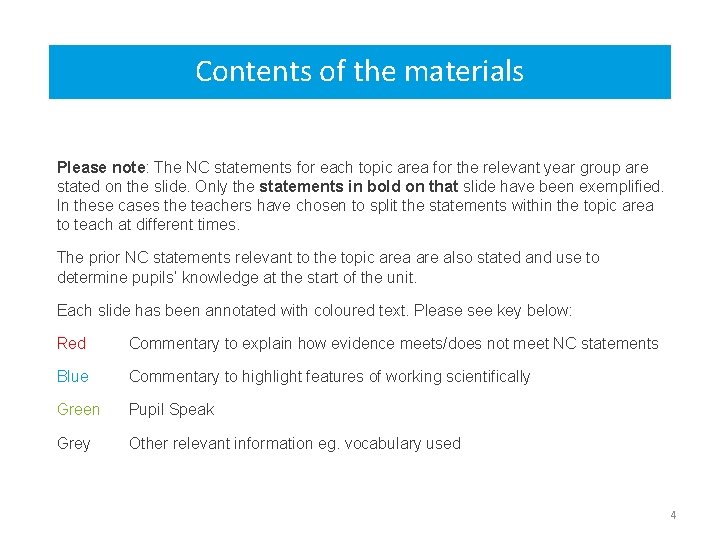
Contents of the materials Please note: The NC statements for each topic area for the relevant year group are stated on the slide. Only the statements in bold on that slide have been exemplified. In these cases the teachers have chosen to split the statements within the topic area to teach at different times. The prior NC statements relevant to the topic area are also stated and use to determine pupils’ knowledge at the start of the unit. Each slide has been annotated with coloured text. Please see key below: Red Commentary to explain how evidence meets/does not meet NC statements Blue Commentary to highlight features of working scientifically Green Pupil Speak Grey Other relevant information eg. vocabulary used 4
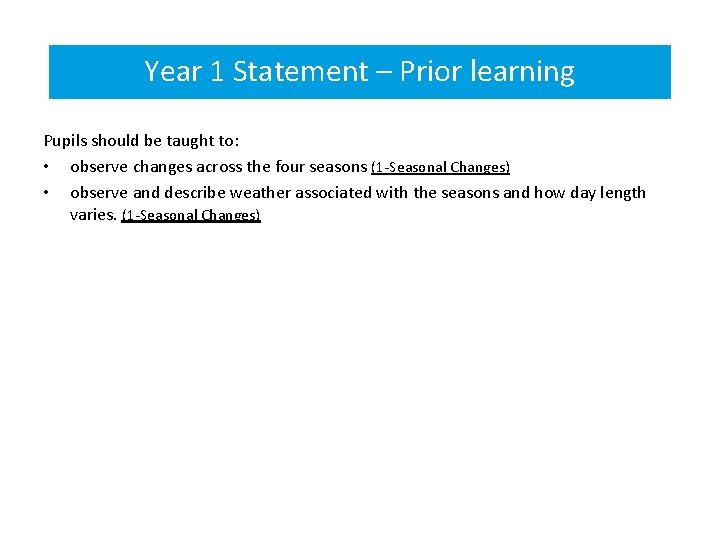
1 Statement ––Prior learning Year 1 objectives prior learning Pupils should be taught to: • observe changes across the four seasons (1 -Seasonal Changes) • observe and describe weather associated with the seasons and how day length varies. (1 -Seasonal Changes)
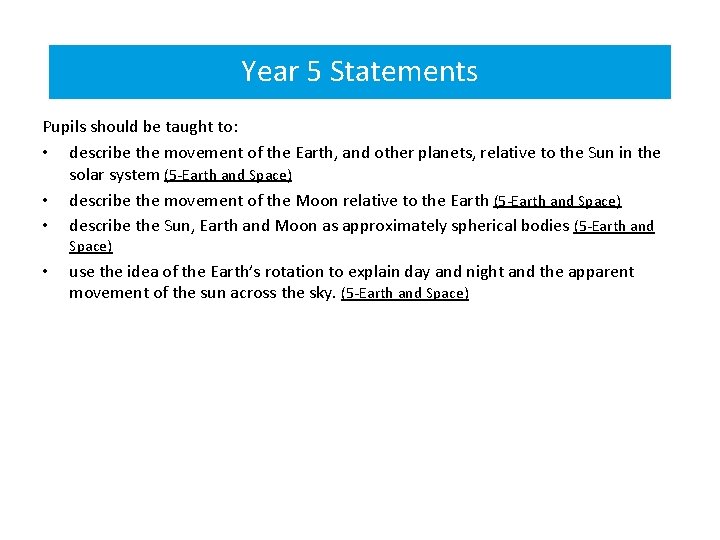
Year 55 Statements Year objectives Pupils should be taught to: • describe the movement of the Earth, and other planets, relative to the Sun in the solar system (5 -Earth and Space) • describe the movement of the Moon relative to the Earth (5 -Earth and Space) • describe the Sun, Earth and Moon as approximately spherical bodies (5 -Earth and Space) • use the idea of the Earth’s rotation to explain day and night and the apparent movement of the sun across the sky. (5 -Earth and Space)
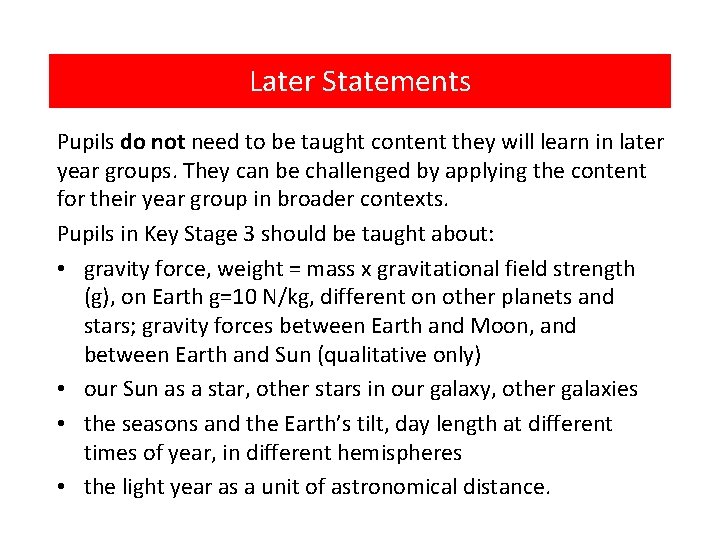
Later Statements Pupils do not need to be taught content they will learn in later year groups. They can be challenged by applying the content for their year group in broader contexts. Pupils in Key Stage 3 should be taught about: • gravity force, weight = mass x gravitational field strength (g), on Earth g=10 N/kg, different on other planets and stars; gravity forces between Earth and Moon, and between Earth and Sun (qualitative only) • our Sun as a star, other stars in our galaxy, other galaxies • the seasons and the Earth’s tilt, day length at different times of year, in different hemispheres • the light year as a unit of astronomical distance.
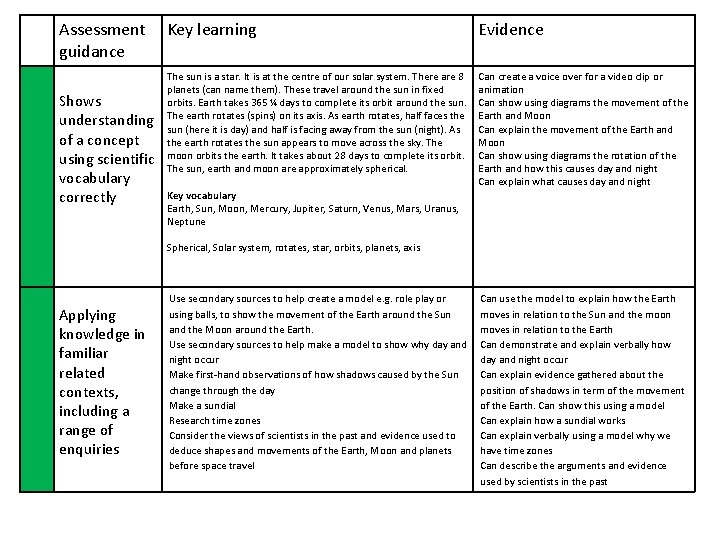
Assessment guidance Shows understanding of a concept using scientific vocabulary correctly Key learning Evidence The sun is a star. It is at the centre of our solar system. There are 8 planets (can name them). These travel around the sun in fixed orbits. Earth takes 365 ¼ days to complete its orbit around the sun. The earth rotates (spins) on its axis. As earth rotates, half faces the sun (here it is day) and half is facing away from the sun (night). As the earth rotates the sun appears to move across the sky. The moon orbits the earth. It takes about 28 days to complete its orbit. The sun, earth and moon are approximately spherical. Can create a voice over for a video clip or animation Can show using diagrams the movement of the Earth and Moon Can explain the movement of the Earth and Moon Can show using diagrams the rotation of the Earth and how this causes day and night Can explain what causes day and night Key vocabulary Earth, Sun, Moon, Mercury, Jupiter, Saturn, Venus, Mars, Uranus, Neptune Spherical, Solar system, rotates, star, orbits, planets, axis Applying knowledge in familiar related contexts, including a range of enquiries Use secondary sources to help create a model e. g. role play or using balls, to show the movement of the Earth around the Sun and the Moon around the Earth. Use secondary sources to help make a model to show why day and night occur Make first-hand observations of how shadows caused by the Sun change through the day Make a sundial Research time zones Consider the views of scientists in the past and evidence used to deduce shapes and movements of the Earth, Moon and planets before space travel Can use the model to explain how the Earth moves in relation to the Sun and the moon moves in relation to the Earth Can demonstrate and explain verbally how day and night occur Can explain evidence gathered about the position of shadows in term of the movement of the Earth. Can show this using a model Can explain how a sundial works Can explain verbally using a model why we have time zones Can describe the arguments and evidence used by scientists in the past
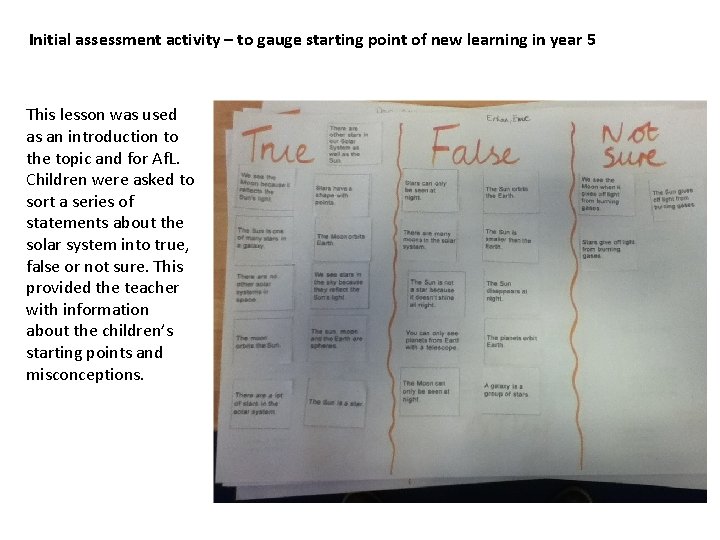
Initial assessment activity – to gauge starting point of new learning in year 5 This lesson was used as an introduction to the topic and for Af. L. Children were asked to sort a series of statements about the solar system into true, false or not sure. This provided the teacher with information about the children’s starting points and misconceptions.
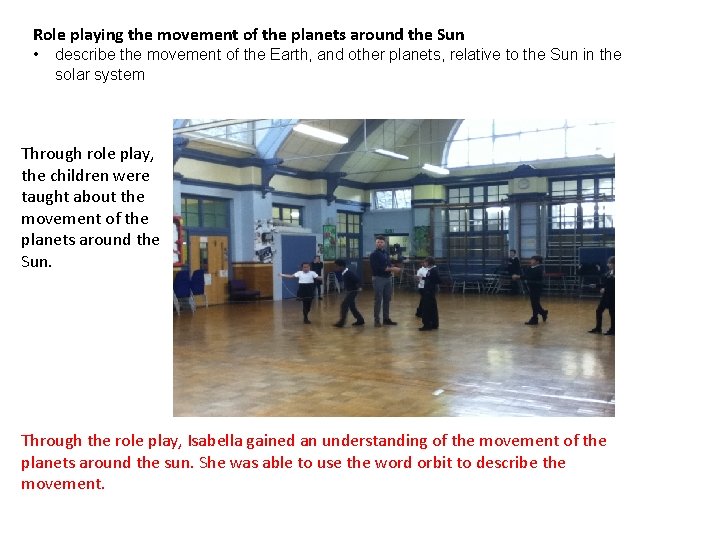
Role playing the movement of the planets around the Sun • describe the movement of the Earth, and other planets, relative to the Sun in the solar system Through role play, the children were taught about the movement of the planets around the Sun. Through the role play, Isabella gained an understanding of the movement of the planets around the sun. She was able to use the word orbit to describe the movement.
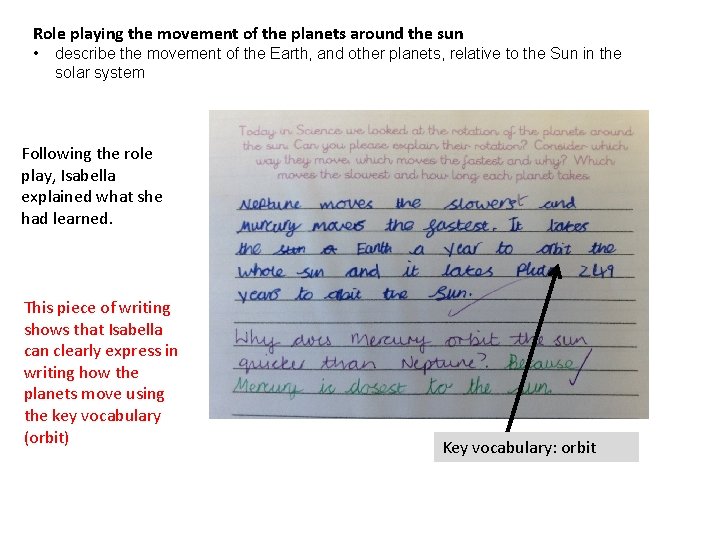
Role playing the movement of the planets around the sun • describe the movement of the Earth, and other planets, relative to the Sun in the solar system Following the role play, Isabella explained what she had learned. This piece of writing shows that Isabella can clearly express in writing how the planets move using the key vocabulary (orbit) Key vocabulary: orbit
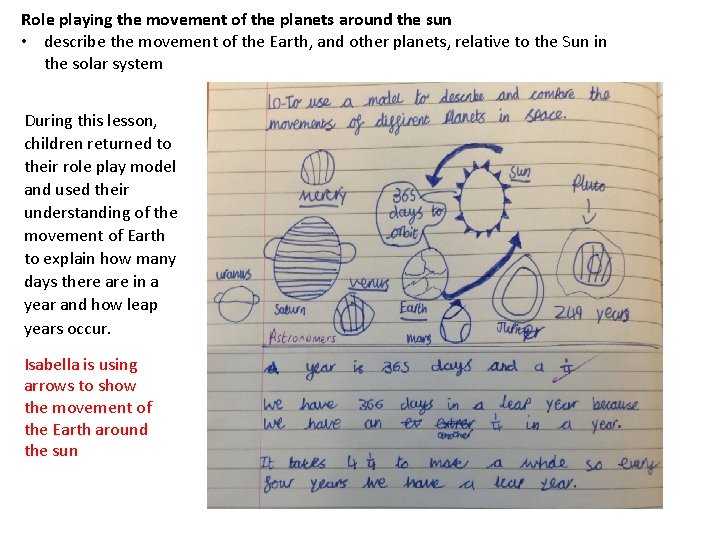
Role playing the movement of the planets around the sun • describe the movement of the Earth, and other planets, relative to the Sun in the solar system During this lesson, children returned to their role play model and used their understanding of the movement of Earth to explain how many days there are in a year and how leap years occur. Isabella is using arrows to show the movement of the Earth around the sun
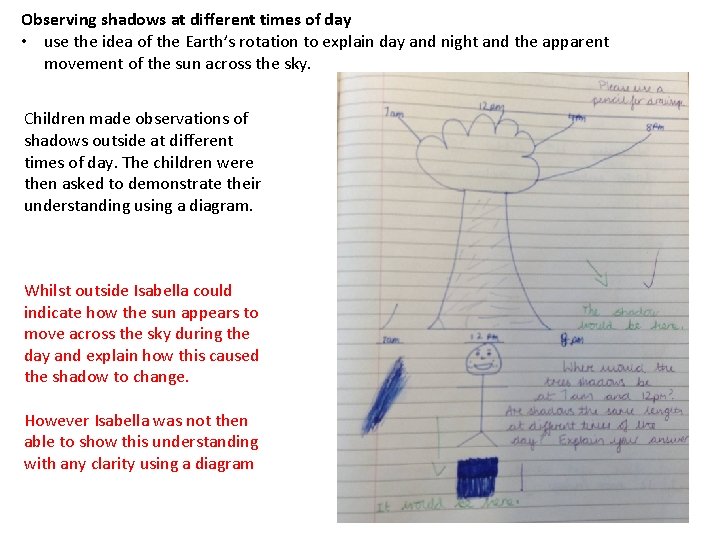
Observing shadows at different times of day • use the idea of the Earth’s rotation to explain day and night and the apparent movement of the sun across the sky. Children made observations of shadows outside at different times of day. The children were then asked to demonstrate their understanding using a diagram. Whilst outside Isabella could indicate how the sun appears to move across the sky during the day and explain how this caused the shadow to change. However Isabella was not then able to show this understanding with any clarity using a diagram
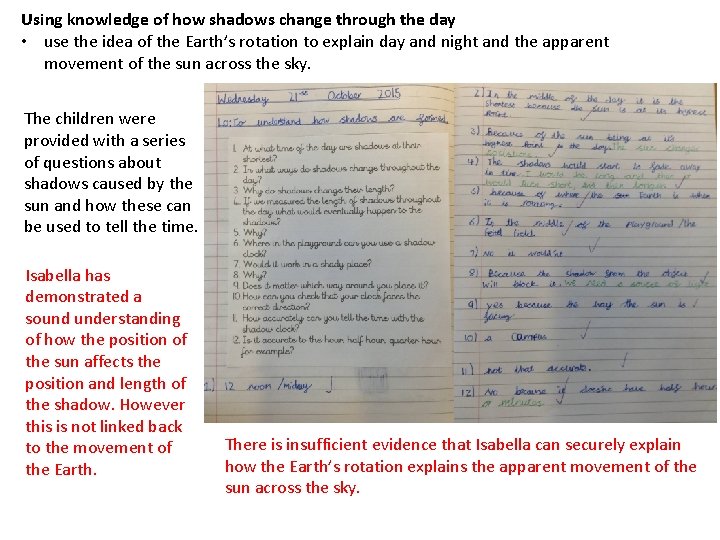
Using knowledge of how shadows change through the day • use the idea of the Earth’s rotation to explain day and night and the apparent movement of the sun across the sky. The children were provided with a series of questions about shadows caused by the sun and how these can be used to tell the time. Isabella has demonstrated a sound understanding of how the position of the sun affects the position and length of the shadow. However this is not linked back to the movement of the Earth. There is insufficient evidence that Isabella can securely explain how the Earth’s rotation explains the apparent movement of the sun across the sky.
Explaining day and night • use the idea of the Earth’s rotation to explain day and night and the apparent movement of the sun across the sky. To confirm Isabella’s understanding of day and night she was asked to use a globe, Lego person and torch to demonstrate how the rotation of the earth causes day and night, the apparent movement of the Sun across the sky and changes in shadows. Her understanding was captured verbally on video. The Earth rotates on its axis. As the Earth rotates, while the sun is shining on one part of the world, the other part of the world is in darkness. This is known as day and night. … Shadows can be made by the Sun. It appears to move across the sky but really it is the Earth spinning. Video Isabella’s explanation shows that she is now secure in her understanding of day and night and can explain using the words axis and rotate.
Role playing the movement of the Moon around the Earth • describe the movement of the Moon relative to the Earth The children used role play to demonstrate the movement of the Moon around the Earth. The child’s understanding was captured verbally. Isabella was able to take different roles within the role play and explain how she was moving. This evidence shows she is secure with the movement of the moon relative to the Earth. Our Moon, which is about the same size as Pluto, orbits around the Earth. It takes roughly 28 days to do this. This is why a lunar month is 28 days. Key vocabulary: orbit
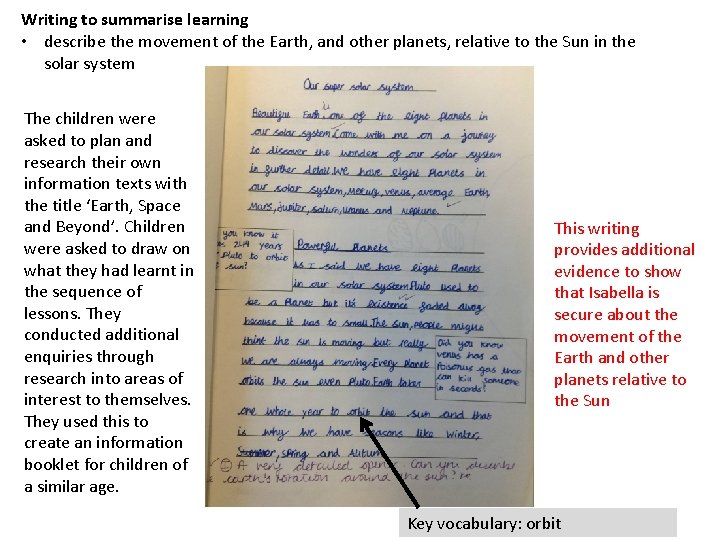
Writing to summarise learning • describe the movement of the Earth, and other planets, relative to the Sun in the solar system The children were asked to plan and research their own information texts with the title ‘Earth, Space and Beyond’. Children were asked to draw on what they had learnt in the sequence of lessons. They conducted additional enquiries through research into areas of interest to themselves. They used this to create an information booklet for children of a similar age. This writing provides additional evidence to show that Isabella is secure about the movement of the Earth and other planets relative to the Sun Key vocabulary: orbit
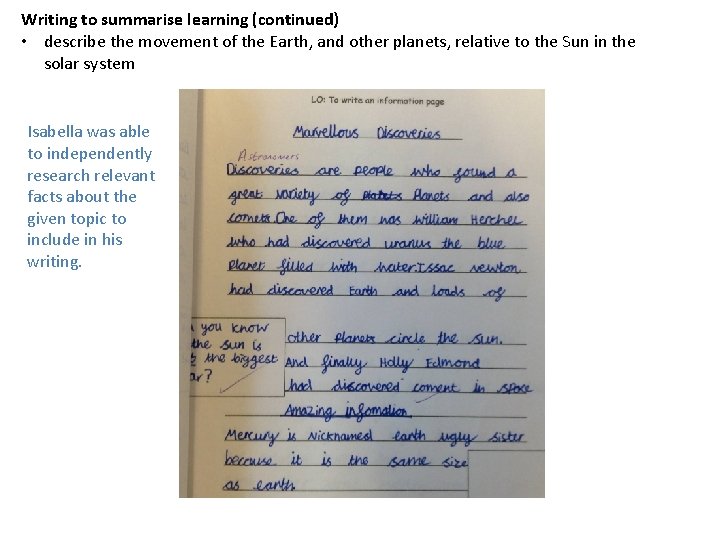
Writing to summarise learning (continued) • describe the movement of the Earth, and other planets, relative to the Sun in the solar system Isabella was able to independently research relevant facts about the given topic to include in his writing.
Overall summary – secure Isabella is able to describe the movement of the Earth, and other planets, relative to the Sun in the solar system. Through role play, Isabella has developed an understanding of the different lengths of time orbits take, dependent on the planet’s distance from the Sun. In addition, Isabella is able to describe the movement of the Moon relative to the Earth. Isabella has understood that the Sun, Earth and Moon are approximately spherical bodies and is able to explain day and night and the apparent movement of the sun across the sky using understanding about the Earth’s rotation. All relevant vocabulary has been used with confidence and in the appropriate context.
Acknowledgements 20