
Plains Indians way of life life Early 1830
- Slides: 5
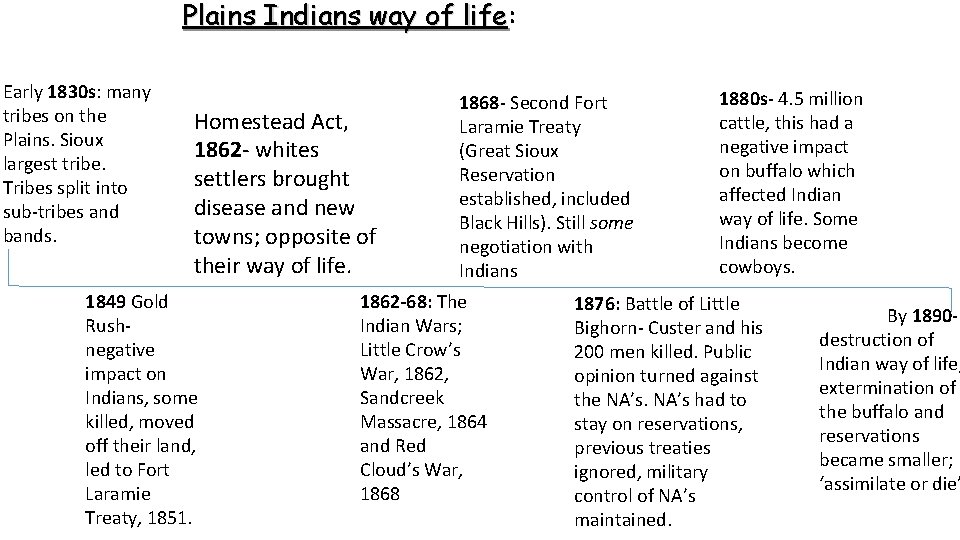
Plains Indians way of life: life Early 1830 s: many tribes on the Plains. Sioux largest tribe. Tribes split into sub-tribes and bands. Homestead Act, 1862 - whites settlers brought disease and new towns; opposite of their way of life. 1849 Gold Rushnegative impact on Indians, some killed, moved off their land, led to Fort Laramie Treaty, 1851. 1868 - Second Fort Laramie Treaty (Great Sioux Reservation established, included Black Hills). Still some negotiation with Indians 1862 -68: The Indian Wars; Little Crow’s War, 1862, Sandcreek Massacre, 1864 and Red Cloud’s War, 1868 1880 s- 4. 5 million cattle, this had a negative impact on buffalo which affected Indian way of life. Some Indians become cowboys. 1876: Battle of Little Bighorn- Custer and his 200 men killed. Public opinion turned against the NA’s had to stay on reservations, previous treaties ignored, military control of NA’s maintained. By 1890 destruction of Indian way of life; extermination of the buffalo and reservations became smaller; ‘assimilate or die’
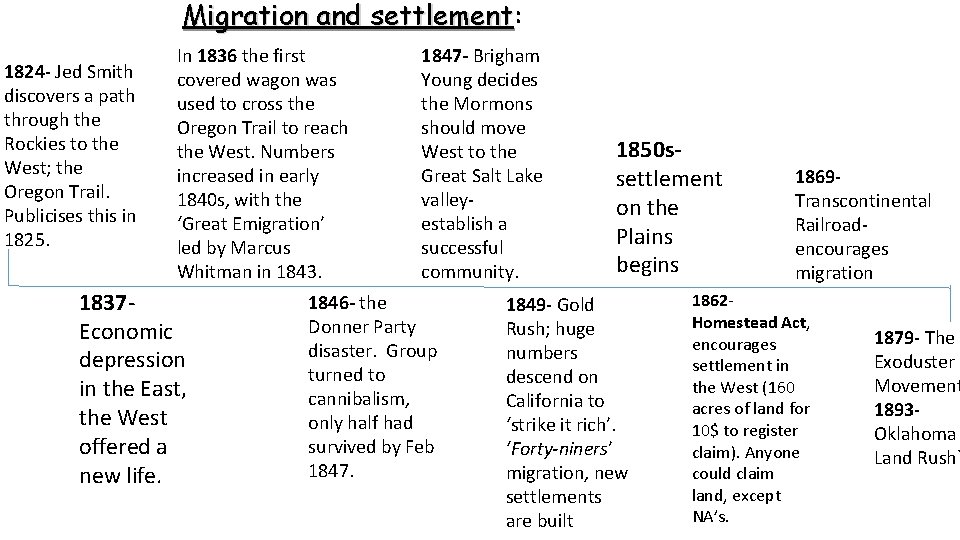
Migration and settlement: settlement 1824 - Jed Smith discovers a path through the Rockies to the West; the Oregon Trail. Publicises this in 1825. In 1836 the first covered wagon was used to cross the Oregon Trail to reach the West. Numbers increased in early 1840 s, with the ‘Great Emigration’ led by Marcus Whitman in 1843. 1837 Economic depression in the East, the West offered a new life. 1847 - Brigham Young decides the Mormons should move West to the Great Salt Lake valleyestablish a successful community. 1846 - the Donner Party disaster. Group turned to cannibalism, only half had survived by Feb 1847. 1850 ssettlement on the Plains begins 1849 - Gold Rush; huge numbers descend on California to ‘strike it rich’. ‘Forty-niners’ migration, new settlements are built 1869 Transcontinental Railroadencourages migration 1862 Homestead Act, encourages settlement in the West (160 acres of land for 10$ to register claim). Anyone could claim land, except NA’s. 1879 - The Exoduster Movement 1893 Oklahoma Land Rush`
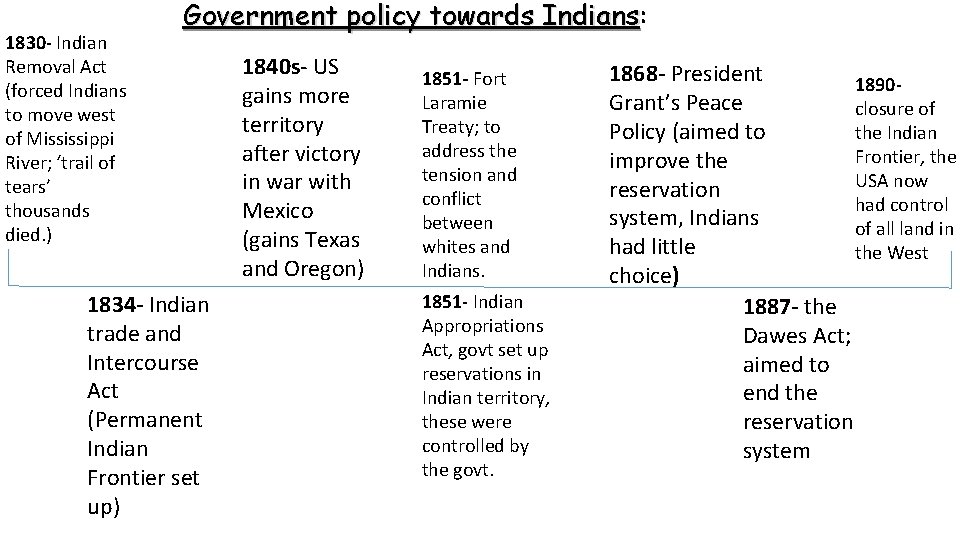
1830 - Indian Removal Act (forced Indians to move west of Mississippi River; ‘trail of tears’ thousands died. ) Government policy towards Indians: Indians 1834 - Indian trade and Intercourse Act (Permanent Indian Frontier set up) 1840 s- US gains more territory after victory in war with Mexico (gains Texas and Oregon) 1851 - Fort Laramie Treaty; to address the tension and conflict between whites and Indians. 1851 - Indian Appropriations Act, govt set up reservations in Indian territory, these were controlled by the govt. 1868 - President 1890 Grant’s Peace closure of Policy (aimed to the Indian Frontier, the improve the USA now reservation had control system, Indians of all land in had little the West choice) 1887 - the Dawes Act; aimed to end the reservation system
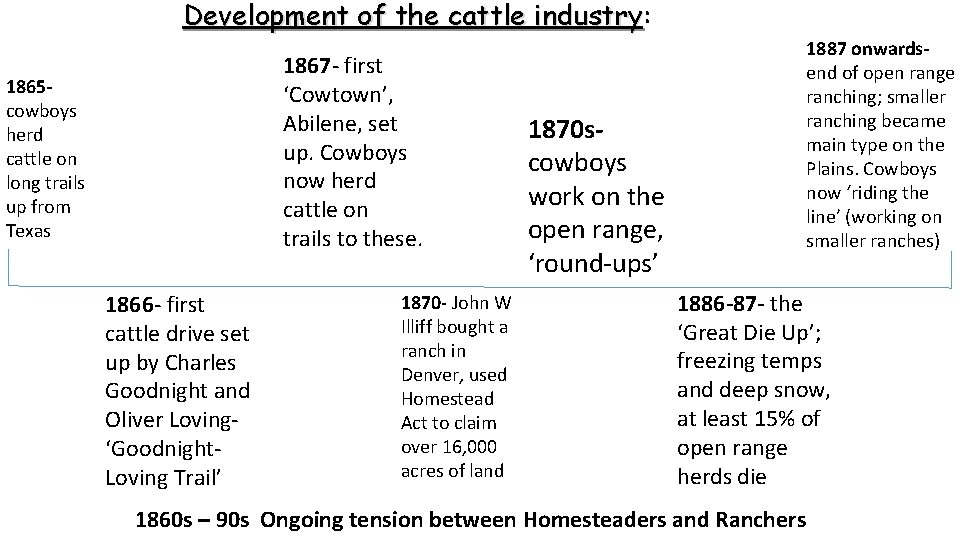
Development of the cattle industry: industry 1867 - first ‘Cowtown’, Abilene, set up. Cowboys now herd cattle on trails to these. 1865 cowboys herd cattle on long trails up from Texas 1866 - first cattle drive set up by Charles Goodnight and Oliver Loving‘Goodnight. Loving Trail’ 1870 - John W Illiff bought a ranch in Denver, used Homestead Act to claim over 16, 000 acres of land 1870 scowboys work on the open range, ‘round-ups’ 1887 onwardsend of open range ranching; smaller ranching became main type on the Plains. Cowboys now ‘riding the line’ (working on smaller ranches) 1886 -87 - the ‘Great Die Up’; freezing temps and deep snow, at least 15% of open range herds die 1860 s – 90 s Ongoing tension between Homesteaders and Ranchers
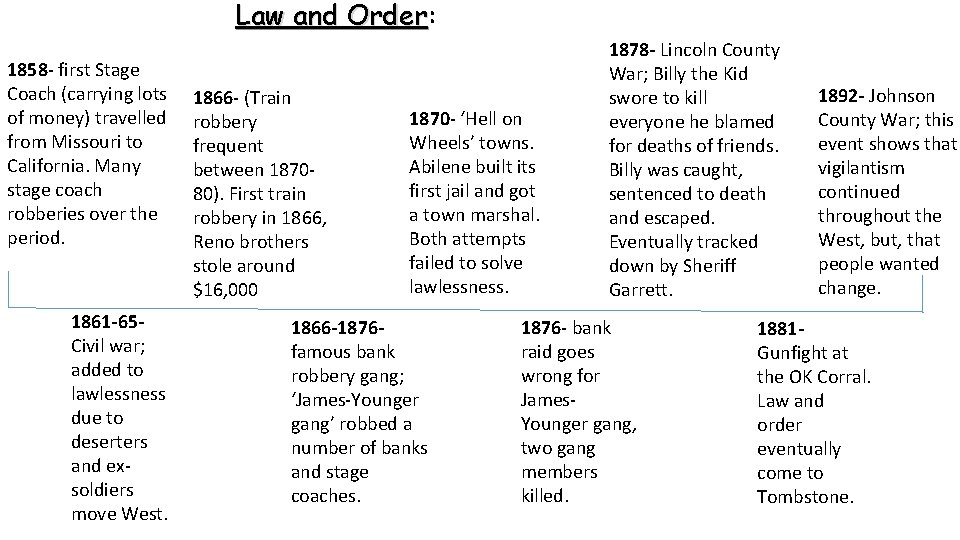
Law and Order: Order 1858 - first Stage Coach (carrying lots of money) travelled from Missouri to California. Many stage coach robberies over the period. 1861 -65 Civil war; added to lawlessness due to deserters and exsoldiers move West. 1866 - (Train robbery frequent between 187080). First train robbery in 1866, Reno brothers stole around $16, 000 1870 - ‘Hell on Wheels’ towns. Abilene built its first jail and got a town marshal. Both attempts failed to solve lawlessness. 1866 -1876 famous bank robbery gang; ‘James-Younger gang’ robbed a number of banks and stage coaches. 1878 - Lincoln County War; Billy the Kid swore to kill everyone he blamed for deaths of friends. Billy was caught, sentenced to death and escaped. Eventually tracked down by Sheriff Garrett. 1876 - bank raid goes wrong for James. Younger gang, two gang members killed. 1892 - Johnson County War; this event shows that vigilantism continued throughout the West, but, that people wanted change. 1881 Gunfight at the OK Corral. Law and order eventually come to Tombstone.