
Plagiarism What it is and how to avoid
- Slides: 12
Plagiarism What it is and how to avoid it.
Learning Goals • To understand what Plagiarism is • To understand apply techniques to avoid it • To be able to paraphrase
What is Plagiarism? • Plagiarism is using someone else’s words, ideas or images as your own. • Plagiarism is dishonest, unethical, and illegal! • Read Student Guide to Avoiding Plagiarism.
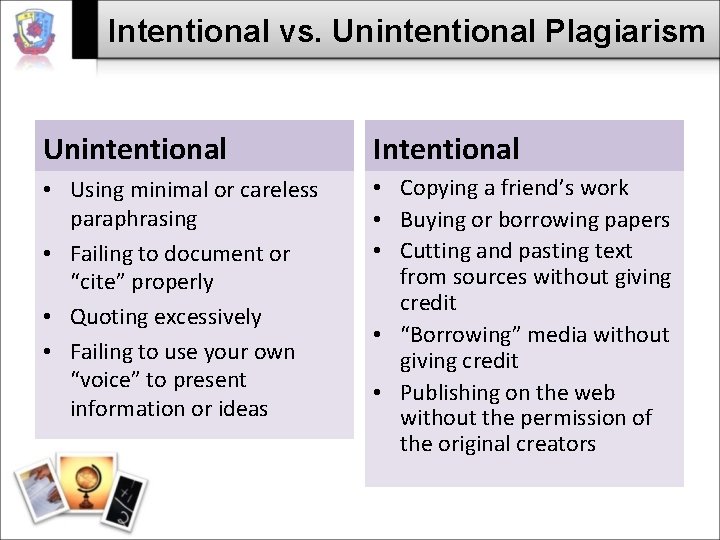
Intentional vs. Unintentional Plagiarism Unintentional Intentional • Using minimal or careless paraphrasing • Failing to document or “cite” properly • Quoting excessively • Failing to use your own “voice” to present information or ideas • Copying a friend’s work • Buying or borrowing papers • Cutting and pasting text from sources without giving credit • “Borrowing” media without giving credit • Publishing on the web without the permission of the original creators
Think, Pair, Share • Do you think you could get in trouble for unintentional plagiarism?
Consequences ZERO credit for work Parents will be notified In high school, note on permanent student record Suspension or expulsion from school activities including sports, clubs, field trips, extra-curriculars, etc. • Could mean expulsion, depending on school • •
4 Corners • What are ways to avoid plagiarism?
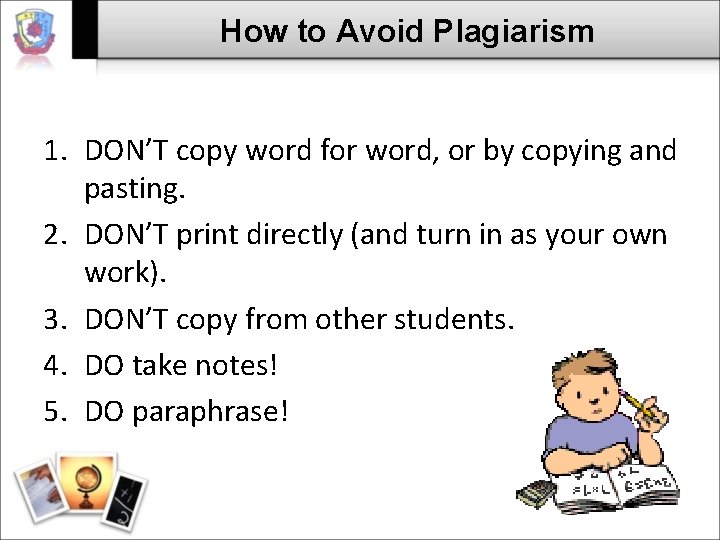
How to Avoid Plagiarism 1. DON’T copy word for word, or by copying and pasting. 2. DON’T print directly (and turn in as your own work). 3. DON’T copy from other students. 4. DO take notes! 5. DO paraphrase!
Paraphrasing • To paraphrase means to read something and put it in your own words. • You can do this way taking jots notes in the points you find most important in what you are reading • Then, put those points in your own words into a paragraph • Make sure you always give credit to the author or website
Quoting Directly is Acceptable! 1. Always put quotation marks around any words that you take directly from a source. 2. Always give credit to the source! a) In a bibliography b) Or webography— (usually online sources)
Use Common Knowledge 1. Info that is known to many people (George Washington was the first president. Mc. Cain and Obama ran for president in the 2008 Presidential Election. ) 2. You do NOT need to cite Common Knowledge! ☺
Try it out. . . • Paraphrase the Toronto Star Article