
PLAGIARISM WHAT IS IT AND HOW TO AVOID
- Slides: 17
PLAGIARISM WHAT IS IT AND HOW TO AVOID IT
THIS IS A VERY IMPORTANT LESSON!!!!
OFFICIAL DEFINITION To plagiarize (verb): ▶ to use the words or ideas of another person as if they were your own words or ideas ▶ to steal and pass off (the ideas or words of another) as one's own : use (another's production) without crediting the source ▶ to commit literary theft : present as new and original an idea or product taken from a source that already exists ▶ *****IMPORTANT***** It is still plagiarism even it is unintentional
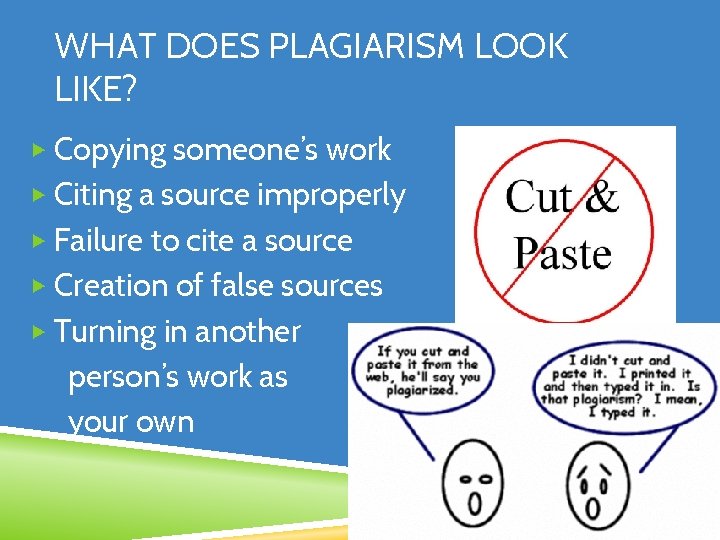
WHAT DOES PLAGIARISM LOOK LIKE? ▶ Copying someone’s work ▶ Citing a source improperly ▶ Failure to cite a source ▶ Creation of false sources ▶ Turning in another person’s work as your own
CONSEQUENCES/PUNISHMENT ▶ Failure of assignment!
HOW TO AVOID PLAGIARISM 1. SUMMARIZING ▶ You must reference the original source ▶ Your summary should be shorter than the text you are summarizing ▶ You must use your own words, usually with a very limited use of quotations
HOW TO AVOID PLAGIARISM 2. PARAPHRASING ▶ You must reference the original source ▶ The text you produce may be shorter or longer than the original text ▶ You must use your own words
HOW TO AVOID PLAGIARISM 3. Quote ▶ You must reference the original source ▶ The text produced is the exact length of the original text quoted (unless ellipses are used) ▶ You must use the original author’s exact words and you must put quotation marks around them ▶ You must include the page number of the source from which you borrowed the author’s original language
HOW TO CITE ▶ Modern Language Association (MLA) A full guide to citations can be found on their website: https: //owl. english. purdue. edu/owl/resource/74 7/01/
IN TEXT CITATION ▶ Indirect Quote: Some researchers note that "children are totally insensitive to their parents' shyness" (Zimbardo, 62). ▶ Direct Quote: Zimbardo notes that “children are totally insensitive to their parents’ shyness” (62). ▶ Paraphrasing/Summarizing: Some researchers have observed that children seem unaware that their parents are considered bashful (Zimbardo, 62).
IN TEXT CITATIONS ▶ From a Book/Journal/Article (Last Name(s), Page #) If there is no author: (“Title”, Page #) ▶ From an Online Source: Use either the author name, or if the page has no known author, article title, in parentheses (Last Name) or (“Article Title”) ▶ If you feel it is unclear you my also site the database Example: (Last Name, NYTimes )
WHAT IS A WORKS CITED? ▶ A Works Cited is a list of sources that goes at the end of you paper or presentation that tells the reader all the sources you have used ▶ Formatting sources in a Works Cited is different from formatting an in text citation ▶ Use this website to help you with citations https: //owl. english. purdue. edu/owl/resource/747/05/
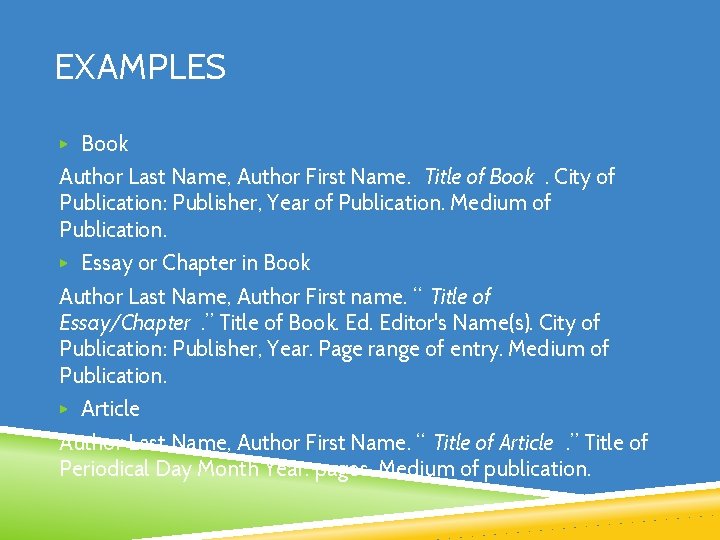
EXAMPLES ▶ Book Author Last Name, Author First Name. Title of Book. City of Publication: Publisher, Year of Publication. Medium of Publication. ▶ Essay or Chapter in Book Author Last Name, Author First name. “ Title of Essay/Chapter. ” Title of Book. Editor's Name(s). City of Publication: Publisher, Year. Page range of entry. Medium of Publication. ▶ Article Author Last Name, Author First Name. “ Title of Article. ” Title of Periodical Day Month Year: pages. Medium of publication.
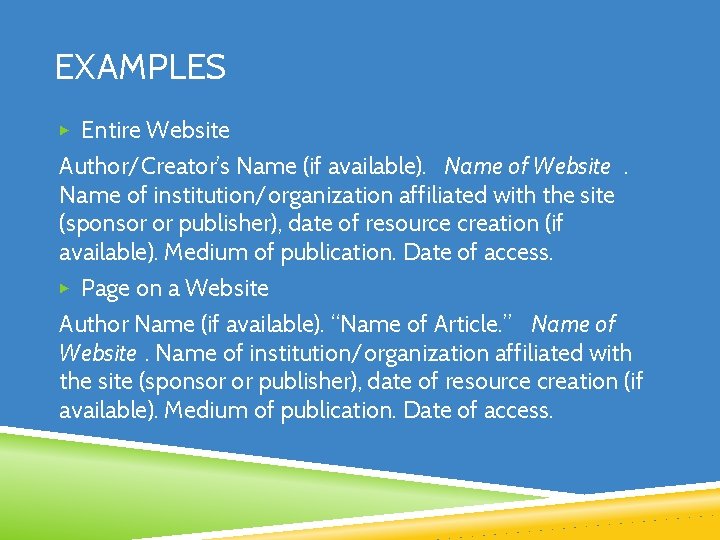
EXAMPLES ▶ Entire Website Author/Creator’s Name (if available). Name of Website. Name of institution/organization affiliated with the site (sponsor or publisher), date of resource creation (if available). Medium of publication. Date of access. ▶ Page on a Website Author Name (if available). “Name of Article. ” Name of Website. Name of institution/organization affiliated with the site (sponsor or publisher), date of resource creation (if available). Medium of publication. Date of access.
IMPORTANT REMINDERS ✓Always double check all your citations for accuracy, proper formatting, author and page number. ✓Make sure all your in text citations match the sources listed in the Works Cited. ✓Anyone reading your work should be able to easily locate the original source of any material you use in your own work.
GOOD SOURCES ▶ University presses (Harvard, Cambridge) ▶ Major Publishing Houses (Penguin, Random ▶ ▶ ▶ House) Well Known Organizations (United Nations, Government websites) Well-Known Newspapers (New York Times) Well Known Media Sources (BBC, CNN) Magazines Online Journals (JSTOR)
BAD SOURCES ▶ Wikipedia ▶ Personal Blogs ▶ Non credible newspapers, magazines, editorials ▶ Think about “bias”