
Plagiarism We Need To Talk Presented by College
Plagiarism: We Need To Talk! Presented by: College of Business and Global Affairs Dr. Lajuan Davis, Business Communication Ms. Lacey Adams, Student Editor
What is Plagiarism? • Definition: Using, or closely imitating, the language and thoughts of another author without that author’s authorization and representing/using that author's work as your own, without crediting the original author (Dictionary. com, 2019). We need to talk. This matter is serious!!
To Avoid Plagiarism. . . Use Citations • When using someone else’s ideas, writing, art, music, graphics, etc. , use a citation (a note) in the text to show who originally developed the ideas, writing, etc.
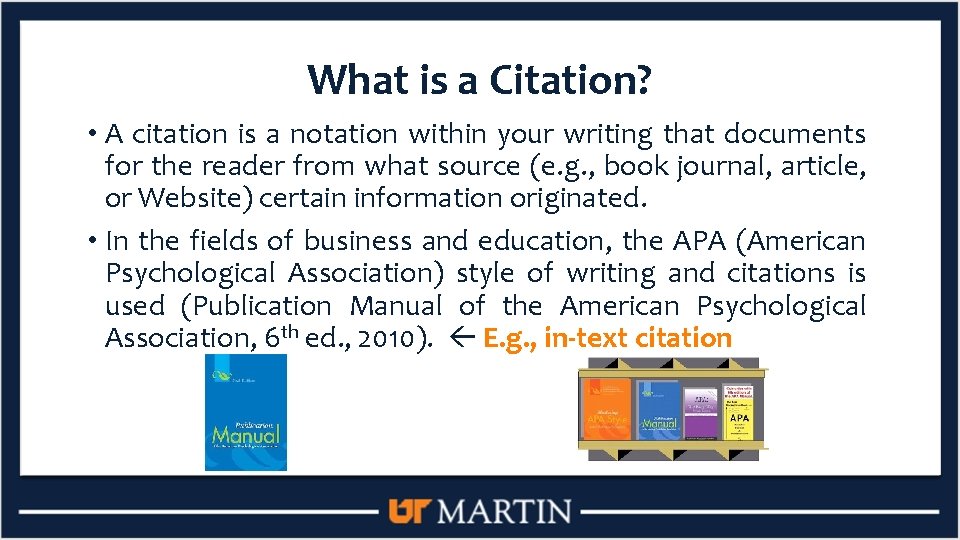
What is a Citation? • A citation is a notation within your writing that documents for the reader from what source (e. g. , book journal, article, or Website) certain information originated. • In the fields of business and education, the APA (American Psychological Association) style of writing and citations is used (Publication Manual of the American Psychological Association, 6 th ed. , 2010). E. g. , in-text citation
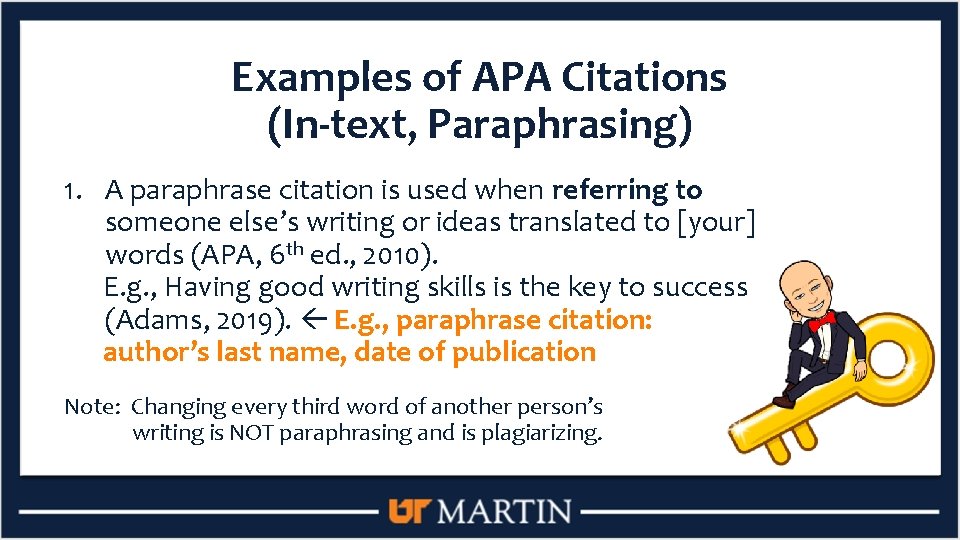
Examples of APA Citations (In-text, Paraphrasing) 1. A paraphrase citation is used when referring to someone else’s writing or ideas translated to [your] words (APA, 6 th ed. , 2010). E. g. , Having good writing skills is the key to success (Adams, 2019). E. g. , paraphrase citation: author’s last name, date of publication Note: Changing every third word of another person’s writing is NOT paraphrasing and is plagiarizing.
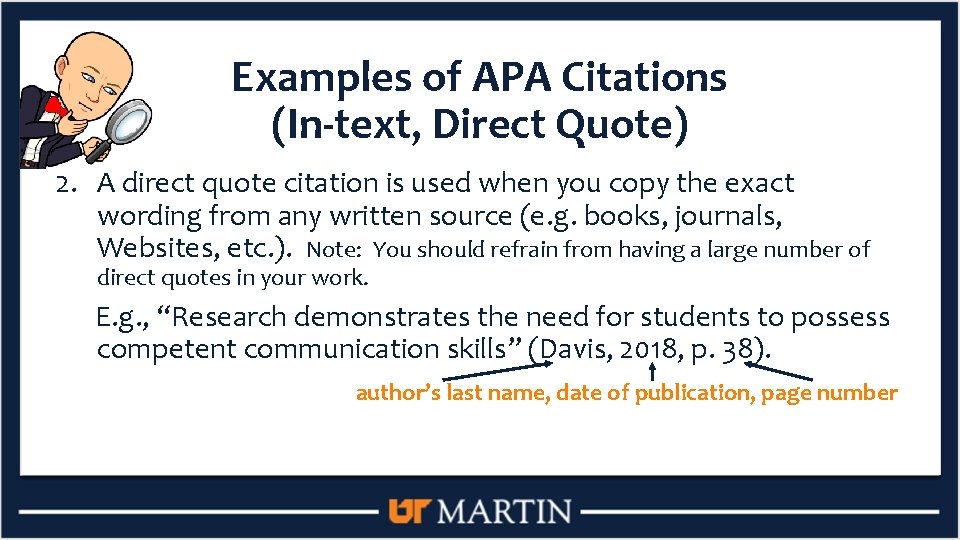
Examples of APA Citations (In-text, Direct Quote) 2. A direct quote citation is used when you copy the exact wording from any written source (e. g. books, journals, Websites, etc. ). Note: You should refrain from having a large number of direct quotes in your work. E. g. , “Research demonstrates the need for students to possess competent communication skills” (Davis, 2018, p. 38). author’s last name, date of publication, page number
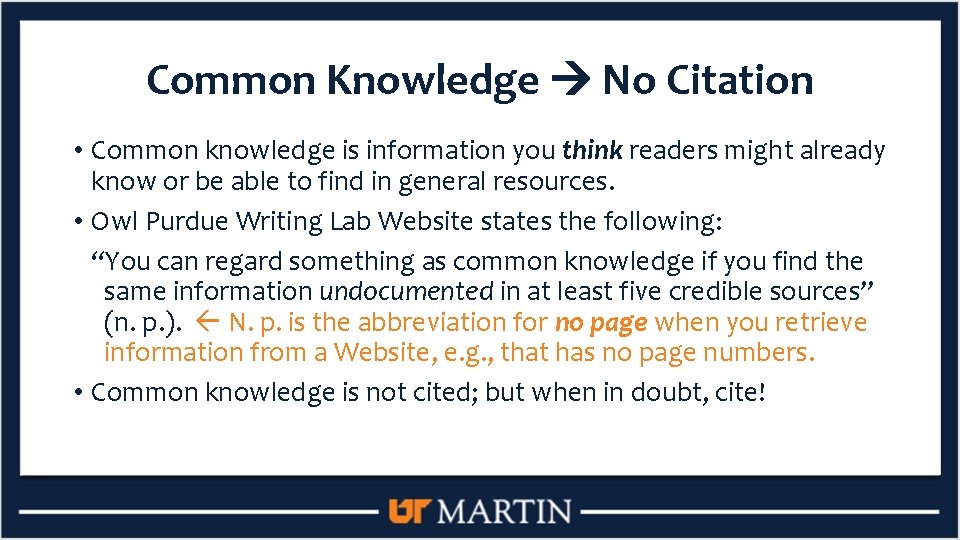
Common Knowledge No Citation • Common knowledge is information you think readers might already know or be able to find in general resources. • Owl Purdue Writing Lab Website states the following: “You can regard something as common knowledge if you find the same information undocumented in at least five credible sources” (n. p. ). N. p. is the abbreviation for no page when you retrieve information from a Website, e. g. , that has no page numbers. • Common knowledge is not cited; but when in doubt, cite!
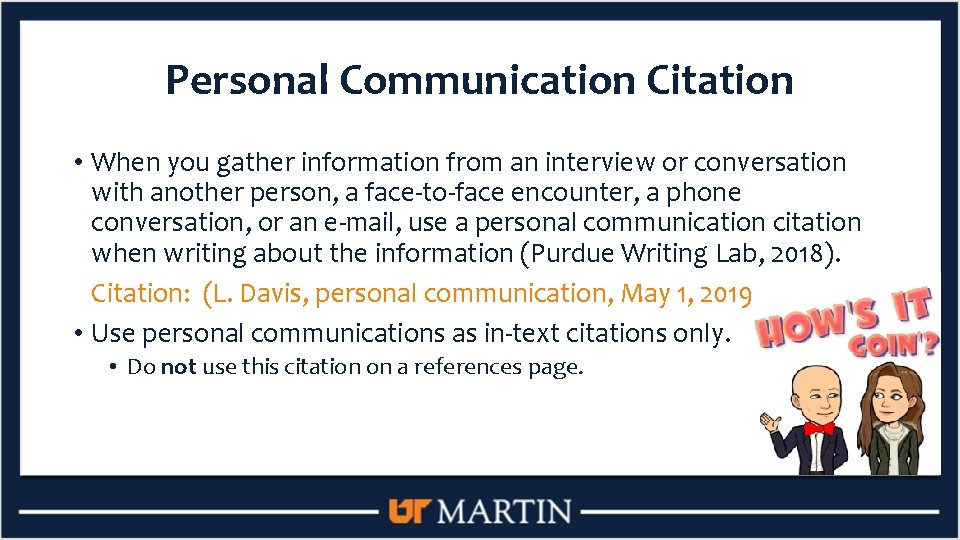
Personal Communication Citation • When you gather information from an interview or conversation with another person, a face-to-face encounter, a phone conversation, or an e-mail, use a personal communication citation when writing about the information (Purdue Writing Lab, 2018). Citation: (L. Davis, personal communication, May 1, 2019). • Use personal communications as in-text citations only. • Do not use this citation on a references page.
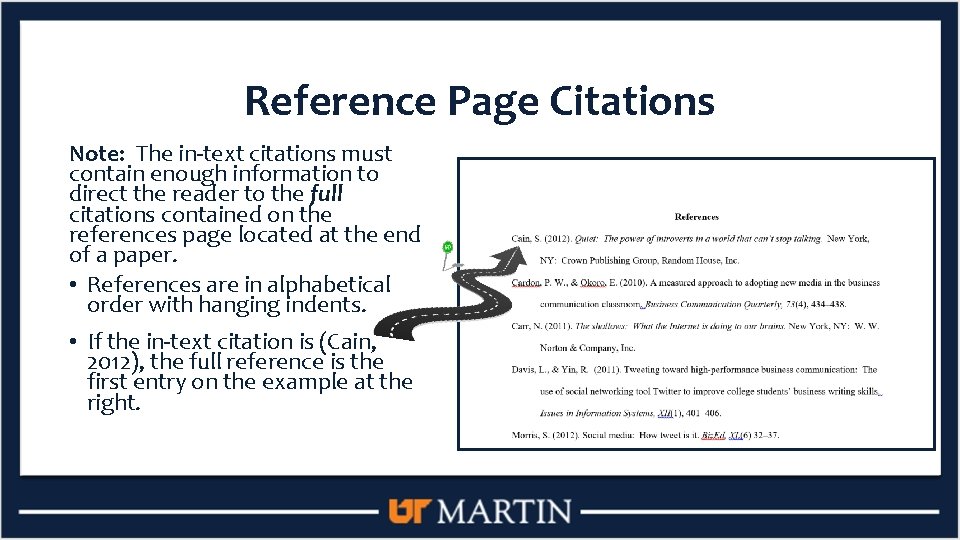
Reference Page Citations Note: The in-text citations must contain enough information to direct the reader to the full citations contained on the references page located at the end of a paper. • References are in alphabetical order with hanging indents. • If the in-text citation is (Cain, 2012), the full reference is the first entry on the example at the right.
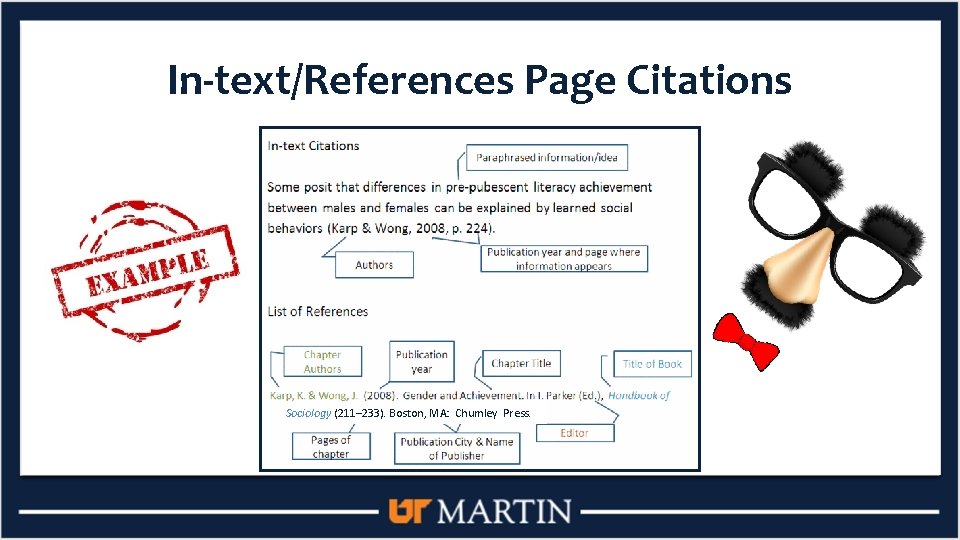
In-text/References Page Citations Sociology (211– 233). Boston, MA: Chumley Press.
For More Information on Citation Styles and Examples. . Consult any of the following sources: • www. utm. edu/library. php • www. apa. org/ • https: //owl. purdue. edu • Publication Manual of the American Psychological Association, 6 th edition
Types of Plagiarism #1 Clone Submitting another’s work, word-for-word, as your own without including citations is plagiarizing! #2 CTRL-C (Copy) Using significant portions of text from a single source without alterations is plagiarizing!
Types of Plagiarism Cont’d. #3 Find/Replace Changing key words and phrases but retaining the essential content of the source is plagiarizing! #4 Remix Mixing paraphrases from multiple sources into one document is plagiarizing!
Types of Plagiarism Cont’d. #5 Recycle Borrowing generously from a writer’s previous work without citations is plagiarizing! #6 Hybrid Combining perfectly cited sources with copied passages that are not cited is still plagiarism!
Types of Plagiarism Cont’d. #7 Mashup Mixing copied material from multiple sources is plagiarism! Cite all sources! Be sure the citation information is correct! #8 404 Error Including citations to non-existent or inaccurate information sources is plagiarism!
Types of Plagiarism Cont’d. #9 Aggregator Including proper citations to sources in a paper that contains almost no original work is plagiarizing! #10 Re-Tweet Including proper citations, but relying too closely on the text’s original wording is still plagiarizing! “Think” to develop your own concepts, ideas, and writing.
Cite When You Write! STOP Plagiarism
To Avoid Plagiarizing… 1. Use in-text citations to document using other writers’ works (ideas, writing, illustrations, graphics, music, etc. ). 2. Do NOT copy-and-paste information from the Internet unless you use citations to show from where the information was obtained.
To Avoid Plagiarizing… 3. Do NOT copy wording directly from written sources such as books, journals, Websites without citing. Note: Changing every third word in copied material is NOT paraphrasing, and not citing the material is plagiarism. 4. Do NOT use another person’s work as if it were yours.
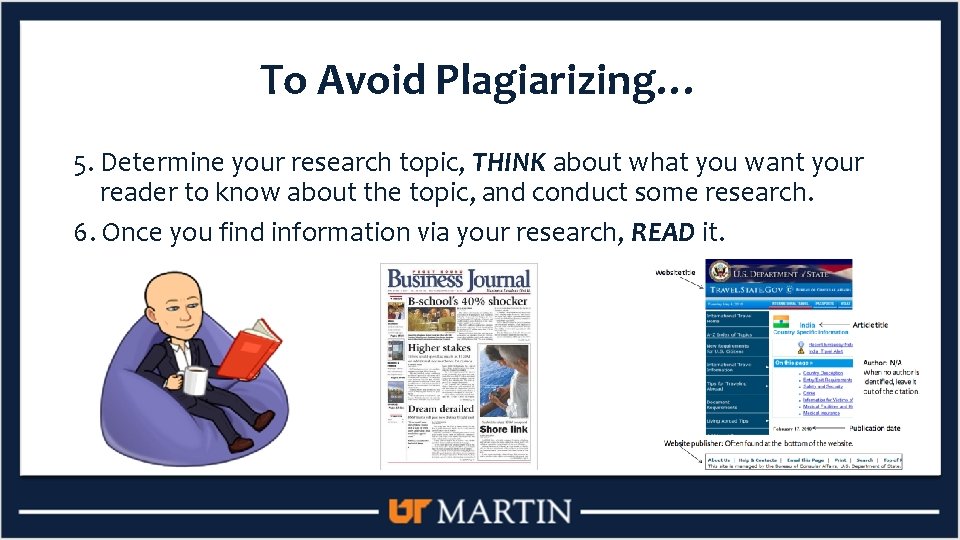
To Avoid Plagiarizing… 5. Determine your research topic, THINK about what you want your reader to know about the topic, and conduct some research. 6. Once you find information via your research, READ it.
To Avoid Plagiarizing… 7. Make an outline of the segments of the information you want the reader to know by ANALYZING the research. 8. Type (or key) a first draft of your paper, including your citations for your information sources. Remember: Even ideas you get from someone else’s work/research should be cited in your paper.
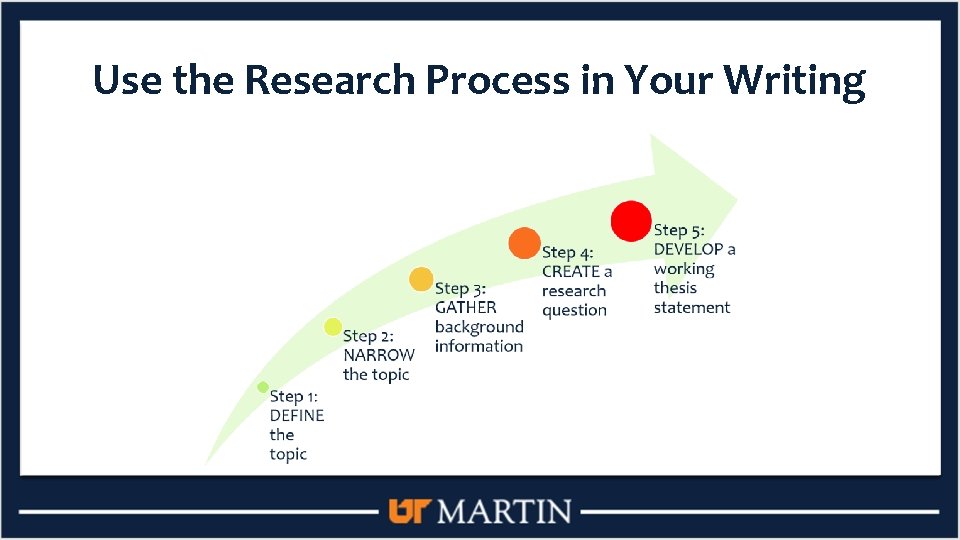
Use the Research Process in Your Writing
To Summarize Cite the Following: • Words or ideas magazines, books, newspapers, television programs, movies, songs, Websites • Personal communication information face-to-face interviews, conversation, or encounters, phone conversations, e-mails • Exact words/wording that has been copied and pasted • Reprinted illustrations, charts, graphics, or pictures • Reposted digital media such as videos, audio materials, or images (Purdue Writing Lab, 2018)
To Summarize Do Not Cite the Following: • Original ideas, experiences, observations, insights, thoughts, or conclusions about some information • Results of an experimental study you conducted • Your own artwork, graphics, photography, video, etc. • Common knowledge information • Generally accepted facts [e. g. , the earth is round] (Purdue Writing Lab, 2018)
Quiz Time
Question One You are working on a 15 -paper for school that is due in two days. To save time, you copy-and-paste exerts word-for-word from different online articles and put the exerts together to form the content for you paper. You cite three articles from which you copied the most content. Are you plagiarizing?
Yes, you are plagiarizing because you did not use any of your original thoughts/writing for the paper, and you only cited a few of the articles you used.
You should use some of your own ideas/thought/writing in your paper, and you need to cite all sources you use.
Question Two In your research paper, you mention a few facts about the Coca-Cola company and you do not cite this “mention” because you consider it common knowledge. Are you plagiarizing?
Correct, you are not plagiarizing because the information you mentioned about Coca-Cola is common knowledge and does not have to be cited in the paper or on the references page.
Incorrect, not citing information that is common knowledge is appropriate.
Question Three In your 15 -page paper, you use information from an interview you held with a representative from Coca-Cola company. You cite the information in your paper as a personal communication and do not include the citation on the references page at the end of the paper. Are you plagiarizing?
Correct, you are not plagiarizing! Information gathered from personal interviews, observations, etc. is cited in the body of the paper as a personal communication and is not included on the references page at the end of the report.
Incorrect, information you gather from conducting personal interviews, observations, etc. is cited only in the body of the paper as a personal communication and is not included on the references page
Common Knowledge • Stuff • Things Set phasers to stun; the war on plagiarism has begun! Dr. Lajuan Davis Business Comm. Prof. Wrong movie, Note Carver! • • Note
36
References • American Psychological Association. (2010). Publication Manual of the American Psychological Association (6 th ed. ). Washington, DC: American Psychological Association. • Plagiarism: Understanding Plagiarism. (2019). Research Guides. Retrieved from https: //libguides. eku. edu/plagiarism • Plagiarism. Dictionary. com. Retrieved from https: //www. dictionary. com/browse/plagiarism
- Slides: 37