
PLAGIARISM TUTORIAL DEFINITION TYPES AVOIDANCE Definition The action

- Slides: 19
PLAGIARISM TUTORIAL DEFINITION, TYPES, AVOIDANCE
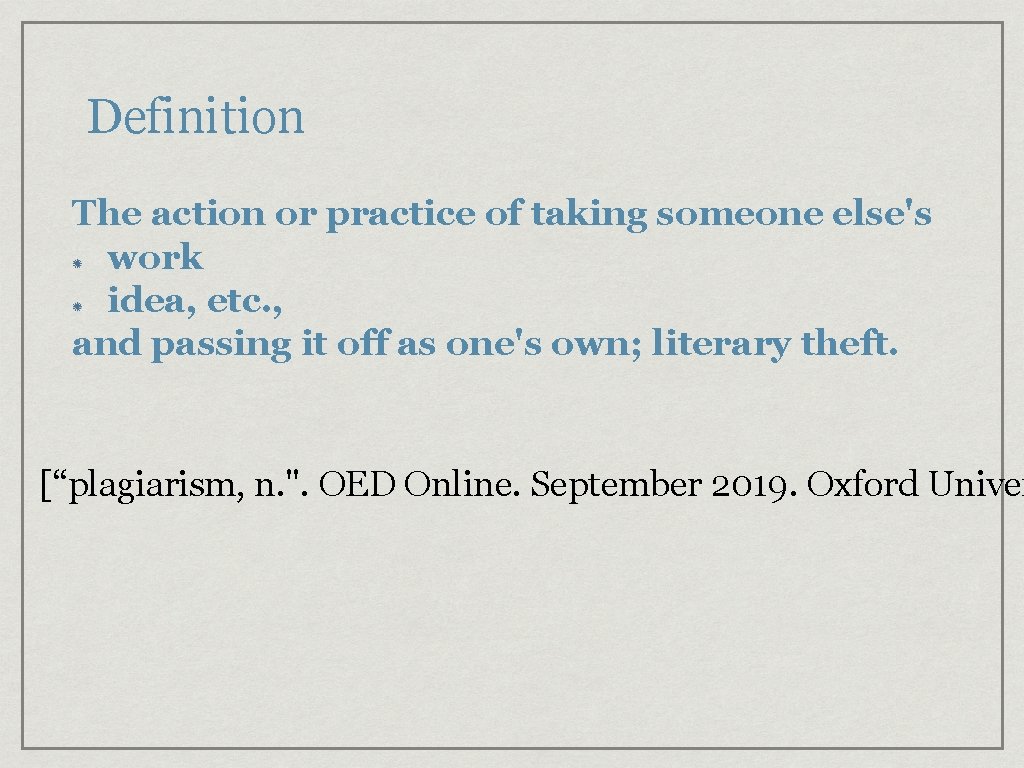
Definition The action or practice of taking someone else's work idea, etc. , and passing it off as one's own; literary theft. [“plagiarism, n. ". OED Online. September 2019. Oxford Univer
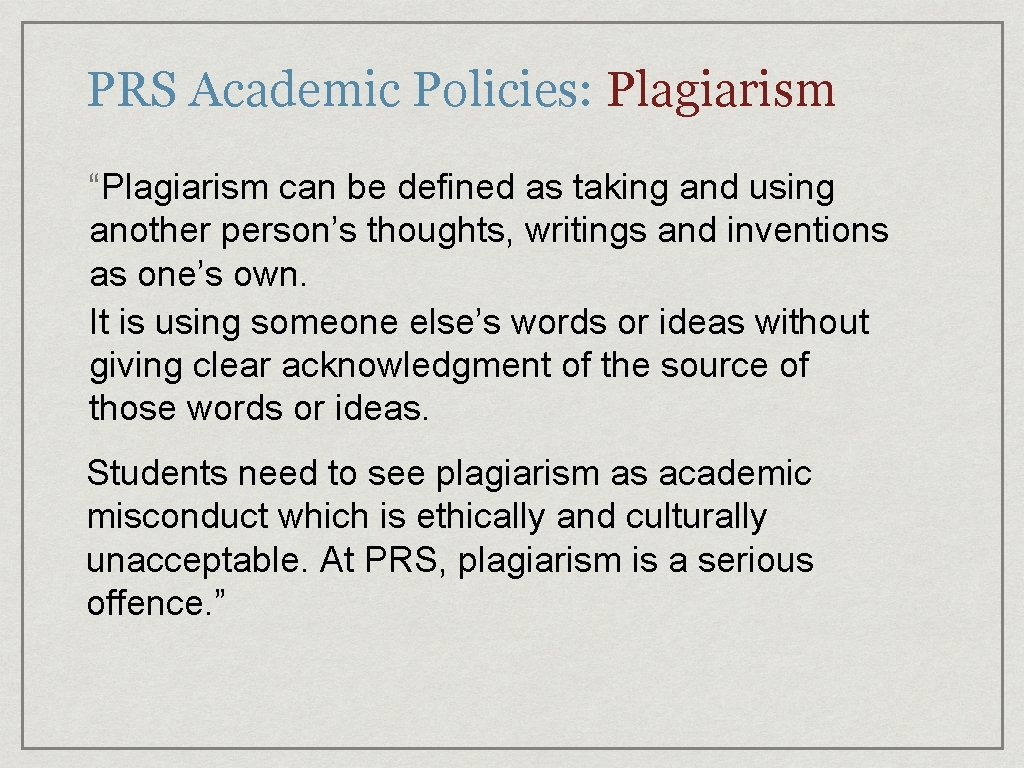
PRS Academic Policies: Plagiarism “Plagiarism can be defined as taking and using another person’s thoughts, writings and inventions as one’s own. It is using someone else’s words or ideas without giving clear acknowledgment of the source of those words or ideas. Students need to see plagiarism as academic misconduct which is ethically and culturally unacceptable. At PRS, plagiarism is a serious offence. ”
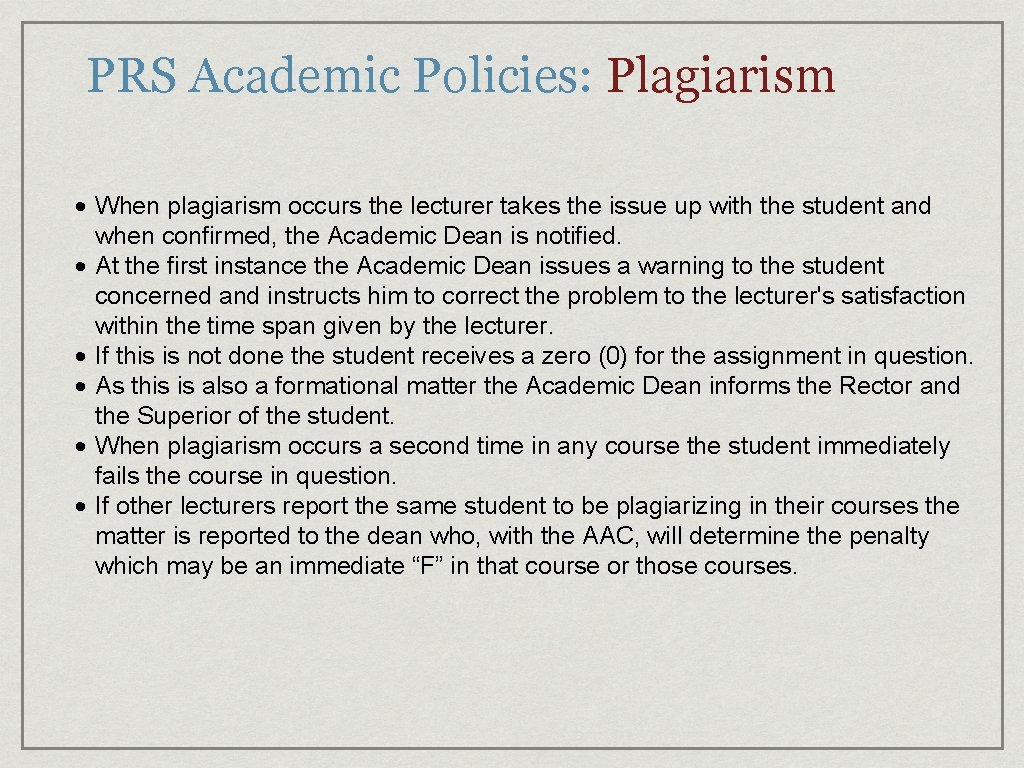
PRS Academic Policies: Plagiarism · When plagiarism occurs the lecturer takes the issue up with the student and when confirmed, the Academic Dean is notified. · At the first instance the Academic Dean issues a warning to the student concerned and instructs him to correct the problem to the lecturer's satisfaction within the time span given by the lecturer. · If this is not done the student receives a zero (0) for the assignment in question. · As this is also a formational matter the Academic Dean informs the Rector and the Superior of the student. · When plagiarism occurs a second time in any course the student immediately fails the course in question. · If other lecturers report the same student to be plagiarizing in their courses the matter is reported to the dean who, with the AAC, will determine the penalty which may be an immediate “F” in that course or those courses.
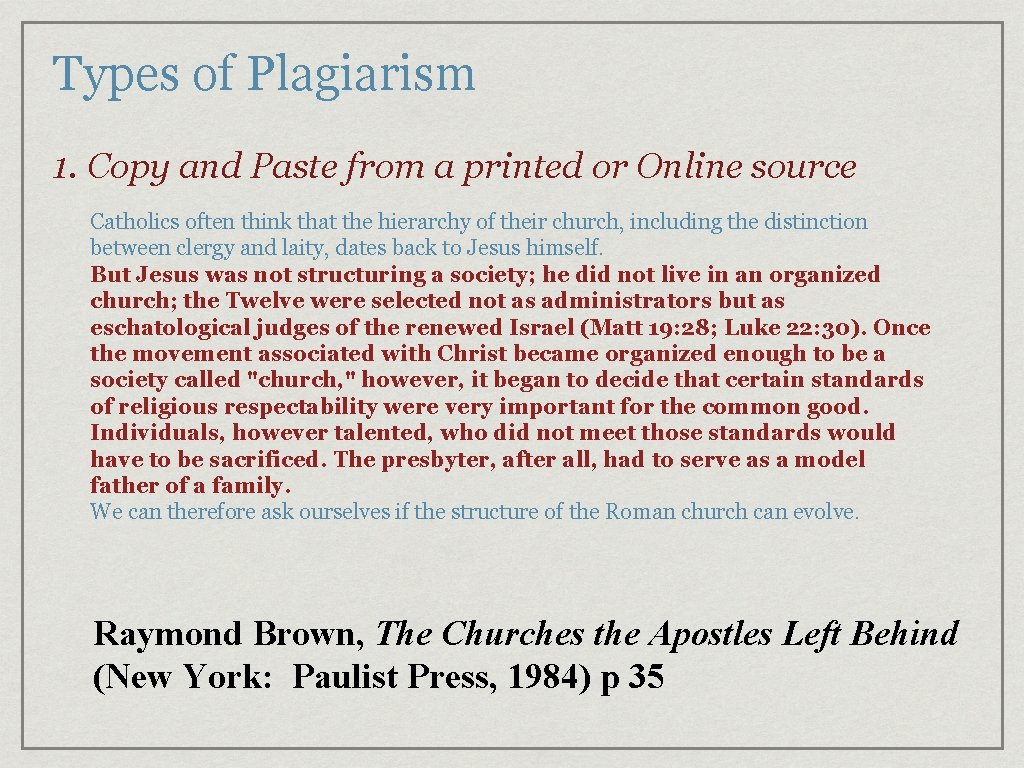
Types of Plagiarism 1. Copy and Paste from a printed or Online source Catholics often think that the hierarchy of their church, including the distinction between clergy and laity, dates back to Jesus himself. But Jesus was not structuring a society; he did not live in an organized church; the Twelve were selected not as administrators but as eschatological judges of the renewed Israel (Matt 19: 28; Luke 22: 30). Once the movement associated with Christ became organized enough to be a society called "church, " however, it began to decide that certain standards of religious respectability were very important for the common good. Individuals, however talented, who did not meet those standards would have to be sacrificed. The presbyter, after all, had to serve as a model father of a family. We can therefore ask ourselves if the structure of the Roman church can evolve. Raymond Brown, The Churches the Apostles Left Behind (New York: Paulist Press, 1984) p 35
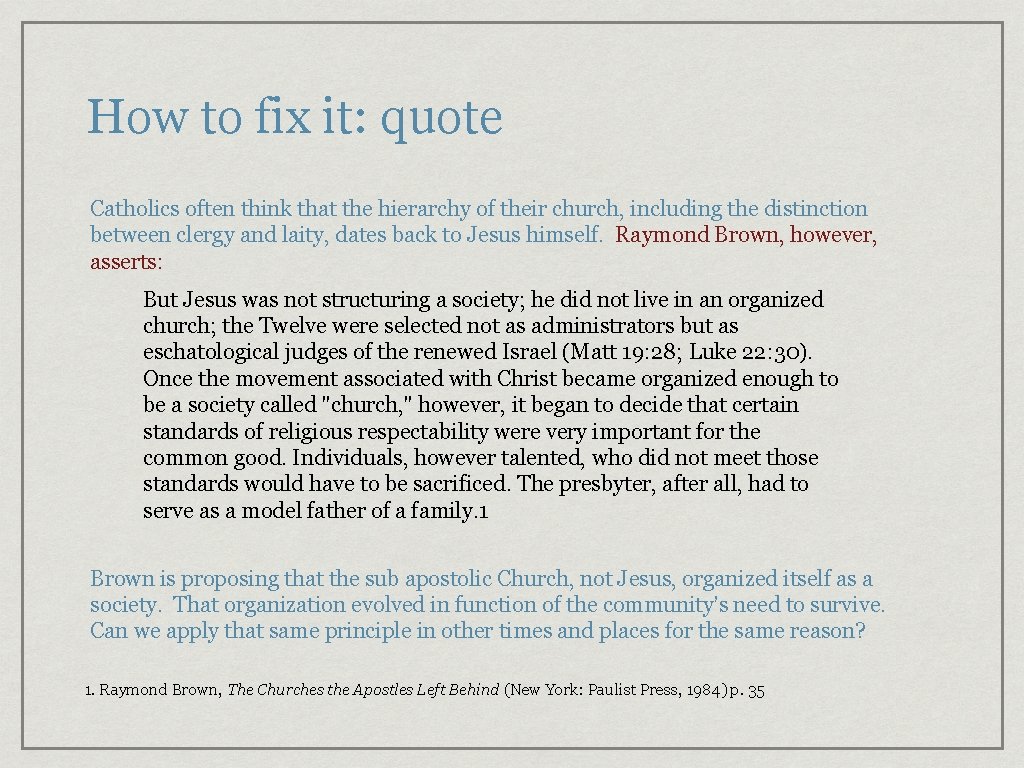
How to fix it: quote Catholics often think that the hierarchy of their church, including the distinction between clergy and laity, dates back to Jesus himself. Raymond Brown, however, asserts: But Jesus was not structuring a society; he did not live in an organized church; the Twelve were selected not as administrators but as eschatological judges of the renewed Israel (Matt 19: 28; Luke 22: 30). Once the movement associated with Christ became organized enough to be a society called "church, " however, it began to decide that certain standards of religious respectability were very important for the common good. Individuals, however talented, who did not meet those standards would have to be sacrificed. The presbyter, after all, had to serve as a model father of a family. 1 Brown is proposing that the sub apostolic Church, not Jesus, organized itself as a society. That organization evolved in function of the community’s need to survive. Can we apply that same principle in other times and places for the same reason? 1. Raymond Brown, The Churches the Apostles Left Behind (New York: Paulist Press, 1984) p. 35
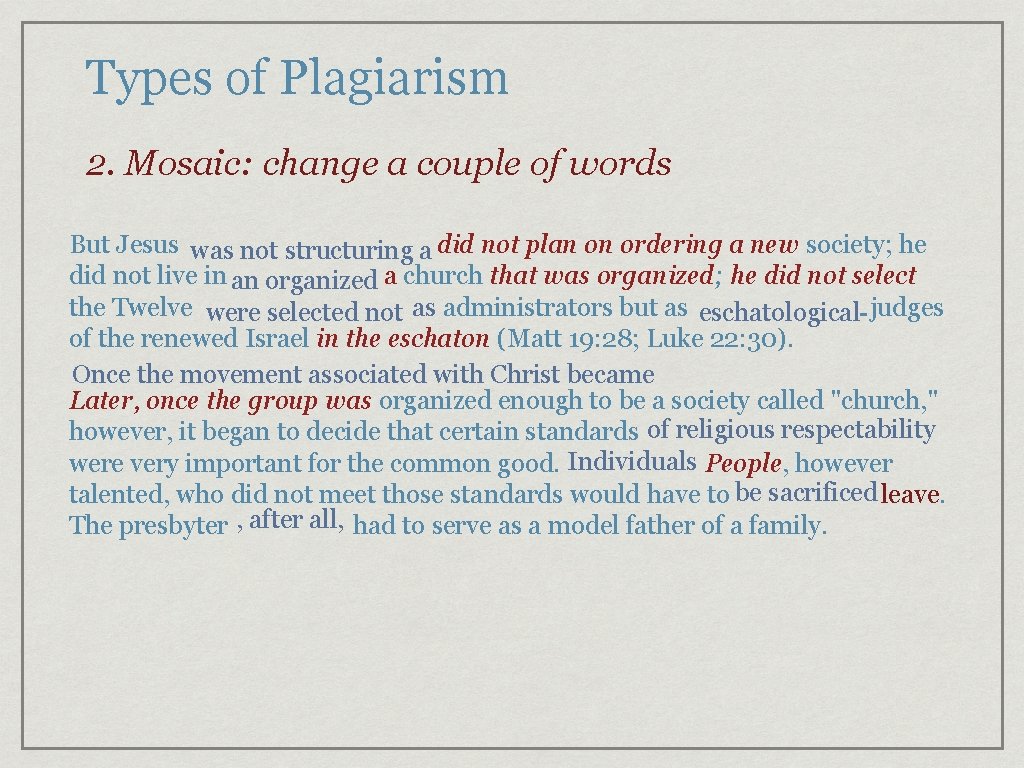
Types of Plagiarism 2. Mosaic: change a couple of words But Jesus was not structuring a did not plan on ordering a new society; he did not live in an organized a church that was organized; he did not select the Twelve were selected not as administrators but as eschatological judges of the renewed Israel in the eschaton (Matt 19: 28; Luke 22: 30). Once the movement associated with Christ became Later, once the group was organized enough to be a society called "church, " however, it began to decide that certain standards of religious respectability were very important for the common good. Individuals People, however talented, who did not meet those standards would have to be sacrificed leave. The presbyter , after all, had to serve as a model father of a family.
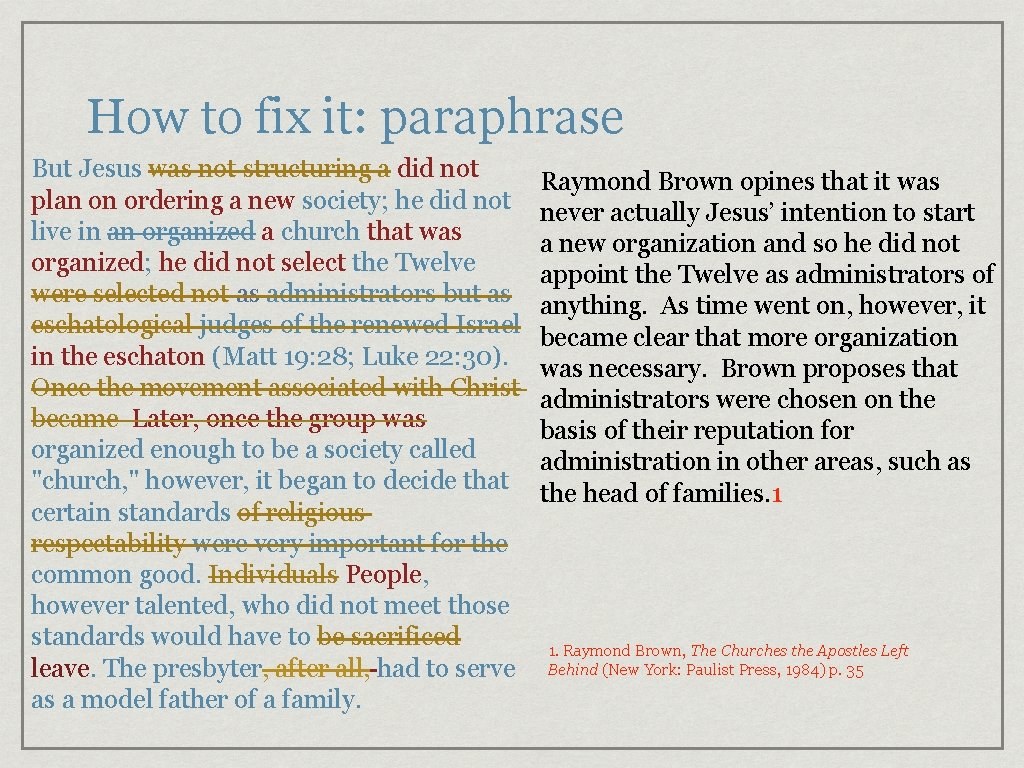
How to fix it: paraphrase But Jesus was not structuring a did not plan on ordering a new society; he did not live in an organized a church that was organized; he did not select the Twelve were selected not as administrators but as eschatological judges of the renewed Israel in the eschaton (Matt 19: 28; Luke 22: 30). Once the movement associated with Christ became Later, once the group was organized enough to be a society called "church, " however, it began to decide that certain standards of religious respectability were very important for the common good. Individuals People, however talented, who did not meet those standards would have to be sacrificed leave. The presbyter, after all, had to serve as a model father of a family. Raymond Brown opines that it was never actually Jesus’ intention to start a new organization and so he did not appoint the Twelve as administrators of anything. As time went on, however, it became clear that more organization was necessary. Brown proposes that administrators were chosen on the basis of their reputation for administration in other areas, such as the head of families. 1 1. Raymond Brown, The Churches the Apostles Left Behind (New York: Paulist Press, 1984) p. 35
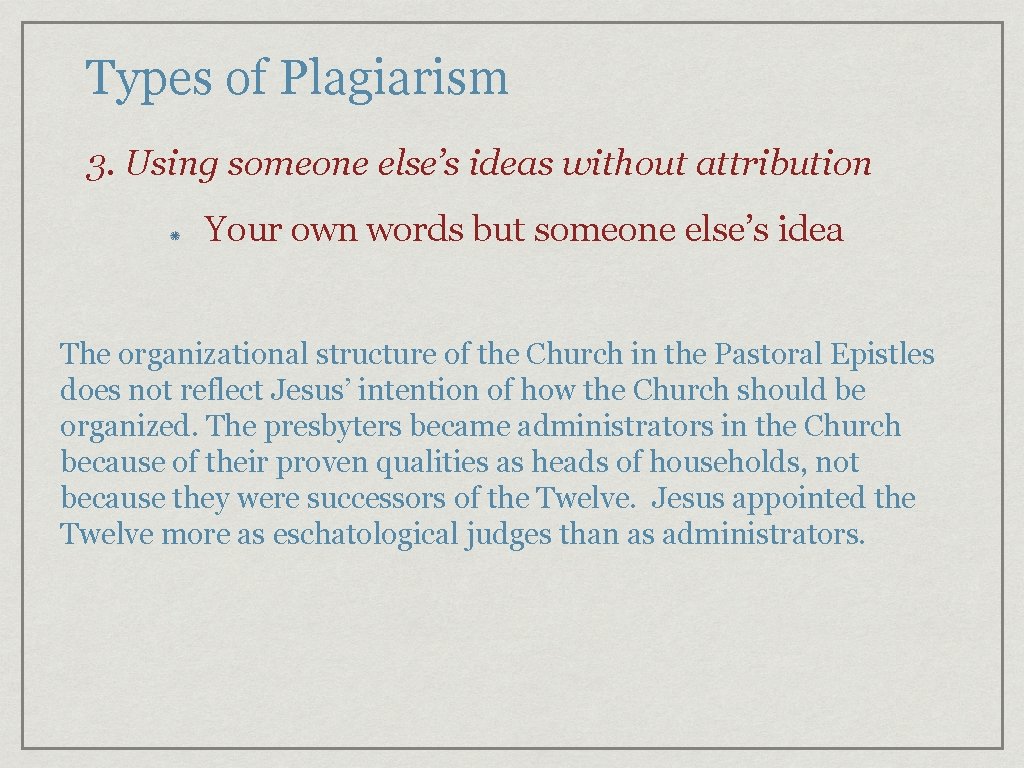
Types of Plagiarism 3. Using someone else’s ideas without attribution Your own words but someone else’s idea The organizational structure of the Church in the Pastoral Epistles does not reflect Jesus’ intention of how the Church should be organized. The presbyters became administrators in the Church because of their proven qualities as heads of households, not because they were successors of the Twelve. Jesus appointed the Twelve more as eschatological judges than as administrators.
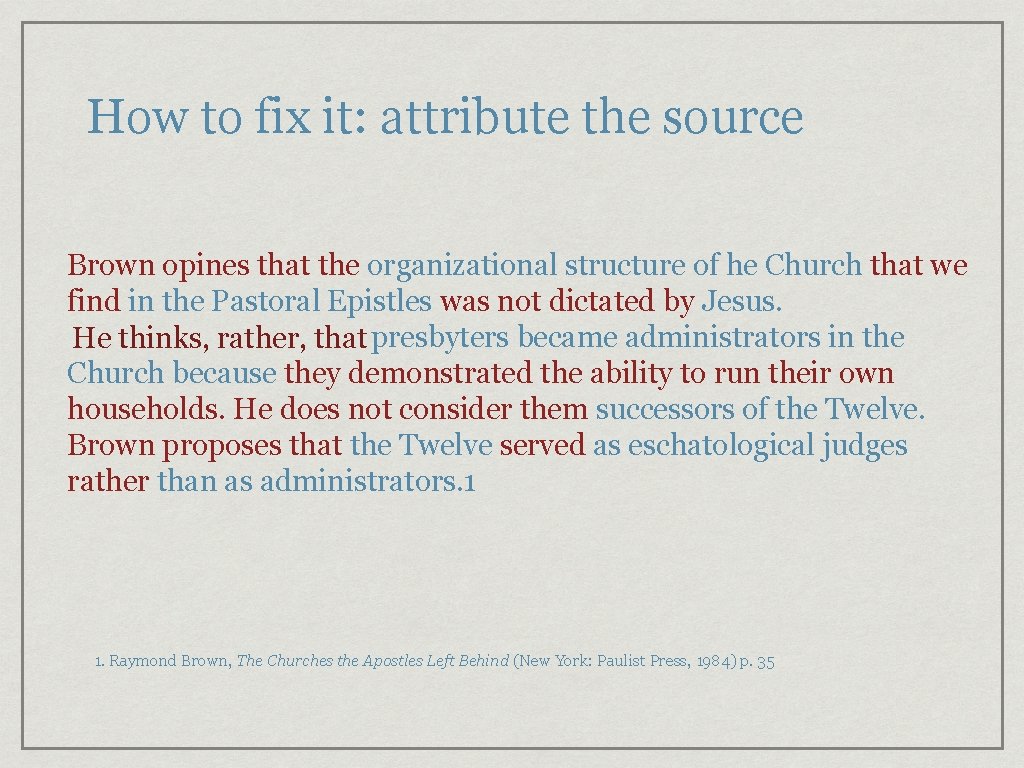
How to fix it: attribute the source Brown opines that the organizational structure of he Church that we find in the Pastoral Epistles was not dictated by Jesus. He thinks, rather, that presbyters became administrators in the Church because they demonstrated the ability to run their own households. He does not consider them successors of the Twelve. Brown proposes that the Twelve served as eschatological judges rather than as administrators. 1 1. Raymond Brown, The Churches the Apostles Left Behind (New York: Paulist Press, 1984) p. 35
Types of Plagiarism 4. Other Some else’s paper Your own paper from another course Have someone else write the paper for you
The Dilemma of “Common Knowledge” Broadly speaking, common knowledge refers to information that the average, educated reader would accept as reliable without having to look it up. [https: //integrity. mit. edu/handbook/citing-yoursources/what-common-knowledge] “However, what may be common knowledge in one culture, nation, academic discipline or peer group may not be common knowledge in another. ” [https: //integrity. mit. edu/handbook/citing-yoursources/what-common-knowledge]
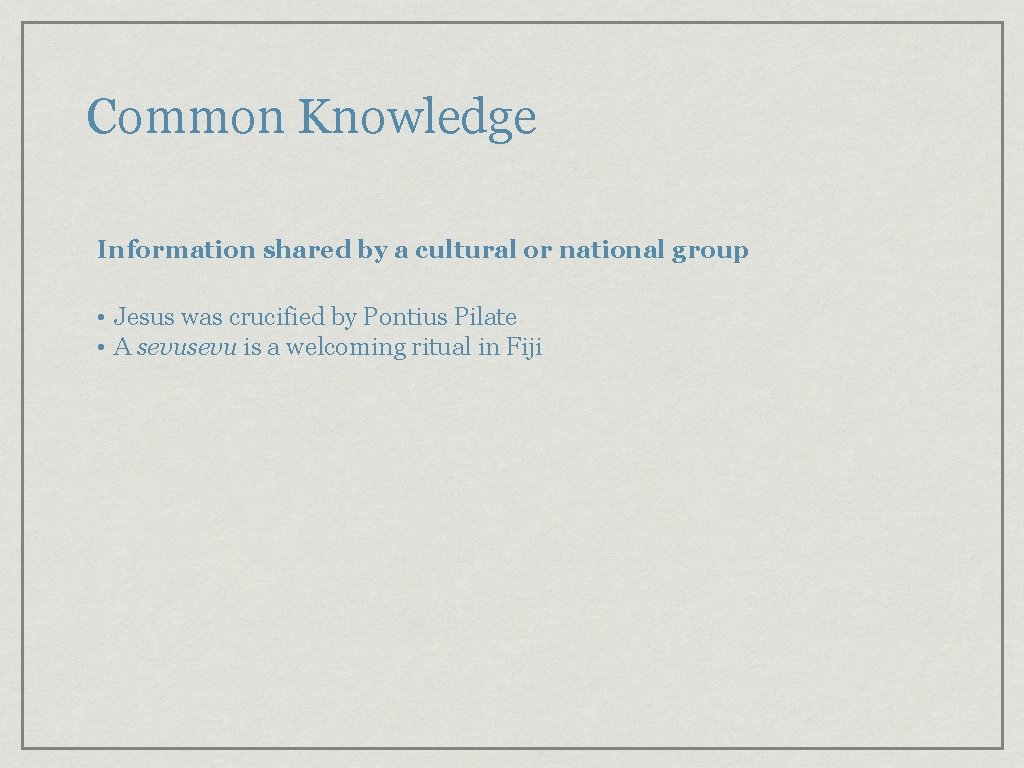
Common Knowledge Information that most people know • Jesus lived in the 1 st century A. D. • Water freezes at 0 Celsius
Common Knowledge Information shared by a cultural or national group • Jesus was crucified by Pontius Pilate • A sevu is a welcoming ritual in Fiji
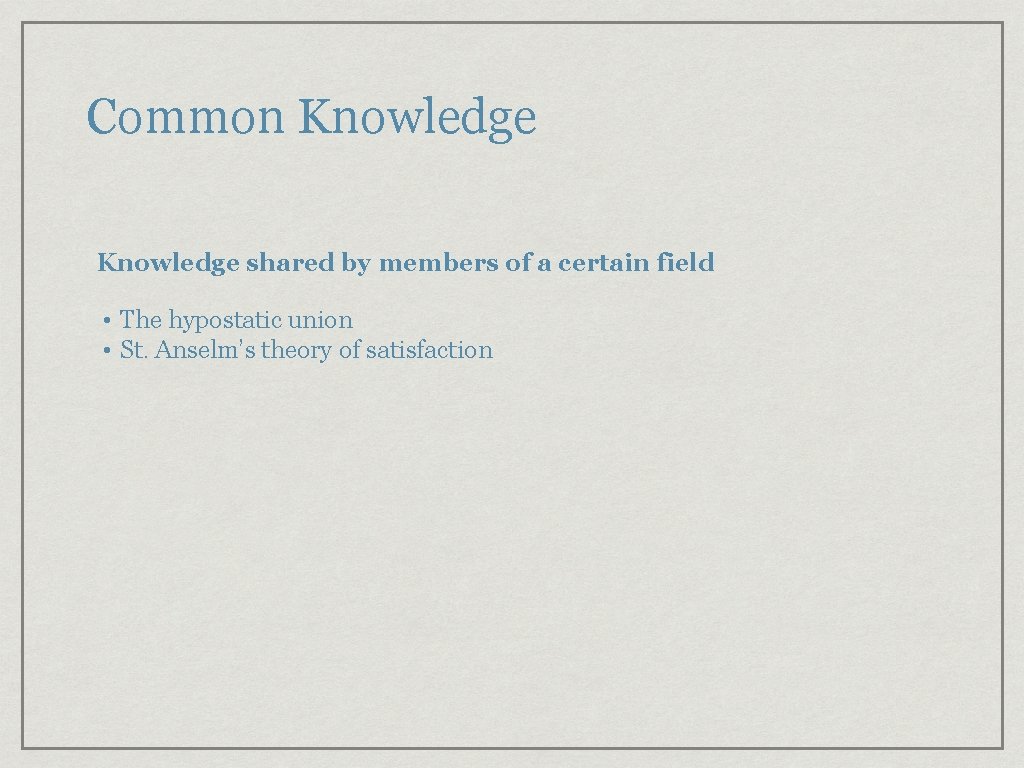
Common Knowledge shared by members of a certain field • The hypostatic union • St. Anselm’s theory of satisfaction
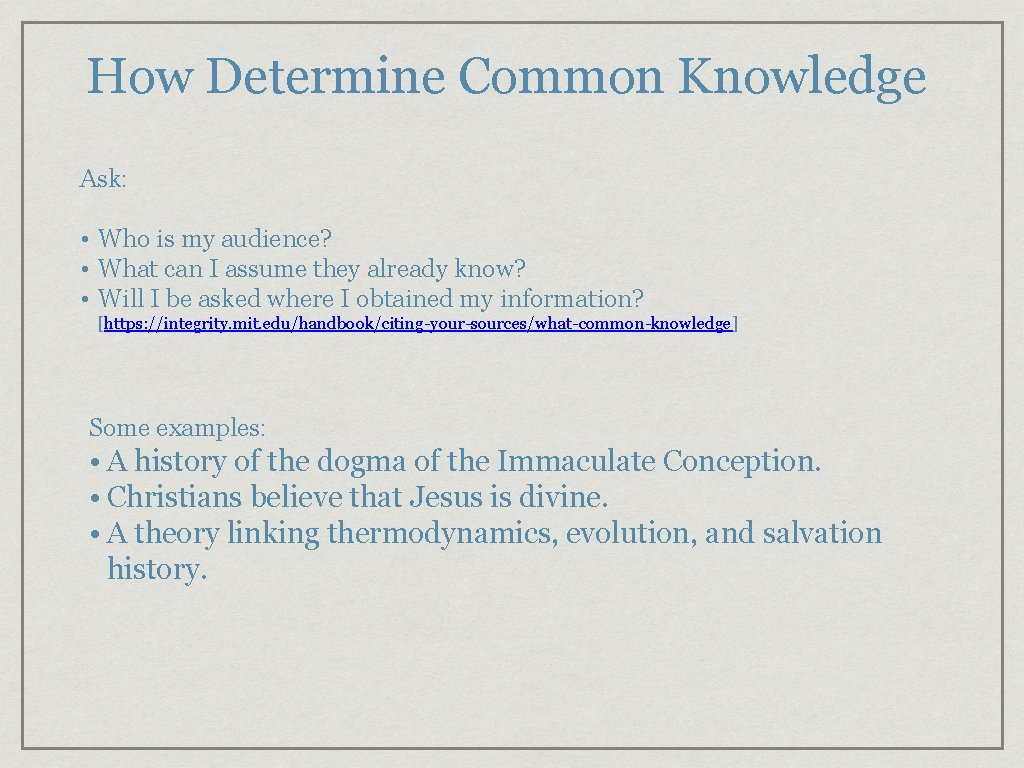
How Determine Common Knowledge Ask: • Who is my audience? • What can I assume they already know? • Will I be asked where I obtained my information? [https: //integrity. mit. edu/handbook/citing-your-sources/what-common-knowledge] Some examples: • A history of the dogma of the Immaculate Conception. • Christians believe that Jesus is divine. • A theory linking thermodynamics, evolution, and salvation history.
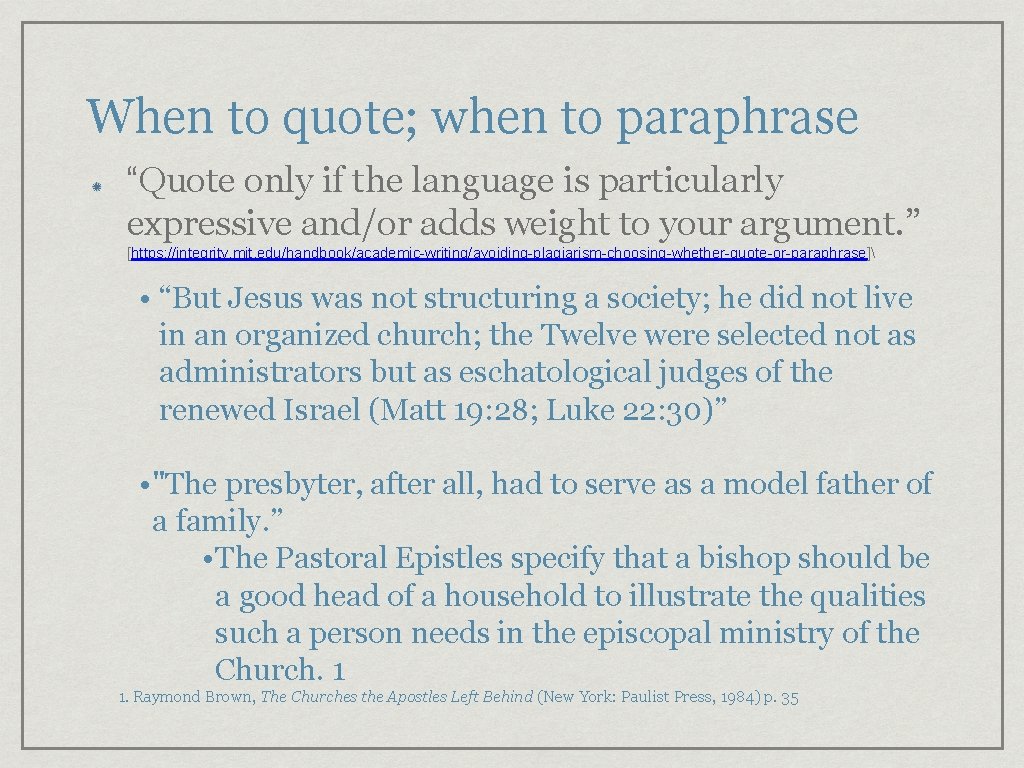
When to quote; when to paraphrase “Quote only if the language is particularly expressive and/or adds weight to your argument. ” [https: //integrity. mit. edu/handbook/academic-writing/avoiding-plagiarism-choosing-whether-quote-or-paraphrase] • “But Jesus was not structuring a society; he did not live in an organized church; the Twelve were selected not as administrators but as eschatological judges of the renewed Israel (Matt 19: 28; Luke 22: 30)” • "The presbyter, after all, had to serve as a model father of a family. ” • The Pastoral Epistles specify that a bishop should be a good head of a household to illustrate the qualities such a person needs in the episcopal ministry of the Church. 1 1. Raymond Brown, The Churches the Apostles Left Behind (New York: Paulist Press, 1984) p. 35
PRS Academic Policies: Cheating “Cheating is any dishonest act in which a student deliberately provides or receives relevant information during an exam, a test or course work. This includes looking at and copying the work of another student. In PRS, cheating is considered a serious offence. ”
PRS Academic Policies: Cheating · If it is proven by the AAC that the student copied the work of another student, then the student who did the copying will be given an “F” and reported to the Rector by the dean. · If a student is caught cheating during an exam, his/her exam paper will be turned over immediately, will get a zero (0) for that particular exam and reported to the dean who informs the Rector. · If a student is accused of cheating during an exam by another student or other students the AAC thoroughly investigates the accusation and when confirmed, the student gets a zero (0) for that exam and the dean relays the decision to the Rector.