
PLAGIARISM HOW DOES IT AFFECT ME By Kingsley
PLAGIARISM: HOW DOES IT AFFECT ME By Kingsley N. Egbukole (CLN) University Library, FUTO
We are going to scale this issue on the following: - 1) 2) 3) 4) 5) 6) 7) 8) Definition Information ethics Ways of incorporating other writers' work into your own writing Types of plagiarism Why plagiarism matters How to avoid plagiarism Types of plagiarism software Turnitin - A plagiarism software i. What is it? ii. My personal experience iii. Common questions people ask about Turnitin iv. How does Turnitin work? v. Interpreting the Similarity Report vi. Precautions on the adoption of Turnitin vii. Short You. Tube Tutorial a. Plagiarism Checker b. Turnitin
• Definition • What do you view plagiarism? How does it affect you?
• What Literature says • Plagiarism is presenting someone else’s work or ideas as your own • With or without their consent • By incorporating it into your work without full acknowledgement. • All published and unpublished material, including manuscript, printed or electronic form, is covered under this definition. • Plagiarism may be intentional or reckless, or unintentional. • Plagiarism is a disciplinary offence (University of Oxford, 2018) NOTE* In academic circles plagiarism is considered to be unethical behavior and the perpetrators may be subject to sanctions, including expulsion from their institution.
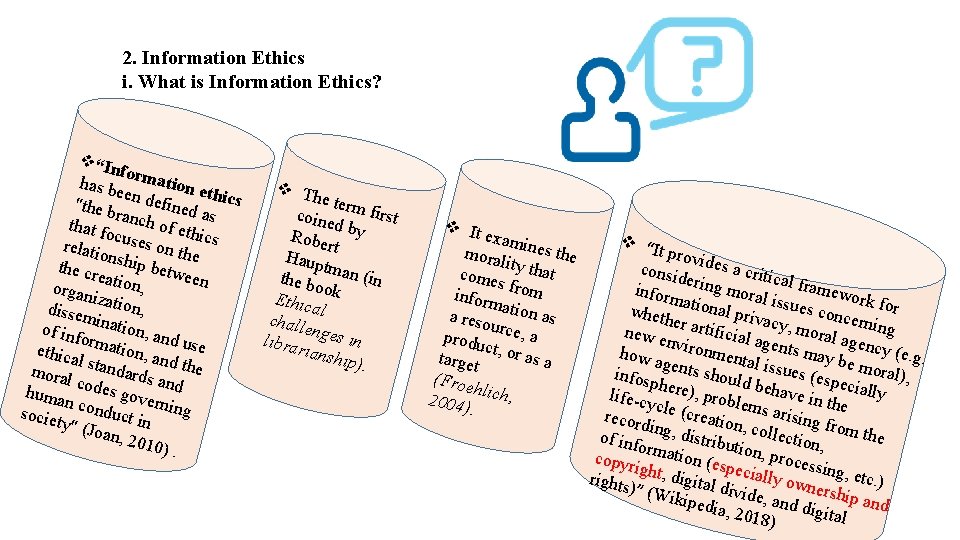
2. Information Ethics i. What is Information Ethics? “In fo has b rmation e T een d thics he ter e fined "the b as ranch coine m first that f d by ocuse of ethics R obert s relati onshi on the H a u ptm p the cr eation between the bo an (in organ , ok izatio E t h ical n, dissem challe of ination, an nges orma d in l i use brari tion, ethica a n ship) and th l stan. e d mora a r d s a l c huma odes gove nd n r socie conduct in ning ty" (J oan, 2 010) . It exam moral ines the it come y that s inform from a a reso tion as u produ rce, a c target t, or as a (Froe h 2004) lich, . “I t prov consid ides a criti ca e inform ring moral l framewo rk is a wheth tional priv sues conce for ac e r new e r artificial y, moral a ning ag ge n how a vironmenta ents may b ncy (e. g. g l e infosp ents should issues (esp moral), ec b h life-cy ere), probl ehave in t ially he em c record le (creation s arising f ro in , of inf g, distribu collection, m the or ti copyr mation (es on, process p ig i rights ht, digital ecially own ng, etc. ) )” (W d ikiped ivide, and ership and digita ia, 20 l 18)
ii. Relationship between Plagiarism and Information Ethics Ownersh ip is a fund amental mo (Ernesto, 2 ral right 013) Plagiaris m violates the author’ ownership s right to th of the work e (Ethical Ru le)
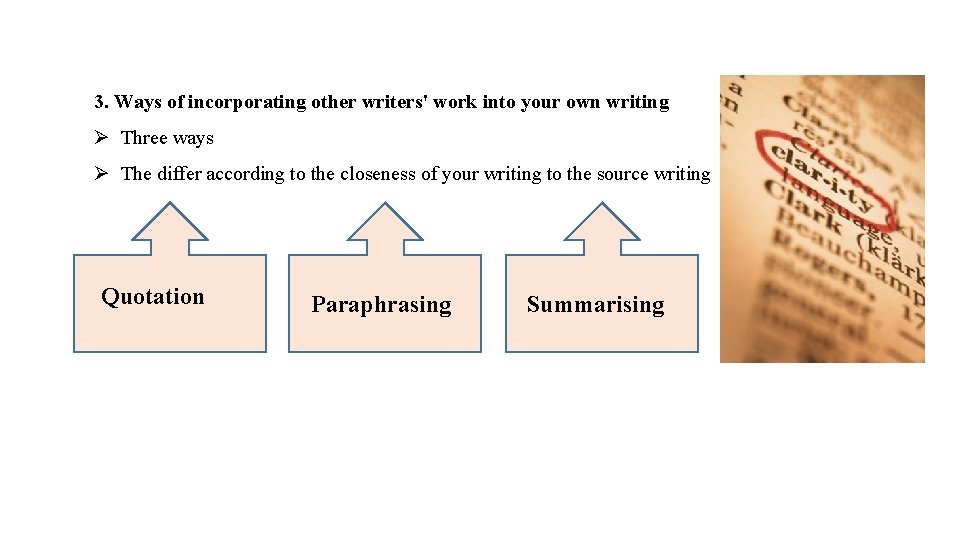
3. Ways of incorporating other writers' work into your own writing Three ways The differ according to the closeness of your writing to the source writing Quotation Paraphrasing Summarising
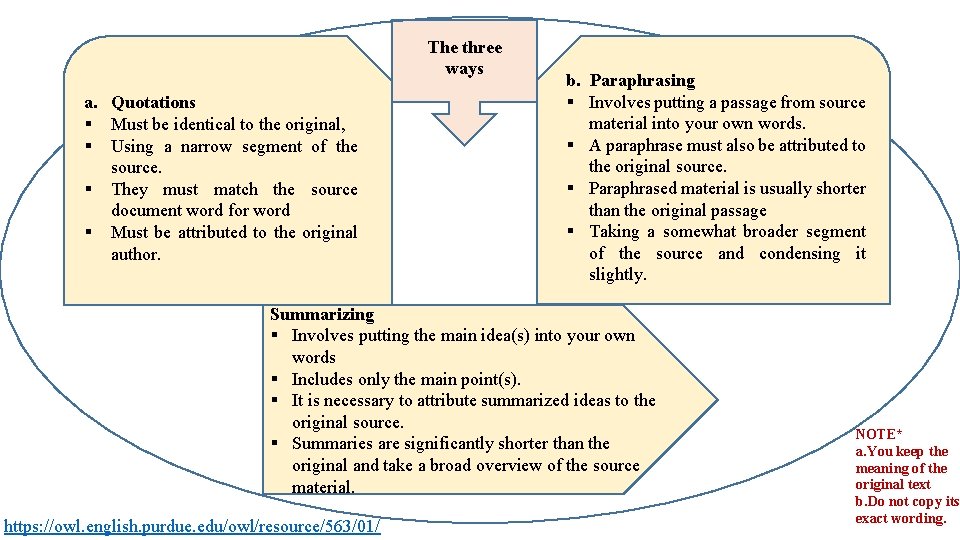
The three ways a. Quotations Must be identical to the original, Using a narrow segment of the source. They must match the source document word for word Must be attributed to the original author. b. Paraphrasing Involves putting a passage from source material into your own words. A paraphrase must also be attributed to the original source. Paraphrased material is usually shorter than the original passage Taking a somewhat broader segment of the source and condensing it slightly. Summarizing Involves putting the main idea(s) into your own words Includes only the main point(s). It is necessary to attribute summarized ideas to the original source. Summaries are significantly shorter than the original and take a broad overview of the source material. https: //owl. english. purdue. edu/owl/resource/563/01/ NOTE* a. You keep the meaning of the original text b. Do not copy its exact wording.
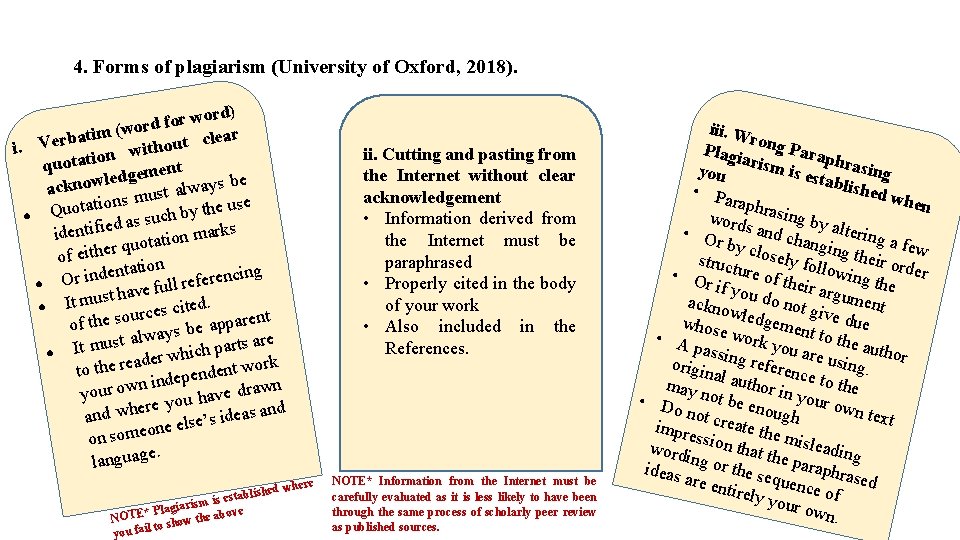
4. Forms of plagiarism (University of Oxford, 2018). d) r o w r o f word ( m i t a ear l b c r e t V u o i. with n o i t a t quo ment e g d e l w ys be a w ackno l a t s ns mu o i t a use t e o h u t Q y b s such a d e i f i t iden marks n o i t a t r quo of eithe ntation e ng i d c n i n e r r e O f e ve full r a h t s u ted. i It m c s e c r u t of the so ays be apparen are ust alw s t r m a t p I h r whic e d a e r ork e w t n to th e d ndepen i n w o r rawn d e you v a h e you r e h w s and a d e d an i s ’ e one els e m o s n o e. languag d wher he establis s i m s ari * Plagi e above h NOTE t w o h l to s you fai ii. Cutting and pasting from the Internet without clear acknowledgement • Information derived from the Internet must be paraphrased • Properly cited in the body of your work • Also included in the References. e NOTE* Information from the Internet must be carefully evaluated as it is less likely to have been through the same process of scholarly peer review as published sources. iii. W r Plagi ong Parap a h you rism is est rasing ablish • Pa ed wh raphr en word asing by • Or s and cha altering a by cl nging few o t s h e e ly fol struct ir ord l u o r w e • Or of th ing th er eir ar if yo e g u u d m o ackno e wledg not give d nt ue whos emen e t wo to • A passin rk you ar the author origin g referen e using. a c may n l author in e to the your • Do ot be en own o not c u text g h r e a impre te ssion the misle t a word ing o hat the pa ding r t ra ideas are e he sequen phrased ntirel c y you e of r own.
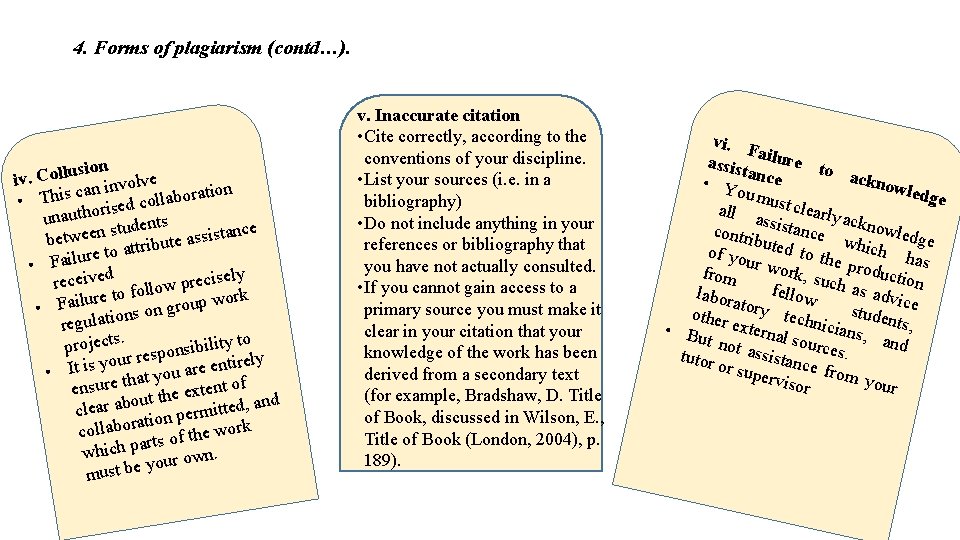
4. Forms of plagiarism (contd…). sion u l l o C . iv ve l o v n i n ca tion • This rised collabora unautho udents st nce between ttribute assista re to a u l i a F • received ollow precisely rk o re to f u w l i p a u F o • s on gr n o i t a l u reg . projects esponsibility to ely r i your r t s n i e t I e r • t you a a h t e r of u t n e ens t x e out the b a d, and r e a t e t l i c m r e tion p a r o b a l ork l w co e h t f arts o which p ur own. yo must be v. Inaccurate citation • Cite correctly, according to the conventions of your discipline. • List your sources (i. e. in a bibliography) • Do not include anything in your references or bibliography that you have not actually consulted. • If you cannot gain access to a primary source you must make it clear in your citation that your knowledge of the work has been derived from a secondary text (for example, Bradshaw, D. Title of Book, discussed in Wilson, E. , Title of Book (London, 2004), p. 189). vi. F a assist ilure to ack a • Yo nce nowl edge u mus t c le all assist arly ackno a w contr ibuted nce whic ledge h of yo ur wo to the pro has ductio rk, su from n c h as a fellow labor dvice atory s tec t u other d e n • Bu external hnicians, ts, sourc t not and e a s s. s tutor i or sup stance fro m yo erviso ur r
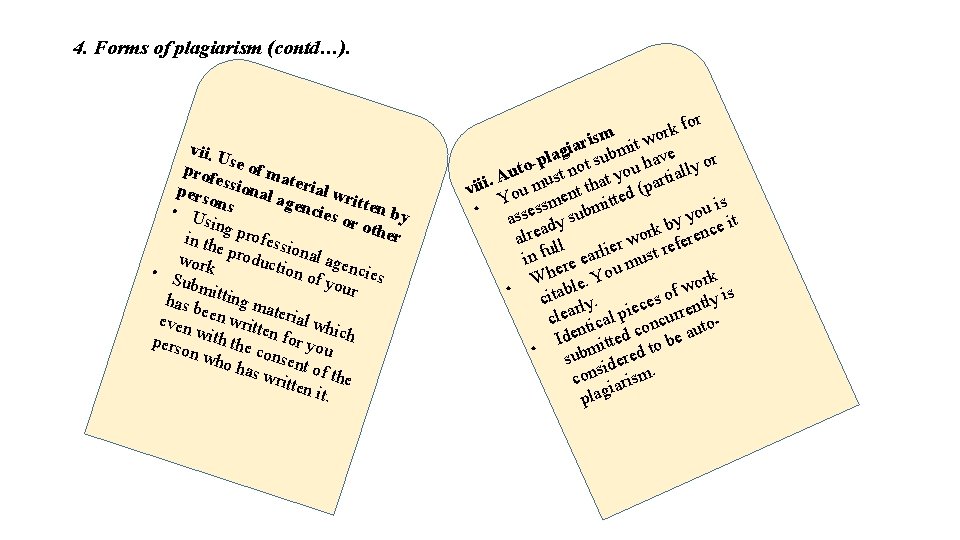
4. Forms of plagiarism (contd…). vii. U prof se of ma e t pers ssional erial wr agen o i cies tten by • U ns or o sing ther p r ofes in th sion e pro al ag work duct ion o encies • S f you ubm r has b itting m a e even en writt terial wh e i pers with the n for yo ch on w u c ho h onsent o as w ritten f the it. or f k sm it wor i r a gi a l ubm have or p s t o ut ust no t you rtially A . viii ou m ent tha ed (pa Y ssm itt is m u • e b o s as dy su y y ce it b a k or feren alre ll w r ie re u in f re earl must u e k r Wh le. Yo o b • f w y is o cita ly. s e tl c n r e e i a r p cle tical oncur tou Iden itted c to be a • m sub idered s con iarism. plag
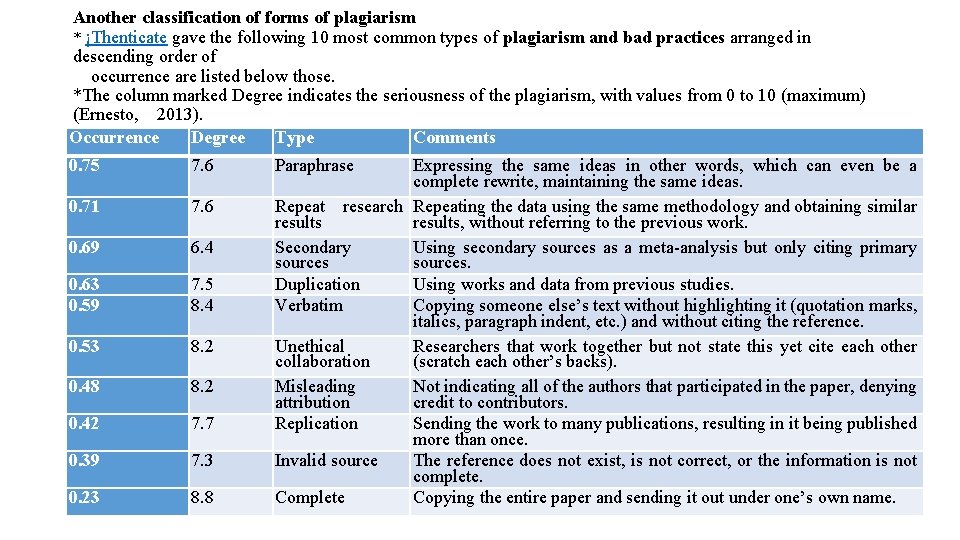
Another classification of forms of plagiarism * ¡Thenticate gave the following 10 most common types of plagiarism and bad practices arranged in descending order of occurrence are listed below those. *The column marked Degree indicates the seriousness of the plagiarism, with values from 0 to 10 (maximum) (Ernesto, 2013). Occurrence Degree Type Comments 0. 75 7. 6 0. 71 7. 6 0. 69 6. 4 0. 63 0. 59 7. 5 8. 4 0. 53 8. 2 0. 48 8. 2 0. 42 7. 7 0. 39 7. 3 0. 23 8. 8 Paraphrase Expressing the same ideas in other words, which can even be a complete rewrite, maintaining the same ideas. Repeat research Repeating the data using the same methodology and obtaining similar results, without referring to the previous work. Secondary Using secondary sources as a meta-analysis but only citing primary sources. Duplication Using works and data from previous studies. Verbatim Copying someone else’s text without highlighting it (quotation marks, italics, paragraph indent, etc. ) and without citing the reference. Unethical Researchers that work together but not state this yet cite each other collaboration (scratch each other’s backs). Misleading Not indicating all of the authors that participated in the paper, denying attribution credit to contributors. Replication Sending the work to many publications, resulting in it being published more than once. Invalid source The reference does not exist, is not correct, or the information is not complete. Complete Copying the entire paper and sending it out under one’s own name.
Further Reading * The complete report can be accessed at: http: //www. ithenticate. com/Portals/92785/docs/ithenticate-decoding-survey-summary-092413. pdf * For a flow chart showing the decision making sequence which publishing industry must be adhered to in the cases where plagiarism is suspected. Guidelines for retracting articles: <http: //publicationethics. org/files/retraction%20 guidelines. pdf>
Why does plagiarism matter? Breach of academic integrity. Against the principle of intellectual honesty The academic community must acknowledge their debt to the originators of the ideas, words, and data which form the basis for their own work. Passing off another’s work as your own is poor scholarship In doing this you have failed to complete the learning process. Plagiarism is unethical and can have serious consequences for your future career It also undermines the standards of one’s institution and of the degrees it issues.
Based on the above one is tempted to ask: i. Does this mean that I shouldn’t use the work of other authors? On the contrary, it is vital that you situate your writing within the intellectual debates of your discipline. Academic essays almost always involve the use and discussion of material written by others, and, with due acknowledgement and proper referencing. The knowledge in your discipline has developed cumulatively as a result of years of research, innovation and debate. You need to give credit to the authors of the ideas and observations you cite. Not only does this accord recognition to their work, it also helps you to strengthen your argument by making clear the basis on which you make it. Moreover, good citation practice gives your reader the opportunity to follow up your references, or check the validity of your interpretation.
ii. Does every statement in my essay have to be backed up with references? You may feel that including the citation for every point you make will interrupt the flow of your essay and make it look very unoriginal. At least initially, this may sometimes be inevitable. However, by employing good citation practice from the start, you will learn to avoid errors such as close paraphrasing or inadequately referenced quotation. It is important to understand the reasons behind the need for transparency of source use. On the other hand, it is not necessary to give references for facts that are common knowledge in your discipline. If you are unsure as to whether something is considered to be common knowledge or not, it is safer to cite it anyway and seek clarification. You do need to document facts that are not generally known and ideas that are interpretations of facts.
Possible solution to Plagiarism How to avoid plagiarism The road to follow
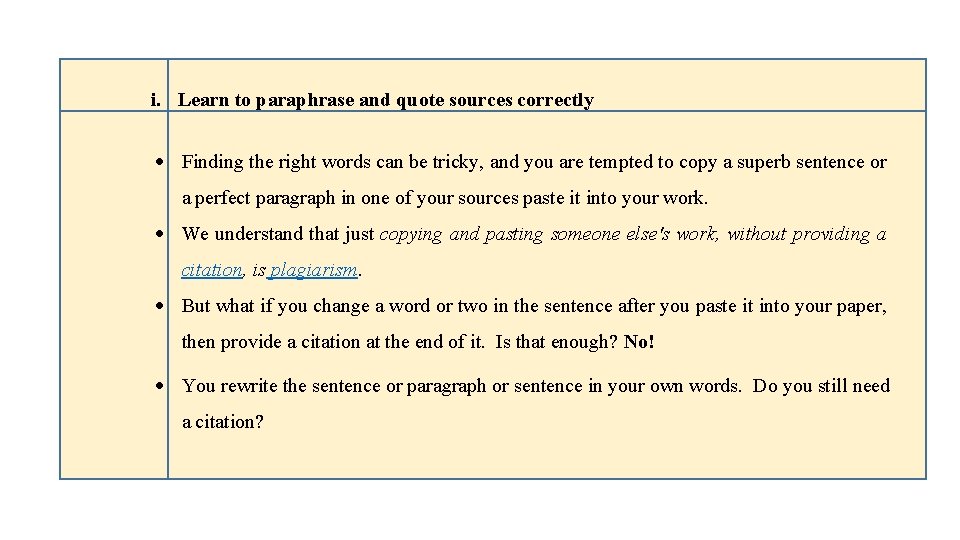
i. Learn to paraphrase and quote sources correctly Finding the right words can be tricky, and you are tempted to copy a superb sentence or a perfect paragraph in one of your sources paste it into your work. We understand that just copying and pasting someone else's work, without providing a citation, is plagiarism. But what if you change a word or two in the sentence after you paste it into your paper, then provide a citation at the end of it. Is that enough? No! You rewrite the sentence or paragraph or sentence in your own words. Do you still need a citation?
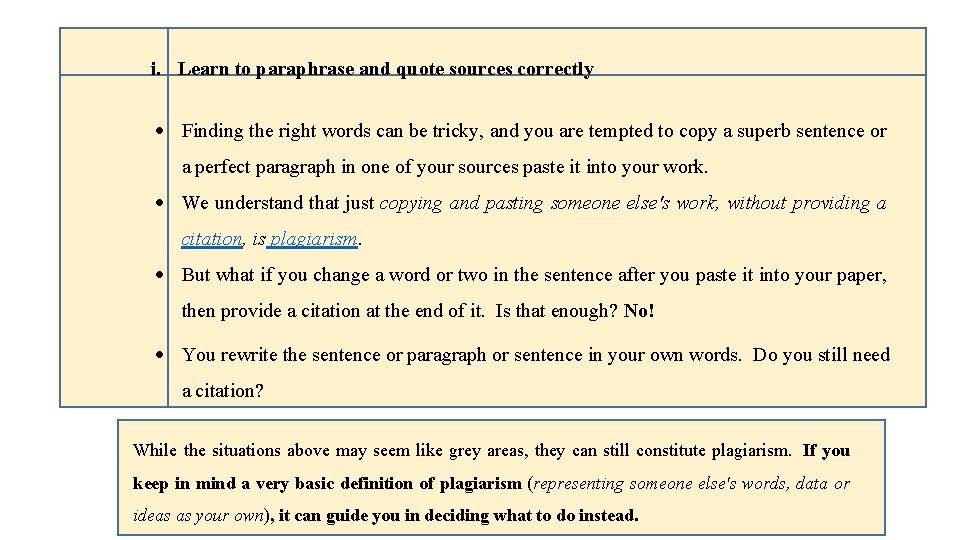
i. Learn to paraphrase and quote sources correctly Finding the right words can be tricky, and you are tempted to copy a superb sentence or a perfect paragraph in one of your sources paste it into your work. We understand that just copying and pasting someone else's work, without providing a citation, is plagiarism. But what if you change a word or two in the sentence after you paste it into your paper, then provide a citation at the end of it. Is that enough? No! You rewrite the sentence or paragraph or sentence in your own words. Do you still need a citation? While the situations above may seem like grey areas, they can still constitute plagiarism. If you keep in mind a very basic definition of plagiarism (representing someone else's words, data or ideas as your own), it can guide you in deciding what to do instead.
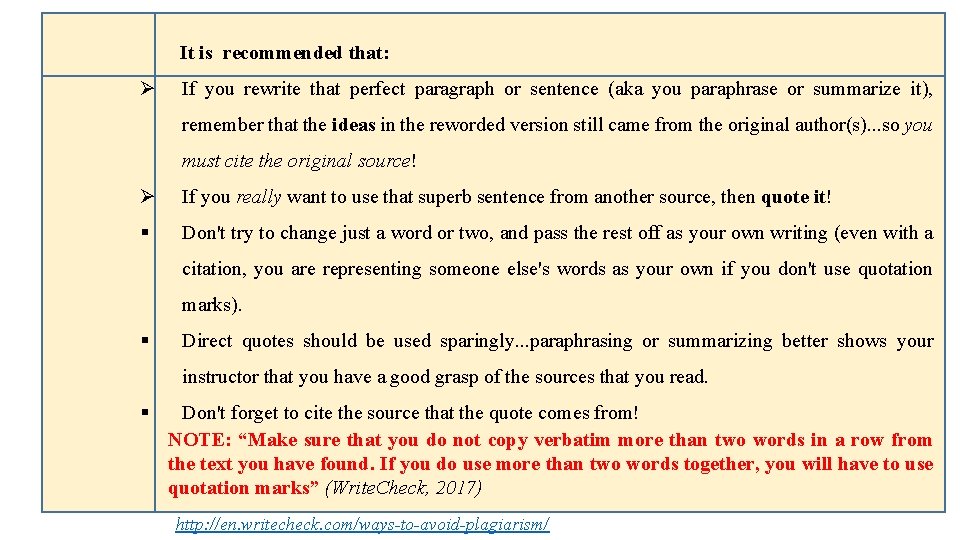
It is recommended that: If you rewrite that perfect paragraph or sentence (aka you paraphrase or summarize it), remember that the ideas in the reworded version still came from the original author(s). . . so you must cite the original source! If you really want to use that superb sentence from another source, then quote it! Don't try to change just a word or two, and pass the rest off as your own writing (even with a citation, you are representing someone else's words as your own if you don't use quotation marks). Direct quotes should be used sparingly. . . paraphrasing or summarizing better shows your instructor that you have a good grasp of the sources that you read. Don't forget to cite the source that the quote comes from! NOTE: “Make sure that you do not copy verbatim more than two words in a row from the text you have found. If you do use more than two words together, you will have to use quotation marks” (Write. Check, 2017) http: //en. writecheck. com/ways-to-avoid-plagiarism/
How to avoid plagiarism continued… ii. Cite paraphrased works Citing is one of the effective ways to avoid plagiarism. Follow the document formatting guidelines (i. e. APA, MLA, Chicago, etc. ) used by your educational institution or the institution that issued the research request. This usually entails the addition of the author(s) and the date of the publication or similar information. Citing is really that simple. Not citing properly can constitute plagiarism iii. Citing Quotes Citing a quote can be different than citing paraphrased material. This practice usually involves the addition of a page number, or a paragraph number in the case of web content.

How to avoid plagiarism continued… iv. Cite your own material used v. Referencing If some of the material you are One of the most important ways to using for your research paper was avoid plagiarism is including a used by you in your current class, reference page or page of works cited at a previous one, or anywhere else you must cite yourself. Treat the text the same as you would if someone else wrote it. It may sound odd, but using material you have used before is called selfplagiarism, and it is not acceptable. the end of your research paper. Again, this page must meet the document formatting guidelines used by your educational institution. This information is very specific and includes the author(s), publication, title, and source. http: //en. writecheck. com/ways-to-avoid-plagiarism/ date of
How to avoid plagiarism continued… vi. Bottom Line Learn the principle of good academic practice “The best way of avoiding plagiarism is to learn and employ the principles of good academic practice from the beginning of your university career. Avoiding plagiarism is not simply a matter of making sure your references are all correct, or changing enough words so the examiner will notice your paraphrase; it is about deploying your academic skills to make your work as good as it can be” (University of Oxford, 2018).
a. Strategies to use when paraphrasing Key Tips Use synonyms for all words that are not generic. Words like world, food, or science are so basic to our vocabulary that is difficult to find a synonym. Change the structure of the sentence. Change the voice from active to passive and vice versa. Change clauses to phrases and vice versa. Change parts of speech. https: //integrity. mit. edu/handbook/academic-writing/avoiding-plagiarism-paraphrasing
b. When should you quote? Key Tips When language is particularly vivid or expressive. When exact wording is needed for technical accuracy. When the words of an important authority lend weight to an argument. (https: //integrity. mit. edu/handbook/academic-writing/avoiding-plagiarism-quoting)
Patchwriting However, care must be taken in paraphrasing to avoid what is called ‘Patchwriting’ Patchwriting is a careless form of paraphrasing It is essentially “patching” together direct quotes or different pieces of information that are too close to the source It may occur when the reader is unfamiliar with the language or vocabulary in a text. You can use it to synthesize the original quote into your own words as part of a rough draft and NEVER in a final copy It can be considered plagiarism even if you credit the source. It is an intellectual dishonesty that indicates that the writer is not actually thinking for herself (Mc. Bride, 2012)
My personal experience One way I found effective to overcome plagiarism is to integrate sources. Examples. i. Quantitative approach is related to the positivist/post positivist paradigm (Alzheimer Europe, 2013) and adopts numeric data for statistical analysis (Sudeshna and Datt, 2016) where the data is generalised across the subject under study and used to analyse a specific occurrence (Richard G. Trefry Library, 2017) ii. An academic library is a library that is attached/supports a college, university or degree awarding institution of higher learning (ALA, 2017), whose role is to support their parent institution in achievement of its objectives (Kumar, 2014) and also serve as an innovation intermediary in the service sense that encourage the creation, sharing and transfer of knowledge through the collaboration of different parties (Casali, 2017). iii. Low bandwidth results in the slow Internet speed (Azubuike and Madu, 2017) and also contribute significantly to the frequent network problems (Oyewo and Mamudu, 2015) and slow rate of information downloading during sharing (Oghenetega et al, 2014).
c. You become an academic writing guru
d. Further Reading (Resources for paraphrasing) Text-based tutorials: Quoting, Paraphrasing, and Summarizing (Purdue OWL) (https: //owl. english. purdue. edu/owl/resource/563/01/) Avoiding Plagiarism - Paraphrasing (MIT) (https: //integrity. mit. edu/handbook/academic-writing/avoiding-plagiarismparaphrasing) Avoiding Plagiarism - Quoting (MIT) (https: //integrity. mit. edu/handbook/academic-writing/avoiding-plagiarismquoting) How to Recognize Unacceptable and Acceptable Paraphrases (Indiana University) Video tutorials: Summarizing, Paraphrasing, and Quoting: A Guide to Doing it Right! (Genesee Community College) (https: //www. youtube. com/watch? v=qo. Cdh. Js. S 6 Bw&feature=youtu. be) Paraphrasing Ideas in your Writing (University of Melbourne) (https: //www. youtube. com/watch? v=jp. E_Dwn. Nc_s&feature=youtu. be) Quoting VS Paraphrasing - APA style (Suffolk County Community College) � (https: //www. youtube. com/watch? v=Mi. L 4 H 09 v 0 g. U&feature=youtu. be) Paraphrasing (Imagine Easy Solutions) (https: //vimeo. com/91548647)

Types of plagiarism software i. Viper Anti-Plagiarism Scanner (hxxp: //www. scanmyessay. com/) ii. Turnitin (http: //turnitin. com/) iii. i. Authenticate software (http: //www. ithenticate. com/) iv. Plagium (http: //www. plagium. com/) Free v. The Plagiarism Checker (http: //www. dustball. com/cs/plagiarism. checker/index. pl ) Free vi. Paperrater http: //www. paperrater. com/) vii. e. Tblast ( http: //etest. vbi. vt. edu/etblast 3/) viii. DOC Cop (http: //www. doccop. com)
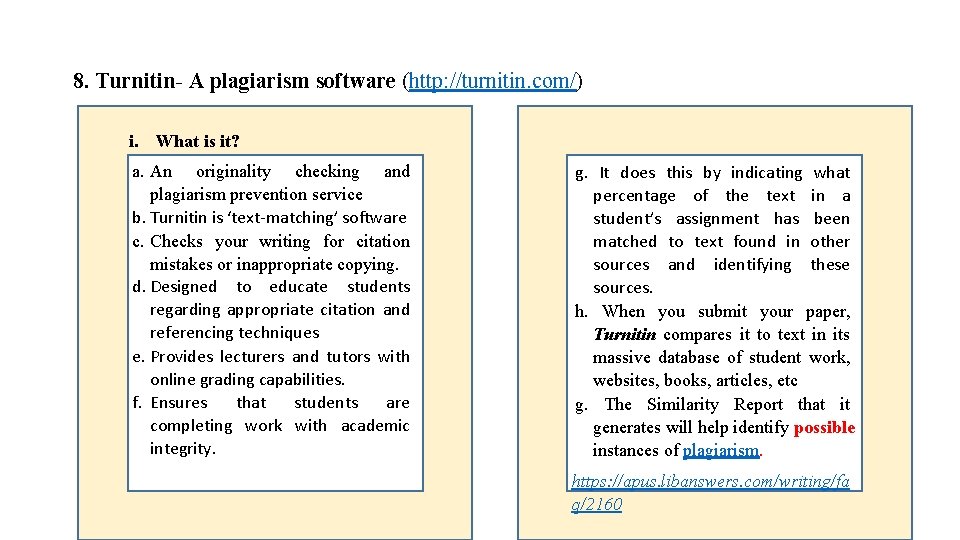
8. Turnitin- A plagiarism software (http: //turnitin. com/) i. What is it? a. An originality checking and plagiarism prevention service b. Turnitin is ‘text-matching’ software c. Checks your writing for citation mistakes or inappropriate copying. d. Designed to educate students regarding appropriate citation and referencing techniques e. Provides lecturers and tutors with online grading capabilities. f. Ensures that students are completing work with academic integrity. g. It does this by indicating what percentage of the text in a student’s assignment has been matched to text found in other sources and identifying these sources. h. When you submit your paper, Turnitin compares it to text in its massive database of student work, websites, books, articles, etc g. The Similarity Report that it generates will help identify possible instances of plagiarism. https: //apus. libanswers. com/writing/fa q/2160
8. Turnitin- A plagiarism software (http: //turnitin. com/) ii. My personal experience University of Pretoria, South Africa experience a. Carnegie CPD, 2015 b. MIT 2016/2017
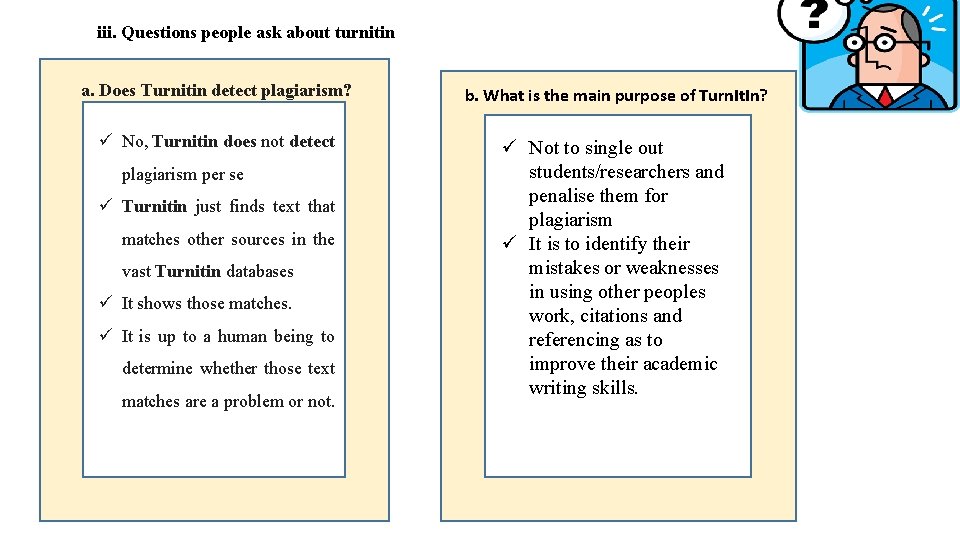
iii. Questions people ask about turnitin a. Does Turnitin detect plagiarism? b. What is the main purpose of Turn. It. In? No, Turnitin does not detect Not to single out students/researchers and penalise them for plagiarism It is to identify their mistakes or weaknesses in using other peoples work, citations and referencing as to improve their academic writing skills. plagiarism per se Turnitin just finds text that matches other sources in the vast Turnitin databases It shows those matches. It is up to a human being to determine whether those text matches are a problem or not.

iii. Questions people ask about turnitin c. Does Turnitin take so long to process? Originality Reports takes about 15 minutes. But it may take up to 24 hours during peak times such as the middle or the end of semesters when many papers are being submitted to Turnitin. Re-submission also takes about 24 d. Can you plagiarize from yourself? There is dissenting voices on this issue. Popular opinion is that you can't plagiarize yourself. Plagiarism is about passing off someone else's work as your own. Reusing work is not the same thing at all, but is a separate issue And doesn't really seem to be much of a problem once you think about it. Others believe that though the idea of self-plagiarism seems almost ridiculous, but it is a very real issue that has consequences. hours en. writecheck. com/self-plagiarism/
iii. Questions people ask about turnitin *NOTE* My take on self-plagiarism. There are different types of self-plagiarism Strictly speaking, coping a paragraph or two from your earlier work to a new one is not plagiarism (by definition) But doing this means presenting an old idea as if it is new (unethical) If you don’t respect your ownership/copyright by proper citation, why would you expect others to
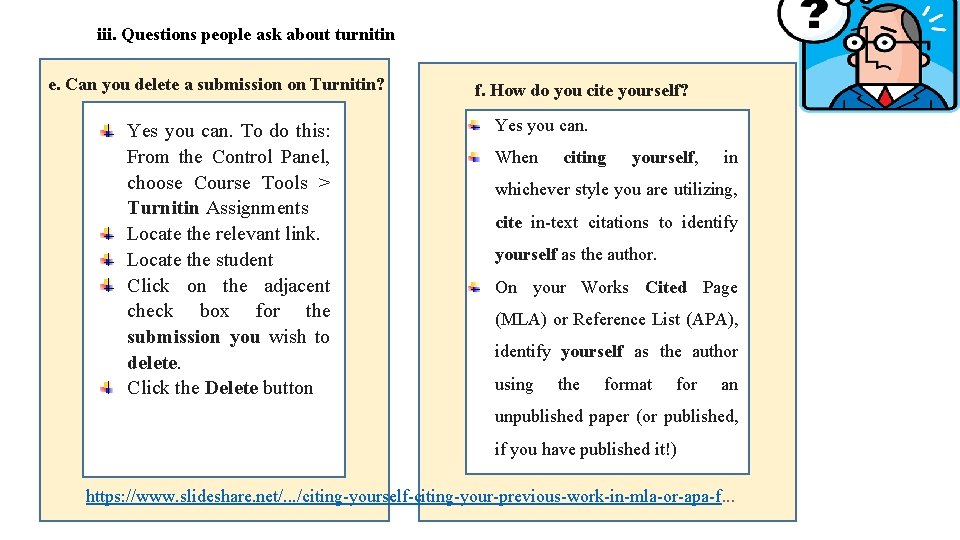
iii. Questions people ask about turnitin e. Can you delete a submission on Turnitin? Yes you can. To do this: From the Control Panel, choose Course Tools > Turnitin Assignments Locate the relevant link. Locate the student Click on the adjacent check box for the submission you wish to delete. Click the Delete button f. How do you cite yourself? Yes you can. When citing yourself, in whichever style you are utilizing, cite in-text citations to identify yourself as the author. On your Works Cited Page (MLA) or Reference List (APA), identify yourself as the author using the format for an unpublished paper (or published, if you have published it!) https: //www. slideshare. net/. . . /citing-yourself-citing-your-previous-work-in-mla-or-apa-f. . .
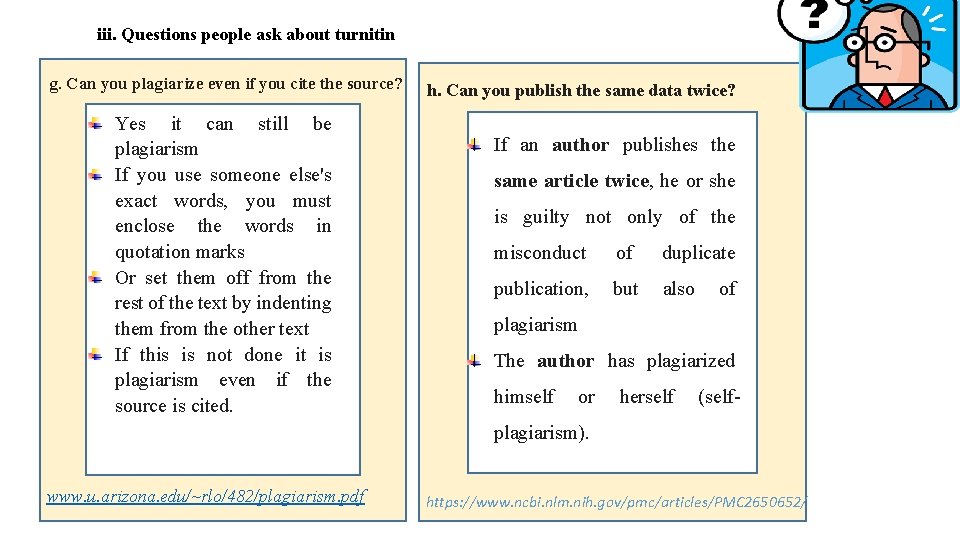
iii. Questions people ask about turnitin g. Can you plagiarize even if you cite the source? Yes it can still be plagiarism If you use someone else's exact words, you must enclose the words in quotation marks Or set them off from the rest of the text by indenting them from the other text If this is not done it is plagiarism even if the source is cited. h. Can you publish the same data twice? If an author publishes the same article twice, he or she is guilty not only of the misconduct of duplicate publication, but also of plagiarism The author has plagiarized himself or herself (selfplagiarism). www. u. arizona. edu/~rlo/482/plagiarism. pdf https: //www. ncbi. nlm. nih. gov/pmc/articles/PMC 2650652/
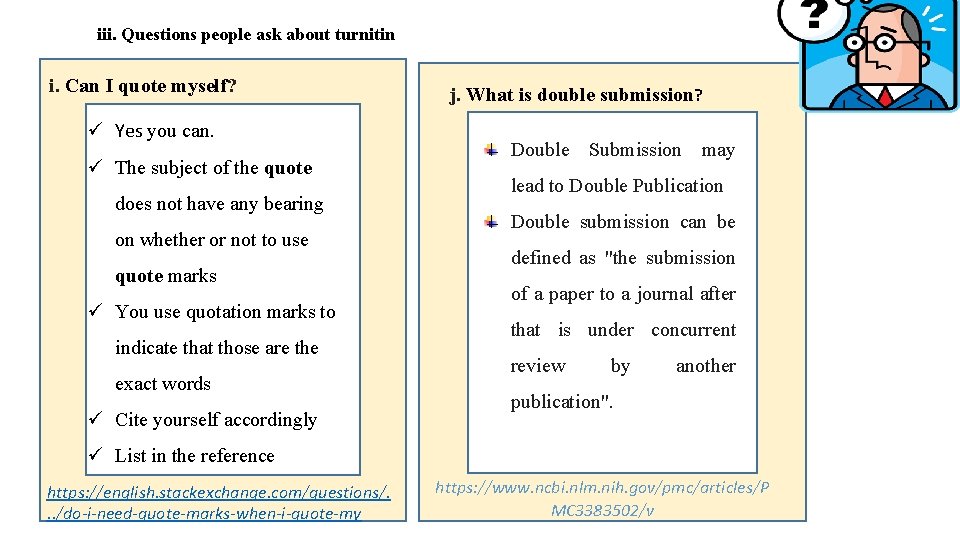
iii. Questions people ask about turnitin i. Can I quote myself? Yes you can. The subject of the quote does not have any bearing on whether or not to use quote marks You use quotation marks to indicate that those are the exact words Cite yourself accordingly List in the reference https: //english. stackexchange. com/questions/. . . /do-i-need-quote-marks-when-i-quote-my j. What is double submission? Double Submission may lead to Double Publication Double submission can be defined as "the submission of a paper to a journal after that is under concurrent review by another publication". https: //www. ncbi. nlm. nih. gov/pmc/articles/P MC 3383502/v
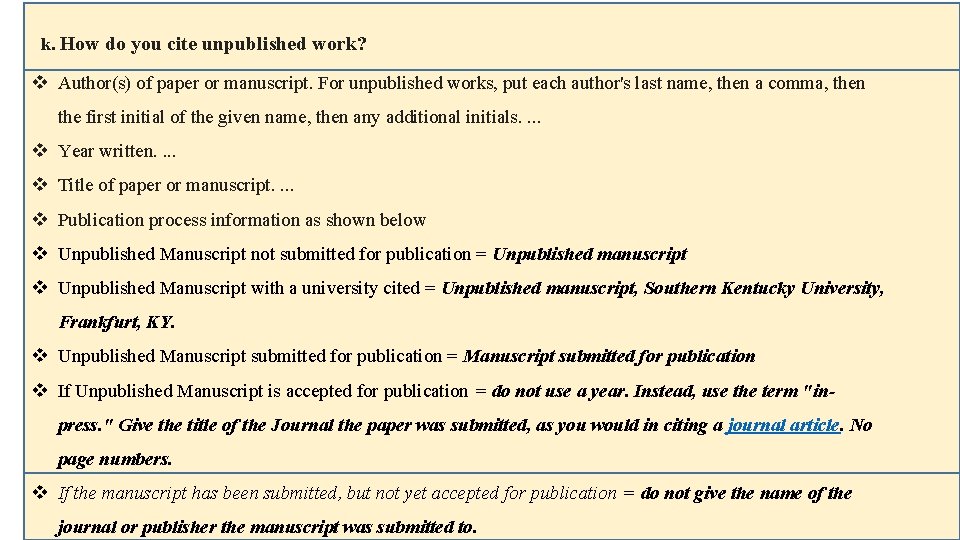
k. How do you cite unpublished work? Author(s) of paper or manuscript. For unpublished works, put each author's last name, then a comma, then the first initial of the given name, then any additional initials. . Year written. . Title of paper or manuscript. . Publication process information as shown below Unpublished Manuscript not submitted for publication = Unpublished manuscript Unpublished Manuscript with a university cited = Unpublished manuscript, Southern Kentucky University, Frankfurt, KY. Unpublished Manuscript submitted for publication = Manuscript submitted for publication If Unpublished Manuscript is accepted for publication = do not use a year. Instead, use the term "inpress. " Give the title of the Journal the paper was submitted, as you would in citing a journal article. No page numbers. If the manuscript has been submitted, but not yet accepted for publication = do not give the name of the journal or publisher the manuscript was submitted to.
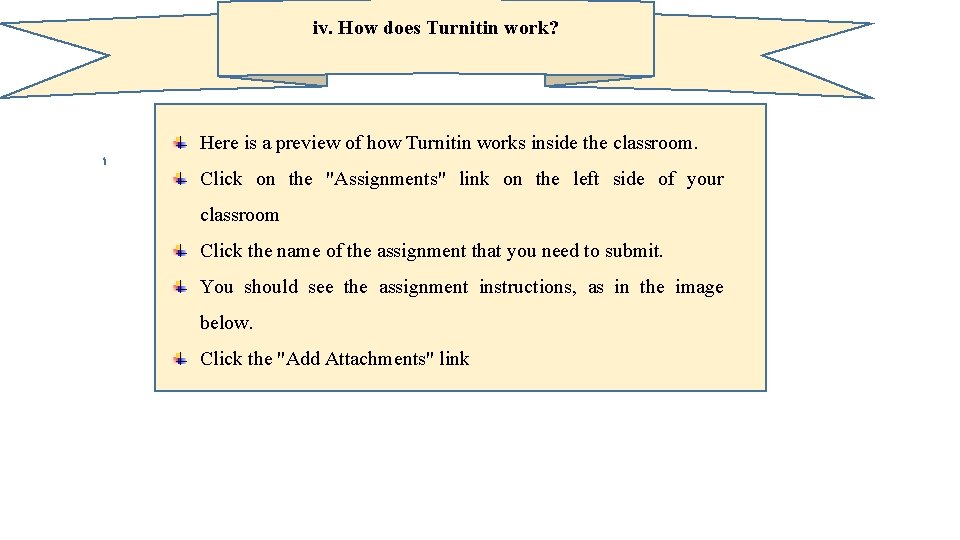
iv. How does Turnitin work? Here is a preview of how Turnitin works inside the classroom. Click on the "Assignments" link on the left side of your classroom Click the name of the assignment that you need to submit. You should see the assignment instructions, as in the image below. Click the "Add Attachments" link
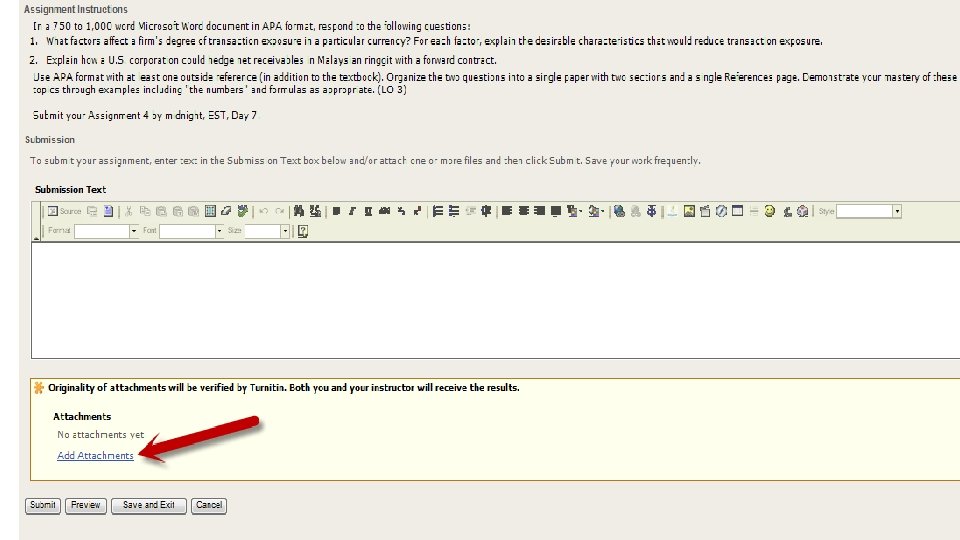
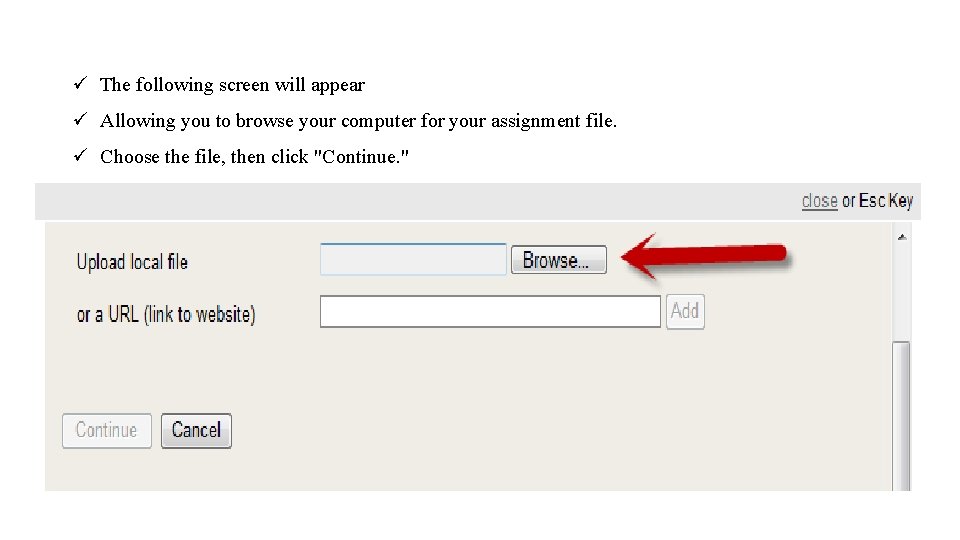
The following screen will appear Allowing you to browse your computer for your assignment file. Choose the file, then click "Continue. "
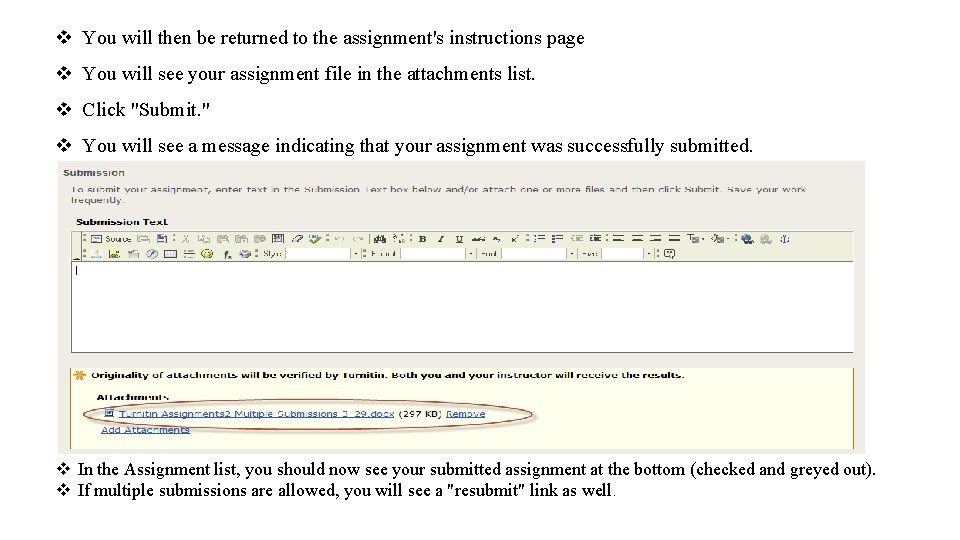
You will then be returned to the assignment's instructions page You will see your assignment file in the attachments list. Click "Submit. " You will see a message indicating that your assignment was successfully submitted. In the Assignment list, you should now see your submitted assignment at the bottom (checked and greyed out). If multiple submissions are allowed, you will see a "resubmit" link as well.
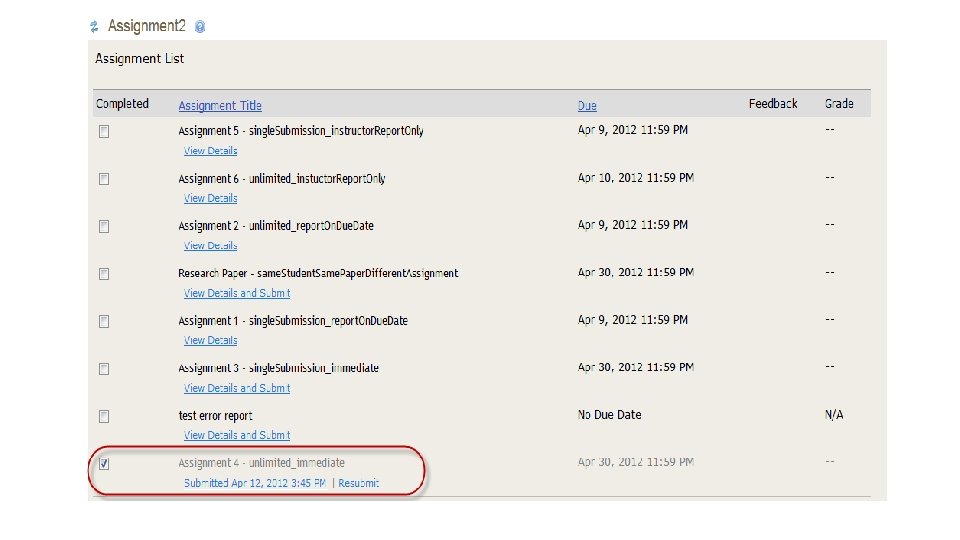
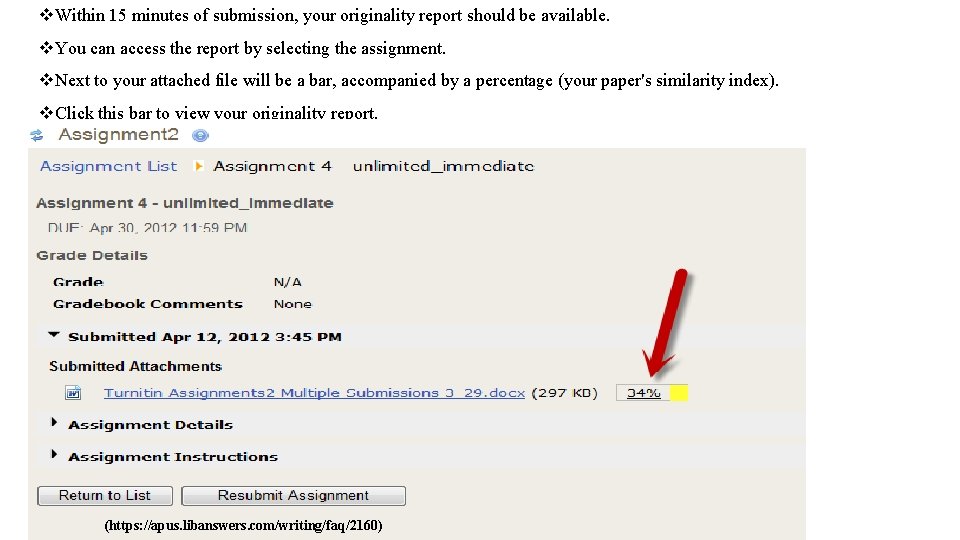
Within 15 minutes of submission, your originality report should be available. You can access the report by selecting the assignment. Next to your attached file will be a bar, accompanied by a percentage (your paper's similarity index). Click this bar to view your originality report. (https: //apus. libanswers. com/writing/faq/2160)
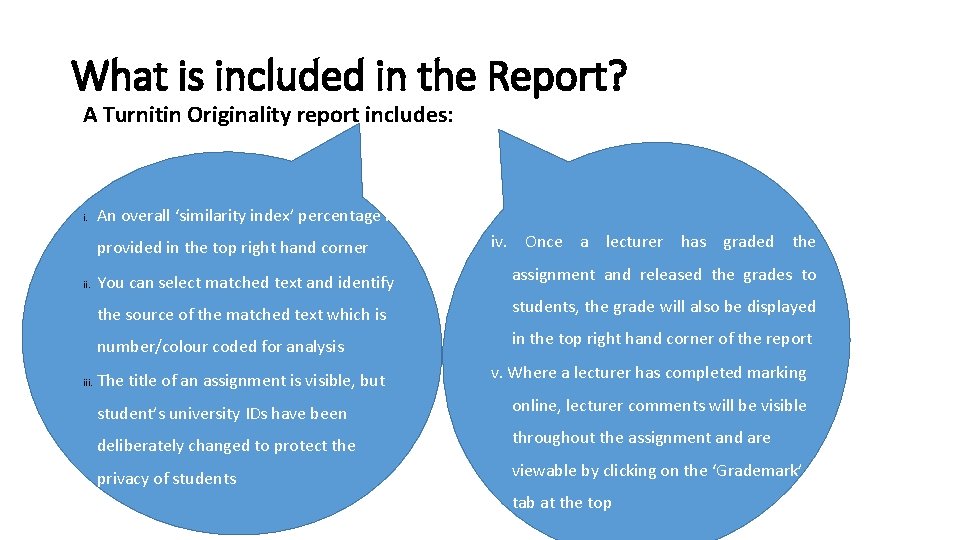
What is included in the Report? A Turnitin Originality report includes: i. An overall ‘similarity index’ percentage is provided in the top right hand corner ii. iv. Once a lecturer has graded the You can select matched text and identify assignment and released the grades to the source of the matched text which is students, the grade will also be displayed number/colour coded for analysis in the top right hand corner of the report The title of an assignment is visible, but v. Where a lecturer has completed marking student’s university IDs have been online, lecturer comments will be visible deliberately changed to protect the throughout the assignment and are privacy of students viewable by clicking on the ‘Grademark’ tab at the top

Example of Turnitin Originality Report Turnitin Orginality Report (3) (1) Originality — only the Originality Report will be active in this mode. (2) Student Identifier the visible identifier is randomly generated to ensure student privacy and security. — Overall Similarity Index a percentage measure indicating the similarity of the text submitted compared to information contained in the Turnitin database and other web sites. — Assign ment Score Click on a source in this panel to view the matching text in your document Click within a text section to view the original source Assignment information (4) Download/ Print View options and tools Assignment information – assignment information, the date of submission and other releevant transaction metadata Download/Print – provides a PDF version of the Orginality Report Filter – provides user options for filtering an assignment to include or exclude the bibliography, quotations, and/or irrelevant matches Text-only Report – removes any graphics to make the report easier to print and read Filter (5) Text-only Report Match Overview — Users can toggle between ‘Match Overview’ and ‘View All Sources’: Match overview is a list of the sections of an assignment that match to existing text in the Turnitin database and other searchable web sites. Matches are colour-coded and listed from the highest to the lowest percentage of matching word area to the submission. Only the highest scores are shown in the panel, all other matches are visible through the ‘Match Breakdown’ and ’All Sources’ modes. View all Sources enables users to view matches between the assignment and a specific selected source in the Turnitin database. This view contains a full list of all matches found rather than the highest scored matches. This is a complete listing of matches and can be extensive.
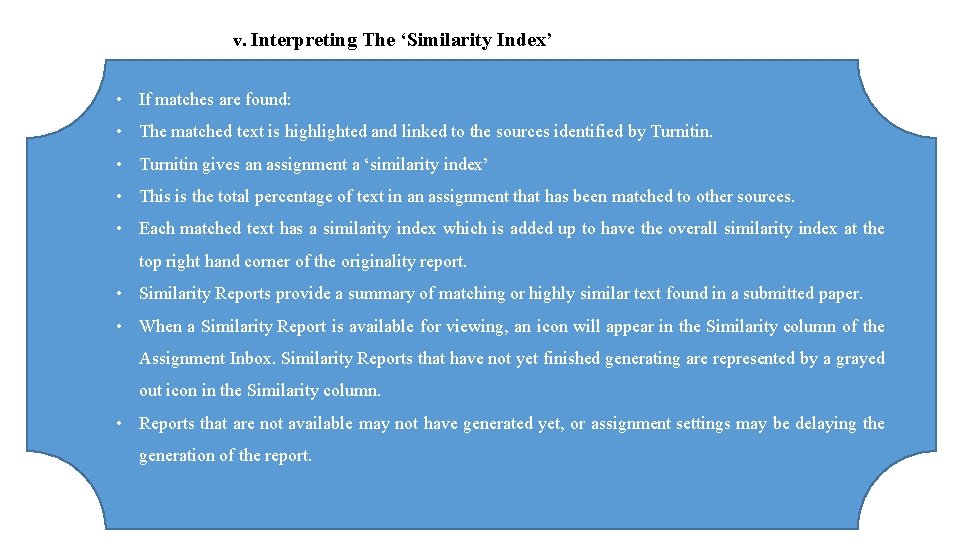
v. Interpreting The ‘Similarity Index’ • If matches are found: • The matched text is highlighted and linked to the sources identified by Turnitin. • Turnitin gives an assignment a ‘similarity index’ • This is the total percentage of text in an assignment that has been matched to other sources. • Each matched text has a similarity index which is added up to have the overall similarity index at the top right hand corner of the originality report. • Similarity Reports provide a summary of matching or highly similar text found in a submitted paper. • When a Similarity Report is available for viewing, an icon will appear in the Similarity column of the Assignment Inbox. Similarity Reports that have not yet finished generating are represented by a grayed out icon in the Similarity column. • Reports that are not available may not have generated yet, or assignment settings may be delaying the generation of the report.

Interpreting The ‘Similarity Index’ (Continued…. ) Tip: i. a ’similarity index’ produced by Turnitin must be interpreted on a case by case basis ii. It is important to remember that a high ‘similarity index’ may not be an indication that there is any inappropriate content in an assignment.
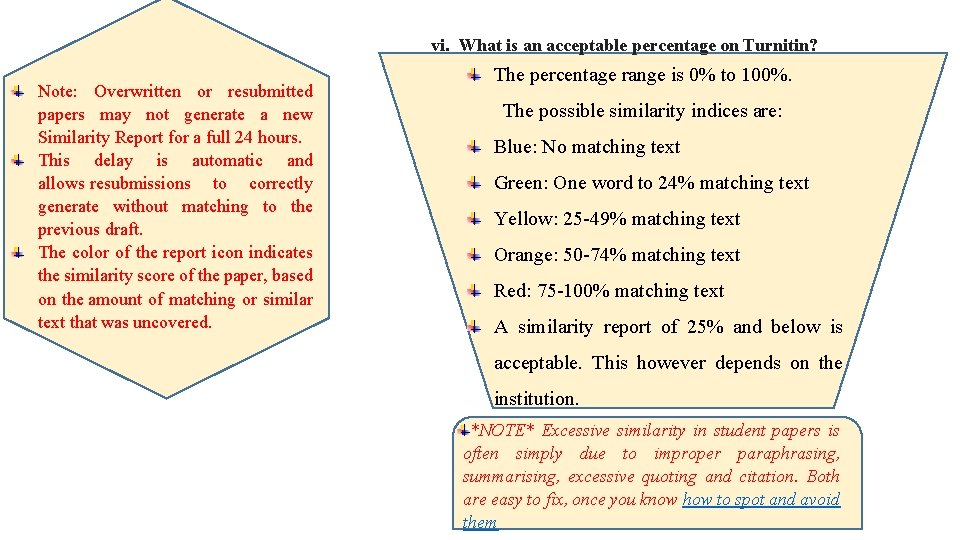
vi. What is an acceptable percentage on Turnitin? Note: Overwritten or resubmitted papers may not generate a new Similarity Report for a full 24 hours. This delay is automatic and allows resubmissions to correctly generate without matching to the previous draft. The color of the report icon indicates the similarity score of the paper, based on the amount of matching or similar text that was uncovered. The percentage range is 0% to 100%. The possible similarity indices are: Blue: No matching text Green: One word to 24% matching text Yellow: 25 -49% matching text Orange: 50 -74% matching text Red: 75 -100% matching text A similarity report of 25% and below is acceptable. This however depends on the institution. *NOTE* Excessive similarity in student papers is often simply due to improper paraphrasing, summarising, excessive quoting and citation. Both are easy to fix, once you know how to spot and avoid them
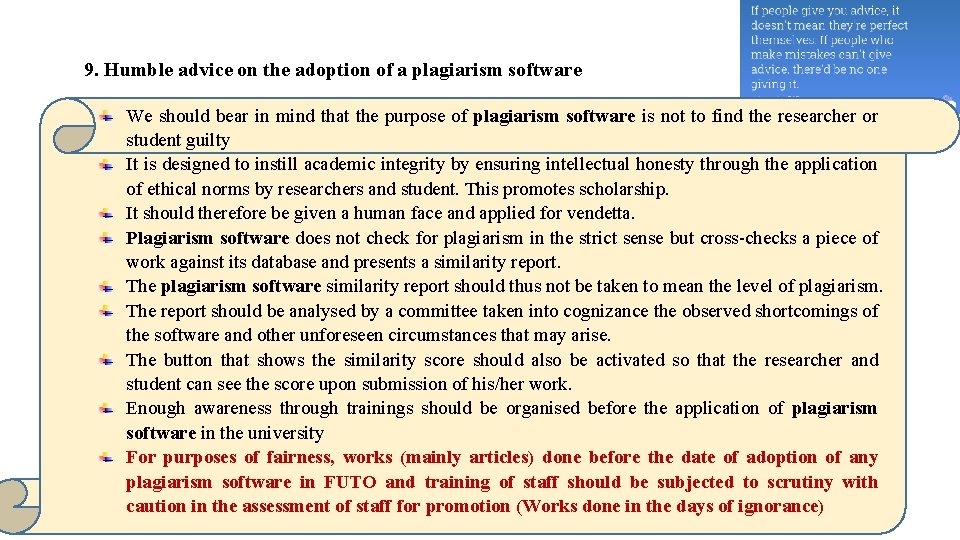
9. Humble advice on the adoption of a plagiarism software We should bear in mind that the purpose of plagiarism software is not to find the researcher or student guilty It is designed to instill academic integrity by ensuring intellectual honesty through the application of ethical norms by researchers and student. This promotes scholarship. It should therefore be given a human face and applied for vendetta. Plagiarism software does not check for plagiarism in the strict sense but cross-checks a piece of work against its database and presents a similarity report. The plagiarism software similarity report should thus not be taken to mean the level of plagiarism. The report should be analysed by a committee taken into cognizance the observed shortcomings of the software and other unforeseen circumstances that may arise. The button that shows the similarity score should also be activated so that the researcher and student can see the score upon submission of his/her work. Enough awareness through trainings should be organised before the application of plagiarism software in the university For purposes of fairness, works (mainly articles) done before the date of adoption of any plagiarism software in FUTO and training of staff should be subjected to scrutiny with caution in the assessment of staff for promotion (Works done in the days of ignorance)
Short You. Tube Tutorial a) Plagiarism Checker b) Turnitin
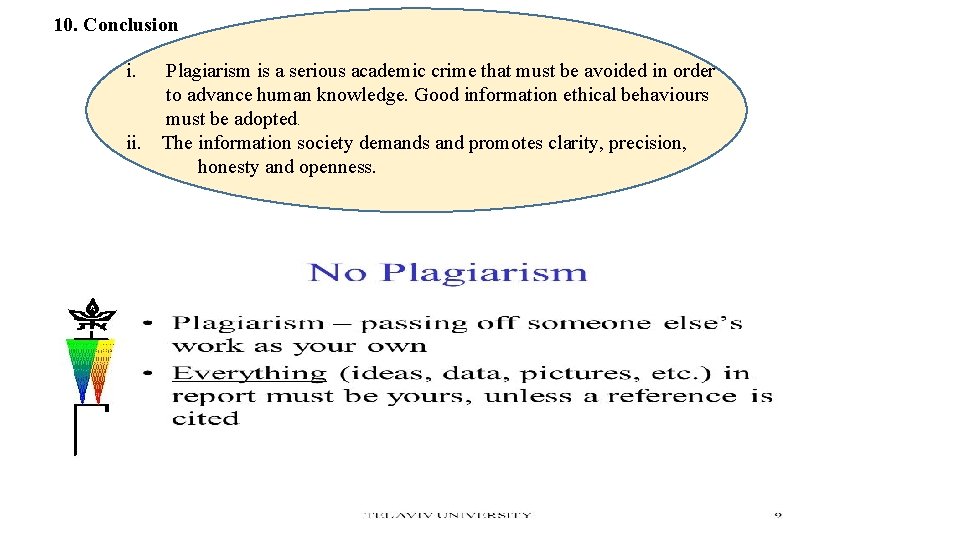
10. Conclusion i. Plagiarism is a serious academic crime that must be avoided in order to advance human knowledge. Good information ethical behaviours must be adopted. ii. The information society demands and promotes clarity, precision, honesty and openness.
Thank you and God bless
References en. writecheck. com/self-plagiarism/ Ernesto, S. (2013). Publication ethics and the problem of plagiarism. Sci. ELO Blog. http: //blog. scielo. org/en/2013/10/02/publication-ethicsand-the-problem-of-plagiarism/#. Wre. Byd. Ewt. Ms Froehlich, T. (2004). "A brief history of information ethics". bid. ub. edu. Kent State University. http: //en. writecheck. com/ways-to-avoid-plagiarism/ https: //apus. libanswers. com/writing/faq/2160 https: //english. stackexchange. com/questions/. . . /do-i-needquote-marks-when-i-quote-my. . . http: //www. easybib. com/guides/students/researchguide/paraphrasing-patchwriting-direct-quotes/dpatchwriting/ https: //www. ncbi. nlm. nih. gov/pmc/articles/PMC 2650652/ https: //www. ncbi. nlm. nih. gov/pmc/articles/PMC 3383502/ https: //www. slideshare. net/. . . /citing-yourself-citing-your-previouswork-in-mla-or-apa-f. . . Joan, R. M. (2010). Information Ethics. Online Dictionary for Library and Information Science. N. p. , <http: //www. abcclio. com/ODLIS/odlis_i. aspx>. linguistics. byu. edu/faculty/henrichsen/APA 14. html sites. umuc. edu/library/libhow/turnitinoriginality_tutorial. cfm https: //guides. turnitin. com/01_Manuals_and_Guides/Student_ Guides/Feedback_Studio/15_The_Similarity_Report/Inte rpreting_the_Similarity_Report Mc. Bride, K. (2012). 'Patchwriting' is more common than plagiarism, just as dishonest. https: //www. poynter. org/news/patchwriting-morecommon-plagiarism-just-dishonest https: //integrity. mit. edu/handbook/academicwriting/avoiding-plagiarism-quoting University of Oxford, 2018. Plagiarism. https: //www. ox. ac. uk/students/academic/guidance/skills/pl agiarism? wssl=1 Wikipedia, 2018. Information ethics. https: //en. wikipedia. org/wiki/Information_ethics https: //integrity. mit. edu/handbook/academic-writing/avoiding -plagiarism-paraphrasing https: //owl. english. purdue. edu/owl/resource/563/01/ www. u. arizona. edu/~rlo/482/plagiarism. pdf
- Slides: 55