
PLAGIARISM Definition Explanation Examples Penalties Rationales Tips PLAGIARISM



- Slides: 52
PLAGIARISM Definition, Explanation, Examples, Penalties, Rationales, Tips
PLAGIARISM Definition of Plagiarism
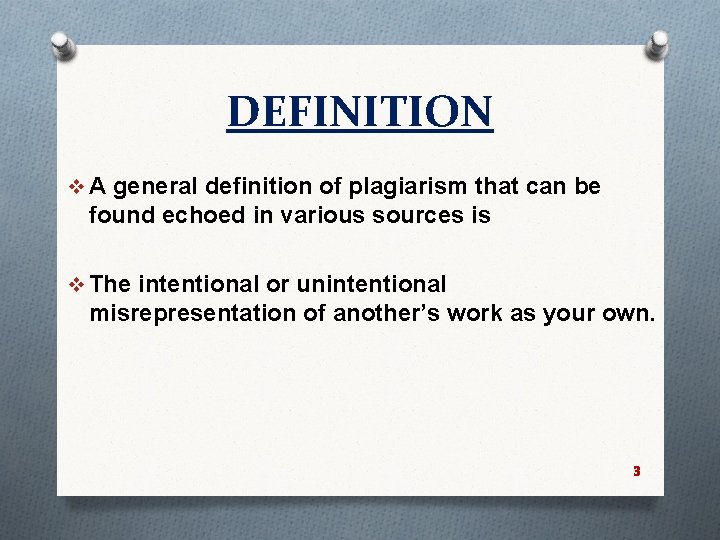
DEFINITION v A general definition of plagiarism that can be found echoed in various sources is v The intentional or unintentional misrepresentation of another’s work as your own. 3
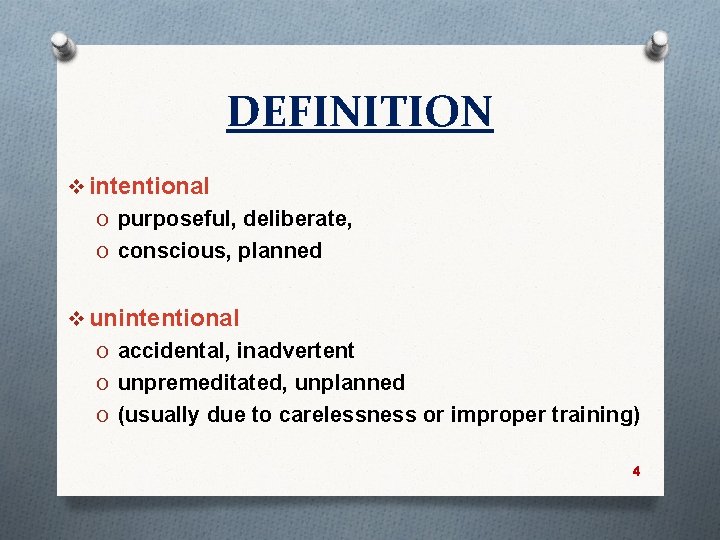
DEFINITION v intentional O purposeful, deliberate, O conscious, planned v unintentional O accidental, inadvertent O unpremeditated, unplanned O (usually due to carelessness or improper training) 4
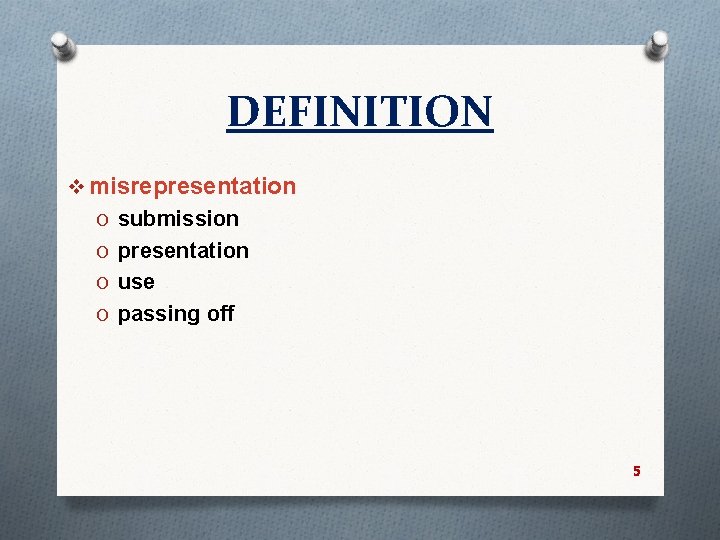
DEFINITION v misrepresentation O submission O presentation O use O passing off 5
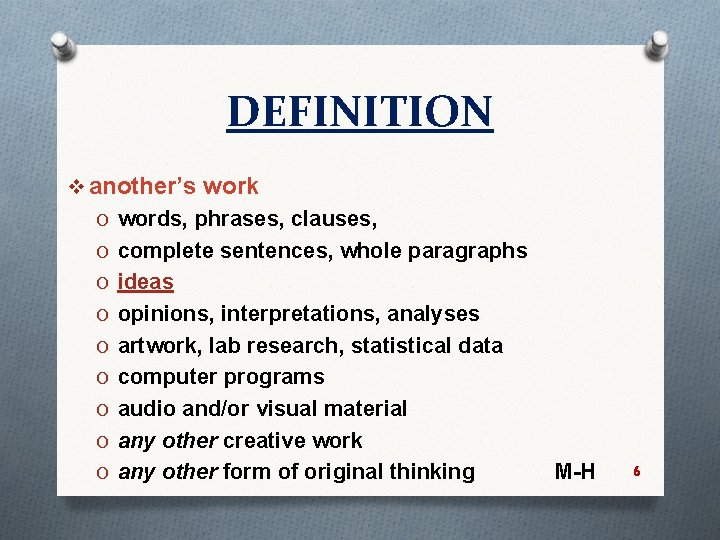
DEFINITION v another’s work O words, phrases, clauses, O complete sentences, whole paragraphs O ideas O opinions, interpretations, analyses O artwork, lab research, statistical data O computer programs O audio and/or visual material O any other creative work O any other form of original thinking M-H 6
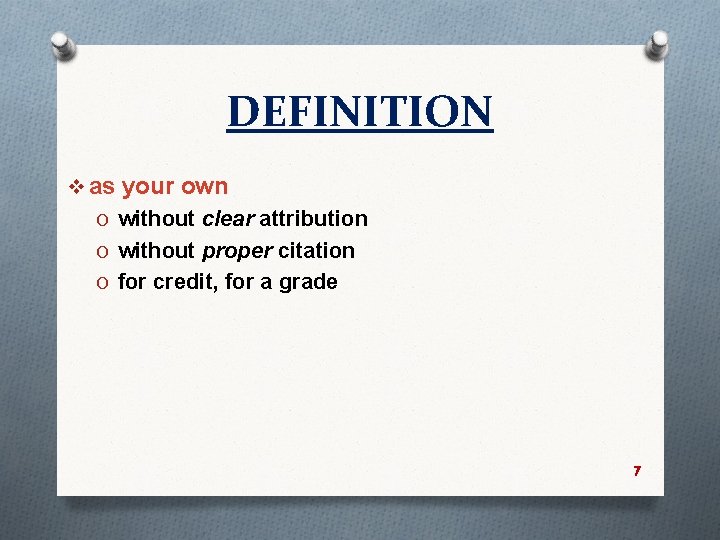
DEFINITION v as your own O without clear attribution O without proper citation O for credit, for a grade 7
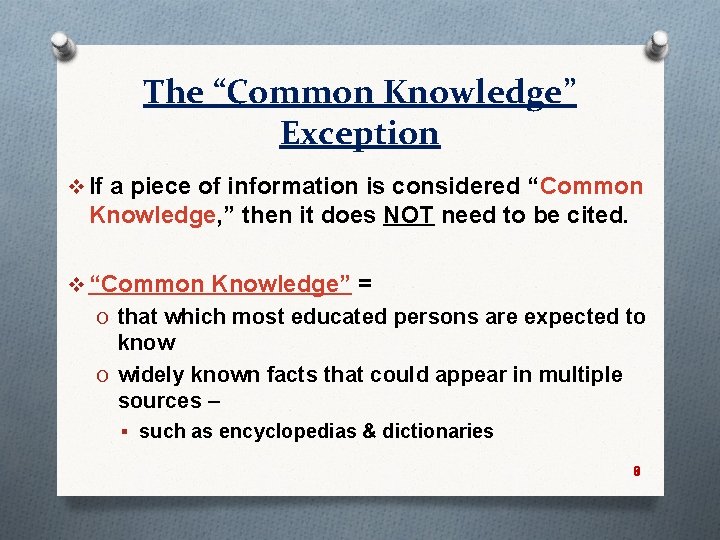
The “Common Knowledge” Exception v If a piece of information is considered “Common Knowledge, ” then it does NOT need to be cited. v “Common Knowledge” = O that which most educated persons are expected to know O widely known facts that could appear in multiple sources – § such as encyclopedias & dictionaries 8
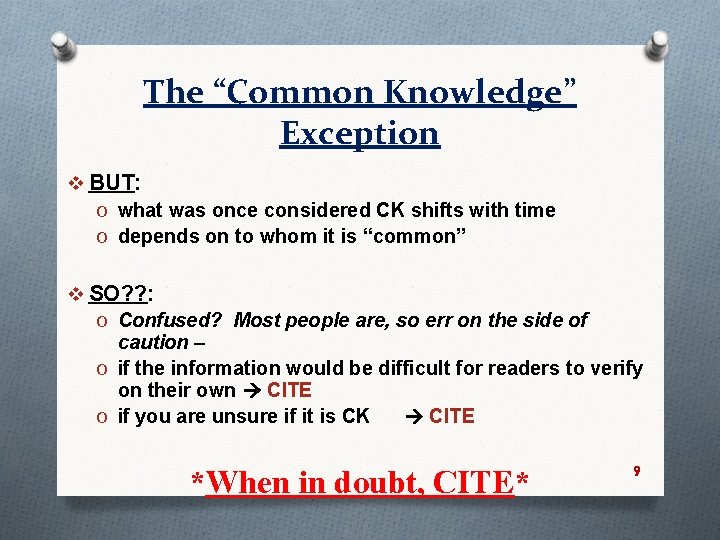
The “Common Knowledge” Exception v BUT: O what was once considered CK shifts with time O depends on to whom it is “common” v SO? ? : O Confused? Most people are, so err on the side of caution – O if the information would be difficult for readers to verify on their own CITE O if you are unsure if it is CK CITE *When in doubt, CITE* 9
PLAGIARISM Why Plagiarism Is Such a Serious Matter: The “Big Deal”
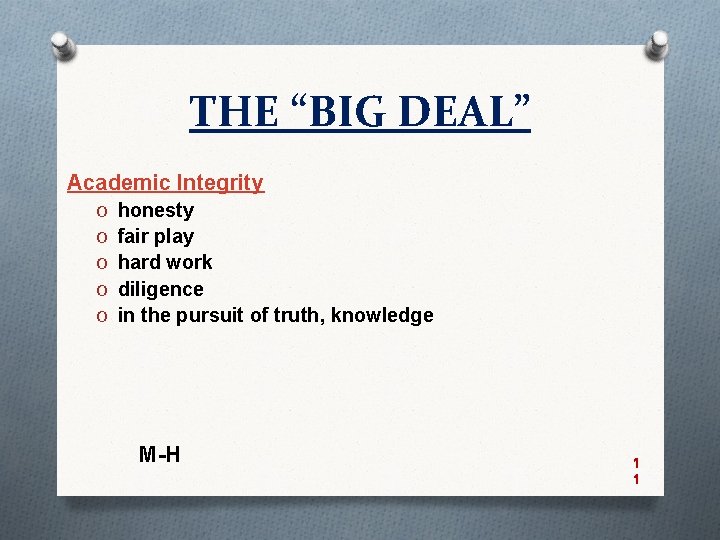
THE “BIG DEAL” Academic Integrity O honesty O fair play O hard work O diligence O in the pursuit of truth, knowledge M-H 1 1
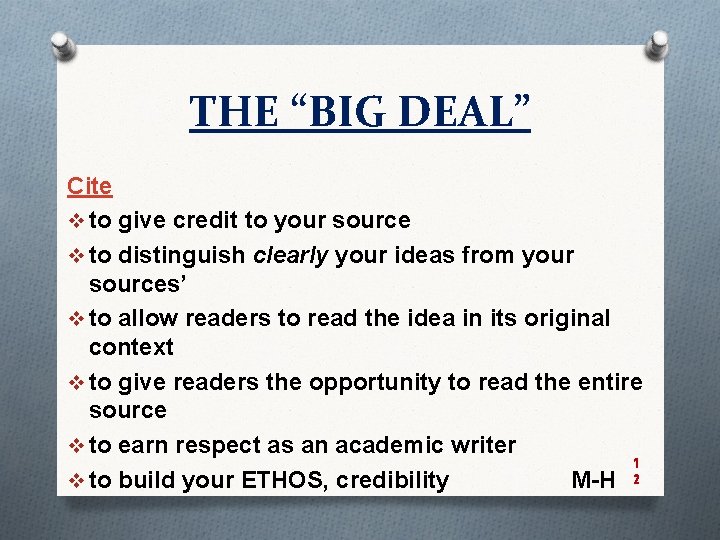
THE “BIG DEAL” Cite v to give credit to your source v to distinguish clearly your ideas from your sources’ v to allow readers to read the idea in its original context v to give readers the opportunity to read the entire source v to earn respect as an academic writer 1 v to build your ETHOS, credibility M-H 2
PLAGIARISM The “Big Deal”: Analogies
THE “BIG DEAL” ANALOGIES (credit) v at the end of the semester, the professor gives the grade you worked quite hard for to someone else, Mongo, the person who barely attended classes and was here more in body than in mind 1 4
THE “BIG DEAL” ANALOGIES (original context) v you heard a song by a band that you found interesting and you would like to hear the rest of the CD (album) O – you would like to hear other CDs by them 1 5
THE “BIG DEAL” ANALOGIES (misrepresentation) v passing off their work as yours = identity theft; your pretending to be them, for a reward v buying grades with their credit card, so to speak O – grades instead of material objects 1 6
PLAGIARISM The “Big Deal”: Effects of Plagiarism
THE “BIG DEAL” EFFECTS of PLAGIARISM v Plagiarism cheats the cheater O you came to college to learn, you are paying tuition to learn O BUT by plagiarizing, you learn nothing § about the subject § about the writing & research processes O you learn only how to cheat, how to be a good cheater M-H 1 8
THE “BIG DEAL” EFFECTS of PLAGIARISM v Plagiarism is theft O robbing intellectual property M-H 1 9
THE “BIG DEAL” EFFECTS of PLAGIARISM v Plagiarism is a breach of ethics O the disregarding of our moral obligation to attribute and cite O without integrity or trust, society cannot function or continue M-H 2 0
THE “BIG DEAL” EFFECTS of PLAGIARISM v Plagiarism amounts to unfair advantage or v Plagiarism amounts to unearned grades v Plagiarism amounts to unearned degree O receiving credit for work you did not honestly perform M-H 2 1
THE “BIG DEAL” EFFECTS of PLAGIARISM v Plagiarism devalues college depreciate, demeans cheapens the grade cheapens the degree cheapens the college, university, institution – weakens its academic reputation O cheapens college in general O O M-H 2 2
THE “BIG DEAL” EFFECTS of PLAGIARISM v Plagiarism ruins society O cheating is cheating, regardless of excuse O creates atmosphere of distrust O pressures others to cheat with those who receive unfair advantage O cheat in school cheat in life § Enron § current market collapse O Wall Street, banks § lawyers, politicians, reporters M-H 2 3
PLAGIARISM Examples of Plagiarism
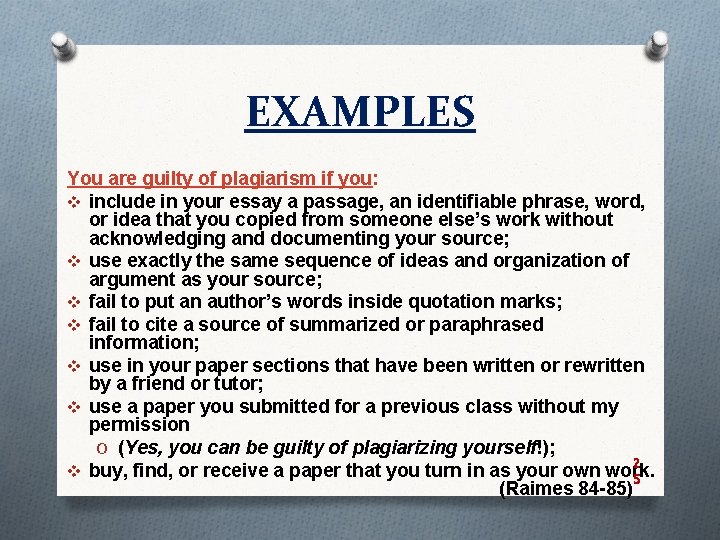
EXAMPLES You are guilty of plagiarism if you: v include in your essay a passage, an identifiable phrase, word, or idea that you copied from someone else’s work without acknowledging and documenting your source; v use exactly the same sequence of ideas and organization of argument as your source; v fail to put an author’s words inside quotation marks; v fail to cite a source of summarized or paraphrased information; v use in your paper sections that have been written or rewritten by a friend or tutor; v use a paper you submitted for a previous class without my permission O (Yes, you can be guilty of plagiarizing yourself!); 2 v buy, find, or receive a paper that you turn in as your own work. 5 (Raimes 84 -85)
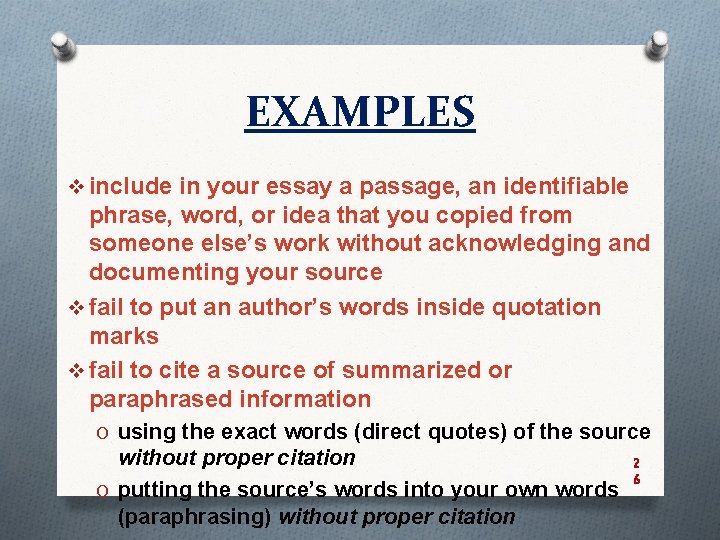
EXAMPLES v include in your essay a passage, an identifiable phrase, word, or idea that you copied from someone else’s work without acknowledging and documenting your source v fail to put an author’s words inside quotation marks v fail to cite a source of summarized or paraphrased information O using the exact words (direct quotes) of the source without proper citation O putting the source’s words into your own words (paraphrasing) without proper citation 2 6
EXAMPLES v use exactly the same sequence of ideas and organization of argument as your source O basically paraphrasing the entire piece 2 7
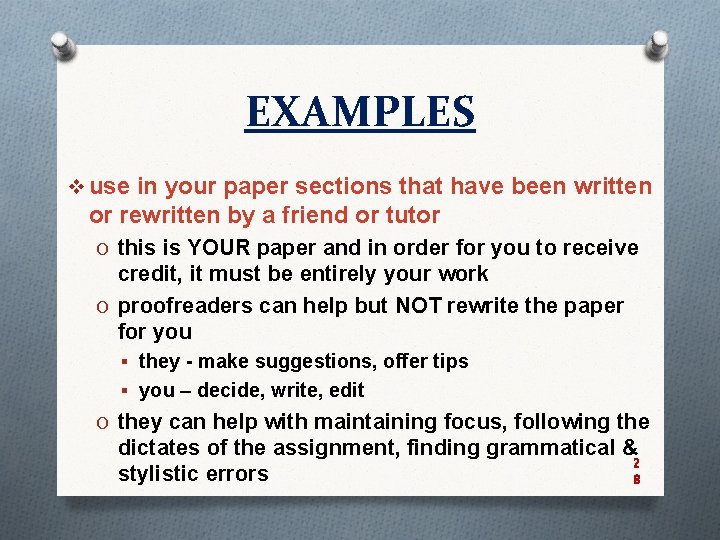
EXAMPLES v use in your paper sections that have been written or rewritten by a friend or tutor O this is YOUR paper and in order for you to receive credit, it must be entirely your work O proofreaders can help but NOT rewrite the paper for you § they - make suggestions, offer tips § you – decide, write, edit O they can help with maintaining focus, following the dictates of the assignment, finding grammatical & 2 stylistic errors 8
EXAMPLES v use a paper you submitted for a previous class without my permission O yes, you can be guilty of plagiarizing yourself! O probably won’t match the parameters of the current assignment O everyone else in the class is working “from scratch” so you must, too O no “unfair advantage” for you 2 9
EXAMPLES v buy, find, or receive a paper that you turn in as your own work O from other students O from students who had this professor before O from online or in-house paper mills O probably won’t match the parameters of the current assignment O not well-written anyway O professors will find it online – easily O you’ll spend money on the course, the text book, the plagiarized paper – and have to take the class 3 0 over again
EXAMPLES Technological Plagiarism: v “cutting and pasting” from an Internet source – without attribution & citation v downloading information from the Web – without attribution & citation v texting answers via cell phones v selling, buying, using any part of essays from an online or in-house paper mill v recycling papers from one of your old classes O saved on flash drive v recycling papers from past students in a professor’s class O found online, found on teacher’s Web site, saved on someone’s flash drive 3 1
PLAGIARISM Penalties for Plagiarism
PENALTIES in school – v fail the assignment v fail the course v receive an Academic Integrity Violation in your permanent record v be expelled from the college/university v receive a cheater’s reputation M-H 3 3
PENALTIES in the work force – v face public humiliation v lose your degree v lose your rank v lose your job v become “radioactive” (unemployable) M-H 3 4
PLAGIARISM Why Students Cheat
WHY STUDENTS CHEAT Why, despite so many costly penalties, do students still plagiarize? v Laziness O O O don’t want to put forth the effort don’t want to work hard don’t want to think for themselves want a free ride don’t want to learn the proper way DG 3 6
WHY STUDENTS CHEAT v Improper Instruction O weren’t taught in high school (or college) O “don’t know any better” O weren’t paying attention when taught O didn’t complete the assigned readings or exercises O confused by the multiple formats (MLA, APA, Chicago, …) O confused by the lack of consistency by style guides (Web sites, text books, teacher’s handouts, …) DG 3 7
WHY STUDENTS CHEAT v Poor Study Skills v Poor Time Management Skills O a lack of or weakness in planning, organization, scheduling, preparation DG 3 8
WHY STUDENTS CHEAT v Competition for Grades v Pressure from Aggressive, “Helicopter Parents” O external pressures, stressors, demands, anxieties, strains, forces O to perform at a high level § limited seating for programs § competition with family members, students § family pride, family necessity O also, “everyone else is doing it” § prevalence of cheating DG 3 9
WHY STUDENTS CHEAT v Lack of Developmental Maturity O too immature to understand the negative effects of cheating § why cheating is wrong O too immature to take personal responsibility DG 4 0
WHY STUDENTS CHEAT v Lax in Societal Mores O mixed messages from society § pop culture media (movies, music) § plagiarism in the news O reporters O professors, college presidents O American Vice-President, President § lack of personal responsibility (in the news) O poor follow-through with Honor Codes on the parts of students, teachers, institutions O prevalence of cheating O “Napsterization of knowledge” (Boynton, qtd. by DG) DG 4 1
WHY STUDENTS CHEAT v Technology O new devices make it easier to cheat § Internet, computers, cell phones O “Napsterization of knowledge” (Boynton, qtd. by DG) DG 4 2
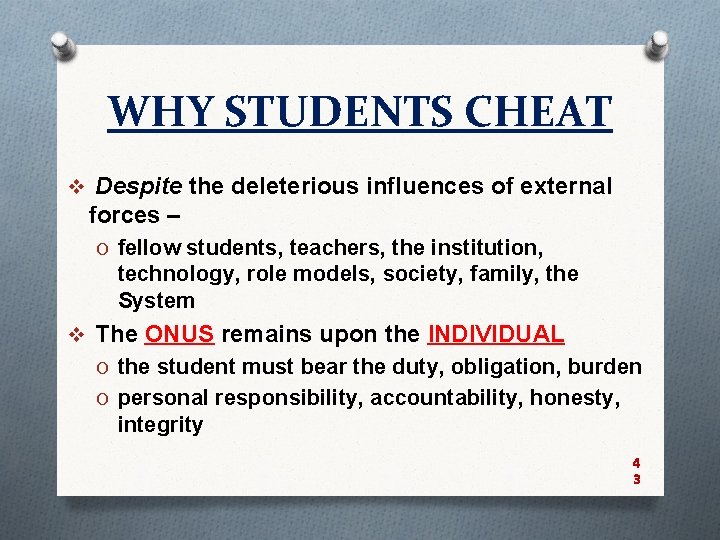
WHY STUDENTS CHEAT v Despite the deleterious influences of external forces – O fellow students, teachers, the institution, technology, role models, society, family, the System v The ONUS remains upon the INDIVIDUAL O the student must bear the duty, obligation, burden O personal responsibility, accountability, honesty, integrity 4 3
PLAGIARISM Tips to Avoid Plagiarism
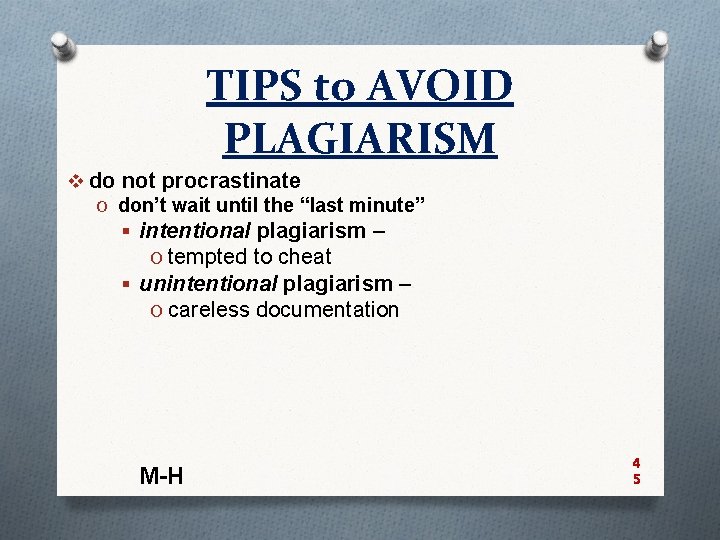
TIPS to AVOID PLAGIARISM v do not procrastinate O don’t wait until the “last minute” § intentional plagiarism – O tempted to cheat § unintentional plagiarism – O careless documentation M-H 4 5
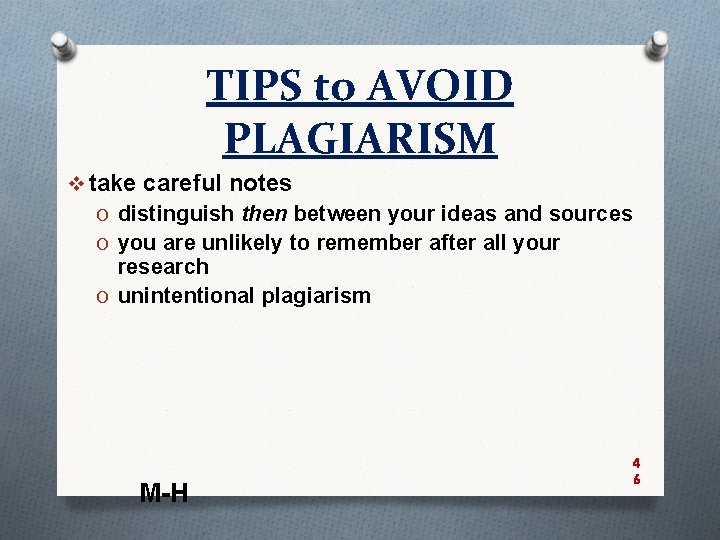
TIPS to AVOID PLAGIARISM v take careful notes O distinguish then between your ideas and sources O you are unlikely to remember after all your research O unintentional plagiarism M-H 4 6
TIPS to AVOID PLAGIARISM v follow MLA format O handouts O text book O OWL (Purdue University) v meet with the professor and/or tutors for assistance M-H 4 7
TIPS to AVOID PLAGIARISM v read text books on plagiarism O Chapter 6 (Crusius’ The Aims of Argument) O p. 471 -73 in Memering and Palmer’s Discovering Arguments (special edition) v rely on credible Web sources for style formatting O OWL: Online Writing lab at Purdue University 4 8
TIPS to AVOID PLAGIARISM * WHEN IN DOUBT CITE * v If you’re not sure if it is or is not “common knowledge” – CITE v If you directly quoted – CITE v If you put the idea into your own words – CITE v If you did not know the idea or material before researching the topic – CITE v If you forgot the material and were reminded of it during research – CITE 4 9
PLAGIARISM Resources
RESOURCES v While most ideas are original or common (as in common sense), some were too close to some sources or were better phrased by them. v DG = O Gregory, Dennis E. “Plagiarism 101; Keys to Preventing Academic Misconduct. ” Power. Point Presentation. Higher Ed Hero. com. 28 Nov. 2007. 4 Apr. 2009 <https: //www. higheredhero. com/audio/ Page. Data/Group 2/Event 1152/Audio. Conference. pdf>. v M-H = O Crusius, Timothy W. and Carolyn E. Channell. The Aims of Argument; A Text and Reader. 6 th ed. New York: 5 Mc. Graw-Hill, 2009. 1
PLAGIARISM The End