
Placido Based Corneal Topography y h p a
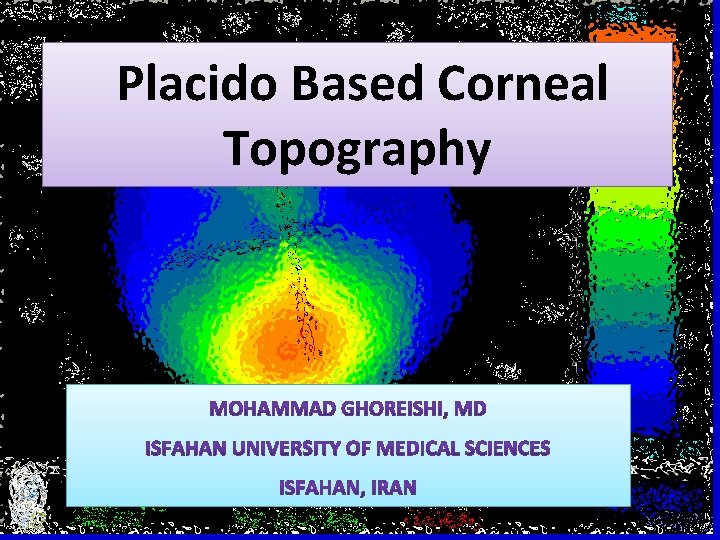
Placido Based Corneal Topography
y h p a r g o Topography is the science of describing or representing the features of a particular surface
y h p a r g o p o t l a e n r Co d e t s i s s a r e t u p m o • C y p o c s o t l a u r f e r k e w o p video d n a e t a r l u a c c e a n r t o s c o f m o t e n e • Th m e r u s a e m r o f l too e c a f r su
The importance of anterior corneal surface • The anterior cornea is the major refractive surface of the eye • Average refractive power is 43 D (+49 D for anterior surface and – 6 D for posterior surface)
Parameters for description of corneal shape • Surface slope • Radius of curvature • Power • Elevation
Curvature and power • Curvature – A measurement of shape of the cornea – Geometric property • Power – A measurement of refractive effect of the cornea – Functional property • Radius of curvature is more accurate than power
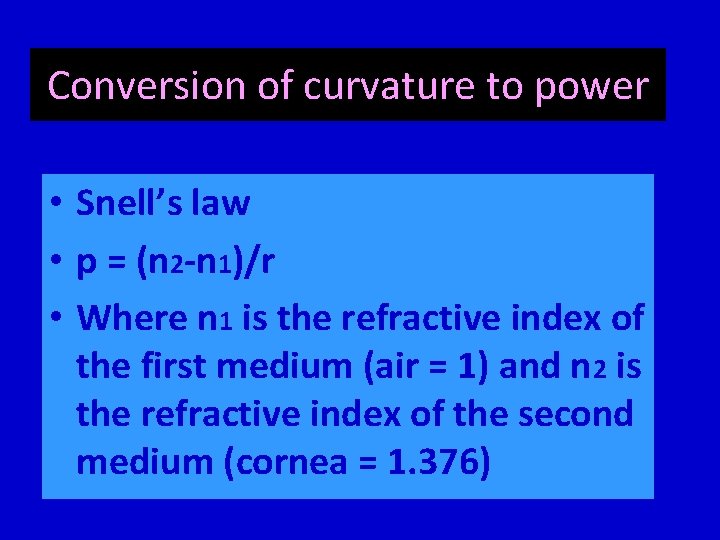
Conversion of curvature to power • Snell’s law • p = (n 2 -n 1)/r • Where n 1 is the refractive index of the first medium (air = 1) and n 2 is the refractive index of the second medium (cornea = 1. 376)
ANSI: Geometry and Optics Ø Curvature is always geometric (a property of surface shape) and can only be applied to surfaces individually. Ø Power is always optical (a property of the surface shape, refractive index, and illumination incidence) and can be applied to any sequence of surfaces. ØAlthough the conventional color maps (axial and tangential) are expressed in diopters (the unit of optical power), they actually display surface curvature. Henceforth these “power” maps will be called curvature maps.
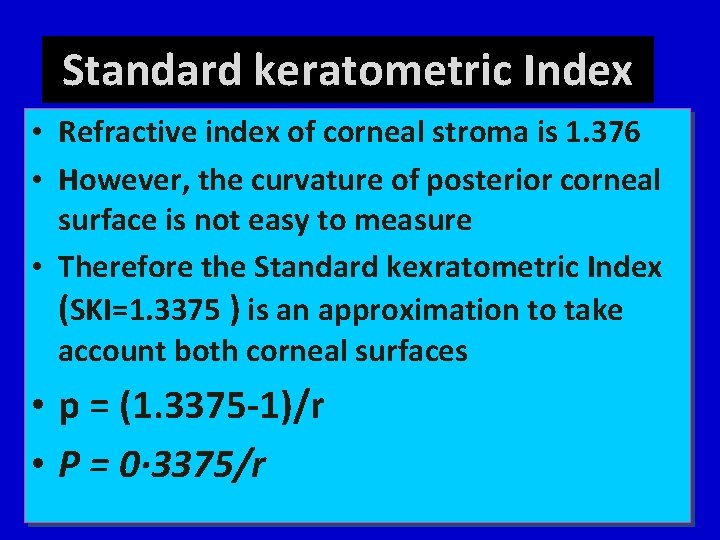
Standard keratometric Index • Refractive index of corneal stroma is 1. 376 • However, the curvature of posterior corneal surface is not easy to measure • Therefore the Standard kexratometric Index (SKI=1. 3375 ) is an approximation to take account both corneal surfaces • p = (1. 3375 -1)/r • P = 0· 3375/r
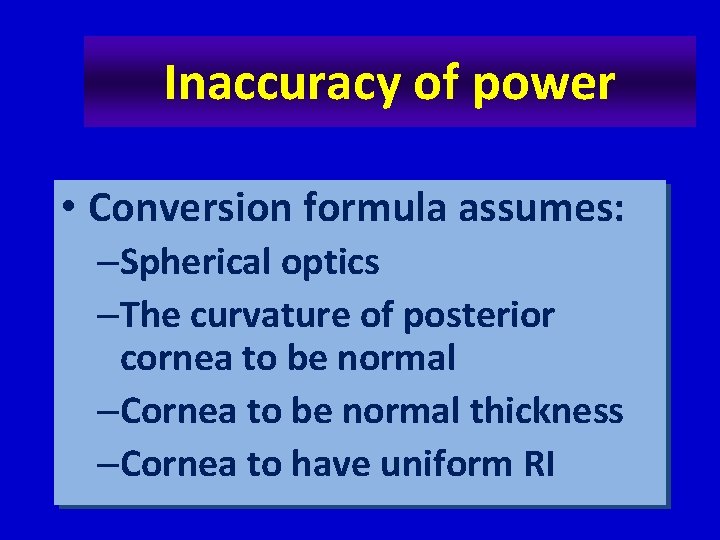
Inaccuracy of power • Conversion formula assumes: –Spherical optics –The curvature of posterior cornea to be normal –Cornea to be normal thickness –Cornea to have uniform RI
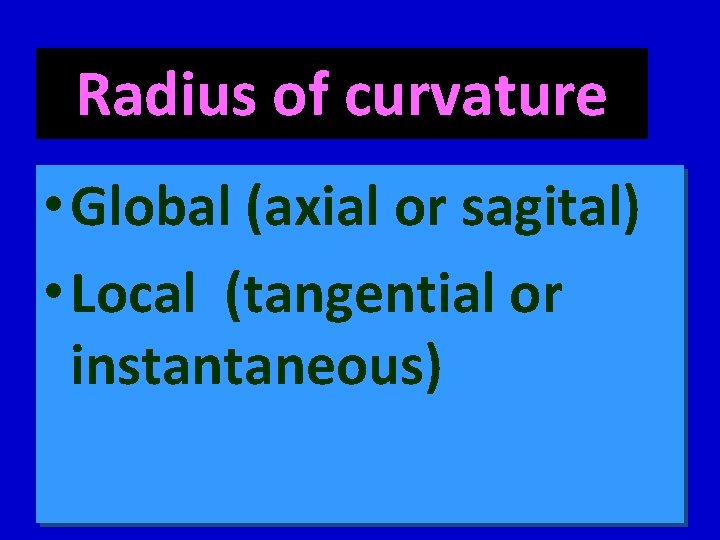
Radius of curvature • Global (axial or sagital) • Local (tangential or instantaneous)
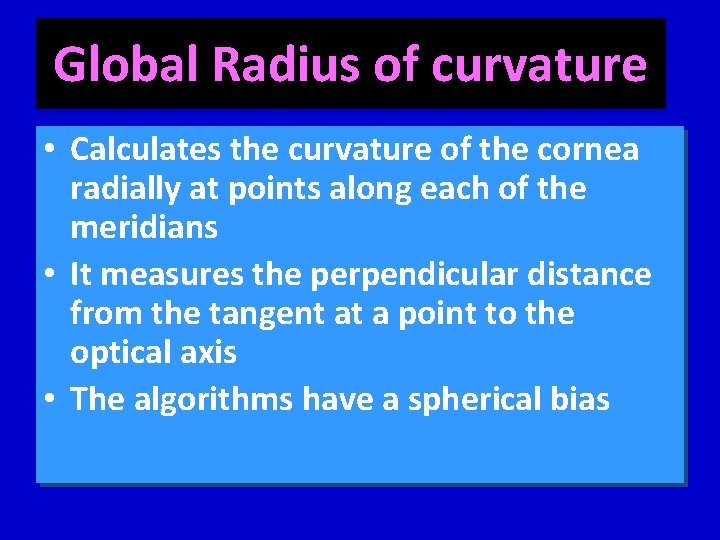
Global Radius of curvature • Calculates the curvature of the cornea radially at points along each of the meridians • It measures the perpendicular distance from the tangent at a point to the optical axis • The algorithms have a spherical bias
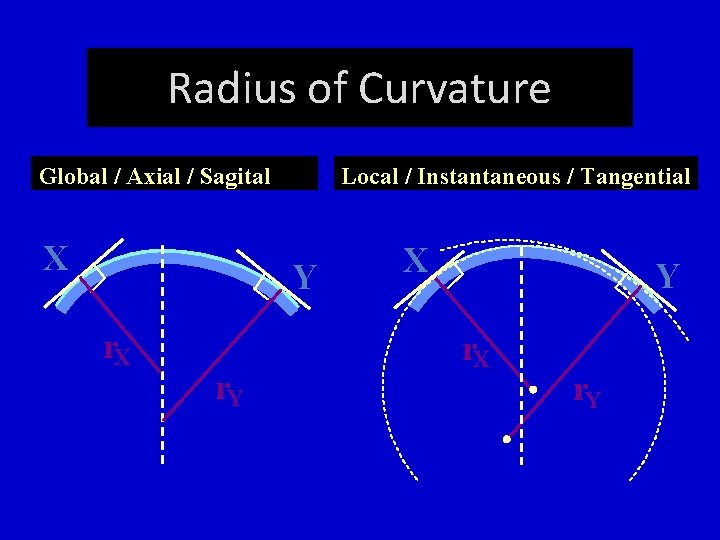
Radius of Curvature Global / Axial / Sagital X Local / Instantaneous / Tangential Y r. X r. Y X Y r. X r. Y
Methods of measurement of corneal shape • Keratometry • Keraoscopy • Photokeratoscopy • Videokeratoscopy
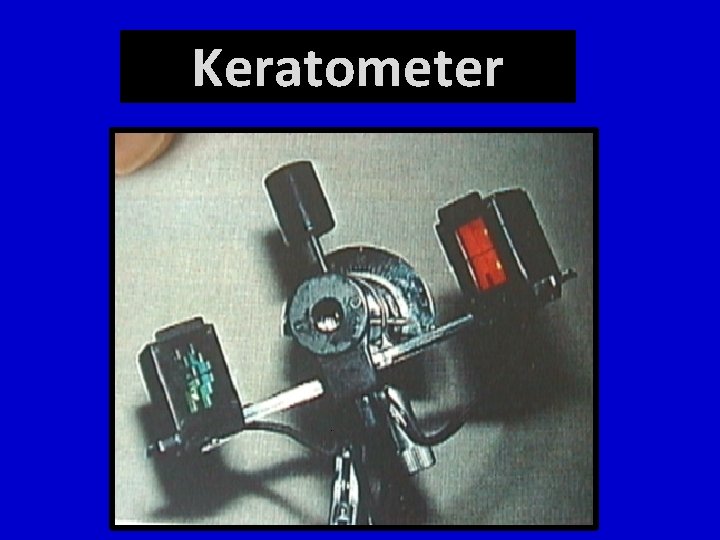
Keratometer
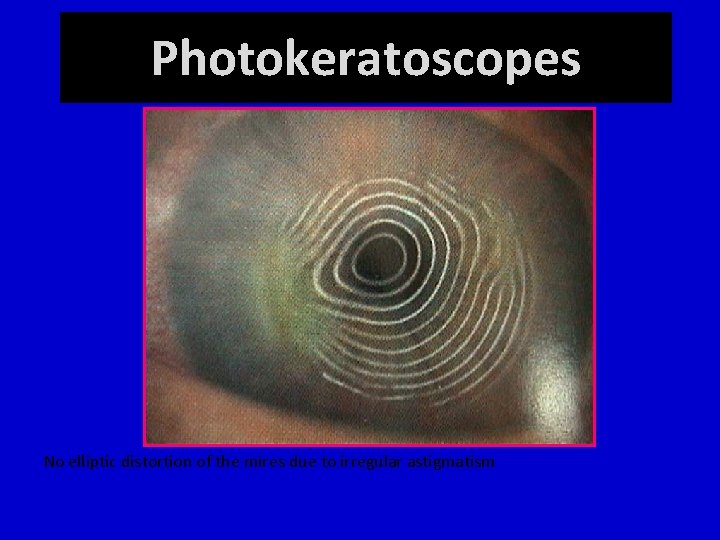
Photokeratoscopes No elliptic distortion of the mires due to irregular astigmatism
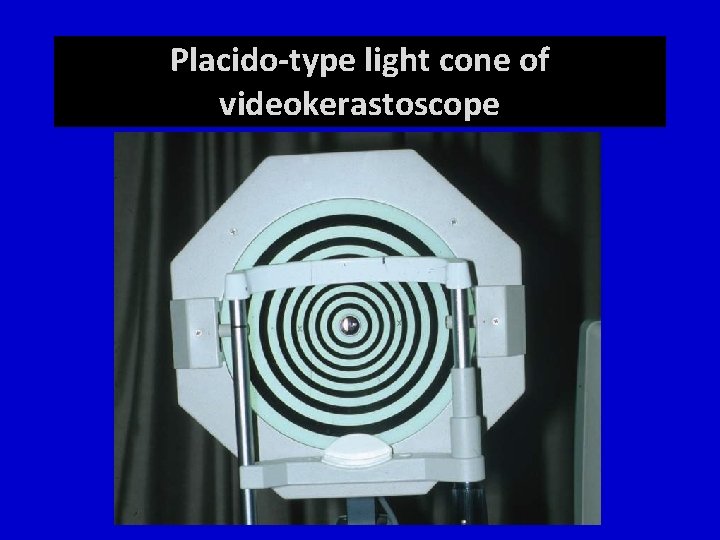
Placido-type light cone of videokerastoscope
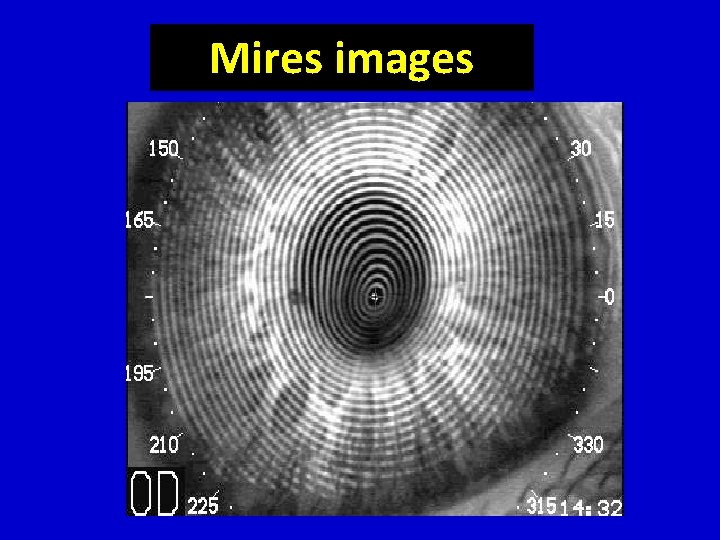
Mires images
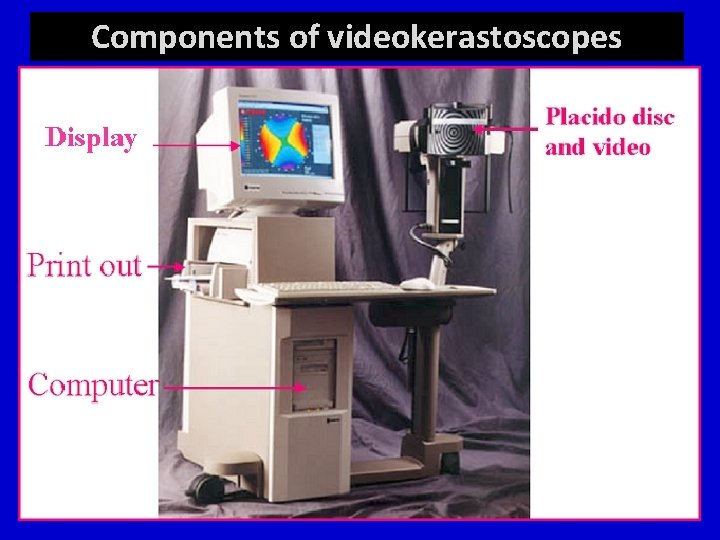
Components of videokerastoscopes
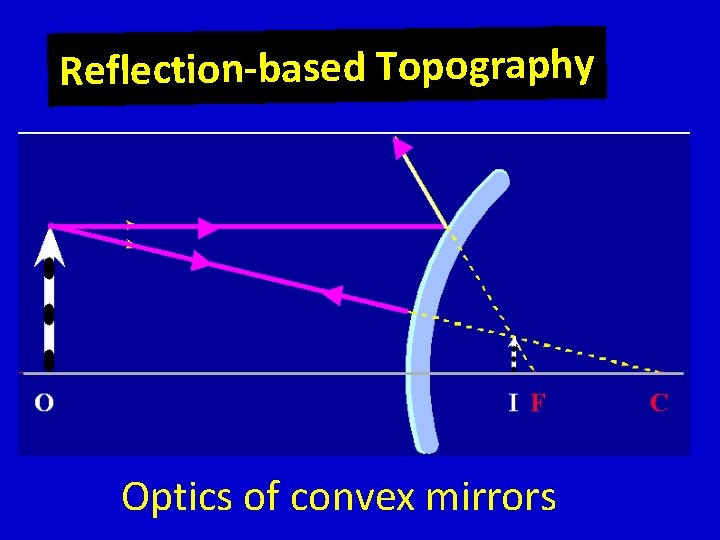
Reflection-based Topography Optics of convex mirrors
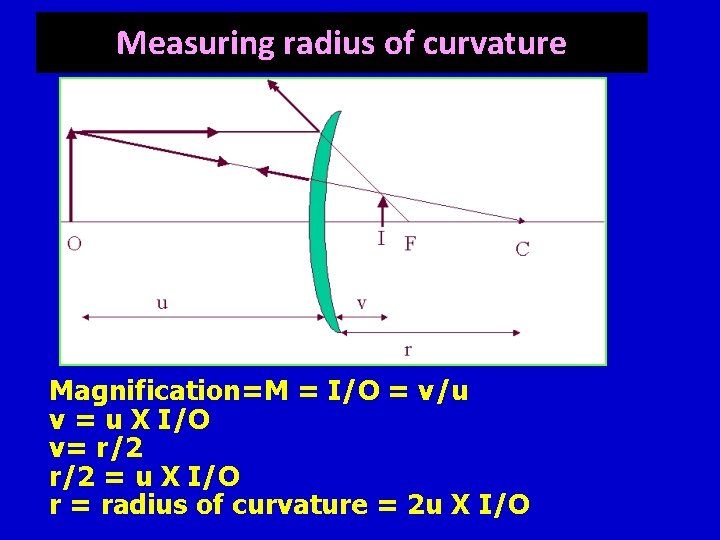
Measuring radius of curvature Magnification=M = I/O = v/u v = u X I/O v= r/2 = u X I/O r = radius of curvature = 2 u X I/O
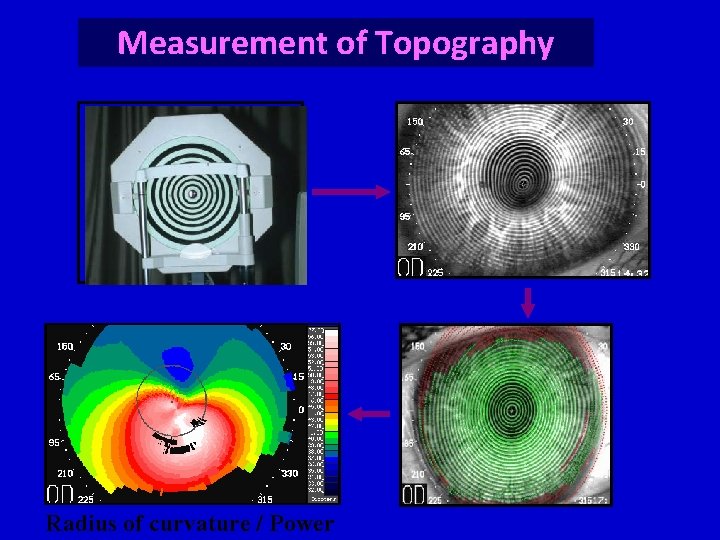
Measurement of Topography Radius of curvature / Power
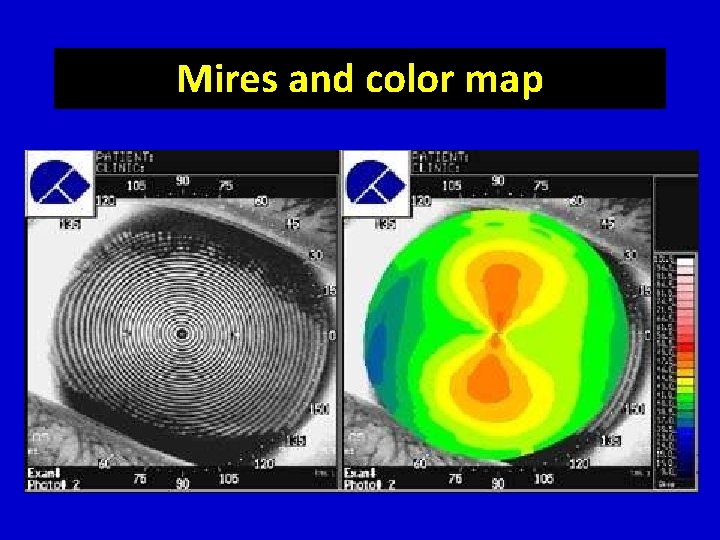
Mires and color map
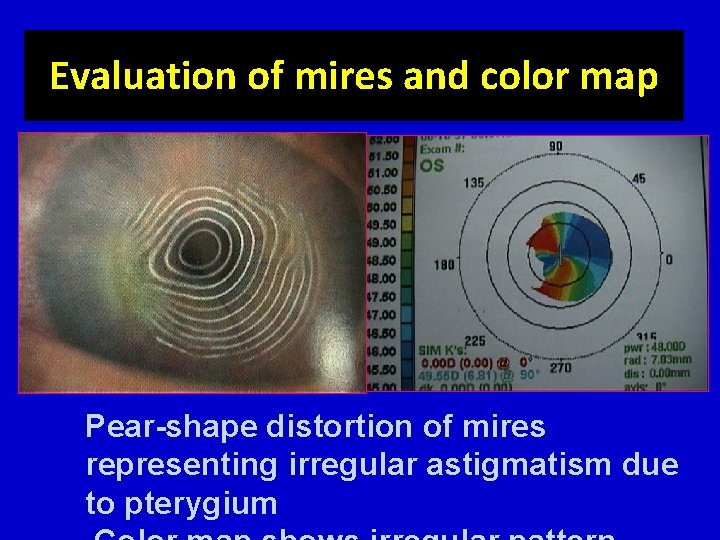
Evaluation of mires and color map Pear-shape distortion of mires representing irregular astigmatism due to pterygium

• The most usef ul form of data presentation is a c o lor-coded corneal contour map • Steep areas a re depicted as "hot colors, " su c h browns, and fla as reds and t "cool colors, " su areas as c h as blues and greens
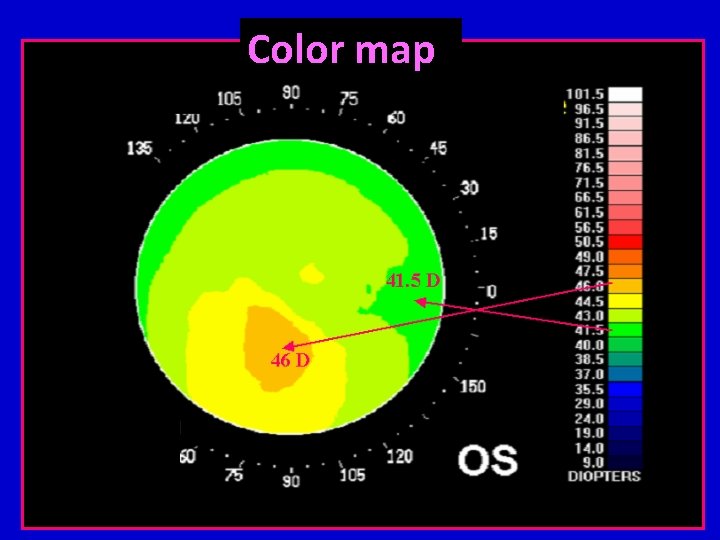
Color map
Color scales –Absolute scale –Normalized scale –Adjustable
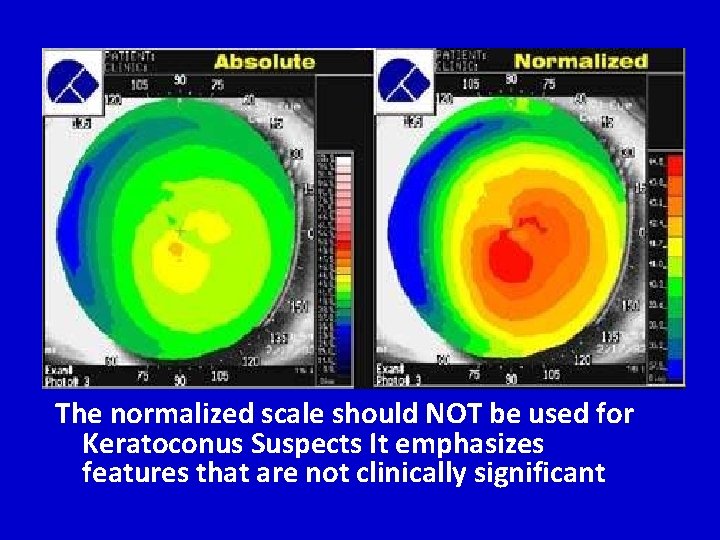
The normalized scale should NOT be used for Keratoconus Suspects It emphasizes features that are not clinically significant
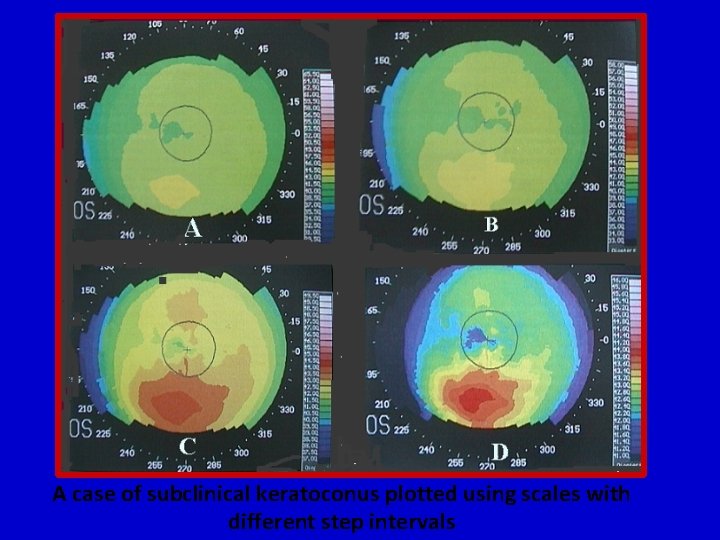
A case of subclinical keratoconus plotted using scales with different step intervals
Axial Map • Axial curvature (formerly termed sagital curvature) measures the curvature at a certain point on the corneal surface in axial direction relative to the center • The axial map shows the corneal curvature calculated with respect to the optical axis of the cornea. • Axial topography is similar to manual keratometry in that it is most accurate within the central portion of the cornea.

- Slides: 31