
Placenta Previa A common vaginal bleeding in third
Placenta Previa A common vaginal bleeding in third trimester YU Xin. Yang The First Affiliated Hospital of Chongqing Medical University
Requirements ¨ Master the definition, types, clinical manifestations, diagnosis and treatment principles. ¨ Be familiar with the pathogenesis, pathophysiology, differential diagnosis, and maternal & fetal outcomes. ¨ Understand the etiology and prevention.
General Consideration ¨ Definition After 28 weeks gestation, any part of the placenta is implanted in the lower uterine segment, even partially or totally covered the internal cervical os. Consequently the placenta is in advance of the presenting part.
General Consideration u Incidence 0. 24%~1. 57% (our country) 0. 5%~0. 90% (other countries) Nulliparas: 1/1000~1/1500 pregnancy Grandmultiparas: 1/20 pregnancy u It is the major reason of hemorrhage in the third trimester pregnancy
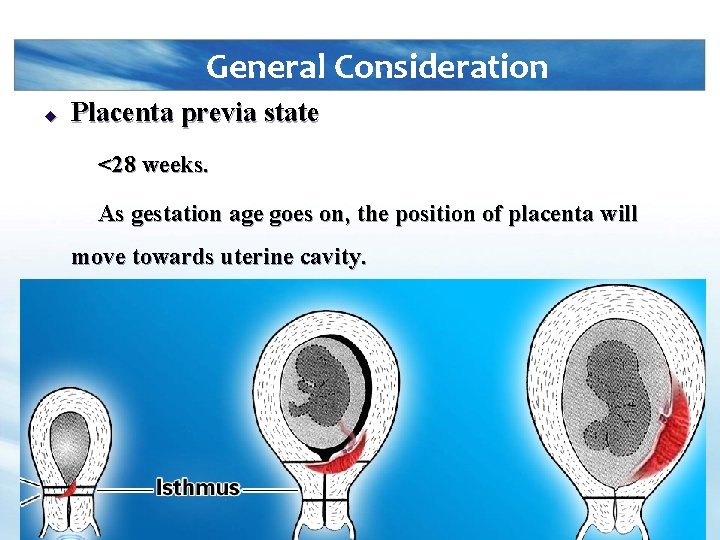
General Consideration u Placenta previa state <28 weeks. As gestation age goes on, the position of placenta will move towards uterine cavity.
Etiology u Uncertain u High risk factors: 1. maternal age: >35 years 2. multiparity 3. prior cesarean delivery: 5 times 4. smoking
Etiology ¨ Causes 1. Endometrial abnormality 1)Scared or poorly vascularized endometrium in the corpus. 2)Curettage, Delivery, CS and infection of endometrium 2. Placental abnormality 1)Large placenta (multiple pregnancy) 2)succenturiate lobe 3. Delayed development of trophoblast cell

Classification u Complete placenta previa u Partial placenta previa u Marginal placenta previa

Classification u Low-lying placenta The placenta is implanted in the lower uterine segment such that the placental edge does not reach the internal os, but is in close proximity to it.

Classification u Pernicious placenta previous c-section + placenta previa placenta accreta: 50%
Manifestation u Symptom: Sudden, recurrently painless vaginal bleeding in third trimester. CHARACTER of bleeding Painless
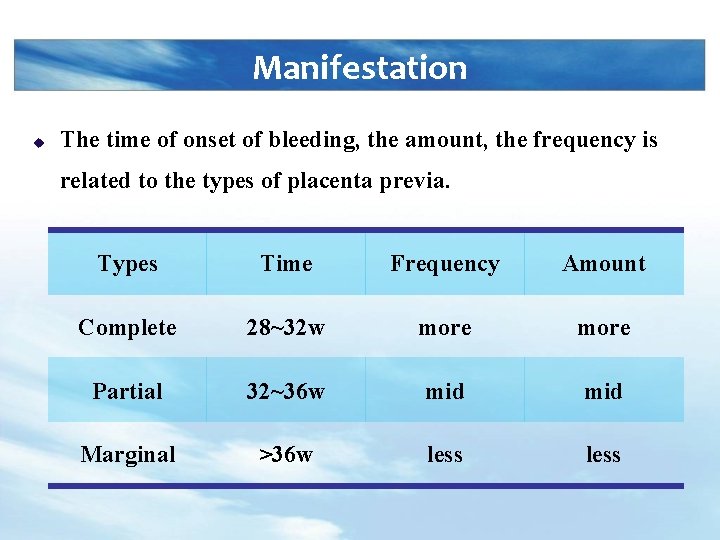
Manifestation u The time of onset of bleeding, the amount, the frequency is related to the types of placenta previa. Types Time Frequency Amount Complete 28~32 w more Partial 32~36 w mid Marginal >36 w less
Manifestation Sign: u Abdominal findings: Uterus is soft, relaxed and no tender. u Contraction may be palpated. u Fetal heart tones maybe disappear.
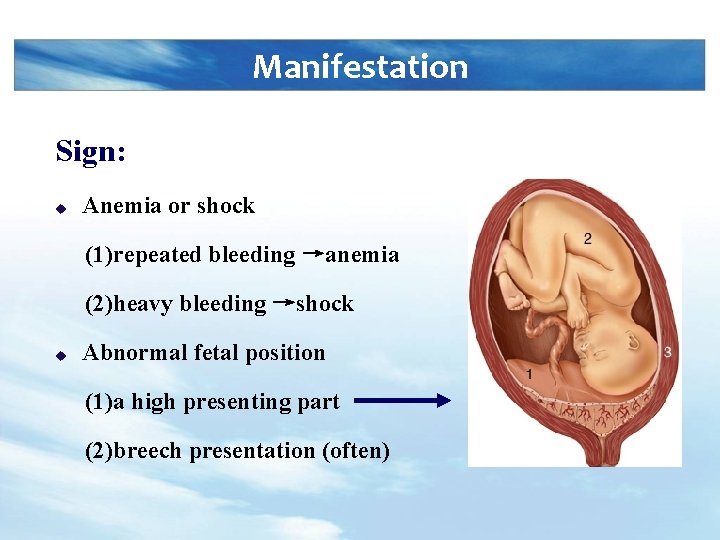
Manifestation Sign: u Anemia or shock (1)repeated bleeding →anemia (2)heavy bleeding →shock u Abnormal fetal position (1)a high presenting part (2)breech presentation (often)
Diagnosis u u u Speculum examination Vaginal examination: seldom used Rectal examination: useless and dangerous
Differential diagnosis u Placental abruption painful vaginal bleeding uterus tenderness
Differential diagnosis Vascular previa Cervix diseases
Effect to mother and fetus u Obstetric hemorrhage u Placenta accreta u Anemia and infection u Premature delivery and perinatal fetus high mortality rate
Treatment principle u Expectant treatment u Termination of pregnancy u Emergent transfer
Expectant treatment Indication: u <36 weeks u Fetal weight <2300 g u Vaginal bleeding few, patient generally good u Fetus alive
Expectant treatment u Purpose: Ensure safe premise to pregnant women, try to extend gestational age and improve perinatal fetus survival. u Object: elementary object: 34 weeks satisfied object: 36 weeks
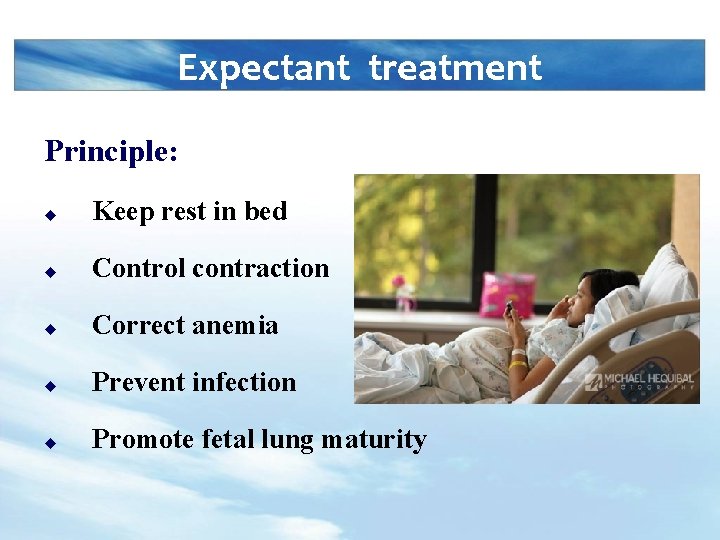
Expectant treatment Principle: u Keep rest in bed u Control contraction u Correct anemia u Prevent infection u Promote fetal lung maturity
Expectant treatment 3 DO: u Absolute rest in bed, calm down, oxygen u To use appropriate contractions inhibitors Mg. SO 4 u Ritodrine Correct anemia, match blood, prepare blood
Expectant treatment---3 DON’T: u Don’t rectal examination u Don’t vaginal examination u Don’t enema
Termination of pregnancy INDICATIONS: u Complete PP and partial PP u Huge bleeding(>400 ml) threaten to mother or fetus u >36 th week u Marginal PP with bleeding too much,can’t delivery immediately u <36 th week, fetal distress u Fetus death or severe malformation
Termination of pregnancy u Cesarean section Complete and partial placenta previa Huge bleeding u Vaginal delivery Marginal placenta previa Head presentation Progress of delivery satisfactory
Termination of pregnancy u Treat postpartum hemorrhage. 1. Promote uterine contractions. – Oxytocin, massage uterus. – Uterine B-lynch suture. – Pack uterine cavity with ribbon gauze. 2. Uterine artery ligation. 3. Subtotal hysterectomy.

- Slides: 28