
Place Value Multiplication Expressions Chapter 1 Standards MAFS
- Slides: 21
Place Value, Multiplication, & Expressions Chapter 1 Standards: MAFS. 5. NBT. 1. 1, MAFS. 5. NBT. 1. 2 , MAFS. 5. NBT. 2. 5, MAFS. 5. NBT. 2. 6, MAFS. 5. OA. 1. 1, MAFS. 5. OA. 1. 2
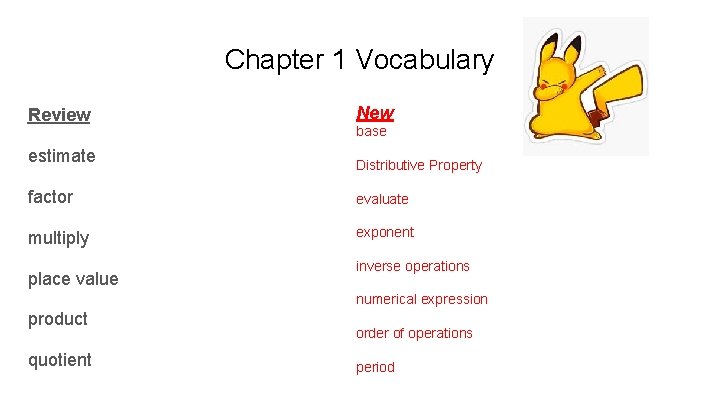
Chapter 1 Vocabulary Review estimate New base Distributive Property factor evaluate multiply exponent place value inverse operations numerical expression product quotient order of operations period
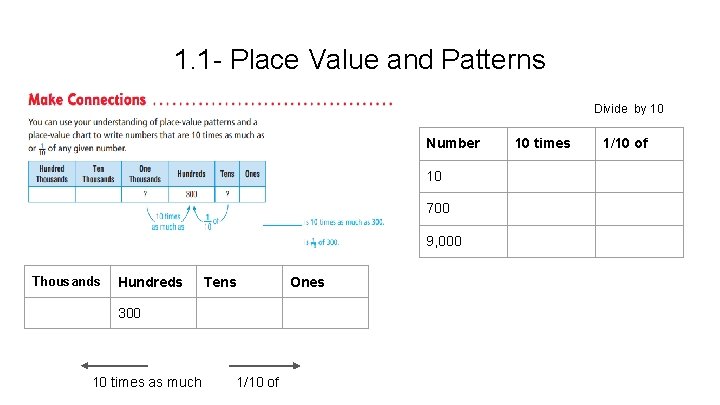
1. 1 - Place Value and Patterns Divide by 10 Number 10 700 9, 000 Thousands Hundreds Tens 300 10 times as much 1/10 of Ones 10 times 1/10 of
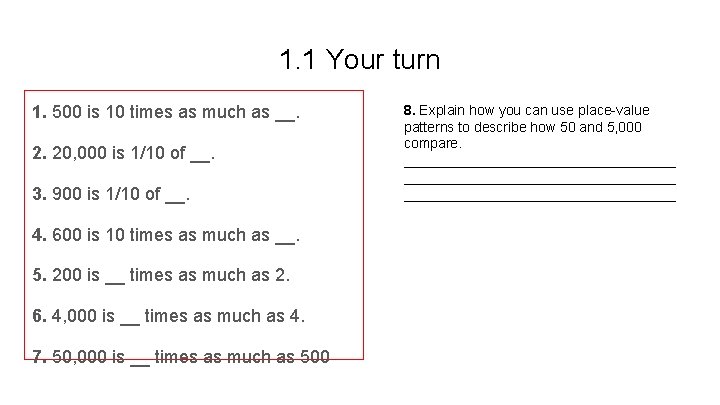
1. 1 Your turn 1. 500 is 10 times as much as __. 2. 20, 000 is 1/10 of __. 3. 900 is 1/10 of __. 4. 600 is 10 times as much as __. 5. 200 is __ times as much as 2. 6. 4, 000 is __ times as much as 4. 7. 50, 000 is __ times as much as 500 8. Explain how you can use place-value patterns to describe how 50 and 5, 000 compare. ___________________________________
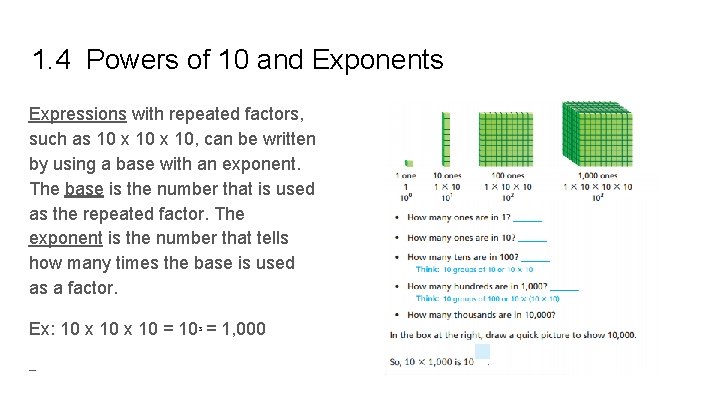
1. 4 Powers of 10 and Exponents Expressions with repeated factors, such as 10 x 10, can be written by using a base with an exponent. The base is the number that is used as the repeated factor. The exponent is the number that tells how many times the base is used as a factor. Ex: 10 x 10 = 10³ = 1, 000 _
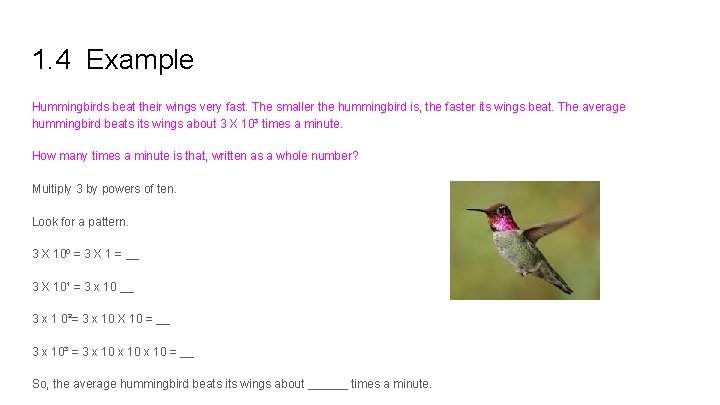
1. 4 Example Hummingbirds beat their wings very fast. The smaller the hummingbird is, the faster its wings beat. The average hummingbird beats its wings about 3 X 10³ times a minute. How many times a minute is that, written as a whole number? Multiply 3 by powers of ten. Look for a pattern. 3 X 10⁰ = 3 X 1 = __ 3 X 10¹ = 3 x 10 __ 3 x 1 0²= 3 x 10 X 10 = __ 3 x 10³ = 3 x 10 = __ So, the average hummingbird beats its wings about ______ times a minute.
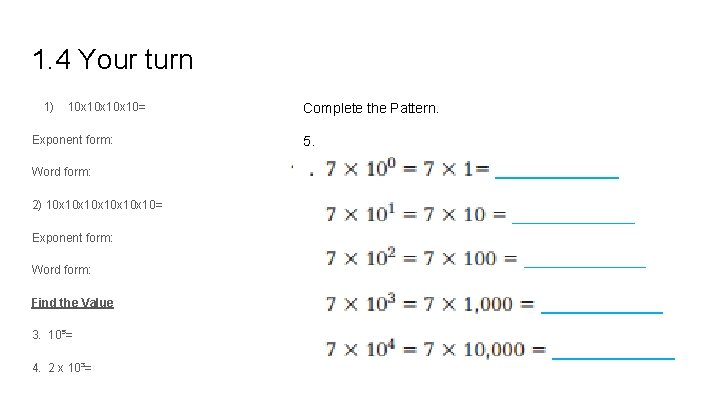
1. 4 Your turn 1) 10 x 10 x 10= Exponent form: Word form: 2) 10 x 10 x 10 x 10= Exponent form: Word form: Find the Value 3. 10⁵= 4. 2 x 10³= Complete the Pattern. 5. 7 X 10⁰ = 7 X 1 = __ 7 X 10¹ = 7 x 10 __ 7 x 10²= 7 x 10 X 10 = __ 7 x 10³ = 7 x 10 = __ 7 x 10⁴= 7 x 10=
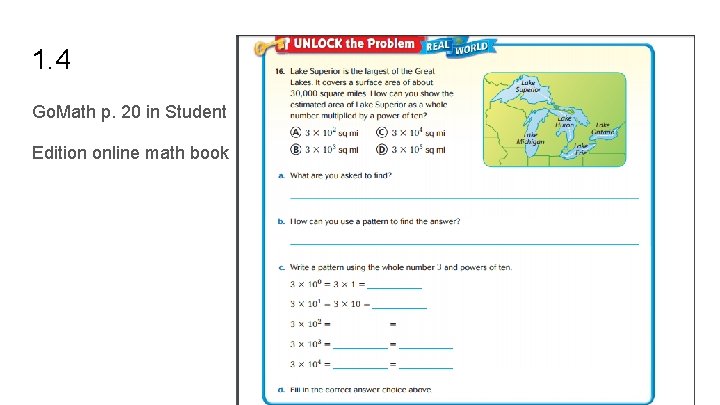
1. 4 Go. Math p. 20 in Student Edition online math book
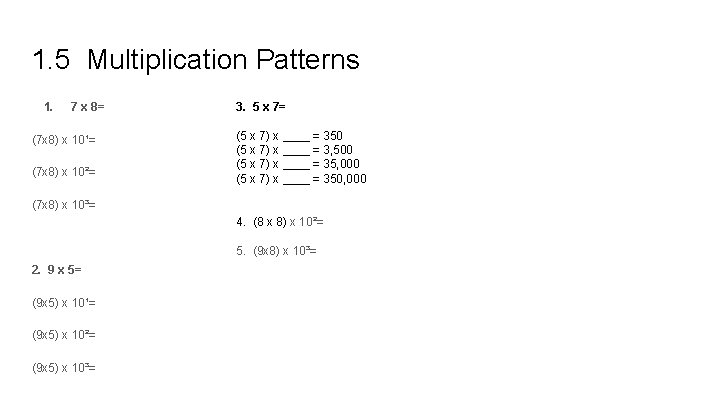
1. 5 Multiplication Patterns 1. 7 x 8= (7 x 8) x 10¹= (7 x 8) x 10²= 3. 5 x 7= (5 x 7) x ____ = 350 (5 x 7) x ____ = 3, 500 (5 x 7) x ____ = 35, 000 (5 x 7) x ____ = 350, 000 (7 x 8) x 10³= 4. (8 x 8) x 10²= 5. (9 x 8) x 10³= 2. 9 x 5= (9 x 5) x 10¹= (9 x 5) x 10²= (9 x 5) x 10³=
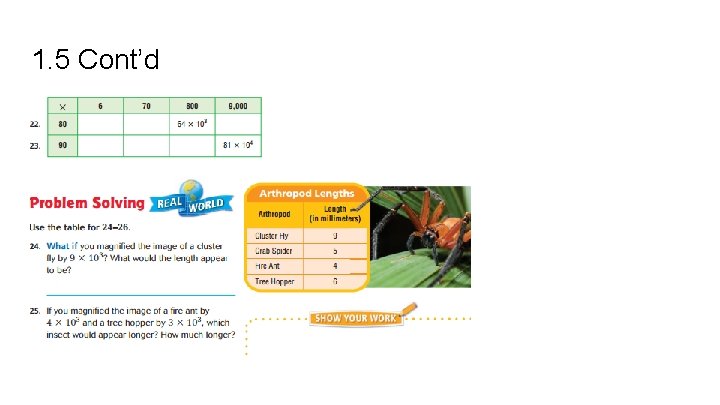
1. 5 Cont’d
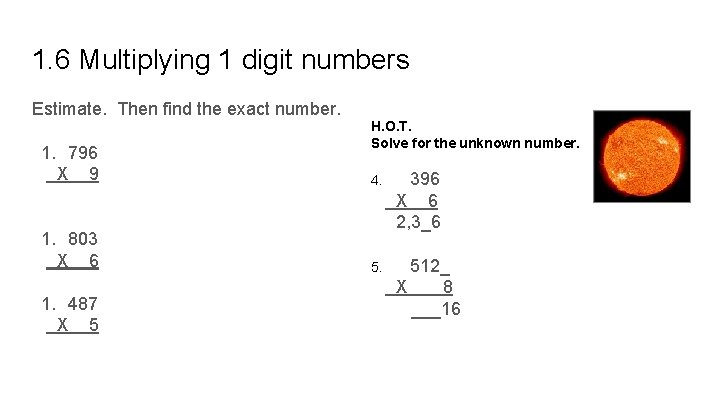
1. 6 Multiplying 1 digit numbers Estimate. Then find the exact number. 1. 796 X 9 1. 803 X 6 1. 487 X 5 H. O. T. Solve for the unknown number. 4. 396 X 6 2, 3_6 5. 512_ X 8 ___16
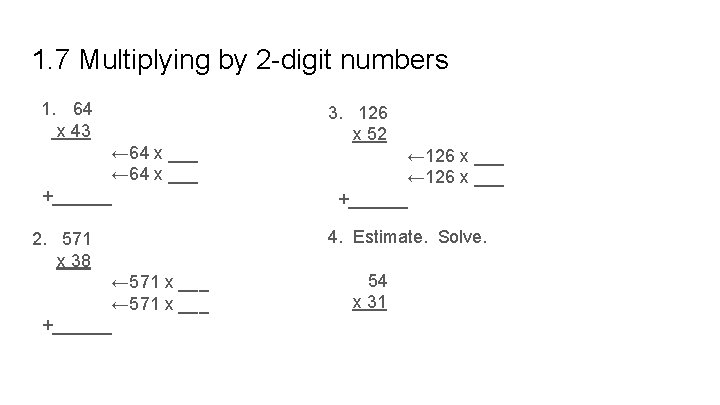
1. 7 Multiplying by 2 -digit numbers 1. 64 x 43 ← 64 x ___ +______ 2. 571 x 38 ← 571 x ___ +______ 3. 126 x 52 ← 126 x ___ +______ 4. Estimate. Solve. 54 x 31
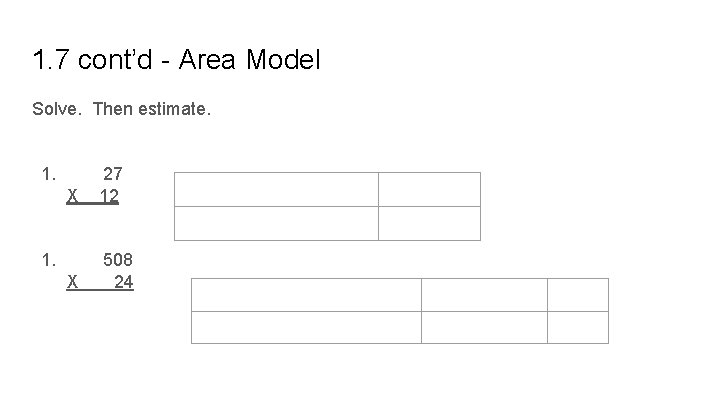
1. 7 cont’d - Area Model Solve. Then estimate. 1. X 27 12 X 508 24 1.
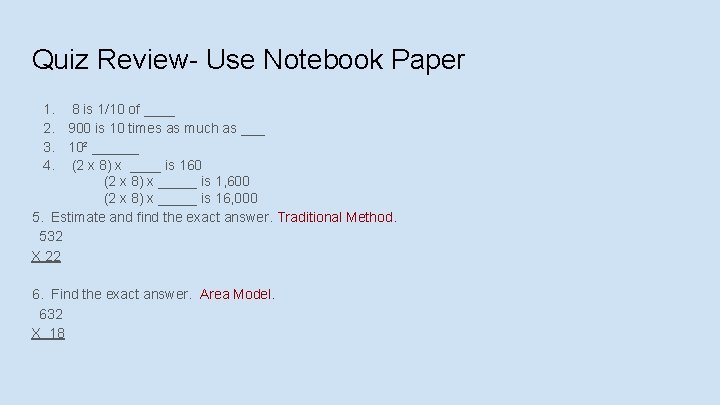
Quiz Review- Use Notebook Paper 1. 8 is 1/10 of ____ 2. 900 is 10 times as much as ___ 3. 10² ______ 4. (2 x 8) x ____ is 160 (2 x 8) x _____ is 1, 600 (2 x 8) x _____ is 16, 000 5. Estimate and find the exact answer. Traditional Method. 532 X 22 6. Find the exact answer. Area Model. 632 X 18
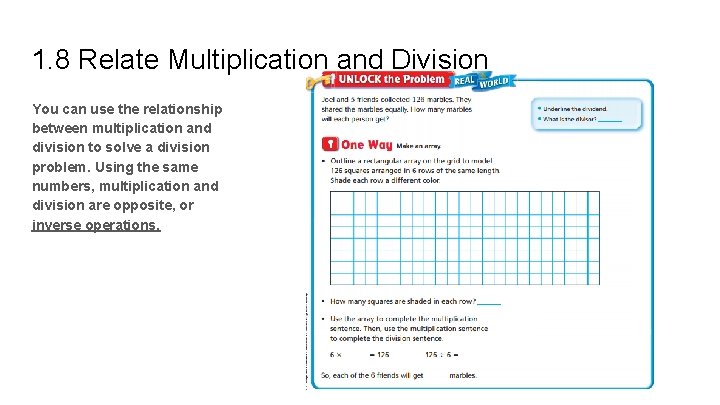
1. 8 Relate Multiplication and Division You can use the relationship between multiplication and division to solve a division problem. Using the same numbers, multiplication and division are opposite, or inverse operations.
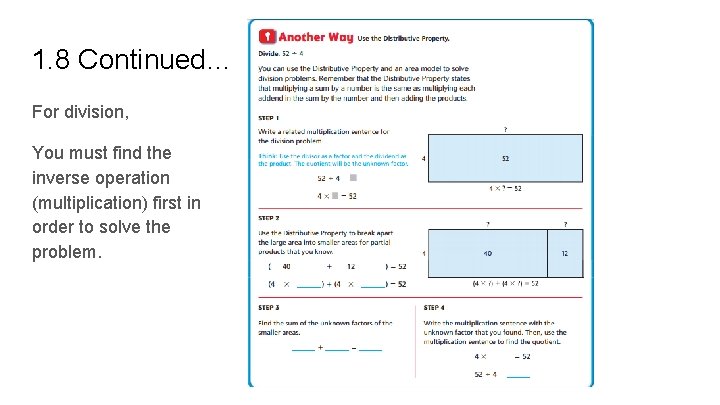
1. 8 Continued… For division, You must find the inverse operation (multiplication) first in order to solve the problem.
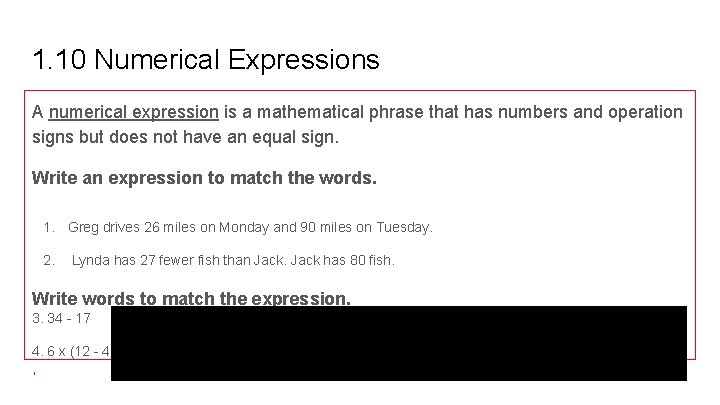
1. 10 Numerical Expressions A numerical expression is a mathematical phrase that has numbers and operation signs but does not have an equal sign. Write an expression to match the words. 1. Greg drives 26 miles on Monday and 90 miles on Tuesday. 2. Lynda has 27 fewer fish than Jack has 80 fish. Write words to match the expression. 3. 34 - 17 Billy Bob has 17 fewer hot dogs than Jesse Joe has 34. 4. 6 x (12 - 4) Jeff has 12 birds than 4 flew away. Later on 6 times as many birds flew to Jeff looking for , food.
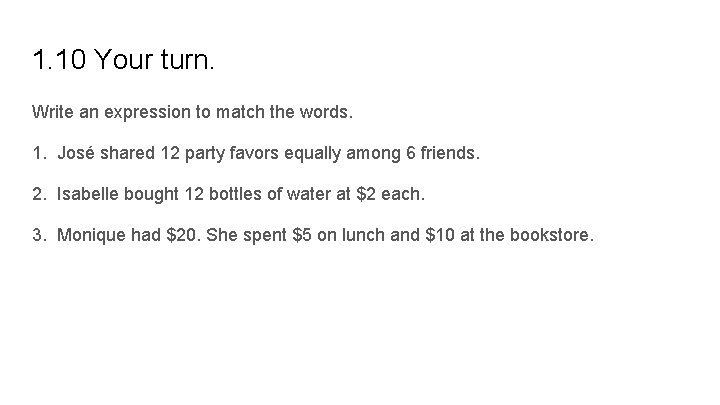
1. 10 Your turn. Write an expression to match the words. 1. José shared 12 party favors equally among 6 friends. 2. Isabelle bought 12 bottles of water at $2 each. 3. Monique had $20. She spent $5 on lunch and $10 at the bookstore.
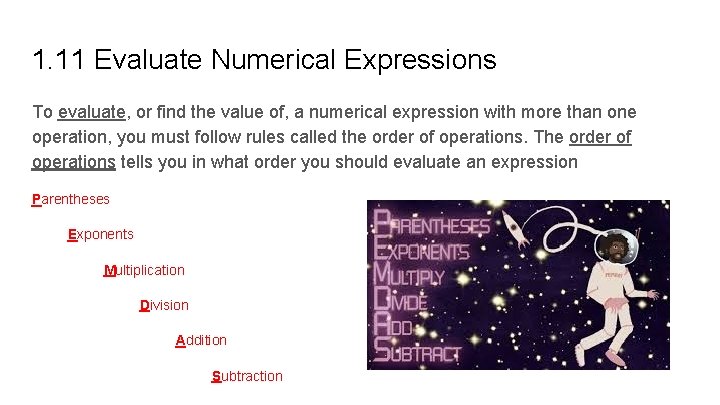
1. 11 Evaluate Numerical Expressions To evaluate, or find the value of, a numerical expression with more than one operation, you must follow rules called the order of operations. The order of operations tells you in what order you should evaluate an expression Parentheses Exponents Multiplication Division Addition Subtraction
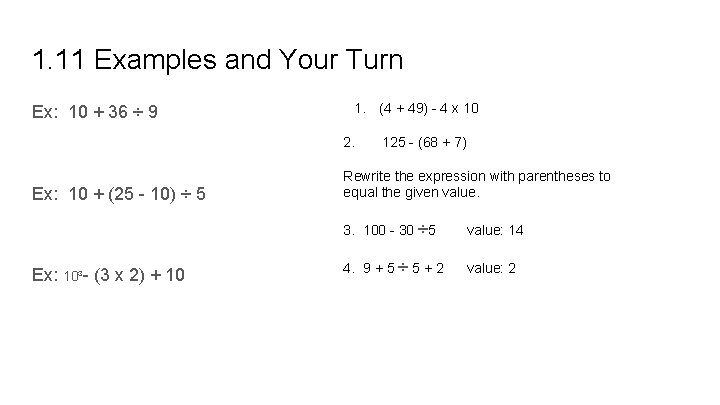
1. 11 Examples and Your Turn Ex: 10 + 36 ÷ 9 1. (4 + 49) - 4 x 10 2. Ex: 10 + (25 - 10) ÷ 5 Ex: 10³- (3 x 2) + 10 125 - (68 + 7) Rewrite the expression with parentheses to equal the given value. 3. 100 - 30 ÷ 5 value: 14 4. 9 + 5 ÷ 5 + 2 value: 2
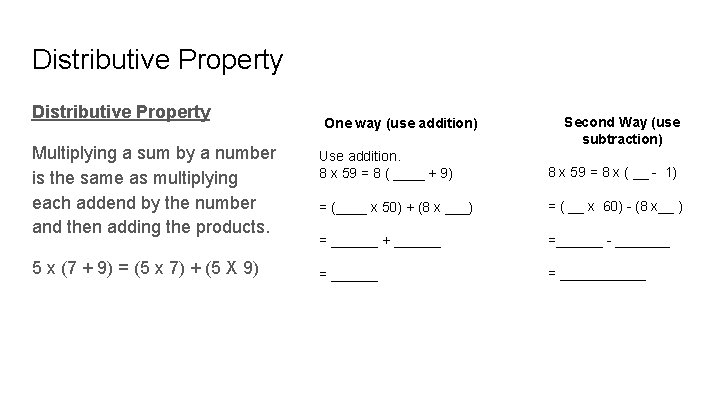
Distributive Property Multiplying a sum by a number is the same as multiplying each addend by the number and then adding the products. 5 x (7 + 9) = (5 x 7) + (5 X 9) One way (use addition) Second Way (use subtraction) Use addition. 8 x 59 = 8 ( ____ + 9) 8 x 59 = 8 x ( __ - 1) = (____ x 50) + (8 x ___) = ( __ x 60) - (8 x__ ) = ______ + ______ =______ - _______ = ______