
Place Value and Division Decimals Addition and Subtraction
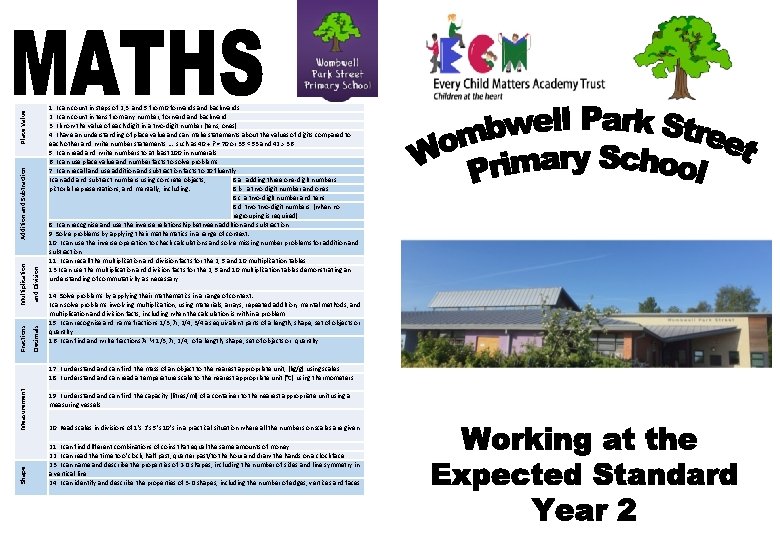
Place Value and Division Decimals Addition and Subtraction Multiplication Fractions 1. I can count in steps of 2, 3 and 5 from 0 forwards and backwards. 2. I can count in tens from any number, forward and backward. 3. I know the value of each digit in a two-digit number (tens, ones) 4. I have an understanding of place value and can make statements about the values of digits compared to each other and write number statements …. such as 40 + ? = 70 or 35 < 53 and 42 > 36 5. I can read and write numbers to at least 100 in numerals 6. I can use place value and number facts to solve problems. 7. I can recall and use addition and subtraction facts to 20 fluently I can add and subtract numbers using concrete objects, 8. a. adding three one-digit numbers 8. b. a two-digit number and ones pictorial representations, and mentally, including: 8. c. a two-digit number and tens 8. d. two-digit numbers (when no regrouping is required) 8. I can recognise and use the inverse relationship between addition and subtraction 9. Solve problems by applying their mathematics in a range of context: 10. I can use the inverse operation to check calculations and solve missing number problems for addition and subtraction 11. I can recall the multiplication and division facts for the 2, 5 and 10 multiplication tables 13. I can use the multiplication and division facts for the 2, 5 and 10 multiplication tables demonstrating an understanding of commutativity as necessary 14. Solve problems by applying their mathematics in a range of context: I can solve problems involving multiplication, using materials, arrays, repeated addition, mental methods, and multiplication and division facts, including when the calculation is within a problem. 15. I can recognise and name fractions 1/3, ½, 2/4, 3/4 as equivalent parts of a length, shape, set of objects or quantity 16. I can find and write fractions ¼ ¾ 1/3, ½, 2/4, of a length, shape, set of objects or quantity Shape Measurement 17. I understand can find the mass of an object to the nearest appropriate unit, (kg/g) using scales 18. I understand can read a temperature scale to the nearest appropriate unit (°C) using thermometers 19. I understand can find the capacity (litres/ml) of a container to the nearest appropriate unit using a measuring vessels 20. Read scales in divisions of 1’s 2’s 5’s 10’s in a practical situation where all the numbers on scales are given 21. I can find different combinations of coins that equal the same amounts of money 22. I can read the time to o’clock, half past, quarter past/to the hour and draw the hands on a clock face 23. I can name and describe the properties of 2 -D shapes, including the number of sides and line symmetry in a vertical line 24. I can identify and describe the properties of 3 -D shapes, including the number of edges, vertices and faces
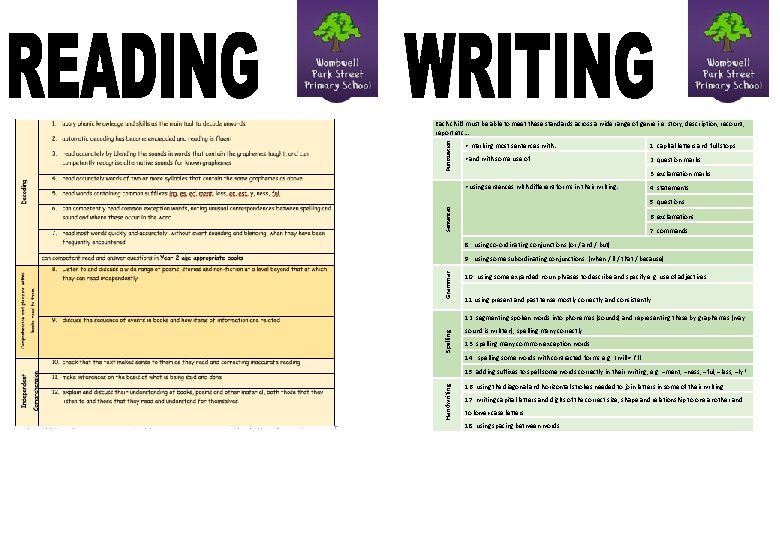
Punctuation Each child must be able to meet these standards across a wide range of genre i. e. story, description, recount, report etc… • marking most sentences with: 1. capital letters and full stops • and with some use of 2. question marks 3. exclamation marks • using sentences with different forms in their writing: 4. statements Sentences 5. questions 6. exclamations 7. commands 8. using co-ordinating conjunctions (or / and / but) Grammar 9. using some subordinating conjunctions (when / if / that / because) 10. using some expanded noun phrases to describe and specify e. g. use of adjectives 11. using present and past tense mostly correctly and consistently Spelling 12. segmenting spoken words into phonemes (sounds) and representing these by graphemes (way sound is written), spelling many correctly 13. spelling many common exception words 14. . spelling some words with contracted forms e. g. I will = I’ll Handwriting 15. adding suffixes to spell some words correctly in their writing, e. g. –ment, –ness, –ful, –less, –ly * 16. using the diagonal and horizontal strokes needed to join letters in some of their writing 17. writing capital letters and digits of the correct size, shape and relationship to one another and to lower-case letters 18. using spacing between words
- Slides: 2