
PLACE AND MANNER OF ARTICULATION Consonant Three main

- Slides: 37
PLACE AND MANNER OF ARTICULATION Consonant
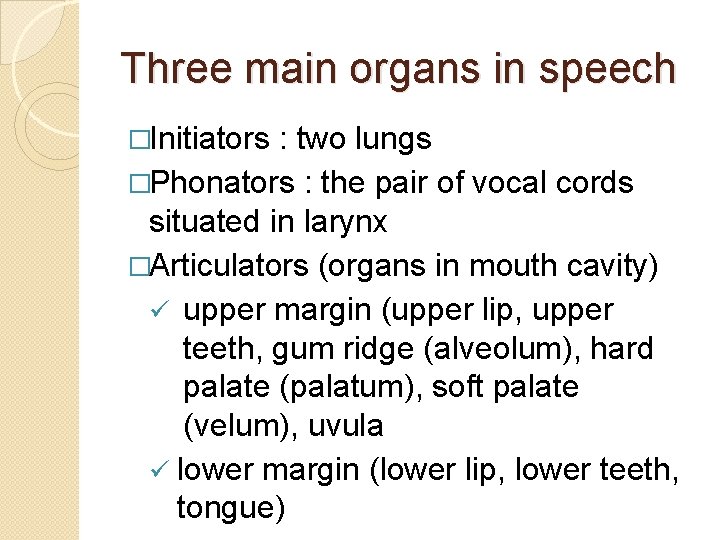
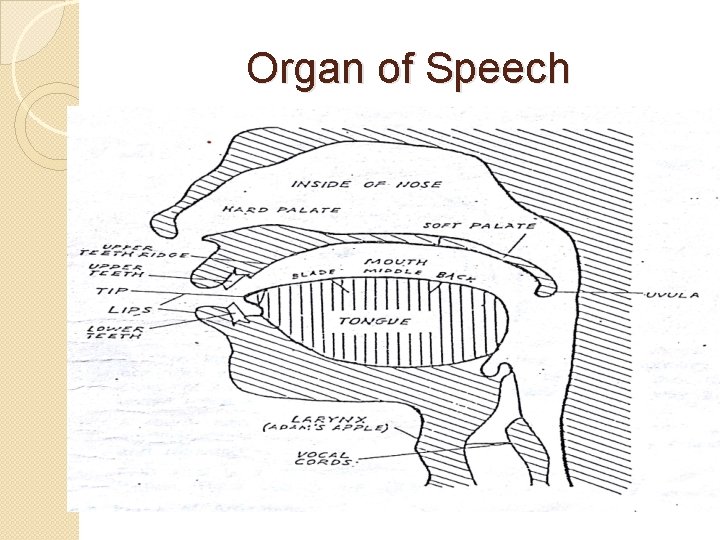
Three main organs in speech �Initiators : two lungs �Phonators : the pair of vocal cords situated in larynx �Articulators (organs in mouth cavity) ü upper margin (upper lip, upper teeth, gum ridge (alveolum), hard palate (palatum), soft palate (velum), uvula ü lower margin (lower lip, lower teeth, tongue)
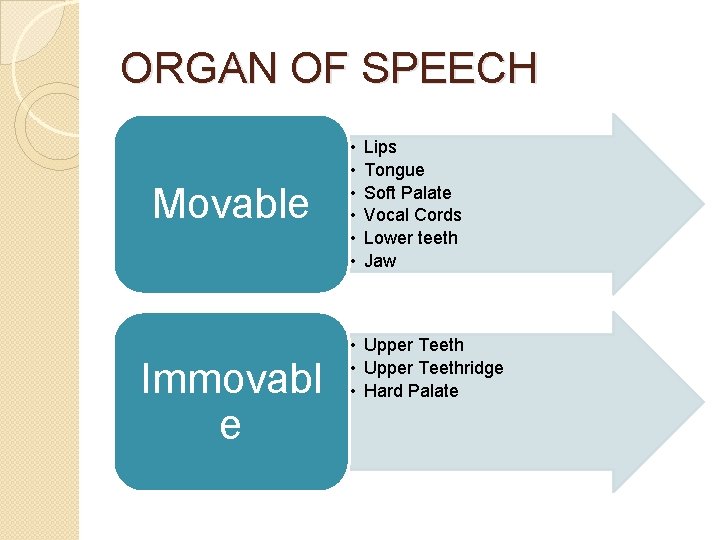
ORGAN OF SPEECH Movable Immovabl e • • • Lips Tongue Soft Palate Vocal Cords Lower teeth Jaw • Upper Teethridge • Hard Palate
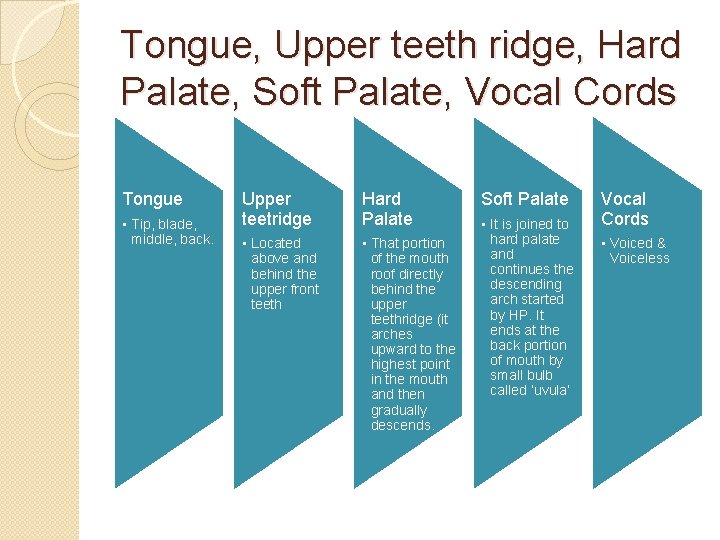
Tongue, Upper teeth ridge, Hard Palate, Soft Palate, Vocal Cords Tongue • Tip, blade, middle, back. Upper teetridge Hard Palate • Located above and behind the upper front teeth • That portion of the mouth roof directly behind the upper teethridge (it arches upward to the highest point in the mouth and then gradually descends. Soft Palate • It is joined to hard palate and continues the descending arch started by HP. It ends at the back portion of mouth by small bulb called ‘uvula’ Vocal Cords • Voiced & Voiceless
Organ of Speech
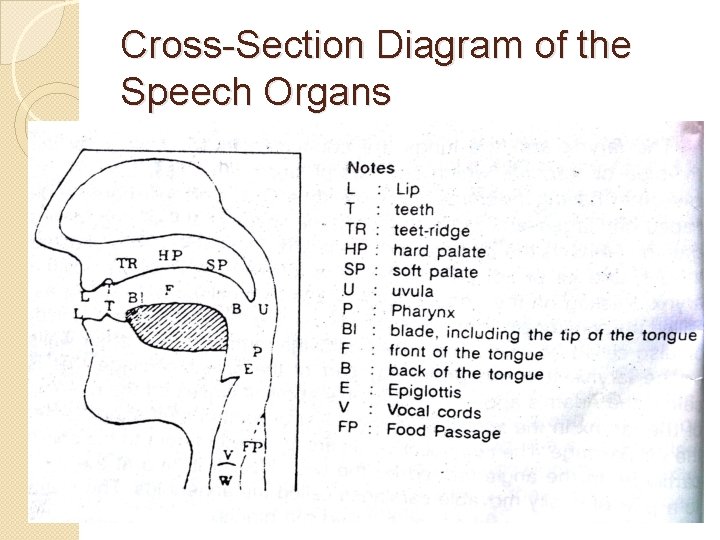
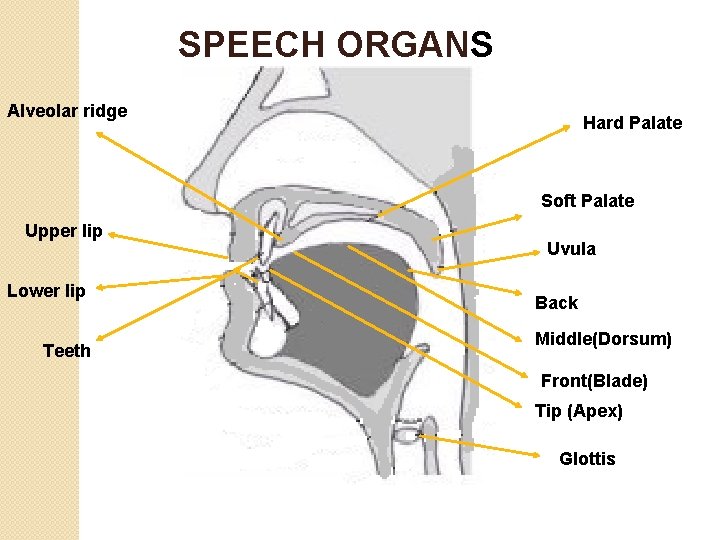
Cross-Section Diagram of the Speech Organs
Besides a brain (and the knowledge of the language), what do you need to use the spoken language? These are the speech organs.
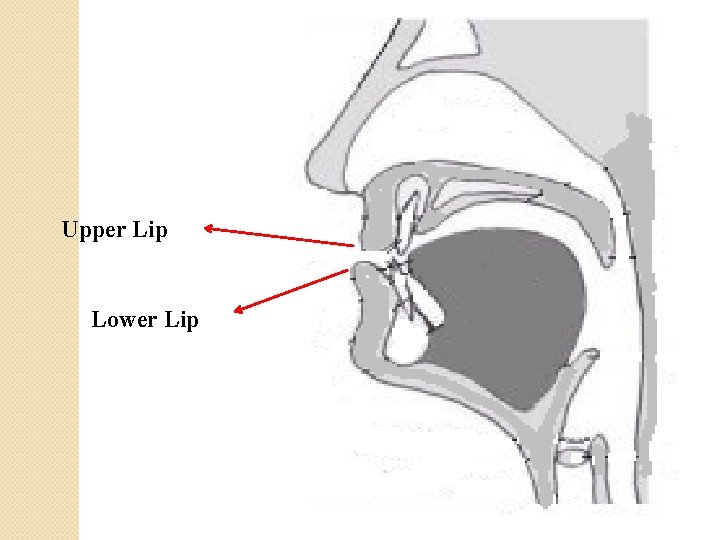
Speech organs that belong to the articulatory system: Lips - they serve for creating different sounds mainly the labial, bilabial (e. g. /p/, /b/, /m/, /hw/, and /w/) and labio-dental consonant sounds (e. g. /f/ and /v/ - and thus create an important part of the speech apparatus.
Upper Lip Lower Lip
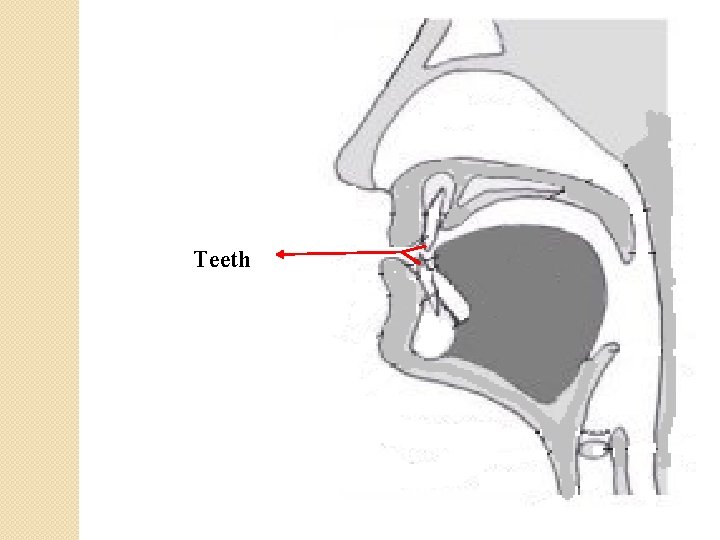
teeth - small whitish structures found in jaws - responsible for creating sounds mainly the labio-dental (e. g. /f/ and /v/and lingua-dental (e. g. /ð/and /θ/)
Teeth
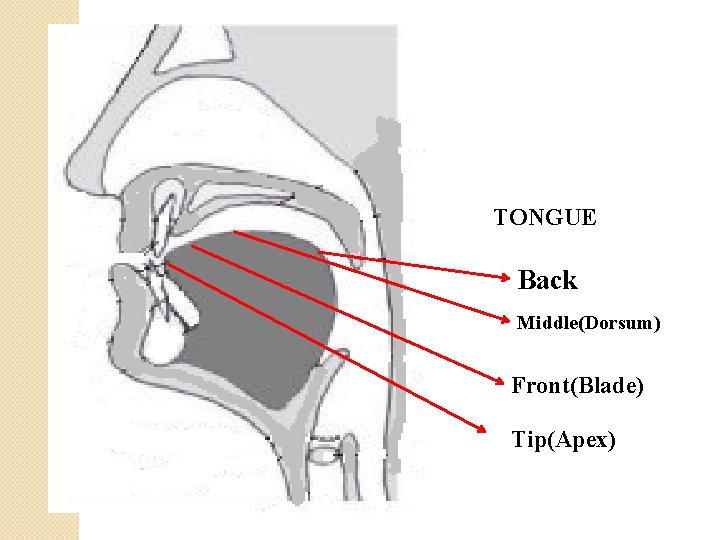
tongue - with its wide variety of possible movements, it assists in forming the sounds of speech.
TONGUE Back Middle(Dorsum) Front(Blade) Tip(Apex)
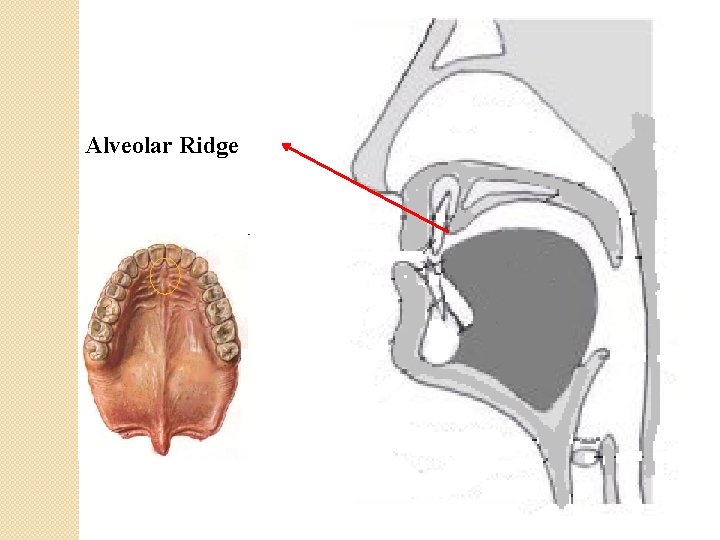
Alveolar ridge - hard ridge behind the upper front teeth. It is between the roof of the mouth and the upper teeth.
�For the sound /s/, air from the lungs passes continuously through the mouth, but the tongue is raised sufficiently close to the alveolar ridge (the section of the upper jaw containing the tooth sockets) to cause friction as it partially blocks the air that passes.
Alveolar Ridge
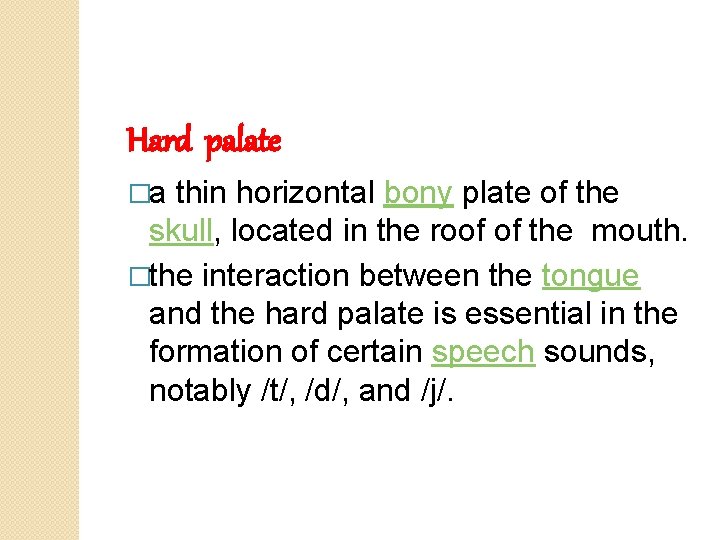
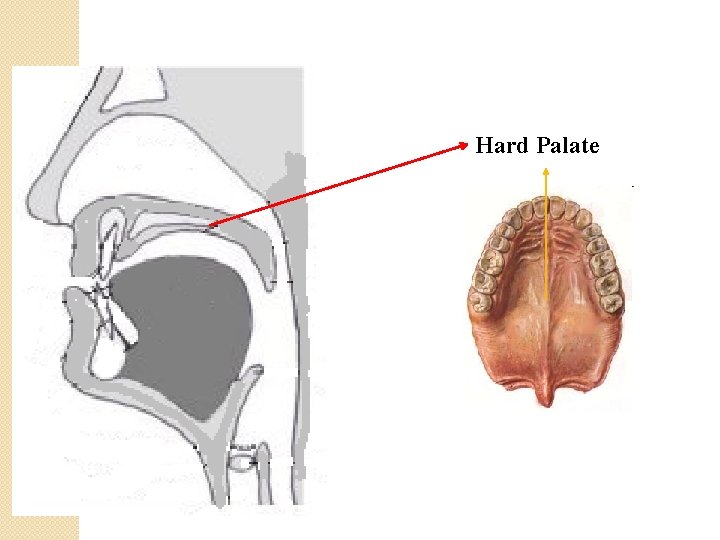
Hard palate �a thin horizontal bony plate of the skull, located in the roof of the mouth. �the interaction between the tongue and the hard palate is essential in the formation of certain speech sounds, notably /t/, /d/, and /j/.
Hard Palate
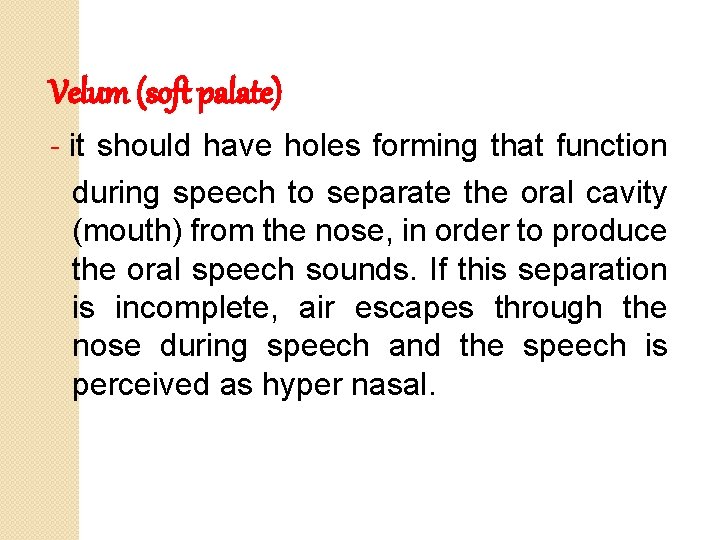
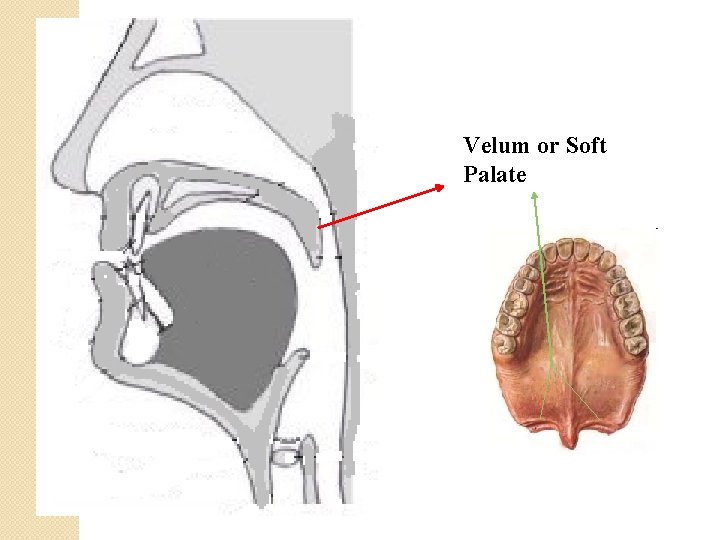
Velum (soft palate) - it should have holes forming that function during speech to separate the oral cavity (mouth) from the nose, in order to produce the oral speech sounds. If this separation is incomplete, air escapes through the nose during speech and the speech is perceived as hyper nasal.
Velum or Soft Palate
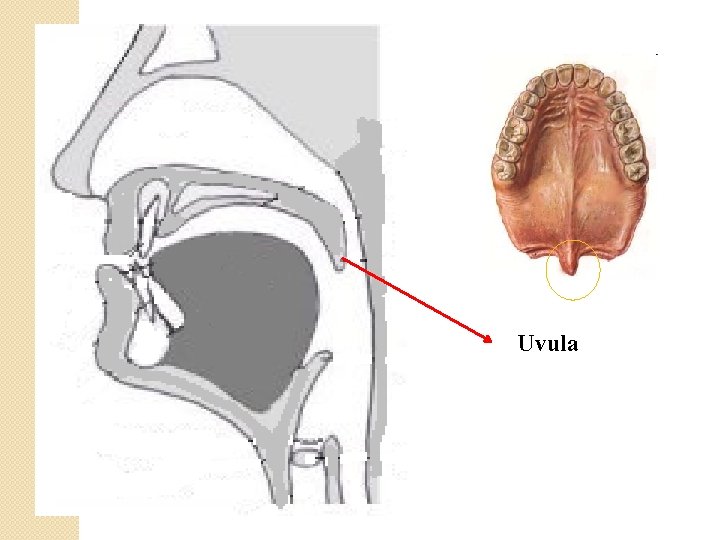
Uvula it functions in tandem with the back of the throat, the palate, and air coming up from the lungs to create a number of guttural and other sounds. - In many languages, it closes to prevent air escaping through the nose when making some sounds. -
Uvula
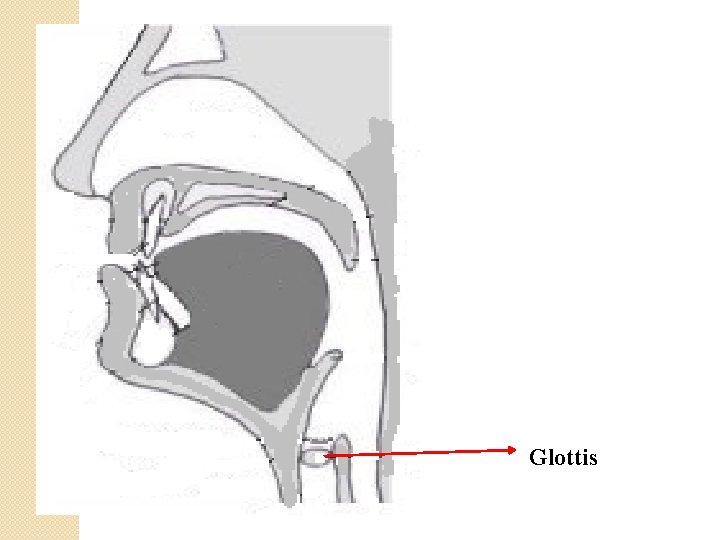
Glottis �combination of vocal folds and space in between the folds �as the vocal folds vibrate, the resulting vibration produces a “buzzing” quality to the speech called voice or voicing or pronunciation. �sound production involving only the glottis is called glottal. Example is the sound /h/.
Glottis
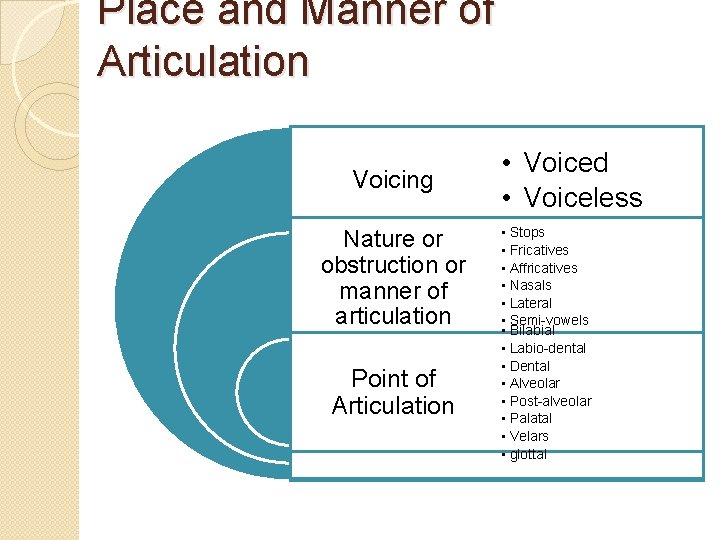
Place and Manner of Articulation Voicing Nature or obstruction or manner of articulation Point of Articulation • Voiced • Voiceless • Stops • Fricatives • Affricatives • Nasals • Lateral • Semi-vowels • Bilabial • Labio-dental • Dental • Alveolar • Post-alveolar • Palatal • Velars • glottal
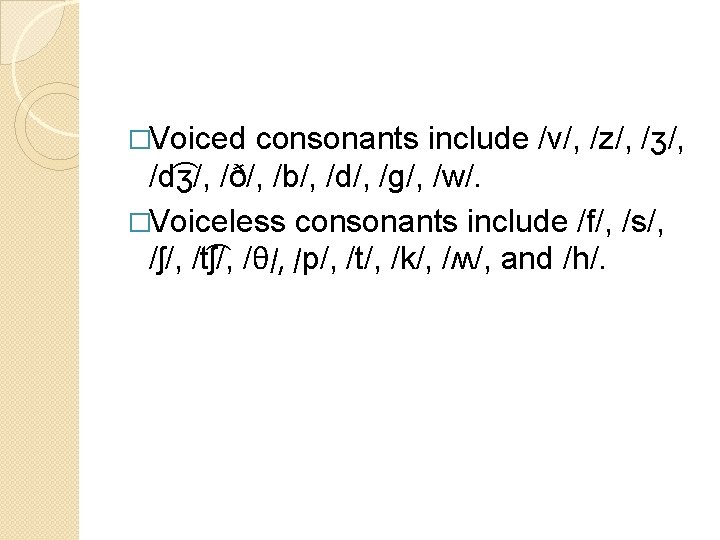
�Voiced consonants include /v/, /z/, /ʒ/, /d ʒ/, /ð/, /b/, /d/, /ɡ/, /w/. �Voiceless consonants include /f/, /s/, /ʃ/, /t ʃ/, /θ/, /p/, /t/, /k/, /ʍ/, and /h/.
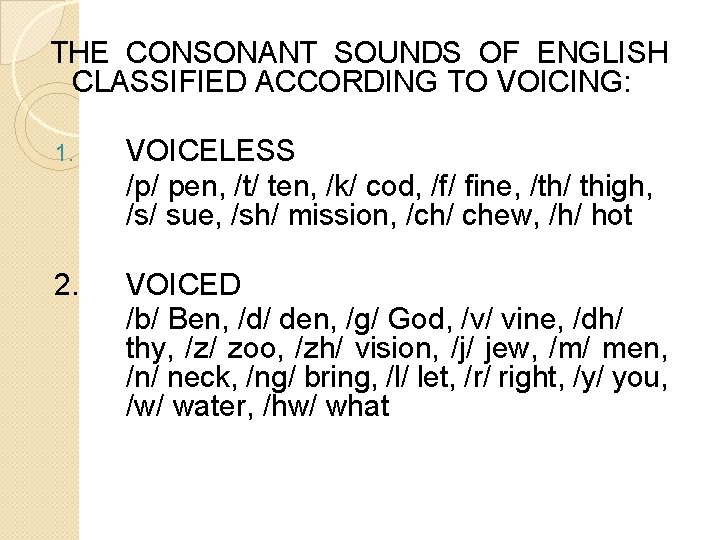
THE CONSONANT SOUNDS OF ENGLISH CLASSIFIED ACCORDING TO VOICING: 1. VOICELESS /p/ pen, /t/ ten, /k/ cod, /f/ fine, /th/ thigh, /s/ sue, /sh/ mission, /ch/ chew, /h/ hot 2. VOICED /b/ Ben, /d/ den, /g/ God, /v/ vine, /dh/ thy, /z/ zoo, /zh/ vision, /j/ jew, /m/ men, /n/ neck, /ng/ bring, /l/ let, /r/ right, /y/ you, /w/ water, /hw/ what
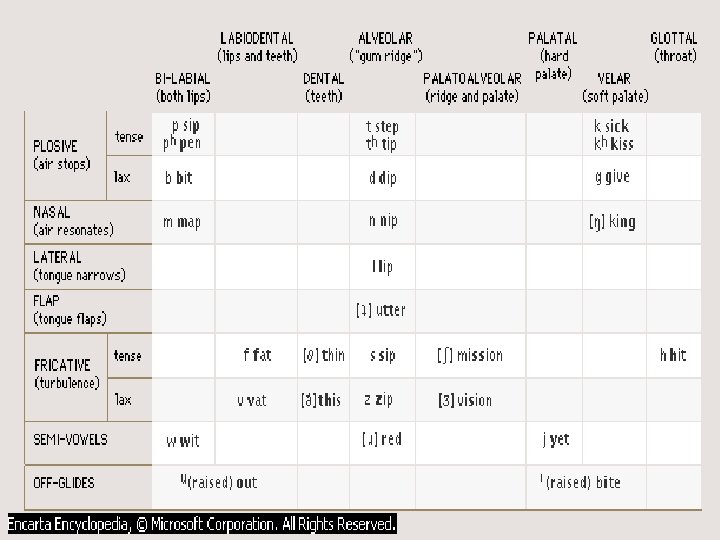
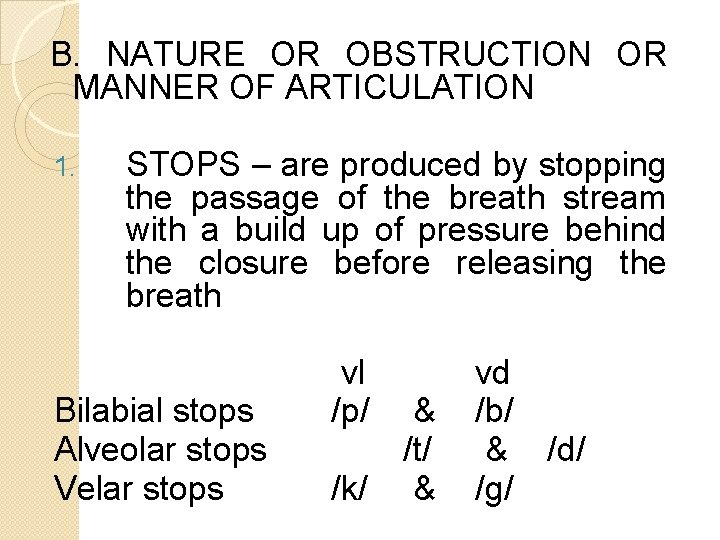
B. NATURE OR OBSTRUCTION OR MANNER OF ARTICULATION 1. STOPS – are produced by stopping the passage of the breath stream with a build up of pressure behind the closure before releasing the breath Bilabial stops Alveolar stops Velar stops vl /p/ /k/ & /t/ & vd /b/ & /g/ /d/
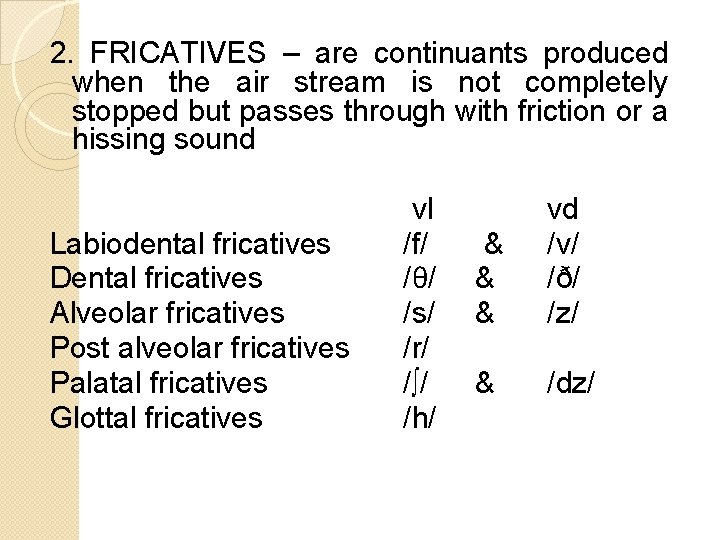
2. FRICATIVES – are continuants produced when the air stream is not completely stopped but passes through with friction or a hissing sound Labiodental fricatives Dental fricatives Alveolar fricatives Post alveolar fricatives Palatal fricatives Glottal fricatives vl /f/ /θ/ /s/ /r/ /∫/ /h/ & & & vd /v/ /ð/ /z/ & /dz/
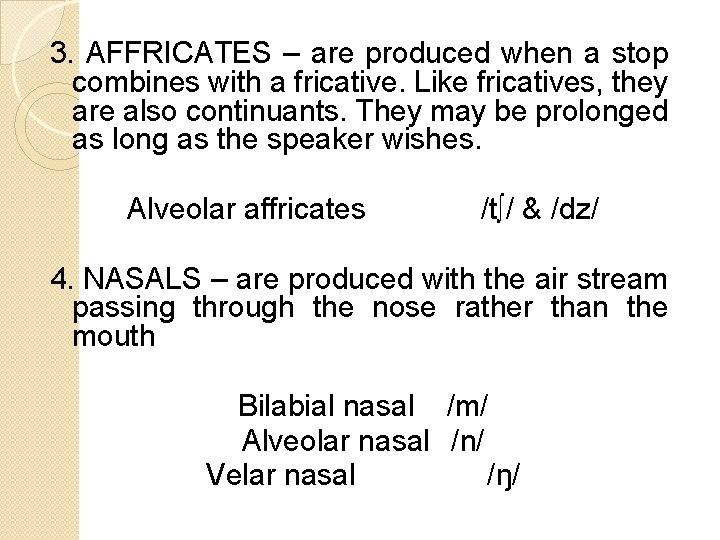
3. AFFRICATES – are produced when a stop combines with a fricative. Like fricatives, they are also continuants. They may be prolonged as long as the speaker wishes. Alveolar affricates /t∫/ & /dz/ 4. NASALS – are produced with the air stream passing through the nose rather than the mouth Bilabial nasal /m/ Alveolar nasal /n/ Velar nasal /ŋ/
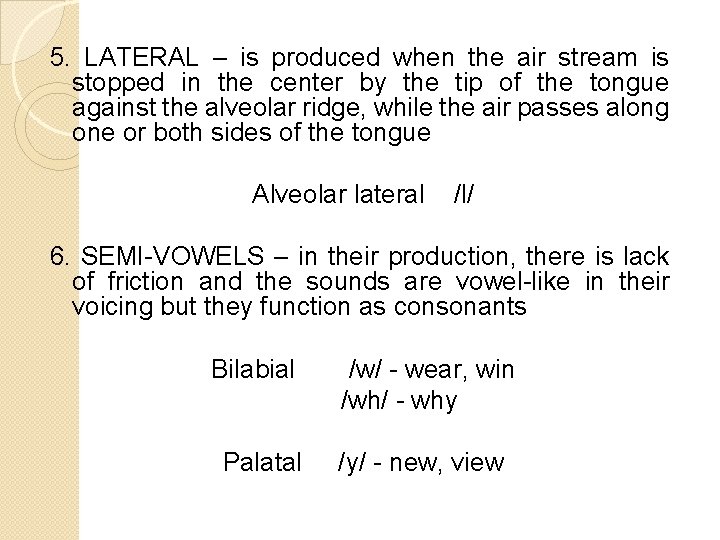
5. LATERAL – is produced when the air stream is stopped in the center by the tip of the tongue against the alveolar ridge, while the air passes along one or both sides of the tongue Alveolar lateral /l/ 6. SEMI-VOWELS – in their production, there is lack of friction and the sounds are vowel-like in their voicing but they function as consonants Bilabial Palatal /w/ - wear, win /wh/ - why /y/ - new, view
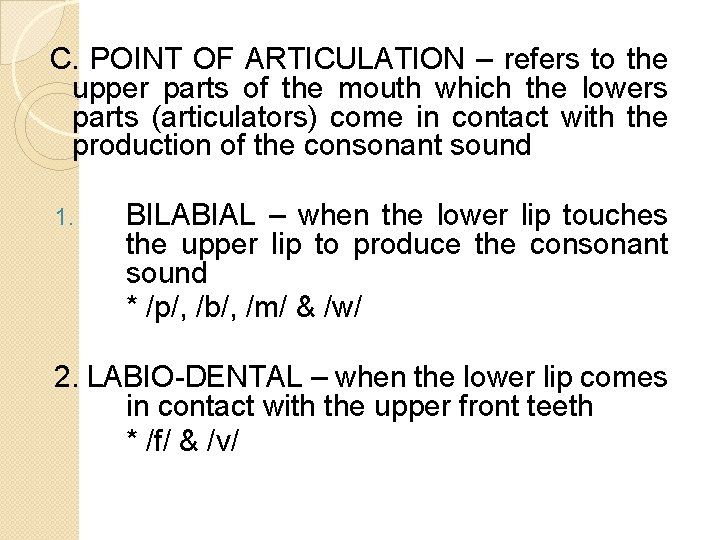
C. POINT OF ARTICULATION – refers to the upper parts of the mouth which the lowers parts (articulators) come in contact with the production of the consonant sound 1. BILABIAL – when the lower lip touches the upper lip to produce the consonant sound * /p/, /b/, /m/ & /w/ 2. LABIO-DENTAL – when the lower lip comes in contact with the upper front teeth * /f/ & /v/
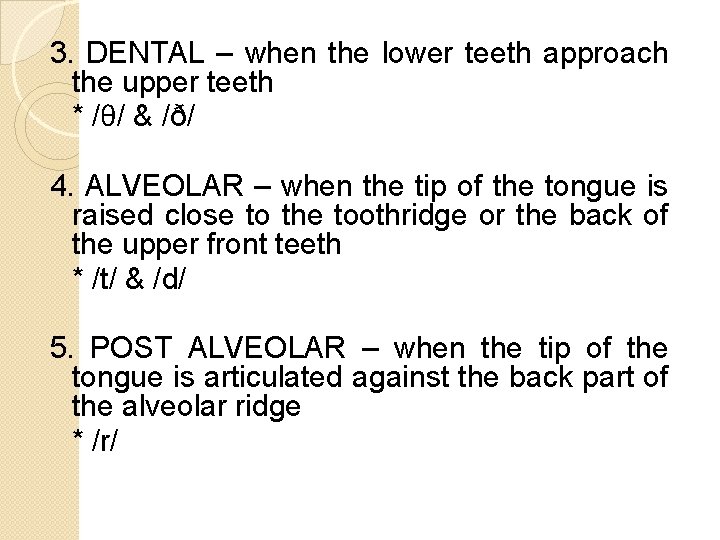
3. DENTAL – when the lower teeth approach the upper teeth * /θ/ & /ð/ 4. ALVEOLAR – when the tip of the tongue is raised close to the toothridge or the back of the upper front teeth * /t/ & /d/ 5. POST ALVEOLAR – when the tip of the tongue is articulated against the back part of the alveolar ridge * /r/
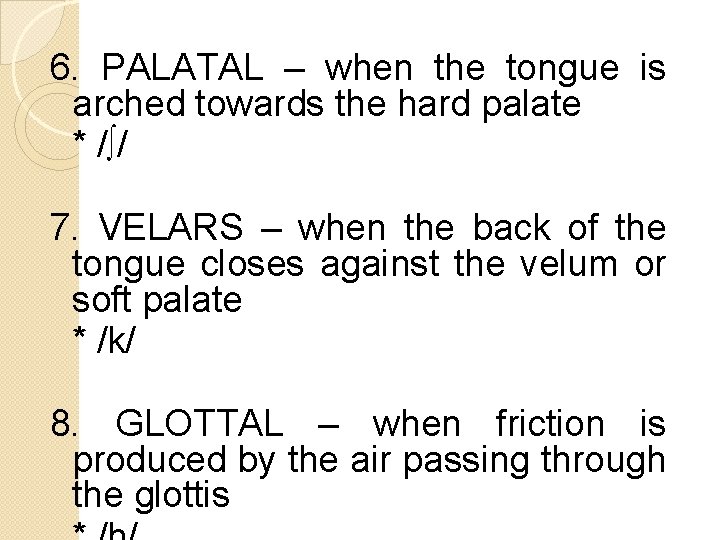
6. PALATAL – when the tongue is arched towards the hard palate * /∫/ 7. VELARS – when the back of the tongue closes against the velum or soft palate * /k/ 8. GLOTTAL – when friction is produced by the air passing through the glottis
SPEECH ORGANS Alveolar ridge Hard Palate Soft Palate Upper lip Lower lip Teeth Uvula Back Middle(Dorsum) Front(Blade) Tip (Apex) Glottis
T HA N K Y O U ! Wassalamu ‘alaikum