
PK inhibitors how to interpret in hemophilia Alfonso
PK / inhibitors: how to interpret in hemophilia Alfonso Iorio, MD Ph. D Mc. Master University, Canada
Alfonso Iorio MD, Ph. D, FRCPC Professor of Medicine Mc. Master University Disclosures Mc. Master University has received research, consultancy and educational funding for Population PK projects from Bayer, Grifols, Novo. Nordisk, Octapharma, Pfizer I am the co-PI of the WAPPS-Hemo project
The Practical Use of How important Pharmacokinetics is PK? in Hemophilia Care Myth Alfonso. Or Iorio Mc. Master University Reality Hamilton ON Canada
Interactive Question 1 Do you use individual PK profiling for tailoring of prophylaxis in hemophiilia? 1. YES, in most patients 2. YES, in some patients 3. NO
Interactive Question 2 Do you use WAPPS for individual PK profiling of your patients? 1. YES 2. Not yet, but maybe I will someday 3. NO
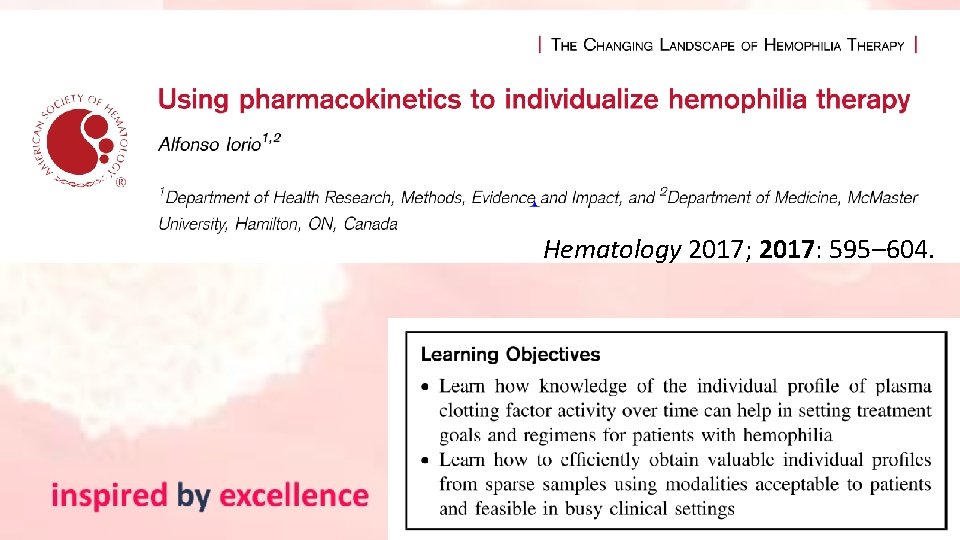
Hematology 2017; 2017: 595– 604.
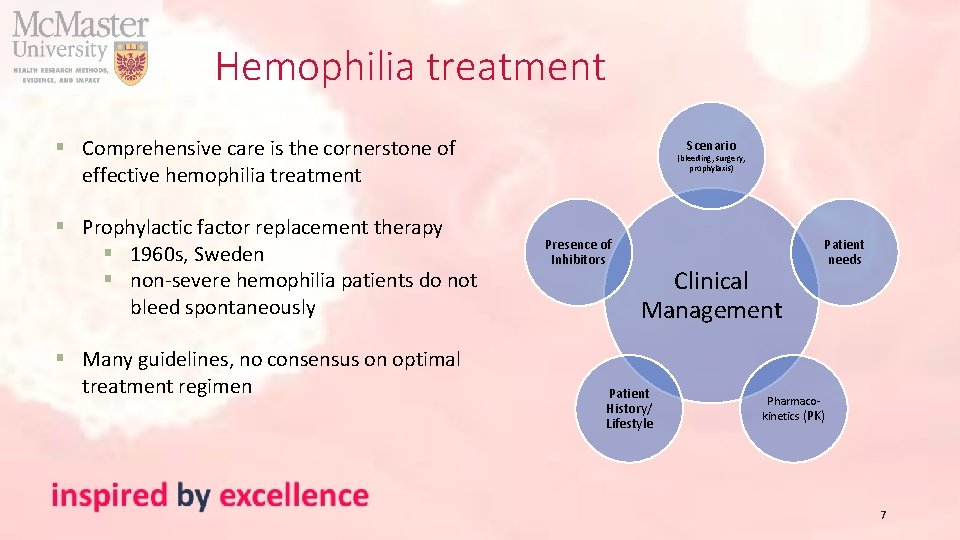
Hemophilia treatment § Comprehensive care is the cornerstone of effective hemophilia treatment § Prophylactic factor replacement therapy § 1960 s, Sweden § non-severe hemophilia patients do not bleed spontaneously § Many guidelines, no consensus on optimal treatment regimen Scenario (bleeding, surgery, prophylaxis) Presence of Inhibitors Clinical Management Patient History/ Lifestyle Patient needs Pharmacokinetics (PK) 7
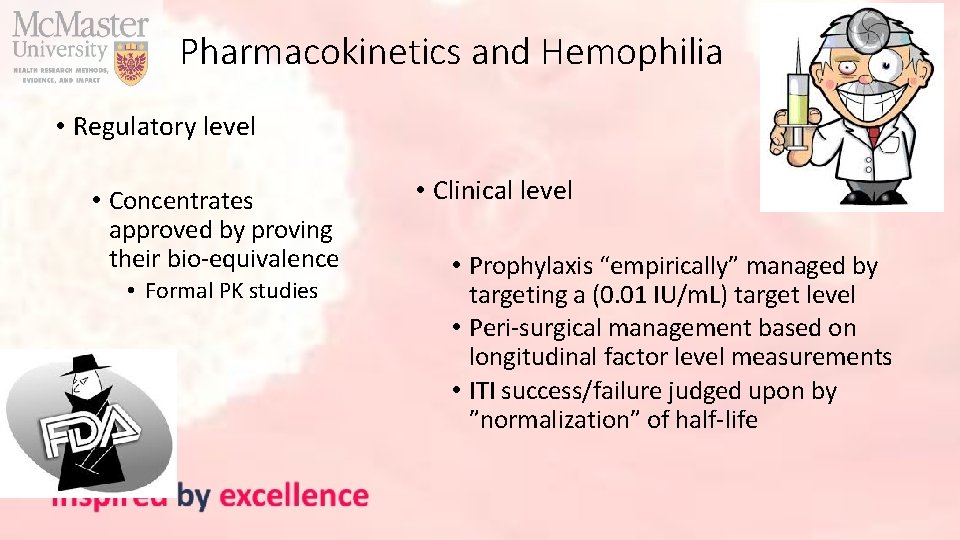
Pharmacokinetics and Hemophilia • Regulatory level • Concentrates approved by proving their bio-equivalence • Formal PK studies • Clinical level • Prophylaxis “empirically” managed by targeting a (0. 01 IU/m. L) target level • Peri-surgical management based on longitudinal factor level measurements • ITI success/failure judged upon by ”normalization” of half-life
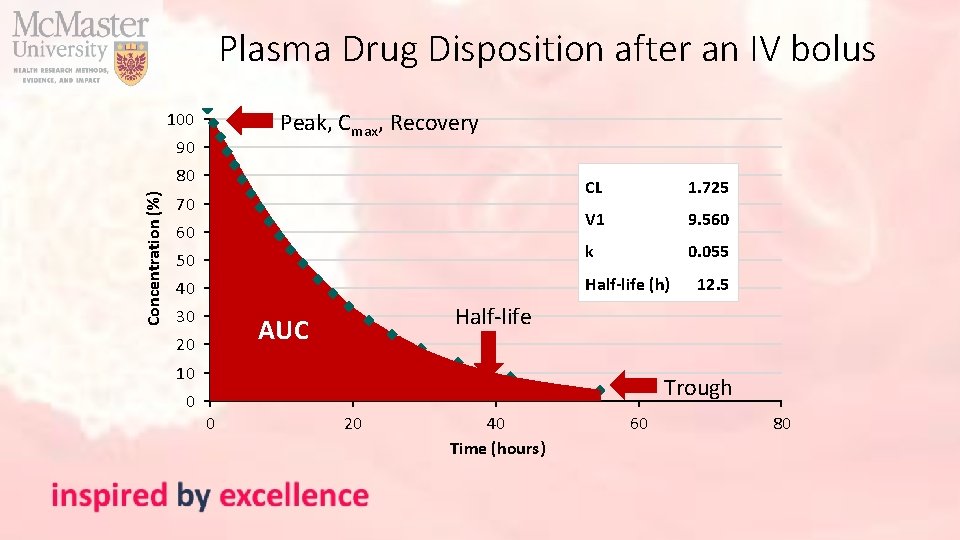
Plasma Drug Disposition after an IV bolus Peak, Cmax, Recovery 100 90 Concentration (%) 80 CL 1. 725 V 1 9. 560 50 k 0. 055 40 Half-life (h) 70 60 30 Half-life AUC 20 10 0 12. 5 Trough 0 20 40 Time (hours) 60 80
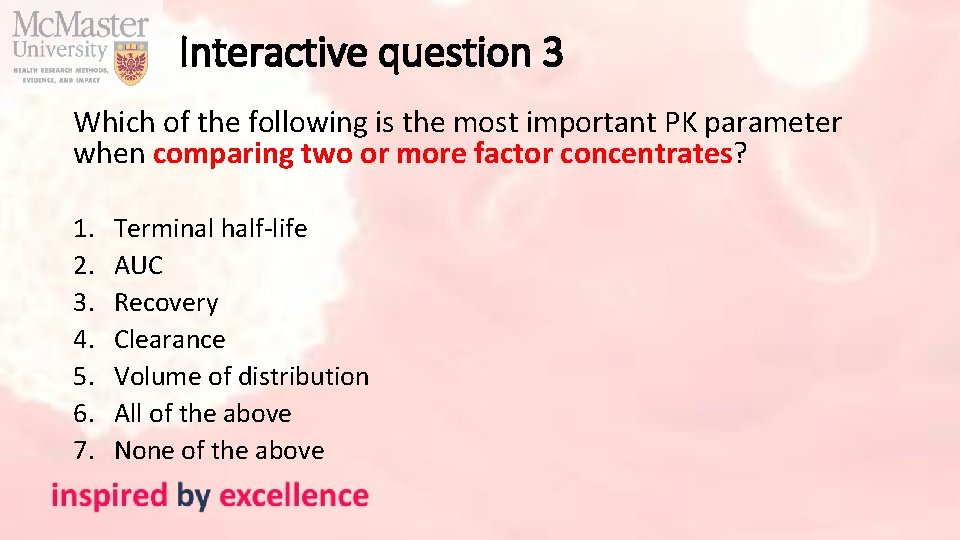
Interactive question 3 Which of the following is the most important PK parameter when comparing two or more factor concentrates? 1. 2. 3. 4. 5. 6. 7. Terminal half-life AUC Recovery Clearance Volume of distribution All of the above None of the above
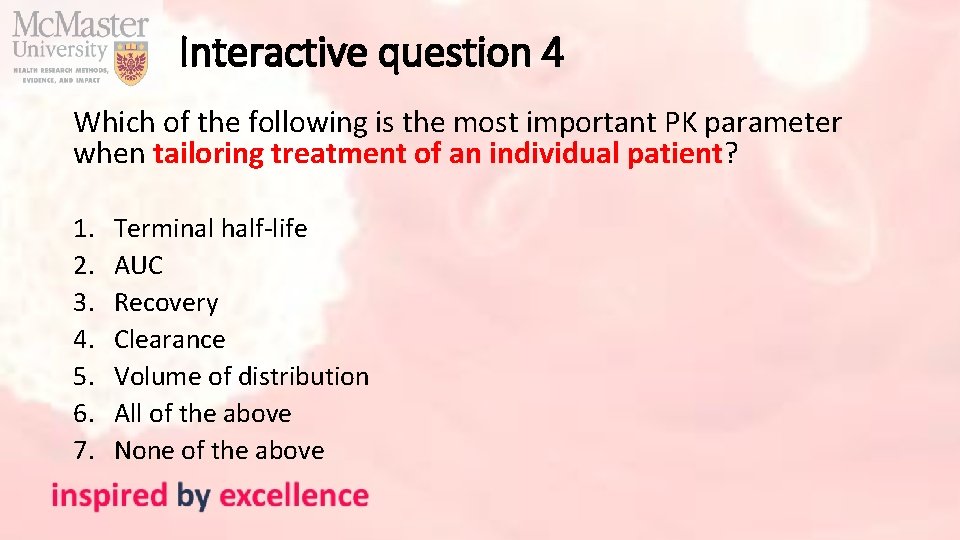
Interactive question 4 Which of the following is the most important PK parameter when tailoring treatment of an individual patient? 1. 2. 3. 4. 5. 6. 7. Terminal half-life AUC Recovery Clearance Volume of distribution All of the above None of the above
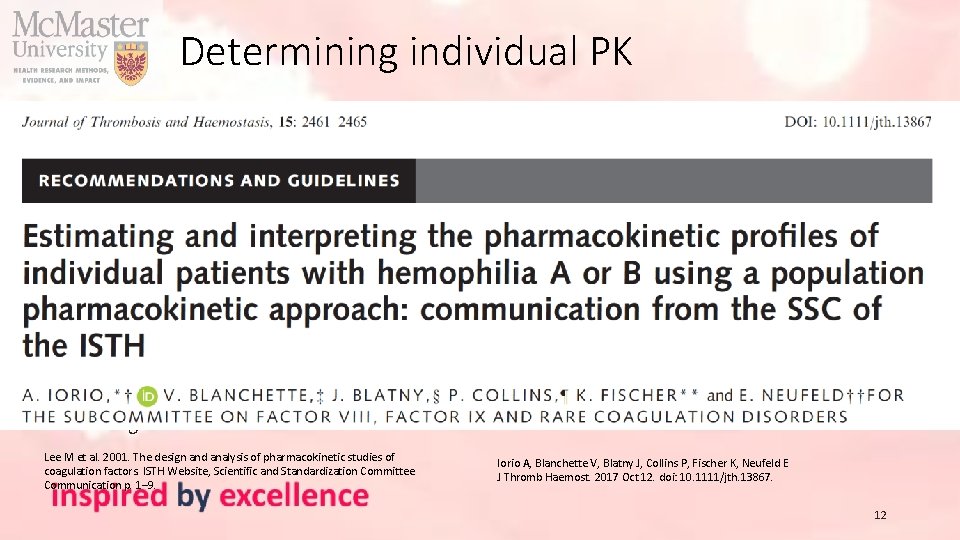
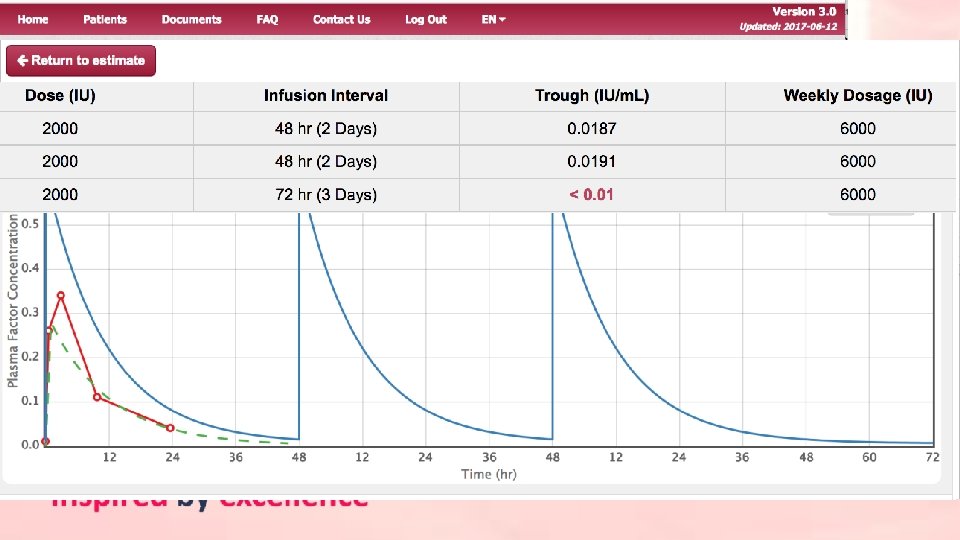
Determining individual PK Designed to understand the average Focus on individual PK estimation 10 or 11 blood samples over a period 2 -3 samples for one patient PK of a concentrate of 32 -72 h after infusing 25 -50 IU/kg at baseline 12 -15 patients with a crossover design Lee M et al. 2001. The design and analysis of pharmacokinetic studies of coagulation factors. ISTH Website, Scientific and Standardization Committee Communication p. 1– 9. Use a population pharmacokinetic model & individual samples to derive individual PK estimates Iorio A, Blanchette V, Blatny J, Collins P, Fischer K, Neufeld E J Thromb Haemost. 2017 Oct 12. doi: 10. 1111/jth. 13867. 12
Interactive question 5 • Which of the following is the most important contribution of population PK modeling to care for hemophilia? 1. 2. 3. 4. Introducing (random) error in clinical practice Increasing the feasibility of individual PK profiles All of the above None of the above

Determining individual PK Historical ISTH guidelines (dense sampling) Designed to understand the average PK of a concentrate 10 or 11 blood samples over a period of 32 -72 h after infusing 25 -50 IU/kg at baseline 12 -15 patients with a crossover design Washout Time Lee M et al. 2001. The design and analysis of pharmacokinetic studies of coagulation factors. ISTH Website, Scientific and Standardization Committee Communication p. 1– 9. 14

Determining individual PK New ISTH guidelines Washout Fixed dose (pop. PK + sparse sampling) Focus on individual PK estimation 2 -3 samples for one patient 4 4 24 24 Use a population pharmacokinetic model & individual samples to derive individual PK estimates Time Iorio A, Blanchette V, Blatny J, Collins P, Fischer K, Neufeld E J Thromb Haemost. 2017 Oct 12. doi: 10. 1111/jth. 13867. 15 48 48
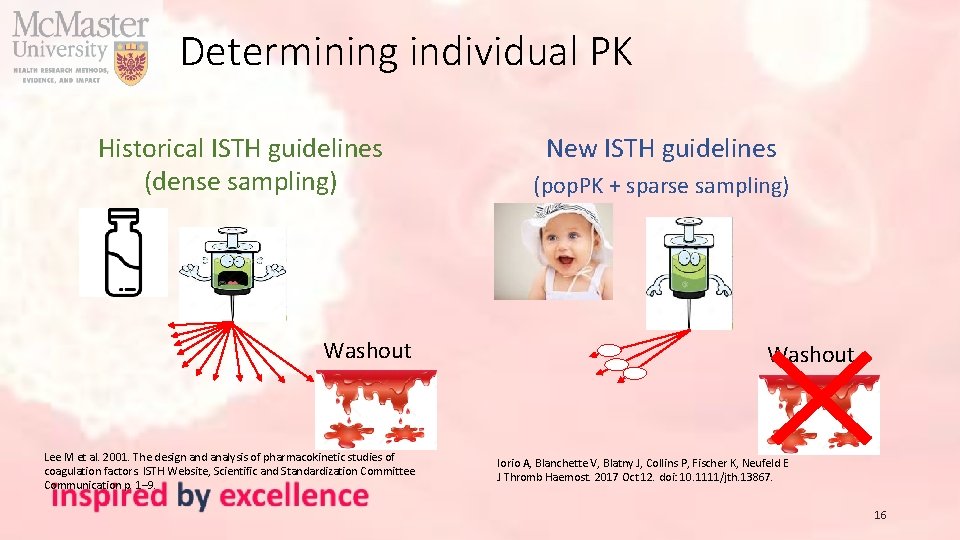
Determining individual PK Historical ISTH guidelines (dense sampling) Washout Lee M et al. 2001. The design and analysis of pharmacokinetic studies of coagulation factors. ISTH Website, Scientific and Standardization Committee Communication p. 1– 9. New ISTH guidelines (pop. PK + sparse sampling) Washout Iorio A, Blanchette V, Blatny J, Collins P, Fischer K, Neufeld E J Thromb Haemost. 2017 Oct 12. doi: 10. 1111/jth. 13867. 16
The 3 key concepts about Pop. PK Individual Pop. PK tailoring of hemophilia treatment is about: 1. Modeling inter-individual variability 2. Cannot be sustituted by using average population data 3. Cancel out the need for understanding PK parameters
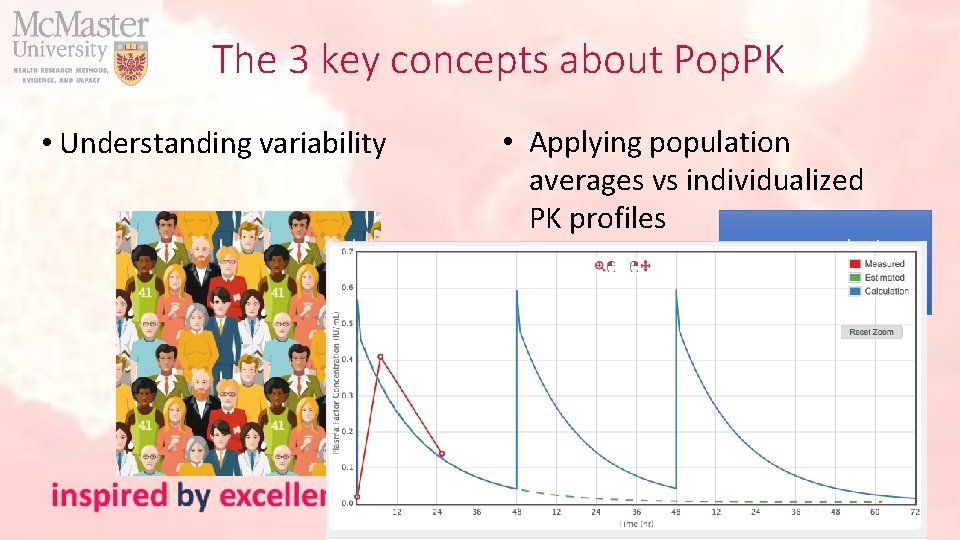
The 3 key concepts about Pop. PK • Understanding variability • Applying population averages vs individualized PK profiles Drug A: 12+/-3 hrs Drug B: 16+/-3 hrs

Understanding variability to define a dosing strategy Infusion 1 Infusion 2 Concentration Maximum concentration Minimum effective concentration Patients have similar PK Individual PK similar over time Generic population dose (e. g. 10 mg/kg) Subject 19
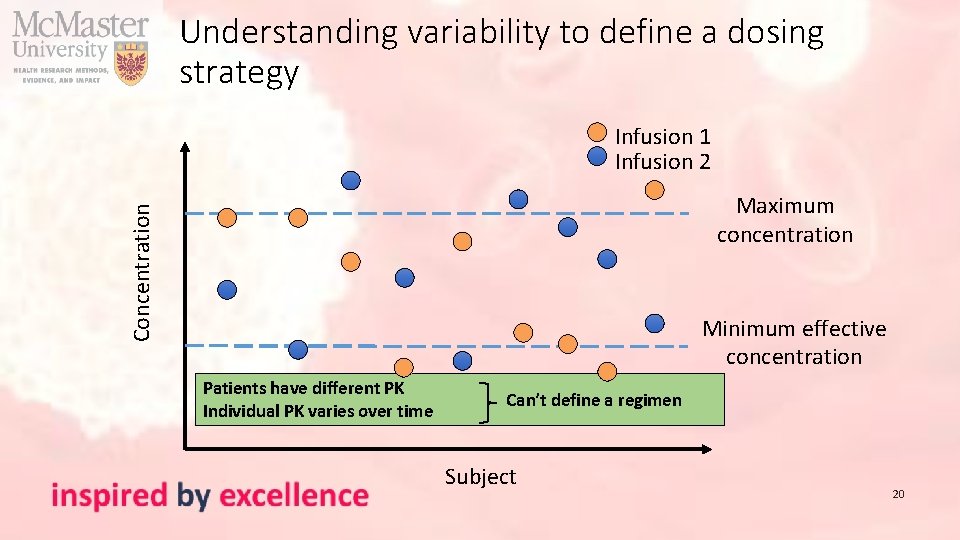
Understanding variability to define a dosing strategy Infusion 1 Infusion 2 Concentration Maximum concentration Minimum effective concentration Patients have different PK Individual PK varies over time Can’t define a regimen Subject 20
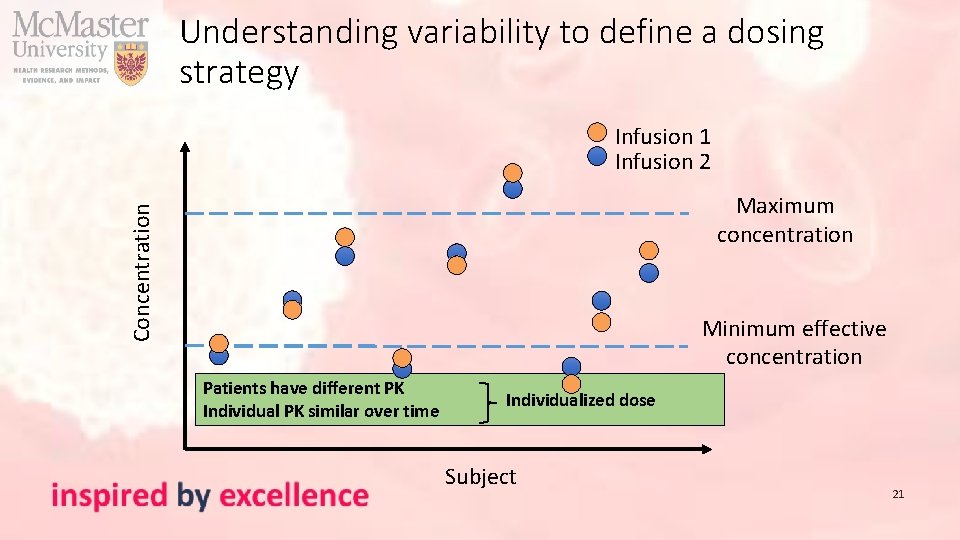
Understanding variability to define a dosing strategy Infusion 1 Infusion 2 Concentration Maximum concentration Minimum effective concentration Patients have different PK Individual PK similar over time Individualized dose Subject 21
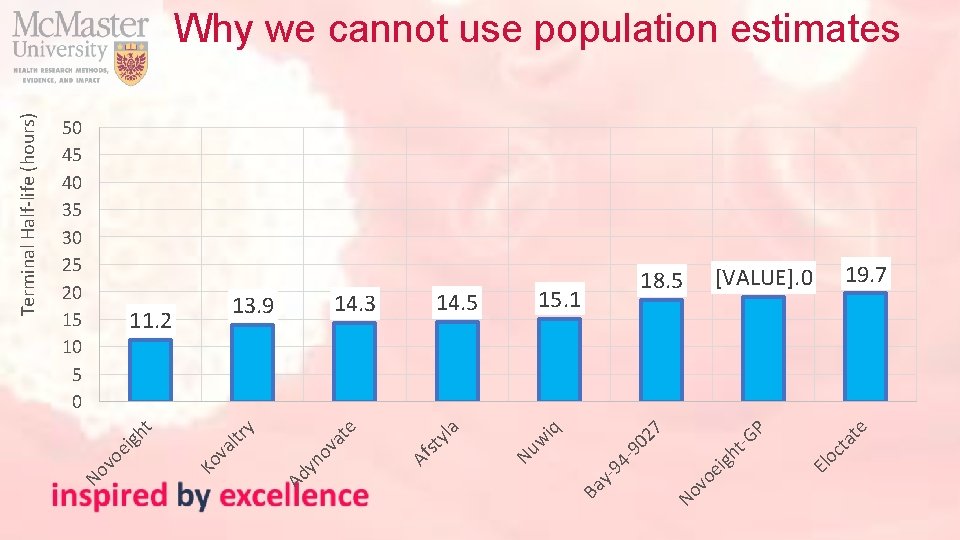
te El oc ta P vo e No Ba y- 94 -9 igh t-G 02 7 iq w 19. 7 [VALUE]. 0 18. 5 15. 1 Nu yla st Af e at yn ov ltr va Ko vo ei gh t y 11. 2 14. 5 14. 3 13. 9 Ad 50 45 40 35 30 25 20 15 10 5 0 No Terminal Half-life (hours) Why we cannot use population estimates
Interactive question 6 How would you rate the average evidence for PK comparisons across concentrates? 1. 2. 3. 4. 5. Very high High Moderate Low Very low
Interactive question 7 Which of the following does reduce the comparability of PK studies of factor concentrates? 1. 2. 3. 4. 5. Population size Population characteristics Study design Analysis method All of the above
Interactive question 8 Which of the following is the most important barrier to the use of average PK estimates for individual tailoring? 1. 2. 3. 4. 5. Study design Population characteristics Analysis method Interindividual variability None of the above
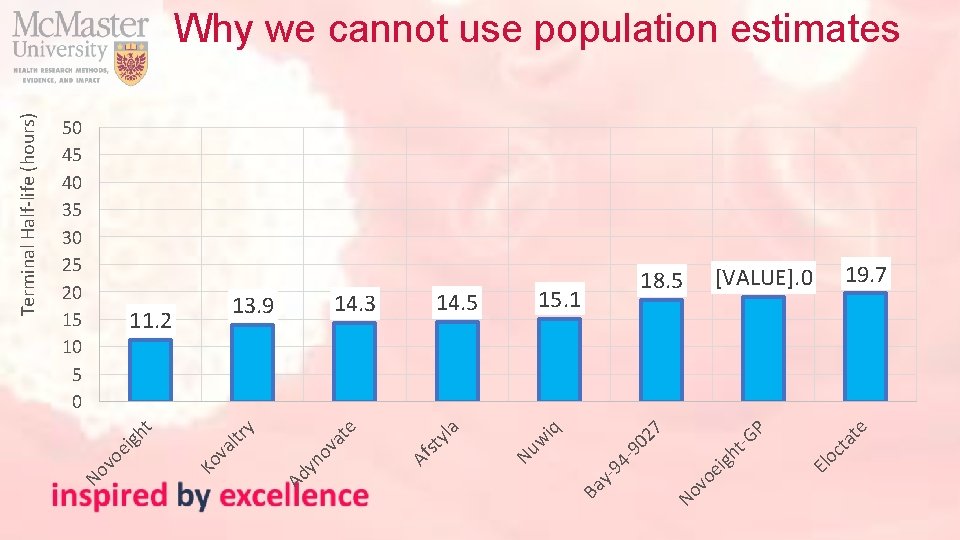
te El oc ta P vo e No Ba y- 94 -9 igh t-G 02 7 iq w 19. 7 [VALUE]. 0 18. 5 15. 1 Nu yla st Af e at yn ov ltr va Ko vo ei gh t y 11. 2 14. 5 14. 3 13. 9 Ad 50 45 40 35 30 25 20 15 10 5 0 No Terminal Half-life (hours) Why we cannot use population estimates
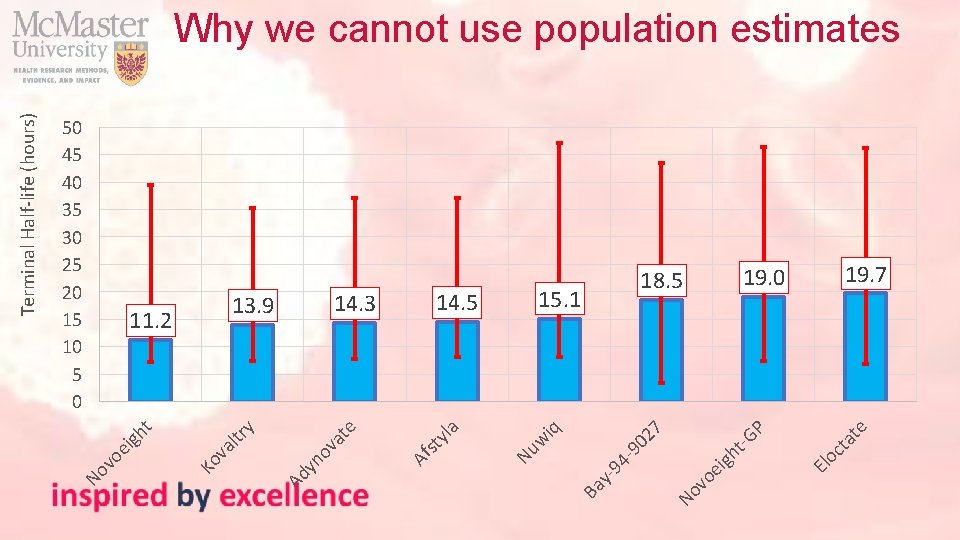
te ta oc 18. 5 El 7 P igh t-G vo e 02 15. 1 No -9 94 y- Ba iq 14. 5 w 14. 3 Nu yla st 13. 9 Af e at yn ov y 11. 2 Ad ltr va 50 45 40 35 30 25 20 15 10 5 0 Ko t ei gh vo No Terminal Half-life (hours) Why we cannot use population estimates 19. 0 19. 7

Individual PK profile Specific patient Specific concentrate (Limited) set of measured data 28
Back-of-napkin individual PK profiling?

Back-of-napkin individual PK profiling?
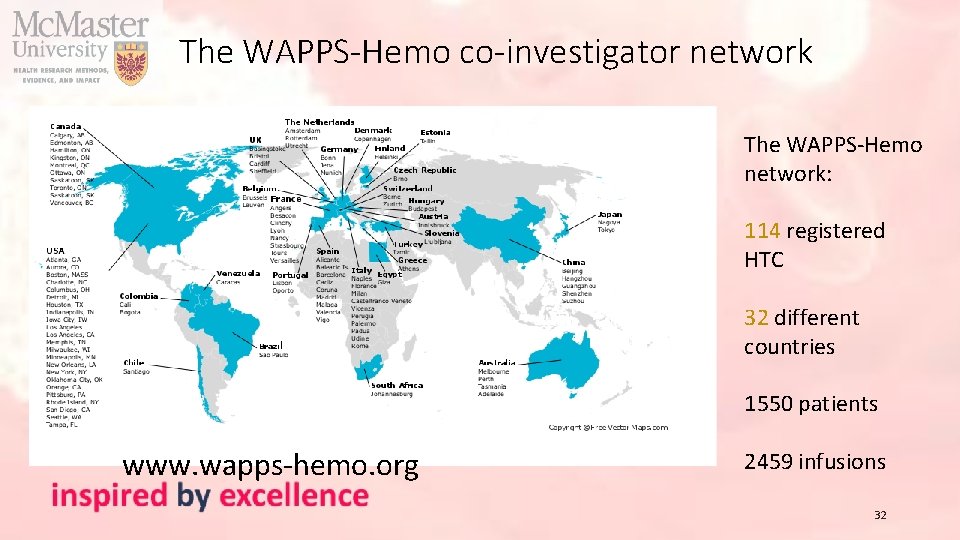
The WAPPS-Hemo co-investigator network The WAPPS-Hemo network: 114 registered HTC 32 different countries 1550 patients www. wapps-hemo. org 2459 infusions 32
Inhibitors
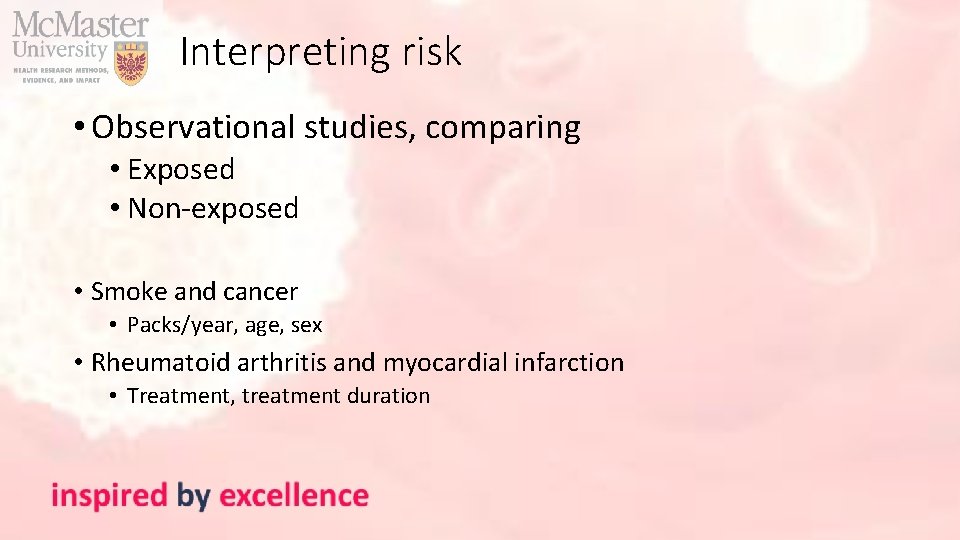
Interpreting risk • Observational studies, comparing • Exposed • Non-exposed • Smoke and cancer • Packs/year, age, sex • Rheumatoid arthritis and myocardial infarction • Treatment, treatment duration
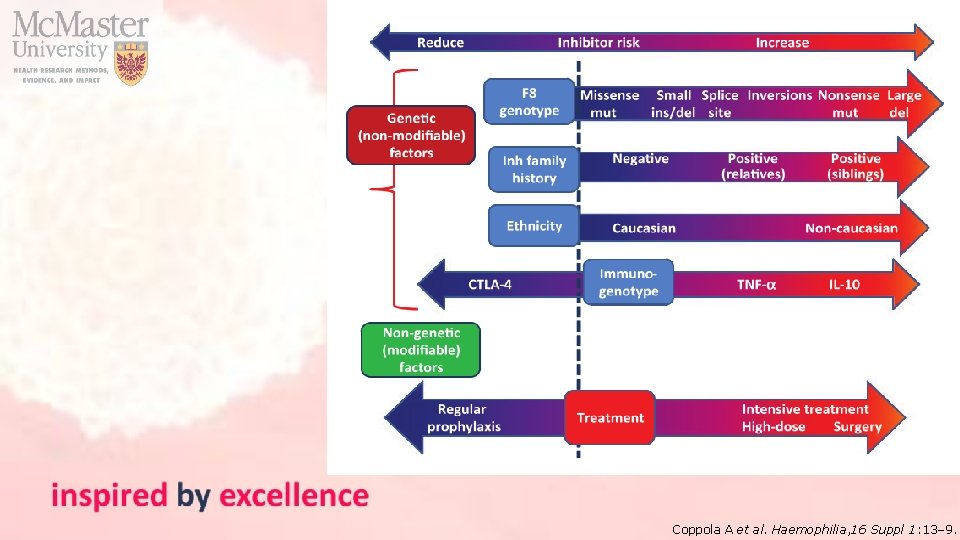
Coppola A et al. Haemophilia, 16 Suppl 1: 13– 9.
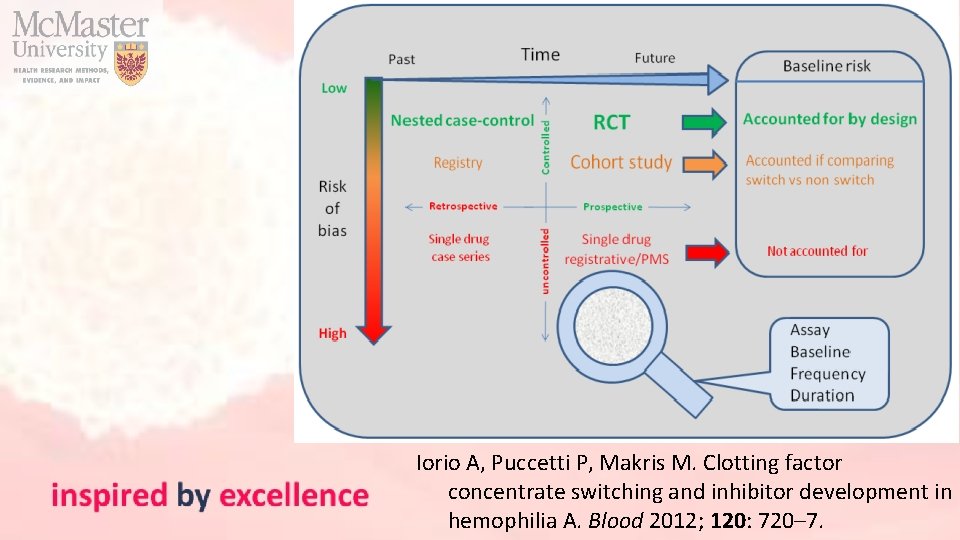
Iorio A, Puccetti P, Makris M. Clotting factor concentrate switching and inhibitor development in hemophilia A. Blood 2012; 120: 720– 7.
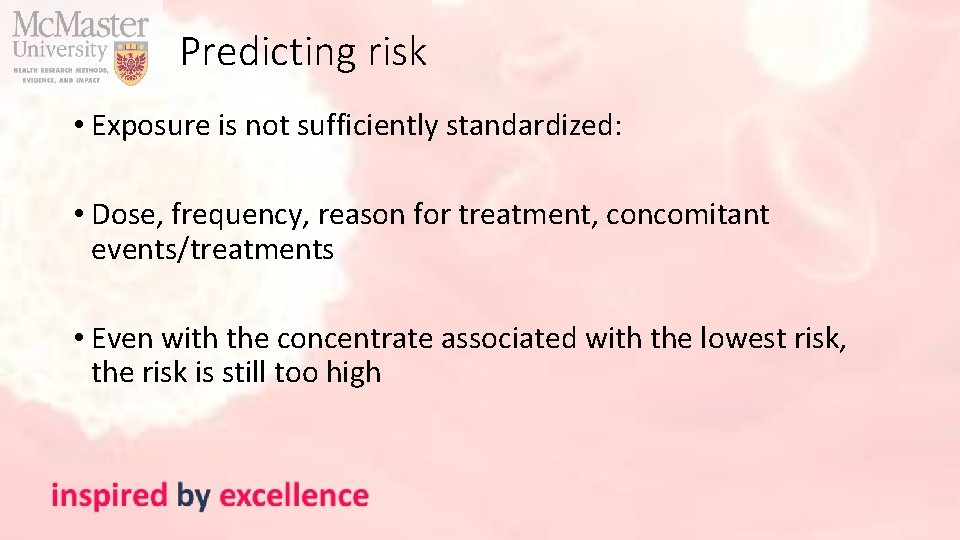
Predicting risk • Exposure is not sufficiently standardized: • Dose, frequency, reason for treatment, concomitant events/treatments • Even with the concentrate associated with the lowest risk, the risk is still too high
Interpreting risk of inhibitors • All studies preformed to date have failed to produce evidence impacting on clinical practice • We need a paradigm shift – an innovative, alternative approach • Mimetics and gene therapy are both changing the landscape, in different ways • NIH research initiative
The future is prevention and cure, not prediction !! 1 2 3 4 Sherman A, Biswas M, Herzog RW. Innovative Approaches for Immune Tolerance to Factor VIII in the Treatment of Hemophilia A. Front Immunol 2017; 8: 1604. Kwon K et al. Expression and assembly of largest foreign protein in chloroplasts: Oral delivery of human FVIII made in lettuce chloroplasts robustly suppresses inhibitor formation in hemophilia A mice. Plant Biotechnol J 2017; : 1– 13. Parvathaneni K et al. Hemophilia A inhibitor treatment: the promise of engineered T-cell therapy. Transl Res Elsevier Inc. ; 2017; 187: 44– 52. Lai JD, Lillicrap D. Factor VIII inhibitors: Advances in basic and translational science. Int J Lab Hematol 2017; 39: 6– 13. Meunier S et al. CD 4 T cells specific for factor VIII are present at high frequency in healthy donors and comprise naïve and memory cells. Blood Adv 2017; 1: 1842– 7.

Thanks – and questions welcome www. wapps-hemo. org
- Slides: 40