
PJA Health Safety Briefing Typical hazards in pipe
PJA Health &Safety Briefing Typical hazards in pipe jacking and common control measures
PJA Health & Safety Briefing This health and safety briefing is divided into three sections: • Pipe Jacking Association health and safety policies and industry specific standards. Hyperlinks connect to publicly available sources. • Typical hazards likely to be encountered on pipe jacking sites. • Common control measures.
Overview: PJA H&S Policies • The Pipe Jacking Association is the UK trade association that represents all major contractors and suppliers in the UK pipe jacking and micro-tunnelling industry. • Health & Safety is an overriding concern of members and it is mandatory that all personnel are certificated and undergo a comprehensive safety induction. • In addition to established construction industry guidelines all members undertake to comply with a range of industry specific safety standards.
Industry Specific Standards The PJA is represented on a range of industry safety standard bodies and has provide major inputs to: • BS 6164: 2011 – Code of practice for health and safety in tunnelling in the construction industry • BS EN 16191 – Tunnelling machinery safety requirements • HSE/BTS/PJA Tunnelling and Pipe Jacking Guidance for Designers • PJA Guidance on Hand Tunnelling • BTS Guide to Good Practice: The management of hand -arm vibration in tunnelling
Site Investigation and CDM • Site investigation, both factual and interpretative, is a necessary precursor to any underground project in order to ascertain ground characteristics and water presence. • SI together with compliance with Construction (Design and Management) Regulations place an onus on promoters, designers and contractors to ensure that safe working practices form an integral part of any tunnelling project design and implementation.
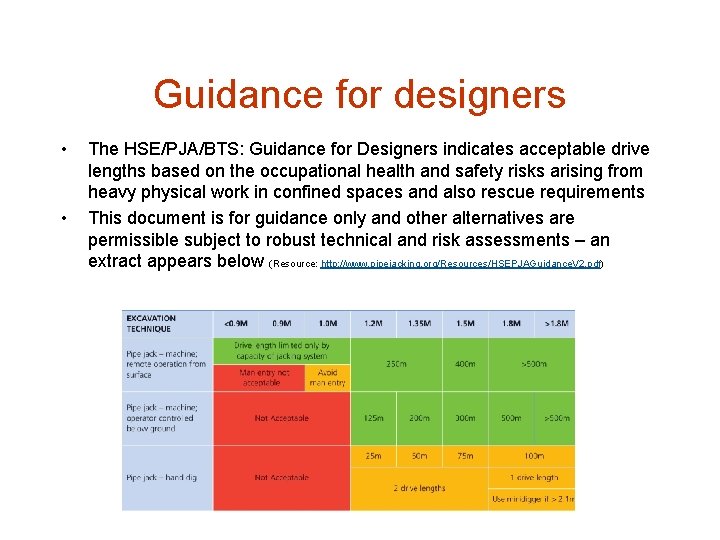
Guidance for designers • • The HSE/PJA/BTS: Guidance for Designers indicates acceptable drive lengths based on the occupational health and safety risks arising from heavy physical work in confined spaces and also rescue requirements This document is for guidance only and other alternatives are permissible subject to robust technical and risk assessments – an extract appears below (Resource: http: //www. pipejacking. org/Resources/HSEPJAGuidance. V 2. pdf)
Temporary Works • Design of shafts & temporary piled pits. • Design of jacking walls and tunnel eyes. • Design of foundations / ground support for craneage operations. • Design of water management.
Hand Excavation • Whilst the majority of pipe jacks are undertaken by machine there are occasions when mechanical excavation is not reasonably practicable. • The PJA has published: Guidance on the design of hand excavated pipe jacks. (Resource: http: //www. pipejacking. org/Resources/PJAGuidancev 2 download. pdf) • This document provides guidance on mitigating any risk from HAVS and noise and also the limitations of hand excavated pipe jacks in various ground conditions.
Training and Risk Management • The PJA has worked closely with CITB and Tunnel. Skills in the development of NVQs for specific pipe jacking and tunnelling operations. (Resource: http: //tunnelskills. org/training/default. asp? tabid=7 ) • This is aligned to the awareness of tunnel entry procedures and a defined level of tunnelling safety knowledge, both mandatory requirements for all underground operatives. (Resource: http: //tunnelskills. org/safety/default. asp? tabid=6) • Risk management is also a major feature of project delivery and the PJA recommends that client organisations operate to the Association of British Insurers/British Tunnelling Society publication: Joint Code of Practice for the Risk Management of Tunnelling Works in the UK. An international version is also available. (Resource: https: //www. britishtunnelling. org. uk/? sitecontentid=881 C 32 EC-21 C 8 -41 A 9 -8 B 7 A-F 8 D 530 E 7987 E)
NVQs in Tunnelling NVQs reflect workplace skills and as such make a significant contribution to safe working practices. Key areas relative to pipe jacking and microtunnelling are: • Shaft Miner • Tunnelling Machine Operator • Pipejacking/Microtunnelling Operative • Spoil Removal Equipment Operative • Separation Plant Operative (Resource: http: //www. tunnelskills. org/qualifications/default. asp? tabid=8&contentid=21)
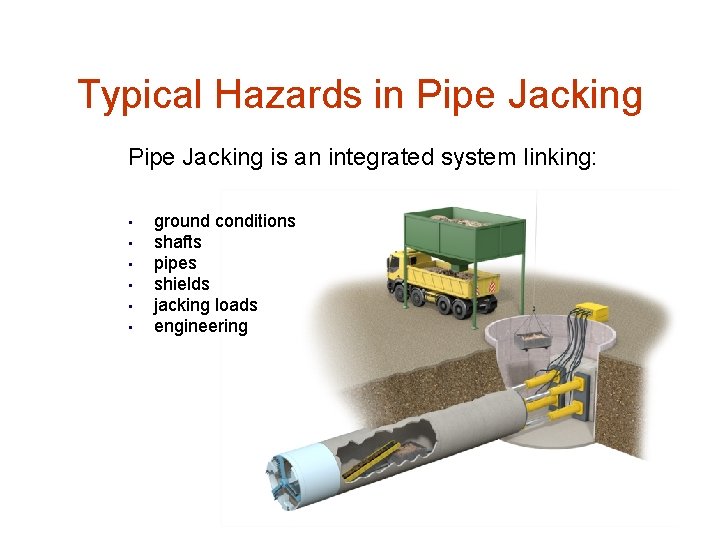
Typical Hazards in Pipe Jacking is an integrated system linking: • • • ground conditions shafts pipes shields jacking loads engineering
Typical Hazards • • Tunnel excavation Confined space/tunnel environment Man/machine interface Stored energy Material usage Working at height/depth Lifting operations Occupational health Issues
Tunnel Excavation - BS 6164 cl 7. 14 • Face stability (Reference: BS 6164 cl 7. 8. 1. 1 9. 1. 1) • Ground water inundation (Reference: BS 6164 cl 9, cl 10) • Ingress of hazardous materials (Reference: BS 6164 cl 7. 4. 4) • Unexpected obstructions, both naturally occurring and man made (Reference: BS 6164 cl 5) • Over/under excavation (Reference: BS 6164 cl 7. 16 and other BTS & ICE publications)
Tunnel Environment • Environmental conditions (Reference: BS 6164 cl 4. 4. 5) • Restricted access (Reference: BS 6164 cl 7. 12. 5) • Fire (Reference: BS 6164 cl 13 EN 16191 cl 4. 6 b) • Slippery surfaces • Underground plant (Reference: BS 6164 cl 24)
Man/machine interface • Movement of plant above and below ground (Reference: BS 6164 cl 23. 1 23. 4 EN 16191 cl 4. 1 a) • Contact with exposed moving parts (Reference: EN 16191 cl 5. 4) • Uncontrolled movement of hydraulic jacks (Reference: BS 6164 cl 7. 14. 1 EN 16191 cl 4. 9)
Stored Energy • Electrical equipment (Reference: BS 6164 cl 25 EN 16191 cl 4. 2) • Pneumatic systems (Reference: BS 6164 cl 24. 2) • Hydraulic systems (Reference: BS 6164 cl 24. 3 EN 16191 cl 4. 1 c) • High pressure water systems (Reference: BS 6164 cl 24. 3 EN 1691 cl 4. 1 c) • Slurry and slurry separation systems (Reference: BS 6164 cl 23. 6)
Materials Usage • Manual handling (Reference: BS 6164 c 4. 4. 6. 2 & Table 2 EN 16191 cl 5. 2. 5) • Pipe handling and storage (Reference: BS 6164 cl 20. 6) • Slurry (Reference: BS 6164 23. 6) • Spoil (Reference: BS 6164 23. 7) • Additives and chemicals (Reference: BS 6164 cl 4. 4, Table 3, 7. 15)
Working at height/depth - BS 6164 cl 22. 5 • Operatives falling down shaft (Reference: BS 6164 cl 20. 6 & 20. 7) • Tools or materials falling down shaft (Reference: BS 6164 cl 20. 6) • Access/egress (Reference: BS 6164 cl 20. 7, EN 16191 cl 4. 1 e)
Lifting Operations - BS 6164 Sec 21 • Working over shafts. • Working within compounds. • Lifting over personnel. • Interaction with the public/traffic.
Occupational Health • Noise (Reference: BS 6164 cl 4. 4. 6. 1 & Table 2, 19. 1, 19. 2 EN 16191 cl 4. 4, Annex C) • Air quality (Reference: BS 6164 cl 12, 15, 16 and 11. 3) • Vibration (Reference: BS 6164 Table 2 and 19. 3) • Heat (Reference: BS 6164 Table 2 & 4. 4. 6. 5 EN 16191 cl 4. 3) • Eye injury/damage • Weils disease (Reference: BS 6164 cl 443, 4. 4. 5, C 126) • Working hours (shift patterns) • Stress BS 6164 cl 4. 4
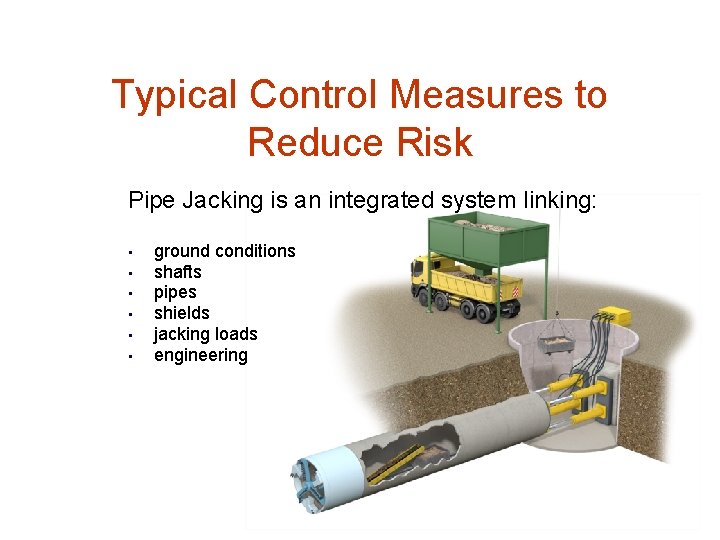
Typical Control Measures to Reduce Risk Pipe Jacking is an integrated system linking: • • • ground conditions shafts pipes shields jacking loads engineering
Tunnel Excavation Control Measures • Face stabilisation. • TBM choice. • Monitor and control rate of advance/ excavation / ground movement and surface settlement. • Manage/control water ingress. • Ventilation. • Non intrusive surveys.
Tunnel Environment Control Measures • Atmospheric monitoring • Competence • Ventilation • Planning • Restrict access • Emergency response • Use permits systems • Housekeeping • Training • Fire suppression
Man/machine interface Control Measures • • Safe systems of work. Planning and set-up. Segregation. Guarding. Competent operatives and operators. Effective communications systems. Failsafe systems. Behaviour based safety.
Stored Energy Hazards Control Measures • Safe systems of work. • Competent personnel. • Inspection/maintenance regime. • Isolation protocols. • Pressurised systems training.
Material Usage Control Measures • Training and competence. • Mechanical handling, where practical. • COSHH assessment and awareness. • Adequate ventilation. • Appropriate PPE.
Working at height/depth Control measures • • Safe systems of work. Training and competence. Security. Adequate barriers. Scaffolding. Use of MEWPs, where practical. 2 means of access/egress from shafts.
Lifting Operations Control measures • • Training and competence. Lift planning and supervision. Communication. Certified plant and equipment. Periodic inspection regime. Properly planned site set up. Design of foundations / ground support for craneage operations. • Avoidance of lifting over personnel. • Safe areas in pit bottom.
Occupational Hazards Control Measures • Membership of constructing better health, offering advice, guidance, information and education on occupational health good practice. • Behavioural based safety, focussing on changing operatives behaviour. • Regular health surveillance. • Monitoring conditions including the atmosphere, water, slurry, contaminated land, grouts, chemical additives and naturally occurring substances such as radon. • Minimise exposure. • Appropriate PPE for the task.
Overview • This list of hazards is not exhaustive; others may be present based on site conditions. • Control measures are intended as guidance only. • Hazards and associated risks should be fully investigated and appropriately and properly assessed.
Summary • PJA members are committed to stringent health and safety standards. • Training policies contribute to this commitment. • Research carried out at leading universities ensure products and practices are fit for purpose. • Mechanisation combined with robust risk management procedures ensure that health and safety of personnel is a priority. • Environmental standards and activities ensure that the disposal of process arisings contributes to sustainability and environmental efficiency.
- Slides: 31