
Pixel Upgrade Outline Overview of FPix system Technology

- Slides: 20
Pixel Upgrade Outline • Overview of FPix system • Technology used • Experience in construction and installation • Limitations at 3× 1034 cm-2 s-1 • Technology choices for the upgrade • Risks and opportunities • Status of R&D • Cost and schedule • Summary Pixel Upgrade D. Bortoletto CERN 8 -Oct-08 1
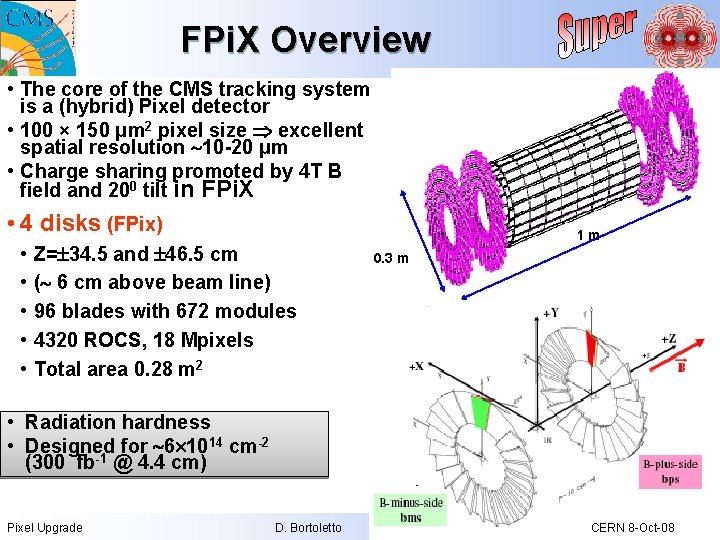
FPi. X Overview • The core of the CMS tracking system is a (hybrid) Pixel detector • 100 × 150 μm 2 pixel size excellent spatial resolution 10 -20 μm • Charge sharing promoted by 4 T B field and 200 tilt in FPi. X • 4 disks (FPix) • • • Z= 34. 5 and 46. 5 cm ( 6 cm above beam line) 96 blades with 672 modules 4320 ROCS, 18 Mpixels Total area 0. 28 m 2 1 m 0. 3 m • Radiation hardness • Designed for 6 1014 cm-2 (300 fb-1 @ 4. 4 cm) Pixel Upgrade D. Bortoletto CERN 8 -Oct-08 2
Pixels pixel 3 D hits are ideal seeds for tracking and reconstruction l Pattern recognition, all 5 track parameters well constrained l The • Excellent position resolution makes pixels essential : • for primary and secondary vertex reconstruction • for b and identification Dark matter candidate Pixel Upgrade D. Bortoletto CERN 8 -Oct-08 3
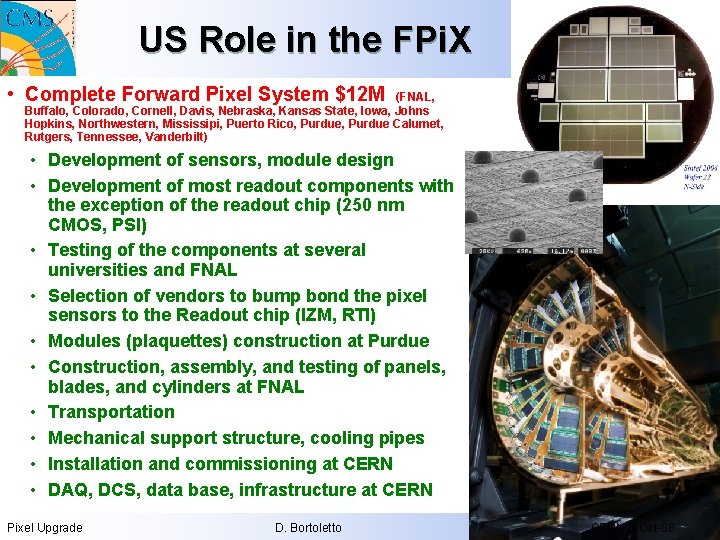
US Role in the FPi. X • Complete Forward Pixel System $12 M (FNAL, Buffalo, Colorado, Cornell, Davis, Nebraska, Kansas State, Iowa, Johns Hopkins, Northwestern, Mississipi, Puerto Rico, Purdue Calumet, Rutgers, Tennessee, Vanderbilt) • Development of sensors, module design • Development of most readout components with the exception of the readout chip (250 nm CMOS, PSI) • Testing of the components at several universities and FNAL • Selection of vendors to bump bond the pixel sensors to the Readout chip (IZM, RTI) • Modules (plaquettes) construction at Purdue • Construction, assembly, and testing of panels, blades, and cylinders at FNAL • Transportation • Mechanical support structure, cooling pipes • Installation and commissioning at CERN • DAQ, DCS, data base, infrastructure at CERN Pixel Upgrade D. Bortoletto CERN 8 -Oct-08 4
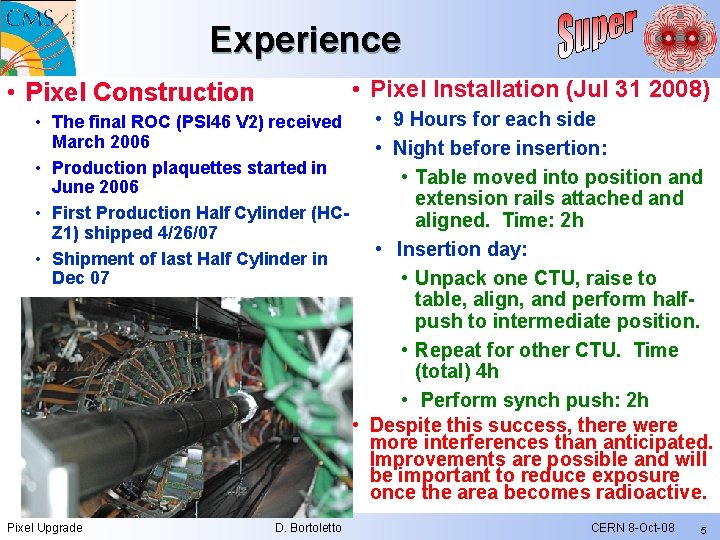
Experience • Pixel Installation (Jul 31 2008) • Pixel Construction • The final ROC (PSI 46 V 2) received March 2006 • Production plaquettes started in June 2006 • First Production Half Cylinder (HCZ 1) shipped 4/26/07 • Shipment of last Half Cylinder in Dec 07 Pixel Upgrade D. Bortoletto • 9 Hours for each side • Night before insertion: • Table moved into position and extension rails attached and aligned. Time: 2 h • Insertion day: • Unpack one CTU, raise to table, align, and perform halfpush to intermediate position. • Repeat for other CTU. Time (total) 4 h • Perform synch push: 2 h • Despite this success, there were more interferences than anticipated. Improvements are possible and will be important to reduce exposure once the area becomes radioactive. CERN 8 -Oct-08 5
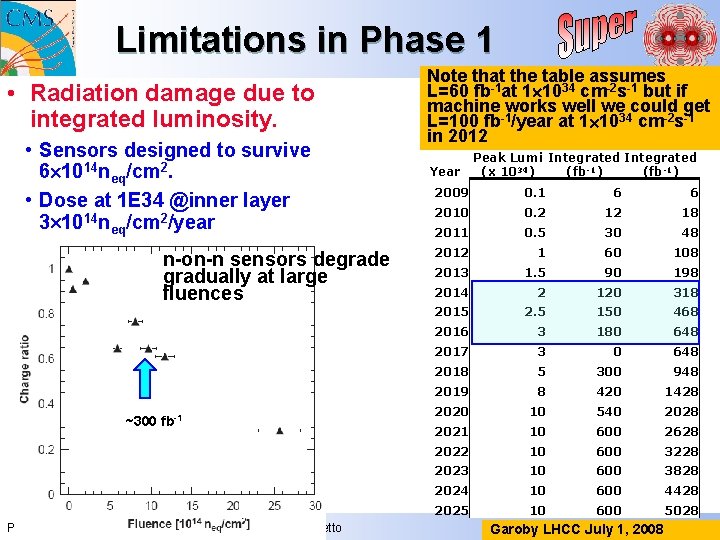
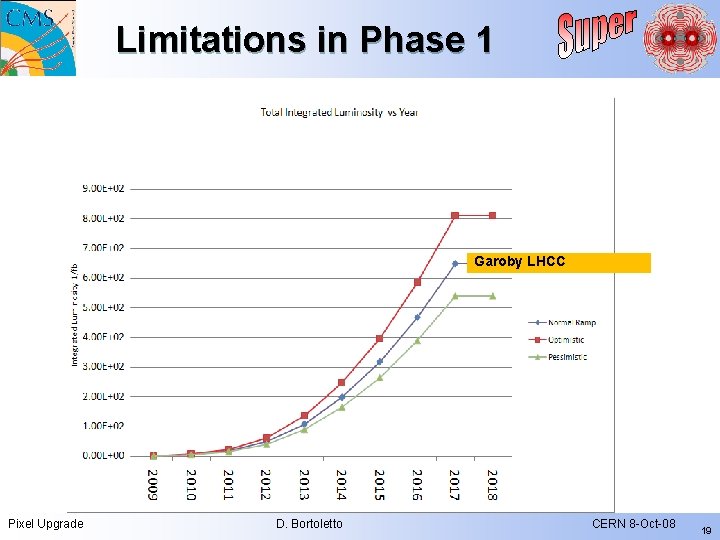
Limitations in Phase 1 • Radiation damage due to integrated luminosity. • Sensors designed to survive 6 1014 neq/cm 2. • Dose at 1 E 34 @inner layer 3 1014 neq/cm 2/year n-on-n sensors degrade gradually at large fluences ~300 fb-1 Pixel Upgrade D. Bortoletto Note that the table assumes L=60 fb-1 at 1 1034 cm-2 s-1 but if machine works well we could get 34 cm-2 s-1 L=100 fb-1/year at 1 10 Normal Ramp in 2012 Annual Total Year Peak Lumi Integrated (x 1034) (fb-1) 2009 0. 1 6 6 2010 0. 2 12 18 2011 0. 5 30 48 2012 1 60 108 2013 1. 5 90 198 2014 2 120 318 2015 2. 5 150 468 2016 3 180 648 2017 3 0 648 2018 5 300 948 2019 8 420 1428 2020 10 540 2028 2021 10 600 2628 2022 10 600 3228 2023 10 600 3828 2024 10 600 4428 2025 10 600 5028 CERN Garoby LHCC July 1, 8 -Oct-08 2008 6
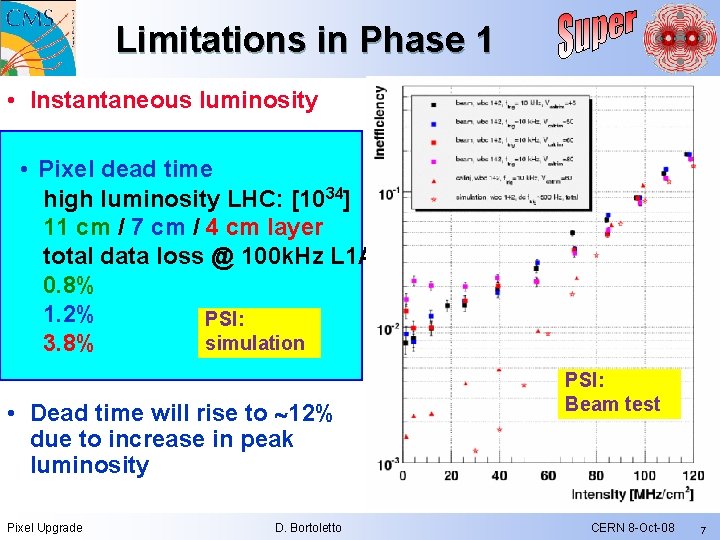
Limitations in Phase 1 • Instantaneous luminosity • Pixel dead time high luminosity LHC: [1034] 11 cm / 7 cm / 4 cm layer total data loss @ 100 k. Hz L 1 A: 0. 8% 1. 2% PSI: simulation 3. 8% • Dead time will rise to 12% due to increase in peak luminosity Pixel Upgrade D. Bortoletto PSI: Beam test CERN 8 -Oct-08 7
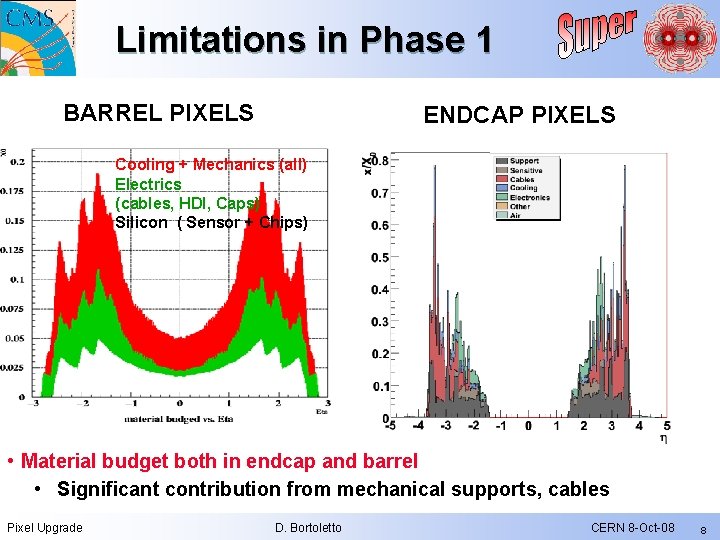
Limitations in Phase 1 BARREL PIXELS ENDCAP PIXELS Cooling + Mechanics (all) Electrics (cables, HDI, Caps) Silicon ( Sensor + Chips) • Material budget both in endcap and barrel • Significant contribution from mechanical supports, cables Pixel Upgrade D. Bortoletto CERN 8 -Oct-08 8
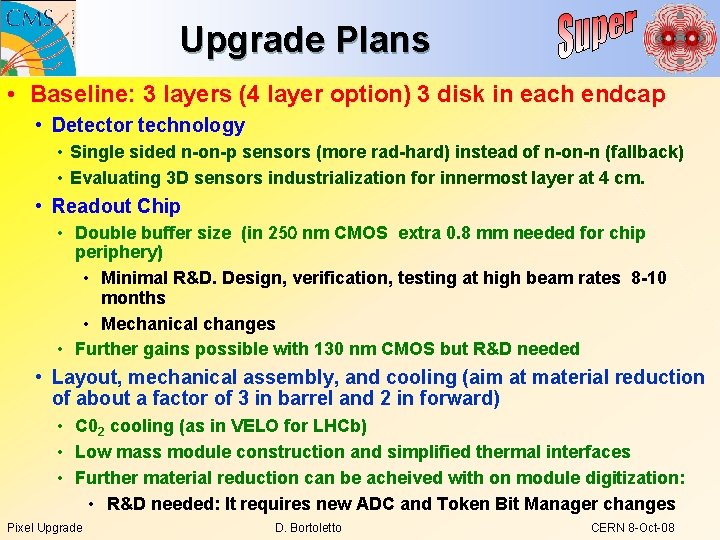
Upgrade Plans • Baseline: 3 layers (4 layer option) 3 disk in each endcap • Detector technology • Single sided n-on-p sensors (more rad-hard) instead of n-on-n (fallback) • Evaluating 3 D sensors industrialization for innermost layer at 4 cm. • Readout Chip • Double buffer size (in 250 nm CMOS extra 0. 8 mm needed for chip periphery) • Minimal R&D. Design, verification, testing at high beam rates 8 -10 months • Mechanical changes • Further gains possible with 130 nm CMOS but R&D needed • Layout, mechanical assembly, and cooling (aim at material reduction of about a factor of 3 in barrel and 2 in forward) • C 02 cooling (as in VELO for LHCb) • Low mass module construction and simplified thermal interfaces • Further material reduction can be acheived with on module digitization: • R&D needed: It requires new ADC and Token Bit Manager changes Pixel Upgrade D. Bortoletto CERN 8 -Oct-08 9
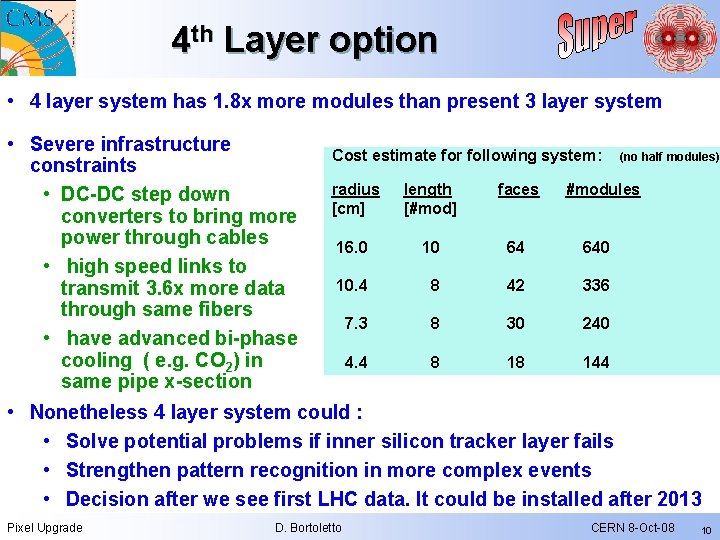
4 th Layer option • 4 layer system has 1. 8 x more modules than present 3 layer system • Severe infrastructure constraints • DC-DC step down converters to bring more power through cables • high speed links to transmit 3. 6 x more data through same fibers • have advanced bi-phase cooling ( e. g. CO 2) in same pipe x-section Cost estimate for following system: radius [cm] length [#mod] faces 16. 0 10 64 640 10. 4 8 42 336 7. 3 8 30 240 4. 4 8 18 144 (no half modules) #modules • Nonetheless 4 layer system could : • Solve potential problems if inner silicon tracker layer fails • Strengthen pattern recognition in more complex events • Decision after we see first LHC data. It could be installed after 2013 Pixel Upgrade D. Bortoletto CERN 8 -Oct-08 10
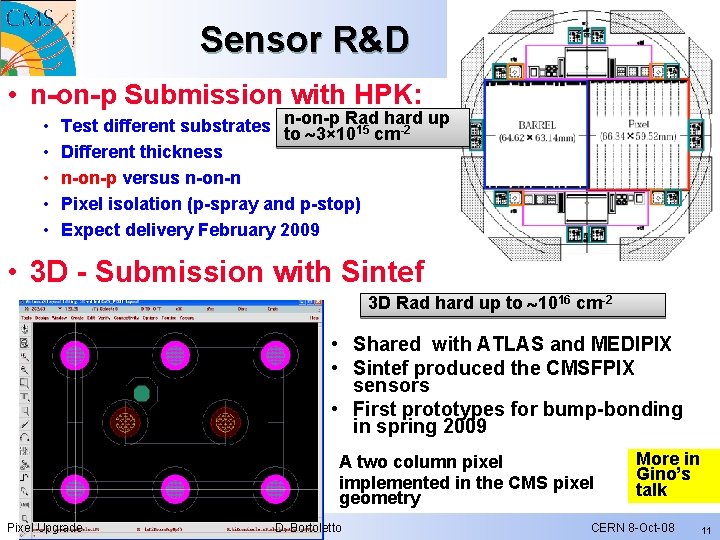
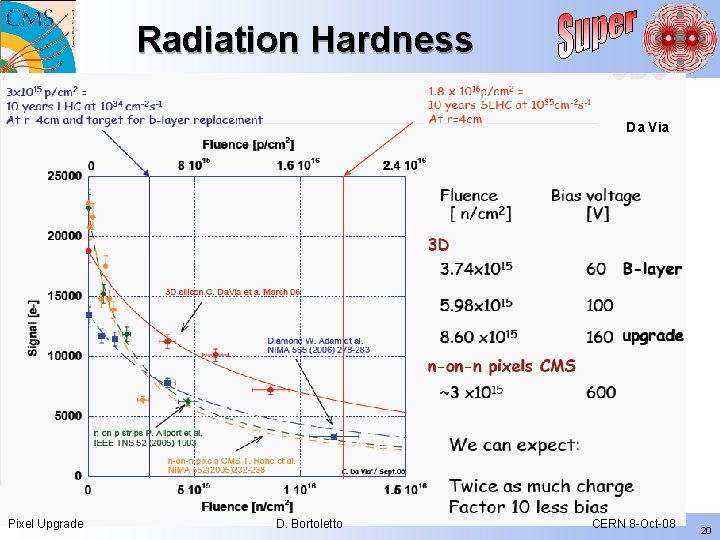
Sensor R&D • n-on-p Submission with HPK: • • • Rad hard up Test different substrates n-on-p to 3× 1015 cm-2 Different thickness n-on-p versus n-on-n Pixel isolation (p-spray and p-stop) Expect delivery February 2009 • 3 D - Submission with Sintef 3 D Rad hard up to 1016 cm-2 • Shared with ATLAS and MEDIPIX • Sintef produced the CMSFPIX sensors • First prototypes for bump-bonding in spring 2009 A two column pixel implemented in the CMS pixel geometry Pixel Upgrade D. Bortoletto More in Gino’s talk CERN 8 -Oct-08 11
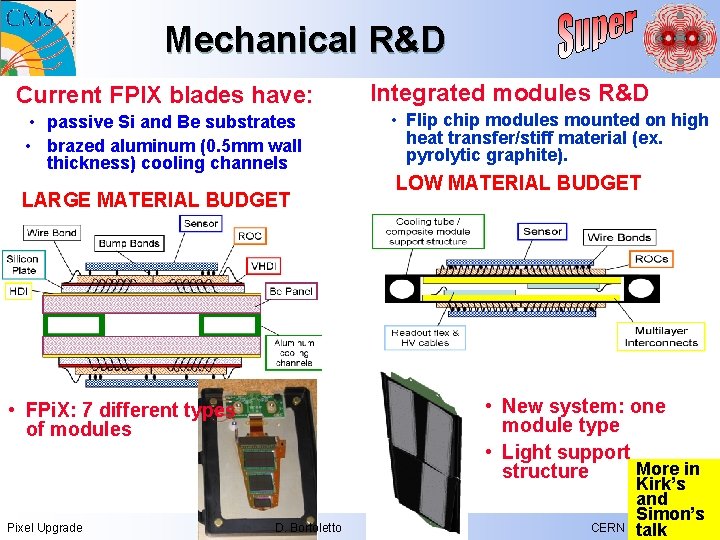
Mechanical R&D Current FPIX blades have: • passive Si and Be substrates • brazed aluminum (0. 5 mm wall thickness) cooling channels LARGE MATERIAL BUDGET • Flip chip modules mounted on high heat transfer/stiff material (ex. pyrolytic graphite). LOW MATERIAL BUDGET • New system: one module type • Light support More in structure • FPi. X: 7 different types of modules Pixel Upgrade Integrated modules R&D D. Bortoletto Kirk’s and Simon’s CERN 8 -Oct-08 12 talk
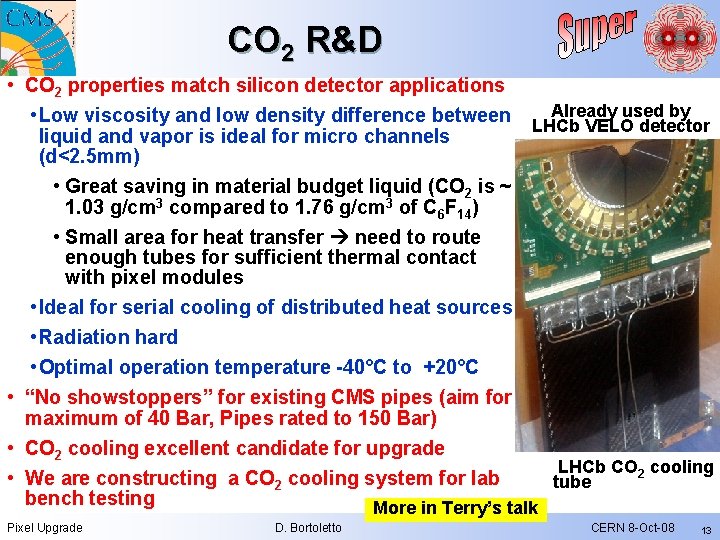
CO 2 R&D • CO 2 properties match silicon detector applications Already used by • Low viscosity and low density difference between LHCb VELO detector liquid and vapor is ideal for micro channels (d<2. 5 mm) • Great saving in material budget liquid (CO 2 is ~ 1. 03 g/cm 3 compared to 1. 76 g/cm 3 of C 6 F 14) • Small area for heat transfer need to route enough tubes for sufficient thermal contact with pixel modules • Ideal for serial cooling of distributed heat sources • Radiation hard • Optimal operation temperature -40°C to +20°C • “No showstoppers” for existing CMS pipes (aim for maximum of 40 Bar, Pipes rated to 150 Bar) • CO 2 cooling excellent candidate for upgrade LHCb CO 2 cooling • We are constructing a CO 2 cooling system for lab tube bench testing More in Terry’s talk Pixel Upgrade D. Bortoletto CERN 8 -Oct-08 13
Organization • Many groups are involved in the planning for the Phase 1 Pixel replacement • FNAL (mechanics, sensors, cooling, electronics including power distribution) • PURDUE (sensors, modules, cooling integration into modules) • PIRE collaboration which includes Kansas, Kansas State, Nebraska, Puerto Rico, UIC (Sensor, ROC, bump bonding) • Mississippi (mechanical support) • Iowa (cooling), Purdue Calumet (testing) • +others? • Most groups have submitted R&D proposals that have been evaluated by CMS and have received a positive evaluation Pixel Upgrade D. Bortoletto CERN 8 -Oct-08 14
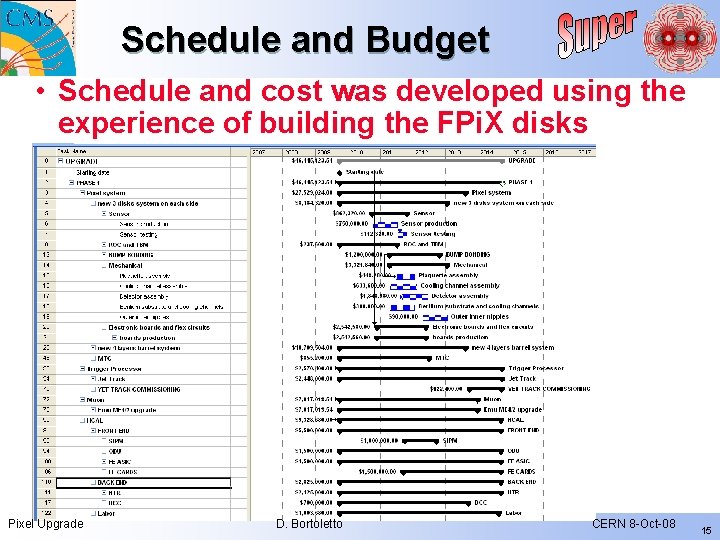
Schedule and Budget • Schedule and cost was developed using the experience of building the FPi. X disks Pixel Upgrade D. Bortoletto CERN 8 -Oct-08 15
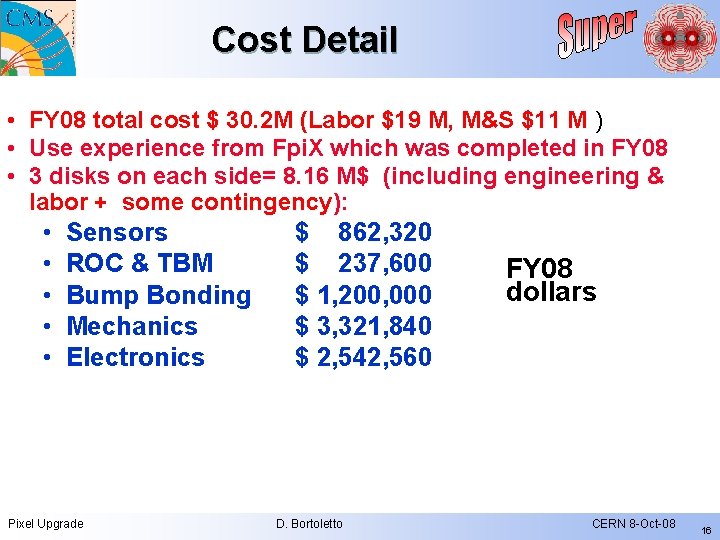
Cost Detail • FY 08 total cost $ 30. 2 M (Labor $19 M, M&S $11 M ) • Use experience from Fpi. X which was completed in FY 08 • 3 disks on each side= 8. 16 M$ (including engineering & labor + some contingency): • • • Sensors ROC & TBM Bump Bonding Mechanics Electronics Pixel Upgrade $ 862, 320 $ 237, 600 $ 1, 200, 000 $ 3, 321, 840 $ 2, 542, 560 D. Bortoletto FY 08 dollars CERN 8 -Oct-08 16
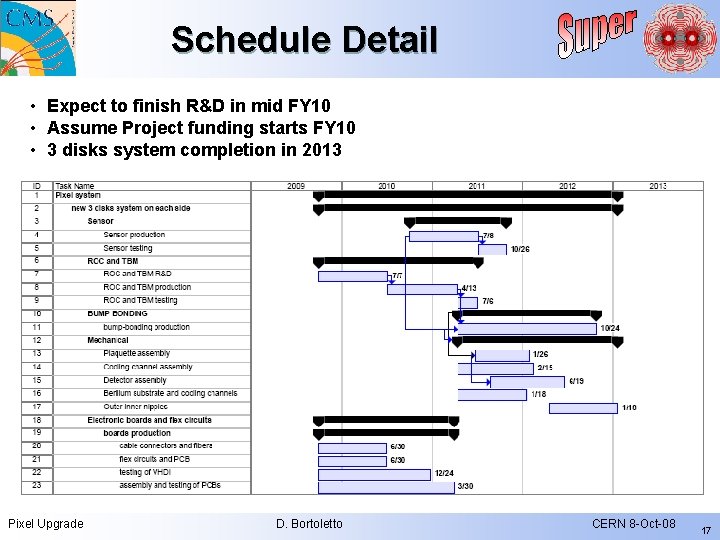
Schedule Detail • Expect to finish R&D in mid FY 10 • Assume Project funding starts FY 10 • 3 disks system completion in 2013 Pixel Upgrade D. Bortoletto CERN 8 -Oct-08 17
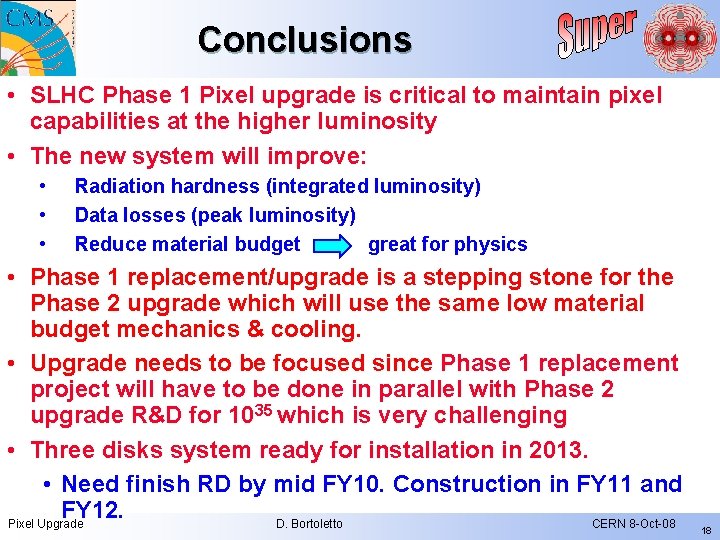
Conclusions • SLHC Phase 1 Pixel upgrade is critical to maintain pixel capabilities at the higher luminosity • The new system will improve: • • • Radiation hardness (integrated luminosity) Data losses (peak luminosity) Reduce material budget great for physics • Phase 1 replacement/upgrade is a stepping stone for the Phase 2 upgrade which will use the same low material budget mechanics & cooling. • Upgrade needs to be focused since Phase 1 replacement project will have to be done in parallel with Phase 2 upgrade R&D for 1035 which is very challenging • Three disks system ready for installation in 2013. • Need finish RD by mid FY 10. Construction in FY 11 and FY 12. Pixel Upgrade D. Bortoletto CERN 8 -Oct-08 18
Limitations in Phase 1 Garoby LHCC Pixel Upgrade D. Bortoletto CERN 8 -Oct-08 19
Radiation Hardness Da Via Pixel Upgrade D. Bortoletto CERN 8 -Oct-08 20