
Pixel Detector Module using MCMD Technology for the

- Slides: 28
Pixel Detector Module using MCM-D Technology for the B-layer of the ATLAS Pixel Detector Pixel 2000 Workshop Christian Grah grah@whep. uni-wuppertal. de University of Wuppertal www. atlas. uni-wuppertal. de O. Bäsken K. H. Becks P. Gerlach Ch. Grah O. Ehrmann M. Töpper J. Wolf June 2000, Genova
Overview Ch. Grah University of Wuppertal ä The concept of building modules in MCMD technology ä MCM-D modules for the ATLAS Pixel Detector ä Measurements on Prototypes â Lab measurements on full scale module and single chip devices â Testbeam measurements on single chip devices ä Conclusion and Outlook Pixel 2000, Genova 2
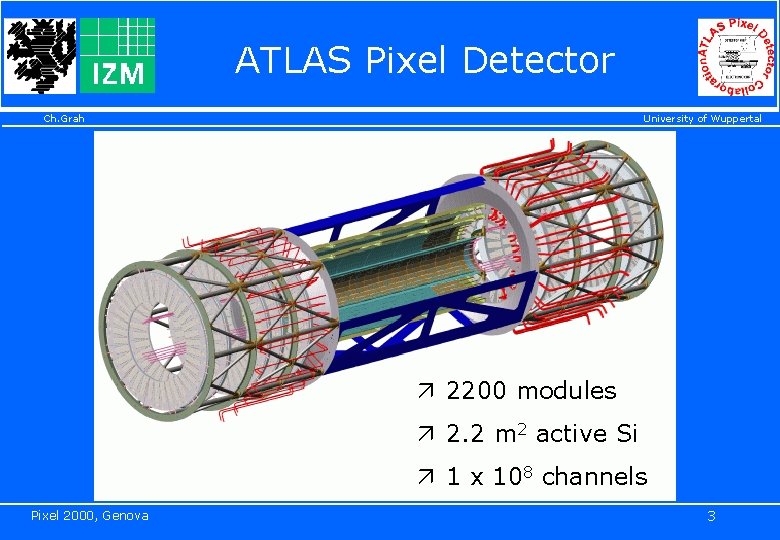
ATLAS Pixel Detector Ch. Grah University of Wuppertal ä 2200 modules ä 2. 2 m 2 active Si ä 1 x 10⁸ channels Pixel 2000, Genova 3
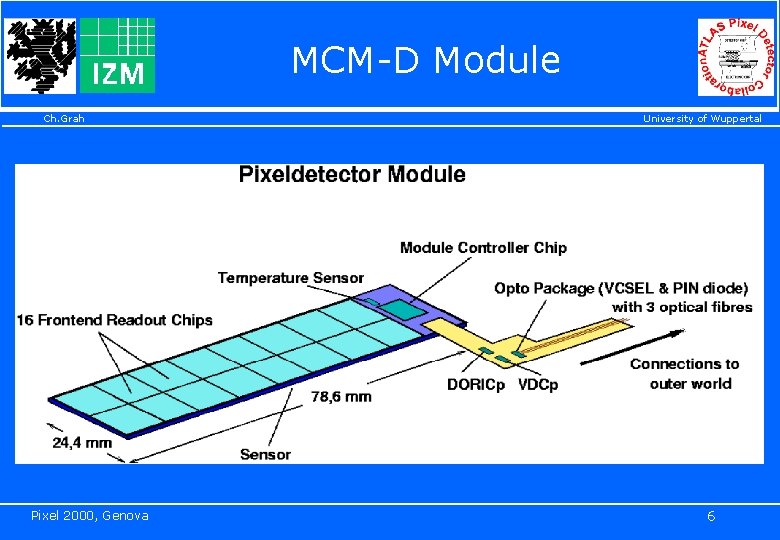
The basic structure of modules for the ATLAS Pixel Detector Ch. Grah University of Wuppertal ä Sensor tile (16. 4 mm x 60. 4 mm active area) Main components which need to be contacted: ä 16 read out IC´s, each providing 18 x 160 pixel unit cells (preamplifier, discriminator, digital readout; pixel cell size: 400 x 50 µm 2) 46080 connections in the pixel cell array per module with bump-bonding and flip-chipping as interconnection technique ä one module controller chip ä Idea of using a Thin Film technology to perform the signal interconnections and power distribution on the active sensor Pixel 2000, Genova 4
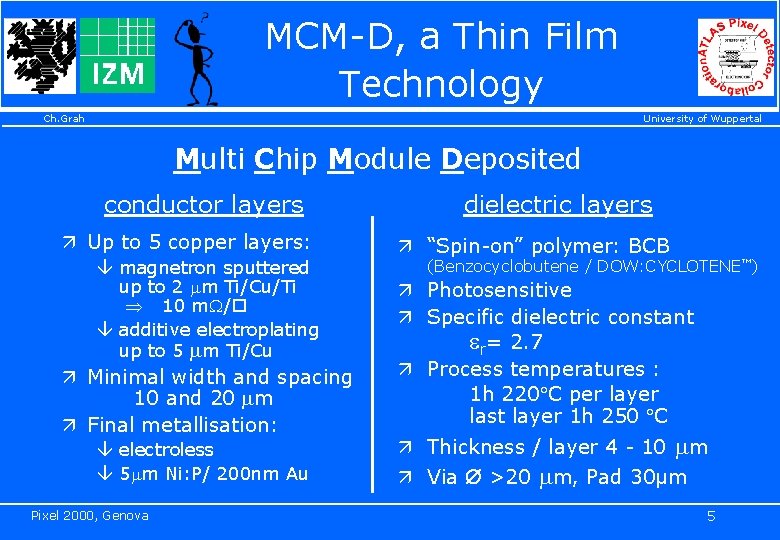
MCM-D, a Thin Film Technology Ch. Grah University of Wuppertal Multi Chip Module Deposited conductor layers ä Up to 5 copper layers: â magnetron sputtered up to 2 mm Ti/Cu/Ti 10 m / â additive electroplating up to 5 mm Ti/Cu ä Minimal width and spacing 10 and 20 mm ä Final metallisation: â electroless â 5 mm Ni: P/ 200 nm Au Pixel 2000, Genova dielectric layers ä “Spin-on” polymer: BCB (Benzocyclobutene / DOW: CYCLOTENE™) ä Photosensitive ä Specific dielectric constant er= 2. 7 ä Process temperatures : 1 h 220 C per layer last layer 1 h 250 C ä Thickness / layer 4 - 10 mm ä Via >20 mm, Pad 30µm 5
MCM-D Module Ch. Grah Pixel 2000, Genova University of Wuppertal 6
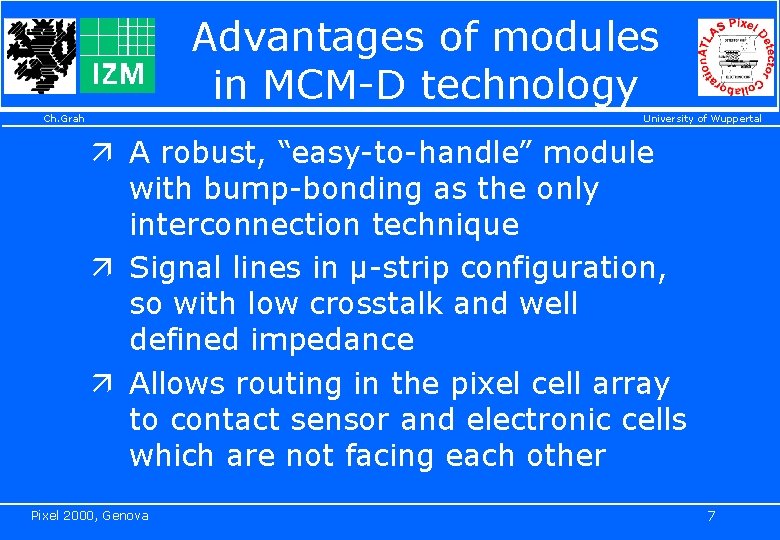
Advantages of modules in MCM-D technology Ch. Grah University of Wuppertal ä A robust, “easy-to-handle” module with bump-bonding as the only interconnection technique ä Signal lines in µ-strip configuration, so with low crosstalk and well defined impedance ä Allows routing in the pixel cell array to contact sensor and electronic cells which are not facing each other Pixel 2000, Genova 7
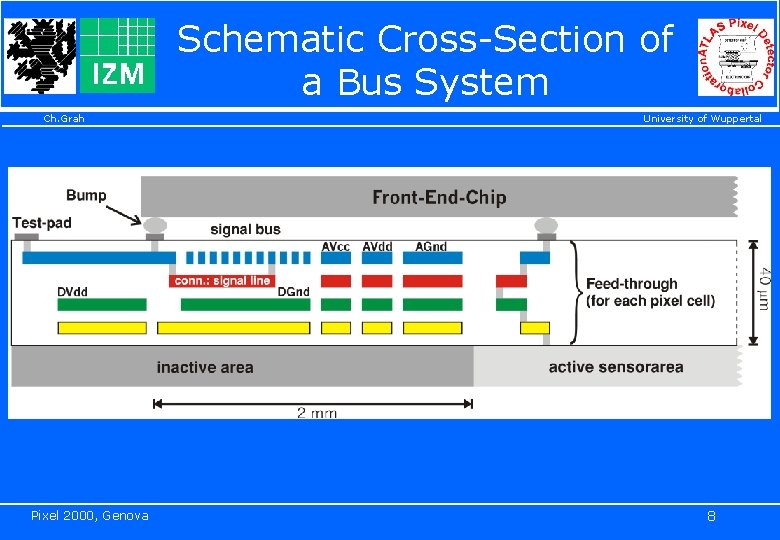
Schematic Cross-Section of a Bus System Ch. Grah Pixel 2000, Genova University of Wuppertal 8
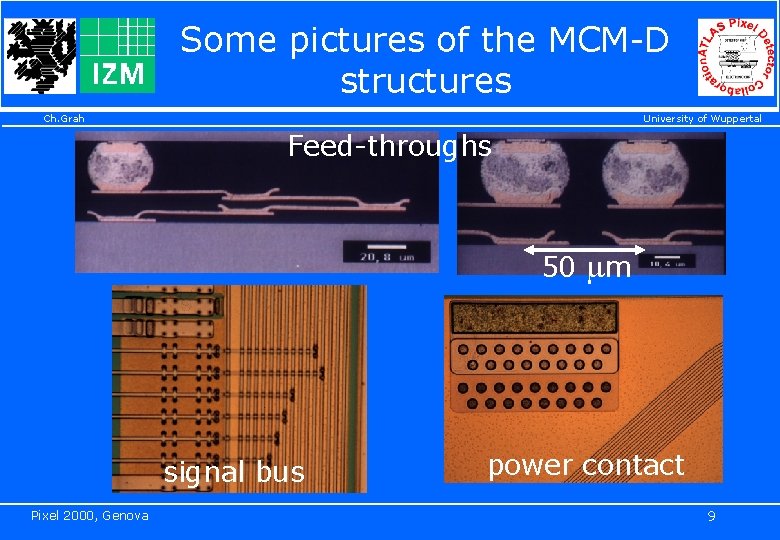
Some pictures of the MCM-D structures Ch. Grah University of Wuppertal Feed-throughs 50 mm signal bus Pixel 2000, Genova power contact 9
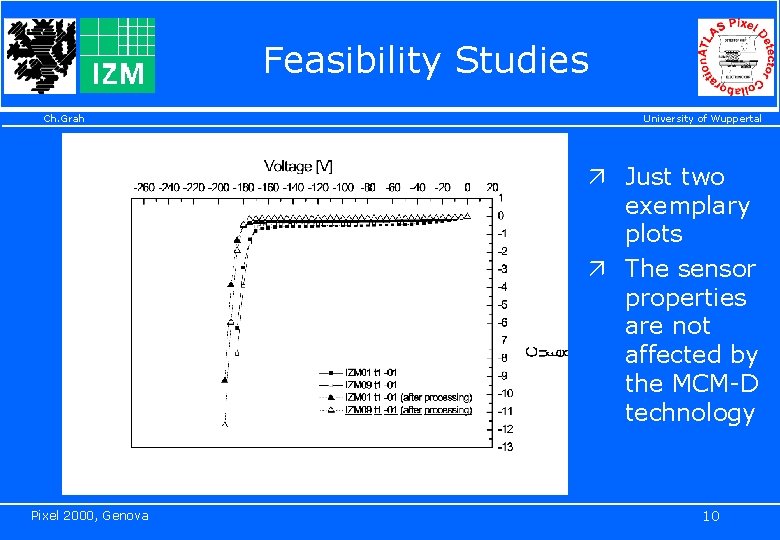
Feasibility Studies Ch. Grah University of Wuppertal ä Just two exemplary plots ä The sensor properties are not affected by the MCM-D technology Pixel 2000, Genova 10
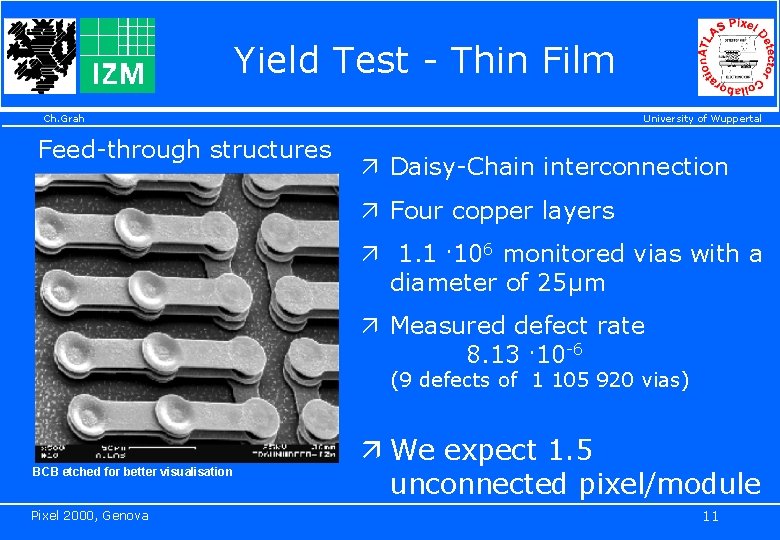
Yield Test - Thin Film Ch. Grah Feed-through structures University of Wuppertal ä Daisy-Chain interconnection ä Four copper layers ä 1. 1. 106 monitored vias with a diameter of 25µm ä Measured defect rate 8. 13. 10 -6 (9 defects of 1 105 920 vias) BCB etched for better visualisation Pixel 2000, Genova ä We expect 1. 5 unconnected pixel/module 11
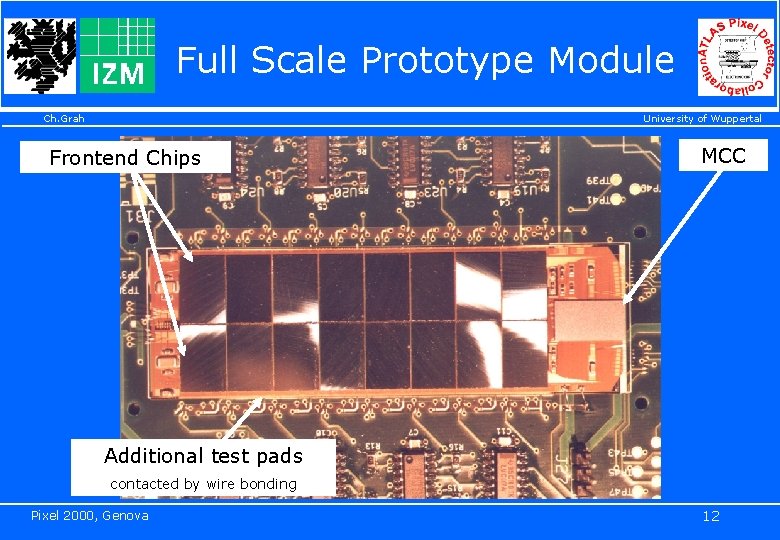
Full Scale Prototype Module Ch. Grah University of Wuppertal Frontend Chips MCC Additional test pads contacted by wire bonding Pixel 2000, Genova 12
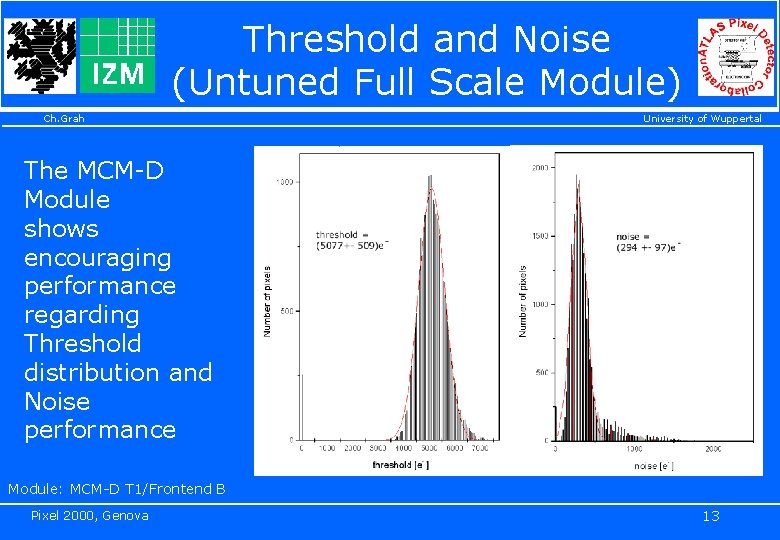
Threshold and Noise (Untuned Full Scale Module) Ch. Grah University of Wuppertal The MCM-D Module shows encouraging performance regarding Threshold distribution and Noise performance Module: MCM-D T 1/Frontend B Pixel 2000, Genova 13
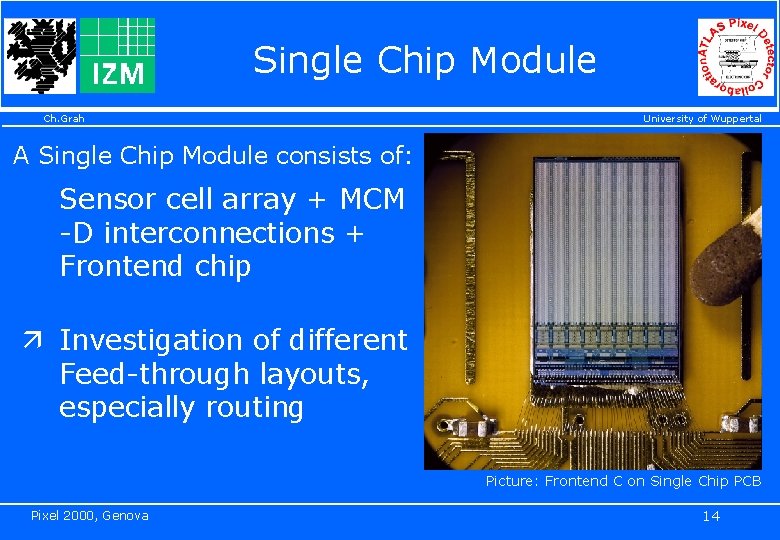
Single Chip Module Ch. Grah University of Wuppertal A Single Chip Module consists of: Sensor cell array + MCM -D interconnections + Frontend chip ä Investigation of different Feed-through layouts, especially routing Picture: Frontend C on Single Chip PCB Pixel 2000, Genova 14
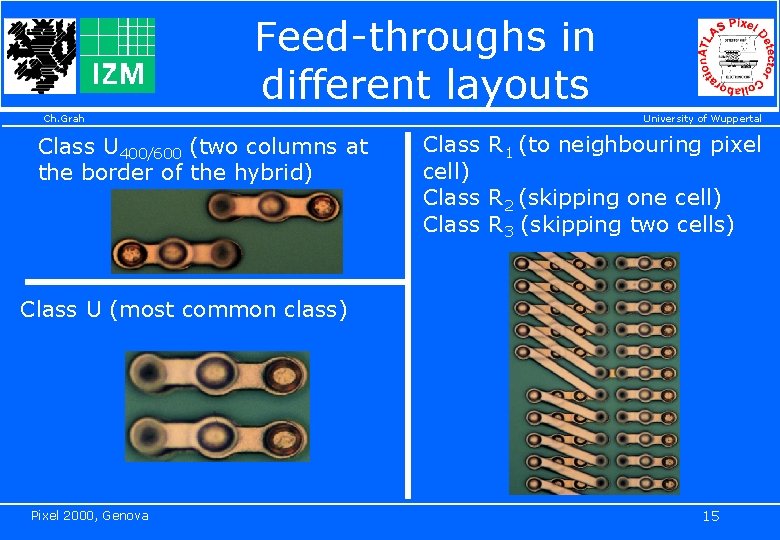
Feed-throughs in different layouts Ch. Grah Class U 400/600 (two columns at the border of the hybrid) University of Wuppertal Class R 1 (to neighbouring pixel cell) Class R 2 (skipping one cell) Class R 3 (skipping two cells) Class U (most common class) Pixel 2000, Genova 15
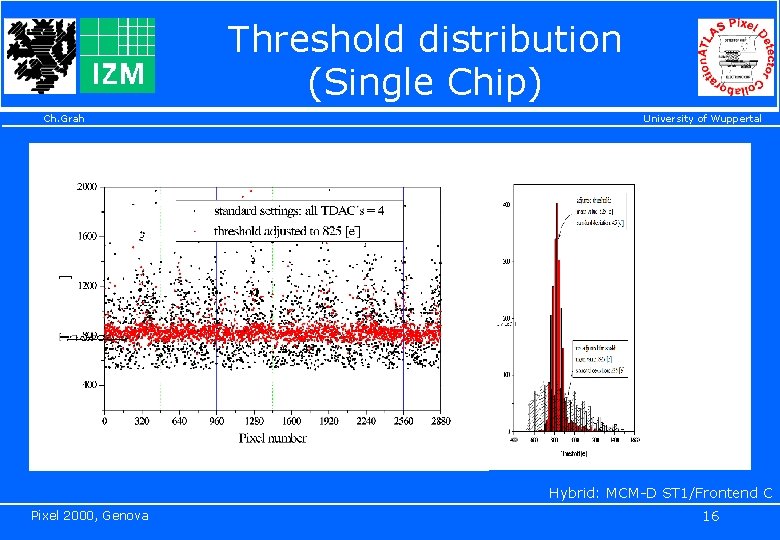
Threshold distribution (Single Chip) Ch. Grah University of Wuppertal Hybrid: MCM-D ST 1/Frontend C Pixel 2000, Genova 16
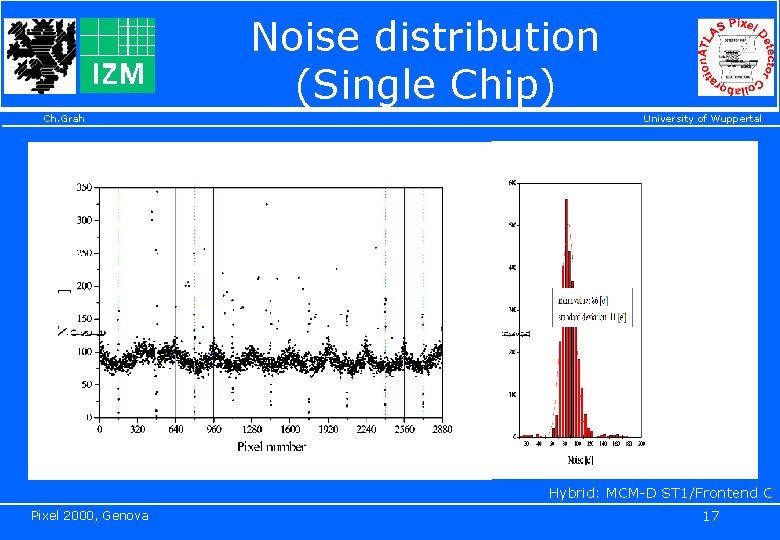
Noise distribution (Single Chip) Ch. Grah University of Wuppertal Hybrid: MCM-D ST 1/Frontend C Pixel 2000, Genova 17
Summary of Noise measurements Ch. Grah University of Wuppertal There is no influence on the performance, due to Feed-throughs in MCM-D. As expected, the crossing of copper lines in different layers (classes Ri) increases the Noise, due to the higher interpixel capacitance. Pixel 2000, Genova 18
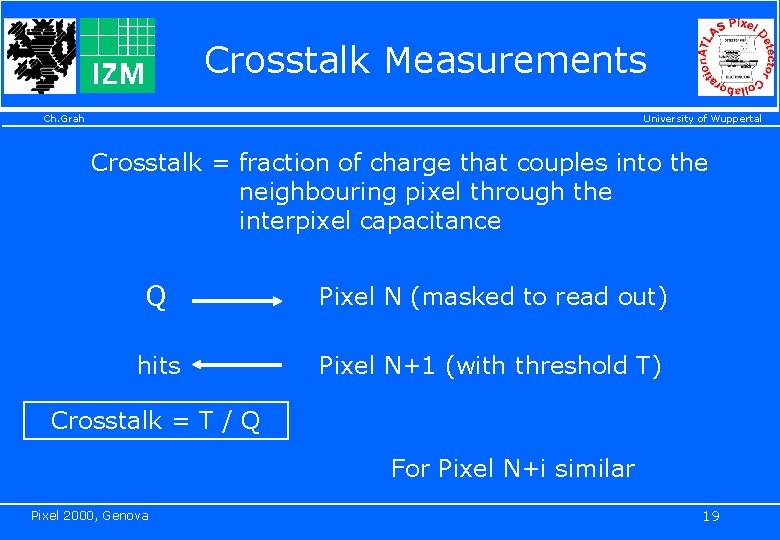
Crosstalk Measurements Ch. Grah University of Wuppertal Crosstalk = fraction of charge that couples into the neighbouring pixel through the interpixel capacitance Q Pixel N (masked to read out) hits Pixel N+1 (with threshold T) Crosstalk = T / Q For Pixel N+i similar Pixel 2000, Genova 19
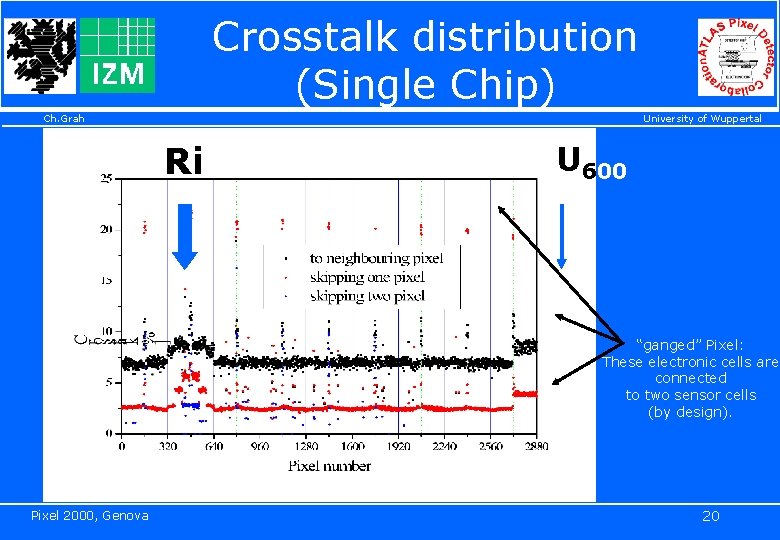
Crosstalk distribution (Single Chip) Ch. Grah University of Wuppertal Ri U 600 “ganged” Pixel: These electronic cells are connected to two sensor cells (by design). Pixel 2000, Genova 20
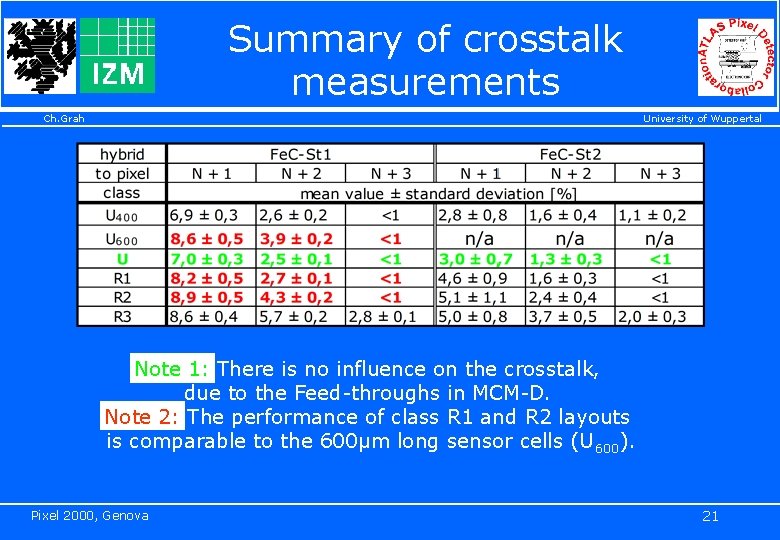
Summary of crosstalk measurements Ch. Grah University of Wuppertal Note 1: There is no influence on the crosstalk, due to the Feed-throughs in MCM-D. Note 2: The performance of class R 1 and R 2 layouts is comparable to the 600µm long sensor cells (U 600). Pixel 2000, Genova 21
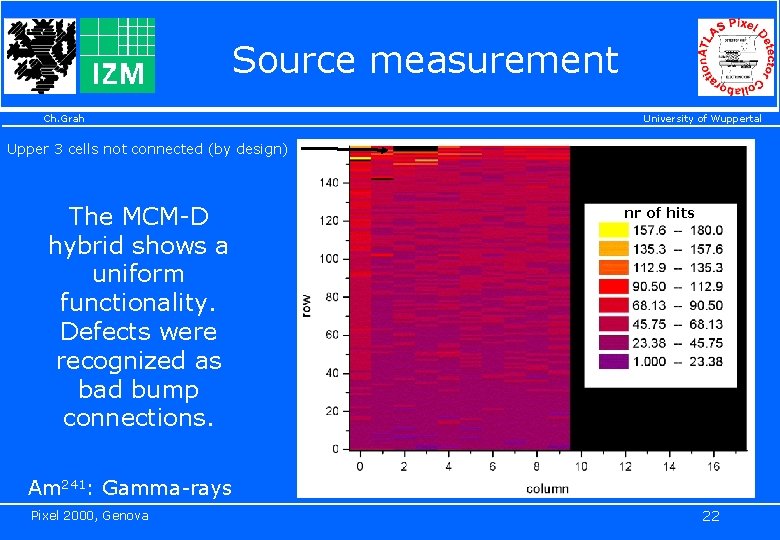
Source measurement Ch. Grah University of Wuppertal Upper 3 cells not connected (by design) The MCM-D hybrid shows a uniform functionality. Defects were recognized as bad bump connections. nr of hits Am 241: Gamma-rays Pixel 2000, Genova 22
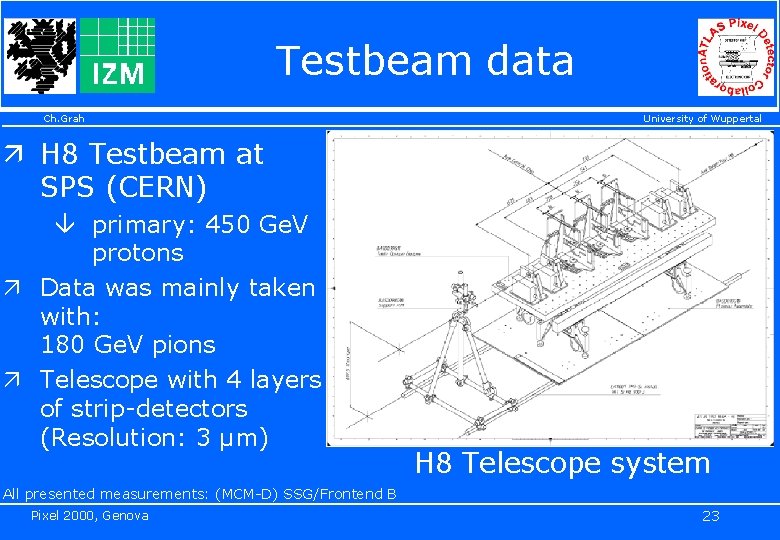
Testbeam data Ch. Grah University of Wuppertal ä H 8 Testbeam at SPS (CERN) â primary: 450 Ge. V protons ä Data was mainly taken with: 180 Ge. V pions ä Telescope with 4 layers of strip-detectors (Resolution: 3 µm) H 8 Telescope system All presented measurements: (MCM-D) SSG/Frontend B Pixel 2000, Genova 23
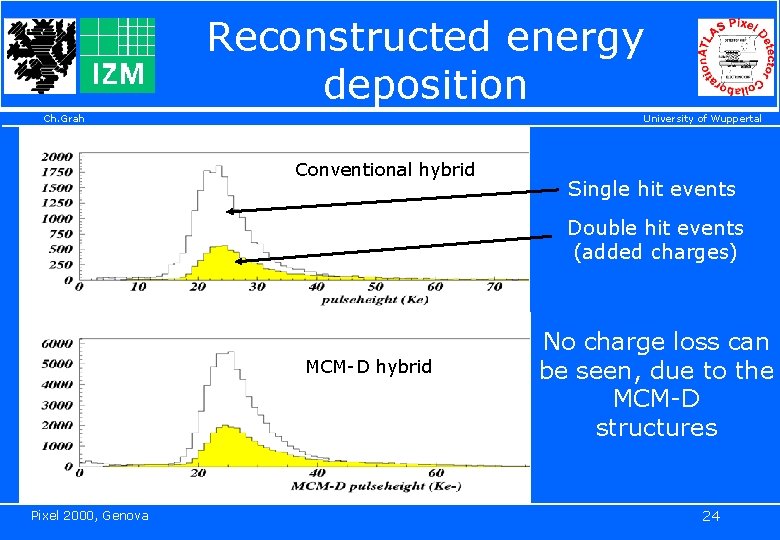
Reconstructed energy deposition Ch. Grah University of Wuppertal Conventional hybrid Single hit events Double hit events (added charges) MCM-D hybrid Pixel 2000, Genova No charge loss can be seen, due to the MCM-D structures 24
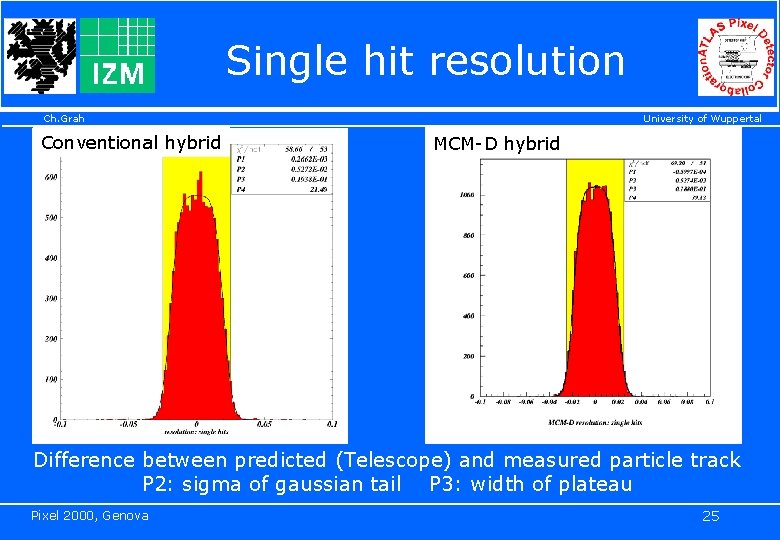
Single hit resolution Ch. Grah Conventional hybrid University of Wuppertal MCM-D hybrid Difference between predicted (Telescope) and measured particle track P 2: sigma of gaussian tail P 3: width of plateau Pixel 2000, Genova 25
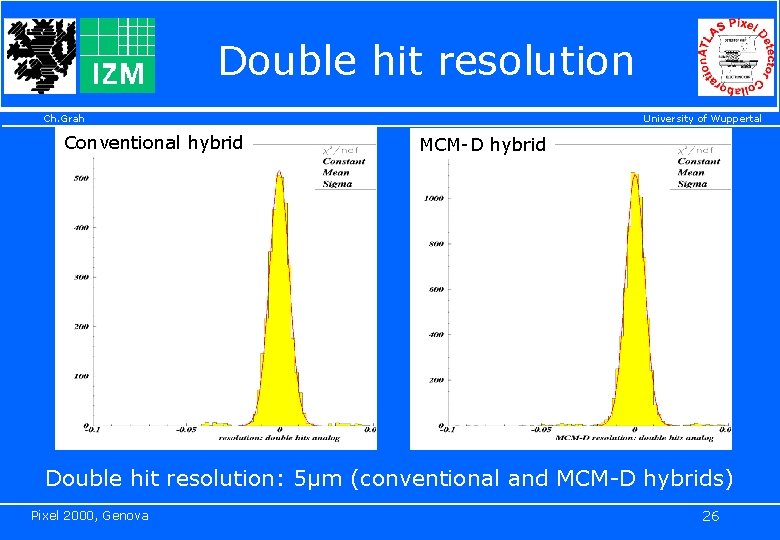
Double hit resolution Ch. Grah Conventional hybrid University of Wuppertal MCM-D hybrid Double hit resolution: 5µm (conventional and MCM-D hybrids) Pixel 2000, Genova 26
Multi Chip Module-Deposited Conclusion Ch. Grah University of Wuppertal ä It is possible to build “easy-to-handle” Pixel Detector Modules with the MCM-D technique. ä The Sensor is not harmed / damaged by the processing. ä The signal and power distribution structures are able to drive full modules. ä No problems appeared due to the necessary connections between electronic and sensor cells. Outlook: ä Explore the full potential of the MCM-D technique, modules with a homogeneous resolution may be build. Pixel 2000, Genova 27
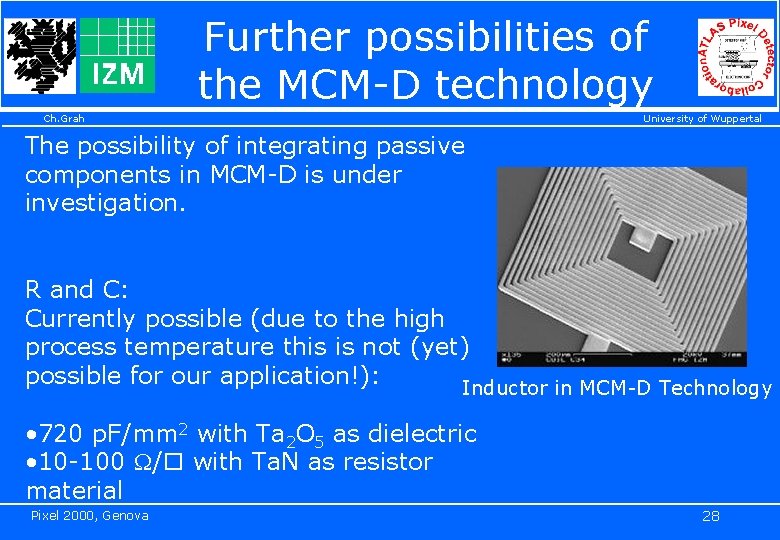
Further possibilities of the MCM-D technology Ch. Grah University of Wuppertal The possibility of integrating passive components in MCM-D is under investigation. R and C: Currently possible (due to the high process temperature this is not (yet) possible for our application!): Inductor in MCM-D Technology • 720 p. F/mm 2 with Ta 2 O 5 as dielectric • 10 -100 / with Ta. N as resistor material Pixel 2000, Genova 28