
PITUITARY GLAND Objectives The microscopic structure of the
PITUITARY GLAND Objectives: • The microscopic structure of the different parts of the pituitary gland in correlation with their functions. • The hypophyseal portal circulation components and significance. ◧ ◧ ◧ Editing file Important Doctor notes / Extra 438 Histology Team Endocrine Block

PITUITARY GLAND ADENOHYPOPHYSIS CEREBRI: Adeno=Gland NEUROHYPOPHYSIS CEREBRI: Pars Distalis (pars anterior) Median eminence Pars Tuberalis Infundibulum: Neural (Infundibular) Stalk Pars Intermedia Pars Nervosa 438 Histology Team - Endocrine Block 2

I- Adenohypophysis Cerebri Pars distalis: Types of parenchymal cells Chromophils Chromophobes cytoplasm does not stain 1 - Acidophils: • Somatotrophs (GH cells). Growth hormone(most common type) • Mammotrophs (Prolactin cells): Increase during lactation Milk formation hormone 2 - Basophils: • Thyrotrophs (TSH Cells) Thyroid stimulated hormone • Corticotrophs (ACTH cells) Adrenocorticotropic hormone • Gonadotrophs (Gonadotropic cells) (FSH, LH) Follicle Stimulating Hormones, Luteinizing hormone may represent: ○ stem cells. ○ degranulated chromophils. ○ degenerated cells. Blue arrow: acidophils Red arrow: basophils Yellow arrow: chromophobes Blood supply: extra, was in 436 lecture but now is removed (1) Superior Hypophyseal Arteries (Rt & Lt): To median eminence & Neural stalk Hypophyseal Portal System : It carries neurohormones from median eminence to adenohypophysis. • 1 ry capillary plexus of fenestrated capillaries • Hypophyseal portal Veins (or venules) • 2 ry capillary plexus of capillaries in adenohypophysis (2) Inferior Hypophyseal Arteries (Rt & Lt): Mainly to pars nervosa, They are Not participating in hypophyseal portal circulation. 438 Histology Team - Endocrine Block 3

II- Neurohypophysis Cerebri Pars nervosa content : 1 - unmyelinated axons • Unmyelinated axons of secretory neurons situated in supraoptic & paraventricular nuclei (i. e. Axons of hypothalamohypophyseal tract). Function : Storage & release of: • Vasopressin (ADH); by supraoptic nuclei • Oxytocin; by paraventricular nuclei 2 - fenestrated blood capillaries. The walls of their endothelial cells have pores (fenestrae) These pores are covered by diaphragm. Cardio flashback : ) 3. Herring bodies (Vesicles) • • Are distensions of the axons in p. nervosa. Representing accumulation of neurosecretory granules at axon termini and along the length of the axons in p. nervosa. 4. Pituicytes: Are glial-like cells in p. nervosa. Structure: Have numerous cytoplasmic Processes. Functions: Support the axons of the p. nervosa. N. B. No secretory or neuronal cells in pars nervosa. Oxytocin work in mammary gland for milk ejection (by contraction of myoepithelial cell, located around the acini) 438 Histology Team - Endocrine Block 4
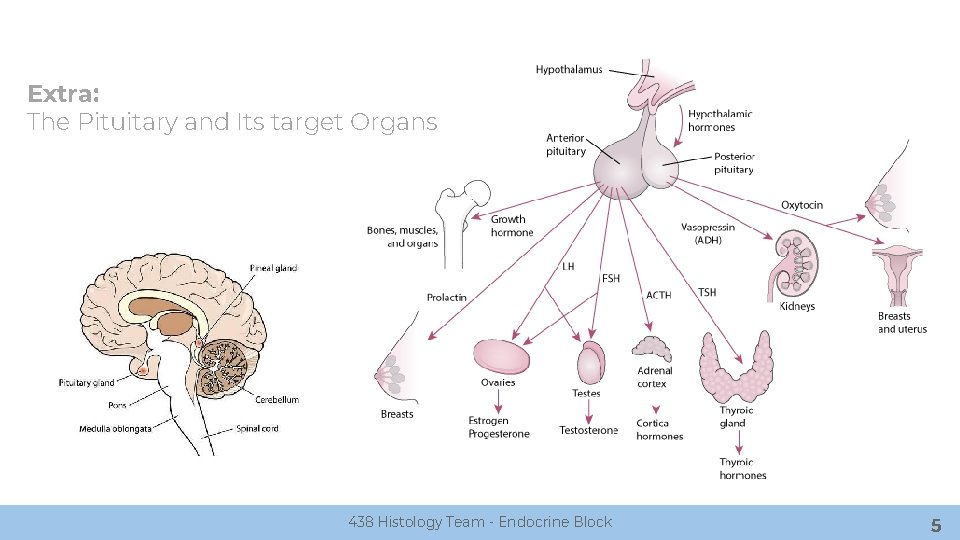
Extra: The Pituitary and Its target Organs 438 Histology Team - Endocrine Block 5
Quiz Q 1 : Which of the following cells belong to the basophils of pars distalis? A. Chromophobes B. Gonadotropins C. Somatotrophs D. Mammotrophs Q 2: Which one of the following structures is found in pars nervosa? A. Chromophobes B. Chromophils C. Pituicytes D. Prolactin cells Q 5: Which type of blood capillaries is found in pars nervosa ? A. fenestrated blood capillaries without diaphragm B. fenestrated blood capillaries with diaphragm C. Sinusoidal blood capillaries D. Continuous blood capillaries Which one of the following hormones is released by posterior pituitary gland ? A. LH B. Prolactin C. Oxytocin D. ACTH 1. B 2. C 3. A 4. A 5. B 6. C Q 3: Corticotrophs contains which cells ? A. ACTH cells. B. TSH cells C. GH cells D. Prolactin cells Q 4 : The cell bodies of hypothalamohypophyseal tract are situated in? A. Supraoptic nucleus B. Suprachiasmatic nucleus C. Dorsomedial nucleus D. Lateral preoptic nucleus 6
Team Leaders ◧ Abdullah shadid ◧ Sarah alflaij Good luck 438 Histology Team - Endocrine Block 7
- Slides: 7