
Pitch accent alignment in Egyptian Arabic more evidence
Pitch accent alignment in Egyptian Arabic more evidence for cross-linguistic variation Sam Hellmuth SOAS samhellmuth@soas. ac. uk Pa. PI 2005, Barcelona 20 th June 2005
Egyptian Arabic pitch accent alignment Aim: • to explore the surface phonetic alignment patterns of Egyptian Arabic pitch targets – in rising pre-nuclear (= non-final) pitch accents – in different syllable types Ø to establish their phonological representation Ø to contribute to the growing range of cross-linguistic alignment data Ø towards pitch-accent typology Egyptian Arabic (EA): • = Egyptian Arabic: the dialect of Arabic spoken in Cairo – and also by educated people throughout Egypt – all data reported here collected in Cairo
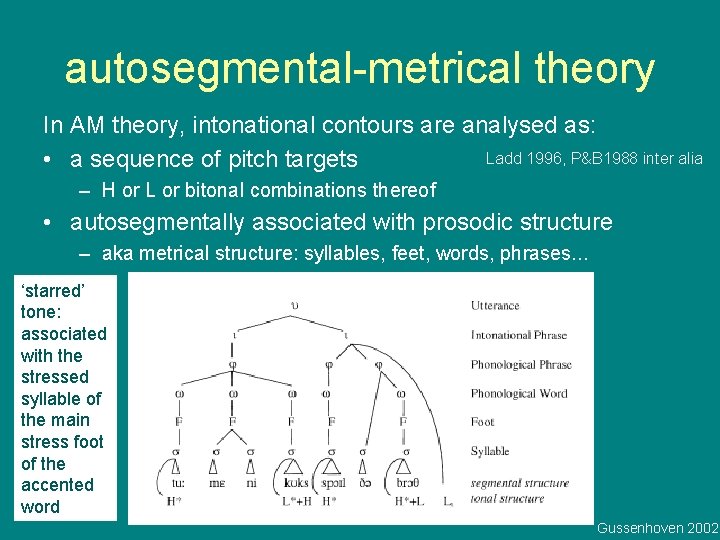
autosegmental-metrical theory In AM theory, intonational contours are analysed as: Ladd 1996, P&B 1988 inter alia • a sequence of pitch targets – H or L or bitonal combinations thereof • autosegmentally associated with prosodic structure – aka metrical structure: syllables, feet, words, phrases. . . ‘starred’ tone: associated with the stressed syllable of the main stress foot of the accented word Gussenhoven 2002
pitch accent alignment • recent discussion: can phonological association (‘starredness’) be inferred from surface alignment of individual pitch targets? Ladd 2003, Prieto et al (in press) • effects of prosodic context on surface alignment – Prieto et al (1995) Mexican Spanish pre-nuclear rising accents • in open syllables eg número – L very stably aligned at left edge of stressed syllable but see Prieto (in press) – H alignment is affected systematically by: • proximity to a prosodic boundary • proximity to other pitch accents – results reproduced for Lebanese Arabic (LA) Chahal 2001 • patterns of surface alignment to segmental landmarks – eg Arvaniti et al (1998) Greek pre-nuclear rising accents – targets independently aligned to specific landmarks in the string – L aligned very stably at the left edge of the stressed syllable • onset of the initial consonant of the stressed syllable (C 0) – H also aligned stably to segmental landmarks Ø ‘segmental anchoring’
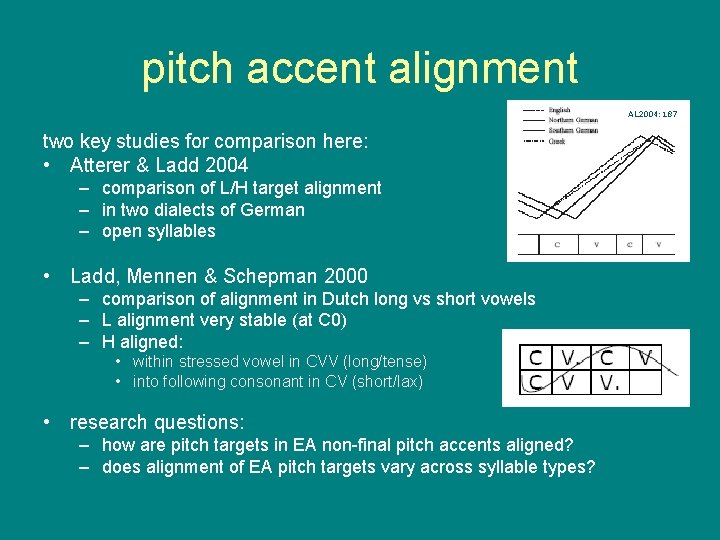
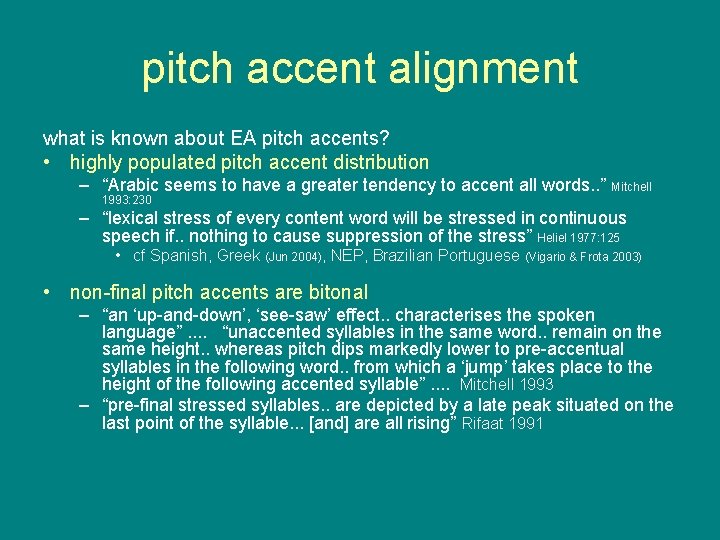
pitch accent alignment AL 2004: 187 two key studies for comparison here: • Atterer & Ladd 2004 – comparison of L/H target alignment – in two dialects of German – open syllables • Ladd, Mennen & Schepman 2000 – comparison of alignment in Dutch long vs short vowels – L alignment very stable (at C 0) – H aligned: • within stressed vowel in CVV (long/tense) • into following consonant in CV (short/lax) • research questions: – how are pitch targets in EA non-final pitch accents aligned? – does alignment of EA pitch targets vary across syllable types?
pitch accent alignment what is known about EA pitch accents? • highly populated pitch accent distribution – “Arabic seems to have a greater tendency to accent all words. . ” Mitchell 1993: 230 – “lexical stress of every content word will be stressed in continuous speech if. . nothing to cause suppression of the stress” Heliel 1977: 125 • cf Spanish, Greek (Jun 2004), NEP, Brazilian Portuguese (Vigario & Frota 2003) • non-final pitch accents are bitonal – “an ‘up-and-down’, ‘see-saw’ effect. . characterises the spoken language”. . “unaccented syllables in the same word. . remain on the same height. . whereas pitch dips markedly lower to pre-accentual syllables in the following word. . from which a ‘jump’ takes place to the height of the following accented syllable”. . Mitchell 1993 – “pre-final stressed syllables. . are depicted by a late peak situated on the last point of the syllable. . . [and] are all rising” Rifaat 1991

methodology study modelled on Atterer & Ladd 2004 BUT: • three types of target syllable 1 CV light open short tense vowel 2 CVC heavy closed short lax vowel Shahin 1996 3 CVV heavy open long tense vowel • target syllables word-initial, target word non-initial in sentence – to clarify alignment facts in heavy vs light syllables – to facilitate comparison with the results of other studies (some CV, some CVC) • word-medial CVC closed syllables also tested: 4 CVC heavy closed short lax vowel – is alignment of pitch targets to word edge(s) or to the stressed syllable? – to facilitate comparison with the results of other studies (some word-initial, some word-medial)
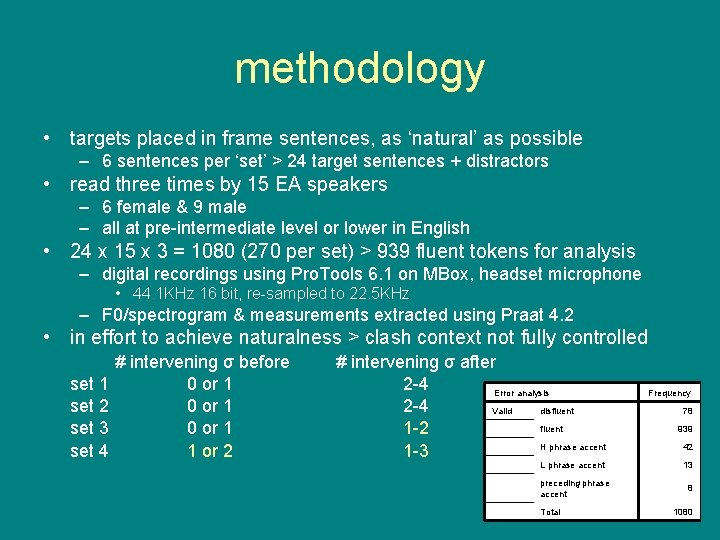
methodology • targets placed in frame sentences, as ‘natural’ as possible – 6 sentences per ‘set’ > 24 target sentences + distractors • read three times by 15 EA speakers – 6 female & 9 male – all at pre-intermediate level or lower in English • 24 x 15 x 3 = 1080 (270 per set) > 939 fluent tokens for analysis – digital recordings using Pro. Tools 6. 1 on MBox, headset microphone • 44. 1 KHz 16 bit, re-sampled to 22. 5 KHz – F 0/spectrogram & measurements extracted using Praat 4. 2 • in effort to achieve naturalness > clash context not fully controlled set 1 set 2 set 3 set 4 # intervening σ before 0 or 1 1 or 2 # intervening σ after 2 -4 Error analysis 2 -4 Valid disfluent 1 -2 H phrase accent 1 -3 L phrase accent preceding phrase accent Total Frequency 78 939 42 13 8 1080
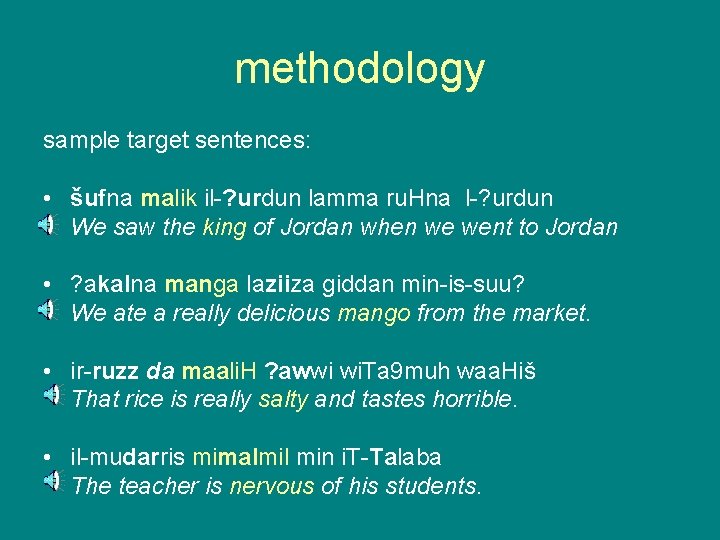
methodology sample target sentences: • šufna malik il-? urdun lamma ru. Hna l-? urdun We saw the king of Jordan when we went to Jordan • ? akalna manga laziiza giddan min-is-suu? We ate a really delicious mango from the market. • ir-ruzz da maali. H ? awwi wi. Ta 9 muh waa. Hiš That rice is really salty and tastes horrible. • il-mudarris mimalmil min i. T-Talaba The teacher is nervous of his students.
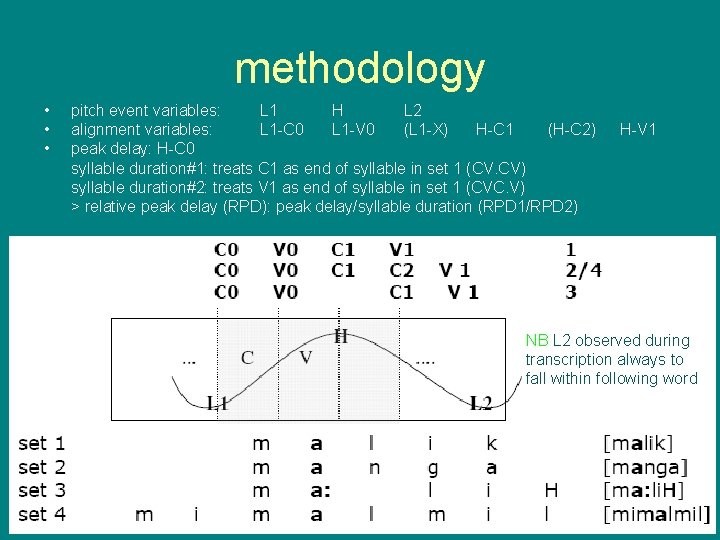
methodology • • • pitch event variables: L 1 H L 2 alignment variables: L 1 -C 0 L 1 -V 0 (L 1 -X) H-C 1 (H-C 2) peak delay: H-C 0 syllable duration#1: treats C 1 as end of syllable in set 1 (CV. CV) syllable duration#2: treats V 1 as end of syllable in set 1 (CVC. V) > relative peak delay (RPD): peak delay/syllable duration (RPD 1/RPD 2) H-V 1 NB L 2 observed during transcription always to fall within following word
results L alignment variables H alignment variables relative peak delay
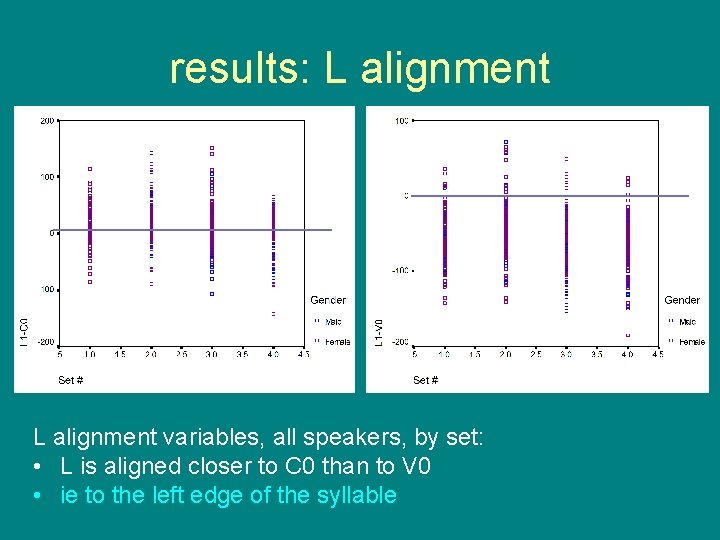
results: L alignment variables, all speakers, by set: • L is aligned closer to C 0 than to V 0 • ie to the left edge of the syllable
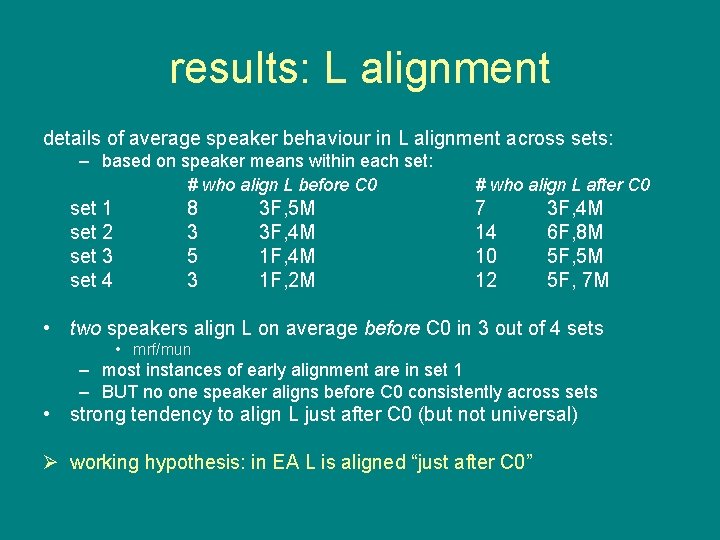
results: L alignment details of average speaker behaviour in L alignment across sets: – based on speaker means within each set: # who align L before C 0 set 1 set 2 set 3 set 4 8 3 5 3 3 F, 5 M 3 F, 4 M 1 F, 2 M # who align L after C 0 7 14 10 12 3 F, 4 M 6 F, 8 M 5 F, 5 M 5 F, 7 M • two speakers align L on average before C 0 in 3 out of 4 sets • mrf/mun – most instances of early alignment are in set 1 – BUT no one speaker aligns before C 0 consistently across sets • strong tendency to align L just after C 0 (but not universal) Ø working hypothesis: in EA L is aligned “just after C 0”
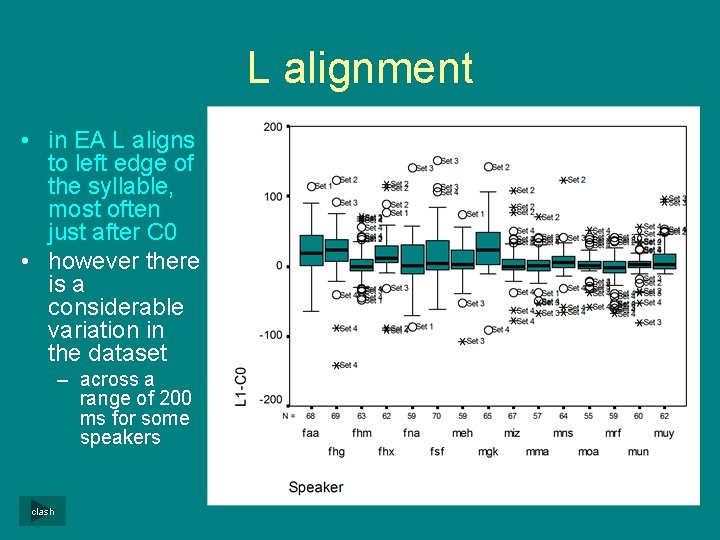
L alignment • in EA L aligns to left edge of the syllable, most often just after C 0 • however there is a considerable variation in the dataset – across a range of 200 ms for some speakers clash
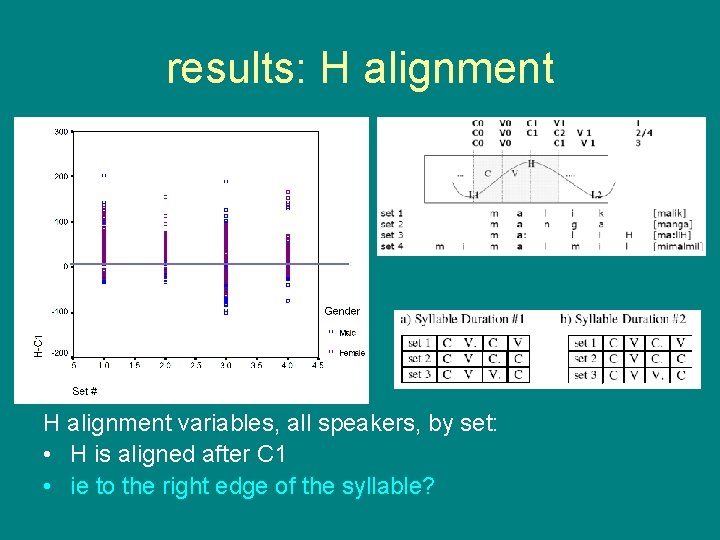
results: H alignment variables, all speakers, by set: • H is aligned after C 1 • ie to the right edge of the syllable?
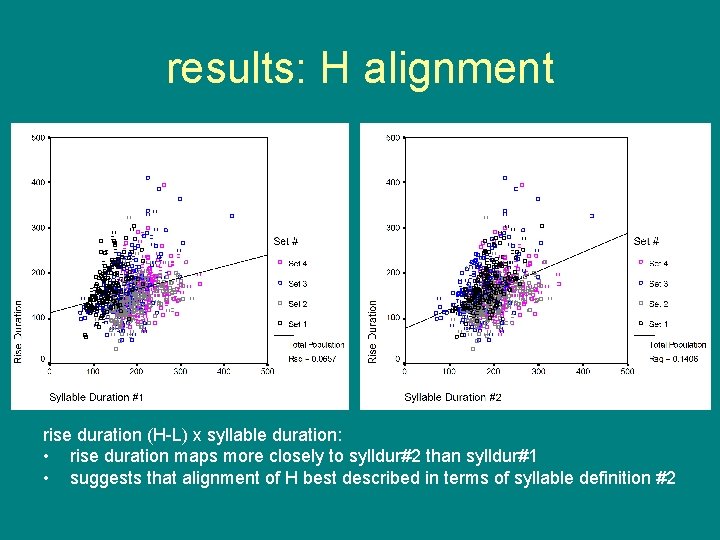
results: H alignment rise duration (H-L) x syllable duration: • rise duration maps more closely to sylldur#2 than sylldur#1 • suggests that alignment of H best described in terms of syllable definition #2
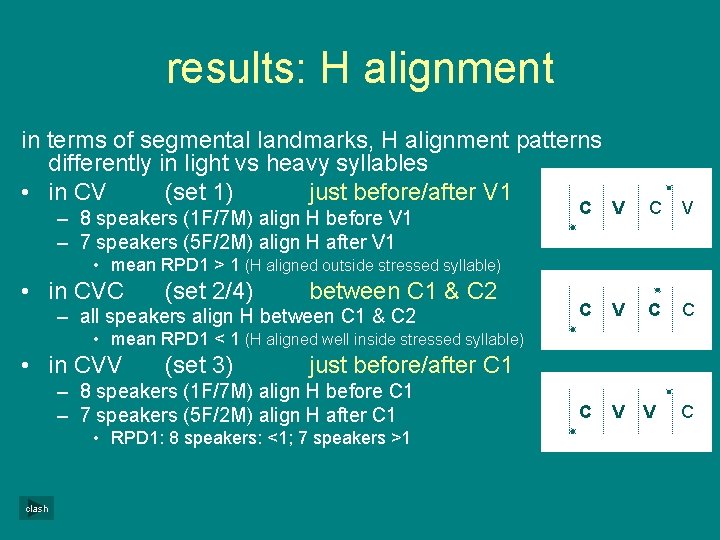
results: H alignment in terms of segmental landmarks, H alignment patterns differently in light vs heavy syllables • in CV (set 1) just before/after V 1 – 8 speakers (1 F/7 M) align H before V 1 – 7 speakers (5 F/2 M) align H after V 1 C V C V C C C V V C • mean RPD 1 > 1 (H aligned outside stressed syllable) • in CVC (set 2/4) between C 1 & C 2 – all speakers align H between C 1 & C 2 • mean RPD 1 < 1 (H aligned well inside stressed syllable) • in CVV (set 3) just before/after C 1 – 8 speakers (1 F/7 M) align H before C 1 – 7 speakers (5 F/2 M) align H after C 1 • RPD 1: 8 speakers: <1; 7 speakers >1 clash
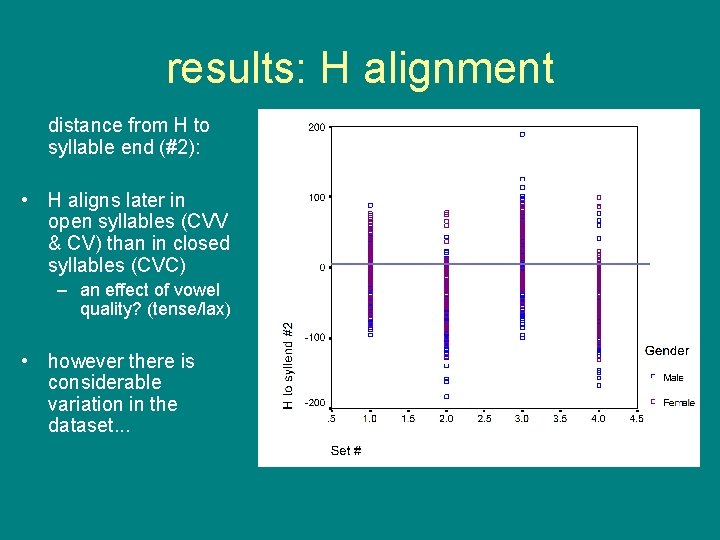
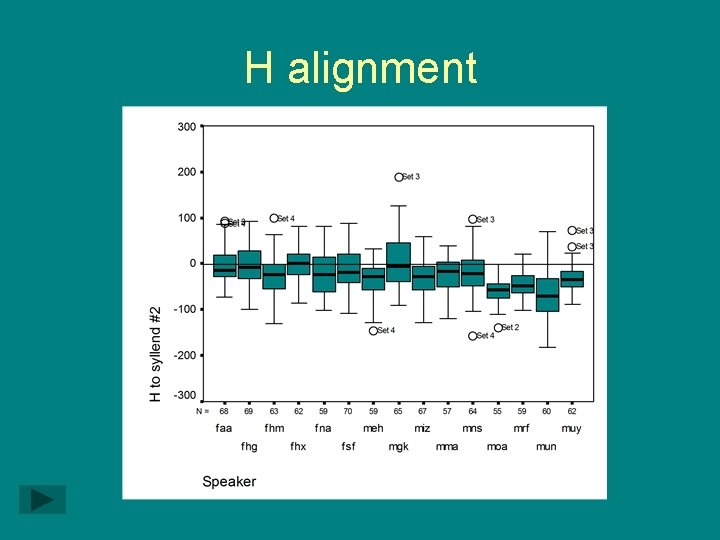
results: H alignment distance from H to syllable end (#2): • H aligns later in open syllables (CVV & CV) than in closed syllables (CVC) – an effect of vowel quality? (tense/lax) • however there is considerable variation in the dataset. . .
H alignment
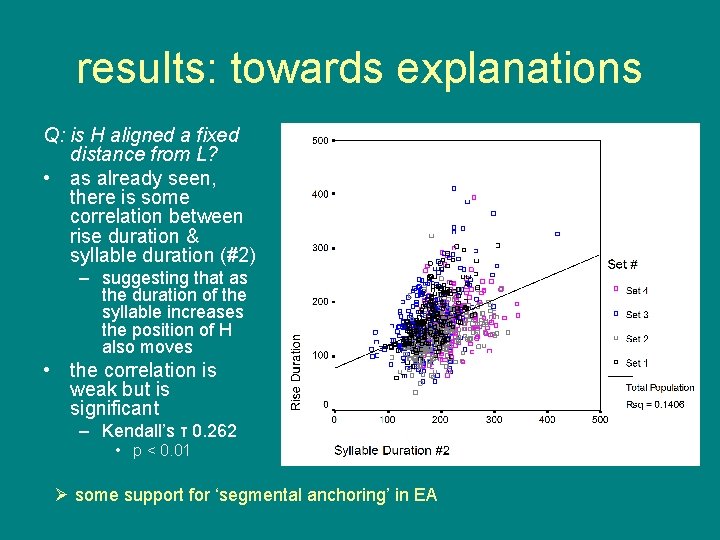
results: towards explanations Q: is H aligned a fixed distance from L? • as already seen, there is some correlation between rise duration & syllable duration (#2) – suggesting that as the duration of the syllable increases the position of H also moves • the correlation is weak but is significant – Kendall’s τ 0. 262 • p < 0. 01 Ø some support for ‘segmental anchoring’ in EA
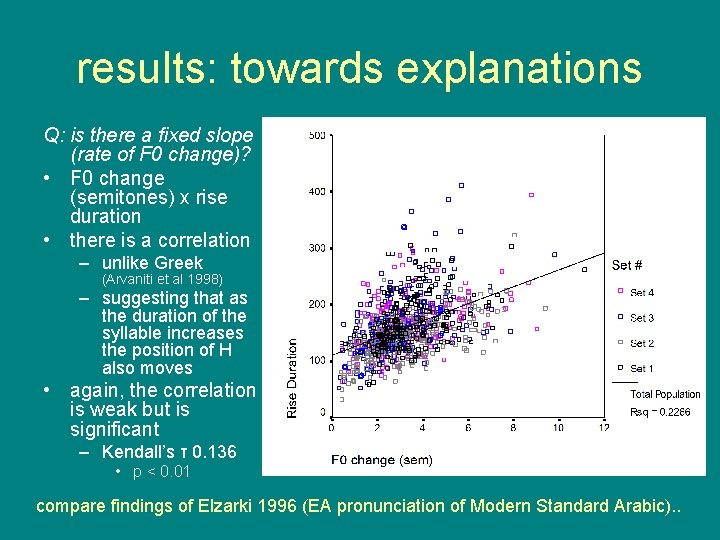
results: towards explanations Q: is there a fixed slope (rate of F 0 change)? • F 0 change (semitones) x rise duration • there is a correlation – unlike Greek (Arvaniti et al 1998) – suggesting that as the duration of the syllable increases the position of H also moves • again, the correlation is weak but is significant – Kendall’s τ 0. 136 • p < 0. 01 compare findings of Elzarki 1996 (EA pronunciation of Modern Standard Arabic). .
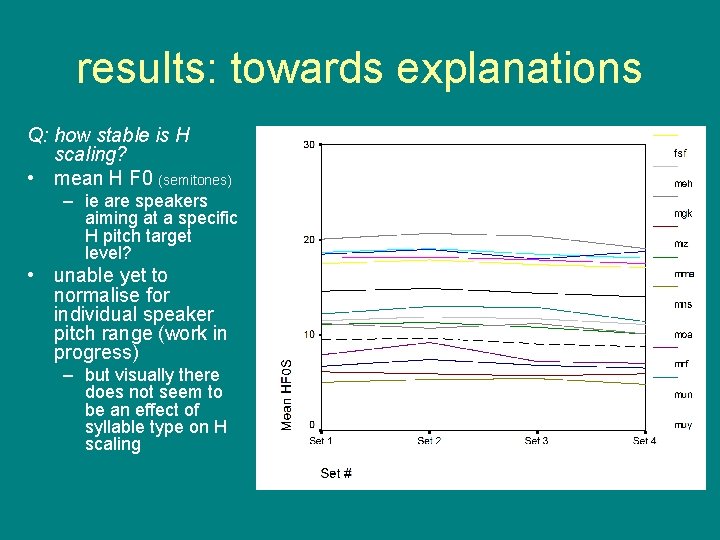
results: towards explanations Q: how stable is H scaling? • mean H F 0 (semitones) – ie are speakers aiming at a specific H pitch target level? • unable yet to normalise for individual speaker pitch range (work in progress) – but visually there does not seem to be an effect of syllable type on H scaling
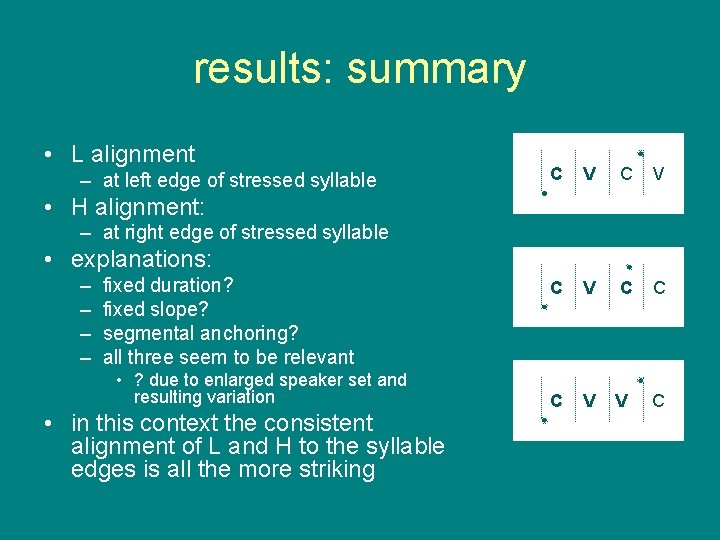
results: summary • L alignment – at left edge of stressed syllable C V C V C C C V V C • H alignment: – at right edge of stressed syllable • explanations: – – fixed duration? fixed slope? segmental anchoring? all three seem to be relevant • ? due to enlarged speaker set and resulting variation • in this context the consistent alignment of L and H to the syllable edges is all the more striking
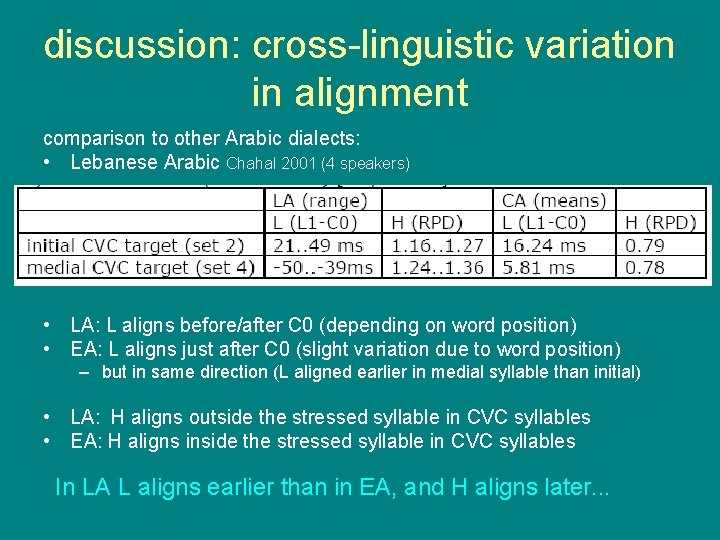
discussion: cross-linguistic variation in alignment comparison to other Arabic dialects: • Lebanese Arabic Chahal 2001 (4 speakers) • LA: L aligns before/after C 0 (depending on word position) • EA: L aligns just after C 0 (slight variation due to word position) – but in same direction (L aligned earlier in medial syllable than initial) • LA: H aligns outside the stressed syllable in CVC syllables • EA: H aligns inside the stressed syllable in CVC syllables In LA L aligns earlier than in EA, and H aligns later. . .
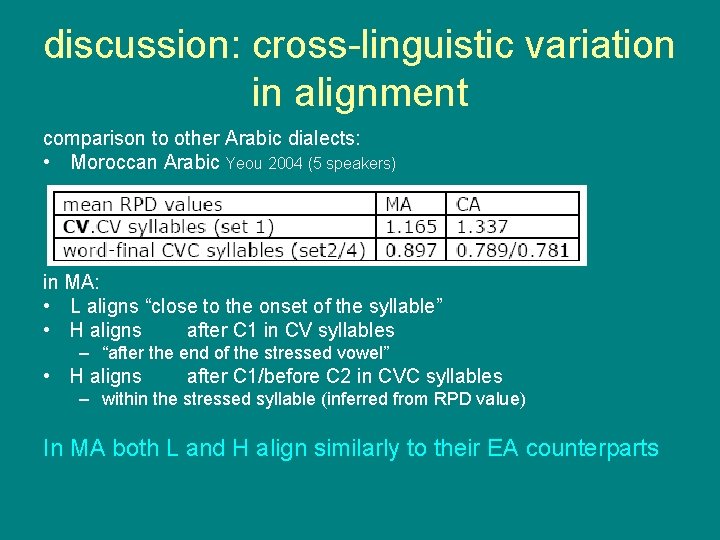
discussion: cross-linguistic variation in alignment comparison to other Arabic dialects: • Moroccan Arabic Yeou 2004 (5 speakers) in MA: • L aligns “close to the onset of the syllable” • H aligns after C 1 in CV syllables – “after the end of the stressed vowel” • H aligns after C 1/before C 2 in CVC syllables – within the stressed syllable (inferred from RPD value) In MA both L and H align similarly to their EA counterparts
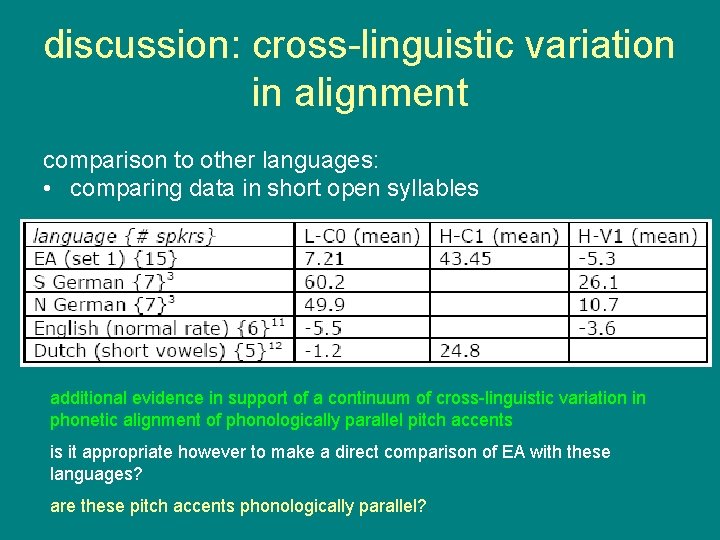
discussion: cross-linguistic variation in alignment comparison to other languages: • comparing data in short open syllables additional evidence in support of a continuum of cross-linguistic variation in phonetic alignment of phonologically parallel pitch accents is it appropriate however to make a direct comparison of EA with these languages? are these pitch accents phonologically parallel?
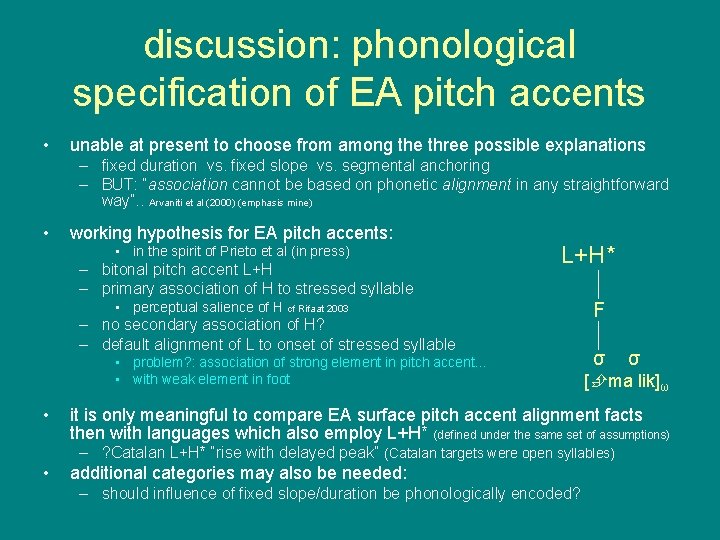
discussion: phonological specification of EA pitch accents • unable at present to choose from among the three possible explanations – fixed duration vs. fixed slope vs. segmental anchoring – BUT: “association cannot be based on phonetic alignment in any straightforward way”. . Arvaniti et al (2000) (emphasis mine) • working hypothesis for EA pitch accents: • in the spirit of Prieto et al (in press) – bitonal pitch accent L+H – primary association of H to stressed syllable L+H* • perceptual salience of H cf Rifaat 2003 – no secondary association of H? – default alignment of L to onset of stressed syllable • problem? : association of strong element in pitch accent. . . • with weak element in foot • F σ [ ma lik]ω it is only meaningful to compare EA surface pitch accent alignment facts then with languages which also employ L+H* (defined under the same set of assumptions) – ? Catalan L+H* “rise with delayed peak” (Catalan targets were open syllables) • σ additional categories may also be needed: – should influence of fixed slope/duration be phonologically encoded?
ﺃﻠﻒ ﺷﻜﺮ thank you! With thanks to • the Egyptian Arabic speakers who acted as consultants • audiences at the UCL Phonology Reading Group & Manchester Phonology Meeting for comments on earlier versions of this paper This work was funded by AHRB postgraduate award 01/59198.
- Slides: 28