
PIR Microwave Motion Detector Dual Technology Features PIR
- Slides: 1
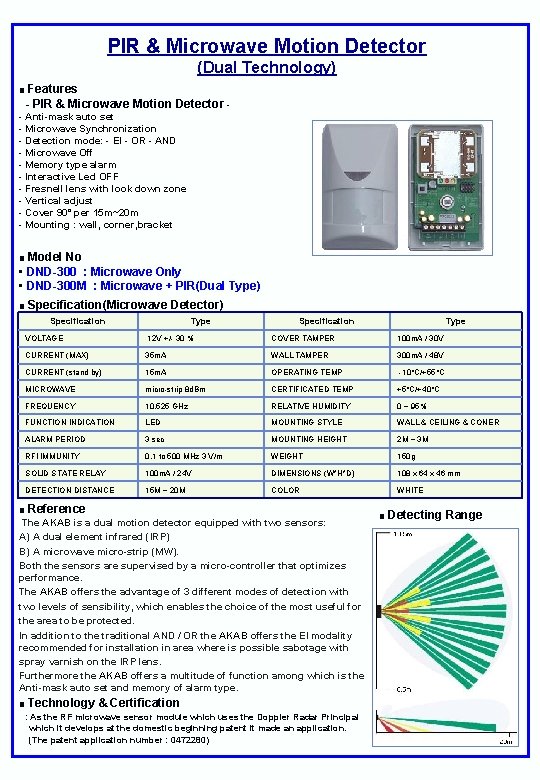
PIR & Microwave Motion Detector (Dual Technology) ■ Features - PIR & Microwave Motion Detector - Anti-mask auto set - Microwave Synchronization - Detection mode: - EI - OR - AND - Microwave Off - Memory type alarm - Interactive Led OFF - Fresnell lens with look down zone - Vertical adjust - Cover 90° per 15 m~20 m - Mounting : wall, corner, bracket ■ Model No • DND-300 : Microwave Only • DND-300 M : Microwave + PIR(Dual Type) ■ Specification(Microwave Detector) Specification Type VOLTAGE 12 V +/- 30 % COVER TAMPER 100 m. A / 30 V CURRENT (MAX) 35 m. A WALL TAMPER 300 m. A / 48 V CURRENT (stand by) 15 m. A OPERATING TEMP -10°C/+55°C MICROWAVE micro-strip 8 d. Bm CERTIFICATED TEMP +5°C/+40°C FREQUENCY 10. 525 GHz RELATIVE HUMIDITY 0 ~ 95% FUNCTION INDICATION LED MOUNTING STYLE WALL & CEILING & CONER ALARM PERIOD 3 sec MOUNTING HEIGHT 2 M ~ 3 M RFI IMMUNITY 0. 1 to 500 MHz 3 V/m WEIGHT 150 g SOLID STATE RELAY 100 m. A / 24 V DIMENSIONS (W*H*D) 108 x 64 x 46 mm DETECTION DISTANCE 15 M ~ 20 M COLOR WHITE ■ Reference The AKAB is a dual motion detector equipped with two sensors: A) A dual element infrared (IRP) B) A microwave micro-strip (MW). Both the sensors are supervised by a micro-controller that optimizes performance. The AKAB offers the advantage of 3 different modes of detection with two levels of sensibility, which enables the choice of the most useful for the area to be protected. In addition to the traditional AND / OR the AKAB offers the EI modality recommended for installation in area where is possible sabotage with spray varnish on the IRP lens. Furthermore the AKAB offers a multitude of function among which is the Anti-mask auto set and memory of alarm type. ■ Technology & Certification : As the RF microwave sensor module which uses the Doppler Radar Principal which it develops at the domestic beginning patent it made an application. (The patent application number : 0472280) ■ Detecting Range