
PIPII QPM System Introduction Bruce Hanna Final Design
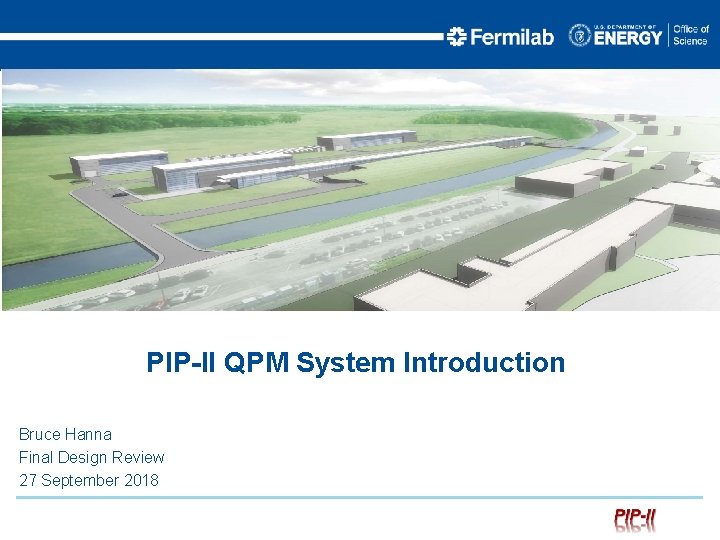
PIP-II QPM System Introduction Bruce Hanna Final Design Review 27 September 2018 In partnership with: India/DAE Italy/INFN UK/STFC France/CEA/Irfu, CNRS/IN 2 P 3
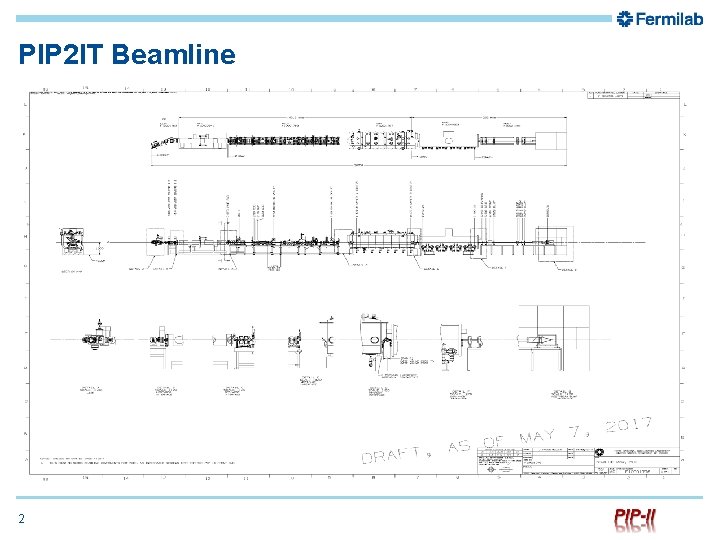
PIP 2 IT Beamline 2
QPM Specifications • Monitor voltages, calculate d. I/dt and determine V-Ld. I/dt – If this value is >1 volt, turn off the supply – QPM will monitor solenoids and correctors – If a solenoid quench is detected, appropriate correctors will be turned off • Detect if systems outside of the QPM/PS system indicate power should not be applied to the magnets – Cryo – Safety System • • 3 Quench detection time < 55 msec Quench response time < 10 msec QPM will be able to store all quench data for later analysis QPM will monitor control PS Voltages and turn off if a failure is detected 12/13/20 17 B. Hanna | Linac Warm Units, Power Supplies, Vacuum and Beam Transfer and Absorber Line
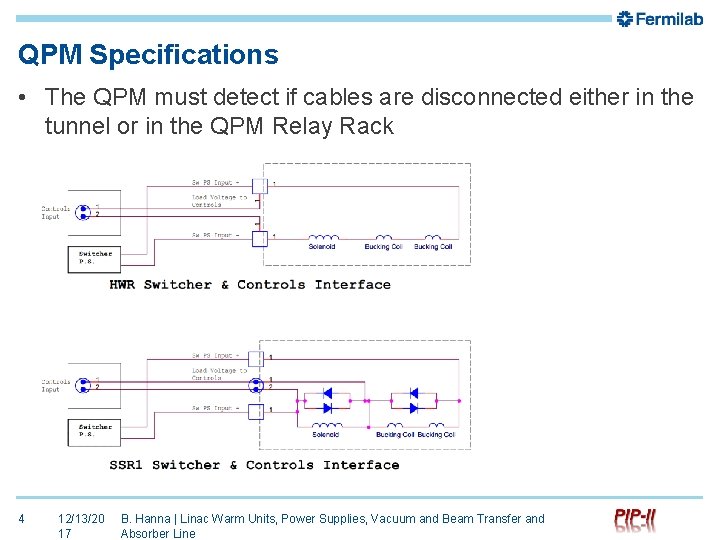
QPM Specifications • The QPM must detect if cables are disconnected either in the tunnel or in the QPM Relay Rack 4 12/13/20 17 B. Hanna | Linac Warm Units, Power Supplies, Vacuum and Beam Transfer and Absorber Line
Magnet Parameters • HWR: – – Solenoid coil Inductance= 1083 m. H Hor and Ver correctors= 80 m. H Coil manufacturer is Crymagnetics Installed and tested by Argonne • In these quench tests the quench protection was simply to have a low voltage limit on the PS so as the quench develops the coil becomes very resistive and the current goes to zero and PS is turned off • SSR 1 – Solenoid coil inductance= 3. 183 H – Bucking coil inductance=. 907 H – Mutual inductance = -. 757 H (direction of magnetic fields are opposite from each other 5 12/13/20 17 B. Hanna | Linac Warm Units, Power Supplies, Vacuum and Beam Transfer and Absorber Line
Cryogenic components (HWR) • Half Wave Resonator (HWR) – 8 cavities – 8 Solenoids • Maximum current in PIP-II is 70 amps • Max ramp rate is 3. 5 A/s • No cold diodes – 16 dipole correctors • +/- 5 amps • Max ramp rate is 10 A/s – These magnets have been quenched at Argonne • Quench at 90 amps – Since there are no voltage taps the QPM will monitor across the whole coil (Solenoid coil and Bucking coils) 6 12/13/20 17 B. Hanna | Linac Warm Units, Power Supplies, Vacuum and Beam Transfer and Absorber Line
Cryogenic Components (SSR 1) • Single Spoke Resonator (SSR 1) – 8 cavities – 4 Solenoids • Maximum current in PIP-II is 70 amps • Max ramp rate is 1. 5 A/s • Cold diodes are across the coils – Switching Rectifier Diodes p/n STTH 6004 W – 16 corrector coils • Maximum ramp rate is 100 A/s • Each solenoid has 4 corrector coils associated with it – By adjusting current in each of these coils we can make H and V dipoles as well as skew quad • No cold diodes across these 7 12/13/20 17 B. Hanna | Linac Warm Units, Power Supplies, Vacuum and Beam Transfer and Absorber Line
Cryogenic components • Note that this agrees well with our measured results – A SSR 1 magnet was tested here at VTS • Results from 2015 showed the coils could “eat” their own energy • In this test, the quench limit was set high due to noise and they monitored across the entire coil – Quench detection time was greater than 100 msec • This same magnet was tested again in Sept of this year using the prototype QPM – Quench detection time were less than 50 msec 8 12/13/20 17 B. Hanna | Linac Warm Units, Power Supplies, Vacuum and Beam Transfer and Absorber Line
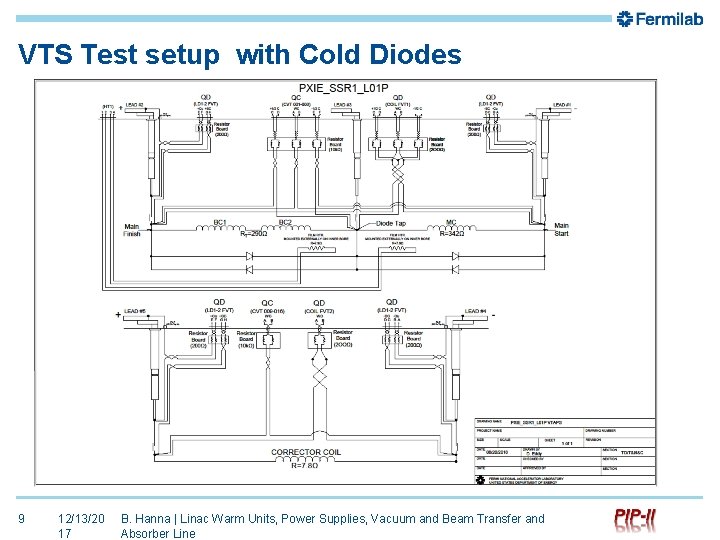
VTS Test setup with Cold Diodes 9 12/13/20 17 B. Hanna | Linac Warm Units, Power Supplies, Vacuum and Beam Transfer and Absorber Line
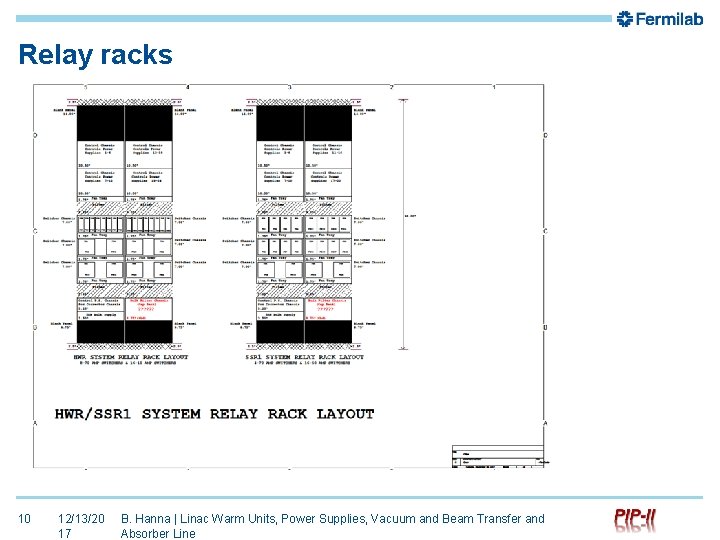
Relay racks 10 12/13/20 17 B. Hanna | Linac Warm Units, Power Supplies, Vacuum and Beam Transfer and Absorber Line
Expectations for the review • This review will focus on the final design (FDR) of the QPM system and on the procurement readiness for this program (PRR) – The expected outcome of the review is the recommendation to proceed with the fabrication of eight QPM systems, which will be installed at PIP 2 IT to demonstrate the reliability of the quench protection scheme. 11 12/13/20 17 B. Hanna | Linac Warm Units, Power Supplies, Vacuum and Beam Transfer and Absorber Line
- Slides: 11