
Pipelining Two forms of pipelining instruction unit overlap
- Slides: 64
Pipelining • Two forms of pipelining – instruction unit • overlap fetch-execute cycle so that multiple instructions are being processed at the same time, each instruction in a different portion of the fetch-execute cycle – operation (functional) unit • overlap execution of ALU operations • only useful if execution takes > 1 cycle – e. g. , floating point operations • We will concentrate mostly on instruction unitlevel – but we will see the necessity for functional unit pipelining later in the semester
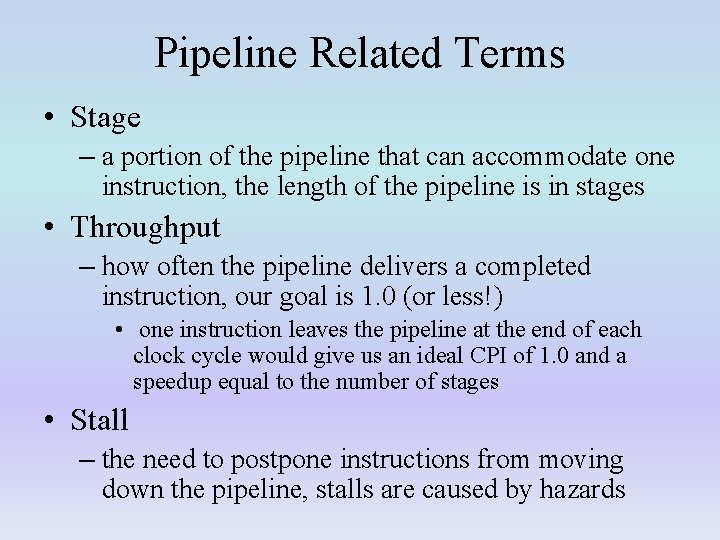
Pipeline Related Terms • Stage – a portion of the pipeline that can accommodate one instruction, the length of the pipeline is in stages • Throughput – how often the pipeline delivers a completed instruction, our goal is 1. 0 (or less!) • one instruction leaves the pipeline at the end of each clock cycle would give us an ideal CPI of 1. 0 and a speedup equal to the number of stages • Stall – the need to postpone instructions from moving down the pipeline, stalls are caused by hazards
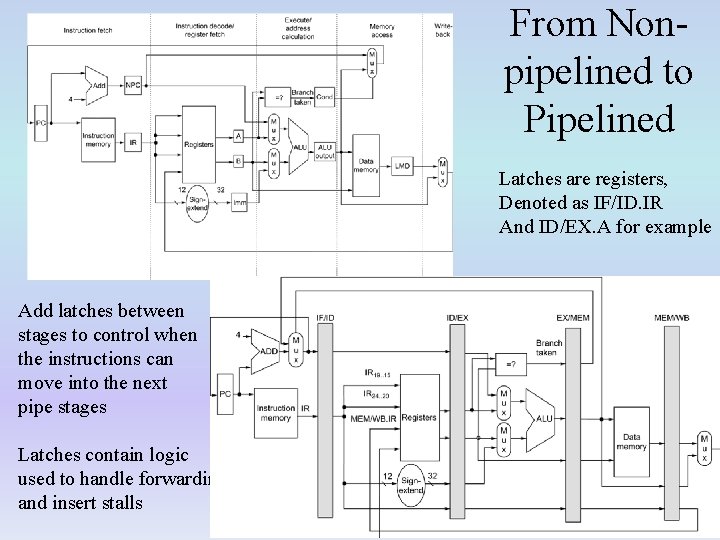
From Nonpipelined to Pipelined Latches are registers, Denoted as IF/ID. IR And ID/EX. A for example Add latches between stages to control when the instructions can move into the next pipe stages Latches contain logic used to handle forwarding and insert stalls
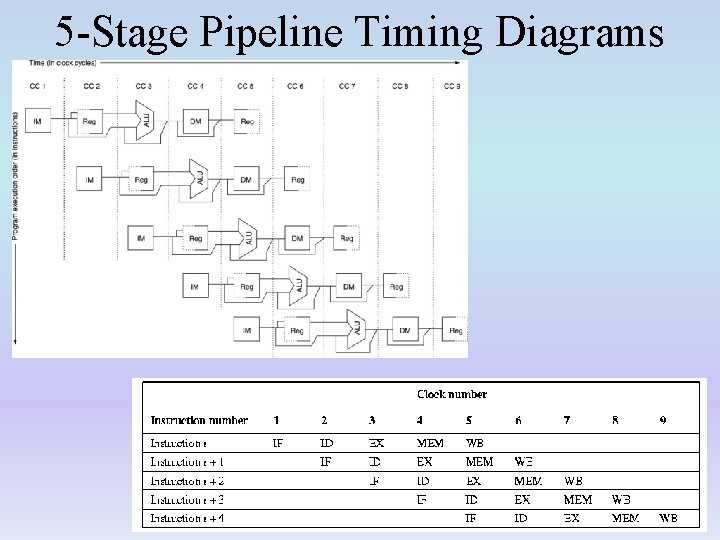
5 -Stage Pipeline Timing Diagrams
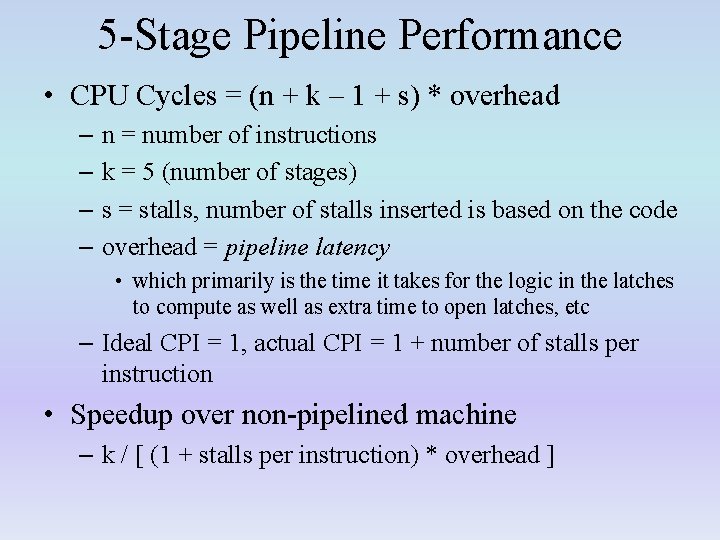
5 -Stage Pipeline Performance • CPU Cycles = (n + k – 1 + s) * overhead – n = number of instructions – k = 5 (number of stages) – s = stalls, number of stalls inserted is based on the code – overhead = pipeline latency • which primarily is the time it takes for the logic in the latches to compute as well as extra time to open latches, etc – Ideal CPI = 1, actual CPI = 1 + number of stalls per instruction • Speedup over non-pipelined machine – k / [ (1 + stalls per instruction) * overhead ]
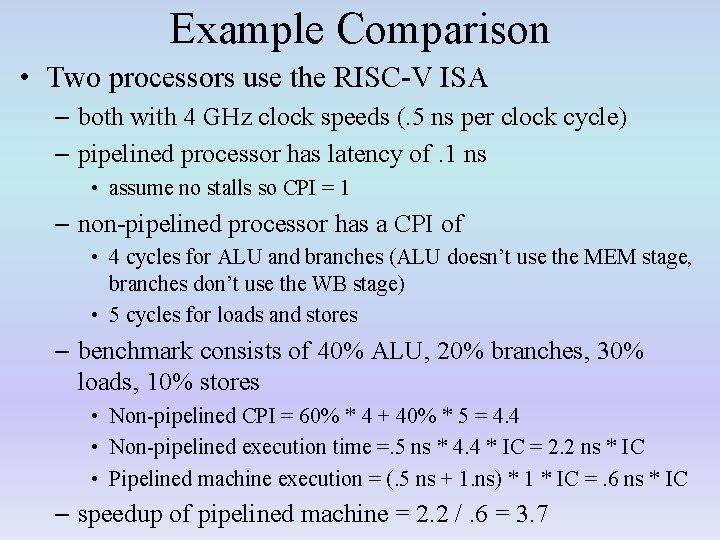
Example Comparison • Two processors use the RISC-V ISA – both with 4 GHz clock speeds (. 5 ns per clock cycle) – pipelined processor has latency of. 1 ns • assume no stalls so CPI = 1 – non-pipelined processor has a CPI of • 4 cycles for ALU and branches (ALU doesn’t use the MEM stage, branches don’t use the WB stage) • 5 cycles for loads and stores – benchmark consists of 40% ALU, 20% branches, 30% loads, 10% stores • Non-pipelined CPI = 60% * 4 + 40% * 5 = 4. 4 • Non-pipelined execution time =. 5 ns * 4. 4 * IC = 2. 2 ns * IC • Pipelined machine execution = (. 5 ns + 1. ns) * 1 * IC =. 6 ns * IC – speedup of pipelined machine = 2. 2 /. 6 = 3. 7
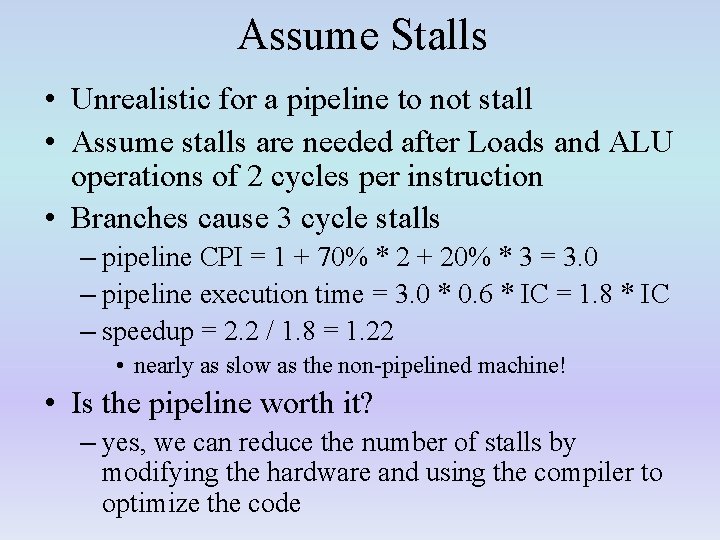
Assume Stalls • Unrealistic for a pipeline to not stall • Assume stalls are needed after Loads and ALU operations of 2 cycles per instruction • Branches cause 3 cycle stalls – pipeline CPI = 1 + 70% * 2 + 20% * 3 = 3. 0 – pipeline execution time = 3. 0 * 0. 6 * IC = 1. 8 * IC – speedup = 2. 2 / 1. 8 = 1. 22 • nearly as slow as the non-pipelined machine! • Is the pipeline worth it? – yes, we can reduce the number of stalls by modifying the hardware and using the compiler to optimize the code
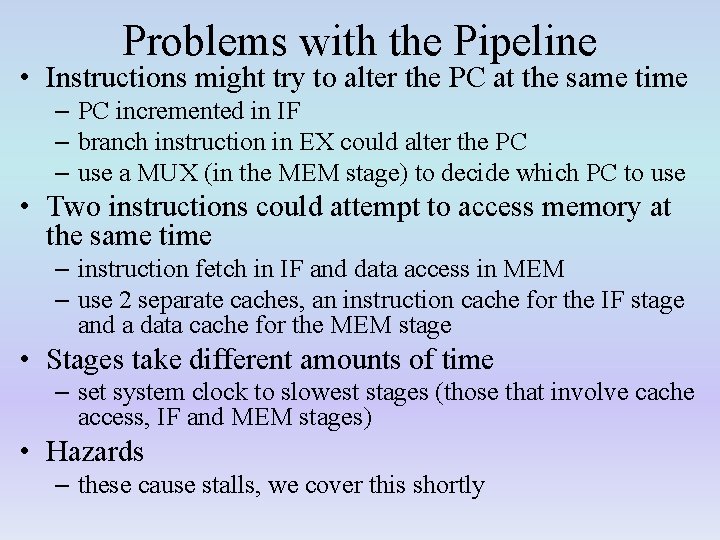
Problems with the Pipeline • Instructions might try to alter the PC at the same time – PC incremented in IF – branch instruction in EX could alter the PC – use a MUX (in the MEM stage) to decide which PC to use • Two instructions could attempt to access memory at the same time – instruction fetch in IF and data access in MEM – use 2 separate caches, an instruction cache for the IF stage and a data cache for the MEM stage • Stages take different amounts of time – set system clock to slowest stages (those that involve cache access, IF and MEM stages) • Hazards – these cause stalls, we cover this shortly
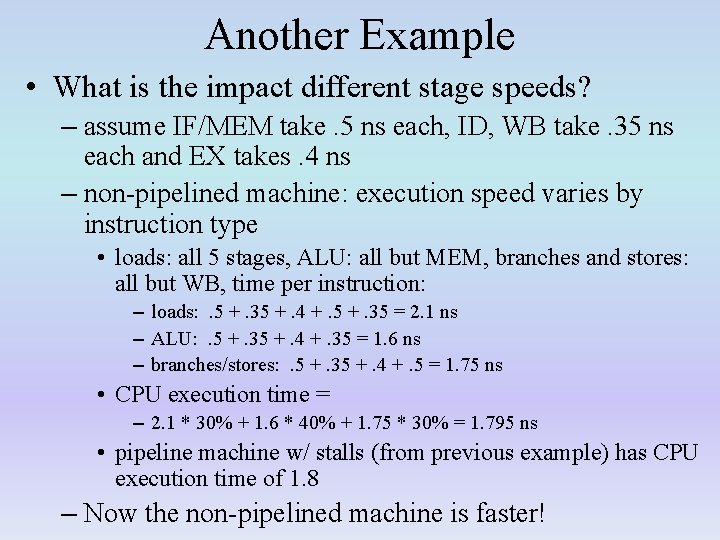
Another Example • What is the impact different stage speeds? – assume IF/MEM take. 5 ns each, ID, WB take. 35 ns each and EX takes. 4 ns – non-pipelined machine: execution speed varies by instruction type • loads: all 5 stages, ALU: all but MEM, branches and stores: all but WB, time per instruction: – loads: . 5 +. 35 +. 4 +. 5 +. 35 = 2. 1 ns – ALU: . 5 +. 35 +. 4 +. 35 = 1. 6 ns – branches/stores: . 5 +. 35 +. 4 +. 5 = 1. 75 ns • CPU execution time = – 2. 1 * 30% + 1. 6 * 40% + 1. 75 * 30% = 1. 795 ns • pipeline machine w/ stalls (from previous example) has CPU execution time of 1. 8 – Now the non-pipelined machine is faster!
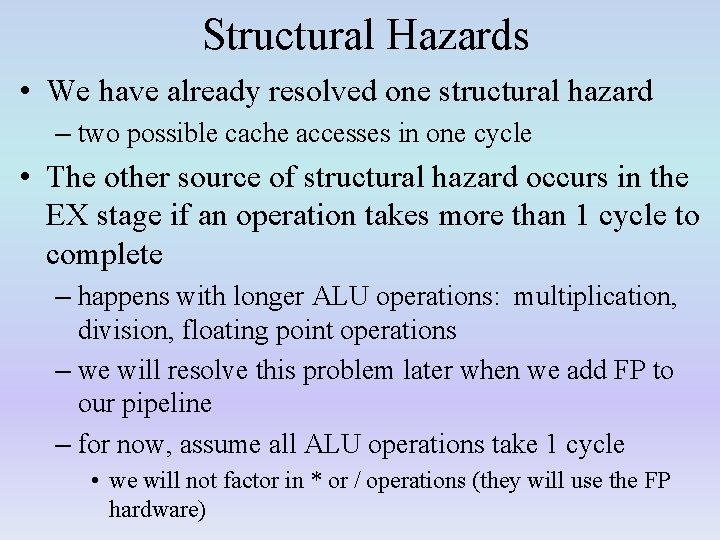
Structural Hazards • We have already resolved one structural hazard – two possible cache accesses in one cycle • The other source of structural hazard occurs in the EX stage if an operation takes more than 1 cycle to complete – happens with longer ALU operations: multiplication, division, floating point operations – we will resolve this problem later when we add FP to our pipeline – for now, assume all ALU operations take 1 cycle • we will not factor in * or / operations (they will use the FP hardware)
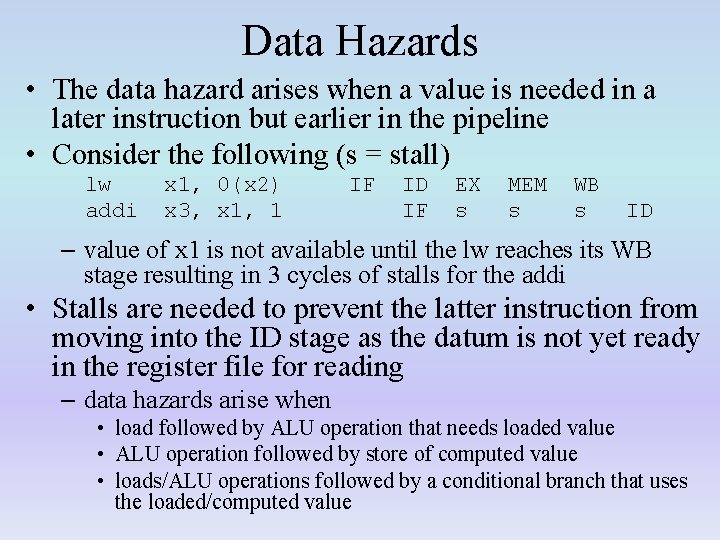
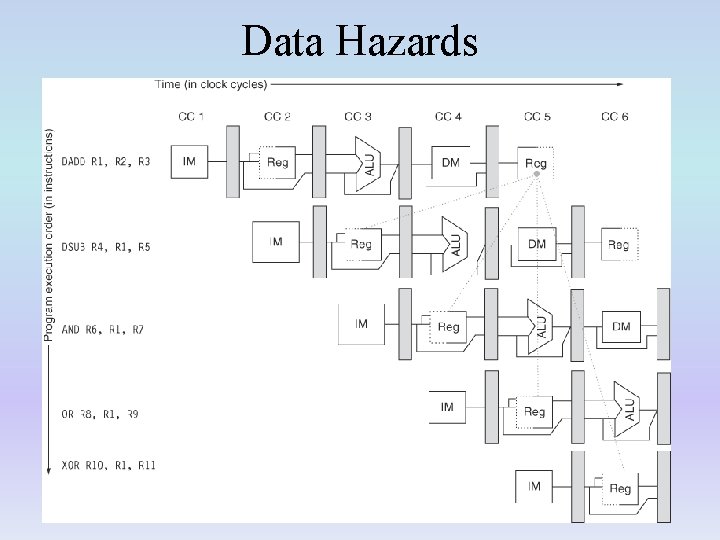
Data Hazards • The data hazard arises when a value is needed in a later instruction but earlier in the pipeline • Consider the following (s = stall) lw addi x 1, 0(x 2) x 3, x 1, 1 IF ID IF EX s MEM s WB s ID – value of x 1 is not available until the lw reaches its WB stage resulting in 3 cycles of stalls for the addi • Stalls are needed to prevent the latter instruction from moving into the ID stage as the datum is not yet ready in the register file for reading – data hazards arise when • load followed by ALU operation that needs loaded value • ALU operation followed by store of computed value • loads/ALU operations followed by a conditional branch that uses the loaded/computed value
Data Hazards
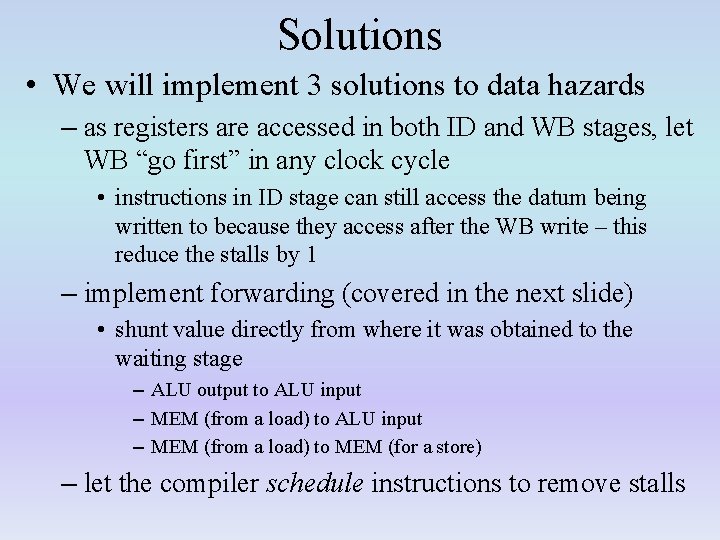
Solutions • We will implement 3 solutions to data hazards – as registers are accessed in both ID and WB stages, let WB “go first” in any clock cycle • instructions in ID stage can still access the datum being written to because they access after the WB write – this reduce the stalls by 1 – implement forwarding (covered in the next slide) • shunt value directly from where it was obtained to the waiting stage – ALU output to ALU input – MEM (from a load) to MEM (for a store) – let the compiler schedule instructions to remove stalls
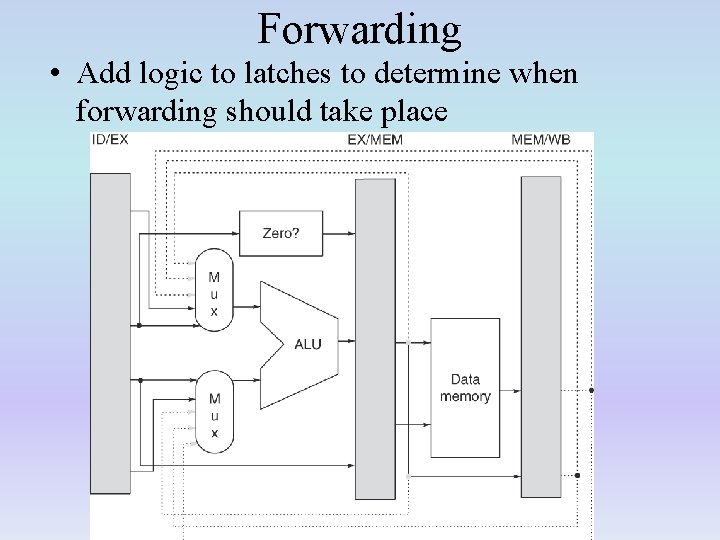
Forwarding • Add logic to latches to determine when forwarding should take place
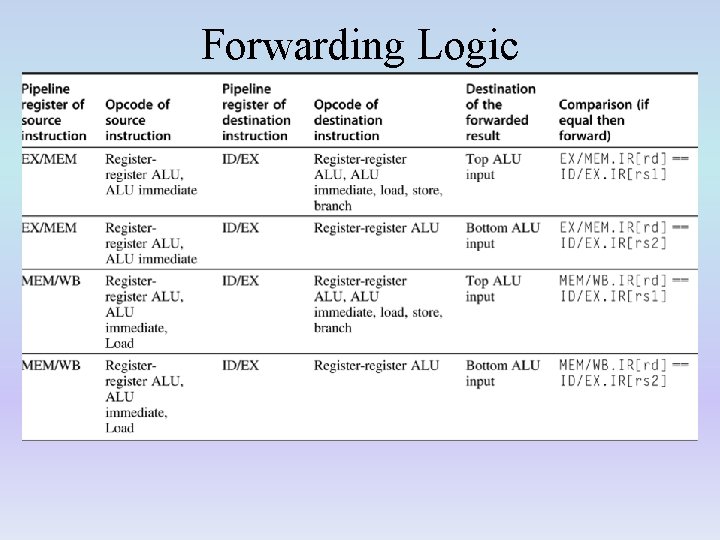
Forwarding Logic
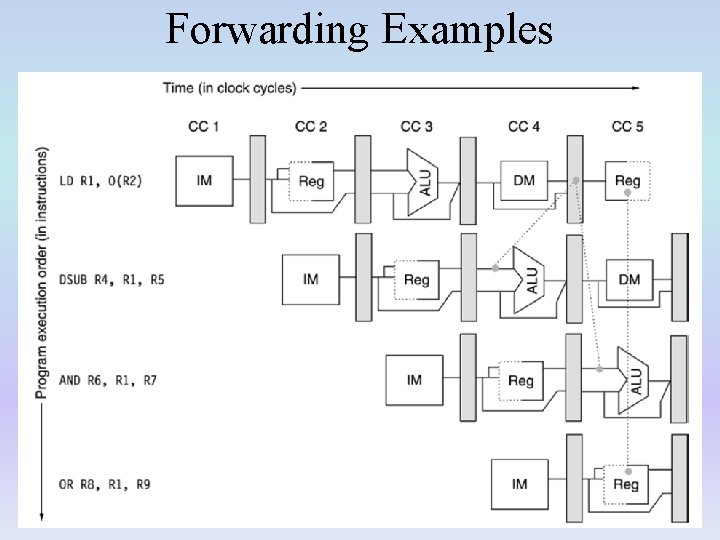
Forwarding Examples
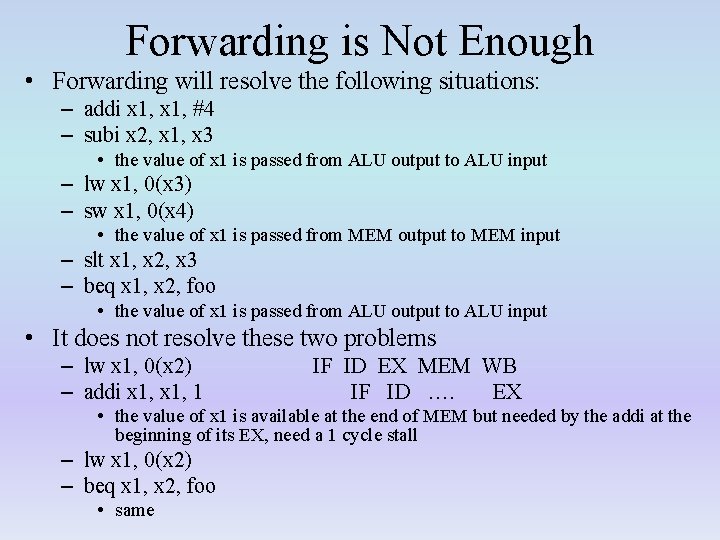
Forwarding is Not Enough • Forwarding will resolve the following situations: – addi x 1, #4 – subi x 2, x 1, x 3 • the value of x 1 is passed from ALU output to ALU input – lw x 1, 0(x 3) – sw x 1, 0(x 4) • the value of x 1 is passed from MEM output to MEM input – slt x 1, x 2, x 3 – beq x 1, x 2, foo • the value of x 1 is passed from ALU output to ALU input • It does not resolve these two problems – lw x 1, 0(x 2) – addi x 1, 1 IF ID EX MEM WB IF ID …. EX • the value of x 1 is available at the end of MEM but needed by the addi at the beginning of its EX, need a 1 cycle stall – lw x 1, 0(x 2) – beq x 1, x 2, foo • same
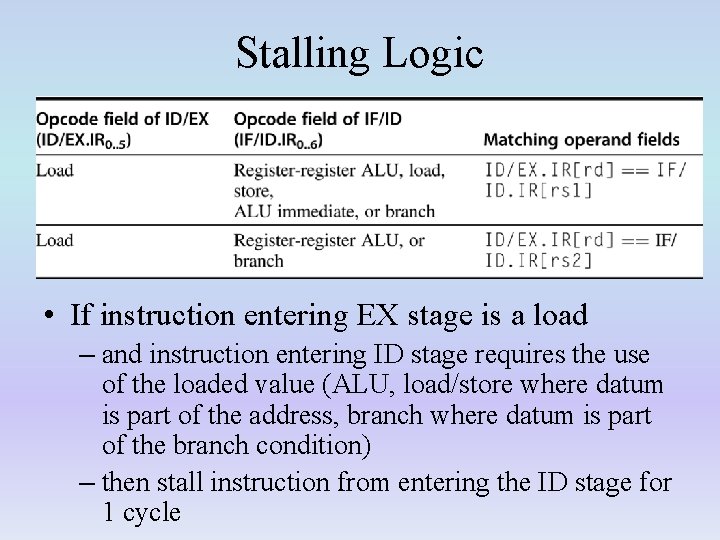
Stalling Logic • If instruction entering EX stage is a load – and instruction entering ID stage requires the use of the loaded value (ALU, load/store where datum is part of the address, branch where datum is part of the branch condition) – then stall instruction from entering the ID stage for 1 cycle
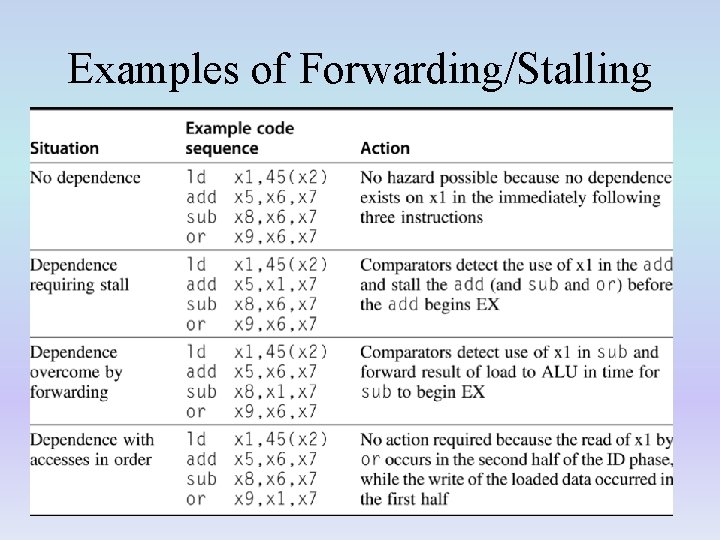
Examples of Forwarding/Stalling
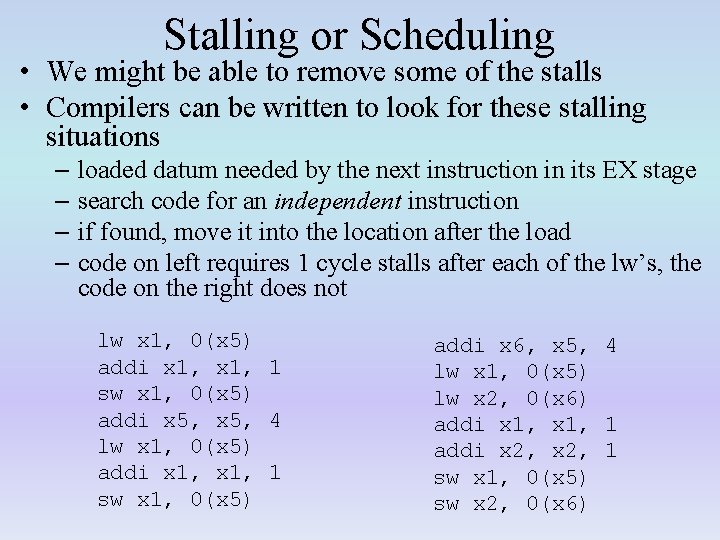
Stalling or Scheduling • We might be able to remove some of the stalls • Compilers can be written to look for these stalling situations – loaded datum needed by the next instruction in its EX stage – search code for an independent instruction – if found, move it into the location after the load – code on left requires 1 cycle stalls after each of the lw’s, the code on the right does not lw x 1, 0(x 5) addi x 1, 1 sw x 1, 0(x 5) addi x 5, 4 lw x 1, 0(x 5) addi x 1, 1 sw x 1, 0(x 5) addi x 6, x 5, 4 lw x 1, 0(x 5) lw x 2, 0(x 6) addi x 1, 1 addi x 2, 1 sw x 1, 0(x 5) sw x 2, 0(x 6)
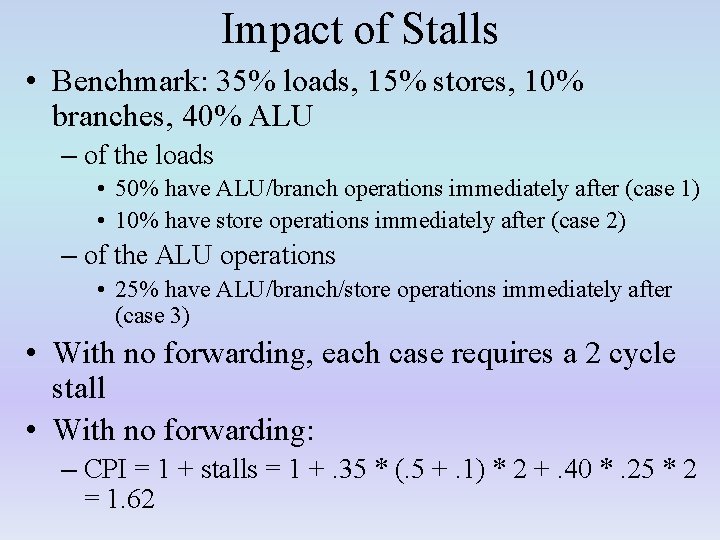
Impact of Stalls • Benchmark: 35% loads, 15% stores, 10% branches, 40% ALU – of the loads • 50% have ALU/branch operations immediately after (case 1) • 10% have store operations immediately after (case 2) – of the ALU operations • 25% have ALU/branch/store operations immediately after (case 3) • With no forwarding, each case requires a 2 cycle stall • With no forwarding: – CPI = 1 + stalls = 1 +. 35 * (. 5 +. 1) * 2 +. 40 *. 25 * 2 = 1. 62
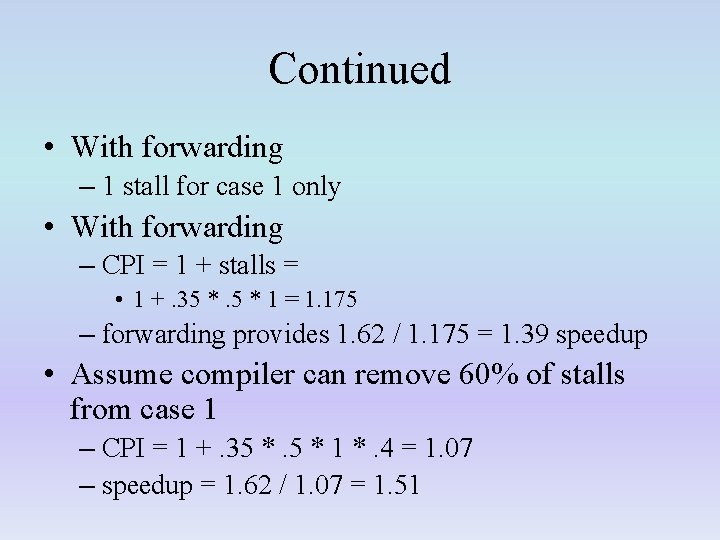
Continued • With forwarding – 1 stall for case 1 only • With forwarding – CPI = 1 + stalls = • 1 +. 35 *. 5 * 1 = 1. 175 – forwarding provides 1. 62 / 1. 175 = 1. 39 speedup • Assume compiler can remove 60% of stalls from case 1 – CPI = 1 +. 35 *. 5 * 1 *. 4 = 1. 07 – speedup = 1. 62 / 1. 07 = 1. 51
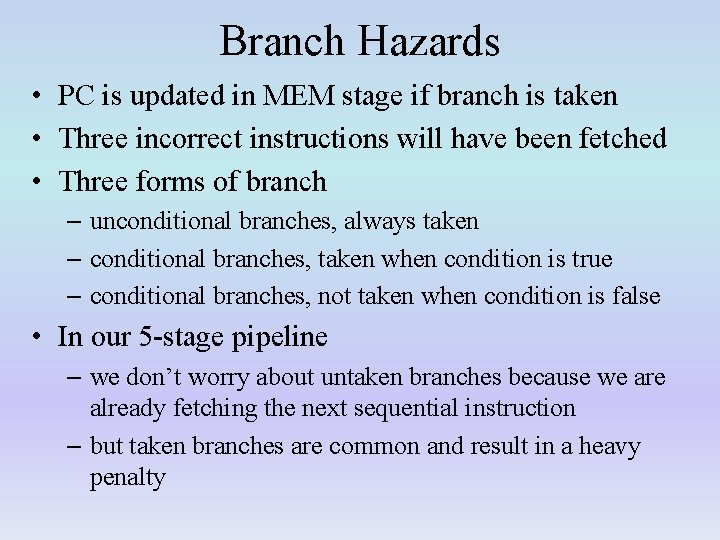
Branch Hazards • PC is updated in MEM stage if branch is taken • Three incorrect instructions will have been fetched • Three forms of branch – unconditional branches, always taken – conditional branches, taken when condition is true – conditional branches, not taken when condition is false • In our 5 -stage pipeline – we don’t worry about untaken branches because we are already fetching the next sequential instruction – but taken branches are common and result in a heavy penalty
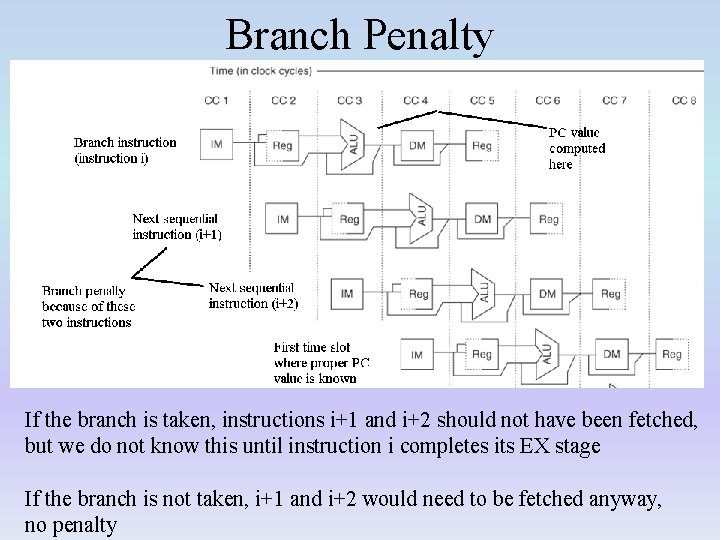
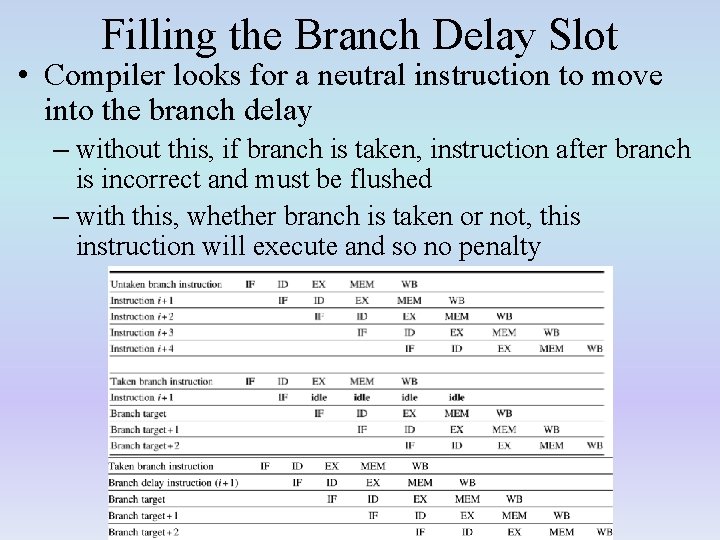
Branch Penalty If the branch is taken, instructions i+1 and i+2 should not have been fetched, but we do not know this until instruction i completes its EX stage If the branch is not taken, i+1 and i+2 would need to be fetched anyway, no penalty
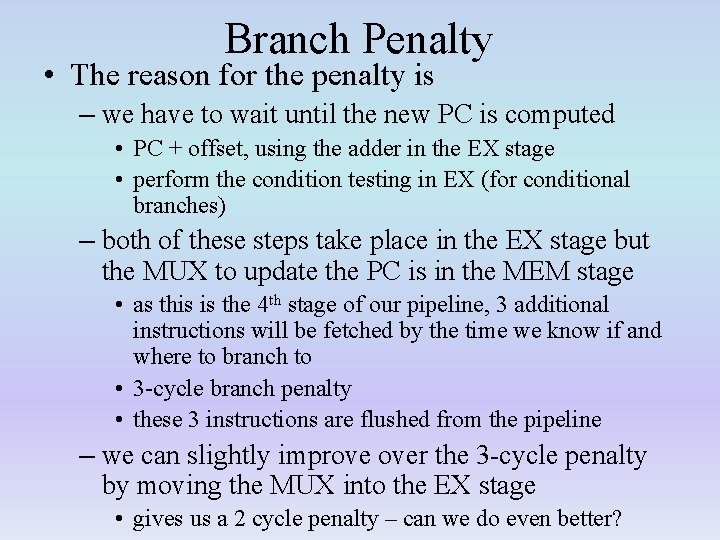
Branch Penalty • The reason for the penalty is – we have to wait until the new PC is computed • PC + offset, using the adder in the EX stage • perform the condition testing in EX (for conditional branches) – both of these steps take place in the EX stage but the MUX to update the PC is in the MEM stage • as this is the 4 th stage of our pipeline, 3 additional instructions will be fetched by the time we know if and where to branch to • 3 -cycle branch penalty • these 3 instructions are flushed from the pipeline – we can slightly improve over the 3 -cycle penalty by moving the MUX into the EX stage • gives us a 2 cycle penalty – can we do even better?
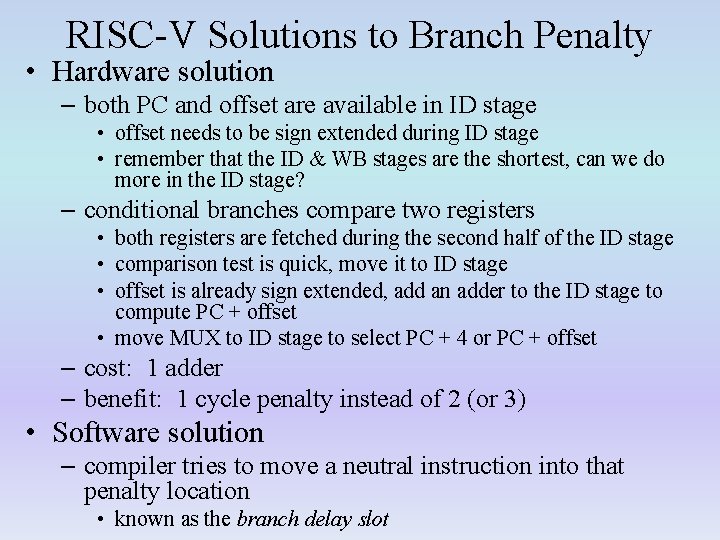
RISC-V Solutions to Branch Penalty • Hardware solution – both PC and offset are available in ID stage • offset needs to be sign extended during ID stage • remember that the ID & WB stages are the shortest, can we do more in the ID stage? – conditional branches compare two registers • both registers are fetched during the second half of the ID stage • comparison test is quick, move it to ID stage • offset is already sign extended, add an adder to the ID stage to compute PC + offset • move MUX to ID stage to select PC + 4 or PC + offset – cost: 1 adder – benefit: 1 cycle penalty instead of 2 (or 3) • Software solution – compiler tries to move a neutral instruction into that penalty location • known as the branch delay slot
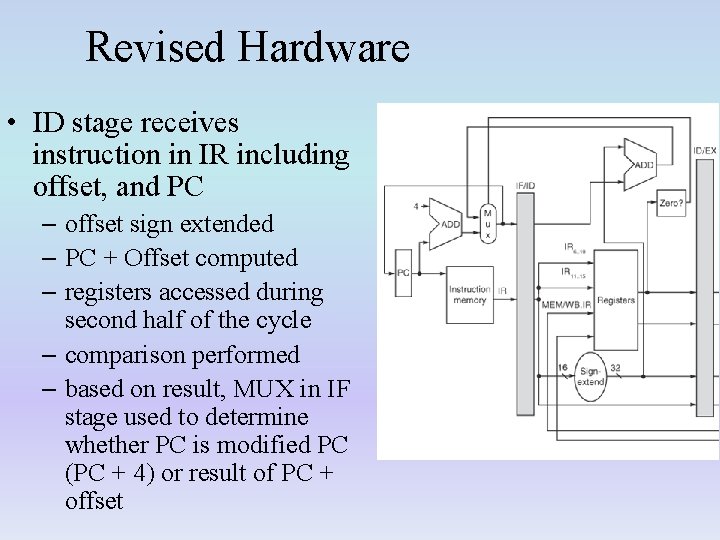
Revised Hardware • ID stage receives instruction in IR including offset, and PC – offset sign extended – PC + Offset computed – registers accessed during second half of the cycle – comparison performed – based on result, MUX in IF stage used to determine whether PC is modified PC (PC + 4) or result of PC + offset
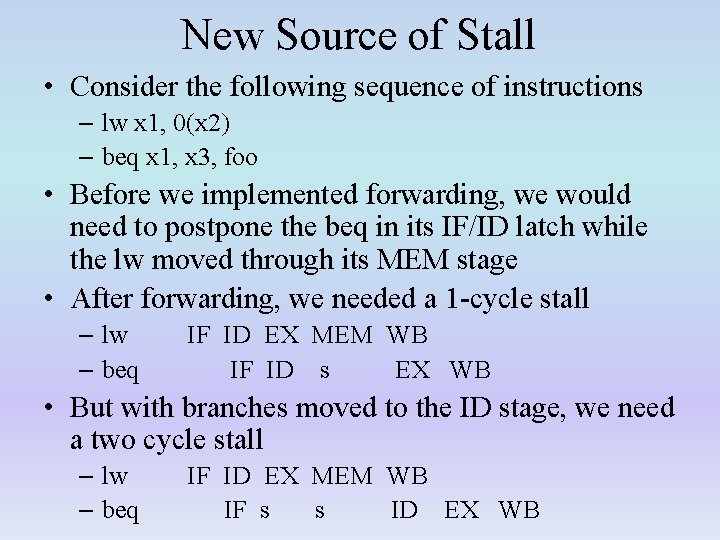
New Source of Stall • Consider the following sequence of instructions – lw x 1, 0(x 2) – beq x 1, x 3, foo • Before we implemented forwarding, we would need to postpone the beq in its IF/ID latch while the lw moved through its MEM stage • After forwarding, we needed a 1 -cycle stall – lw – beq IF ID EX MEM WB IF ID s EX WB • But with branches moved to the ID stage, we need a two cycle stall – lw – beq IF ID EX MEM WB IF s s ID EX WB
Filling the Branch Delay Slot • Compiler looks for a neutral instruction to move into the branch delay – without this, if branch is taken, instruction after branch is incorrect and must be flushed – with this, whether branch is taken or not, this instruction will execute and so no penalty
Impact of Branch Hazards • Assume a benchmark of – 30% loads, 10% stores, 40% ALU operations, 16% conditional branches and 4% unconditional branches, assume 67% of conditional branches are taken – assume for all conditional branches that none of the registers are loaded from memory but instead computed using ALU operations • Compute impact of branches if – original pipeline with no compiler scheduling – revised pipeline where compiler can fill branch delay slot 60% of the time
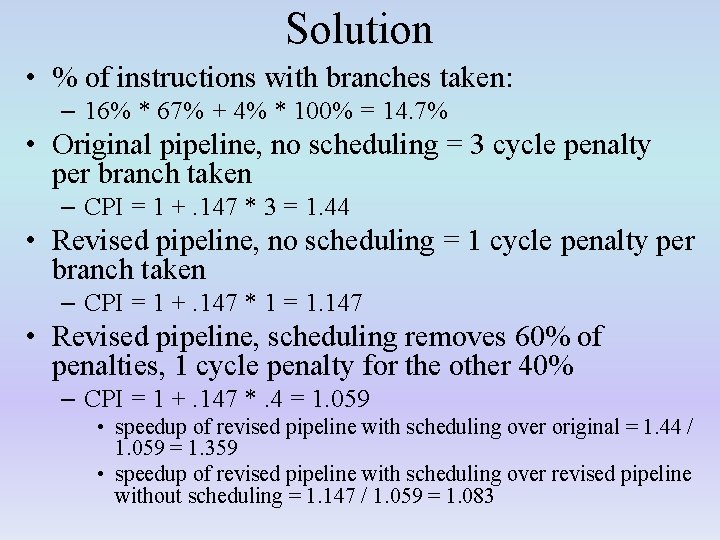
Solution • % of instructions with branches taken: – 16% * 67% + 4% * 100% = 14. 7% • Original pipeline, no scheduling = 3 cycle penalty per branch taken – CPI = 1 +. 147 * 3 = 1. 44 • Revised pipeline, no scheduling = 1 cycle penalty per branch taken – CPI = 1 +. 147 * 1 = 1. 147 • Revised pipeline, scheduling removes 60% of penalties, 1 cycle penalty for the other 40% – CPI = 1 +. 147 *. 4 = 1. 059 • speedup of revised pipeline with scheduling over original = 1. 44 / 1. 059 = 1. 359 • speedup of revised pipeline with scheduling over revised pipeline without scheduling = 1. 147 / 1. 059 = 1. 083
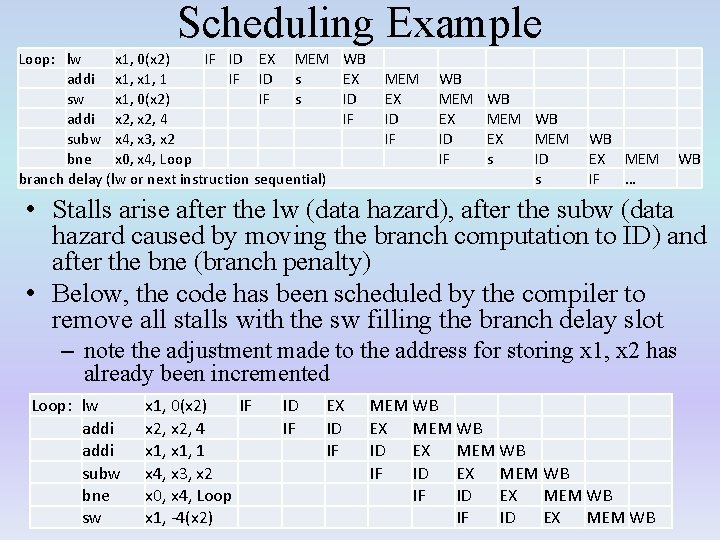
Scheduling Example Loop: lw x 1, 0(x 2) IF ID EX MEM addi x 1, 1 IF ID s sw x 1, 0(x 2) IF s addi x 2, 4 subw x 4, x 3, x 2 bne x 0, x 4, Loop branch delay (lw or next instruction sequential) WB EX ID IF MEM EX ID IF WB MEM WB EX MEM s ID s WB EX MEM IF … WB • Stalls arise after the lw (data hazard), after the subw (data hazard caused by moving the branch computation to ID) and after the bne (branch penalty) • Below, the code has been scheduled by the compiler to remove all stalls with the sw filling the branch delay slot – note the adjustment made to the address for storing x 1, x 2 has already been incremented Loop: lw addi subw bne sw x 1, 0(x 2) IF x 2, 4 x 1, 1 x 4, x 3, x 2 x 0, x 4, Loop x 1, -4(x 2) ID IF EX ID IF MEM WB EX MEM WB ID EX MEM WB IF ID EX MEM WB
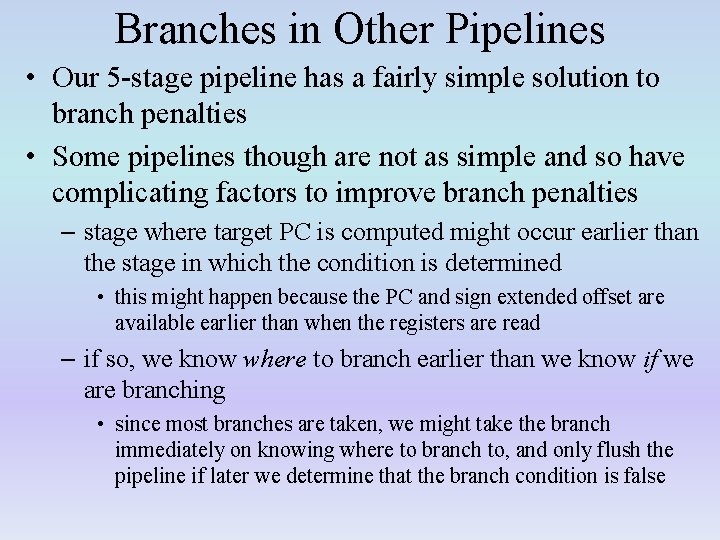
Branches in Other Pipelines • Our 5 -stage pipeline has a fairly simple solution to branch penalties • Some pipelines though are not as simple and so have complicating factors to improve branch penalties – stage where target PC is computed might occur earlier than the stage in which the condition is determined • this might happen because the PC and sign extended offset are available earlier than when the registers are read – if so, we know where to branch earlier than we know if we are branching • since most branches are taken, we might take the branch immediately on knowing where to branch to, and only flush the pipeline if later we determine that the branch condition is false
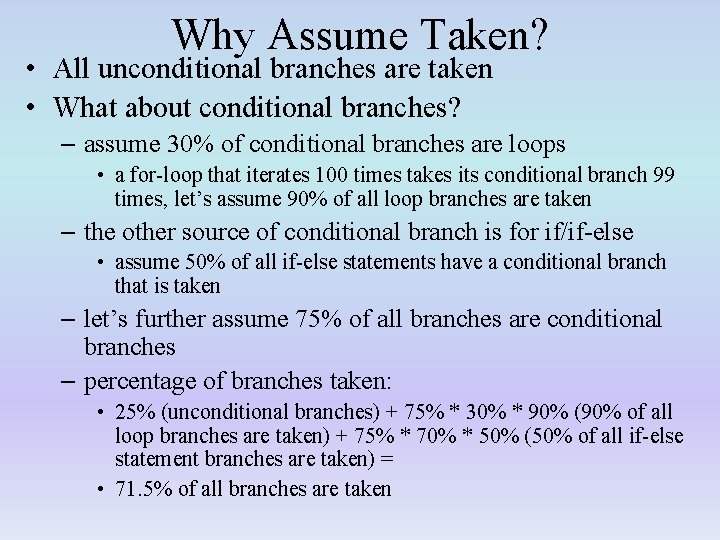
Why Assume Taken? • All unconditional branches are taken • What about conditional branches? – assume 30% of conditional branches are loops • a for-loop that iterates 100 times takes its conditional branch 99 times, let’s assume 90% of all loop branches are taken – the other source of conditional branch is for if/if-else • assume 50% of all if-else statements have a conditional branch that is taken – let’s further assume 75% of all branches are conditional branches – percentage of branches taken: • 25% (unconditional branches) + 75% * 30% * 90% (90% of all loop branches are taken) + 75% * 70% * 50% (50% of all if-else statement branches are taken) = • 71. 5% of all branches are taken
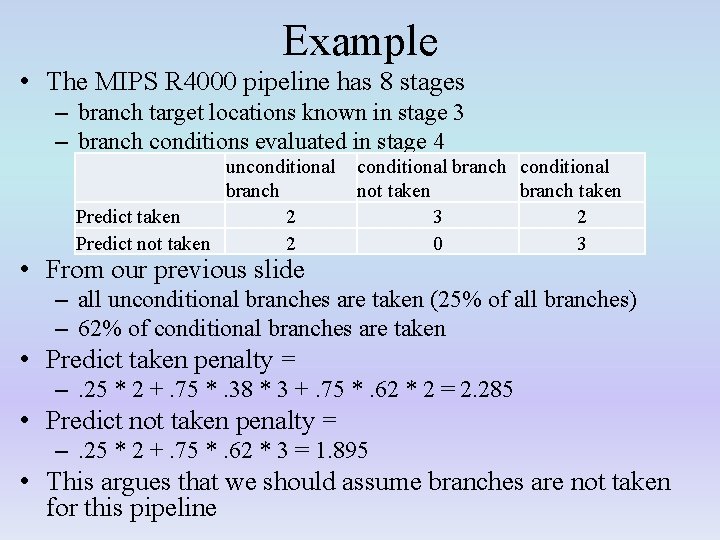
Example • The MIPS R 4000 pipeline has 8 stages – branch target locations known in stage 3 – branch conditions evaluated in stage 4 unconditional branch Predict taken 2 Predict not taken 2 • From our previous slide conditional branch conditional not taken branch taken 3 2 0 3 – all unconditional branches are taken (25% of all branches) – 62% of conditional branches are taken • Predict taken penalty = –. 25 * 2 +. 75 *. 38 * 3 +. 75 *. 62 * 2 = 2. 285 • Predict not taken penalty = –. 25 * 2 +. 75 *. 62 * 3 = 1. 895 • This argues that we should assume branches are not taken for this pipeline
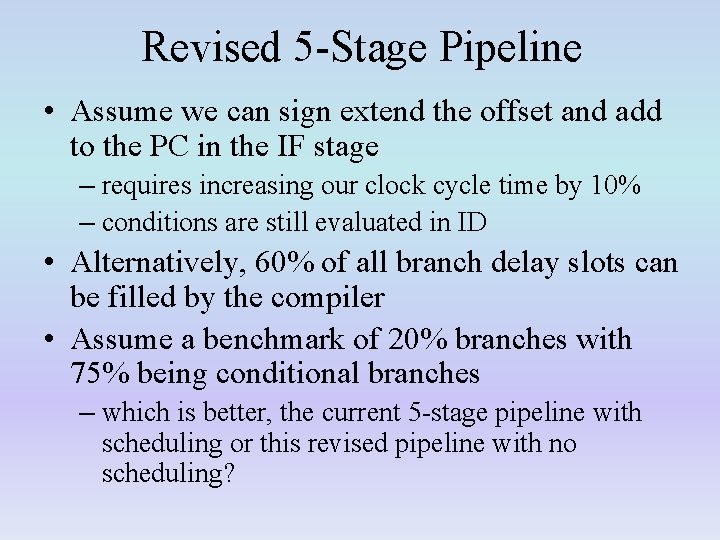
Revised 5 -Stage Pipeline • Assume we can sign extend the offset and add to the PC in the IF stage – requires increasing our clock cycle time by 10% – conditions are still evaluated in ID • Alternatively, 60% of all branch delay slots can be filled by the compiler • Assume a benchmark of 20% branches with 75% being conditional branches – which is better, the current 5 -stage pipeline with scheduling or this revised pipeline with no scheduling?
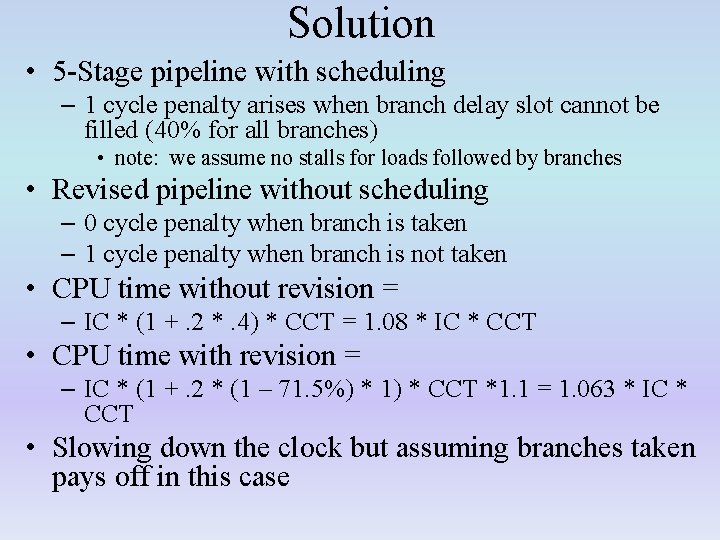
Solution • 5 -Stage pipeline with scheduling – 1 cycle penalty arises when branch delay slot cannot be filled (40% for all branches) • note: we assume no stalls for loads followed by branches • Revised pipeline without scheduling – 0 cycle penalty when branch is taken – 1 cycle penalty when branch is not taken • CPU time without revision = – IC * (1 +. 2 *. 4) * CCT = 1. 08 * IC * CCT • CPU time with revision = – IC * (1 +. 2 * (1 – 71. 5%) * 1) * CCT *1. 1 = 1. 063 * IC * CCT • Slowing down the clock but assuming branches taken pays off in this case
Another Strategy: Speculation • With branch locations and branch conditions being computed in the same stage, there is no point to assuming taken versus not taken – there is also a minimal penalty in the 5 -stage pipeline if we can schedule the branch delay slot • Other pipelines may benefit by using branch speculation, which we might use in a longer pipeline – where branch locations are computed earlier than branch conditions • The idea is to predict whether the branch is taken and immediately branch there once we’ve computed the new location if we predict taken – if we predict not taken, continue fetching instructions sequentially as normal
Implementing Speculation • Prediction buffer stored in a cache – stores for each branch reached so far its last outcome • stored in the cache using the branch instruction’s address – prediction is merely a binary value – taken or not taken – in the IF stage when fetching an instruction, access the prediction buffer using the same address • only branches are found in the buffer, non-branches result in a miss which we can ignore because by the ID stage we know its not a branch • if the buffer gives us a hit and the prediction is to branch, we branch as soon as possible • if the instruction is a branch and an entry is not found in the buffer, wait until we know the outcome of the branch condition, perform the branch and store the result in the cache
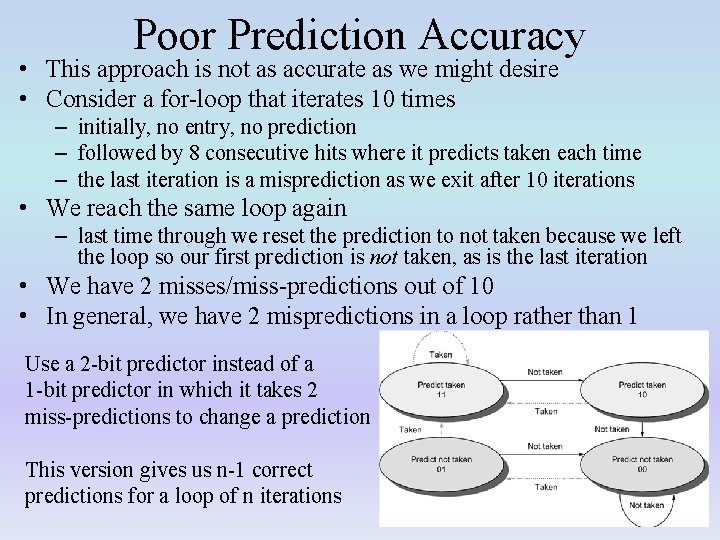
Poor Prediction Accuracy • This approach is not as accurate as we might desire • Consider a for-loop that iterates 10 times – initially, no entry, no prediction – followed by 8 consecutive hits where it predicts taken each time – the last iteration is a misprediction as we exit after 10 iterations • We reach the same loop again – last time through we reset the prediction to not taken because we left the loop so our first prediction is not taken, as is the last iteration • We have 2 misses/miss-predictions out of 10 • In general, we have 2 mispredictions in a loop rather than 1 Use a 2 -bit predictor instead of a 1 -bit predictor in which it takes 2 miss-predictions to change a prediction This version gives us n-1 correct predictions for a loop of n iterations
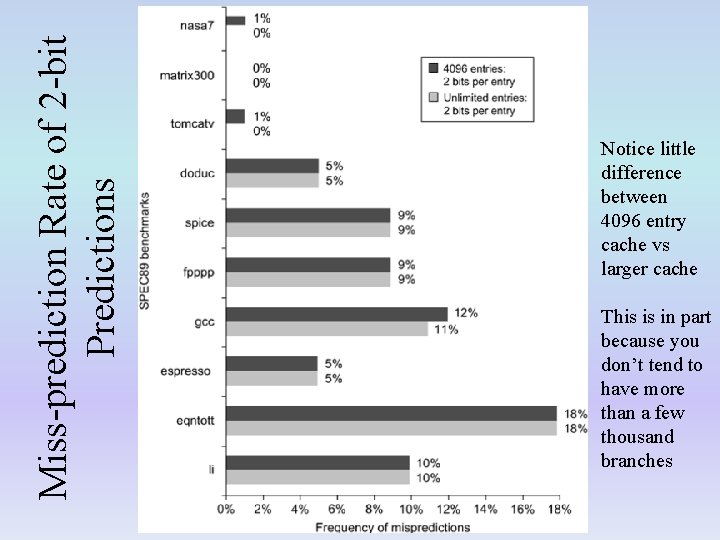
Miss-prediction Rate of 2 -bit Predictions Notice little difference between 4096 entry cache vs larger cache This is in part because you don’t tend to have more than a few thousand branches
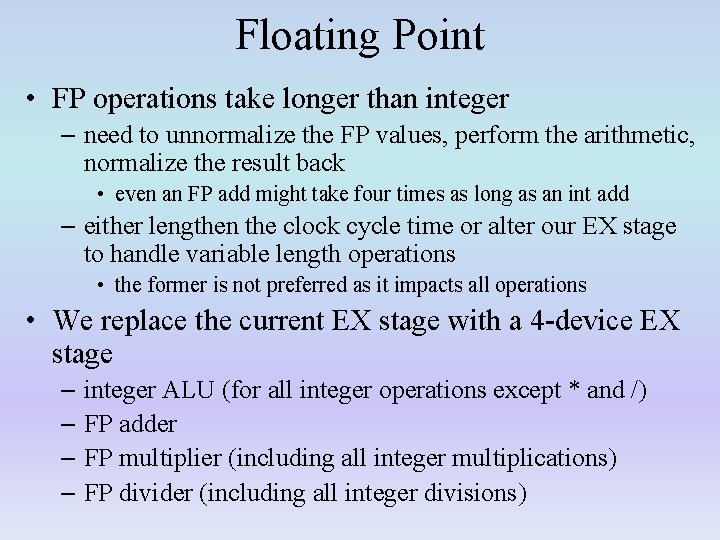
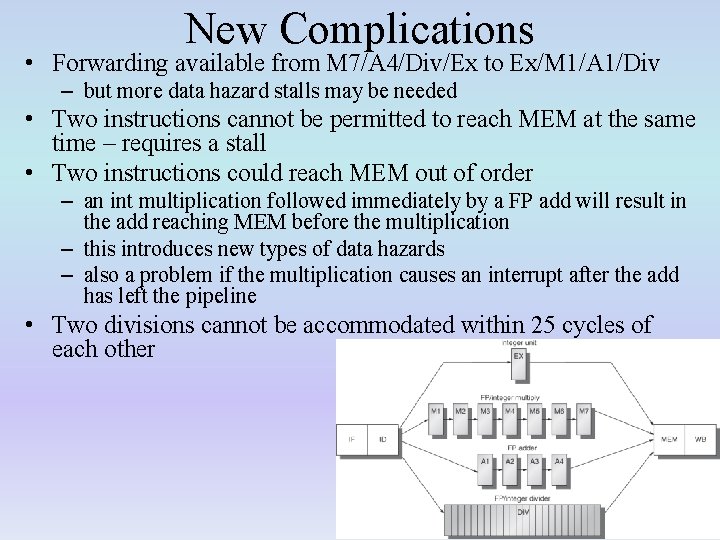
Floating Point • FP operations take longer than integer – need to unnormalize the FP values, perform the arithmetic, normalize the result back • even an FP add might take four times as long as an int add – either lengthen the clock cycle time or alter our EX stage to handle variable length operations • the former is not preferred as it impacts all operations • We replace the current EX stage with a 4 -device EX stage – integer ALU (for all integer operations except * and /) – FP adder – FP multiplier (including all integer multiplications) – FP divider (including all integer divisions)
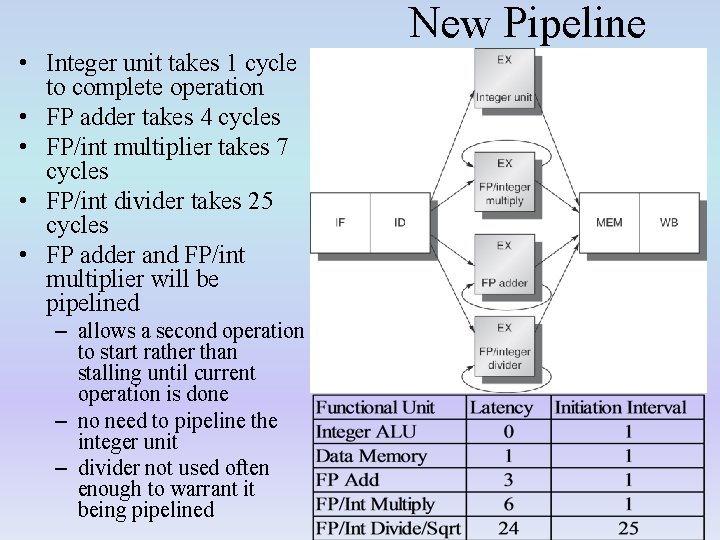
New Pipeline • Integer unit takes 1 cycle to complete operation • FP adder takes 4 cycles • FP/int multiplier takes 7 cycles • FP/int divider takes 25 cycles • FP adder and FP/int multiplier will be pipelined – allows a second operation to start rather than stalling until current operation is done – no need to pipeline the integer unit – divider not used often enough to warrant it being pipelined
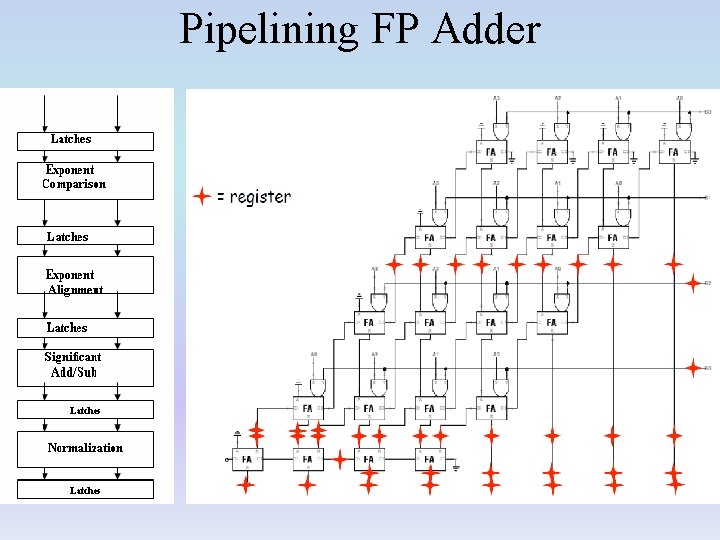
Pipelining FP Adder
New Complications • Forwarding available from M 7/A 4/Div/Ex to Ex/M 1/A 1/Div – but more data hazard stalls may be needed • Two instructions cannot be permitted to reach MEM at the same time – requires a stall • Two instructions could reach MEM out of order – an int multiplication followed immediately by a FP add will result in the add reaching MEM before the multiplication – this introduces new types of data hazards – also a problem if the multiplication causes an interrupt after the add has left the pipeline • Two divisions cannot be accommodated within 25 cycles of each other
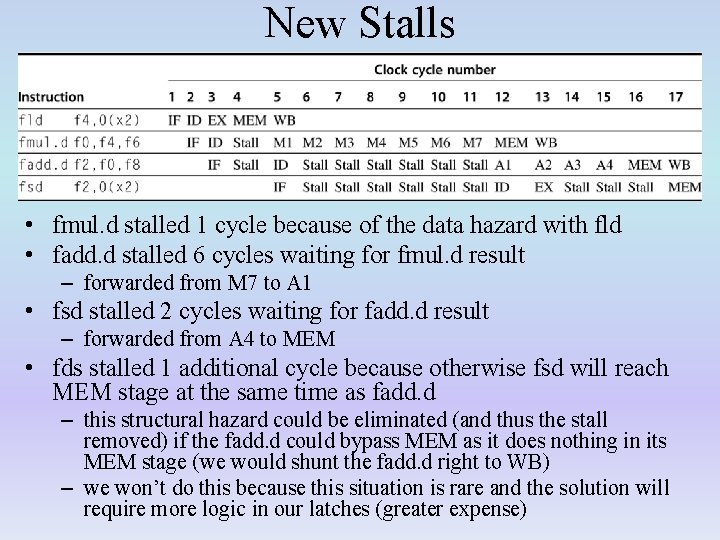
New Stalls • fmul. d stalled 1 cycle because of the data hazard with fld • fadd. d stalled 6 cycles waiting for fmul. d result – forwarded from M 7 to A 1 • fsd stalled 2 cycles waiting for fadd. d result – forwarded from A 4 to MEM • fds stalled 1 additional cycle because otherwise fsd will reach MEM stage at the same time as fadd. d – this structural hazard could be eliminated (and thus the stall removed) if the fadd. d could bypass MEM as it does nothing in its MEM stage (we would shunt the fadd. d right to WB) – we won’t do this because this situation is rare and the solution will require more logic in our latches (greater expense)
Data Hazards Revised • We classify data hazards into three categories – RAW (read after write) • a later instruction needs to read from a register before the write of an earlier instruction has provided it • we have handled this through forwarded and/or stalls – WAW (write after write) • the same register is written to by 2 instructions, but the writes are out of order thanks to different length instructions • this form of hazard can not arise with the 5 -stage pipeline but can arise with our revised FP pipeline – WAR (write after read) • this cannot happen in the 5 -stage pipeline because all reads are in the ID stage and all writes in the WB stage • other pipelines might suffer from this hazard (example shown on next slide)
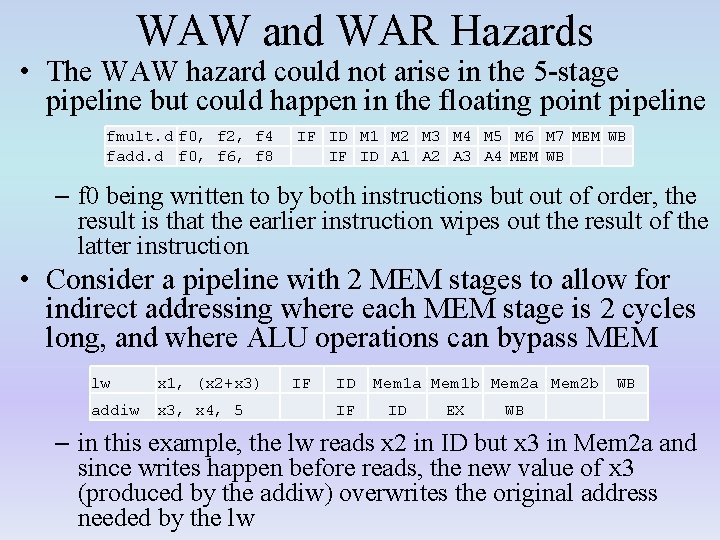
WAW and WAR Hazards • The WAW hazard could not arise in the 5 -stage pipeline but could happen in the floating point pipeline fmult. d f 0, f 2, f 4 fadd. d f 0, f 6, f 8 IF ID M 1 M 2 M 3 M 4 M 5 M 6 M 7 MEM WB IF ID A 1 A 2 A 3 A 4 MEM WB – f 0 being written to by both instructions but of order, the result is that the earlier instruction wipes out the result of the latter instruction • Consider a pipeline with 2 MEM stages to allow for indirect addressing where each MEM stage is 2 cycles long, and where ALU operations can bypass MEM lw x 1, (x 2+x 3) addiw x 3, x 4, 5 IF ID IF Mem 1 a Mem 1 b Mem 2 a Mem 2 b ID EX WB WB – in this example, the lw reads x 2 in ID but x 3 in Mem 2 a and since writes happen before reads, the new value of x 3 (produced by the addiw) overwrites the original address needed by the lw
Handling WAW Hazards • The WAW hazard cannot arise in the 5 -stage pipeline but can arise in our revised pipeline with the FP units since instructions can finish out of order • Logically, WAW hazard makes no sense – we are using the same destination without any intervening loads so the first result is never used – its like doing the following two instructions sequentially in a program • x = y * 5; • x = z + 1; – in spite of them being illogical, WAW hazards can arise • compiler optimizations dealing with branch delays and speculation • dynamic scheduling (something we cover in chapter 3) • To handle WAW hazards, when detected, the pipeline shuts off the earlier instruction so that it does not reach the WB stage – WAR hazards can also arise because of dynamic scheduling but not with standard pipelines – we’ll find another mechanism for coping with WAR hazards
Handling Interrupts • In a non-pipelined machine, interrupts are handled at the end of each fetch-execute cycle – handling the interrupt requires saving the important register values (PC, IR, etc) • In a pipelined machine, there are multiple instructions and so multiple register values – which PC do we save? which IR? • Exceptions are somewhat simplified in our 5 -stage pipeline – – – IF: page fault, memory violation, misaligned memory access ID: undefined or illegal op code EX: arithmetic exception MEM: same as IF WB: none • This list does not include break points or hardware interrupts
Simple Solution • At the stage an interrupt arises – shut down all register writes and memory writes for instructions earlier in the pipeline • instructions further down the pipeline can be permitted to complete – insert a TRAP instruction in the next IF stage rather than an instruction fetch (the trap is a branch to the OS) – save the PC of the faulting instruction when the TRAP is executed so that we can resume executing from that point
Problems • What if the faulting instruction is in the branch delay slot? – if the branch is taken, the PC value is already replaced with the branch target location – to resolve this problem, we can pass the PC value down the pipeline in the latches • What if we have out-of-order completion so that a later instruction has completed before an earlier instruction raises the interrupt? – consider a fmult. d followed by an integer add • the add completes and updates a register and then the fmult. d causes an overflow, the add’s result has already altered a register
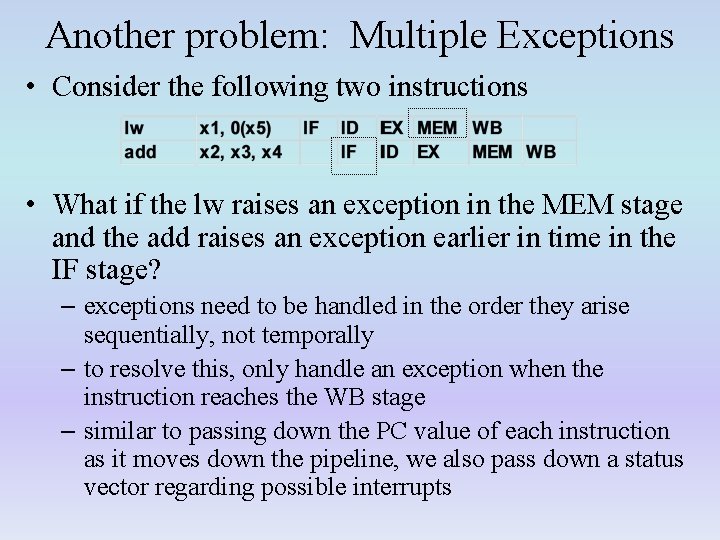
Another problem: Multiple Exceptions • Consider the following two instructions • What if the lw raises an exception in the MEM stage and the add raises an exception earlier in time in the IF stage? – exceptions need to be handled in the order they arise sequentially, not temporally – to resolve this, only handle an exception when the instruction reaches the WB stage – similar to passing down the PC value of each instruction as it moves down the pipeline, we also pass down a status vector regarding possible interrupts
Other Concerns • Handling exceptions is trickier in longer pipelines – multiple stages where registers might be written to – multiple stages for memory writes – if condition codes are used, they also have to be passed down the pipeline • A precise exception is one that can be handled as if the machine were not pipelined – pipelined machines may not be able to easily handle precise exceptions – some pipelines use two modes, imprecise modes in which exceptions can be handled out of order (which may lead to errors) or precise mode which may cause a slower performance
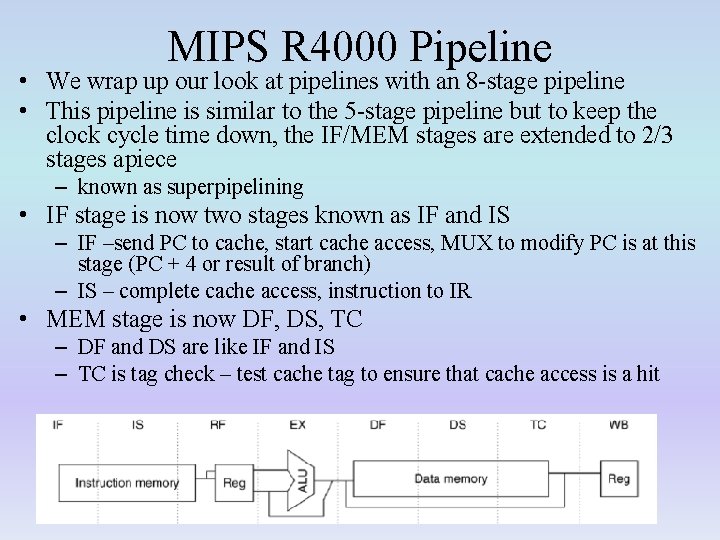
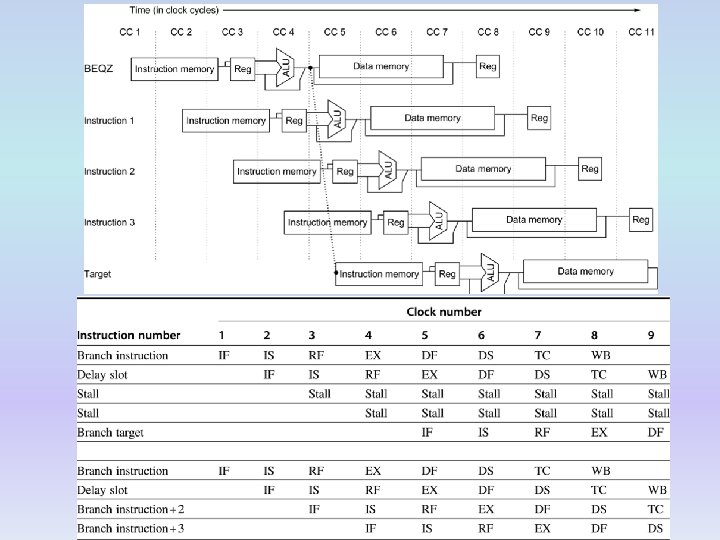
MIPS R 4000 Pipeline • We wrap up our look at pipelines with an 8 -stage pipeline • This pipeline is similar to the 5 -stage pipeline but to keep the clock cycle time down, the IF/MEM stages are extended to 2/3 stages apiece – known as superpipelining • IF stage is now two stages known as IF and IS – IF –send PC to cache, start cache access, MUX to modify PC is at this stage (PC + 4 or result of branch) – IS – complete cache access, instruction to IR • MEM stage is now DF, DS, TC – DF and DS are like IF and IS – TC is tag check – test cache tag to ensure that cache access is a hit
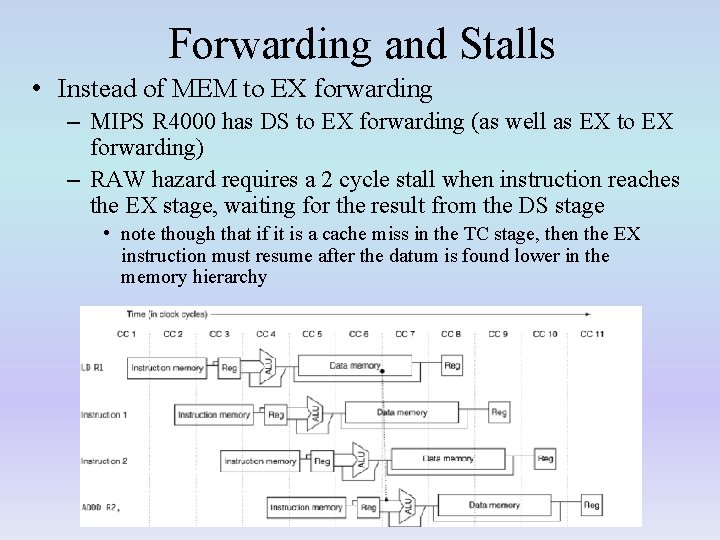
Forwarding and Stalls • Instead of MEM to EX forwarding – MIPS R 4000 has DS to EX forwarding (as well as EX to EX forwarding) – RAW hazard requires a 2 cycle stall when instruction reaches the EX stage, waiting for the result from the DS stage • note though that if it is a cache miss in the TC stage, then the EX instruction must resume after the datum is found lower in the memory hierarchy
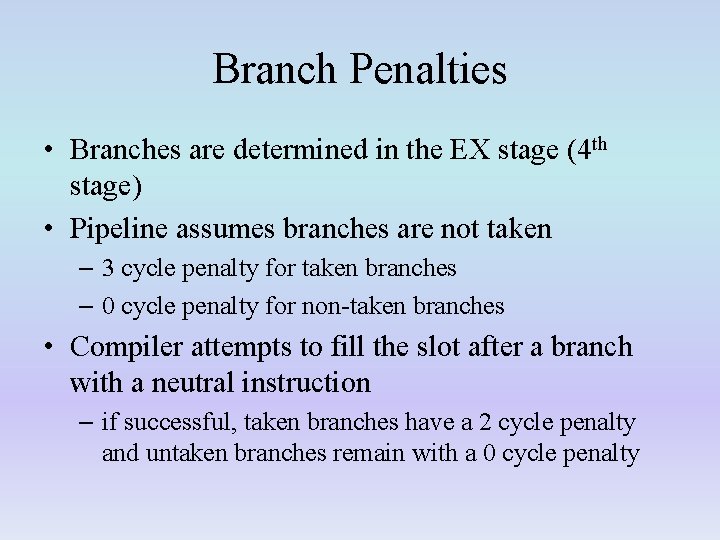
Branch Penalties • Branches are determined in the EX stage (4 th stage) • Pipeline assumes branches are not taken – 3 cycle penalty for taken branches – 0 cycle penalty for non-taken branches • Compiler attempts to fill the slot after a branch with a neutral instruction – if successful, taken branches have a 2 cycle penalty and untaken branches remain with a 0 cycle penalty
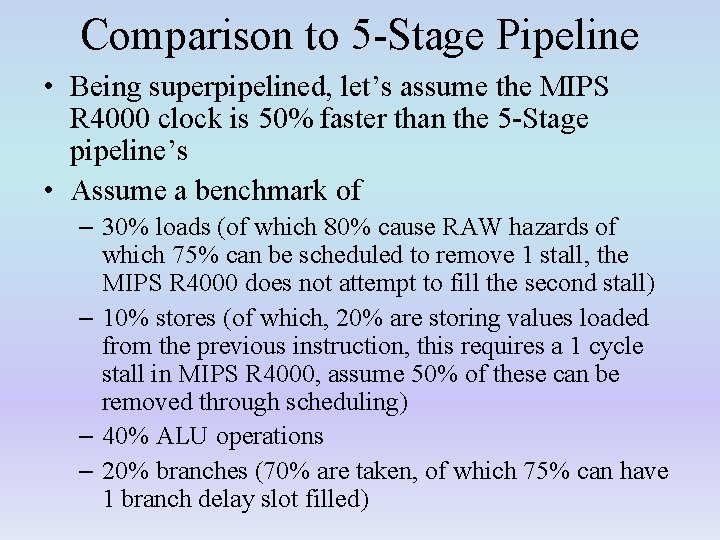
Comparison to 5 -Stage Pipeline • Being superpipelined, let’s assume the MIPS R 4000 clock is 50% faster than the 5 -Stage pipeline’s • Assume a benchmark of – 30% loads (of which 80% cause RAW hazards of which 75% can be scheduled to remove 1 stall, the MIPS R 4000 does not attempt to fill the second stall) – 10% stores (of which, 20% are storing values loaded from the previous instruction, this requires a 1 cycle stall in MIPS R 4000, assume 50% of these can be removed through scheduling) – 40% ALU operations – 20% branches (70% are taken, of which 75% can have 1 branch delay slot filled)
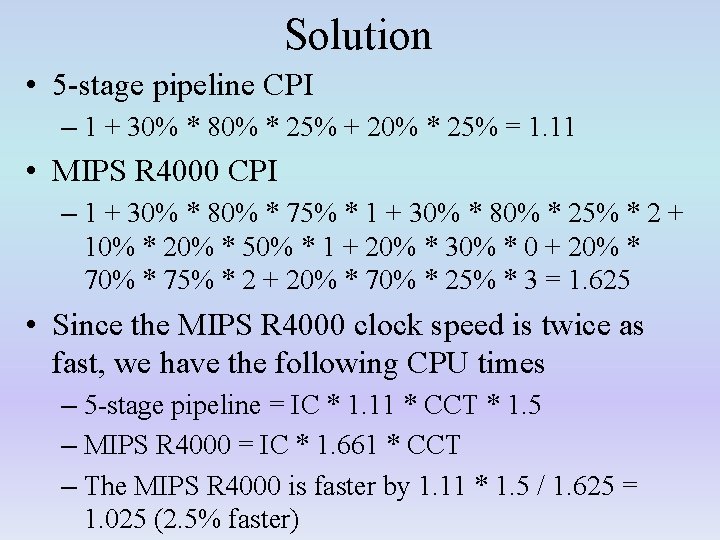
Solution • 5 -stage pipeline CPI – 1 + 30% * 80% * 25% + 20% * 25% = 1. 11 • MIPS R 4000 CPI – 1 + 30% * 80% * 75% * 1 + 30% * 80% * 25% * 2 + 10% * 20% * 50% * 1 + 20% * 30% * 0 + 20% * 75% * 2 + 20% * 70% * 25% * 3 = 1. 625 • Since the MIPS R 4000 clock speed is twice as fast, we have the following CPU times – 5 -stage pipeline = IC * 1. 11 * CCT * 1. 5 – MIPS R 4000 = IC * 1. 661 * CCT – The MIPS R 4000 is faster by 1. 11 * 1. 5 / 1. 625 = 1. 025 (2. 5% faster)
More on the R 4000 • The FP version of the pipeline is similar to the 5 stage pipeline – separate units – out of order completion permitted – FP units are pipelined – forwarding available from end of unit to beginning of EX stage • details are shown in figures C. 41 -C. 46 on pages C-60 – C-63, we skip them here • Recall the ideal CPI for a pipelined machine is 1. 0 – various benchmarks have a CPI ranging from slightly over 1. 0 (compress) to about 2. 7 (doduc) • most of the stalls are due to FP operations • the average branch delay for a benchmark is 0. 36 • details shown in figures C. 47 and C. 48 on page C-64
Dynamic Scheduling in Pipelines • We study this in detail in chapter 3 – static scheduling has the compiler rearranging instructions to remove stalling situations – dynamic scheduling requires hardware to select instructions to launch down the pipeline (known as issuing) – having fetched an instruction in the IF stage, the ID stage • decodes the instruction to determine what hardware is required • checks for structural hazards (is the appropriate functional unit available? ), if so, issues the instruction to that unit (EX, FP add, FP/int mult, FP/int divide) • operands are read at the functional unit itself once they become available from their source (load unit, other functional unit) • as operands are read later, there can be WAR hazards • Implemented in the CDC 6600 using a scoreboard – 16 functional units (4 FP, 5 memory, 7 integer)
Revised Pipeline for Dynamic Issue • IF – same as before • ID – divided into – issue stage (issue to hardware unit when available) – read operand (when data are available) • watch for WAW and WAR hazards • EX – handled strictly within the hardware unit, including memory access in memory units – since memory operations handled in functional units, there is no MEM stage • WB – store result in register and forward result to other EX units – if WAR hazard is detected, WB stage is postponed – we will cover the details in chapter 3
Fallacies and Pitfalls • P: Unexpected execution sequences can cause unexpected data hazards (primarily WAW) • P: Extensive pipelining can impact other aspects of a design – longer pipelines tend to have faster clock speeds but are more susceptible to stalls – we saw that the 5 -stage pipeline and the MIPS R 4000 had similar performances but the MIPS R 4000 was more costly to build • P: Evaluating dynamic or static scheduling of unoptimized code – we need the compiler’s assistance to take the most advantage of the pipeline, without that, results may not be encouraging