
Pipelining Preview Basics Challenges Kai Bu kaibuzju edu

Pipelining Preview Basics & Challenges Kai Bu kaibu@zju. edu. cn

Outline • Part 1 Basics what’s pipelining principles RISC and its five-stage pipeline • Part 2 Challenges: Pipeline Hazards structural hazard data hazard control hazard
Outline • Part 1 Basics what’s pipelining principles RISC and its five-stage pipeline • Part 2 Challenges: Pipeline Hazards structural hazard data hazard control hazard

What’s Pipelining You already knew! Try the laundry example:
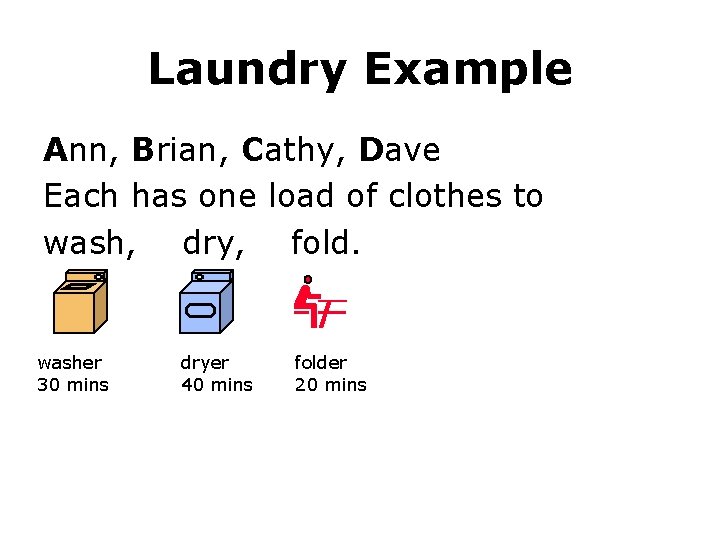
Laundry Example Ann, Brian, Cathy, Dave Each has one load of clothes to wash, dry, fold. washer 30 mins dryer 40 mins folder 20 mins
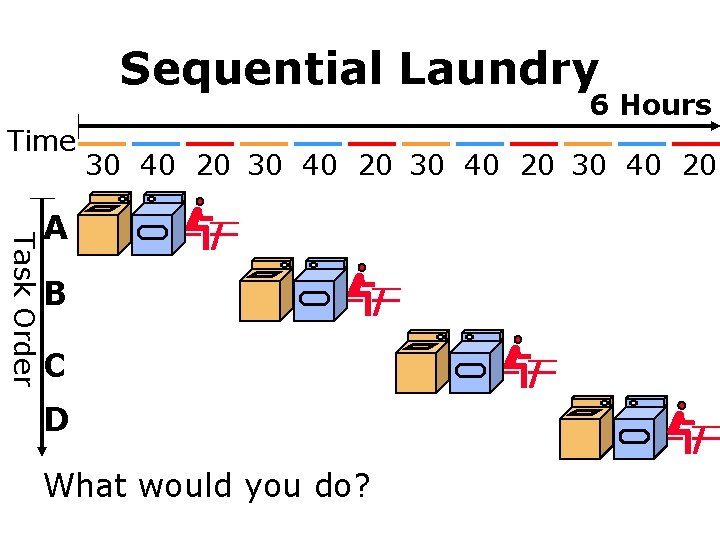
Sequential Laundry 6 Hours Time 30 40 20 Task Order A B C D What would you do?
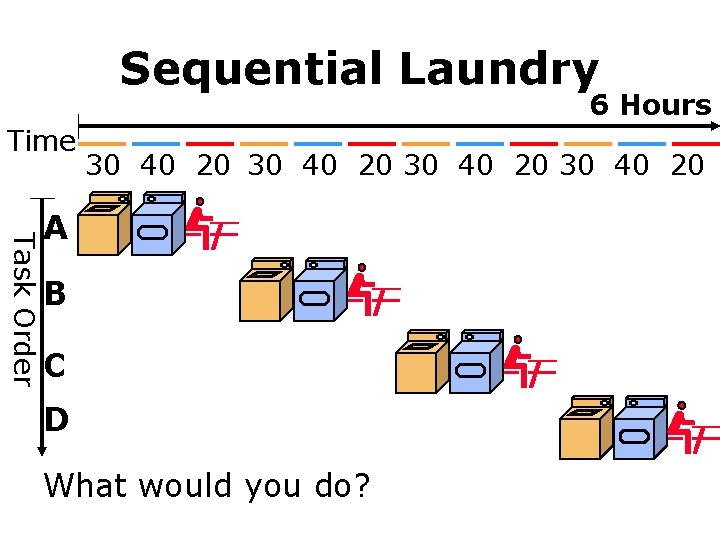
Sequential Laundry 6 Hours Time 30 40 20 Task Order A B C D What would you do?
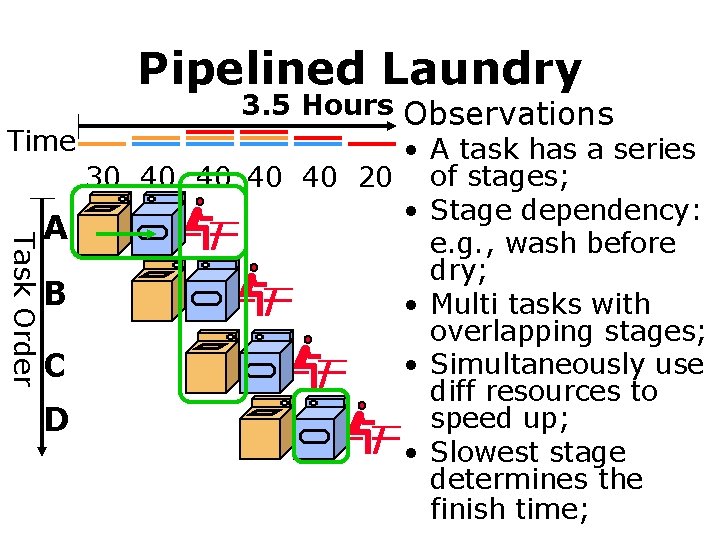
Pipelined Laundry Task Order 3. 5 Hours Observations Time • A task has a series 30 40 40 20 of stages; • Stage dependency: A e. g. , wash before dry; B • Multi tasks with overlapping stages; • Simultaneously use C diff resources to speed up; D • Slowest stage determines the finish time;
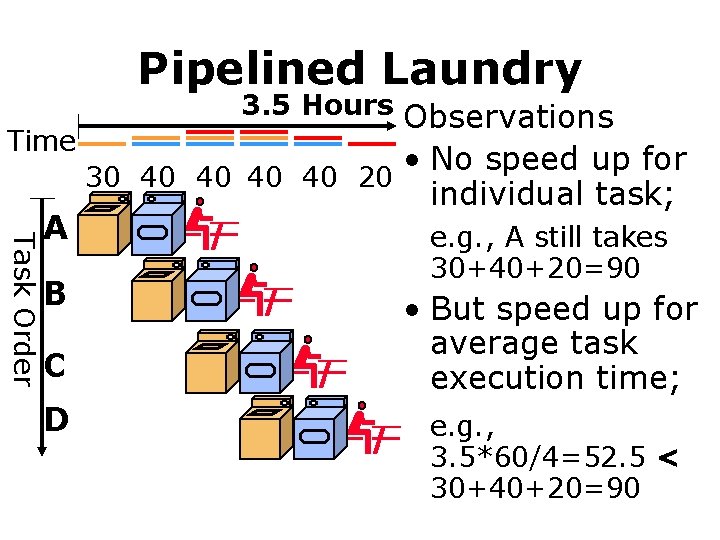
Pipelined Laundry Time Task Order A B C D 3. 5 Hours Observations • No speed up for 30 40 40 20 individual task; e. g. , A still takes 30+40+20=90 • But speed up for average task execution time; e. g. , 3. 5*60/4=52. 5 < 30+40+20=90
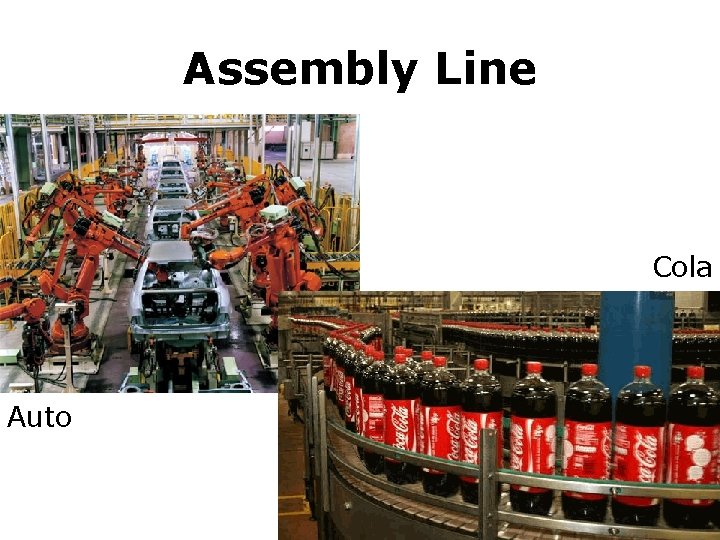
Assembly Line Cola Auto
Outline • Part 1 Basics what’s pipelining principles RISC and its five-stage pipeline • Part 2 Challenges: Pipeline Hazards structural hazard data hazard control hazard

Pipelining • An implementation technique whereby multiple instructions are overlapped in execution. A e. g. , B wash while A dry B • Essence: Start executing one instruction before completing the previous one. • Significance: Make fast CPUs.
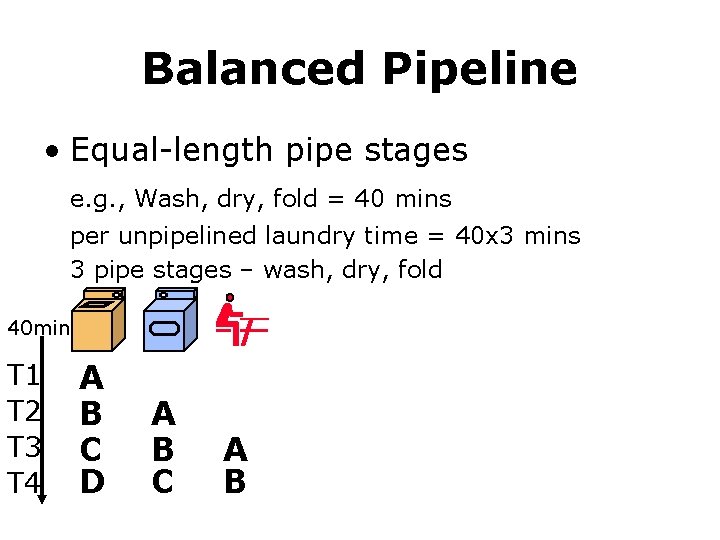
Balanced Pipeline • Equal-length pipe stages e. g. , Wash, dry, fold = 40 mins per unpipelined laundry time = 40 x 3 mins 3 pipe stages – wash, dry, fold 40 min T 1 T 2 T 3 T 4 A B C D A B C A B
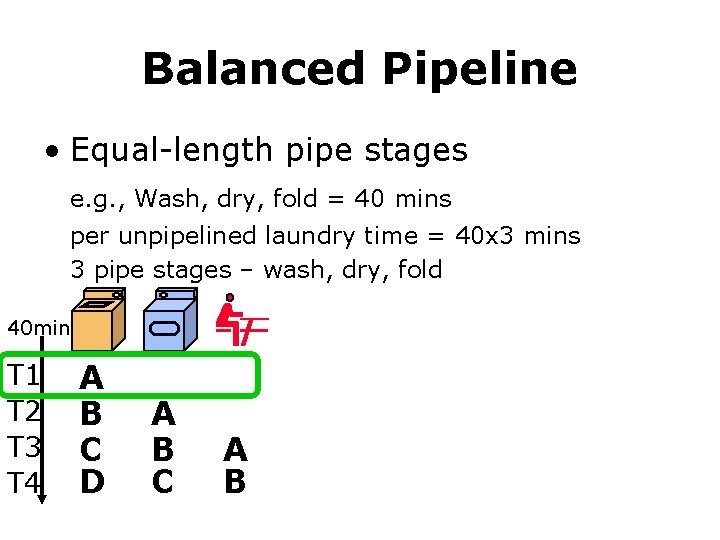
Balanced Pipeline • Equal-length pipe stages e. g. , Wash, dry, fold = 40 mins per unpipelined laundry time = 40 x 3 mins 3 pipe stages – wash, dry, fold 40 min T 1 T 2 T 3 T 4 A B C D A B C A B
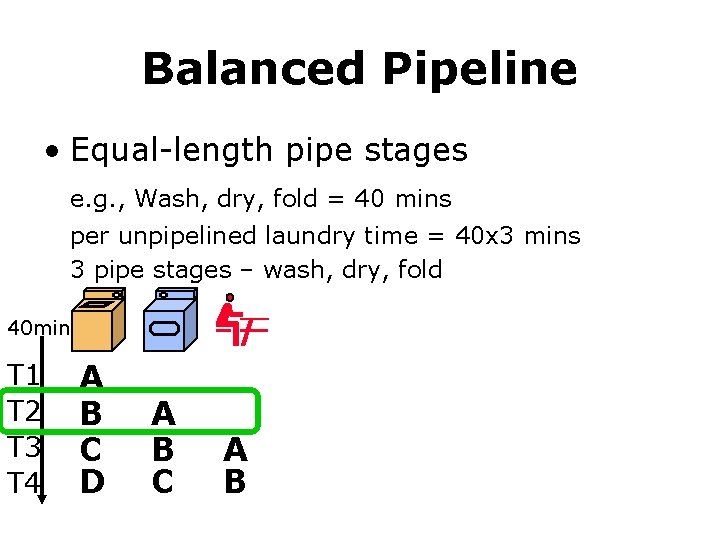
Balanced Pipeline • Equal-length pipe stages e. g. , Wash, dry, fold = 40 mins per unpipelined laundry time = 40 x 3 mins 3 pipe stages – wash, dry, fold 40 min T 1 T 2 T 3 T 4 A B C D A B C A B
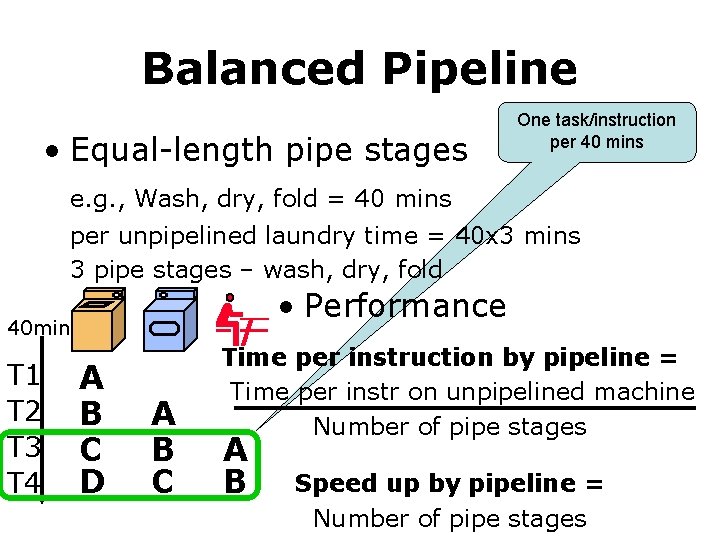
Balanced Pipeline • Equal-length pipe stages One task/instruction per 40 mins e. g. , Wash, dry, fold = 40 mins per unpipelined laundry time = 40 x 3 mins 3 pipe stages – wash, dry, fold • Performance 40 min T 1 T 2 T 3 T 4 A B C D A B C Time per instruction by pipeline = Time per instr on unpipelined machine Number of pipe stages A B Speed up by pipeline = Number of pipe stages
Pipelining Terminology • Latency: the time for an instruction to complete. • Throughput of a CPU: the number of instructions completed per second. • Clock cycle: everything in CPU moves in lockstep; synchronized by the clock. • Processor Cycle: time required between moving an instruction one step down the pipeline; = time required to complete a pipe stage; = max(times for completing all stages); = one or two clock cycles, but rarely more. • CPI: clock cycles per instruction
Outline • Part 1 Basics what’s pipelining principles RISC and its five-stage pipeline • Part 2 Challenges: Pipeline Hazards structural hazard data hazard control hazard
RISC: Reduced Instruction Set Computer Properties: • All operations on data apply to data in registers and typically change the entire register (32 or 64 bits per reg); • Only load and store operations affect memory; load: move data from mem to reg; store: move data from reg to mem; • Only a few instruction formats; all instructions typically being one size.
RISC: Reduced Instruction Set Computer 32 registers 3 classes of instructions - 1 • ALU (Arithmetic Logic Unit) instructions operate on two regs or a reg + a signextended immediate; store the result into a third reg; e. g. , add (DADD), subtract (DSUB) logical operations AND, OR
RISC: Reduced Instruction Set Computer 3 classes of instructions - 2 • Load (LD) and store (SD) instructions operands: base register + offset; the sum (called effective address) is used as a memory address; Load: use a second reg operand as the destination for the data loaded from memory; Store: use a second reg operand as the source of the data stored into memory.
RISC: Reduced Instruction Set Computer 3 classes of instructions - 3 • Branches and jumps conditional transfers of control; Branch: specify the branch condition with a set of condition bits or comparisons between two regs or between a reg and zero; decide the branch destination by adding a sign-extended offset to the current PC (program counter);
RISC: Reduced Instruction Set Computer at most 5 clock cycles per instruction – 1 IF ID EX MEM WB • Instruction Fetch cycle send the PC to memory; fetch the current instruction from mem; PC = PC + 4; //each instr is 4 bytes
RISC: Reduced Instruction Set Computer at most 5 clock cycles per instruction – 2 IF ID EX MEM WB • Instruction Decode/register fetch cycle decode the instruction; read the registers (corresponding to register source specifiers);
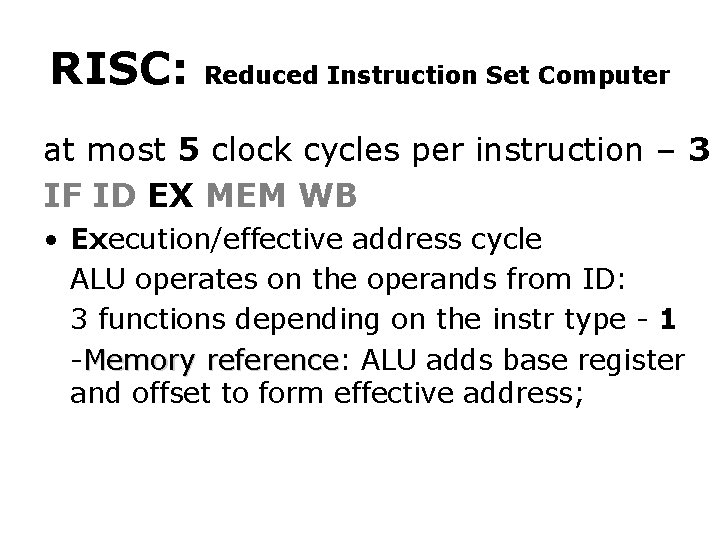
RISC: Reduced Instruction Set Computer at most 5 clock cycles per instruction – 3 IF ID EX MEM WB • Execution/effective address cycle ALU operates on the operands from ID: 3 functions depending on the instr type - 1 -Memory reference: reference ALU adds base register and offset to form effective address;

RISC: Reduced Instruction Set Computer at most 5 clock cycles per instruction – 3 IF ID EX MEM WB • Execution/effective address cycle ALU operates on the operands from ID: 3 functions depending on the instr type - 2 -Register ALU instruction: instruction ALU performs the operation specified by opcode on the values read from the register file;
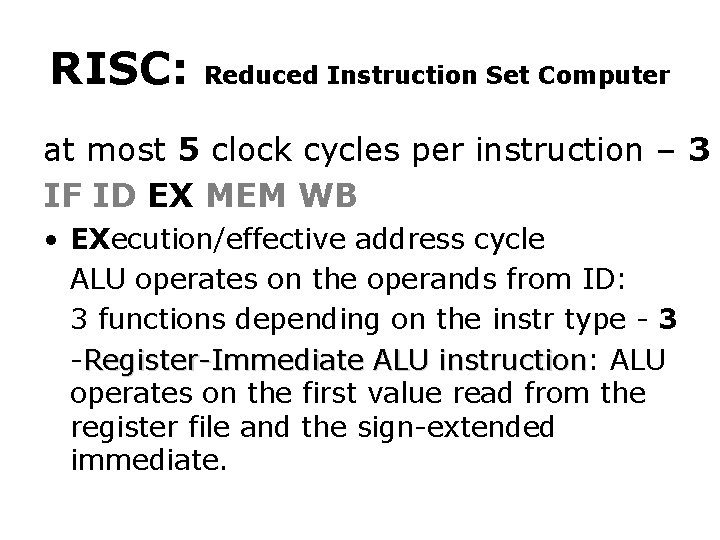
RISC: Reduced Instruction Set Computer at most 5 clock cycles per instruction – 3 IF ID EX MEM WB • EXecution/effective address cycle ALU operates on the operands from ID: 3 functions depending on the instr type - 3 -Register-Immediate ALU instruction: instruction ALU operates on the first value read from the register file and the sign-extended immediate.
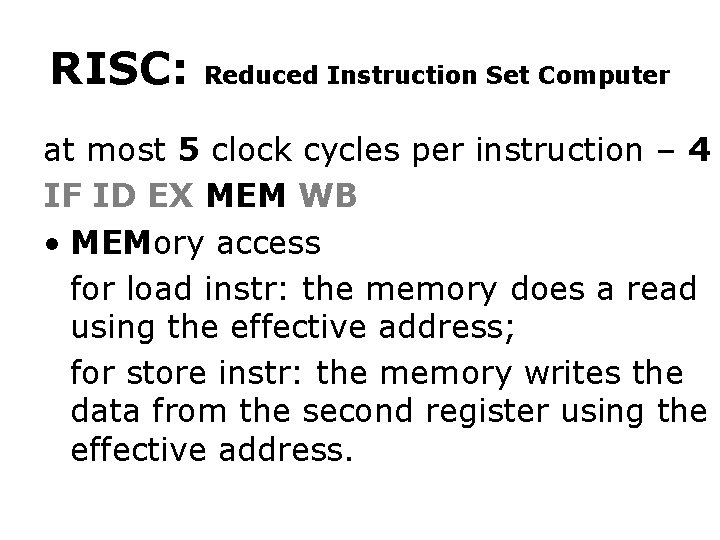
RISC: Reduced Instruction Set Computer at most 5 clock cycles per instruction – 4 IF ID EX MEM WB • MEMory access for load instr: the memory does a read using the effective address; for store instr: the memory writes the data from the second register using the effective address.
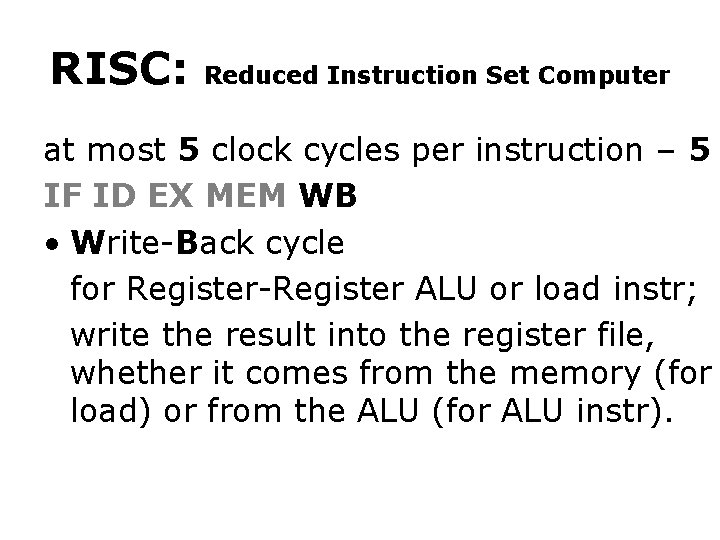
RISC: Reduced Instruction Set Computer at most 5 clock cycles per instruction – 5 IF ID EX MEM WB • Write-Back cycle for Register-Register ALU or load instr; write the result into the register file, whether it comes from the memory (for load) or from the ALU (for ALU instr).
RISC: Reduced Instruction Set Computer at most 5 clock cycles per instruction IF ID EX MEM WB
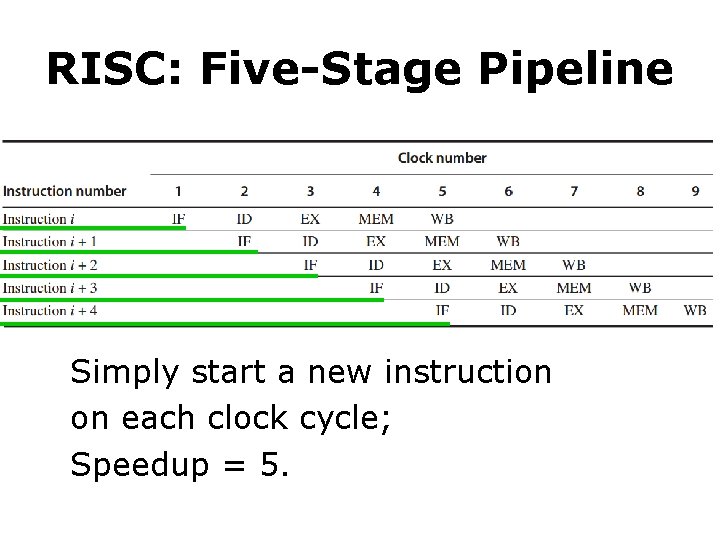
RISC: Five-Stage Pipeline Simply start a new instruction on each clock cycle; Speedup = 5.
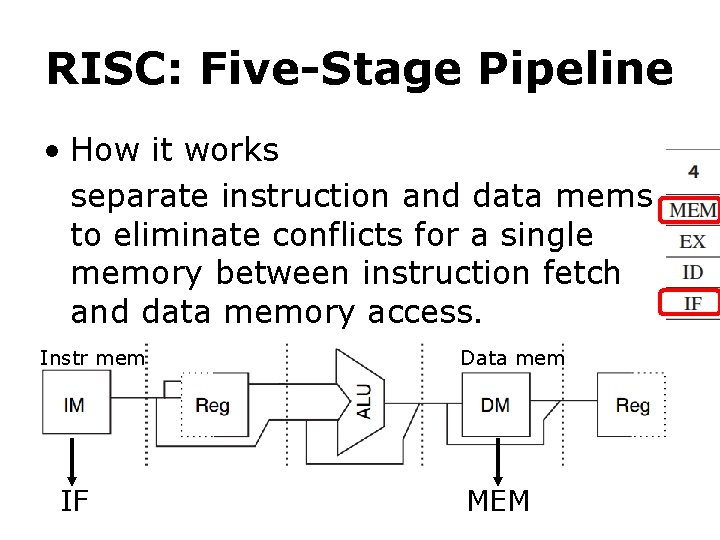
RISC: Five-Stage Pipeline • How it works separate instruction and data mems to eliminate conflicts for a single memory between instruction fetch and data memory access. Instr mem IF Data mem MEM

RISC: Five-Stage Pipeline • How it works use the register file in two stages; either with half CC; ID read in one clock cycle, write before read WB write
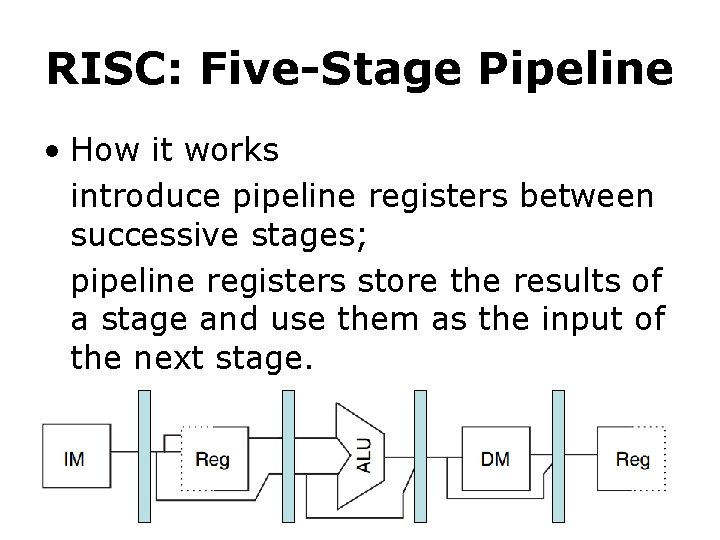
RISC: Five-Stage Pipeline • How it works introduce pipeline registers between successive stages; pipeline registers store the results of a stage and use them as the input of the next stage.
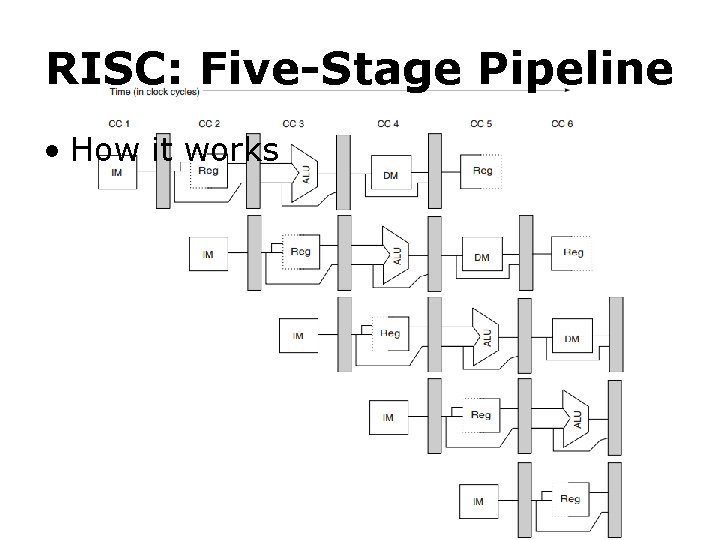
RISC: Five-Stage Pipeline • How it works
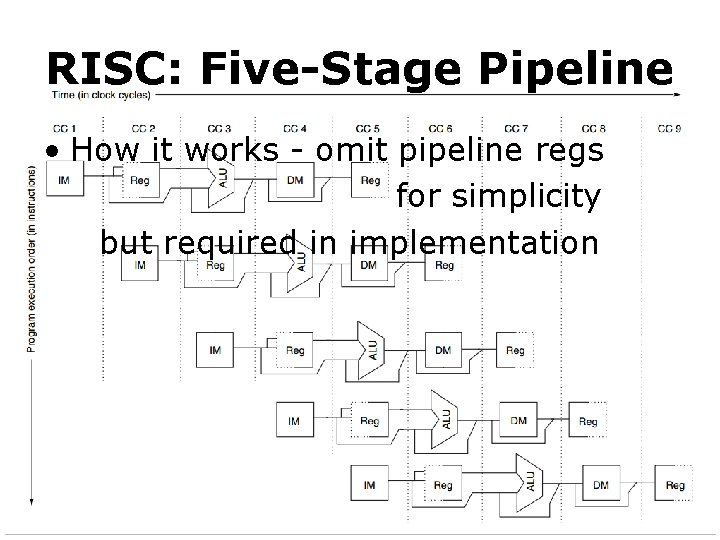
RISC: Five-Stage Pipeline • How it works - omit pipeline regs for simplicity but required in implementation
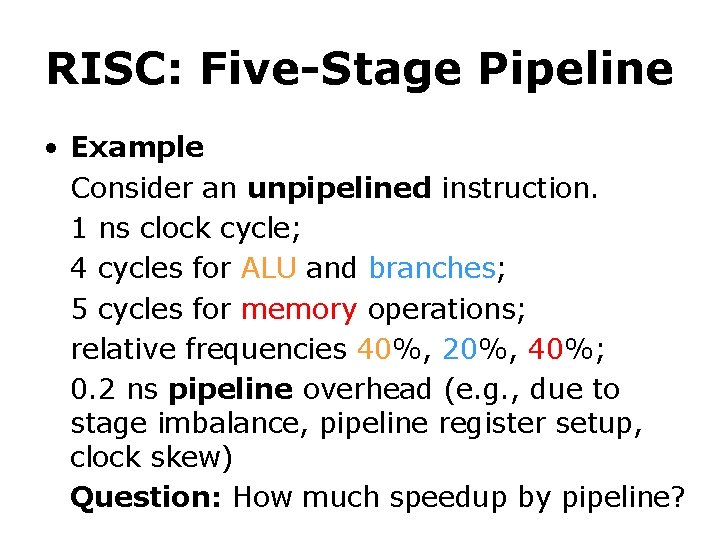
RISC: Five-Stage Pipeline • Example Consider an unpipelined instruction. 1 ns clock cycle; 4 cycles for ALU and branches; 5 cycles for memory operations; relative frequencies 40%, 20%, 40%; 0. 2 ns pipeline overhead (e. g. , due to stage imbalance, pipeline register setup, clock skew) Question: How much speedup by pipeline?
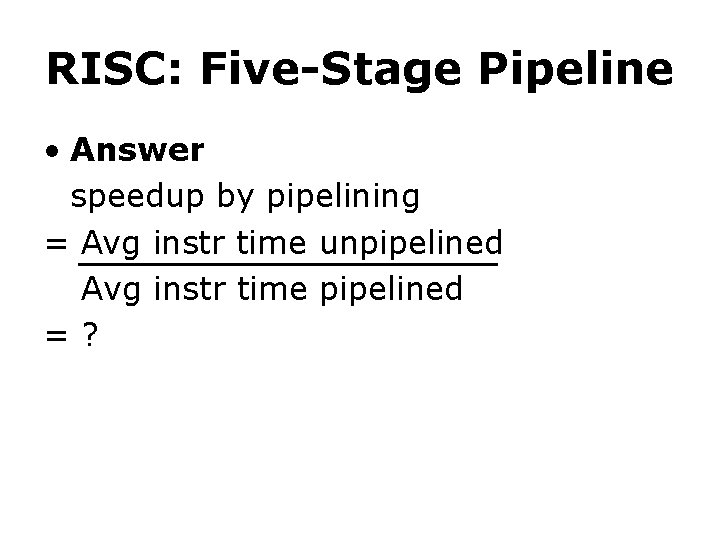
RISC: Five-Stage Pipeline • Answer speedup by pipelining = Avg instr time unpipelined Avg instr time pipelined =?
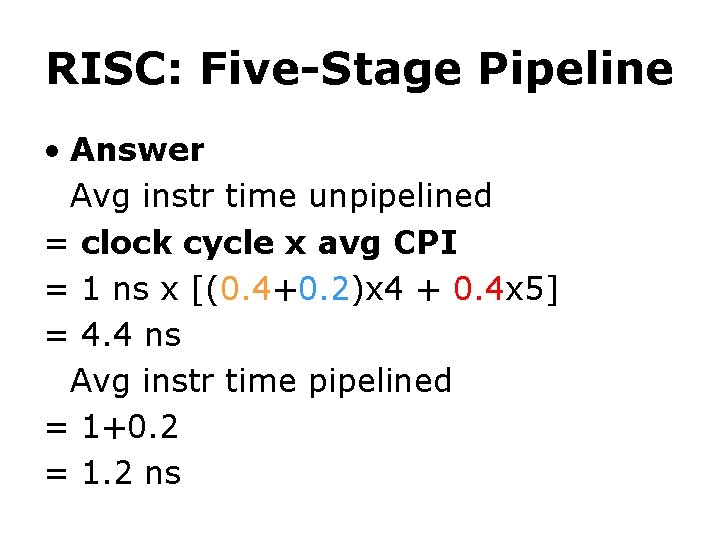
RISC: Five-Stage Pipeline • Answer Avg instr time unpipelined = clock cycle x avg CPI = 1 ns x [(0. 4+0. 2)x 4 + 0. 4 x 5] = 4. 4 ns Avg instr time pipelined = 1+0. 2 = 1. 2 ns
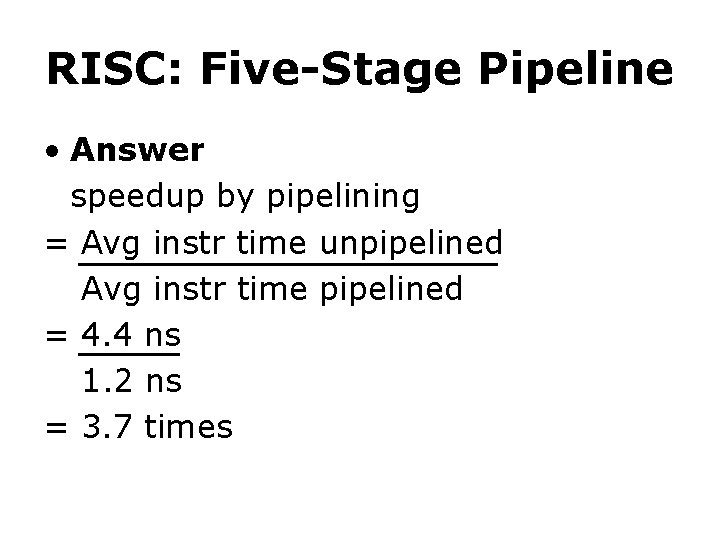
RISC: Five-Stage Pipeline • Answer speedup by pipelining = Avg instr time unpipelined Avg instr time pipelined = 4. 4 ns 1. 2 ns = 3. 7 times

That’s it !

That’s it?
When Pipeline Is Stuck LD R 1, 0(R 2) R 1 DSUB R 4, R 1, R 5
Outline • Part 1 Basics what’s pipelining principles RISC and its five-stage pipeline • Part 2 Challenges: Pipeline Hazards structural hazard data hazard control hazard
Pipeline Hazards • Hazards: situations that prevent the next instruction from executing in the designated clock cycle. • 3 classes of hazards: structural hazard – resource conflicts data hazard – data dependency control hazard – pc changes (e. g. , branches)
Outline • Part 1 Basics what’s pipelining principles RISC and its five-stage pipeline • Part 2 Challenges: Pipeline Hazards structural hazard data hazard control hazard
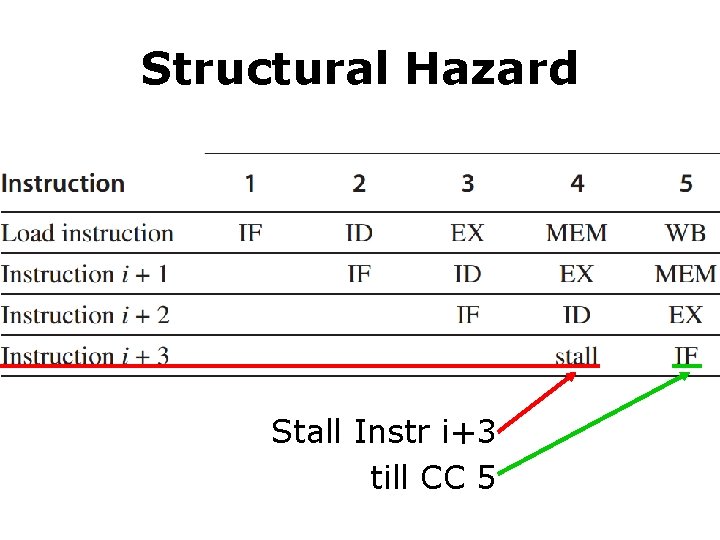
Structural Hazard • Root Cause: resource conflicts e. g. , a processor with 1 reg write port but intend two writes in a CC • Solution stall one of the instructions until required unit is available
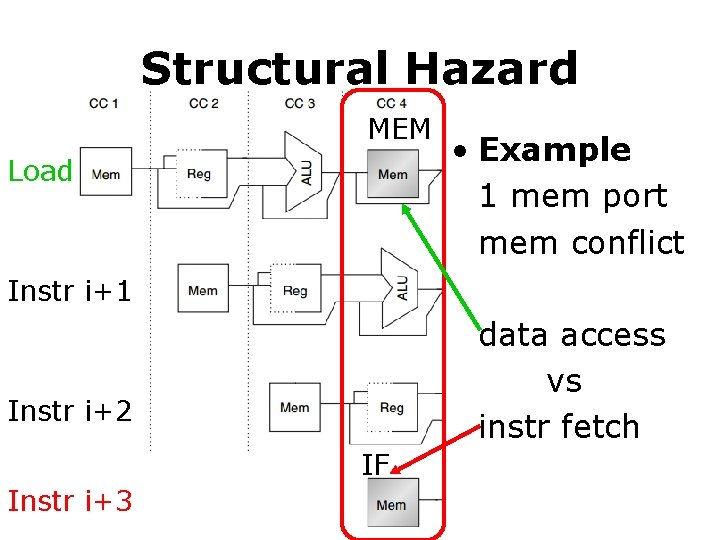
Structural Hazard MEM Load • Example 1 mem port mem conflict Instr i+1 data access vs instr fetch Instr i+2 IF Instr i+3
Structural Hazard Stall Instr i+3 till CC 5
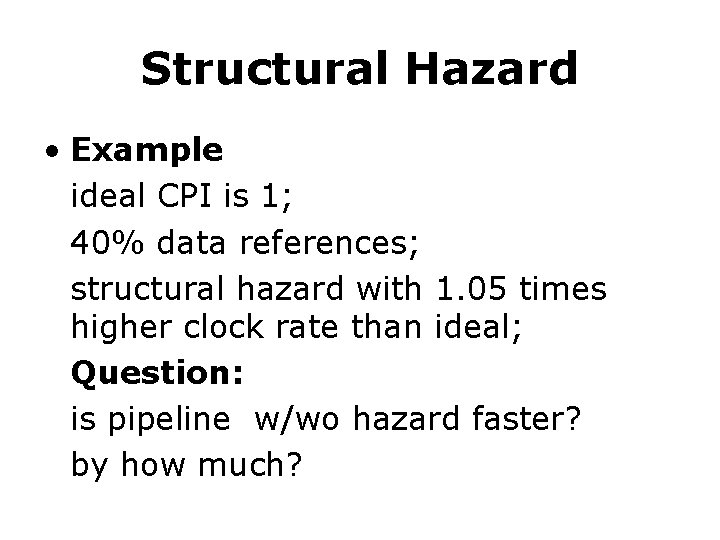
Structural Hazard • Example ideal CPI is 1; 40% data references; structural hazard with 1. 05 times higher clock rate than ideal; Question: is pipeline w/wo hazard faster? by how much?
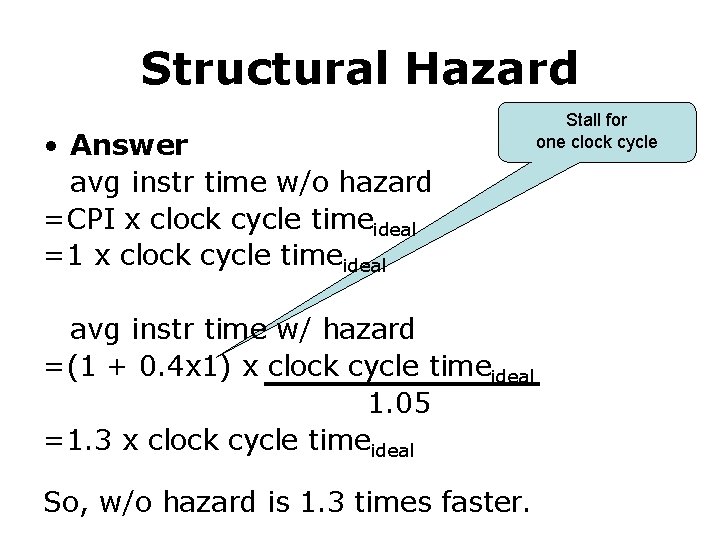
Structural Hazard • Answer avg instr time w/o hazard =CPI x clock cycle timeideal =1 x clock cycle timeideal avg instr time w/ hazard =(1 + 0. 4 x 1) x clock cycle timeideal 1. 05 =1. 3 x clock cycle timeideal So, w/o hazard is 1. 3 times faster. Stall for one clock cycle
Outline • Part 1 Basics what’s pipelining principles RISC and its five-stage pipeline • Part 2 Challenges: Pipeline Hazards structural hazard data hazard control hazard
Data Hazard • Root Cause: data dependency when the pipeline changes the order of read/write accesses to operands; so that the order differs from the order seen by sequentially executing instructions on an unpipelined processor.
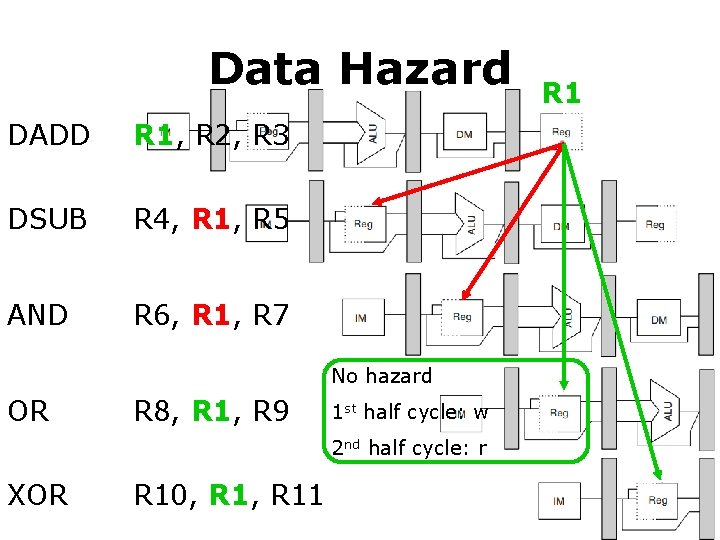
Data Hazard DADD R 1, R 2, R 3 DSUB R 4, R 1, R 5 AND R 6, R 1, R 7 No hazard OR R 8, R 1, R 9 1 st half cycle: w 2 nd half cycle: r XOR R 10, R 11 R 1
Data Hazard • Solution: forwarding directly feed back EX/MEM&MEM/WB pipeline regs’ results to the ALU inputs; if forwarding hw detects that previous ALU has written the reg corresponding to a source for the current ALU, control logic selects the forwarded
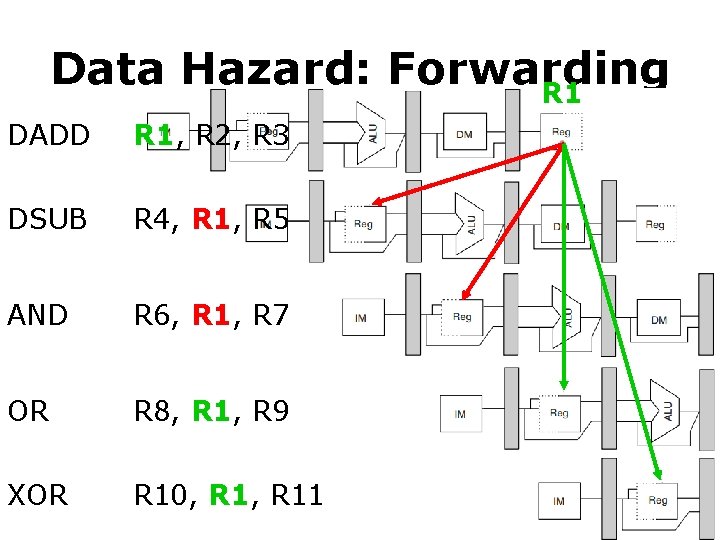
Data Hazard: Forwarding R 1 DADD R 1, R 2, R 3 DSUB R 4, R 1, R 5 AND R 6, R 1, R 7 OR R 8, R 1, R 9 XOR R 10, R 11
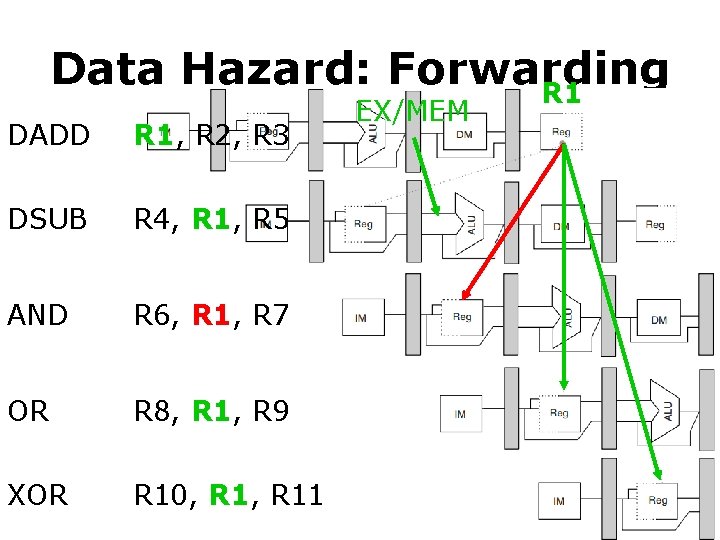
Data Hazard: Forwarding R 1 DADD R 1, R 2, R 3 DSUB R 4, R 1, R 5 AND R 6, R 1, R 7 OR R 8, R 1, R 9 XOR R 10, R 11 EX/MEM
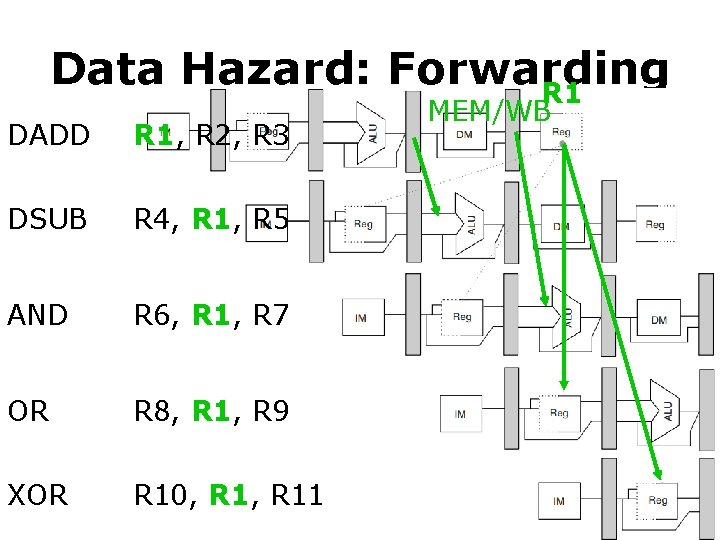
Data Hazard: Forwarding R 1 DADD R 1, R 2, R 3 DSUB R 4, R 1, R 5 AND R 6, R 1, R 7 OR R 8, R 1, R 9 XOR R 10, R 11 MEM/WB
Data Hazard: Forwarding • Generalized forwarding pass a result directly to the functional unit that requires it; forward results to not only ALU inputs but also other types of functional units;
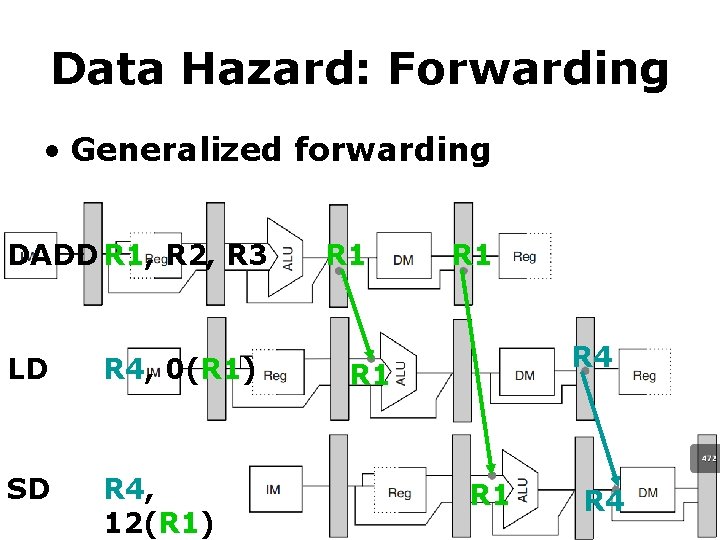
Data Hazard: Forwarding • Generalized forwarding DADD R 1, R 2, R 3 LD R 4, 0(R 1) SD R 4, 12(R 1) R 1 R 1 R 4
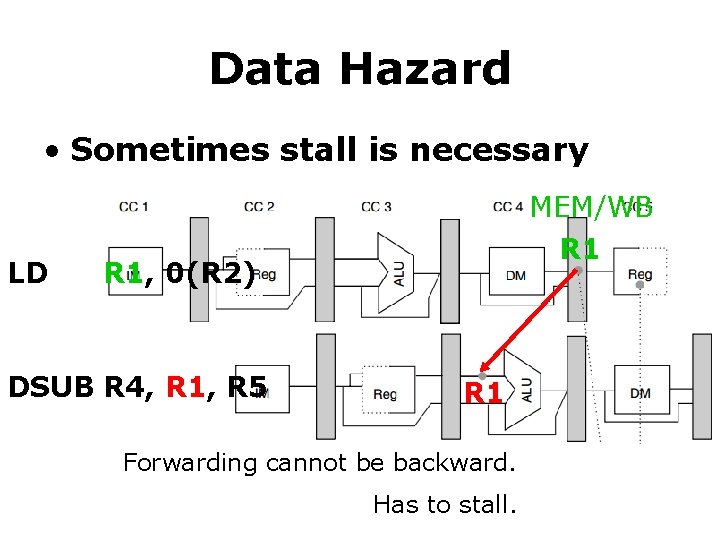
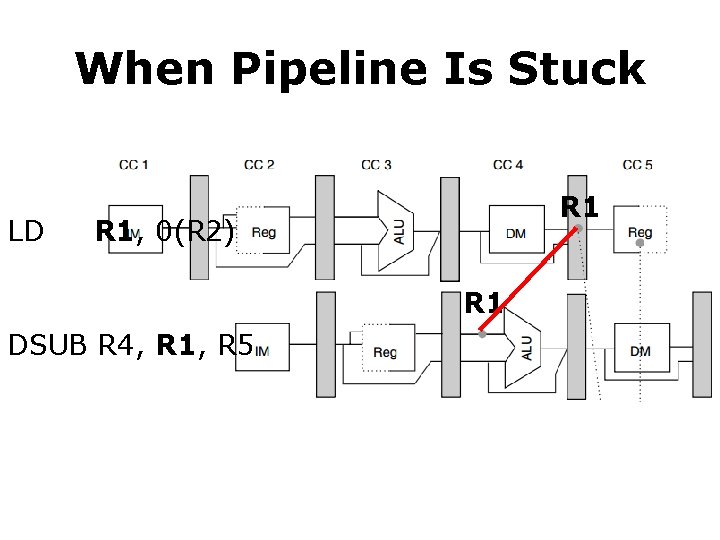
Data Hazard • Sometimes stall is necessary LD MEM/WB R 1, 0(R 2) DSUB R 4, R 1, R 5 R 1 Forwarding cannot be backward. Has to stall.
Outline • Part 1 Basics what’s pipelining principles RISC and its five-stage pipeline • Part 2 Challenges: Pipeline Hazards structural hazard data hazard control hazard
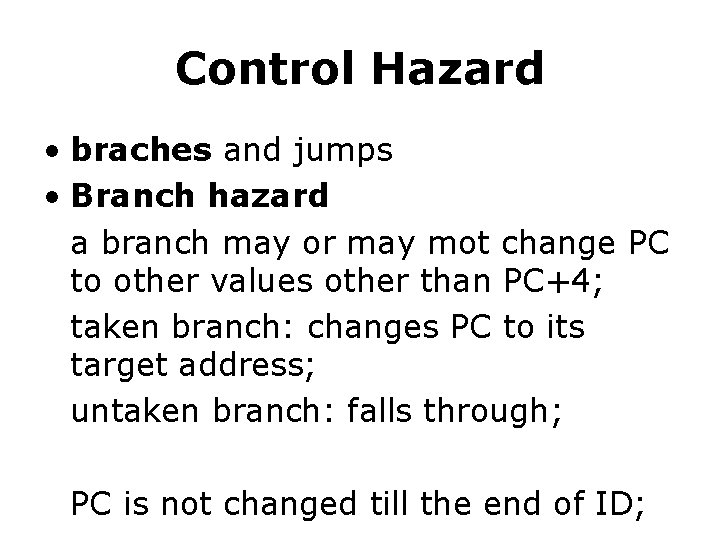
Control Hazard • braches and jumps • Branch hazard a branch may or may mot change PC to other values other than PC+4; taken branch: changes PC to its target address; untaken branch: falls through; PC is not changed till the end of ID;
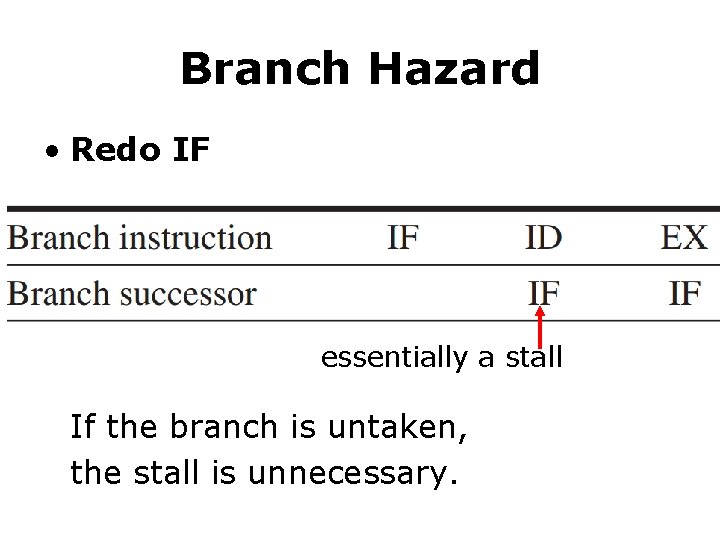
Branch Hazard • Redo IF essentially a stall If the branch is untaken, the stall is unnecessary.
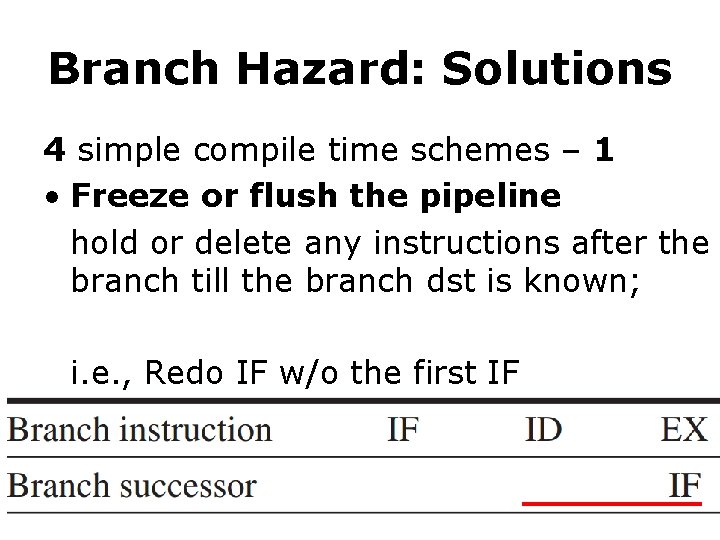
Branch Hazard: Solutions 4 simple compile time schemes – 1 • Freeze or flush the pipeline hold or delete any instructions after the branch till the branch dst is known; i. e. , Redo IF w/o the first IF
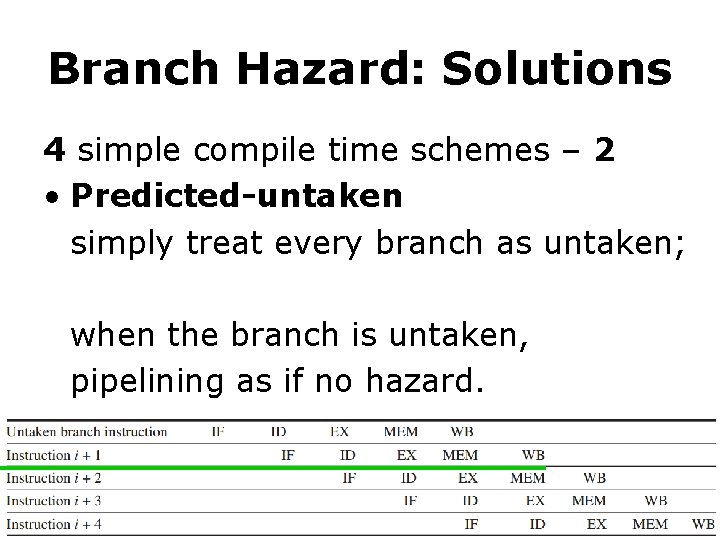
Branch Hazard: Solutions 4 simple compile time schemes – 2 • Predicted-untaken simply treat every branch as untaken; when the branch is untaken, pipelining as if no hazard.
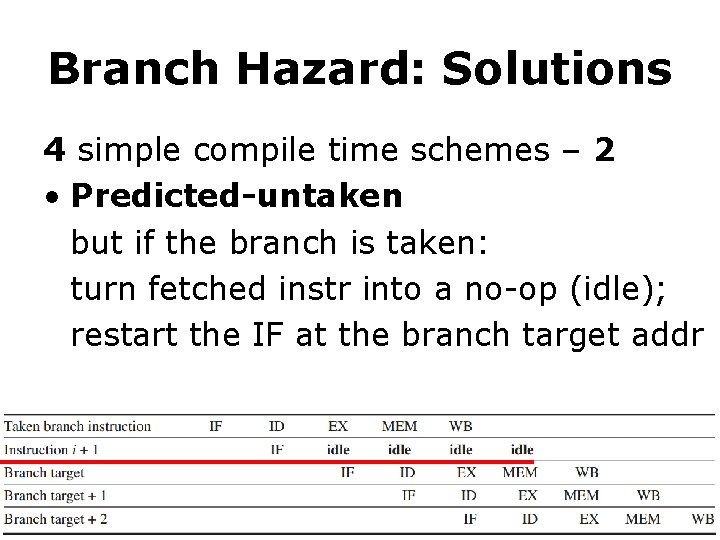
Branch Hazard: Solutions 4 simple compile time schemes – 2 • Predicted-untaken but if the branch is taken: turn fetched instr into a no-op (idle); restart the IF at the branch target addr
Branch Hazard: Solutions 4 simple compile time schemes – 3 • Predicted-taken simply treat every branch as taken; not apply to the five-stage pipeline; apply to scenarios when branch target addr is known before branch outcome.
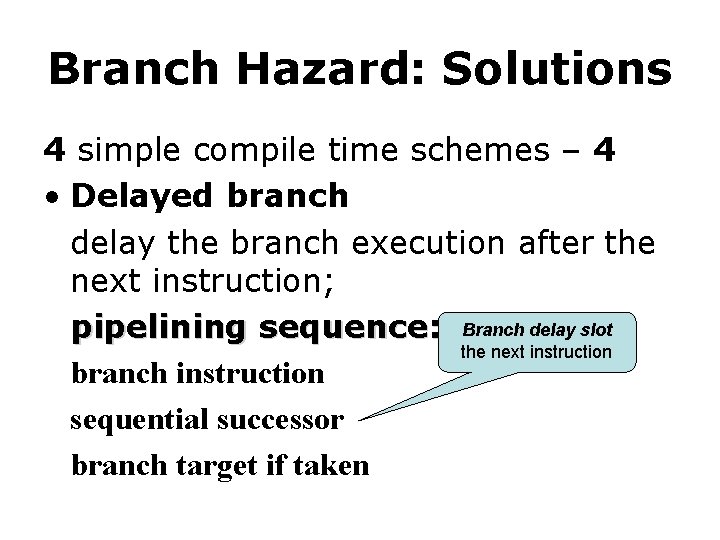
Branch Hazard: Solutions 4 simple compile time schemes – 4 • Delayed branch delay the branch execution after the next instruction; pipelining sequence: Branch delay slot the next instruction branch instruction sequential successor branch target if taken
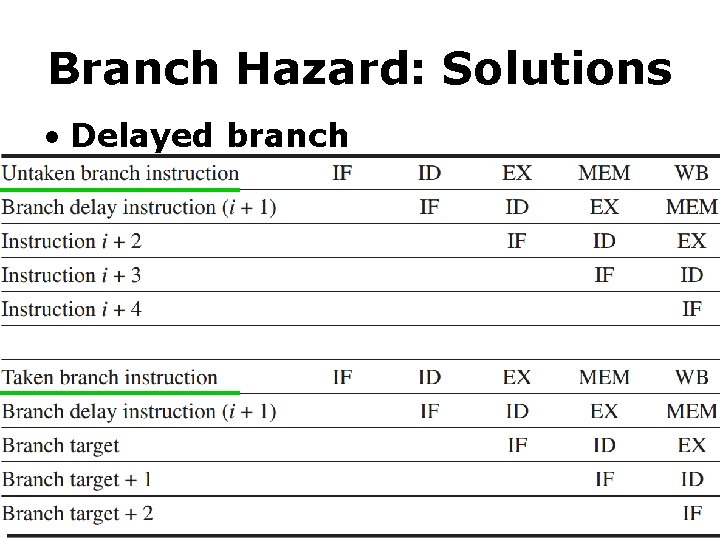
Branch Hazard: Solutions • Delayed branch
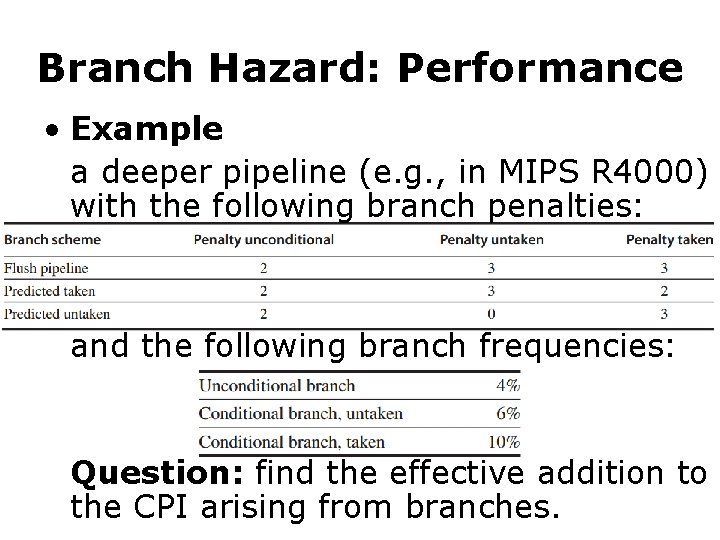
Branch Hazard: Performance • Example a deeper pipeline (e. g. , in MIPS R 4000) with the following branch penalties: and the following branch frequencies: Question: find the effective addition to the CPI arising from branches.
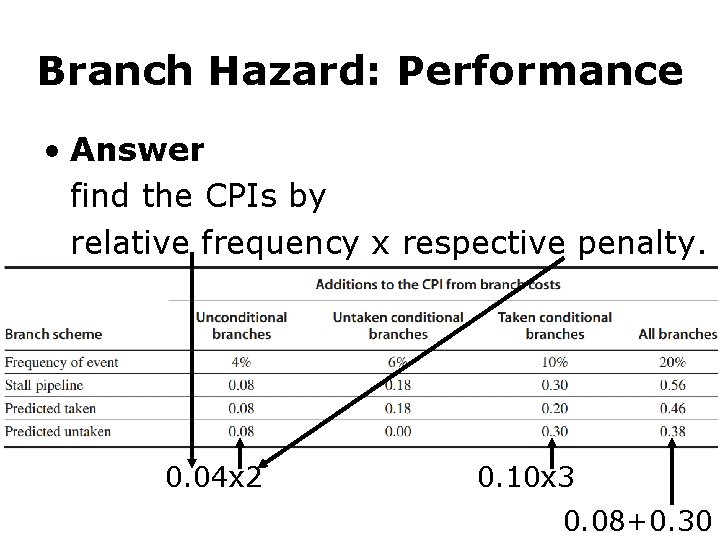
Branch Hazard: Performance • Answer find the CPIs by relative frequency x respective penalty. 0. 04 x 2 0. 10 x 3 0. 08+0. 30

Conclusion • Pipelining promises fast CPU by starting the execution of one instruction before completing the previous one. • Classic five-stage pipeline for RISC IF – ID – EX –MEM - WB • Pipeline hazards limit ideal pipelining structural/data/control hazard

Questions?
Further Readings • RISC wiki http: //en. wikipedia. org/wiki/Reduced_inst ruction_set_computing • MIPS wiki http: //en. wikipedia. org/wiki/MIPS_archite cture • RISC Processors http: //www. scs. carleton. ca/sivarama/org_ book/org_book_web/solution_manual/org _soln_one/arch_book_solution_ch 14. pdf • …
- Slides: 75